“The Terminal List” and America’s Vision of the Heroic

“Trust no one” could be the motto of “The Terminal List.” And “kill all those who betray you.”

W.J. Astore

What is it about this country and guns and violence?  

The Westerns I watched as a kid (John Wayne in particular) had guns in them, of course.  Colt pistols, Winchester rifles, an occasional shotgun.  And there was no shortage of violence.

But nowadays shows/movies feature much more gunplay with military-grade weapons and armor.  The Western isn’t in vogue today.  It’s military dramas instead.  America’s overseas wars have come home for real on our streets and in mass shootings, but they’ve also come home on our screens, where SEALs are the new heroes.

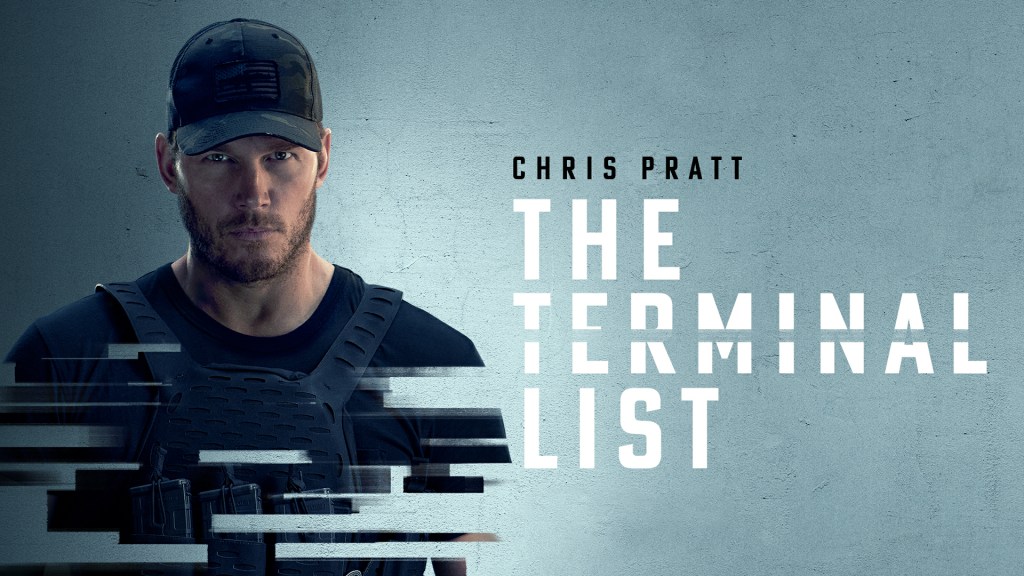
A short series I recently watched, The Terminal List, features a Navy SEAL who must “go to war” domestically because he’s been betrayed by the U.S. government, which even kills his wife and daughter.  Action scenes feature sniper rifles, assault rifles, grenades, explosions, and torture (one man is hung by his own intestines).

Torture and war, common to America’s war on terror, are now here to terrorize us, on our screens but also increasingly on our streets. Strangely, I don’t hear anyone complaining about violence on TV, as people did in the 1980s.  It’s now acceptable, par for the course.  We are inured to it.  Worse: we desire it, or at least some of us do, judging by the success of The Terminal List and similar shows.

The theme is “trust no one” and exact your revenge in the most violent way possible.  The SEAL in Terminal List keeps his own kill list: echoes of Barack Obama and his presidential kill list.  But a democracy saturated in militarized violence can’t possibly survive as a democracy.

Interestingly, today it’s the MAGA Right that distrusts government with a passion.  Fifty years ago, with the Vietnam War running down and Watergate winding up, it was the Left that distrusted government.

One of my favorite movies from the 1970s is Three Days of the Condor, which can profitably be compared to The Terminal List.  The hero in the first movie is a bookish guy who’s betrayed by the CIA.  The hero in this year’s Terminal List is a Navy SEAL and a violent man of action.  In Condor, Robert Redford’s character outthinks his opponents and goes to the New York Times with proof of governmental corruption.  The Navy SEAL simply kills all his enemies, or they kill themselves when faced with his demands for retribution, with an impressive range of deadly weapons.  (Of course, such violent fantasies of hard men meting out murderous justice are hardly new; think of Sylvester Stallone as Rambo or various Chuck Norris vehicles.)

The Terminal List is truly a series for our times.  It’s slickly done, and Chris Pratt is good in it.  What it reveals is the profound skepticism so many Americans have in their government and in corporations — and rightly so.

The problem is elevating a Navy SEAL as the principled hero. SEALs make good warriors but are they what America wants for vigilante justice?  In real life, SEALs can be loose cannons, as recent events show.

For me, real heroes are not often chiseled men of action like Chris Pratt’s Navy SEAL, with all his guns and violence.  Or for that matter Rambo. Think instead of Chelsea Manning, Daniel Hale, Edward Snowden, and Julian Assange.  They may lack bulging biceps and impressive arsenals, yet Manning and Hale went to prison to reveal war crimes, Snowden is in exile for taking on the government and telling us the truth about wars and our surveillance state, and Assange is being tortured in prison for practicing oppositional journalism, otherwise known as real reporting.

Heroes in life come in all shapes and sizes; a Navy SEAL may be among the least likely of shapes and sizes we’ll see.  They often do their best work without guns and grenades and without lengthy kill lists and torture routines.  Their strength is measured by their principles, not by their pecs.

I think even John Wayne might agree with me here.

Biden Tackles Student Debt — and Misses

W.J. Astore

At long last, the Biden administration has taken a modest step on student debt relief. Biden announced yesterday a plan to forgive up to $10K in student debt (assuming you make less than $125K) and up to $20K if you received a Pell grant. It’s a start, right? Naturally, Republicans framed it as yet another government giveaway to the undeserving, which makes me think more highly of Biden, at least for a moment.

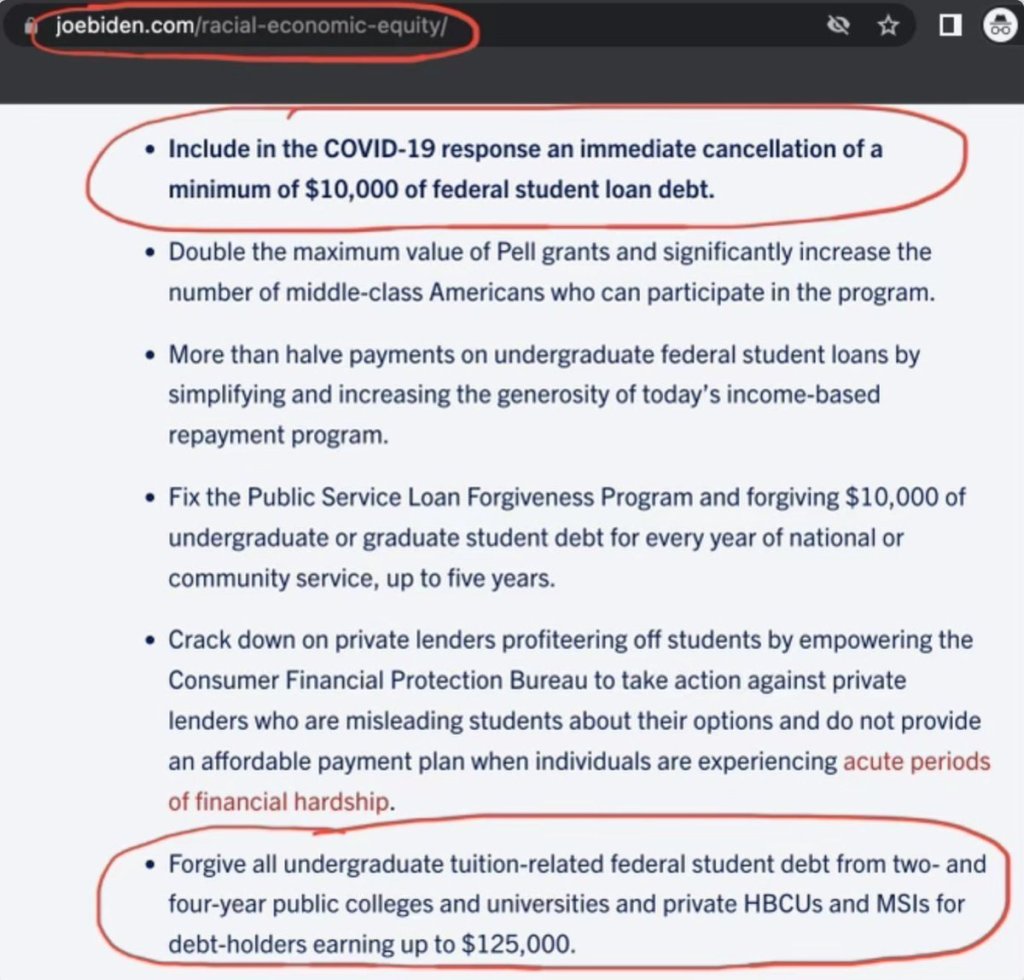
Why am I disappointed in Biden’s action? Let’s take a look at his own website and its promises on student debt relief:

So, Biden had promised “immediate cancellation” of a minimum of $10K, with no preconditions and no need to jump through paperwork hoops. That “immediate cancellation” still hasn’t come (you must still apply and wait for “relief”), and “immediate” took 18+ months, timed so as to win some positive feeling in this fall’s election cycle. So be it. Something is better than nothing, right?

But look at Biden’s second big promise. He was going to forgive all tuition-related student debt for many students, especially minority students. I’ll repeat that: all student debt. His latest announcement doesn’t come close to his own stated goal.

What people tell me is this: Too bad. The Republicans wouldn’t give students any relief whatsoever, so the Democrats deserve your vote because they gave $10K in relief. Be happy with that, shut up, and vote blue no matter who.

Color me unconvinced. Student debt in America sits at $1.7 to $1.9 trillion. Biden just canceled about $200 billion of that debt, or just over 10% of it. As I said, it’s a start, but it represents a half-measure at best when you compare it to Biden’s own stated promises and goals.

In the past, Senator Joe Biden helped to secure legislation that prevented student debt from being discharged during personal bankruptcies. So even if you go bankrupt (and the leading cause of bankruptcy in America is medical bills), you still owe all the money on your student debt. As far as I know, that hasn’t changed. Thanks for that too, Joe.

For the cost of the F-35 jet fighter over its lifetime, Joe Biden could cancel all student debt in America. Instead, he chose to nibble at the edges, canceling about 10% of it, while fully funding the F-35, new nuclear weapons, and announcing yet more military “aid” for Ukraine.

Is this really the best the Democrats can do on student debt relief? Is this the best our country can do? Say it ain’t so, Joe.

For the lifetime cost of this warplane, you could cancel all student debt in America.

The Betrayal of Dwight D. Eisenhower by His Own Memorial in Washington DC

Eisenhower knew war and hated it. He spoke of spending on wars and weapons as humanity crucifying itself on a cross of iron. He warned America in the strongest terms of the perils of the “military-industrial complex.” The Eisenhower Memorial in DC fails to capture his most powerful and memorable sentiments against war

W.J. Astore

Dwight D. Eisenhower’s most famous address was his last one to the nation in January of 1961, when he warned America of what he termed “the military-industrial complex.” It was a warning as powerful as it was prescient, and though Ike achieved much in life, surely this speech and the meaning of his warning deserve to be captured in the boldest terms in the memorial to Ike in Washington, DC.

Sadly, it isn’t. Though I haven’t yet seen the monument in person, images of it are available online with audio commentary. Let’s tackle the audio commentary first. In Part 5, “Leader of the Free World,” the narrator speaks of Ike’s “farewell address,” not his address on the military-industrial complex, and that it included a “caution” (not a “warning”) to the nation. Ike is allowed a few sentences on the military-industrial complex, but the narrator provides no additional context or commentary. The narrator then ends by saying this was Ike’s goodbye speech; again, no mention of how powerful Ike’s speech was in its criticism of a force that Ike declared threatened America’s democracy and our personal liberties. And then the kicker: at the end of the narration, we’re told the audio commentary was made possible by “a generous donation” by Boeing!

I burst out in rueful laughter. Of course Ike’s warning about the military-industrial complex was played down; the military-industrial complex funded the audio commentary! I felt like Ralphie in “A Christmas Story” when he discovers his secret magic decoder ring is only useful for decoding crummy commercials that urge him to drink his Ovaltine.

Turning to the memorial inscriptions themselves, here is the one for Ike’s “farewell address”:

Throughout America’s adventure in free government, our basic purposes have been to keep the peace; to foster progress in human achievement, and to enhance liberty, dignity and integrity among people and among nations. A vital element in keeping the peace is our military establishment. Our arms must be mighty, ready for instant action, so that no potential aggressor may be tempted to risk his own destruction. This conjunction of an immense military establishment and a large arms industry is new in the American experience. We recognize the imperative need for this development. Yet we must not fail to comprehend its grave implications. In the councils of government, we must guard against the acquisition of unwarranted influence, whether sought or unsought, by the military-industrial complex. Akin to and largely responsible for the sweeping changes in our industrial-military posture, has been the technological revolution during recent decades. It is the task of statesmanship to mold, to balance, and to integrate these and other forces, new and old, within the principles of our democratic system — ever aiming toward the supreme goals of our free society. We pray that…all peoples will come to live together in a peace guaranteed by the binding force of mutual respect and love.

Farewell Address
January 17, 1961

Notice how Ike’s warning (which I’ve bolded) about the military-industrial complex is buried in the text. Even more critically, the very heart of Ike’s warning is torn out. For here are Ike’s words that followed the warning about a military-industrial complex, and which are omitted on the memorial:

The potential for the disastrous rise of misplaced power exists and will persist.

We must never let the weight of this combination endanger our liberties or democratic processes. We should take nothing for granted. Only an alert and knowledgeable citizenry can compel the proper meshing of the huge industrial and military machinery of defense with our peaceful methods and goals, so that security and liberty may prosper together.

Why weren’t these powerful words of Ike also engraved in stone? Could it be because no one in the DC area, especially the military, its many corporations, and the Congress, wants the American people to come to grips with “the disastrous rise of misplaced power” in America?

Putting this memorial together required corporate funding. Congress was also heavily involved. So too was the military. Is it any wonder that Ike’s warning about the military-industrial-Congressional complex has been watered down to a “caution” and buried in the text of a fond “farewell”?

Remember, Ike implored us to be alert and knowledgeable citizens. How can we be when his speeches are bowdlerized at his own memorial and the audio commentary to the same is funded by Boeing?

It’s easy to lose the thrust of Ike’s powerful warning about the military-industrial complex when it’s buried in the middle of this monument, and when Ike’s strongest words weren’t even included

You truly need to sharpen your focus if you want to catch a glimpse of what truly worried Ike:

Something tells me that Ike, if he were alive today, would be none too happy about this. Ike’s memorial celebrates his boyhood, his service and great victory in World War II, and his presidency, but it fails to capture his finest speeches against war, against wasteful and immoral spending on deadly weaponry, and against a powerful alliance among the military, its weapons makers, and Congress that Ike saw as a fundamental threat to liberty and democracy.

Our monuments betray us, America, in more ways than one.

Why Did Nancy Pelosi Go to Taiwan?

W.J. Astore

House Speaker Nancy Pelosi’s trip to Taiwan was a disaster. It angered China, provoking a military response (missile firings and the like) that could escalate into something far worse. It interfered with cooperative efforts between China and the U.S. on vitally important fronts such as climate change. And it featured a startlingly incoherent speech by the Speaker in which she implied Benjamin Franklin was an early U.S. president as she proceeded to misquote and butcher his sentiment on liberty and security. Jimmy Dore does an excellent job here of allowing Pelosi to slay herself with her own words:

So, why did she go to Taiwan? Putting aside her own conceit and vainglory, she went for two reasons. The first was domestic politics. Just as the Democrats have (falsely) accused Trump and the Republicans of being soft on Russia, the Republicans have (falsely) accused Biden and the Democrats of being soft on China. Pelosi’s trip was meant to inoculate the Democrats against charges of “softness” vis-a-vis China. Meanwhile, as both major political parties accuse the other of being “soft” vis-a-vis regional powers (China, Russia), the military-industrial complex continues to cash in with record-setting “defense” budgets.

The second reason is connected to the first. Pelosi’s trip has generated the response the military-industrial complex was looking for from China. Thus on NBC News today, you see the following article that touts a resurgent Chinese military and how it constitutes a major threat to U.S. imperial dominance in the Pacific. The conclusion you’re supposed to draw from this is simple: China is a big-time threat to America, therefore we must spend even more money to “rebuild” America’s military to meet that threat.

There’s possibly a third reason, and that is the unreliability of Joe Biden and Kamala Harris as deliverers of a coherent message. Both Biden and Harris rely heavily on teleprompters; when they depart from the script, Biden is liable to blurt out inappropriate remarks that need to be “walked back” by aides, whereas Harris has a tendency to laugh inappropriately to cover her confusion. It’s doubly ironic that the Speaker of the House, sent to speak for America and the Democrats, spoke so poorly and confusingly.

This is no laughing matter, since diplomacy depends on clear communication. Certainly, the Chinese are speaking clearly with their military exercises and diplomatic warnings. That America’s leaders can’t speak clearly and exercise sound judgment is assuredly the clearest sign yet of U.S. decline, a decline that will not be arrested by throwing more money at the military.

Sound policy requires sound leaders. Whatever else one might say, the words of Biden, Harris, and Pelosi are unsound, marking them as not just ineffective leaders but dangerous ones.

I keep this globe in my office. It comes in handy to remind me of America’s “global reach” and “global power.” You can see how close Taiwan is to mainland China, and also how far Taiwan is from the U.S. But of course U.S. hegemony has no geographical limits, hence the presence of roughly 750 U.S. military bases globally. The world is not enough, since the U.S. must dominate space and cyberspace as well. Perhaps Nancy Pelosi should give her next muddled speech from low Earth orbit. Or the Moon?

Bully Boys with Bull Bars

W.J. Astore

Even as gas and diesel prices soar along with global temperatures, American vehicles continue to get bigger. In my first Air Force job in 1985, I had a friend who drove a classic Ford Bronco. It was a little bigger than a jeep and truly meant for off-road adventures in Colorado where four-wheel drive is a necessity. Nowadays, Ford trucks and SUVs are much more likely to resemble military vehicles like Humvees or even MRAPs. Bigger is better, especially for the truck makers and fossil fuel companies, who profit much more by selling and fueling steroidal trucks than Ford Escorts or hybrids.

But there’s a darker side to these steroidal, quasi-military vehicles on America’s roads, notes Stan Cox today at TomDispatch.com. They’re being used to intimidate, to bully, even to injure and kill people that the drivers of these vehicles don’t like. Typical targets are protesters for the BLM movement or women trying to protect abortion rights. When Dodge named their Ram pickup, I really don’t think they meant you should use it as a battering ram, but that seems to be crude animus motivating more than a few white male drivers today.

This phenomenon isn’t just limited to flyover states like Kansas, where Stan Cox lives. Here in Blue Massachusetts, I recently saw a pickup that was proudly flying a “Fuck Joe Biden” flag, modeled after Trump MAGA flags. Heck, I don’t much like Joe Biden, but I don’t feel the need to mount a giant flag on my vehicle to that effect. I guess I’m just too humble or shy — or sane.

Steroidal trucks are nothing new in America, and I’ve seen plenty with stickers that say “No Fear” or even “Fear This.” (You learn quickly to give these idiots on wheels a wide berth.) But using these trucks to hurt people is truly cowardly. What kind of young men are we producing?

The wars are coming home again, America. Just look around at all the mini-tanks in America’s parking lots and driveways.

A final caution: Beware of bully boys with bull bars, coming soon (though I hope not) to a protest near you. If you stand your ground, they might just run you over — and in some states you’ll be to blame for blocking their way.

So use common sense and get out of their way. You’re not the coward: they are.

Fear this!

Of Products and Assets and Families

W.J. Astore

When I was a college professor, whether civilian or military, I was told unironically that I was part of a “family.” I had an Air Force “family.” I had a Penn College “family.” But when these institutions wanted me to do something, often something I really didn’t want to do, the “family” talk went out the window and I was reminded I was an “employee” in the civilian world and “just another f*cking officer” in the military world. None of this surprised me because I never bought any of that “family” crap. I only have one family, thank you very much, and they are related to me by blood or by marriage. My “family” is not my boss, not my employer.

Management loves to talk about employees as if they’re “family” when they really think of us as “assets” or “products” or even simply “the cost of doing business” (and the quickest way to reduce cost is often to get rid of “family” members).

It’s especially telling to hear corporate/management talk in the sports world. Sam Kennedy, who’s the president of the Red Sox, talks openly about putting the best “product” on the baseball diamond. He doesn’t see his players as people, he reduces them to “assets” that are basically interchangeable. Winning only matters in the sense that it produces profit while elevating the value of the “product.”

Of course, this is nothing new. In Slap Shot (1977), an amusingly vulgar and perceptive movie about a minor-league hockey team starring Paul Newman as an aging player, we learn that the team is owned by a wealthy woman who decides to liquidate the team rather than sell it because it’s more valuable that way as a tax write-off. The players, the fans, all the employees, mean nothing to this absentee owner. All that matters is money.

Paul Newman as player-coach Reg Dunlop in “Slap Shot,” one of the finest movies about sports in America

And of course any Red Sox fan can cite “the curse of the Bambino,” when a century ago the owner of the Red Sox sold Babe Ruth to the New York Yankees to raise money (for a theater production, if memory serves).

Capitalism reduces everything to products, assets, profit margins, and the like. I don’t know about you, but this is not how I think of my real family.

American Exceptionalism

W.J. Astore

Two images of American exceptionalism to mull over today. The first shows how exceptional the U.S. is with its military spending:

Of course, U.S. military spending is projected to rise in FY 2023 to $840 billion or so. Note how most of the countries that spend significant sums on their military are U.S. allies, such as Germany, the U.K., Japan, and South Korea. Russia is weakening due to its war with Ukraine, yet U.S. military spending continues to soar because of alleged threats from Russia and China.

The second image is a spoof sent by a friend, but it wouldn’t entirely surprise me if it did become the official seal of the Department of Education:

Jesus riding a dinosaur: Why not? We have serious museums for creationists in the U.S., where dinosaurs wear saddles and Adam and Eve are depicted as cavorting with creatures dating to the Jurassic and Cretaceous eras. I’m not sure how they all fit on Noah’s ark, but the Lord does work in mysterious ways.

Given the emphasis on gun rights, babies, and Jesus in America, perhaps the bald eagle isn’t our best national symbol. Perhaps it should be the Baby Jesus holding an assault rifle. It certainly would give new meaning to “love God” and “love thy neighbor.”

Destroying the Village in Vietnam

It seems the Vietnam War may as well be the Punic Wars for most Americans, i.e. ancient history. Yet it was a scant 50 years ago that America finally pulled out of that disastrous war, leaving a horrific legacy of towns and villages bombed, burned, and poisoned.

High explosive, napalm, Agent Orange, and other ordnance was dropped in massive quantities by U.S. warplanes, yet North Vietnam remained unbowed. The self-serving lesson the U.S. military took from this was twofold. First, it obviously couldn’t be the military’s fault.  Blame was most often pinned on alleged civilian micro-management; more bombing, with fewer limits, would have worked, so airpower enthusiasts argued. The second lesson was to hide or otherwise obscure or deny civilian casualties in future wars, a cynical approach lacking in integrity but one we’ve seen used with considerable success in Iraq and Afghanistan, among other places.

These were not the lessons that leaders with integrity would have drawn. But they are the lessons that a system designed to protect itself did draw.

U.S. leaders refuse to consider the costs of war, not only on foreign peoples but also on ourselves. The words of James Hildreth remind us of the costs of war as well as the seductiveness of destruction and of lies.

It’s a lesson to bear in mind, whether with the Russia-Ukraine War or possible future wars, e.g. current talk of a possible war with Iran.

wjastore's avatarBracing Views

W.J. Astore

One day, a village of roughly 1200 people in South Vietnam ceased to exist. The U.S. Air Force destroyed it, and the report read “Target 100% destroyed, body-count 1200 KBA (killed by air) confirmed.”

It wasn’t an “enemy” village. It was a village that had failed to pay its taxes to a South Vietnamese provincial commander, a lieutenant colonel and ostensibly a U.S. ally. He wanted the village destroyed to set an example to other recalcitrant villages, and the U.S. Air Force did what it does: It put bombs and napalm on target.

At Seventh Air Force headquarters, the brass knew this village’s “crime.” As a brigadier general said to then-Lieutenant Colonel James Robert “Cotton” Hildreth, “Damn, Cotton, don’t you know what’s going on? That village didn’t pay their taxes. That [South Vietnamese] lieutenant colonel … is teaching them a lesson.”

It’s a “lesson” that made Cotton Hildreth…

View original post 646 more words

The Giant War Robot that Rules America

Not exactly the “Great Society” envisioned by LBJ in the 1960s. How long before war becomes both programmed and automated into our society as an unstoppable force?

W.J. Astore

Readers, I admit to you I’m demoralized after seeing this news a couple of days ago:

The House on Thursday passed, 329-101, its version of the fiscal 2023 National Defense Authorization Act, which would authorize $840.2 billion in national defense spending.

I’ve been writing against massive and unnecessary spending on wars and weapons since the early 1980s, when I did a college project that was highly critical of the Reagan “Defense Buildup” under then-Secretary of Defense Caspar Weinberger. Those were the days when there was a real movement against Reagan’s pursuit of the MX “Peacekeeper” ICBM and the deployment of nuclear-tipped Pershing II and GLCMs (ground-launched cruise missiles, or “glick-ems”) to Europe. The Nuclear Freeze Movement helped to stimulate talks between Reagan and Gorbachev that led to the elimination of weapons like the Pershing II, the GLCMs, and Soviet SS-20s, introducing a small sliver of (temporary) sanity to U.S.-Soviet relations.

Then came the collapse of the Soviet Union in 1991 and America’s unipolar moment of triumph. Who knew that 30 years later, America would be vigorously advancing and inflating a new Russian threat that would then be used to “justify” renewed spending on all sorts of esoteric, exorbitant, and wildly unnecessary weaponry to feed the never-satiated military-industrial-congressional complex (MICC). I didn’t predict it, that’s for sure.

For the last 15 years, I’ve been writing for TomDispatch.com, averaging six articles a year whose main theme has been the often colossal failures of the MICC and the total lack of accountability for the same. Never has failure bred so much success for an institution. And the institution itself, I truly hesitate to write, is woefully lacking in integrity. Whether it was the Pentagon Papers in Vietnam, the Afghan War Papers, the lies about WMD in Iraq that precipitated the disastrous Iraq War in 2003, or that hoary chestnut about babies being ripped from incubators in Kuwait that helped to justify Desert Shield/Storm in 1991-92, the American people have been told so many lies about war by “their” MICC that it boggles the mind.

And don’t even get me started about how the military lied about Pat Tillman’s death, tarnishing the legacy of a brave soldier inspired by service and idealism.

People with integrity who try to tell us the truth about America’s wars, like Chelsea Manning and Daniel Hale, end up in jail. The liars and the ones who always get it wrong end up being richly rewarded and often promoted to the highest levels.

This has to end, or America itself will come to an end. And it’s so frustrating because, again, I’ve been writing about this, off and on, for forty years, and steadily over the last 15 years. But nothing I say or write, or other critics like Andrew Bacevich and William Hartung say or write, makes any difference, so it seems, as the MICC continues to become the giant war robot that rules America.

Democrats, Republicans, and the Need for Alternatives

W.J. Astore

The last real Democratic President was Jimmy Carter. The last U.S. election offering a real alternative vision was George McGovern versus Richard Nixon in 1972.

Since then, Democratic Presidents like Clinton, Obama, and Biden have been DINOs, or Democrats in name only. In a rare moment of honesty, Obama admitted his administration had echoed the policies of “moderate” Republicans. Friendly to Wall Street, banking interests, corporations, the military-industrial complex, and the usual assortment of oligarchs. Obama’s health care plan was a corporate-friendly sellout that echoed the plan put together by Republicans like Mitt Romney. The DINOs fully support forever war and huge military budgets; Obama was quite happy to admit America had “tortured some folks” and that he’d gotten very good at ordering people to be killed, mainly via assassination by drone. It’s a far cry from Jimmy Carter trying to put human rights at the center of his foreign policy in the late 1970s.

Democrats began to move rightwards after McGovern’s resounding defeat in 1972. They haven’t stopped this rightward drift; indeed, it’s accelerated. The Republicans responded by embracing men like Trump as they found plenty of room even further to the right of the DINOs. America, Gore Vidal once said, basically has one property party with two right wings, and that’s only become truer and more obvious over the last fifty years.

What is to be done? We need viable alternatives, but of course the game is rigged, as Matthew Hoh, principled candidate for the Senate in North Carolina, discovered as Democrats conspired to keep him off the ballot, even though his efforts with the Green Party were more than sufficient to earn him a place on that ballot. Both parties, Democrat and Republican, will do anything to keep their duopoly while also endlessly punching each other. Neither party serves the interests of the people.

Perhaps Caitlin Johnstone can offer some hope, or at least a diagnosis for the right path ahead. Here’s what she had to say in her latest post about how the political system in America is structured and manipulated for the benefits of the powerful:

1. Use narrative manipulation to divide the population into a roughly 50/50 ideological split.

2. Ensure you control both of those factions.

3. Convince everyone that the only reason nothing changes is because their half of the population doesn’t win enough elections.

Everyone’s pulling on a rope that doesn’t lead anywhere and doesn’t do anything, convinced by powerful manipulators that they’re engaged in a life-or-death tug o’ war match of existential importance. Meanwhile the powerful just do as they like, completely indifferent to that spectacle and its back-and-forth exchanges.

A group is artificially split into two sides and told to pull a rope in opposite directions while someone else stands back and shoots them all with a BB gun. When they complain about the welts, they’re told it’s happening because their side isn’t pulling hard enough. But really they’d be getting shot no matter what they did.

This doesn’t mean give up, it just means give up on the fake tug o’ war game. If you’re playing tug o’ war while someone rummages through your handbag looking for cash, the first step to stopping them is putting down the rope and going after them. It’s like if everyone was pushing on a fake fire escape in a burning building: the first step to getting them out of there is showing them that the door is just painted on the wall and doesn’t lead anywhere. That’s not telling them to give up hope, it’s just telling them to give up on an ineffective strategy.

Perhaps Johnstone didn’t go far enough here. Americans go in for assault rifles, not BB guns. But she’s surely right that you’re not going to reform this system from within, i.e. from pulling harder on the Democrat or Republican rope. You need to stop playing an unwinnable game.

Organize. Vote third party when a sane candidate is available. Stop donating to DINOs and their even more dubious Republican cousins. Protest. Tell others. You never know what will be the spark that ignites true and meaningful change.