The Pentagon has failed eight consecutive financial audits. For decades it has been unable to account for trillions of dollars. It has not won a major war since World War II. That is not a record of excellence. It is a record of entrenched failure.
Naturally, President Trump’s answer is to give it another $500 billion in next year’s budget.
If enacted, that would drive annual U.S. military spending north of $1.5 trillion. The math is almost too neat: U.S. GDP hovers around $30 trillion; five percent of that is $1.5 trillion. Somewhere along the way, the arbitrary idea that “defense” spending should equal 5 percent of GDP hardened into dogma. A considered strategy no longer informs budgets. Arbitrary numerology does.
Did the Pentagon request an extra half-trillion dollars? No. Has the administration identified a new existential threat that requires it? No. There is no grand strategy unveiled to justify this “surge.” Just a number — large, round, politically expedient.
An institution that cannot pass an audit is not prepared to manage another half-trillion dollars. Pouring money into a system riddled with cost overruns, duplicated programs, and strategic confusion does not produce security. It produces contractors’ profits and future disasters.
Let’s be honest about what this really is. The national security state — the blob, the military-industrial-congressional-intelligence-media-academia-think tank complex — is already the most powerful force in Washington. When you add “defense,” nuclear weapons, intelligence, veterans’ programs, and homeland security, it consumes well over half of federal discretionary spending. It is the unofficial fourth branch of government, and arguably the first in power.
Few presidents confront it. Dwight D. Eisenhower warned about the military-industrial complex — and even he presided over huge Cold War budgets. John F. Kennedy spoke of peace while deepening involvement in Vietnam. Lyndon B. Johnson escalated that war catastrophically. Barack Obama accepted a Nobel Peace Prize and then defended the necessity of permanent American war. Presidents learn quickly: you appease the Pentagon or you risk political ruin.
And so Trump does what presidents do. Even as he talks of peace, he feeds the war machine.
We are told this is about safety. That peace comes only through overwhelming force. That America must dominate every domain — land, sea, air, space, cyberspace — indefinitely. That garrisoning the globe is synonymous with freedom. That “exceptional” nations do not generate blowback.
Yet two decades in Iraq and Afghanistan ended not in triumph but exhaustion and retreat. Each failure somehow justifies a larger budget. Nothing succeeds like failure.
In a functioning democracy, military spending would be tied to actual defense. It would be scrutinized, debated, constrained. Instead, military failure yields medals and ribbons. Audit failure yields budget growth. Strategic stalemate yields expansion. The larger the disappointment, the louder the demand for more money and authority.
When an institution grows more powerful no matter how poorly it performs, accountability has died. When elected officials dare not meaningfully challenge it, civilian control becomes theater. Call it what you will, but a republic that cannot rein in its military establishment is drifting toward a system where the sword outweighs the ballot and proves mightier than the pen.
As Joe Biden once said, “Show me your budget, and I’ll tell you what you value.” A $1.5 trillion military budget tells us that war — or at least preparation for it — sits at the center of national life.
Perhaps not so happy
On Presidents’ Day, it is worth recalling that George Washington surrendered military power to constitutional authority. That was the founding act of the republic. The test of any president is whether he sees himself as bound by law — or as a ruler who commands legions.
Empires require Caesars. Republics require restraint. The colossal size of Trump’s proposed war budget suggests which path he (and America) is choosing.
Hello Everyone: here’s an interview I did with Dick Price and Sharon Kyle at LA Progressive about why we can’t seem to heed Ike’s warning about the dangers of the military-industrial complex in 1961.
Other topics covered include sports and the military, Hollywood and the Pentagon, first-person shooter games, and toxic masculinity.
We also discuss what it would take to change America—to redirect energies dedicated to imperialism and war to democracy and peace. I say something here about idealism, a sign perhaps of my own naïveté.
You can have my ideals when you pry them from my cold dead brain.
Hi Everyone: Here’s my latest post for TomDispatch.com. It was inspired by President Trump’s notion of a “dream military,” a dream that consists of throwing another $500 billion at the Pentagon while building a “golden dome,” more nuclear weapons, and a new class of naval battleship named after—you guessed it—Donald Trump.
Once upon a time, in the aftermath of a devastating civil war, Americans recognized that “war is all hell.” Do we need the antidote of another calamitous war to move us to rethink our imperial march and global warmongering? If that war should go nuclear, it will be far too late to rethink anything as humanity (what’s left of it) struggles to survive a post-apocalyptic hellscape.
What does not kill us does not necessarily make us stronger.
What constitutes national security and how is it best achieved? Does massive military spending really make a country more secure, and what perils to democracy and liberty are posed by vast military establishments? Questions like those are rarely addressed in honest ways these days in America. Instead, the Trump administration favors preparations for war and more war, fueled by potentially enormous increases in military spending that are dishonestly framed as “recapitalizations” of America’s security and safety.
Such framing makes Pete Hegseth, America’s self-styled “secretary of war,” seem almost refreshing in his embrace of a warrior ethos. Republican Senator Lindsey Graham is another “warrior” who cheers for conflict, whether with Venezuela, Iran, or even — yes! — Russia. Such macho men revel in what they believe is this country’s divine mission to dominate the world. Tragically, at the moment, unapologetic warmongers like Hegseth and Graham are winning the political and cultural battle here in America.
Of course, U.S. warmongering is anything but new, as is a belief in global dominance through high military spending. Way back in 1983, as a college student, I worked on a project that critiqued President Ronald Reagan’s “defense” buildup and his embrace of pie-in-the-sky concepts like the Strategic Defense Initiative (SDI), better known as “Star Wars.” Never did I imagine that, more than 40 years later, another Republican president would again come to embrace SDI (freshly rebranded as “Golden Dome”) and ever-more massive military spending, especially since the Soviet Union, America’s superpower rival in Reagan’s time, ceased to exist 35 years ago. Amazingly, Trump even wants to bring back naval battleships, as Reagan briefly did (though he didn’t have the temerity to call for a new class of ships to be named after himself). It’ll be a “golden fleet,” says Trump. What gives?
For much of my life, I’ve tried to answer that very question. Soon after retiring from the U.S. Air Force, I started writing for TomDispatch, penning my first article there in 2007, asking Americans to save the military from itself and especially from its “surge” illusions in the Iraq War. Tom Engelhardt and I, as well as Andrew Bacevich, Michael Klare, and Bill Hartung, among others, have spilled much ink (symbolically speaking in this online era) at TomDispatch urging that America’s military-industrial complex be reined in and reformed. Trump’s recent advocacy of a “dream military” with a proposed budget of $1.5 trillion in 2027 (half a trillion dollars larger than the present Pentagon budget) was backed by places like the editorial board of the Washington Post, which just shows how frustratingly ineffectual our efforts have been. How discouraging, and again, what gives?
Sometimes (probably too often), I seek sanctuary from the hell we’re living through in glib phrases that mask my despair. So, I’ll write something like: America isn’t a shining city on a hill, it’s a bristling fortress in a valley of death; or, At the Pentagon, nothing succeeds like failure, a reference to eight failed audits in a row (part of a 30-year patternof financial finagling) that accompanied disastrous wars in Vietnam, Afghanistan, Iraq, and elsewhere. Such phrases, no matter how clever I thought they were, made absolutely no impression when it came to slowing the growth of militarism in America. In essence, I’ve been bringing the online equivalent of a fountain pen to a gun fight, which has proved to be anything but a recipe for success.
In America, nothing — and I mean nothing! — seems capable of reversing massive military spending and incessant warfare. President Ronald Reagan, readers of a certain (advanced) age may recall, was nicknamed the “Teflon president” because scandals just didn’t seem to stick to him (at least until the Iran-Contra affair proved tough to shed). Yet history’s best candidate for Teflon “no-stick” status was never Reagan or any other president. It was and remains the U.S. warfare state, headquartered on the Potomac River in Washington, D.C. And give the sclerotic bureaucracy of that warfare state full credit. Even as the Pentagon has moved from failure to failure in warfighting, its war budgets have continued to soar and then soar some more.
Forgive the repetition, but what gives? When is our long, national nightmare of embracing war and (wildly overpriced) weaponry going to end? Obviously, not anytime soon. Even the Democrats, supposedly the “resistance” to President Trump, boast openly of their support for what passes for military lethality (or at least overpriced weaponry), while Democratic members of Congress line up for their share of war-driven pork. To cite a cri de coeur from the 1950s, have they no sense of decency?
The Shameless Embrace of Forever War and Its Spoils
I’m just an aging, retired Air Force lieutenant colonel. Who cares what I think? But America should still care about the words of Dwight D. Eisenhower, also known as Ike, the victorious five-star general of D-Day in 1944 and beyond, and this country’s president from 1953 to 1961. Ike was famously the first significant figure to warn Americans about the then-developing military-industrial complex (MIC) in his farewell address to the nation. Yet, even then, his words were largely ignored. Recently, I reread Ike’s warning, perhaps for the 100th time and was struck yet again by the way he highlighted the spiritual dimension of the challenge that is, all too sadly, still facing us.
In case you’ve forgotten them (or never read them), here are Ike’s words from that televised address in January 1961, when he put the phrase “the military-industrial complex” in our language:
“This conjunction of an immense military establishment and a large arms industry is new in the American experience. The total influence — economic, political, even spiritual — is felt in every city, every state house, every office of the Federal government. We recognize the imperative need for this development. Yet we must not fail to comprehend its grave implications. Our toil, resources, and livelihood are all involved; so is the very structure of our society.
“In the councils of government, we must guard against the acquisition of unwarranted influence, whether sought or unsought, by the military-industrial complex. The potential for the disastrous rise of misplaced power exists and will persist.
“We must never let the weight of this combination endanger our liberties or democratic processes. We should take nothing for granted. Only an alert and knowledgeable citizenry can compel the proper meshing of the huge industrial and military machinery of defense with our peaceful methods and goals, so that security and liberty may prosper together.”
Those were the prescient words of the most senior military man of his era, a true citizen-soldier and president, and more than six decades later, we should and must act on them if we have any hope left of preserving “our liberties and democratic processes.”
Again, wise words, yet our leaders have seldom heeded them. Since 1961, the “disastrous rise of misplaced power” when it comes to the MIC has infected our culture, our economy, even — to steal a term from the era of the disastrous American war in Vietnam — our hearts and minds. Indeed, despite the way the MIC failed so spectacularly to win the hearts and minds of the Vietnamese, the Afghans, the Iraqis, and other embattled peoples across the globe in various misbegotten and mendacious wars, it did succeed spectacularly over the years in winning the hearts and minds of those who make the final decisions in the U.S. government.
In an astonishing paradox, a spendthrift military establishment that almost never wins anything, while consistently evading accountability for its losses, has by now captured almost untrammeled authority within our land. It defies logic, but logic never was this country’s strong suit. In fact, only recently, we reached a point of almost ultimate illogic when America’s bully-boy commander-in-chief insisted that a Pentagon budget already bloated with cash needs an extra $500 billion. That, of course, would bring it to about $1.5 trillion annually. Apologies to my Navy friends but even drunken sailors would be challenged to spend that mountain of money.
In short, no matter what it does, the Pentagon, America’s prodigal son, never gets punished. It simply gets more.
More, More, More!
Not only is such colossal military spending bad for this country, but it’s also bad for the military itself, which, after all, didn’t ask for Trump’s proposed $500 billion raise. America’s prodigal son was relatively content with a trillion dollars in yearly spending. In fact, the president’s suggested increase in the Pentagon budget isn’t just reckless; it may well wreck not just what’s left of our democracy, but the military, too.
Like any massive institution, the Pentagon always wants more: more troops, more weapons, more power, invariably justified by inflating (or simply creating) threats to this country. Yet, clarity of thought, not to speak of creativity, rarely derives from excess. Lean times make for better thinking, fat times make for little thought at all.
Not long ago, Trump occasionally talked sense by railing on the campaign trail against the military-industrial complex and its endless wars. Certainly, more than a few Americans voted for him in 2024 because they believed he truly did want to focus on domestic health and strength rather than pursue yet more conflicts globally (and the weapons systems that went with them). Tragically, Trump has morphed into a warlord, greedily siphoning oil from Venezuela, posturing for the annexation of Greenland and all its resources, while not hesitating to bomb Iran, Nigeria, or most any other country. Meanwhile, China and Russia lurk in the wings as scary “near-peer” rivals and threats.
Although Trump’s supporters may indeed have been conned into imagining him as a prince of peace, this country’s militarism and imperialism clearly transcend him. Generally speaking, warfare and military boosterism have been distinctly bipartisan pursuits in America, making reform of any sort that much more difficult. Replacing Trump in 2028 won’t magically erase deep-rooted militarism, megalomaniacal imperial designs, or even the possibility of a $1.5 trillion military budget. Clearly, more, more, more is the bipartisan war song being sung inside the Pentagon, Congress, and the White House these days.
Taking on the MICIMATTSHG, or Blob
Ex-CIA analyst Ray McGovern coined a useful acronym from the classic military-industrial complex, or MIC. He came up with MICIMATT (the Military-Industrial-Congressional-Intelligence-Media-Academia-Think-Tank complex) to highlight its blob-like growth. And it’s true that Congress and the rest are all deeply implicated in the blob. To which I’d add an “S” for the sporting world, an “H” for Hollywood, and a “G” for the gaming sector, all of which are implicated in, influenced by (as well as influencing), and often subservient to Ike’s old MIC. So, what we now have is the MICIMATTSHG. Recall that Ike warned us about the “disastrous rise of misplaced power” if we failed to challenge it back in 1961. Recall that he also warned us that the MIC could change the very structure of our society, making America far less democratic and also far less free. And most subtly, he warned us that it might also weaken America spiritually.
What did he mean by that? To reference a speech Ike made in 1953, he warned then that we could end up hanging ourselves from a cross of iron. He warned that we could become captives of militarism and war, avid believers in spending the sweat of our laborers, the genius of our scientists, and the blood of our youth, pursuing military dominance globally, while losing our democratic beliefs and liberties at home in the process. And that, it seems to me, is exactly what did indeed happen. We the people were seduced, silenced, or sidelined via slogans like “support our troops” or with over-the-top patriotic displays like military parades, no matter that they represented something distinctly less than triumphant in their moment.
And it never ends, does it? Americans in various polls today indicate that they don’t want a war against either Venezuela or Iran, but our opinions simply aren’t heeded. Increasingly, we live in a “might makes right” country, even as military might has so regularly made for wrong since 1945.
And what in the world is to be done? Many things, but most fundamentally it’s time as a society to perform an “about-face,” followed by a march in double-time away from permanent war and toward peace. And that, in turn, must lead to major reductions in Pentagon spending. The best and only way to tackle the inexorable growth of the blob is to stop feeding it money — and stop worshipping it as well. Instead of a $500 billion increase, Congress should insist on a $500 billion decrease in Pentagon spending. Our task should be to force the military-industrial complex to think, improvise, become leaner, and focus on how most effectively to protect and defend America and our ideals, rather than fostering the imperial dreams of the wannabe warlords among us.
Trump’s current approach of further engorging the imperial blob is the stuff of national nightmares, not faintly a recipe for American greatness. It is, in fact, a sure guarantee of further decline and eventual collapse, not only economically and politically but spiritually as well, exactly as Ike warned in 1961. More wars and weapons simply will not make America great (again). How could they when, as Civil War General William T. Sherman so famously observed, war is “all hell”?
Americans, we must act to cut the war budget, shrink the empire, embrace diplomacy, and work for peace. Sadly, however, the blob has seemingly become our master, a well-nigh unstoppable force. Aren’t you tired yet of being its slave?
On the 250th anniversary of America’s founding, which was predicated on resistance to empire and military rule, it should be considered deeply tragic that this country has met the enemy — and he is indeed us. Here the words of Ike provide another teachable moment. Only Americans can truly hurt America, he once said. To which I’d add this corollary: Only Americans can truly save America.
As we celebrate our nation’s birthday this July 4th, wouldn’t it be wonderful if we could save this deeply disturbed country by putting war and empire firmly in the rearview mirror? A tall task for sure, but so, too, was declaring independence from the mighty British Empire in 1776.
The AI hype train is here and is speeding ahead like the fastest Japanese bullet train. It’s a “revolution,” and AI is going to change everything and/or doom us all. Or maybe it’ll usher in a glorious utopia? New technologies always seem to mobilize both the doomsayers and the utopian dreamers.
Amazingly, ChatGPT is already recording 800 million weekly active users. Meanwhile, investment in AI races ahead—not without serious implications. Today, I noted these two stories at the New York Times:
So, the demand for chips may inflate the price of your next computer even as investors in AI continue to throw money at its promise.
Given the nature of the corporations and governments making decisions about AI and its future, I’m not optimistic for an AI-driven utopia. Count me among the (guarded) pessimists.
Why? Here’s one snippet I gleaned from the New York Times the other day:
28,000,000,000
— That’s how many liters of water Microsoft said it would use for its data centers in 2030, according a report obtained by The Times.The company had promised to cut its water use, but big tech companies are guzzling water during the A.I. frenzy.
That’s an enormous quantity of water when water scarcity is a major issue for our climate change-driven future.
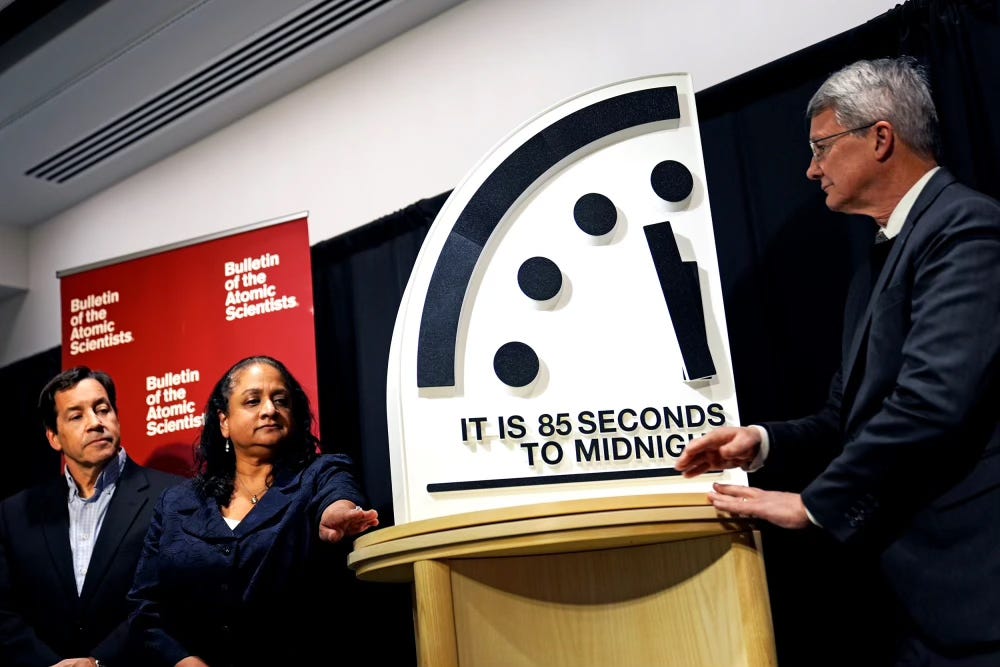
Along with that, I saw where the Bulletin of the Atomic Scientists moved the Doomsday Clock to 85 seconds to midnight, the closest it’s ever been to nuclear Armageddon. In their statement, the scientists cited the rise of AI and its application to weapons and war as one reason for the clock’s creep toward midnight.
So, what gives with this “AI frenzy”? My guess is that AI is being harnessed by the powerful for their purposes. They’re not investing big money to help the little people. This is not to say that every AI application is nefarious and evil. But I think the general trend will be AI-driven “efficiency,” meaning lots of people losing their jobs, along with AI-driven surveillance and control, in the name of greater “safety and security,” naturally.
One thing is certain: we shouldn’t blame the technology. Whatever AI is or becomes, it will be a manifestation of us—but, more worryingly, a manifestation of the agendas of the capitalists, the corporatists, and the warmongers among us, those who are always seeking dominance, even “full-spectrum” dominance, including AI and everything it’s capable of, “guardrails” be damned.
Scrolling through old files today, I came across this paper that I prepared for a “Strategic Studies Seminar” at Oxford that I presented on 28 January 1993. Back then, I was a captain in the Air Force, and in the room were other serving and retired military officers. Anyhow, here’s what I read to my peers (and the two professors hosting the seminar) about the U.S. defeat in Vietnam. Again, this presentation is 33 years old, but I hope it’s still useful despite its age.
Insurgencies and America’s Defeat in Vietnam (1993)
A revolutionary war is a war within a state; the ultimate aim of the insurgents is political control of the state. Nowhere is Clausewitz’s dictum of war as a continuation of politics more true than in a revolutionary war. It typically takes the form of a protracted struggle, conducted patiently and inexorably, a variant of Chinese water torture. Educating or, more accurately, indoctrinating, the people – gaining their sympathy, cooperation, and assistance – is paramount. And all people have a role to play: men and women, young and old. After World War II, insurgencies have been guided by Mao Zedong’s concept of People’s War, and inspired by a complex combination of nationalism, anti-colonialism, and communism. They have bedeviled France, Great Britain, and the United States. This paper addresses the strategy of People’s War in terms of means, ends, and will, and details some of the reasons why the United States lost the Vietnam War.
The strategic end of People’s War is simple in its boldness: the overthrow of the existing government and its replacement with an insurgent-led government. The means are incredibly complex, encompassing social, economic, psychological, military, and political dimensions, but it must be remembered that all means are directed towards the political end. Strength of will usually favors the insurgents, partly because a major goal of People’s War is to mold the minds of its followers to convince them of the righteousness of their cause.
People’s War passes through three stages. At first the insurgents get to know the people as they spread propaganda and build a political infrastructure.
Every insurgent is an ambassador for the cause. They create safe havens while intimidating opponents and neutrals, and they commit terrorist acts to undermine the legitimacy of the government. They build their safe havens on the periphery of the state, usually in rural or impoverished areas where they can feed on the misery of the people. The more difficult the terrain, the better, whether it be the mountains of Spain and Afghanistan or the jungles of Malaya and Vietnam. They extend their control over the countryside and into the urban areas during the second stage of People’s War. They use guerrilla tactics and terrorism to further undermine the political legitimacy of the government. The main target is not the government’s troops but the will of its leaders. As they extend their physical control over the countryside, they install their own political structure to control the people. With the government’s will fatally weakened, the insurgents move to the final stage: a conventional military offensive to overthrow the government.
The three stages are not rigidly sequential, however. For example, while conducting guerrilla operations against the government, the insurgents continue to build their infrastructure, conduct terrorist acts, and spread propaganda. Even during the last stage — the general offensive — the insurgents continue stages one and two. This aspect of People’s War was well expressed by John M. Gates in the Journal of Military History in July 1990:
American conventional war doctrine does not anticipate reliance upon population within the enemy’s territory for logistical and combat support. It does not rely upon guerrilla units to fix the enemy, establish clear lines of communication, and maintain security in the rear. And it certainly does not expect enemy morale to be undermined by political cadres within the very heart of the enemy’s territory, cadres who will assume positions of political power as the offensive progresses. Yet all of these things happened in South Vietnam in 1975….
Flexibility, judgement, and comprehensiveness of methods are the keys to success. If the insurgents overestimate the weakness of the government and lose large-scale battles, they slip back into the earlier two phases and continue to work towards weakening the government for the next general offensive.
It bears repeating the primary goal of insurgents is political control. Military actions are only one tool for obtaining this control. As Mao cautions, guerrilla operations are just “one aspect of the revolutionary struggle.” The insurgent appeals to the hearts and minds of the people. He is, after all, one of them. Too much can be made of Mao’s “fish and sea” analogy. The insurgent is not just a fish that swims in the sea of the people: his purpose is to convert the sea to his purpose. He wants to walk on water. He employs any method to command the sea to his will. He would prefer ideological converts, true believers, but converts through terror are acceptable. Those who can’t be converted he ruthlessly kills. That his methods produce squeamishness among some in the West only accentuates their value to him.
As a strategy, People’s War is difficult but not impossible to counter. The United States defeated the Philippine insurrection in the first two decades of this century, and after World War II Great Britain put down a communist insurgency in Malaya. More famous, however, have been the stunning successes of People’s War: Mao’s victory over Japan and the Nationalists in the 1930s and ‘40s, and Ho Chi Minh’s victories over France and the United States in the 1950s, ‘60s, and ‘70s. Perhaps most unsettling was America’s defeat in Vietnam. How could the world’s foremost superpower lose to, in the words of General Richard G. Stilwell in 1980, a “fourth-rate half-country?”
There are no simple answers to America’s defeat, although Hollywood tells us otherwise. A theory still believed by some in the US military is a variation of the German “stab-in-the-back” legend of the Great War. Our hands were tied by meddling civilians who didn’t let the military fight and win the war. One American soldier is the equal of hundreds of pajama-clad midgets, or so it appears in the Rambo flicks. A wretched, dishonorable government also abandoned our POWs to the godless communists, now rescued several times over by Stallone, Chuck Norris, and other martial arts experts. That such films make money is an affront to the genuine sacrifices of Americans represented so tragically by the Vietnam War memorial in Washington.
Perhaps such sentiments seem out of place in a paper devoted to a dispassionate strategic analysis of America’s role in Vietnam. Yet my feelings are perhaps typical of the emotionalism that still surrounds this topic among Americans. A dispassionate critique from an American, let alone an American service member, may still be impossible; nevertheless, I’ll give it a shot.
The United States lost the war for several related reasons. First, we fought the wrong kind of war. As the Navy and especially the Air Force built up their nuclear forces, the army chaffed against its “New Look” and diminished role in the 1950s. Under Kennedy and Johnson, the Army had a new doctrine – Flexible Response – and an opportunity – the Vietnam War – to prove its worth. Vietnam was to be the proving ground for a revitalized Army.
The opposite proved to be the case because the Army pursued the wrong strategy. From 1965-68, when we sent more than half a million troops to Vietnam, the US Army tried to fight a conventional war against the Viet Cong (VC) and North Vietnamese Army (NVA). As LTG Harry Kinnard, commander of the Army’s elite 1st Cavalry Division (Airmobile), put it, “I wanted to make them fight our kind of war. I wanted to turn it into a conventional war – boundaries – and here we go, and what are you going to do to stop us?” Obeying Mao’s teachings, the VC and NVA wisely avoided stand up fights. The Army responded with search-and-destroy operations to find, fix and kill the enemy. The goal was attrition through decisive battles, reflected by high body counts. Nothing illustrates the bankruptcy of American strategy better than the idea of body counts. In theory, a high body count means you’re killing the fish in the sea, without hurting the sea. In practice, a high body count is a measure of the success of the insurgents: they’re recruiting many fish to their cause. And in killing the fish, Americans poisoned the sea with defoliants, bomb craters, unexploded artillery shells, the list goes on. Americans were stuck in Catch-22 dilemmas: they had to destroy villages to save them, they had to destroy villagers’ crops while pursuing guerrilla bands. Such an approach flies in the face of Mao’s “Three Rules and Eight Remarks,” which exhibit a profound respect for the people and their property.
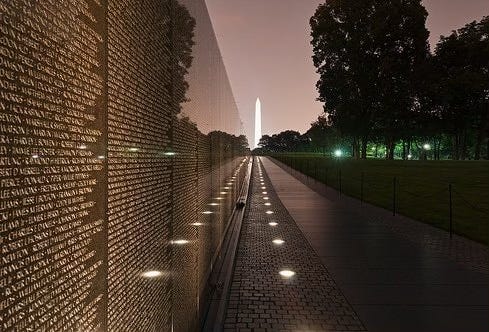
The Vietnam War Memorial in DC
After killing, or perhaps more often not killing, the guerrillas, the Army left, and the guerrillas regained control of the area. This did not disturb LTG Stanley Larson, who observed that if guerrillas returned, “we’ll go back in and kill more of the sons of bitches.” But the VC and NVA retained the initiative, had plenty of manpower, and time was on their side.
Why did the Army pursue such a faulty strategy? In part due to the legacy of World War II, particularly American experience in the Pacific. In island-hopping to Japan, Americans gained faith in massive firepower and lost interest in controlling land. The islands were a means to an end, not the end itself, and success could be measured in some sense by the number of Japanese casualties. Such was not the case in Vietnam, where control of the land was essential to winning the support of the people. Part of the Army’s problem was its lack of experience in counterinsurgency (or COIN) operations. Ronald Spector reports that in the 1950s, COIN operations were limited to four hours in most infantry training courses. What little was taught focused on preventing a conventional enemy from holding raids or infiltrating rear areas. But in the end, the Army fought the war it was trained to fight: a conventional war of maneuver and massive firepower. This worked well in Desert Storm, but failed in Vietnam.
In contrast to the Army, the Marines were far more aware of the nature of the war they were fighting, reports Andrew Krepinevich. They combined 15 marines and 34 Popular Force territorial troops (who lived in and provided security for a village or hamlet) into combat action platoons (CAPs). These CAPs sought to destroy insurgent infrastructure, protect the people and the government infrastructure, organize local intelligence networks, and train local paramilitary troops. In other words, they adopted traditional COIN tactics. But the Army ran the show in Vietnam, and its leaders rejected the Marines’ approach.
The Marines were not alone in their appreciation of the multidimensional aspects of COIN. Robert Komer’s Phoenix program also targeted the Viet Cong infrastructure, but the efforts of the CIA were not well coordinated with those of the military or the State Department, let alone the South Vietnamese. In fact Westmoreland refused to create a combined command to coordinate American actions with those of the South Vietnamese. The latter were an especially neglected resource. Admittedly, the Army of the Republic of Vietnam (ARVN) was corrupt and at times incompetent, but part of the problem was caused by American mistraining and the Army’s contempt. In the 1950s, American military advisors trained ARVN to repel a conventional invasion from the north, using North Korea as a model. From 1965-68, the US Army gave ARVN the static security mission, judged to be of low importance by the Army. US advisors assigned to help ARVN recognized their careers were endangered: they would advance far quicker if they had “true” combat assignments. After years of neglect, ARVN was built up with billions of US dollars during Nixon’s Vietnamization policy (and that’s exactly what it was – a policy, not a strategy), but by 1969 the rot had gone too far. ARVN lacked a unifying national spirit, VC agents had penetrated the ranks, and the officers were thoroughly politicized. Our ally always thought we’d be there if they ran into trouble, but they didn’t understand how American government worked. As Ambassador Bui Diem explained in 1990, “Our faith in America was total, and our ignorance was equally total.” South Vietnam paid the price in 1975.
Could the United States have won the Vietnam War if we had followed a proper strategy? This question may be unanswerable and ultimately moot, but it’s worth discussing. First, one must admit the war may not have been worth winning. Hannah Arendt has stated the Vietnam War was a case of excess means applied for minor aims in a region of marginal interest. In retrospect this seems irrefutable, but in the climate of the Cold War and Containment Vietnam seemed a critical theater in which communist aggression had to be stopped. Second, one must admit the United States was not protecting a viable government in South Vietnam: we were trying to create one. But we were creating one in our image. We ignored the Vietnamese culture and destroyed their economy with our hard currency. Rear area troops with money to spend spread prostitution and drugs in the streets of Saigon. In short, we alienated the people instead of winning them over to our cause. The few people we did win over were terrorized and often killed by the Viet Cong. Even following a proper COIN strategy, victory would have taken 5-10 more years at least. With weak support from the American people, (the “Silent Majority” was silent due to its ignorance and ambivalence), which waned dramatically after Tet, we never had a chance in Vietnam.
The one strategy that would have succeeded for the United States, I believe, is Mao’s People’s War. We must not deceive ourselves: if free elections had been held as promised in 1956, Ho Chi Minh would have won and unified the country. His was the legitimate government; we were trying to overthrow that government and replace it with almost any non-communist regime. In that effort, we should have formed an alliance of military, state department, intelligence, and academic resources to educate Americans in Vietnamese language and culture. These experts, with a suitable, politically-indoctrinated military force to protect them, would win the hearts of the people. Our main weapons would be our ideas and the ideological fervor of our troops, whether civilian or military. Diplomacy and military strikes would be used to cut-off the flow of arms to the VC and NVA from the Soviet Union. The political infrastructure of the enemy would be targeted, including Ho Chi Minh himself.
But this is ridiculous. Our very arrogance blinded us to the war’s complexities. We attacked the symptoms of the disease – the guerrillas and NVA – without examining what caused the disease in the body politic. Our can-do attitude was reinforced by our military traditions and our pride in our nation as being more moral than the rest of the world. We became our own worst enemy as we tried to manage the war. The commitment was there (at least among the soldiers), the energy was there, the money was there, the technology was there -the strategy, intelligence, and leadership wasn’t. People’s War proved superior to search-and-destroy, the VC and NVA intelligence proved superior to ARVN and ignorant Americans, the brilliant Giap out-thought the dedicated but shortsighted Westmoreland. The Vietnam War was ultimately unwinnable.
In the aftermath of the American-led victory over Iraq in Desert Storm, many Americans predicted the stigma of our defeat in Vietnam had finally been exorcised from our minds. Such was not the case, nor is such a result even desirable. The “dreaded V-word,” as the London Times recently described it, is being whispered again in the endless corridors of the Pentagon. If this breeds an aversion to the use of military force, harm may result; but if it leads to more thought and a more subtle study of the efficacy of military force as applied under different conditions, the dreaded V-word will have served a useful purpose, and those names engraved on the Wall in Washington will not have died in vain.
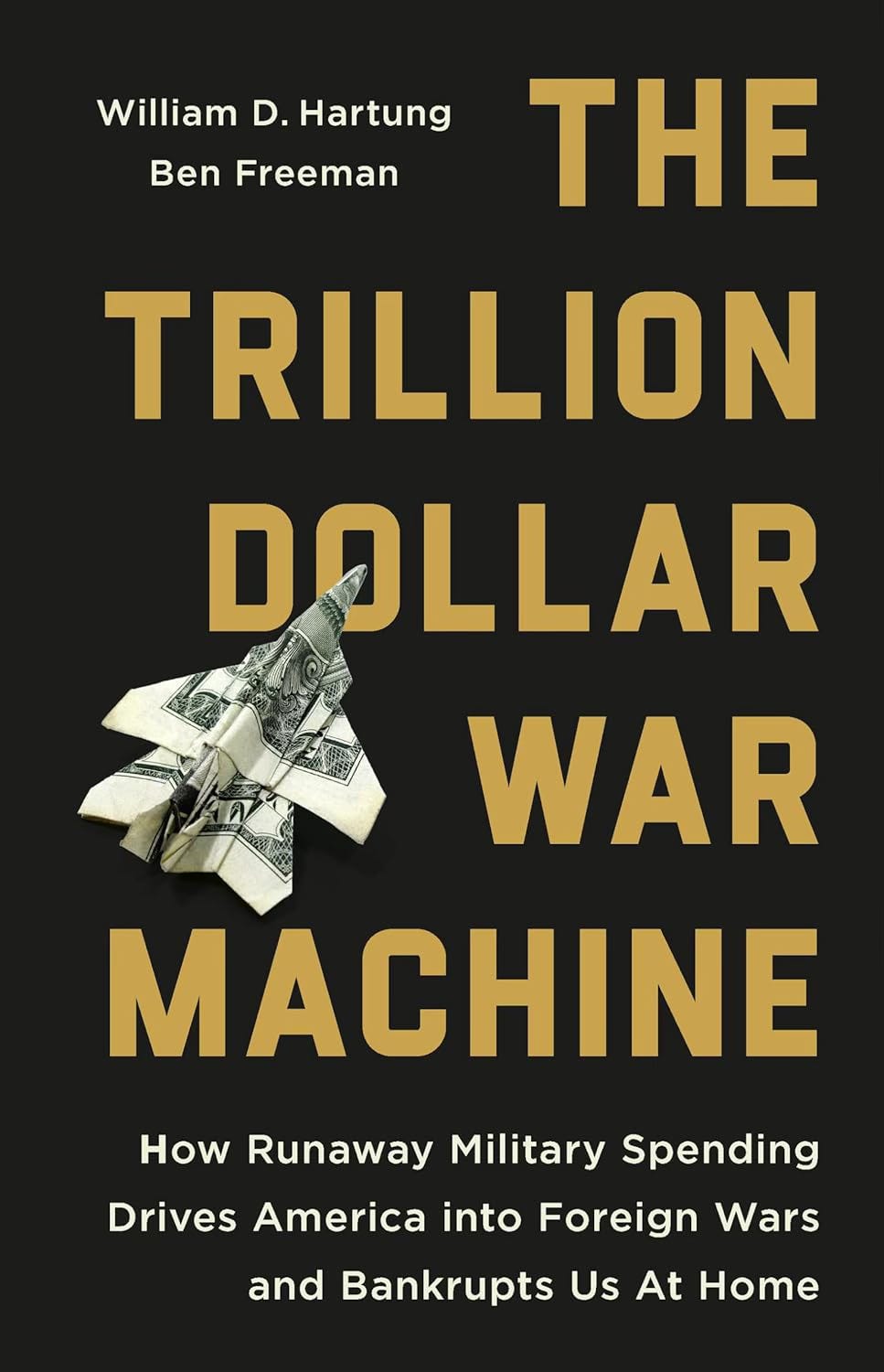
Wow. Just wow. That was my response after reading “The Trillion Dollar War Machine” by Bill Hartung and Ben Freeman. The book’s subtitle captures the “wow” part succinctly: “How runaway military spending drives America into foreign wars and bankrupts us at home.” And now, naturally, President Trump wants even more money for that runaway war machine: an almost unimaginable $500 billion more for FY2027. Egads! How did America’s so-called elites come to embrace war and weapons so wholeheartedly, so lustily, so greedily?
Many of the answers to that question are provided by Hartung and Freeman. They cite and explore President Dwight D. Eisenhower’s famous warning from 1961 about an emerging military-industrial complex. They explain how Congress is complicit in the growing power (and dangers) of the MIC, funding incessant warfare overseas and explosive spending on (often overpriced and largely ineffective) weaponry like the F-35 fighter and the Littoral Combat Ship (known colloquially as “little crappy ships”). Corruption, they show, is baked into the system: the corruption of the revolving door that spins so easily between the military, think tanks, the government, and weapons makers like Boeing and Lockheed Martin. It’s all thoroughly shocking as well as depressing.
Hartung and Freeman, both experienced researchers, know the MIC well. They also know it’s more than the MIC: it’s more like the MICIMATTSHG, or the military-industrial-congressional-intelligence-media-academe-think-tank-sports-Hollywood-gaming complex, so thoroughly has profiteering through militarism and war permeated American culture and society. Military and weapons funding is so colossal it’s seemingly everywhere even as it adds inexorably to the U.S. debt while contributing to military adventurism that further deepens that same debt. Small wonder that our national debt clock is fast approaching $39 trillion. It’s a golden dome of debt!
Reading this book made me think back to another classic account of the MIC and its many follies: James Fallows’s “National Defense.” That book came out in 1981, just as the “defense” buildup under President Ronald Reagan began. Timely as that book was, the Pentagon and its many camp followers were and are rarely forced to retreat when confronted by sensible and logical analysts. I fear this latest effort by Hartung and Freeman, much needed as it is, will similarly be ignored by a purblind Pentagon always in pursuit of power irrespective of the cost.
That would truly be a shame, not only for Americans in general but for the Pentagon as well. Hartung and Freeman aren’t anti-military: they’re pro-defense when defense is smart, effective, thrifty, and focused on upholding the U.S. Constitution. Everyone in uniform, indeed everyone without a uniform, should read this book. You really should know where so much of your taxpayer dollars go—and how much of that money is being wasted by a system that is not only burning your money but weakening America as a democracy. (Indeed, when it comes to money, the Pentagon may be the ultimate burn pit.)
Buy it, study it, absorb it. As Sun Tzu said, it’s smart to know your opponent. Far too often, the military-industrial complex is exactly that.
Last January, I published “My Father’s Journal,” which recounts my dad’s experience surviving the Great Depression, serving in the Civilian Conservation Corps in Oregon fighting forest fires, military service in the Army during World War II, and bringing up five children during the “Baby Boom” years of the 1950s and 1960s while serving as a city firefighter. If you’re interested, it’s available at Amazon for $10 for the paperback and $5 for the Kindle version. Follow this link, and thanks!
*****
I received two interesting queries this week, one on Blitzkrieg and the other on how much the U.S. spends on weapons and war. On the first subject, I was asked about the characteristics of Blitzkrieg, when the concept was developed and seen in battle, and for post-World War II examples. I was also asked about Russia-Ukraine and the recent U.S. attack on Venezuela. Here are my answers:
1. Speed, surprise, combined arms, and disruption are the main characteristics of Blitzkrieg. “Combined arms” refers to all combat arms working synergistically, i.e. infantry, armor, artillery, supported by air forces (nowadays, drones might be involved in large numbers). Special forces like airborne units may also be involved. Deception and misdirection are also aspects of Blitzkrieg. The fundamental idea is to move and maneuver so quickly that the enemy can’t keep pace–to disrupt the enemy’s cohesion. To place them in an untenable position where they have to withdraw or perhaps even surrender.
2. Blitzkrieg, though associated with Nazi Germany in World War II, is an old concept in warfare. Perhaps the best practitioners were the Mongols in the 13th century. The Western concept has its roots in World War I and the stalemate of trench warfare. Ideas associated with what became known as Blitzkrieg were tried on various World War I battlefields. The idea was to break the stalemate of fixed lines and fortifications without getting into costly battles of attrition. These ideas came to maturity in World War II.
3. Blitzkrieg, perhaps ironically, is sometimes attached to the Israeli Defense Forces, as in their attacks in 1967 in the Six Day War. You might say the USA used Blitzkrieg against Iraq in 1991. Russia’s initial attack on Ukraine in 2022 was not a Blitzkrieg–it was more of an uncoordinated show of force that backfired. The USA attack on Venezuela was a “snatch and grab” kidnapping, not a military campaign per se.
*****
The second query focused on how much the U.S. spends on weaponry and war and how we measure that as a percentage of the federal budget. Here’s my answer to that:
Yes, it’s a numbers game. If you include all federal spending (including non-discretionary spending like social security and Medicare/Medicaid), it’s a smaller percentage. Roughly 15% of the federal budget.
If you focus on discretionary spending, it’s more than 50%. It depends on how you count it. If you add Pentagon spending to Homeland Security, the VA, the DOE (nukes), and interest on the federal debt due to wars and military spending, the percentage is 60% or even higher.
When the warmongers really want to minimize war spending, they compare it to GDP.
*****
No matter how you measure it (or attempt to minimize it), a trillion dollars is a lot of money. Of course, the best way to think of “defense” spending is from President Dwight D. Eisenhower’s “Cross of Iron” speech in 1953:
Every gun that is made, every warship launched, every rocket fired signifies, in the final sense, a theft from those who hunger and are not fed, those who are cold and are not clothed. This world in arms is not spending money alone. It is spending the sweat of its laborers, the genius of its scientists, the hopes of its children… This is not a way of life at all, in any true sense. Under the cloud of threatening war, it is humanity hanging from a cross of iron.
That is the true cost of spending on weapons and war.
Tuesday, I went on Judge Napolitano’s show, and we talked about several challenging issues. Among them, the Trump administration’s military coup in Venezuela and the illegality of the same, the difficulty of disobeying illegal orders (and of distinguishing what is legal under pressure and within a hierarchical organization), colossal spending on the U.S. military, and the ongoing threat of nuclear armageddon, even as the “glitter” of nuclear weapons continues to enthrall, appealing to technical arrogance while offering illusions of illimitable power, as Freeman Dyson once explained.
A clarification: I mentioned in the interview that there are more than 5000 nuclear weapons and warheads around the world; I should have said that’s the number in the U.S. nuclear arsenal. Russia has an equivalent number, China a much smaller but growing arsenal, and other countries like Britain, France, India, and Pakistan have their own. The total global arsenal is roughly 13,000 nuclear weapons, which I suppose illustrates our collective death wish (though we’ll take most of life on earth with us if we ever use these weapons).
Many thanks to Judge Napolitano for being willing to address such serious issues, issues that are rarely discussed in the U.S. mainstream media today.
Recently, the Bulletin of the Atomic Scientists featured a fiction contest: “Write Before Midnight.” I sent in an entry, which, sad to say, didn’t win. (The winners can be found here.) But that’s OK: I enjoyed writing something other than my usual essays. My “losing” entry to the contest follows. (Re-reading it, it’s perhaps too much like a memoir rather than fiction.)
*****
Making Armageddon Great Again
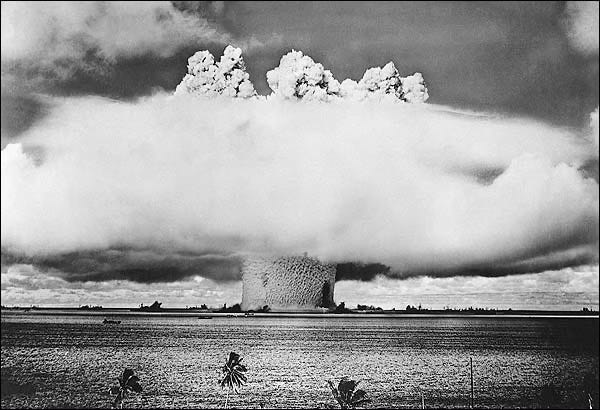
And so the missiles are finally here. Long ago, I thought I’d put nuclear war in the rearview mirror. I never expected to see a mushroom cloud through my windshield, rising in the near distance.
I’d seen something like it before—Russian nuclear missiles flying over the North Pole on their way to America—but that was fifty years ago. I was a young lieutenant then, working in the Missile Warning Center deep inside Cheyenne Mountain. Those missile tracks weren’t real; they were part of a war game, fed into our computers on magnetic tape. The exercise ended with a simulated Armageddon, soundless, screamless.
Even so, when the tracks terminated at U.S. cities, we all went quiet. Sitting two thousand feet under granite, staring at monochrome monitors, we imagined those cities vaporized in an instant. Millions dead, incinerated in a heartbeat. The thought chilled us.
I was 24 then, serving my country against the “evil empire” of the Soviet Union, near the tail end of the Cold War. The first Cold War, I should add—as opposed to the “new” one we’ve been trapped in for the past two decades. Well, it’s plenty hot now. Thermonuclear hot.
I was far enough from my city’s ground zero to survive the initial blast and heat. But at 74, I know these are my last days. Fallout will finish me—unless I take care of it myself first.
I now know for certain that, after an unimaginably destructive nuclear exchange (a nice euphemism, isn’t it?), the living will envy the dead. For now, I’m one of the living, caught in a land of the dead.
How did it come to this? We always ask that, don’t we? How did I let a 50-year-old nightmare scenario on magnetic tape become real? Couldn’t I have done something—anything—to stop it?
Even now, I like to think I could have. There was nothing inevitable about the “new” Cold War or its culmination in MAD—mutual assured destruction. I just wasn’t mad enough to resist it with the ferocity required. I gave my quiet consent to the warmongers, the death-wishers, the ones who talk tough about “big-boy pants,” the ones haunted by missile envy and mindless fear. The ones who blow hardest just before they decide to blow up the world.
I saw it coming. So did many others. I wrote against the “new” Cold War. I denounced so-called investments in new nuclear weapons. I warned about militarizing space, how our early warning satellites and sensors could be blinded. I cautioned that President Trump’s “Golden Dome” missile shield might make nuclear war more likely. None of it mattered. Money spoke louder than I ever could—talk of jobs and the promise of profits outweighed any argument I could muster.
And so here I am, facing darkness—smoke, ash, soot blotting out the sun. I’ve stocked enough supplies to last a couple of weeks, but what’s the point? I have no desire to navigate a post-apocalyptic hellscape.
Once upon a time, I was an Air Force historian, a captain, teaching cadets about the making and use of the atomic bomb. That was 1992—45 years ago. Where does the time go? We even took the cadets to Los Alamos, the birthplace of the bomb, and then on to the Trinity test site.
Back then I was oddly optimistic. The Soviet Union had collapsed. Politicians were talking about peace dividends. Some even hinted that America might become a normal country in normal times. Normalcy! Imagine that today.
I remember a somewhat glum spokesman at Los Alamos talking about reinventing the lab—shifting to peaceful purposes, maybe consumer electronics like VCRs and CD players, competing with Japan. I was skeptical. Nuclear physicists designing camcorders and video games? A longshot—but better than cranking out new warheads and bombs.
At Trinity, what struck me most was the absence of the tower from which the “gadget” had been suspended. Vaporized instantly. Only twisted rebar remained at the base. And that had been a baby nuke—mere kilotons compared to the megatons in our arsenal. I tried to impress this on the cadets, some of whom might someday be ordered to launch such weapons. But who can really picture megatons of destruction, repeated again and again and again?
A sharp-eyed cadet found a sliver of trinitite. For some reason, I had to touch it, briefly, radioactivity be damned. This tiny fragment, this ghost of Trinity, made it all seem real. As a few atomic tourists walked around the scrub desert in masks, fearful still of breathing in radioactive particles, I thought of Oppenheimer’s god of death, the destroyer of worlds. That god has finally come for us—bringing mass death just as Oppie knew he would.
Now, back in the present, at least I’ve filled both bathtubs with water. A small reserve. At Cheyenne Mountain, there was a pond underground, a kind of giant bathtub, complete with a rowboat, so I was told. Maybe Charon did the rowing. We used to joke that boat and reservoir was the Navy’s presence in our Air Force-run bunker. I never saw that boat or pond. I wish I had.
There’s a lot I wish I’d seen. I thought there’d be more time. Next month, next year, next life.
Next life. That’s what I cling to now. I fought the good fight. I tried to argue for disarmament as the only sane option—for America, for humanity, for the entire living breathing beautiful planet of ours. But others thought differently. Some were simply making too much money, making Armageddon great again.
So don’t judge me for thinking about the unthinkable. I know suicide is a mortal sin for us Catholics. But my Ruger 9mm sits by my side. Twelve rounds in the magazine—but I’ll only need the one in the chamber.
Yes, I’ve seen the mushroom cloud. And soon, quite soon, there’ll be a smoking gun.
Sometimes, imagining an opposite scenario can bring folly and illegality into relief.
Imagine if Venezuela attacked the U.S. Imagine if President Trump and Melania Trump were seized, and that the Venezuelan attorney general said they would face justice in Venezuela. I’d imagine that nearly all Americans would see this as an act of war, a gross violation of national sovereignty. American vengeance would be swift.
Of course, this is not Opposite Day. It’s the U.S. that has attacked Venezuela, seizing Maduro and his wife, with U.S. Attorney General Pam Bondi vowing “They will soon face the full wrath of American justice on American soil in American courts.”
WTF? After kidnapping foreign leaders in an obvious act of war, we’re then going to try them in U.S. courts as if they’re American citizens subjects? When did U.S. courts become international courts of justice? I know—that’s hardly the worst of it.
The conceit here is stunning, as is the exertion of executive privilege. Apparently, Trump didn’t bother to consult with Congress before launching this war. That is unconstitutional and an impeachable offense.
Yesterday, I was reading about how the Maduro government was open to negotiations with the Trump administration. Today, Maduro is apparently in American hands, kidnapped in a military coup.
Yes, the people of Venezuela would prefer to elect or depose their own presidents. Yankee go home!
I know Trump and others have always lusted after Venezuela’s oil and gas reserves, but seriously? Which country are we going to invade next, which leaders will we kidnap next, using the false pretext of fighting a war on drugs? (Speaking of drugs, it seems like half the ads on TV now are for selling “legal” drugs of one sort or another, featuring lots of smiling happy people; are we going to declare war on Big Pharma?)
I’m tempted to write the U.S. has hit a new low on the international stage, but surely we know lower acts are coming. The optimism of the New Year died so quickly, didn’t it?







 Bracing Views