A Largely Issueless Campaign Season?

W.J. Astore

Kamalove versus MAGA

Are you feeling “Kamalove” for Kamala Harris? Are you gaga for MAGA and Donald Trump? Or maybe you’re angry J.D. Vance once made a comment about “childless cat ladies.” This is the preferred narrative being pushed by the great CON, the corporate-owned news.* 

It wasn’t that long ago that, thanks to Bernie Sanders, among others, Americans were talking about real issues. Affordable health care for all. A $15 federal minimum wage. Sweeping student loan debt relief. Tax reforms that would favor the working classes rather than the richest among us. Campaign finance reform that would get “big money” out of politics.

This is the madness of war. (Mourners from the Druze minority carry the coffins of some of the 12 children and teenagers killed in the rocket strike in the village of Majdal Shams. Photograph: Léo Corrêa/AP)

Another vital issue, of course, is America’s seemingly permanent state of war and its slavish support of Israel in its ongoing demolition of Gaza. As expected, that genocidal act is beginning to spin out of control as it appears Israel is preparing to strike Hezbollah in Lebanon in the aftermath of a deadly missile strike on the Israeli-occupied Golan Heights.

When will the madness of war in the Middle East end? And is it the intent of the U.S. government to continue to provide all the weapons Israel needs to continue its campaign of mass killing? (Always done in the name of “defense” and “security,” naturally.)

In his recent address to America, President Biden declared that under him U.S. troops weren’t at war for the first time this century. His exact words were: “I’m the first president in this century to report to the American people that the United States is not at war anywhere in the world.” This boast came as U.S. forces were bombing Yemen in support of Israel’s operations in Gaza. Meanwhile, America leads the world in selling weapons and spends more on its military than the next ten countries combined, most of those being U.S. allies.

When does the U.S. get to become a normal country in normal times, rather than a nation permanently at war and forever preparing for it, even for nuclear Armageddon? Why are we spending possibly as much as $2 trillion on “modernizing” a nuclear triad that, if used, could easily destroy life on earth as well as several other earth-sized planets? When are we going to end this insanity?

We need to challenge Democrats and Republicans as well as the media to cover real issues, issues of life and death, rather than writing puff pieces about Kamalove and MAGA.

*Thanks to John R. Moffett for the CON acronym.

“Peace” Seems to Be the Hardest Word

W.J. Astore

Bipartisan Support in America for More War

With apologies to Elton John and Bernie Taupin, “peace” seems to be the hardest word, for both Democrats and Republicans.

This is hardly surprising. The National Security State is the unofficial fourth branch of government and arguably the most powerful. Presidents and Congress serve it, and the SCOTUS carves out special exceptions for it. Back in the days of a bit more honesty, it was called the Department of War. And so it remains.

Let’s say you’re like me and you see war as humanity’s greatest failing. We kill and maim each other, we scorch and kill every living thing in the path of our weapons, we destroy the environment, we even have the capacity to destroy life on earth via nuclear weapons. War—it really is good for absolutely nothin’, unless, of course, you profit from it.

Gaza after an Israeli bombing attack. Anyone want more war?

So, who are you going to vote for in America who sees the awfulness of war and who’s willing to pursue diplomacy and peace instead? Democrats? Republicans?

Generally speaking, Democrats are fixated on war with Russia. They support massive aid to Ukraine and are against negotiations. They also support massive aid to Israel in its ongoing genocide against Palestinians in Gaza. And they fully support the military-industrial-congressional complex (MICC) and soaring spending on weapons and war, including “investing” in new nuclear weapons.

Republicans are much the same, except they tend to see China rather than Russia as the main threat, e.g. Donald Trump and J.D. Vance are willing to negotiate an end to the Russia-Ukraine War. But, in the main, Republicans fervently support Israel in its genocide, are outspoken critics of Iran (Got to punch them hard, Vance recently said), are willing enablers of the MICC, and also vote for massive spending on weaponry and war, including nuclear weapons.

Neither major U.S. political party, the red or blue teams, is pro-peace. Both are pro-aggression and pro-empire. They just occasionally choose different targets for their ire, even as they accuse the other team of “weakness,” of being “Putin puppets” or “Manchurian candidates.” 

As I’ve said before, the only word or sentiment apparently forbidden among the red and blue teams is “peace.” If you want an antiwar candidate in America, you have to go outside the two main parties to the Greens or similar fringe parties.

In America, “antiwar” is defined by America’s propaganda machine, otherwise known as the corporate media, as weak and unAmerican, because “the health of the state” is war.  Every election, whether the red or blue team prevails, the National Security State, the old War Department, wins. And humanity loses. 

The last mainstream candidate for the presidency who spoke consistently of peace was George McGovern in 1972. Unless we the people demand peace, we will continue to get war. In fact, in a bizarrely Orwellian way, colossal military spending and incessant wars are sold to us as keeping America safe. “War is peace” is quite literally the message of the National Security State and its Ministry of Truth, the corporate-owned media.

What is the solution? Here’s one possible approach: Whenever America deploys troops overseas, those troops most immediately in harm’s way must be drawn from the ranks of America’s most privileged and their children. So, corporate CEOs, Members of Congress, lawyers at White Shoe firms, private equity billionaires and millionaires and their progeny, Hollywood celebrities and America’s best-known sports stars: those Americans who prosper and profit the most from empire should be the first to serve it. And that service must be made mandatory, no exceptions, no way to buy your way out or plead that you have “higher” priorities.

Those who want war should serve in war, leaving the rest of us alone. This rule, more than any other, might just keep the chickenhawks from screeching for more war with Russia, or China, or Iran, or North Korea, or Syria, or somebody. A few minutes at the front, facing bullets and shells and cluster munitions while hearing the screams of the dying, might just cure these wannabe “warriors” of their fever.

Want a war? Go to war. And leave the rest of us in peace.

Declaring Our Independence from War

W.J. Astore

“War is a madhouse”

It’s Independence Day in America, so it seems like a good day to declare our independence from the insanity of war.

Sadly, since the presidency of George W. Bush if not before, it’s become routine for U.S. commanders-in-chief to boast of having the world’s finest military in all of history. Obama did it routinely, and Biden recently said the same during his disastrous debate with Trump. Few Americans stop to think about the implications of boasting about having the world’s greatest military—is such a boast truly consistent with democracy, liberty, and freedom?

Certainly, empires rely on strong militaries. Think of the Roman Empire or the Mongol Empire, or the Third Reich (Empire) of Nazi Germany. Do we want to be like them?

Those empires lived by the sword (quite literally so with the Roman Empire) and died by it as well. Their militaries, I would argue, were also more effective than the U.S. one, which hasn’t won a major war since 1945, the latter with a lot of help from our “friends” like the Soviet Union. The Roman, Mongol, and German empires are no more, worn down in part through the constant costs and demands of war. We need to learn more from history than the “fact” that America’s military is supposedly the world’s best since forever and a day ago.

I’ve been reading Oriana Fallaci’s “Nothing, and So Be It,” in which she recounted her time reporting on the Vietnam War. Two conversations with U.S. troops in Vietnam caught my attention. On pages 22-23, she recounts a conversation with Army Captain Scher, during which Scher confesses his disgust with war: 

God, how disgusting war is. Let me say it—I’m a soldier. People who enjoy making war, who find it glorious and exciting, must have twisted minds. There’s nothing glorious, nothing exciting; it’s just a filthy tragedy you can only cry over. You cry for the man you refused a cigarette to and who didn’t come back with the patrol. You cry for the man you bawled out and who is blown to pieces in front of you. You cry for the man who killed your friends …

Later in the book, she interviews a Marine Lieutenant whose surname is Teanek (pages 174-75). Here’s what he had to say:

Teanek: “Men have been saying that [we should abolish war] for thousands of years, and with the justification that they’re abolishing war, they’ve soaked the greatest periods of their civilization in blood.”

Fallaci: “That’s no good reason to keep on doing it.”

Teanek: “Theoretically, you’re right, but in practice what you’re saying is very silly. It’s like convincing yourself—as I bet you do—that when you describe people dying in war you’re helping to abolish war. On the contrary. The more you see people who’ve been killed in war, the more you want to go on fighting wars: it’s a mystery of the human soul.”

It is indeed “a mystery of the human soul” why we humans persist in killing each other in such vast numbers through war. Of course, it’s partly because we glorify it, when we should recognize, as Fallaci does on page 187, that “War is a madhouse.”

I am sane!

One of my favorite scenes in any war film came in “The Big Red One,” a World War II movie by Samuel Fuller starring Lee Marvin as a grizzled Army sergeant of the 1st Infantry Division. It’s a scene in which U.S. troops liberate an insane asylum.

The unforgettable part of this scene for me is when one of the madhouse residents picks up a submachine gun and starts blasting away, crying “I am one of you. I am sane!”

We need to declare our independence from that.

Fumbling the Nuclear Football

W.J. Astore

Being President Is Not a Part-Time Job

Being President of the United States (POTUS) is not a part-time job.

Apologists for Joe Biden suggest that he’s capable of doing the job during normal office hours. Say roughly 10AM to 4PM. But sadly last week’s debate started at 9PM and Biden was tired, he had a cold, and he just couldn’t think and speak clearly and coherently.

So, let’s remind America’s rivals that if they are to launch any attack that might, just might, activate nuclear contingency plans in the Biden administration, they had best do it when the president is capable of clear thinking, which apparently means a six-hour window, Monday through Friday, 10AM-4PM EST.

Seriously, as an American, all my life I’ve been told that being POTUS is the toughest, most demanding, job in the world. That POTUS has in his charge the nuclear “football,” the codes that would unleash America’s awesome, possibly world-destroying, nuclear arsenal, and that therefore the president had to be a person of sound body and of soundest mind. And now I’m being told that Joe Biden, a man in obvious decline, is exactly that person of sound body and of soundest mind to serve another four years as president and commander-in-chief.

The nuclear “football” is actually a briefcase containing the codes needed to authorize and authenticate a nuclear attack

The nuclear football is not something to fumble. Once those missiles are unleashed, there will be no redo.

Joe Biden’s recent debate performance featured sustained moments where he stared blankly into space, where he was obviously confused, where he spoke nonsense. Put bluntly, there were times when he quite literally didn’t know what he was saying.

Sure, Biden isn’t always confused, muddled, or whatever term you care to use to describe obvious mental compromise. But no POTUS can afford to be mentally muddled or compromised because you never know when he or she may be needed to make a decision (under the severest pressure and in a matter of minutes) involving nuclear weapons. It’s an awesome, almost unimaginable responsibility that requires the most stringent vetting of America’s candidates for POTUS.

Today’s Joe Biden is not up to that responsibility. Anyone who says otherwise is denying the evidence of their own eyes and ears.

Standard Disclaimer: This is not in any way an argument for Trump. It’s an argument for a fitter president, right now, and for the Democrats to nominate someone other than Biden to run against Trump this November.

“War Is Making Us Poor”

W.J. Astore

Peace Activist John Rachel Challenges Us to Imagine a Better World

War is the health of the (anti-democratic) state. On those terms, America is very healthy indeed. America dominates the global trade in weaponry, accounting for 40% of that trade over the last five years (“We’re #1 in bombs, bullets, and blowing things up!”). America spends more on its military than the next ten nations combined (most of them being U.S. allies). Roughly 60% of federal discretionary spending is devoted to the Pentagon, sold to the American people as an “investment” in national security, even as it’s truly all about imperial dominance and resource extraction and exploitation.

John Rachel knows this. He asked me to write a foreword to his new book. “War Is Making Us Poor,” and what follows is that foreword. Check out his website and consider buying his book. Its succinct title sums up much about what’s wrong in America.

FOREWORD

Recently, I was reading the letters of Thomas Henry Huxley, who made a wise assertion in 1888: “Battles, like hypotheses, are not to be multiplied beyond necessity.”

My country, the United States of America, has been needlessly multiplying its battles around the world without necessity.  The result has been a series of devastating wars in places like Vietnam, Iraq, and Afghanistan, wars that killed millions for little purpose other than the enrichment of what President Dwight D. Eisenhower in 1961 termed the military-industrial complex.  Thus, Martin Luther King Jr. was right to conclude in 1967 that the United States had become the greatest purveyor of violence on the planet, its unbridled pursuit of militarism producing a form of spiritual death.

As James Madison, one of America’s founders, wrote near the close of the eighteenth century, no nation can preserve its freedom and maintain a healthy democracy when it embraces and pursues endless warfare.  John Rachel knows this, feels this, and embraces the challenge of fighting against it.  He knows America is dedicating more than half of its federal discretionary spending to wars, as the Pentagon budget soars toward $900 billion in 2024.  He knows America is suffering from a form of spiritual death.  He knows militarism will be the death, not only of democracy in America, but possibly of our planet itself, whether in quick time due to global nuclear war or in slow motion due to war-driven calamities aggravated by climate change.

America needs to change course.  It needs to learn the word “peace” again.  It needs to embrace diplomacy and reject militarism.  It needs to stop being the world’s greatest purveyor of violence.  It needs to dismantle its global network of 800 military bases, it needs to reject its vision of “full-spectrum dominance,” it needs to end its glorification of warriors and warfighters as heroes, it needs to stop exporting weapons to the world’s worst hotspots.  But how?

As I write this, the U.S. government is sending massive arms shipments to Israel to enable ethnic cleansing in Gaza.  Palestinian innocents, including thousands of women and children, are being pummeled and eviscerated by bombs and missiles carrying the label, “Made in USA.”  America, which fancies itself a beacon of freedom, has become an abattoir of death through endless war.

I served in the U.S. military for twenty years.  I taught thousands of military cadets the lessons of history.  Yet I failed to question and challenge the system in meaningful ways until after I retired from the military.  Somehow, collectively, Americans need to find the courage to change our violent ways.  We need to act—now.

John Rachel’s book, by provoking us to think and to examine our often-unquestioned biases and assumptions, is just what we need to execute an “about-face” in America’s constant march to war.

Is Joe Biden Issuing Legal Orders to the U.S. Military?

W.J. Astore

Enabling a Genocide in Gaza Is Surely Unconstitutional as well as Morally Wrong

Is it legal for a U.S. president to order American troops to take action that enables a genocide? I should think not. The president takes essentially the same oath of office as military members do. Its essential thrust is supporting and defending the U.S. Constitution. As the civilian commander-in-chief, the President issues orders to the military that are of course authoritative, that must be obeyed, except when those orders are illegal. So, for example, U.S. presidents shouldn’t be able to order torture, nor should they be able to issue orders that contribute to genocide, and, if they do, service members are within their rights to refuse to obey such orders. Indeed, if they put “integrity first” (the leading Air Force core value) as well as the U.S. Constitution, one might argue that should feel compelled by conscience to disobey.

It’s not an easy issue for sure, because the Biden administration claims that Israel is not prosecuting a genocide in Gaza. In fact, the Biden administration sees Israel as a vital ally to America, fully deserving of near-total U.S. support, therefore any service member who objects to orders on legal or moral grounds runs up against the full authority and weight of the chain of command.

Honestly, I’m glad I was never put in this position when I was in the U.S. military. Yet I still think about it. How would I feel as an Air Force officer loading or flying 2000-pound bombs to Israel to be dropped on Palestinians in Gaza? How would I feel as a Navy officer covering the flanks of Israel so that the IDF can concentrate its forces in murderous assaults on Gaza? How would these and similar actions be in the cause of defending America and supporting the Constitution against all enemies, foreign and domestic?

(In the video clip above, Matthew Hoh further discusses this issue. I highly recommend it.)

Judging by this article by Mike Prysner, more than a few service members within the U.S. military have their own doubts, with some seeking conscientious objector status and others going AWOL or simply refusing to consider reenlisting. I have to assume that a lot of Soldiers, Marines, sailors, and airmen are thinking, “This is not what I volunteered for. This is not serving the best interests of my country, most especially the rights enumerated in the U.S. Constitution, to which I swore an oath.”

So, it’s quite possible Joe Biden is issuing illegal or at the very least morally questionable orders to American troops. Shouldn’t this matter? Shouldn’t Americans be talking about this more?

I’m not picking on Biden here. I strongly condemned Donald Trump back in 2016 when he claimed U.S. troops would follow his orders no matter what, even if he ordered torture, assassinations, and other acts forbidden by law.

Either we follow the law or we don’t. Either we respect the Constitution or we don’t. Either we use our military wisely or we don’t.

Beware the military that has been used poorly by its leaders. Beware the military that feels betrayed. For that military will soon be hollow, or, even worse, estranged from the people and the nation, and perhaps angry enough to seek vengeance.

Build Submarines

W.J. Astore

Destroy the World!

Whenever I watch my hometown baseball team, the Boston Red Sox, at Fenway Park I’m told by a message painted along the first and third base lines to “build submarines.” At commercial breaks between innings, sometimes I get another reminder courtesy of the following ad:

The ad features some serious welding, including a comely female welder, showcasing the diversity of the military-industrial complex. Hooray America!

We build giants, the ad says, but there’s no sense of what those giants can do to the world. That’s where Frida Berrigan comes in. Her post today at TomDispatch.com details the awesome destructive power of the Navy’s new class of nuclear-missile-firing submarines. I like her title: The Art of the Submarine, or 5,824 Hiroshimas per Sub.

The new subs are part of the Columbia class, but they really should be called the Armageddon class. Here’s how Berrigan describes them:

Columbia Class nuclear submarines [are what] General Dynamics Electric Boat is building right now. The Navy’s budget for just 12 of those ballistic missile submarines is $126.4 billion. Imagine! If the Navy’s budget for that one weapons system was a country, it would have the third-largest military budget on earth.

The Columbia will be the biggest and most expensive submarine ever built. How perfectly American, right? Even down to the fact that it’s named in honor of the District of Columbia, the disenfranchiseddesperately unequal, and remarkably segregated capital of the United States of America. I’d love to see an artwork that encapsulates that grim irony.

Those new Columbia subs will dwarf what Beatrice Cuming’s welders were working on when she captured them in 1944. Each will be 560 feet long, or a few feet more than the height of the Washington Monument. And its bulk will displace 20,810 tons of water.

But the size and expensiveness aren’t anywhere near as important as the payload of nuclear weapons it will carry with a power those welders of Cuming’s time could hardly have imagined and that Cuming would have been hard-pressed to render with brushes and paint. Each of those 12 new submarines will be equipped with 16 nuclear missile tubes for Trident II D5 submarine-launched ballistic missiles (SLBMs). And those tubes will each be able to house up to 12 independently targetable nuclear warheads, known as W88s, costing about $150 million each and packing a mind-boggling 455-kiloton wallop. 

Okay, now do the math with me. What does 12 times 16 times 12 equal? That’s right: 2,304. Now, multiply that by the thermonuclear force of 455 kilotons, and you get more than one million kilotons. An unthinkable power.

America is yet again spending enormous sums of money on weaponry capable of ending life on Earth if those weapons should ever be used. Better dead than red, I suppose.

It’s great that welders are being put to work, but maybe they should be fixing America’s many bridges and buildings that are structurally less than sound. After all, why is it a good thing that our comely welder in the ad above is helping to build a “giant” that could very well destroy us all?

Instead of “build submarines” at my favorite ballpark, what we really need are ads like “repair bridges.” And maybe a message as well that submarines whose missiles are equivalent to thousands of Hiroshima bombs are, to put it mildly, a potential season-ending error, not only for Team America, but for team humanity.

The Heretics

W.J. Astore

Global Dominance at Any Price

American foreign policy remains in the grip of heretics. They believe that the Prince of Peace is actually a god of war. They believe America is strengthened by entangling alliances (think here of our so-called alliance with Israel). They believe in constant war as a recipe both for dominant power and greater freedom and democracy throughout the world. They believe that spending roughly a trillion dollars each year on weapons and war is a wise “investment.” And they believe they are the toughest and truest of patriots, the ones who see further, the ones with the guts to get things done, no matter how poorly America’s wars have gone from Korea and Vietnam through Afghanistan, Iraq, and today’s proxy wars.

There used to be a different America, a much less militaristic and bellicose one. The American tradition is rich and complex; it contains multitudes, as Walt Whitman might say. Why are we so stuck on warmongers, thieves, and vainglorious simps of empire?

As an American, I’m very much a part of my country’s complexity and richness. And the America that speaks to me contains elements and lessons such as these:

George Washington’s prescient warning about the dangers of entangling alliances with foreign powers.

James Madison’s warning that constant warfare is the direst of enemies of liberty, freedom, and democracy in America.

General Smedley Butler’s confession that “war is a racket” and that he had often served as a “gangster for capitalism.” 

The Nye Commission in the U.S. Senate that investigated arms manufacturers and weapons makers as “Merchants of Death” that profited greatly from war.

President Dwight D. Eisenhower’s “cross of iron” speech and his warning about the growing power and insidious nature of the military-industrial complex.

President John F. Kennedy’s powerful peace speech in which he extended an olive branch to the Soviet Union.

Martin Luther King Jr.’s powerful speech against the Vietnam War and the perils of militarism, racism, and materialism in America.

Of course, America has always had its dark side, with slavery and the genocidal treatment of Native Americans being at the top of the list. Yet America also has had its triumphs of wisdom and goodness. That is the America we should be embracing and celebrating. I believe it’s captured in the words of Washington, Madison, JFK, MLK, and so many others who’ve fought for peace and sanity, people like Dorothy Day, the Catholic activist who fought against war and all its awful excesses.

All that said, sometimes cartoons can express truths in ways that are as powerful as they are simple. In the cartoon below, the heretics of U.S. foreign policy are so many Calvins, spreading destruction and employing nukes in the name of manly seriousness. They are wrong. They are heretics. And if we continue to allow them to rule, they will surely lead America (as they already are in Gaza) to mass graves.

The Triad Is Not the Trinity

W.J. Astore

Or, Ending My Thermonuclear Odyssey

Also today at TomDispatch.com

As a late-stage baby boomer, a child of the 1960s, I grew up dreaming about America’s nuclear triad. You may remember that it consisted of strategic bombers like the B-52 Stratofortress, land-based intercontinental ballistic missiles (ICBMs) like the Minuteman, and submarine-launched ballistic missiles (SLBMs) like the Poseidon, all delivery systems for what we then called “the Bomb.” I took it for granted that we needed all three “legs” — yes, that was also the term of the time — of that triad to ward off the Soviet Union (aka the “evil empire”).

It took me some time to realize that the triad was anything but the trinity, that it was instead a product of historical contingency. Certainly, my mind was clouded because two legs of that triad were the prerogative of the U.S. Air Force, my chosen branch of service. When I was a teenager, the Air Force had 1,054 ICBMs (mainly Minutemen missiles) in silos in rural states like Montana, North Dakota, and Wyoming, along with hundreds of strategic bombers kept on constant alert against the Soviet menace. They represented enormous power not just in destructive force measured in megatonnage but in budgetary authority for the Air Force. The final leg of that triad, the most “survivable” one in case of a nuclear war, was (and remains) the Navy’s SLBMs on nuclear submarines. (Back in the day, the Army was so jealous that it, too, tried to go atomic, but its nuclear artillery shells and tactical missiles were child’s play compared to the potentially holocaust-producing arsenals of the Air Force and Navy.)

When I said that the triad wasn’t the trinity, what I meant (the obvious aside) was this: the U.S. military no longer needs nuclear strategic bombers and land-based ICBMs in order to threaten to destroy the planet. As a retired Air Force officer who worked in Cheyenne Mountain, America’s nuclear redoubt, during the tail end of the first Cold War, and as a historian who once upon a time taught courses on the atomic bomb at the Air Force Academy, I have some knowledge and experience here. Those two “legs” of the nuclear triad, bombers and ICBMs, have long been redundant, obsolete, a total waste of taxpayer money — leaving aside, of course, that they would prove genocidal in an unprecedented fashion were they ever to be used.

Buy the Book

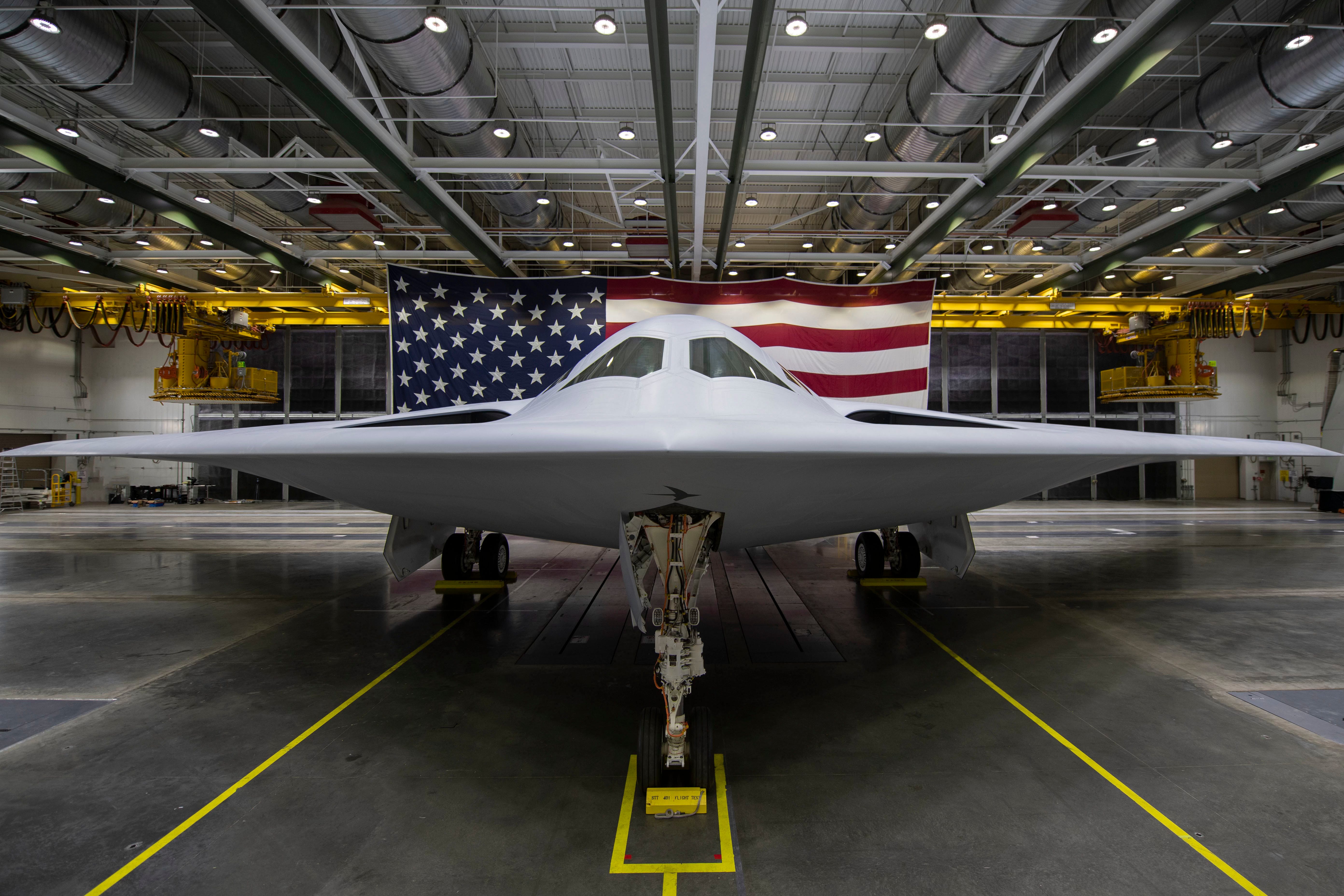
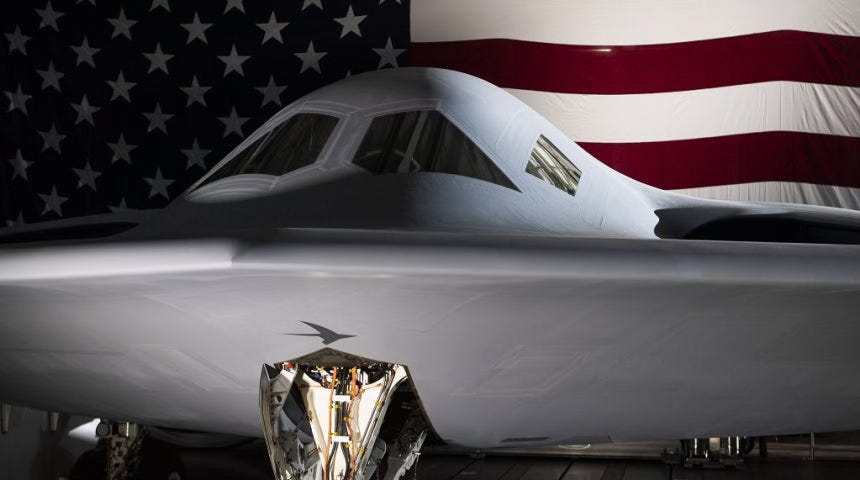
Nevertheless, such thoughts have no effect on our military. Instead, the Air Force is pushing ahead with plans to field — yes! — a new strategic bomber, the B-21 Raider, and — yes, again! — a new ICBM, the Sentinel, whose combined price tag will likely exceed $500 billion. The first thing any sane commander-in-chief with an urge to help this country would do is cancel those new nuclear delivery systems tomorrow. Instead of rearming, America should begin disarming, but don’t hold your breath on that one.

A Brief History of America’s Nuclear Triad

It all started with atomic bombs and bombers. In August 1945, the Japanese cities of Hiroshima and Nagasaki were obliterated by two atomic bombs carried by B-29 bombers, ending World War II. However, in the years that followed, as the Cold War with the Soviet Union heated up, the only “delivery system” the military had for its growing thermonuclear arsenal was the strategic bomber. Those were the glory days of the Strategic Air Command, or SAC, whose motto (believe it or not) was “Peace Is Our Profession” — the “peace” of a mass nuclear grave, had those hydrogen bombs ever been dropped on their intended targets in the Soviet Union and China.

However, as this country’s weapons makers produced ever more powerful hydrogen bombs and strategic bombers, a revolution was afoot in missile technology. By the late 1950s, missiles tipped with nuclear warheads became a practical reality. By the 1960s, the Air Force was already lobbying for 10,000 ICBMs, even if my old service had to settle for a mere thousand or so of them during the administration of President John F. Kennedy. Meanwhile, the Navy was maneuvering its way into the act by demonstrating that it was indeed possible for mobile, difficult-to-detect submarines to carry nuclear-tipped missiles.

By the late 1960s, that triad of potentially ultimate nuclear death had become so sacrosanct that it was untouchable. More than half a century later, America’s nuclear triad has endured and, all too sadly, is likely to do so far longer than you or me (if not, of course, used).

You might wonder why that should be so. It’s not for any sensible military or strategic reason. By the 1980s, if not before, bombers and ICBMs were obsolete. That was why President Jimmy Carter canceled the B-1 bomber in 1977 (though it would be revived under President Ronald Reagan, with the Air Force buying 100 of those expensive, essentially useless aircraft). That was why the Air Force developed the “peacekeeper” MX ICBM, which was supposed to be mobile (shuffled around by rail) or hidden via an elaborate shell game. Such notions were soon abandoned, though not the missiles themselves, which were stuffed for a time into fixed silos. The endurance of such weapons systems owes everything to Air Force stubbornness and the lobbying power of the industrial side of the military-industrial complex, as well as to members of Congress loath to give up ICBM and bomber bases in their districts, no matter how costly, unnecessary, and omnicidal they may be.

In that light, consider the Navy’s current force of highly capable Ohio-class nuclear submarines. There are 14 of them, each armed with up to 20 Trident II missiles, each with up to eight warheads. We’re talking, in other words, about at least 160 potentially devastating nuclear explosions, each roughly five to 20 times more powerful than the Hiroshima bomb, from a single sub. In fact, it’s possible that just one of those submarines has an arsenal with enough destructive power not just to kill millions of us humans, but to tip the earth into a nuclear winter in which billions more of us could starve to death. And America has 14 of them!

Why, then, does the Air Force argue that it, too, “needs” new strategic bombers and ICBMs? The traditional arguments go like this: bombers can be launched as a show of resolve and, unlike missiles, recalled. They are also allegedly more flexible. In Air Force jargon, they can be rerouted against “targets of opportunity” in a future nuclear war. Of course, generals can always produce a scenario, however world-ending, to justify any weapons system, based on what an enemy might or might not do or discover. Nonetheless, strategic bombers were already nearing obsolescence when Stanley Kubrick made his classic antinuclear satire, Dr. Strangelove (1964), so prominently featuring them.

And what about land-based ICBMs? Once the claim was that they had more “throw-weight” (bigger warheads) than SLBMs and were also more accurate (being launched from fixed silos rather than a mobile platform like a submarine). But with GPS and other advances in technology, submarine-launched missiles are now as accurate as land-based ones and “throw-weight” (sheer megatonnage) always mattered far less than accuracy.

Worse yet, land-based ICBMs in fixed silos are theoretically more vulnerable to an enemy “sneak” attack and so more escalatory in nature. The U.S. currently has 400 Minuteman III ICBMs sitting in silos. If possible incoming enemy nuclear missiles were detected, an American president might have less than 30 minutes — and possibly only 10 or so — to decide whether to launch this country’s ICBM force or risk losing it entirely.

That’s not much time to determine the all-too-literal fate of the planet, is it, especially given the risk that the enemy attack might prove to be a “false alarm“? Just before I arrived at Cheyenne Mountain, there were two such alarms (one stemming from a technical failure, the other from human error when a simulation tape was loaded into computers without any notification that it was just a “war game”). Until they were found to be false alarms, both led to elevated DEFCONs (defense readiness conditions) in preparation for possible nuclear war.

New ICBMs will only add “use them or lose them” pressure to the global situation. Mobile, elusive, and difficult to detect, the Navy’s submarine force is more than sufficient to deter any possible enemy from launching a nuclear attack on the United States. Strategic bombers and ICBMs add plenty of bang and bucks but only to the Air Force budget and the profits of the merchants of mass nuclear death who make them.

A Sane Path Forward for America’s Nuclear Force

I still remember the nuclear freeze movement, the stunningly popular antinuclear protest of the early 1980s. I also remember when President Reagan and Soviet leader Mikhail Gorbachev met in 1986 and seriously discussed total nuclear disarmament. I remember Barack Obama, as a 2008 presidential candidate, being joined by old Cold War stalwarts like Henry Kissinger and Sam Nunn in calling for the eventual elimination of nuclear weapons.

Today, we’re not supposed to recall any of that. Instead, we’re told to focus on the way a developing “new cold war” with Russia and China is driving a “requirement” for a “modernized” U.S. nuclear triad that could cost $2 trillion over the next 30 years. Meanwhile, we’re discouraged from thinking too much about the actual risks of nuclear war. The Biden administration, for example, professes little concern about the possibility that arming Ukraine with weaponry capable of hitting deep inside Russia could lead to destabilization and the possible use of nuclear weapons on the battlefield (something Vladimir Putin has threatened to do). Nor are we to fret about surrounding China with ever more U.S. military bases and sending ever more weaponry to Taiwan, while the Chinese are enlarging their own force of ICBMs; or, for that matter, about the fact that the last nuclear agreement limiting the size of the American and Russian arsenals will run out in less than 1,000 days.

To such issues, the only response America’s “best and brightest” ever have is this one: give us more/newer strategic bombers, more/newer ICBMs, and more/newer nuclear submarines (whatever the cost)! To those men, it’s as if nuclear war were a theoretical (and distinctly money-making) chess match — and yes, they are indeed still mostly men! — a challenging game whose only components are profits, jobs, money, and power. Yet when the only story to be told is one featuring more nuclear warheads and more delivery systems, it’s hard not to conclude that, in some horrific fashion, nuclear Armageddon is indeed us (or at least them).

And though few spend much time thinking about it anymore, that’s madness personified. What’s needed instead is a new conviction that a nuclear Armageddon must not be our fate and, to make that so, we must act to eliminate all ICBMs, cancel the B-21 bomber, retire the B-1s and B-2s, work on global nuclear disarmament, start thinking about how to get rid of those nuclear subs, and begin to imagine what it would be like to invest the money saved in rebuilding America. It sure beats destroying the world.

And again, in the most practical terms possible, if we’re set on preserving Armageddon, America’s existing force of Ohio-class nuclear submarines is more than enough both to do so and undoubtedly to “deter” any possible opponent.

There was a time, in the early stages of the first Cold War, when America’s leaders professed fears of “bomber” and “missile” gaps vis-à-vis the Soviet Union — gaps that existed only in their minds; or rather only in the reverse sense, since the U.S. was ahead of the Soviets in both technologies. Today, the bomber and missile “gaps” are, in fact, gaps in logic wielded by a Pentagon that insists strategic bombers and ICBMs remain a “must” for this country’s safety and security.

It’s all such nonsense and I’m disgusted by it. I want my personal thermonuclear odyssey to come to an end. As a kid in the 1970s, I built a model of the B-1 bomber. As a ROTC cadet in the early 1980s, I made a presentation on the U.S./Soviet nuclear balance. As a young Air Force officer, I hunkered down in Cheyenne Mountain, awaiting a nuclear attack that fortunately never came. When I visited Los Alamos and the Trinity Test Site at Alamogordo, New Mexico, in 1992, I saw what J. Robert Oppenheimer’s original atomic “gadget” had done to the tower from which it had been suspended. When the Soviet Union collapsed, I genuinely hoped that this country’s (and the world’s) long nuclear nightmare might finally be coming to an end.

Tragically, it was not to be. The gloomy Los Alamos of 1992, faced with serious cuts to its nuclear-weapons-producing budget, is once again an ebullient boom town. Lots of new plutonium pits are being dug. Lots more money is flooding in to give birth to a new generation of nuclear weapons. Of course, it’s madness, sheer madness, yet,this time, it’s all happening so quietly.

Even as the nuclear clock ticks ever closer to midnight, nobody is ducking and covering in America’s classrooms anymore (except against mass shooters). No one’s building a nuclear bomb shelter in their backyard (though doomsday shelters for the ultra-rich seem to have become status symbols). We’re all going about our business as if such a war were inconceivable and, in any case, akin to a natural disaster in being essentially out of our control.

And yet even as we live our lives, the possibility of a nuclear Armageddon remains somewhere in our deepest fears and fantasies. Worse yet, the more we suppress the thought of such horrors and the more we refuse even to think about acting to prevent them, the more likely it is that such an Armageddon will indeed come for all of us one day, and the “trinity” we’ll experience will be a horrific version of the blinding flash of light first seen by J. Robert Oppenheimer and crew at that remote desert site nearly 80 years ago.

Waging War Against War

W.J. Astore

Even as the Military-Industrial Complex Becomes Ever Stronger and More Dangerous, We Must Keep Fighting Against It

In today’s article, I’d like to feature insights from friends and colleagues.

At TomDispatch, Tom Engelhardt takes on man’s seemingly endless addiction to war, an addiction most certainly manifested by the US of A, where bumper stickers tell me peace comes through superior firepower. Check out Tom’s article here. Not only do we wage war on each other, Tom notes, we wage war on the planet. In fact, few things degrade the environment more than war and all the destruction it brings with it. 

John Rachel, a peace activist, has a telling theme: War is making us poor. He’s been making short punchy videos to hammer home the point. Check out his latest here:

Why are wars so persistent in the U.S., despite their stupidity, their destruction, their waste? One of my readers put it well in a comment to me: 

The endless wars without a traditional definition of success have not been failures to those who have profited. For them, the only war that is lost, is the one that ends. God forbid one should be won under the standard definition and profits then ended.

Cynical? Not when you measure that statement against the U.S. experience of war since 1945.

Finally, also at TomDispatch, David Vine and Theresa Arriola have an article: “The Military-Industrial Complex Is Killing Us All,” which is what Ike warned us about in 1961 if we refused to act as alert and knowledgeable citizens to keep that complex in check. Their article features clear and insightful charts on the basic features of the MIC and the dangers it poses. Here’s an example:

Vine and Arriola are part of an effort whose goal it is to dismantle, or very much to downsize, that complex. (I’ve been involved in their efforts.) Here’s the website: 

https://www.dismantlethemic.org

Where you’ll find more charts and resources.

Meanwhile, last week the “liberal” New York Times posted an article ostensibly written by Senator Roger Wicker calling for even more military spending by the U.S.

Here’s how The New York Times introduced Wicker’s op-ed on May 29th:

In a guest essay today, Senator Roger Wicker writes that we are approaching a version of that moment [a major war crisis] “faster than most Americans think.” Worse, he argues, the U.S. military is unprepared to meet the moment. After decades of underfunding, the American military lacks the strength or the equipment to deal with the wide range of new threats coming from our nation’s adversaries, including Iran, China, Russia and North Korea, he writes.

The answer to this problem, Wicker says, is a short-term “generational investment” in the U.S. military — and a national conversation on how to create a safer future for America. In a new white paper, he lays out a road map to “rebuild” the military, starting with an additional $55 billion in military spending in the 2025 fiscal year and an increase of annual military G.D.P. spending from its current projected level of around 3 percent to 5 percent over the next five to seven years.

That’s a serious amount of money that will inevitably raise big questions about where it will come from — and at the expense of what — at a moment when voices all along the political spectrum are questioning both U.S. military spending overseas and the role of the American military in the world today.

Wicker makes the case that the cost of a war with an increasingly powerful adversary like China would be far higher. “Regaining American strength will be expensive,” he writes. “But fighting a war — and worse, losing one — is far more costly.”

Readers, isn’t that inspiring? A “generational investment” in more guns, more bombs, and, as likely as not, more war? What a great idea!

Apparently, the only way to prevent a war is to prepare mightily for one, according to Senator Wicker. Wicker has apparently never heard, or read, or understood the words of Ike.

Senator Wicker is a shining example of the military-industrial-congressional complex that perpetuates war to the detriment of us all, indeed to all life on our planet. But it’s his words that are amplified by the “liberal” New York Times, not the wise words of my friends and colleagues here.

And so it goes, unless we act to put an end to it. We must be the alert and knowledgeable citizens that Ike implored us to be.