Like too many people, I sometimes make the mistake of talking about nuclear war, when it’s really annihilation and genocide we’re talking about.
Wars have winners and losers. In nuclear “war,” everyone loses. The planet loses. Life loses and death triumphs on a scale we simply can’t imagine.
Language is so important here. I grew up learning about nuclear exchanges. EXCHANGES! The U.S. military talks of nuclear modernization and “investing” in nukes when the only dividend of this “investment” is mass death.
One of the few honest acronyms is MAD, or mutually assured destruction. Lately, it’s an acronym that’s largely disappeared from American discourse.
More than anything, though, realistic images of a nuclear attack are perhaps the most compelling evidence against building more nukes, as in this powerful and unforgettable scene from Terminator 2:
To me, nothing beats that scene. That is nuclear “war.”
The U.S. has over 5000 nuclear weapons; the Russians close to 6000. That’s more than enough to destroy the earth and a few other earth-sized planets. Imagine the scene above repeated eleven thousand times on our planet.
The insanity, the immorality of spending another $2 trillion on new nukes … well, it boggles my mind. We’ve become like the mutants in Beneath the Planet of the Apes, worshipping the bomb, acolytes of death and destruction.
If we all don’t end up killing ourselves and the planet in “an exchange,” we’ll likely degenerate into utter barbarism, as depicted in Cormac McCarthy’s The Road. And even that grim novel has a life-affirming ending that is most unlikely.
Amazingly, after I wrote the above passages about nuclear “war” and “exchanges,” I came across Admiral TR Buchanan’s recent keynote address at the Center for Strategic and International Studies (CSIS), where he uses the word “exchange” in a remarkably banal (and frightening!) way.
BUCHANAN: Yeah, so it’s certainly complex because we go down a lot of different avenues to talk about what is the condition of the United States in a post-nuclear exchange environment. And that is a place that’s a place we’d like to avoid, right? And so when we talk about non-nuclear and nuclear capabilities, we certainly don’t want to have an exchange, right?
I think everybody would agree if we have to have an exchange, then we want to do it in terms that are most acceptable to the United States. So it’s terms that are most acceptable to the United States that puts us in a position to continue to lead the world, right? So we’re largely viewed as the world leader.
And do we lead the world in an area where we’ve considered loss? The answer is no, right? And so it would be to a point where we would maintain sufficient – we’d have to have sufficient capability.
We’d have to have reserve capacity. You wouldn’t expend all of your resources to gain winning, right? Because then you have nothing to deter from at that point.
So very complex problem, of course. And as I think many people understand, nuclear weapons are political weapons. I think Susan Rice said that at one point.
The motto of Admiral Buchanan might be: We had to destroy the world in order to lead it. Buchanan here is less sane than General Buck Turgidson in Dr. Strangelove.
This admiral thinks we might have to have “an exchange” with Russia, and that, if we do, we could do so “in terms that are most acceptable to the United States,” and that even after “an exchange,” the U.S. can still “continue to lead the world.”
Truly this is the banality of evil. I like how even after “the exchange,” we need to have a “reserve capacity” so that we can nuke the world again.
This is madness–sheer madness–but it’s received as probity and sane “strategic” thinking by the national security blob.
This guy was promoted to admiral precisely because he thinks this way. He thinks without thinking. With no humanity.
Well, as General Turgidson says in Dr. Strangelove, we might just get our hair mussed during a nuclear “exchange,” but does it really matter as long as we can kill more of them than us?
In my morning news feed from the New York Times came this article on Tulsi Gabbard:
How Tulsi Gabbard Became a Favorite of Russia’s State Media
President-elect Donald J. Trump’s pick to be the director of national intelligence has raised alarms among national security officials.
Here’s the key paragraph from the article, which, of course, is delayed until the sixth paragraph:
No evidence has emerged that she has ever collaborated in any way with Russia’s intelligence agencies. Instead, according to analysts and former officials, Ms. Gabbard seems to simply share the Kremlin’s geopolitical views, especially when it comes to the exercise of American military power. [Emphasis added]
Did you get that? NO EVIDENCE. Tulsi has never collaborated with Russia in any way. The problem is that she’s a critic of unnecessary and disastrous wars like Iraq and Afghanistan. She’s a critic of massive U.S. military aid to Ukraine. And since those criticisms are vaguely useful to Russia, she must therefore be a “Russian asset,” a dupe of Putin, according to Hillary Clinton and now the New York Times.
Within the so-called intelligence community (IC), you are allowed to be a cheerleader, a booster, even a selective critic in the sense that you may call for more money for the IC because of certain limitations or oversights, but you are not allowed to question America’s disastrously wasteful imperial foreign policy.
No matter how poorly the IC performs (consider the colossal failure of 9/11, or the total obliviousness about the impending collapse of the Soviet Union in the late 1980s, or recent disastrous wars in Afghanistan, Iraq, and Libya), no one is ever held accountable, even as the IC gets more money and authority.
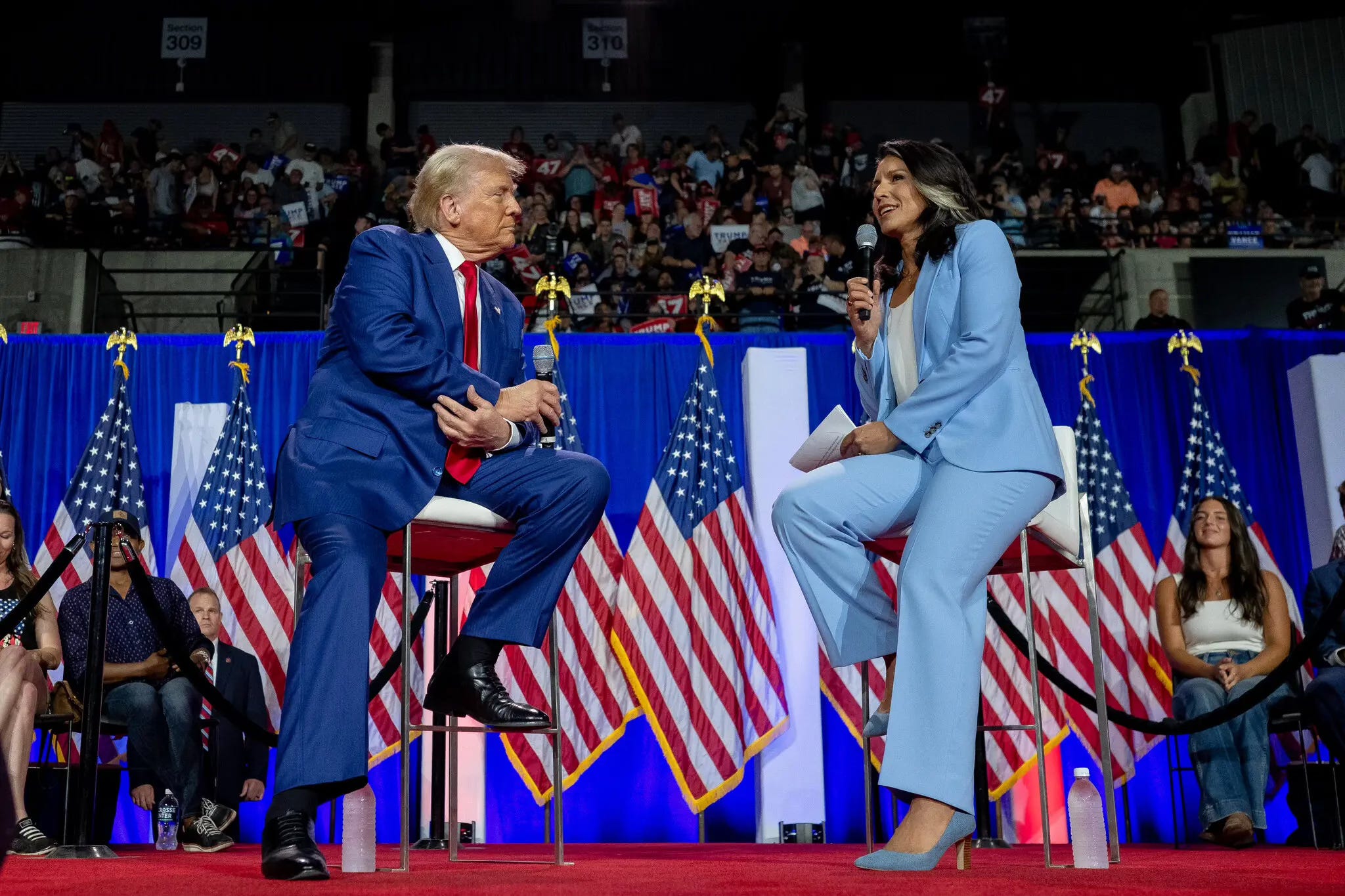
Tulsi Gabbard with President-elect Trump. (Jim Vondruska for the NYT)
Tulsi Gabbard promises to be a game-changer. Skeptical of the blatant misuse of American military power, she’s been an articulate critic of forever wars. She is especially sensitive to deploying U.S. troops in harm’s way for purposes other than the defense of the United States.
The “liberal” New York Times is having none of that. Consider this remarkable paragraph:
“Nominating Gabbard for director of national intelligence is the way to Putin’s heart, and it tells the world that America under Trump will be the Kremlin’s ally rather than an adversary,” Ruth Ben-Ghiat, a professor of history at New York University and the author of “Strongmen,” a 2020 book about authoritarian leaders, wrote on Friday. “And so we would have a national security official who would potentially compromise our national security.” [Emphasis added]
Who knew that “Putin’s heart” could be won so easily? And note the weasel wording that Tulsi could “potentially compromise” U.S. national security. Again, no evidence is presented.
Well, we certainly don’t want the U.S. to have a rapprochement with Putin. He must always be our adversary, am I right? How dare that Trump and Gabbard might, just might, pursue a policy that is less antagonistic toward the Kremlin? Don’t you enjoy teetering on the brink of a world-ending nuclear exchange? I much prefer that to listening and negotiation.
In making enemies of Hillary Clinton and now the New York Times, Tulsi Gabbard has demonstrated she has what it takes to serve as director of national intelligence.
Purge at the Pentagon! Reuters reports that the incoming Trump administration is drawing up a list of generals to be fired. These are generals associated with former Chairman of the JCS Mark Milley and anyone else branded with a scarlet “W” for woke. The current Chairman, Air Force General C.Q. Brown, may also be fired, as some within the Trump camp suspect he may have been a DEI hire.
This is how Reuters put it: Hegseth [Trump’s nominee for Defense Secretary] has also taken aim at Milley’s successor, Air Force General C.Q. Brown, asking whether he would have gotten the job if he were not Black.
“Was it because of his skin color? Or his skill? We’ll never know, but always doubt – which on its face seems unfair to CQ. But since he has made the race card one of his biggest calling cards, it doesn’t really much matter,” he wrote.
Ouch. It does indeed seem unfair to CQ.
General C.Q. Brown, Chairman of the JCS
Retired General Milley is no fan of Trump, having called the president “fascist to the core,” so it’s time for vengeance against him and his cohort. General Brown might be collateral damage, but of course the general, if purged, will find seven-figure salaries available to him on the industrial side of the military-industrial complex, so don’t cry for him too hard.
What’s amazing about all this is reason for the purge. Wokeness. Vengeance. Not military incompetence.
Think about it. The U.S. military lost in Vietnam. Lost in Iraq. Lost in Afghanistan. And no general was fired for cause. Sure, Obama dismissed General Stanley McChrystal in 2010, but that was because McChrystal was an idiot. The last general I can remember who was fired for just cause by a president exercising true authority was Douglas MacArthur during the Korean War. That was over 70 years ago.
As Army officer Paul Yingling famously wrote (“A Failure in Generalship”), a private is severely punished for losing a rifle but generals get promoted for losing wars. I doubt this is going to change. Instead, under Trump it appears the firing of generals is another leg of his vengeance tour, a purge of those who are perceived as disloyal.
Back in March of 2016, I wrote Trump had disqualified himself for the position of commander-in-chief because he had no understanding of the U.S. Constitution. For Trump, laws, principles, integrity, and character are far less important than loyalty and obedience to Trump.
If the Trump administration does indeed pursue a Pentagon purge based on vengeance, a courageous and principled officer corps should resign en masse in protest against this usurpation of authority. I’m no fan of the generals, but firing them because they’re associated with “woke” (whatever that means) and/or Milley is a misuse of power.
If you want to fire generals, fire them because they’ve failed in their primary duties, not because they’re allegedly “woke.”
Trump and the war hawks. Or war sluts. Or war pigs. I thought about all three of these. Then I thought: Why insult hawks, sluts, or pigs?
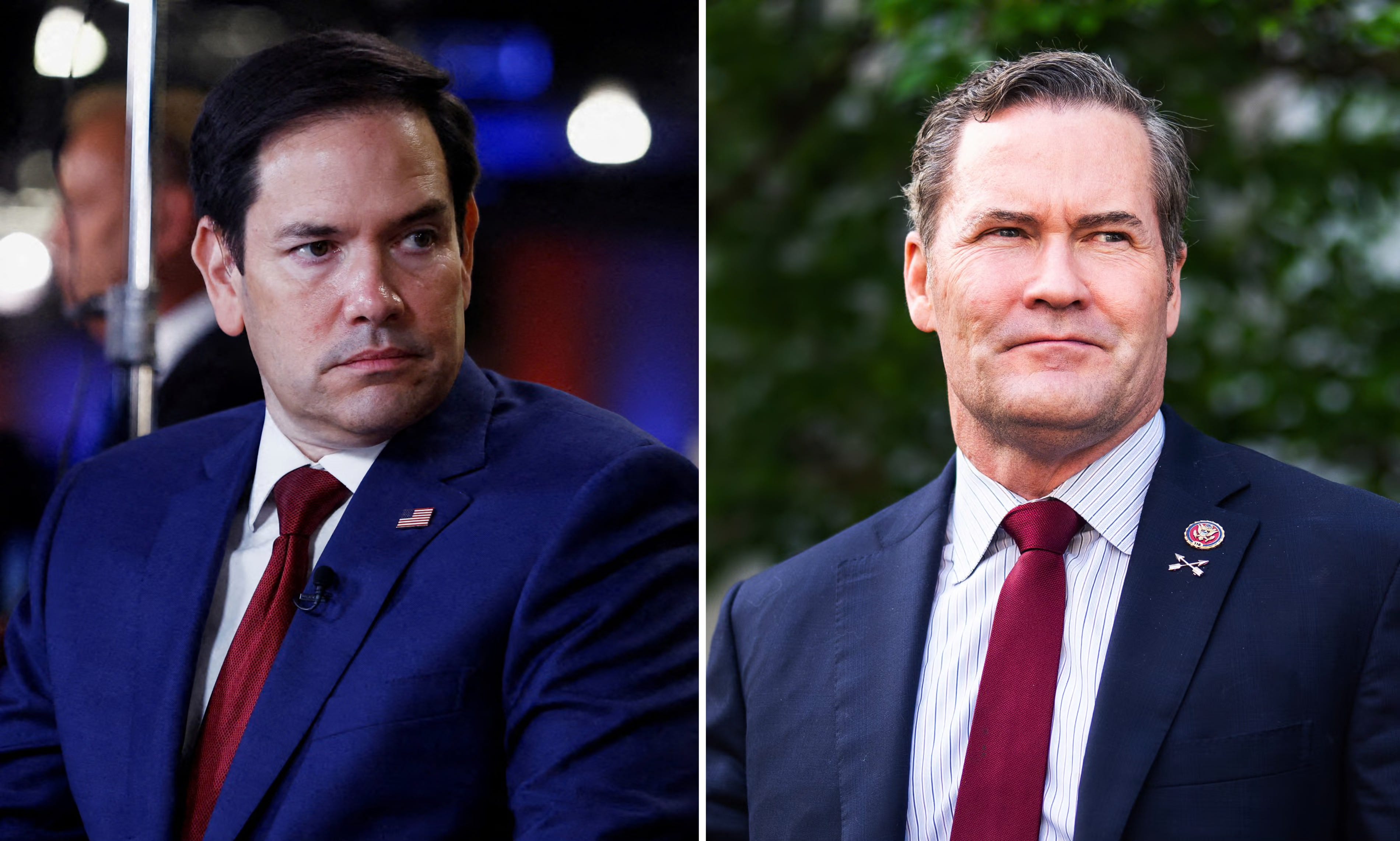
Marco Rubio and Mike Waltz, seeing enemies everywhere while wearing their red power ties
Donald Trump is forming his cabinet by rounding up the usual warmongers. In 2016, he gathered the generals, men like James Mattis and John Kelly. This time around, he’s tapping people like Marco Rubio. “Little Marco” as Secretary of State, a man who’s rarely met a war he didn’t like. For Secretary of Defense he’s nominated Pete Hegseth, whose main concern seems to be waging a war on “woke” generals. One thing is certain: Rubio and Hegseth won’t challenge the military-industrial complex. They will feed it … and feed it again.
Other nominations include Elise Stefanik, a rabid Zionist, as UN ambassador, along with Mike Huckabee, a pro-Israel evangelical who believes in the “end times,” as U.S. ambassador to Israel. Trump may trump Biden as being more slavishly pro-Israel. “Bombs for Bibi to kill babies” should be their motto.
Kristi Noem, who shot and killed her own dog because she couldn’t train it, will run Homeland Security. (If you work for DHS, it might be a good idea to watch your back, or at least to avoid being alone with Noem at a gravel pit.) Mike Waltz will be the National Security Advisor; here’s how Caitlin Johnstone describes him:
Waltz is a warmongering freak. Journalist Michael Tracey has been filling up his Twitter page since the announcement with examples of Waltz’s insane hawkishness, including his support for letting Ukraine use US weapons to strike deep into Russian territory, criticizing Biden for not escalating aggressively enoughin Ukraine, advocating bombing Iran, opposing the US military withdrawal from Afghanistan, and naming Iran, North Korea, China, Russia and Venezuela as “on the march” against the United States toward global conflict. The mainstream press are calling Waltz a “China hawk”, but from the look of things he’s a war-horny hawk toward all the official enemies of the United States.
Once again, Trump isn’t draining the swamp. He’s filling it with warmongers and Zionists who are even more extreme than the warmongers and Zionists of the Biden administration.
Of course, the fundamental problem is that Republicans want to boost military spending even higher than Biden and Harris have. Republicans are “all in” on revamping the nuclear triad, for example, which is likely to cost $2 trillion factoring in the usual cost overruns.
It’s possible Trump/Vance will be more likely to pursue diplomacy with Russia; perhaps the war in Ukraine will finally stumble to an end. But the imperial vision remains, aggravated perhaps by a war within to expel “illegal” immigrants, together with a coup within the military against “woke” officers.
That sounds pessimistic. If I’m being optimistic, perhaps Trump can have a “Nixon goes to China” moment. Trump can sell virtually anything to his followers. He is also driven by ego. Maybe there’s a way to drive him toward peace, dangling the carrot of a Nobel Peace Prize for him. Trump loves accolades, and if he could be influenced to stop throwing all of America’s chips into the Pentagon, that would be a good thing.
But, if personnel is policy, America had better prepare for more war, catastrophically so, even as more bombs are sent to Bibi to kill babies. There’s certainly nothing “woke” about that.
The Bombs Land Softer When a Latina Lesbian Drops Them
Listening to Chris Hedges and Cornel West the other day, I heard them use the term “multicultural militarism” to describe the Democratic Party’s embrace of war and the U.S. military. It fits. Consider Kamala Harris as commander-in-chief. She’ll be celebrated as the first woman of color, the first Black and South Asian president, even as she embraces and boasts about the “lethality” of the U.S. military and the utility of war. And by “utility,” I mean Harris’ support of Ukraine and Israel to the tune of $200 billion in weapons and other forms of mainly military aid.
But do the bombs and missiles land softer because a Latina lesbian Air Force pilot drops and launches them?
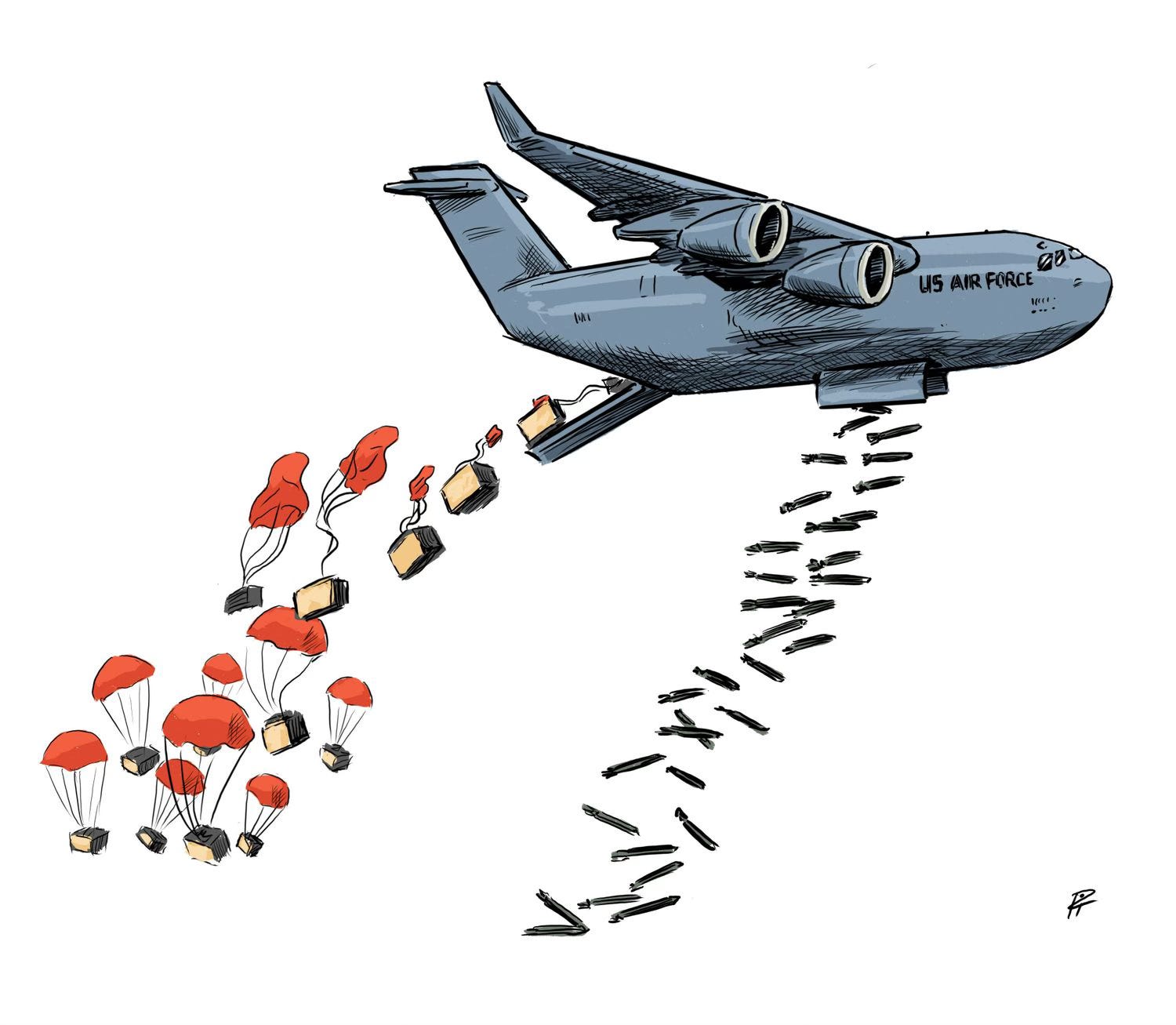
Speaking of the Air Force, my old service, I caught this cartoon by Pia Guerra:
The U.S. government really believes it can have it both ways. It can provide bombs to Israel to annihilate Gaza while at the same time dropping care packages among the wounded and desperate. Call it feel-good militarism. Have some MREs with your HE.* A new form of American (un)happy meal.
Harris and Trump reflect the bipartisan consensus in DC that Pentagon budgets must always go up. They both boast and brag about the U.S. military and its deadliness. They mainly disagree on which enemy is the most serious, with Harris favoring Iran and Russia while Trump hypes China. Neither candidate sees militarism as a problem: they see it as something to celebrate. It’s just that Harris and the Democrats prefer “diverse” militarism.
Trump, of course, has said he wants to end the Russia-Ukraine War. He also raised the specter of nuclear war. Harris, apparently, seems to think she must be more hawkish than Trump, hence her embrace of generals and her talk of lethality.
Whether Harris or Trump wins, higher military budgets are guaranteed and probably more war too. Interestingly, Trump talks more of the enemy within than the enemy without, though his “enemy within” is typically a caricature of woke liberals out to destroy America by forcing your kids to undergo gender-reassignment surgery. Just as Trump is using threat inflation for the enemy within, Harris is inflating the Iranian and Russian threats from without.
Civil discord within America or more war outside of America? That may be our “choice” on November 5th. Or maybe we’ll get both.
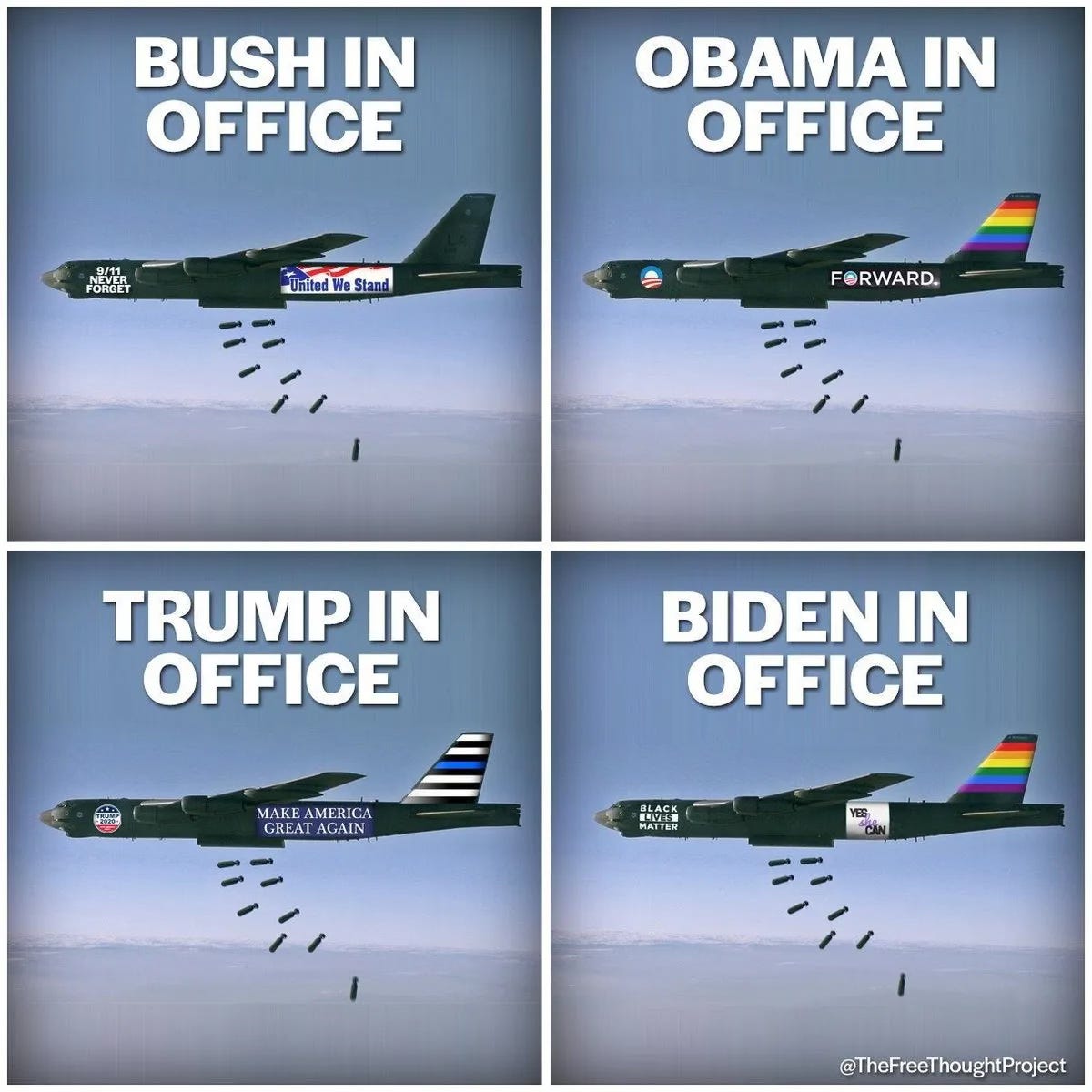
One thing is certain: A B-52 with a rainbow flag and a BLM slogan is still a B-52.
I suppose a Harris B-52 will be the first joyful bomber
* That’s meals ready to eat (MRE), or rations, with your high explosives (HE).
Spend More on the Military! Says the New York Times
As the U.S. deploys more troops to the Middle East (now nearing 50,000 and rising), as Israel expands its war into Lebanon by killing nearly 500 people there, as Palestinians continue to die in Gaza and the West Bank as Israel steals their land, the “liberal” New York Times is running features on how “weak” the U.S. military is.
This is from yesterday’s New York Times send-out, citing a recent (and typical) bipartisan study:
*******
American weaknesses
The report cited several major U.S. weaknesses, including:
A failure to remain ahead of China in some aspects of military power. “China is outpacing the United States and has largely negated the U.S. military advantage in the Western Pacific through two decades of focused military investment,” the report concluded.
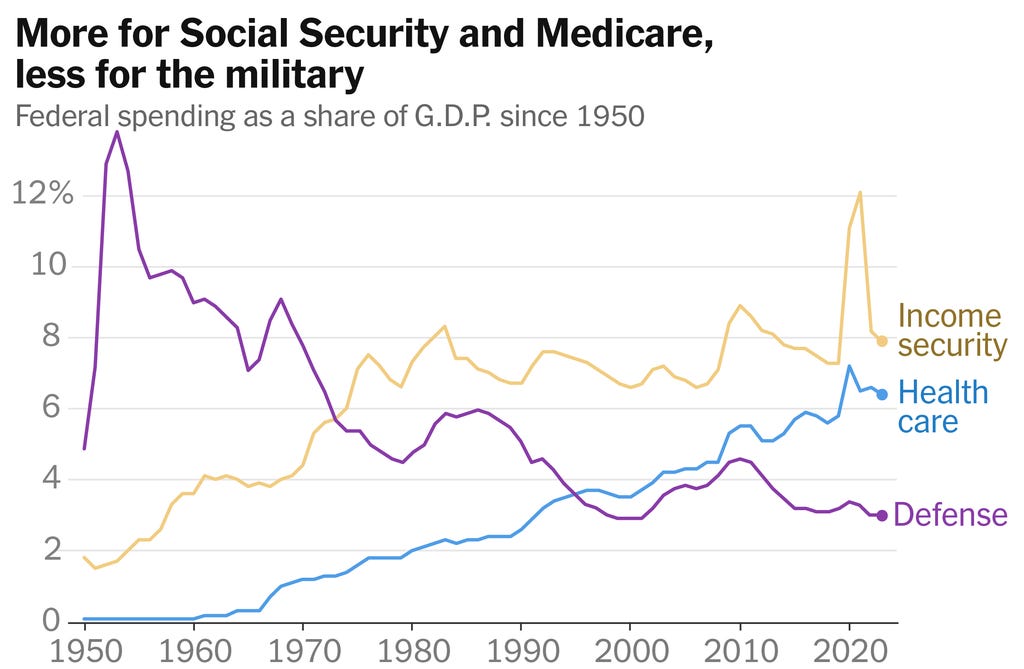
One reason is the decline in the share of U.S. resources devoted to the military. This Times chart, which may surprise some readers, tells the story:
Source: Congressional Budget Office | By The New York Times
The report recommended increasing military spending, partly by making changes to Medicare and Social Security (which is sure to upset many liberals) and partly by increasing taxes, including on corporations (which is sure to upset many conservatives). The report also called for more spending on diplomacy and praised the Biden administration for strengthening alliances in Europe and Asia.
A Pentagon bureaucracy that’s too deferential to military suppliers. The report criticized consolidation among defense contractors, which has raised costs and hampered innovation. The future increasingly lies with drones and A.I., not the decades-old equipment that the Pentagon now uses.
A U.S. manufacturing sector that isn’t strong enough to produce what the military needs. A lack of production capacity has already hurt the country’s efforts to aid Ukraine, as The Times has documented. “Putin’s invasion has demonstrated how weak our industrial base is,” David Grannis, the commission’s executive director, said. If the Pentagon and the innovative U.S. technology sector collaborated more, they could address this problem, Grannis added.
A polarized political atmosphere that undermines national unity. A lack of patriotism is one reason that the military has failed to meet its recent recruitment goals. Perhaps more worrisome, many Americans are angry at one another rather than paying attention to external threats.
*******
Where to begin with such nonsense?
So-called “defense” spending currently sits at or above $1 trillion, representing roughly 60% of federal discretionary spending. It continues to rise. Showing it as declining vis-a-vis the GDP is lying through statistics.
Even if military spending was truly declining, which it isn’t, that would be a “good news” story. As President Eisenhower explained in 1953, military spending represents a theft from those who hunger, those who need shelter, those who need better schools and hospitals.
Social Security: Yes, the government is going to keep trying to cut benefits while handing the savings to military contractors. Ditto for Medicare.
Notice who’s mainly to blame for the alleged need for higher military spending: Putin and China.
The Pentagon has misspent funds and misunderstands war. The solution: give the Pentagon more money as a reward.
Americans are allegedly so angry with each other we’re not sufficiently hating Russians, Chinese, Iranians, and other alleged “external threats.”
America lacks patriotism!
All this is reported with a straight face and the utmost seriousness by your “liberal” friends at the New York Times.
So, when your Social Security benefits are reduced, when your Medicare bills go up, as you struggle even more mightily to make ends meet, just know your money is going to the Pentagon and the weapons makers.
Got a problem with that? The real problem just might be your lack of patriotism.
America is one warbird with two right wings. That’s my expression, though of course I’m borrowing from Gore Vidal, who put it this way:
There is only one party in the United States, the Property Party … and it has two right wings: Republican and Democrat. Republicans are a bit stupider, more rigid, more doctrinaire in their laissez-faire capitalism than the Democrats, who are cuter, prettier, a bit more corrupt — until recently … and more willing than the Republicans to make small adjustments when the poor, the black, the anti-imperialists get out of hand. But, essentially, there is no difference between the two parties.
Gore Vidal (R) from the movie, “Gattaca”
Speaking of bipartisanship, the 2024 presidential election is a fascinating exercise in the mechanics of (impossible) flight, as the two right wings flap vigorously as America spirals downwards.
Let’s look at Trump. Two of his leading surrogates, Tulsi Gabbard and Robert F. Kennedy Jr., are former Democrats. Tulsi left the party as she was smeared by Hillary Clinton and NBC as a Putin puppet, and RFK Jr. learned the hard way that Democrats were not about to allow any serious challenge to Biden/Harris. They are helping Trump in part because they were betrayed by establishment Democrats.
Let’s look at Harris. She’s embraced Dick and Liz Cheney and their endorsement of her, along with another letter of endorsement signed by more than 100 Republicans associated with national security. Harris has also vowed to put at least one Republican in her Cabinet if she’s elected. The Republicans who’ve supported Harris tend to be those who’ve been sidelined by Trump and MAGA.
Both “wings,” Republican and Democrat, fully support Israel in its genocide against Gaza. Both support more war, though Republicans tend to stress China as the primary threat instead of Democrats, who are fixated on Putin and Russia. Both support trillion dollar Pentagon budgets, though Republicans are more vocal in boosting military spending to even higher levels.
Of course, there are differences on certain domestic issues like abortion, for example. Yet, when it comes to war, foreign policy, and world crises, America the warbird flaps its bipartisan right wings with almost equal vigor, caught in a death spiral of its own making.
Any mention of the vaguest so-called left wing policies, such as reductions in military spending and the pursuit of diplomacy instead of war, is instantly denounced as impractical, foolish, unwise, even as un-American.
And so the warbird flaps on, the best scenario being that it goes nowhere, the worst being a crippling fall from the sky.
The Real Winner in November Won’t Be Harris or Trump
Former CIA analyst Ray McGovern coined the term MICIMATT to describe America’s sprawling national (in)security state. It’s an expanded version of President Dwight D. Eisenhower’s military-industrial-congressional complex, which Ike warned America about in 1961. (Ike originally included Congress in his warning, but in the speech he gave he left it out so as not to offend the DC elites.)
MICIMATT includes the military, industry (the weapons makers), Congress, the intelligence “community,” media, academia, and various think tanks funded by weapons makers and seeded with “thinkers” beholden to the donors. The acronym’s awkwardness is more than compensated by its acuity and scope. In fact, even MICIMATT isn’t quite sprawling enough. You’d also have to add Hollywood (all those movies and TV shows that glorify the military and war) and the sporting world to the mix. MICIMATTHS, perhaps? And I’m sure we could think of another letter or two to add, perhaps another “S” for the State Department, which has become a tiny branch of the Pentagon.
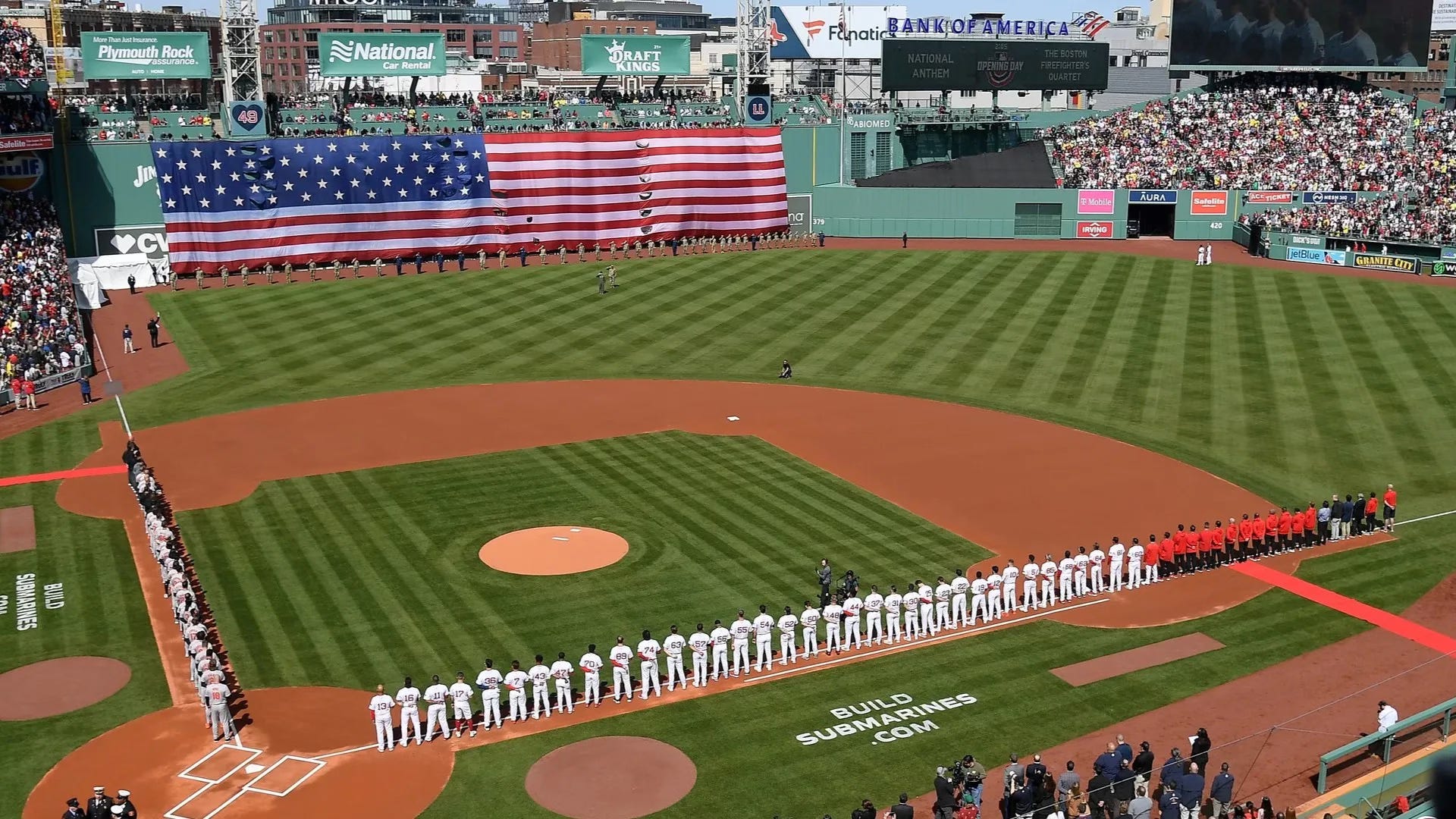
At every Boston Red Sox game this year, I’ve been reminded that America needs to build more nuclear submarines. Imagine an ad along each baseline that read: “PromotePeace”
Given the sweep as well as the power of the MICIMATT over our lives in America, especially our mindset, our culture, our way of thinking and doing, the real president that America is electing this November isn’t personages like Kamala Harris or Donald Trump. The real POTUS is the MICIMATT, a colossus that rules much of our lives and which dominates and largely determines U.S. foreign policy.
To tackle that colossus, you’ve got to cut its funding in a major way: 25% immediately, and perhaps 50% over the next five years. You’ve also got to change our culture. End threat inflation, end fear-mongering, end the worship of all things military. And I don’t see this happening whether the POTUS is Harris or Trump.
*****
On a related subject, I heard once again from my friend who believes I am too critical of Biden/Harris and insufficiently critical of Trump. For what it’s worth, here’s my reply:
Friend, as I’ve written time and time again, I’m against both Trump and Biden/Harris.
Lately, I’ve written more about Biden/Harris since the Dems are the party in power. Though I hope Trump doesn’t win, you’ll see plenty of articles criticizing him if he takes office again.
Also, there’s no shortage of anti-Trump articles in the mainstream media. I’m not about to repeat those. It’s not what my site is about. Why read BV if I just echo MSNBC?
I’m not confident that a Trump victory will produce a result that is more congenial to me with respect to the MICC and perpetual war. Even with Tulsi and RFK Jr. in the mix. Sorry, I can’t “own” that.
In my view, the worst outcome is another Trump victory. Close behind that is a Harris victory for reasons you already know, e.g. genocide in Gaza, more wars, tight embrace of Pentagon lethality, praise for the Cheneys and other Republcian neocons, etc.
In contributing to Harris and voting for her with some enthusiasm, are you prepared to “own” her tacit support of genocide in Gaza as well as her celebration of U.S. military lethality and her embrace of Republican neocons as true patriots?
I started blogging in 2007 for TomDispatch.com. Tom Engelhardt, the mastermind of that indispensable site, saw something in an article I sent him on saving the U.S. military from itself. That is, from its own vainglory, its own global ambitions for power and dominance, its own illusions of being number one, both the world’s toughest military and also the world’s freedom-bringers. Certainly, the megalomania and Messiah-like fantasies weren’t a military mindset alone; it was even more pronounced among the neocons who orbited the Bush/Cheney administration and who still largely define U.S. foreign policy in the Biden/Harris administration. Things are so bad that some (wrongly) believe Trump/Vance offer a more moderate, far less warlike, alternative, when Trump’s record suggests little of the sort.
Anyhow, this is my 108th article for TomDispatch in the 17 years I’ve been writing for the site, a mark of persistence that suggests a certain folly on my part, and considerable patience on Tom’s part.
During World War II, American leaders proudly proclaimed this country the “arsenal of democracy,” supplying weapons and related materiel to allies like Great Britain and the Soviet Union. To cite just one example, I recall reading about Soviet armored units equipped with U.S. Sherman tanks, though the Soviets had an even better tank of their own in the T-34 and its many variants. However, recent news that the United States is providing yet more massive arms deliveries to Israel (worth $20 billion) for 2026 and thereafter caught me off guard. Israel quite plainly is engaged in the near-total destruction of Gaza and the massacre of Palestinians there. So, tell me, how over all these years did the self-styled arsenal of democracy become an arsenal of genocide?
Israel, after all, couldn’t demolish Gaza, killing at least 40,000 Palestinians in a population of only 2.1 million, including thousands of babies and infants, without massive infusions of U.S. weaponry. Often, the U.S. doesn’t even sell the weaponry to Israel, a rich country that can pay its own bills. Congress just freely gifts body- and baby-shredding bombs in the name of defending Israel from Hamas. Obviously, by hook or crook, or rather by shells, bombs, and missiles, Israel is intent on rendering Gaza Palestinian-free and granting Israelis more living space there (and on the West Bank). That’s not “defense” — it’s the 2024 equivalent of Old Testament-style vengeance by annihilation.
As Tacitus said of the rampaging Romans two millennia ago, so it can now be said of Israel: they create a desert — a black hole of death in Gaza — and call it “peace.” And the U.S. government enables it or, in the case of Congress, cheers on its ringleader, Israeli Prime Minister Bibi Netanyahu.
Of course, anyone who knows a little American history should have some knowledge of genocide. In the seventeenth century, Native Americans were often “satanized” by early colonial settlers. (In 1994, a friend of mine, the historian David Lovejoy, wrote a superband all-too-aptly titled article on exactly that topic: “Satanizing the American Indian.”) Associating Indians with the devil made it all the easier for the white man to mistreat them, push them off their lands, and subjugate or eradicate them. When you satanize an enemy, turning them into something irredeemably evil, all crimes become defensible, rational, even justifiable. For how can you even consider negotiating or compromising with the minions of Satan?
Growing up, I was a strong supporter of Israel, seeing that state as an embattled David fighting against a Goliath, most notably during the Yom Kippur War of 1973. Forty years later, I wrote an article suggesting that Israel was now the Goliath in the region with Palestinians in Gaza playing the role of a very much outgunned and persecuted David. An American-Jewish friend told me I just didn’t get it. The Palestinians in Gaza were all terrorists, latent or incipient ones in the case of the infants and babies there. At the time, I found this attitude uncommon and extreme, but events have proven it to be far too common (though it certainly remains extreme). Obviously, on some level, the U.S. government agrees that extremism in the pursuit of Israeli hegemony is no vice and so has provided Israel with the weaponry and military cover it needs to “exterminate all the brutes.” Thus, in 2024, the U.S. “cradle of democracy” reveals its very own heart of darkness.
Looking Again at the World Wars That Made America “Great”
When considering World Wars I and II, we tend to see them as discrete events rather than intimately connected. One was fought from 1914 to 1918, the other from 1939 to 1945. Americans are far more familiar with the Second World War than the First. From both wars this country emerged remarkably unscathed compared to places like France, Germany, Russia, the United Kingdom, China, and Japan. Add to that the comforting myth that America’s “greatest generation” pretty much won World War II, thereby saving democracy (and “Saving Private Ryan” as well).
Perhaps, however, we should imagine those years of conflict, 1914-1945, as a European civil war (with an Asian wing thrown in the second time around), a new Thirty Years’ War played out on a world stage that led to the demise of Europe’s imperial powers and their Asian equivalent and the rise of the American empire as their replacement. Germanic militarism and nationalism were defeated but at an enormous cost, especially to Russia in World War I and the Soviet Union in World War II. Meanwhile, the American empire, unlike Germany’s Second and Third Reichs or Japan’s imperial power, truly became for a time an untrammeled world militarist hegemon with the inevitable corruption inherent in the urge for near-absolute power.
Vast levels of destruction visited upon this planet by two world wars left an opening for Washington to attempt to dominate everywhere. Hence, the roughly 750 overseas bases its military set up to ensure its ultimate global reach, not to speak of the powerful navy it created, centered on aircraft carriers for power projection and nuclear submarines for possible global Armageddon, and an air force that saw open skies as an excuse for its own exercises in naked power projection. To this you could add, for a time, U.S. global economic and financial power, enhanced by a cultural dominance achieved through Hollywood, sports, music, and the like.
Not, of course, that the United States emerged utterly unchallenged from World War II. Communism was the specter that haunted its leaders, whether in the Soviet Union, China, or Southeast Asia (where, in the 1960s and early 1970s, it would fight a disastrous losing war, the first of many to come, in Vietnam, Laos, and Cambodia). Here, there, and everywhere, even under the very beds of Americans, there was a fear of the “commie rat.” And for a while, communism, in its Soviet form, did indeed threaten capitalism’s unbridled pursuit of profits, helping American officials to create a permanent domestic war state in the name of containing and rolling back that threat. The collapse of the Soviet Union in 1991 erased that fear, but not the permanent war state that went with it, as Washington sought new enemies to justify a Pentagon budget that today is still rising toward the trillion-dollar mark. Naturally (and remarkably disastrously), it found them, whether in Afghanistan, Iraq, or so many other places in the case of the costly and ultimately futile Global War on Terror in the aftermath of the 9/11 attacks.
And eternally losing (or at least not winning) its wars raised the question: What will replace it? What will happen as imperial America continues to decline, burdened by colossal debt and strategic overreach, and crippled from within by a rapacious class of oligarchs who fancy themselves as a new all-American aristocracy. Will that decline lead to collapse or can its officials orchestrate a soft landing? In World Wars I and II, Europeans fought bitterly for world dominance, powered by militarism, nationalism, racism, and greed. They suffered accordingly and yet did recover even if as far less powerful nations. Can the U.S. manage to curb its own militarism, nationalism, racism, and greed in time and so recover similarly? And by “racism,” I mean, for example, reviving the idea (however put) of China as a “yellow peril,” or the tendency to see the darker-skinned peoples of the Middle East as violent “terrorists” and the latest minions of Satan.
And then, of course, there’s always the fear that, in the future, a world war could once again break out, raising the possibility of the use of nuclear weapons from global arsenals that are always being “modernized” and the possible end of most life on Earth. It’s an issue worth highlighting, since the U.S. continues to “invest” significant sums in producing yet more nuclear weapons, even as it ratchets up tensions with nuclear powers like Russia and China. Though a winnable nuclear war among the great powers on this planet is inconceivable, that hasn’t stopped my country from pushing for a version of nuclear superiority (disguised, of course, as “deterrence”).
Making America Sane Again
The world wars of the previous century facilitated America’s global dominance in virtually all its dimensions. That, in fact, was their legacy. No other nation in history had, without irony or humility, divided the globe into military combatant commandslike AFRICOM for Africa, CENTCOM for the Middle East, and NORTHCOM here at home. There are also “global” commands for strategic nuclear weapons, cyber dominance, and even the dominance of space. It seemed that the only way America could be “safe” was by dominating everything everywhere all at once. That insane ambition, that vainglory, was truly what made the U.S. the “exceptional” nation on the world stage.
Such a boundless pursuit of dominance, absurdly disguised as benefiting democracy, is now visibly fraying at the seams and may soon come apart entirely. In 2024, it’s beyond obvious that the United States no longer dominates the world, even if its military-industrial-congressional complex (MICC) does indeed dominate its national (in)security state and so increasingly the country. What an irony, in fact, that defeating European militarism in two world wars only accelerated the growth of American militarism and nationalism, making the world’s lone superpower for so many decades the scariest country for all too many peoples outside its borders.
Think, in fact, of the U.S. emerging from World War II with what might be thought of as victory disease. The last nearly 80 years of its foreign policy witnessed the remarkable progression of that “disease,” despite a lack of actual victories (unless you count minor escapades like the invasion of Grenada). Put differently, the U.S. emerged from World War II so singularly an economic, financial, and cultural juggernaut that subsequent military defeats almost didn’t seem to matter.
Even as America’s economic, financial, and cultural power has waned in this century, along with its moral position (consider President Obama’s curt “We tortured some folks” admission, along with support for Israel’s ongoing genocide), the government does continue to double-down on military spending. Pentagon budgets and related “national security” costs now significantly exceed $1 trillion annually even as arms shipments and sales continue to surge. War, in other words, has become big business in America or, as General Smedley Butler so memorably put it 90 years ago, a first-class “racket.”
Worse yet, war, however prolonged and even celebrated, may be the very definition of insanity, a deadly poison to democracy. Don’t tell that to the MICC and all its straphangers and camp followers, though.
Ironically, the two countries, Germany and Japan, that the U.S. took credit for utterly defeating in World War II, forcing their unconditional surrender, have over time emerged in far better shape. Neither of them is perfect, mind you, but they largely have been able to avoid the militarism, nationalism, and constant warmongering that so infects and weakens American-style democracy today. Whatever else you can say about Germany and Japan in 2024, neither of them is bent in any fashion on either regional or global domination, nor are their leaders bragging of having the finest military in all human history. American presidents from George W. Bush to Barack Obama have indeed bragged about having a matchless, peerless, “finest” military. The Germans and Japanese, having known the bitter price of such boasts, have kept their mouths shut.
My brother Stevie once memorably said: “No brag, just facts.”
My brother has a saying: no brag, just facts. And when we look at facts, the pursuit of global dominance has been driving the American empire toward an early grave. The “finest” military lost disastrously, of course, in Vietnam in the last century, and in Afghanistan and Iraq in this one. It functionally lost its self-proclaimed Global War on Terror and it keeps losing in its febrile quest for superiority everywhere.
If we met a person dressed in a military uniform who insisted he was Napoleon, boasted that his Imperial Guard was the world’s best, and that he could rule the world, we would, of course, question his sanity. Why are we not questioning the collective sanity of America’s military and foreign-policy elites?
This country doesn’t need to be made great again, it needs to be made sane again by the rejection of wars and the weaponry that goes with them. For if we continue to follow our present pathway, MADness could truly lie in wait for us, as in the classic nuclear weapons phrase, mutually assured destruction (MAD).
Another form of madness is having a president routinely implore God — yes, no one else! — to protect our troops. This is not a knock on Joe Biden alone. He’s just professing a nationalist piety that’s designed to win applause and votes. Assuming Biden has the Christian God in mind, consider the irony, not to say heresy, of functionally begging Christ, the Prince of Peace, to protect those who are already armed to the teeth. It’s also an abdication of the commander-in-chief’s responsibility to support and defend the U.S. Constitution while protecting those troops himself. Who has the biggest impact, God or the president, when it comes to ensuring that troops aren’t sent into harm’s way without a justifiable cause supported by the American people through a Congressional declaration of war?
Consider the repeated act of looking skyward to God to support military actions as a major league cop-out. But that’s what U.S. presidents routinely do now. Such is the pernicious price of pursuing a vision that insists on global reach, global power, and global dominance. America’s leaders have, in essence, elevated themselves to a god-like position, a distinctly angry, jealous, and capricious one, far more like Zeus or Ares than Jesus. Speaking of Jesus, he is alleged to have said, “Suffer the children to come unto me.” The militarized American god, however, says: suffer the children of Gaza to die courtesy of bombs and shells made here in the U.S.A. and shipped off to Israel at a remarkably modest price (given the destruction they cause).
To echo a popular ad campaign, Jesus may “get” us, but our leaders (self-avowed Christians, all) sure as hell don’t get him. I may be a lapsed Catholic, not a practicing one like Joe Biden, but even I remember my catechism and a certain commandment that Thou shalt not kill.
Kamala Harris and Donald Trump have something in common. They both embrace colossal Pentagon budgets and both celebrate the “lethality” of the U.S. military, which, they agree, must be the strongest, bestest, in the world. They also agree on giving a blank check to Israel and its leaders to do whatever they want in Gaza to the Palestinians and will continue to provide whatever weapons Israel desires to kill massive numbers of Palestinians while flattening and destroying the Gaza Strip.
With respect to Iran, Harris appears to be even more hawkish than Trump, and indeed criticized him for not being aggressive enough with Iran’s leaders. Harris is also a strong supporter of Ukraine, seeing war as its best option to defeat Russia, whereas Trump is more skeptical of war and more open to diplomacy with Putin and Russia.
This isn’t surprising. Mainstream Democrats in DC are basically warmongering neo-conservatives on foreign policy, so a vote for Harris/Walz is a vote, as the “liberal” New York Times reported, for “muscular patriotism” (or, to paraphrase my wife, febrile and unapologetic nationalism). This is Washington Beltway conformity at its finest, as organs such as the National Interest write unironic articles about cheerleading the wonders of the military-industrial complex (MIC).
Ike got it all wrong. Embrace the MIC! Cheer for it!
See, President Dwight D. Eisenhower got it all wrong. We shouldn’t be wary of the MIC; we shouldn’t worry that its unchecked power threatens democracy and our very freedoms. No, we should embrace the MIC, celebrate it, enrich it with even more of our taxpayer dollars.
At Responsible Statecraft, Bill Hartung wrote a thoughtful response to the recent National interest piece. To me, it all depends on what vision of America you want to advance. If you want to advance America as the world’s hegemon, the empire of global reach, power, and dominance, the empire of constant warfare, then, heck, three cheers for the MIC.
But, if you want to advance America as a republic that leads “by the power of its example,” one that focuses on national defense and defense alone, then “three cheers for the MIC” guarantees the death of that republic and the corruption of its moral authority as an exemplar of democracy.
Of course, whether you choose to support Harris or Trump, we are witnessing exactly that latter fate. When you embrace the MIC, war, and empire, you set in motion the death of Democracy.
Whether America’s politicians put an “R” after their names or a “D,” it doesn’t alter the fundamental reality that the power of America’s example is very much driven and determined by examples of its military power. That is not about to change whether Harris or Trump prevails.






 Bracing Views