Stalemate: That’s the word of choice being used by U.S. generals to describe the Afghan War. What, exactly, is a stalemate? I played chess at an early age, caught up in the Bobby Fischer craze of the early 1970s, and I still play occasionally. In chess, a stalemate is a special kind of draw, and an often frustrating one. Put concisely, “Stalemate is a situation in the game of chess where the player whose turn it is to move is not in check but has no legal move.”
For example, I may be winning decisively, with only my opponent’s king left on the board. But if I carelessly put my opponent’s (unchecked) king in such a position that his only move is into harm (or “check”), the position is stalemated. My decisive material advantage makes no difference: the game is over, it’s a draw. In effect, given my material advantage, it’s a win for him and a loss for me.
Is the Afghan War “stalemated”? Not according to the U.S. military, since it believes the “stalemate” can be reversed, that the U.S. can still “win.” Indeed, President Trump has already gone on record last week as saying his administration is winning in Afghanistan. No stalemate here.
A stalemated chess match is simply a bad metaphor for the Afghan War. It’s not that one side can’t make a legal move, therefore the game is over. (Would that the war could end so easily and cleanly!) The situation today in Afghanistan is that the Taliban continues to tighten its grip on the country, or, in chess terms, it’s enlarging its span of control over the board, even as U.S. and Coalition forces send more troops, expend more munitions, and issue more reports about how they can still win — as long as U.S. generals get exactly what they want.
So, if stalemate is the wrong word, what is the right one? I have one: defeat. U.S. and Coalition forces have been fighting the Afghan War for 16 years. Surges have come and gone. More than a trillion dollars has been spent. Yet the enemy retains the initiative and largely dictates the terms of the conflict. Whatever this is, it isn’t “victory”; it’s not “progress”; nor is it “stalemate.” It’s a lost position, a defeat, pure and simple.
There’s nothing wrong with defeat. The very best chess grandmasters lose; and when they do, they almost always tip their king and resign before they’re checkmated (defeated utterly). By doing so, they conserve their energy for the next opponent, even as they study the lost game so they can learn from their mistakes.
Isn’t it time the U.S. did the same in the Afghan War? Admit a lost position, resign, and withdraw? Then learn?
Trump, of course, says he’s all about winning. He’ll continue to push pieces about the board, despite the lost position. This is not reversing a stalemate (which, by the rules of chess, can’t be done). It’s only delaying defeat – at a high cost indeed to all those “pieces” being shunted about and sacrificed on the chessboard that is Afghanistan.
U.S. and Coalition forces have seriously undercounted the number of civilians killed in air attacks against ISIS. That is the key finding of an 18-month-long investigation led by Azmat Khan and Anand Gopal and published this week in the New York Times Magazine. Khan/Gopal surveyed 103 sites of air strikes in northern Iraq, extrapolating from these attacks into other regions in which the Coalition launched air attacks against ISIS since 2014. They conclude that between 8000 and 10,000 civilians have been killed in these attacks, far higher than the U.S. government’s estimate of roughly 500 civilians killed (or the 3000 civilian deaths estimated by Airwars.org over this same period).
Does it matter to Americans if the true count of civilian deaths is closer to 10,000 than 500? To most Americans, sadly, I’m not sure it matters. Not if these air strikes are described and defended as saving American and Coalition lives as well as killing terrorists.
Airwars.org keeps a running tally of U.S. and Coalition airstrikes in Iraq and Syria. Their website today (11/19/17) records 28,380 strikes over an almost four-year period, using 102,082 bombs and missiles. It would be remarkable if only a few hundred innocents were killed by such an astonishing number of bombs and missiles, and indeed they estimate that nearly 6000 civilians have been killed in these attacks.
Why are U.S./Coalition figures so much lower than those estimated by Khan/Gopal and Airwars.org?
In March 2013, I wrote an article for TomDispatch in which I explained that airpower and bombing missions are neither cheap nor surgical nor decisive. More recently, I lamented the horrific euphemism of “collateral damage,” a term often used to elide the realities of death by bombing. There are good reasons why officialdom in Washington is content to undercount the number of civilians killed in bombing and drone attacks overseas. Some are obvious; others perhaps less so:
It’s not in the best interests of the U.S. military to give a full and honest accounting of civilian casualties, so they don’t.
A full and honest accounting requires direct investigations (boots on the ground) like the ones conducted by Khan/Gopal. These are not generally done, partly because they would expose U.S. troops to considerable risk.
A full and honest accounting might suggest that air attacks are too costly, murderously so. The Coalition and the U.S. military prefer to advertise airpower as a “precise” and “decisive” weapon, and of course the Coalition relies on airpower to keep their casualties limited.
Related to (3), as airpower is sold as “surgical” and decisive, there are billions and billions of dollars riding on this image. Think of the hundreds of billions of dollars invested in warplanes, drones, and munitions. Is the U.S. willing to suggest that this approach is often not that effective in the “war on terror”? Even worse, that it results in the death and grievous wounding of thousands of innocent men, women, and children? That it may, in fact, exacerbate terrorism and intensify the war?
Another possible angle: Do you want to tell pilots and other crew members that their bombs and missiles often kill innocents rather than the enemy? What would that do to morale?
When civilian deaths are mentioned in the U.S. media, they are often explained, or explained away, as the byproduct of ISIS/ISIL using innocents as human shields, or of the messiness and unpredictability of urban warfare in densely packed cities like Mosul. But the Khan/Gopal study notes that civilian deaths from the air war are often due to poor intelligence – a failure of process, the result of insufficient resources and inadequate understanding of events on the ground. In a word, negligence.
Again, do Americans care about civilian casualties in Iraq or Syria or other faraway places? We seem to have a blasé attitude toward foreign peoples being killed at a distance in air strikes. I suppose this is so because those killings are termed “accidental” by military spokesmen even as they’re attributed to a nefarious enemy or to technological errors. It’s also so because these deaths have been both undercounted and underreported in America.
In showing that the U.S. government seriously undercounts civilian casualties and by highlighting systemic flaws in intelligence-gathering and targeting, the Khan/Gopal study makes a major contribution to our understanding of the true costs of America’s endless war on terror.
Here are two items this morning from FP: Foreign Policy (foreignpolicy.com), which provides a daily summary (Situation Report, or SITREP) of news items related to the U.S. military and foreign policy. Together, they represent the very definition of insanity.
Item 1: The Congressional Budget Office on Tuesday said U.S. taxpayers are on the hook for about $1.2 trillion over the next 30 years to modernize the country’s nuclear arsenal. That huge number takes into account the replacement of nuclear-capable submarines, ICBMs, and new aircraft for the Air Force.
The budget office warned that the projected costs would muscle out some conventional weapons programs in the coming years unless the Pentagon’s budget is increased substantially. The CBO identified some cost savings however, saying the Pentagon could save as much as $139 billion if it delayed production of a new ICBM, stalled a secretive new nuclear-capable bomber called the B-21, and reduced the number of ICBMs and missile-carrying nuclear submarines than planned.
All of those plans are carry-overs from the Obama administration, as the Trump team has yet to articulate a nuclear weapons strategy.
Item 2: War in Afghanistan, redacted. The Afghan government is losing control of more and more territory to the Taliban, according a grim new report from the congressionally-mandated Special Inspector General for Afghanistan Reconstruction. On the humanitarian side, civilian casualties from coalition and Afghan air strikes spiked by 52 percent in the first nine months of this year over last year, the report notes.
In response to those unfriendly stats, the U.S. military has started to withhold information from the American public, refusing to report figures related to the size and success of Afghan security forces — which the U.S. taxpayer has spent tens of billions to build and sustain.
“The Afghans know what’s going on; the Taliban knows what’s going on; the U.S. military knows what’s going on,” John F. Sopko, the special inspector general for Afghanistan, told the New York Times. “The only people who don’t know what’s going on are the people paying for it.”
In sum, the American people will possibly pay more than a trillion dollars in the next three decades for more nuclear weapons (when the stated goal of leaders like Obama had been to eliminate them), even as information about the never-ending war in Afghanistan is withheld from the American people (especially the jaw-dropping waste of billions of dollars on Afghan security forces that can’t or won’t fight).
Meanwhile, U.S. citizens in Puerto Rico languish in the dark, the victims of a U.S. government that seeks to punish the island for its debt to various financial institutes and power brokers.
Nick Turse has an excellent article at TomDispatch.com documenting how U.S. special ops forces are involved in many countries that share a border with Russia. A telling quotation from his article comes from General Raymond Thomas, the head of U.S. Special Operations Command (SOCOM). Testifying before Congress, Thomas said
“We are working relentlessly with our [European] partners and the Department of State to build potency in eastern and northern Europe to counter Russia’s approach to unconventional warfare, including developing mature and sustainable Special Operations capabilities across the region.”
This looks like typical bureaucratese, but two words struck me as revealing: “relentlessly” and “potency.” Typically, one might say one is working “tirelessly,” or “cooperatively,” or just plain working. The idea one is working “relentlessly” serves to highlight the often frenetic nature of U.S. military deployments, the emphasis on ceaseless toil and constant action, especially of the kinetic variety. This is a leading feature of America’s can-do military, a strong preference for acting first, thinking later. And it doesn’t bode well as American special ops forces take up “mature and sustainable” positions in former Soviet satellite countries for the alleged reason of deterring Russian aggression.
The second word that struck me from the general’s testimony was “potency.” Americans certainly can’t be seen as impotent. But potency here is really a weasel word for offensive potential — the ability to strike “kinetically” at an enemy. For example, one could say the Soviets were building up potency in Cuba during the early 1960s, but the Kennedy administration didn’t exactly see nuclear missiles being based there in those terms. Is Kim Jong-un similarly building up regional “potency,” working “relentlessly” to deter U.S. aggression in his region of the world? American military and foreign policy experts would laugh at those words and sentiments coming from the mouth of rival leaders like Vladimir Putin or Kim Jong-un.
With ever bigger military budgets, and ever growing ambitions, the U.S. military is relentlessly building up potency, which is nevertheless always framed as defensive, even benign.
Something tells me the Russians don’t see it this way.
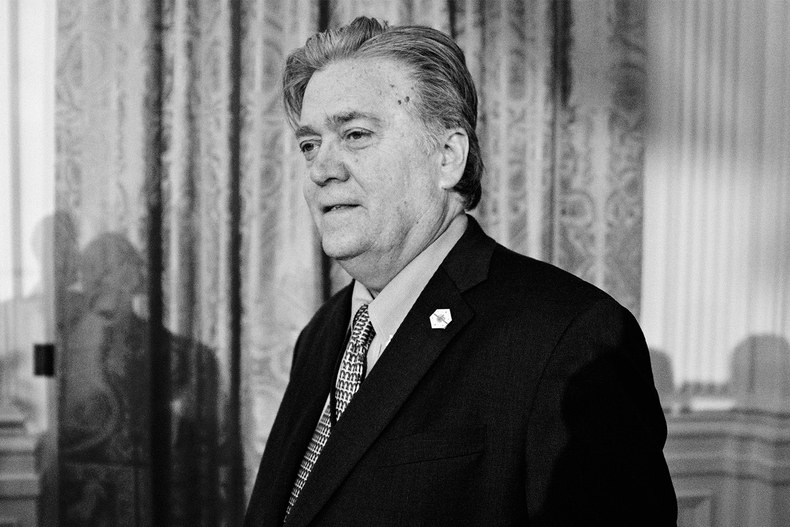
After Republican Bob Corker had the guts to criticize President Trump for his bellicose rhetoric and incompetent management of U.S. foreign policy, Steve Bannon issued the following riposte:
“Bob Corker has trashed the commander in chief of our armed forces while we have young men and women in harm’s way.”
The indecency of Bannon’s argument is obvious. According to Bannon, Corker’s criticism of Trump is tantamount to treason, because an attack on Trump is an attack on “our” troops “in harm’s way.”
If Bannon had his way, no one would be allowed to criticize Trump about foreign policy while U.S. troops are in harm’s way. Since U.S. troops are deployed to more than 800 bases overseas and to more than 130 countries while incessantly fighting wars in places like Afghanistan, they are, in essence, always in harm’s way. Thus, no criticism of our Great Leader would ever be allowed, which is convenient for Trump and Bannon Wormtongue.
It’s infuriating how men like Bannon attempt to squelch criticism of the president by hiding behind the troops. Judging by his rhetoric, Bannon doesn’t want to live in a democracy; he’d much prefer a dictatorship. Meanwhile, Trump’s riposte to Bob Corker focused on his height. (Corker is roughly six inches shorter than Trump.)
Mr. Bannon, Trump is more mocker-in-chief than a commander. And, in defending our chief mocker, your sophistic attempt to hide behind the troops was more than shameful. It’s grotesque.
“It’s their [South Vietnam’s] war to win. We can help them … but in the final analysis, it’s their people and their government who have to win or lose this struggle.” President Kennedy in September 1963
“We are not about to send American boys nine or ten thousand miles from home [to fight in Vietnam] to do what Asian boys ought to be doing for themselves.” President Johnson in 1964
I’ve now watched all ten episodes of the Burns/Novick series on the Vietnam War. I’ve written about it twice already (here and here), and I won’t repeat those arguments. Critical reviews by Nick Turse, Peter Van Buren, Andrew Bacevich, and Thomas Bass are also well worth reading.
I now know the main message of the series: the Vietnam war was an “irredeemable tragedy,” with American suffering being featured in the foreground. The ending is revealing. Feel-good moments of reconciliation between U.S. veterans and their Vietnamese counterparts are juxtaposed with Tim O’Brien reading solemnly from his book on the things American troops carried in Vietnam. The Vietnamese death toll of three million people is briefly mentioned; so too are the bitter legacies of Agent Orange and unexploded ordnance; regional impacts of the war to Laos and Cambodia are briefly examined. But the lion’s share of the emphasis is on the American experience, with the last episode focusing on subjects like PTSD and the controversy surrounding the Vietnam War Memorial in Washington, D.C.
The series is well made and often powerful. Its fault is what’s missing. Little is said about the war being a crime, about the war being immoral and unjust; again, the war is presented as a tragedy, perhaps an avoidable one if only U.S. leaders had been wiser and better informed, or so the series suggests. No apologies are made for the war; indeed, the only apology featured is by an antiwar protester near the end (she’s sorry today for the harsh words she said decades ago to returning veterans).
The lack of apologies for wide-scale killing and wanton destruction, the lack of serious consideration of the war as a crime, as an immoral act, as unjust, reveals a peculiarly American bias about the war, which Burns/Novick only amplify. The series presents atrocities like My Lai as aberrations, even though Neil Sheehan is allowed a quick rejoinder about how, if you include massive civilian casualties from U.S. artillery and bombing strikes, My Lai was not aberrational at all. Not in the sense of killing large numbers of innocent civilians indiscriminately. Such killing was policy; it was routine. Sheehan’s powerful observation is not pursued, however.
What the Burns/Novick series truly needed was a two-hour segment devoted exclusively to the destruction inflicted on Southeast Asia and the suffering of Vietnamese, Laotian, and Cambodian peoples. Such a segment would have been truly eye-opening to Americans. Again, the series does mention napalm, Agent Orange, massive bombing, and the millions of innocents killed by the war. But images of civilian suffering are as fleeting as they are powerful. The emphasis is on getting to know the veterans, especially American ones, of that war. By comparison, the series neglects the profound suffering of Vietnamese, Laotians, and Cambodians.
In short, the series elides the atrocious nature of the war. This is not to say that atrocities aren’t mentioned. My Lai isn’t ignored. But it’s juxtaposed with communist atrocities, such as the massacre of approximately 2500 prisoners after the Battle of Hue during the Tet Offensive, a war crime committed by retreating North Vietnamese Army (NVA) and National Liberation Front (NLF) forces.
Yet in terms of scale and frequency the worst crimes were committed by U.S. forces, again because they relied so heavily on massive firepower and indiscriminate bombing. I’ve written about this before, citing Nick Turse’s book, Kill Anything That Moves, as well as the writings of Bernard Fall, who said that indiscriminate bombing attacks showed the U.S. was not “able to see the Vietnamese as people against whom crimes can be committed. This is the ultimate impersonalization of war.”
Why did many Americans come to kill “anything that moves” in Vietnam? Why, in the words of Fall, did U.S. officialdom fail to see the peoples of Southeast Asia as, well, people? Fellow human beings?
The Burns/Novick series itself provides evidence to tackle this question, as follows:
At the ground level, U.S. troops couldn’t identify friend from foe, breeding confusion, frustration, and a desire for revenge after units took casualties. It’s said several times in the series that U.S. troops thought they were “chasing ghosts,” “phantoms,” a “shadowy” enemy that almost always had the initiative. In American eyes, it wasn’t a fair fight, so massive firepower became the equalizer for the U.S.—and a means to get even.
Racism, depersonalization, and alienation. U.S. troops routinely referred to the enemy by various racist names: gooks, dinks, slopes, and so on. (Interestingly, communist forces seem to have referred to Americans as “bandits” or “criminals,” negative terms but not ones dripping with racism.) Many U.S. troops also came to hate the countryside (the “stinky” rice paddies, the alien jungle) as well. Racism, fear, and hatred bred atrocity.
Body count: U.S. troops were pushed and rewarded for high body counts. A notorious example was U.S. Army Lieutenant General Julian Ewell. The commanding general of the 9th Infantry Division, Ewell became known as the “Butcher of the Delta.” Douglas Kinnard, an American general serving in Vietnam under Ewell, recounted his impressions of him (in “Adventures in Two Worlds: Vietnam General and Vermont Professor”). Ewell, recalled Kinnard, “constantly pressed his units to increase their ‘body count’ of enemy soldiers. This had become a way of measuring the success of a unit since Vietnam was [for the U.S. Army] a war of attrition, not a linear war with an advancing front line. In the 9th [infantry division] he had required all his commanders to carry 3” x 5” cards with body count tallies for their units by date, by week, and by month. Woe unto any commander who did not have a consistently high count.”
The Burns/Novick series covers General Ewell’s “Speedy Express” operation, in which U.S. forces claimed a kill ratio of 45:1 (45 Vietnamese enemy killed for each U.S. soldier lost). The series notes that an Army Inspector General investigation of “Speedy Express” concluded that at least 5000 innocent civilians were included as “enemy” in Ewell’s inflated body count—but no punishment was forthcoming. Indeed, Ewell was promoted.
Ewell was not the only U.S. leader who drove his troops to generate high body counts while punishing those “slackers” who didn’t kill enough of the enemy. Small wonder Vietnam became a breeding ground for atrocity.
Helicopters. As one soldier put it, a helicopter gave you a god’s eye view of the battlefield. It gave you distance from the enemy, enabling easier kills (If farmers are running, they’re VC, it was assumed, so shoot to kill). Helicopters facilitated a war based on mobility, firepower, and kill ratios, rather than a war based on territorial acquisition and interaction with the people. In short, U.S. troops were often in and out, flitting about the Vietnamese countryside, isolated from the land and the people—while shooting lots and lots of ammo.
What are we fighting for? For the grunt on the ground, the war made no sense. Bernard Fall noted that, after talking to many Americans in Vietnam, he hadn’t “found anyone who seems to have a clear idea of the end – of the ‘war aims’ – and if the end is not clearly defined, are we justified to use any means to attain it?”
The lack of clear and defensible war aims, aims that could have served to limit atrocities, is vitally important in understanding the Vietnam war. Consider the quotations from Presidents Kennedy and Johnson that lead this article. JFK claimed it wasn’t America’s war to win — it was South Vietnam’s. LBJ claimed he wasn’t going to send U.S. troops to Vietnam to fight; he was going to leave that to Asian boys. Yet JFK committed America to winning in South Vietnam, and LBJ sent more than half a million U.S. “boys” to wage and win that war.
Alienated as they were from the land and its peoples, U.S. troops were also alienated from their own leaders, who committed them to a war that, according to the proclamations of those same leaders, wasn’t theirs to win. They were then rewarded for producing high body counts. And when atrocities followed, massacres such as My Lai, U.S. leaders like Richard Nixon conspired to cover them up.
In short, atrocities were not aberrational. They were driven by the policy; they were a product of a war fought under false pretenses. This is not tragedy. It’s criminal.
Failing to face fully the horrific results of U.S. policy in Southeast Asia is the fatal flaw of the Burns/Novick series. To that I would add one other major flaw*: the failure to investigate war profiteering by the military-industrial complex, which President Eisenhower famously warned the American people about as he left office in 1961. Burns/Novick choose not to discuss which corporations profited from the war, even as they show how the U.S. created a massive “false” economy in Saigon, riven with corruption, crime, and profiteering.
As the U.S. pursued Vietnamization under Nixon, a policy known as “yellowing the bodies” by their French predecessors, the U.S. provided an enormous amount of weaponry to South Vietnam, including tanks, artillery pieces, APCs, and aircraft. Yet, as the series notes in passing, ARVN (the South Vietnamese army) didn’t have enough bullets and artillery shells to use their American-provided weaponry effectively, nor could they fly many of the planes provided by U.S. aid. Who profited from all these weapons deals? Burns/Novick remain silent on this question—and silent on the issue of war profiteering and the business side of war.
The Vietnam War, as Tim O’Brien notes in the series, was “senseless, purposeless, and without direction.” U.S. troops fought and died to take hills that were then quickly abandoned. They died in a war that JKF, Johnson, and Nixon admitted couldn’t be won. They were the losers, but they weren’t the biggest ones. Consider the words of North Vietnamese soldier, Bao Ninh, who says in the series that the real tragedy of the war was that the Vietnamese people killed each other. American intervention aggravated a brutal struggle for independence, one that could have been resolved way back in the 1950s after the French defeat at Dien Bien Phu.
But U.S. leaders chose to intervene, raining destruction on Southeast Asia for another twenty years, leading to a murderous death toll of at least three million. That was and is something more than a tragedy.
*A Note: Another failing of the Burns/Novick series is the lack of critical examination about why the war was fought and for what reasons, i.e. the series takes at face value the Cold War dynamic of falling dominoes, containment, and the like. It doesn’t examine radical critiques, such as Noam Chomsky’s point that the U.S. did achieve its aims in the war, which was the prevention of Vietnamese socialism/communism emerging as a viable and independent model for economic development in the 1950s and 1960s. In other words, a debilitating war that devastated Vietnam delayed by several decades that people’s emergence as an economic rival to the U.S., even as it sent a message to other, smaller, powers that the U.S. would take ruthless action to sustain its economic hegemony across the world. This line of reasoning demanded a hearing in the series, but it’s contrary to the war-as-tragedy narrative adopted by Burns/Novick.
For Chomsky, America didn’t accidentally or inadvertently or ham-fistedly destroy the Vietnamese village to save it; the village was destroyed precisely to destroy it, thereby strengthening capitalism and U.S. economic hegemony throughout the developing world. Accurate or not, this critique deserves consideration.
I’ve watched the first three episodes of the Ken Burns/Lynn Novick series on the Vietnam War, which take us from the French colonial period beginning in the 19th century to the end of 1965 and a mushrooming U.S. military commitment. The narrative thread, it seems to me, is the notion of the war as a tragic mistake, most especially for the United States.
The series begins with a voice-over that suggests the war was begun in good faith by America, even as other American voices in the series suggest otherwise. I kept a notebook handy and jotted down the following notes and thoughts as the series progressed:
There were divisions among the Vietnamese people, but they were more or less united by one idea: resist the foreign invaders/occupiers, whether that foreign presence was French, Japanese, the French again, American, or (both earlier and later) Chinese. And there’s no doubt Ho Chi Minh would have won a democratic election, as promised at Geneva. Which is exactly why that election never came.
As one American admitted, the U.S. totally misread the situation in Indochina after the French defeat in 1954. The Cold War and Falling Dominoes dominated the thoughts of Americans, obscuring the reality of a powerful and popular anti-colonial and nationalist revolt that tapped Vietnamese patriotism.
When not fearing Falling Dominoes, U.S. officials were far more concerned about their own prestige (or political fortunes) than they were with the Vietnamese people.
U.S. officials recognized South Vietnam was a fiction, a puppet government propped up by American money and power, and that they had “backed the wrong horse.” But they came to believe it was the only horse they had in the race against communism.
U.S. presidents, stuck with a losing horse of their own creation, began to lie. As president, Kennedy said he hadn’t sent combat troops; he had. As president, Johnson tried to obscure both the size and intent of the U.S. military’s commitment. These lies were not done to deceive the enemy — they were done to deceive the American people.
After backing the wrong horse (Diem and his family), American leaders conspired to eliminate him in a coup. When Diem was assassinated, matters only grew worse. Left with no horse in the race and a “turnstile” government in South Vietnam, the U.S. began to bomb North Vietnam and committed combat units beginning in March of 1965.
More duplicity by U.S. officials: Battles such as Ap Bac and Binh Gia, which revealed the “miserable performance” of the South Vietnamese army (ARVN), were reinterpreted and sold as victories by senior U.S. military leaders.
Both JFK and LBJ had serious reservations about going to war in Vietnam. However, domestic political concerns, together with concerns about containing the spread of communism, always came up trumps. For example, the series quotes Kennedy as saying he believed America couldn’t win in Vietnam, but that he couldn’t win the 1964 presidential election if he withdrew U.S. advisors from Vietnam. LBJ was similarly skeptical but took a tough line with the Gulf of Tonkin resolution, which saw his approval rating on Vietnam soar from 42% to 72%, ensuring his electoral victory over Goldwater in 1964.
One of the more compelling sound bites comes from then-Major Charles Beckwith, who is at pains to praise the fighting quality of Viet Cong/NLF forces, their total commitment to the struggle. If only he had (Vietnamese) troops like them to work with, says Beckwith.
To summarize: the series provides evidence of U.S. dishonesty and duplicity and showcases the mistakes generated by hubris when aggravated by ignorance. Yet, the overall message is one of sadness about a “tragic mistake” committed by decent men who were overwhelmed by fears of international communism.
Final points: As we watch the series, we follow individual Americans, and hear American commentators, far more than we hear Vietnamese voices. Also, while the series shows U.S. bombing from afar and mentions Agent Orange, the effects of this destruction haven’t yet been shown in detail. (A telling exception: a young Vietnamese women joins the communist resistance after U.S. bombing destroys a center for senior citizens near her home.)
In short, the Burns/Novick series privileges the American experience, suggesting that U.S. troops of that era fought courageously as a new “greatest generation,” even as senior U.S. leaders spoke privately of an unwinnable war.
Is killing millions of people in a lost cause merely a tragic mistake? Or is it something far worse? More to come as the series continues to air on PBS.
Candidate Trump occasionally said unconventional things about the Pentagon and America’s wars. He attacked the Pentagon for wasteful spending; cost overruns on the F-35 jet fighter were a favorite target. He attacked the Iraq and Afghan wars as wasteful, asserting they’d cost trillions of dollars without aiding the U.S. in any measurable way. He argued for friendlier relations with Russia, a détente of sort compared to the policies followed by the Obama administration. Naturally, even as he declaimed against America’s wasteful wars and costly weaponry, he promised to fund the military generously. Finally, he wasn’t afraid to take America’s generals to task, asserting he knew more than they did about war and foreign policy.
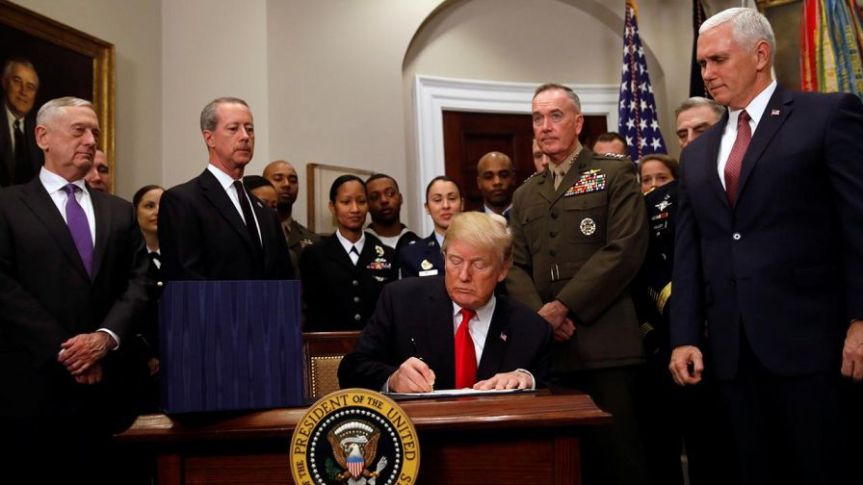
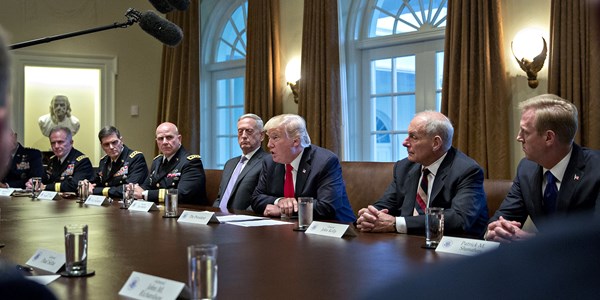
President Trump is a different man. “His” generals have brought him under control. Criticism of the F-35 has gone away. Trump, even if reluctantly, has embraced the Afghan war and the Pentagon’s open-ended commitment to it. Russian détente has taken a back seat to tough talk and sanctions (not that Trump had much of a choice, considering his campaign is under investigation for possible collusion with Russia). More than anything, Trump has tacitly admitted “his” generals know far more than he does. Mattis controls the Pentagon and the National Security State. Kelly, as White House Chief of Staff, does his best to control Trump. McMaster, as National Security Adviser, increasingly controls what Trump knows and when he knows it with respect to security policy.
In short, the generals have won. Consider the fates of Steve Bannon, Sebastian Gorka, and John Bolton. Bannon was eased out; Gorka was fired; and Bolton, according to today’s FP: Foreign Policy report, “has been shut out of the White House under the new leadership of chief of staff John Kelly. FP’s Dan De Luce writes that several sources confirm Bolton’s regular meetings with Trump are a thing of the past, and he has been unable to deliver a plan he devised to get Washington out of the deal it signed with Tehran to halt that country’s nuclear program.”
I’m no fan of Bannon-Gorka-Bolton, but they did represent a challenge to the U.S. military and the neo-con orthodoxy that rules Washington.
Trump is now firmly under the U.S. military’s control, even as he continues to feed the beast with more money and influence. His only way out is to starve the beast — to cut its funding by cutting its mission. Fat chance of that happening anytime soon, with generals like Mattis, Kelly, and McMaster in charge.
Most in the mainstream media see this in a positive light. We read about how Trump’s generals are the adults in the room, a moderating influence on Trump’s ill-informed impetuosity. There may even be some truth to this. But here’s the rub: President Trump, at least on national security policy, has ironically morphed into Hillary Clinton. He’s become a conventional hawk with no new ideas, when as a candidate he had the temerity to criticize America’s wasteful weaponry and disastrous imperial policies.
Trump, surrounded by troops and patriotic bunting, defines his “new” Afghan strategy (Carolyn Kaster/AP)
W.J. Astore
As a private citizen and presidential candidate, Donald Trump railed against the Afghan war. A waste, he said. Americans should withdraw, he said. But in last night’s speech, Trump went against his own instincts (so he said) and went with the failed policies of his predecessors. The war will continue, no timetable set, no troop levels determined, with conditions on the ground dictating America’s actions, according to the president.
What caught my attention, beyond the usual paeans of praise to America’s “warriors” and “warfighters,” was the specious reasoning to justify the continuation of the war. Trump gave three reasons, so let’s take them one at a time:
“First, our nation must seek an honorable and enduring outcome worthy of the tremendous sacrifices that have been made, especially the sacrifices of lives …”
It’s piss-poor reasoning to argue that, because a lot of people have sacrificed and died in a war, the war should continue (with more people dying) to justify those previous sacrifices. By this logic, the more who die, the more we should keep fighting, meaning more dead, meaning more fighting, and so on. Where is the honor and “worthy” outcome here?
“Second, the consequences of a rapid exit are both predictable and unacceptable. 9/11, the worst terrorist attack in our history, was planned and directed from Afghanistan because that country was ruled by a government that gave comfort and shelter to terrorists. A hasty withdrawal would create a vacuum that terrorists, including ISIS and al Qaeda, would instantly fill, just as happened before September 11th.”
Actually, the consequences of an American withdrawal are both unpredictable and (most probably) acceptable. Sure, terrorist organizations may gain impetus from an American withdrawal. It’s also possible that a notoriously corrupt Afghan government might finally negotiate with the Taliban and other organizations, and that regional power brokers like Pakistan and Iran, who have their own interests in regional stability, might broker a settlement that Americans could live with.
Trump further argued that a rapid U.S. withdrawal from Iraq in 2011 led to “hard-won gains slip[ping] back into the hands of terrorist enemies. Our soldiers watched as cities they had fought for, and bled to liberate, and won, were occupied by a terrorist group called ISIS.” The truth is far more complex. The prolonged U.S. occupation of Iraq helped to create ISIS in the first place, and failed American efforts to create and train reliable Iraqi security forces contributed to easy ISIS victories after U.S. forces left in 2011.
“Third and finally, I concluded that the security threats we face in Afghanistan and the broader region are immense. Today, 20 U.S.-designated foreign terrorist organizations are active in Afghanistan and Pakistan — the highest concentration in any region anywhere in the world.”
Isn’t it remarkable that, after sixteen years of sustained effort by the U.S. military, the Af-Pak region is now home to 20+ terrorist organizations? The “highest concentration” in the world? Is this not an admission of the utter failure of U.S. policy and actions since 2001? How is this failure to be rectified by yet more U.S. attacks?
Trump said the new American goal is to kill terrorists. This is not a strategy. It’s a perpetual and deadly game of Whac-A-Mole. That’s what Trump’s vaunted new strategy boils down to, despite the talk of economic pressure and working with Pakistan and India and other regional powers.
On Afghanistan, Trump should have listened to his instincts and withdrawn. Instead, he listened to “his” generals. With Trump, the generals won this round. What they can’t win, however, is the war.
The news out of Washington, D.C. is that another 4000 or so U.S. troops will be sent to help stabilize and reverse the “stalemate” in Afghanistan. The commitment, relatively small in the number of troops, is open-ended in duration, and of course the numbers could (and likely will) rise.
Back in 2009, I wrote the following article for TomDispatch.com, urging then-President Obama not to give in to the “urge to surge.” Of course, America did surge in Afghanistan in 2009-10, but that surge, roughly ten times larger than the mini-surge of this moment, failed to alter the fundamentals on the ground. Indeed, the Taliban and related insurgent forces in Afghanistan have only grown stronger in the aftermath of the failed Obama surge.
Perhaps the new motto of the U.S. military should be: If at first you don’t succeed, surge, surge again.
*****************
Mary McCarthy in Vietnam, Barack Obama in Afghanistan
Seven Lessons and Many Questions for the President
By William Astore (written in 2009)
In 1967, outraged by the course of the Vietnam War, as well as her country’s role in prolonging and worsening it, Mary McCarthy, novelist, memoirist, and author of the bestseller The Group, went to Saigon, then the capital of South Vietnam, to judge the situation for herself. The next year, she went to the North Vietnamese capital, Hanoi. She wrote accounts of both journeys, published originally in pamphlet format as Vietnam (1967) and Hanoi (1968), and later gathered with her other writings on Vietnam as a book, The Seventeenth Degree (1974). As pamphlets, McCarthy’s accounts sold poorly and passed into obscurity; deservedly so, some would say.
Those who’d say this, however, would be wrong. McCarthy brought a novelist’s keen eye to America’s activities and its rhetoric in Vietnam. By no means a military expert, not even an expert on Vietnam — she only made a conscious decision to study the war in Vietnam after she returned from her trip to Saigon — her impressionistic writings were nevertheless insightful precisely because she had long been a critical thinker beholden to no authority.
Mary McCarthy
Her insights into our approach to war-fighting and to foreign cultures are as telling today as they were 40 years ago, so much so that President Obama and his advisors might do well to add her unconventional lessons to their all-too-conventional thinking on our spreading war in Afghanistan and Pakistan.
What were those lessons? Here are seven of them, each followed by questions that, four decades later, someone at President Obama’s next press conference should consider asking him:
1. McCarthy’s most fundamental objection was to the way, in Vietnam, the U.S. government decided to apply “technology and a superior power to a political situation that will not yield to this.” At the very least, the United States was guilty of folly, but McCarthy went further. She condemned our technocentric and hegemonic form of warfare as “wicked” because of its “absolute indifference to the cost in human lives” to the Vietnamese people.
Even in 1967, the widespread, at times indiscriminate, nature of American killing was well known. For example, U.S. planes dropped roughly 7 million tons of bombs on Vietnam and parts of Laos and Cambodia during the war, nearly five times the tonnage used against Germany during World War II. The U.S. even waged war on the Vietnamese jungle and forest, which so effectively hid Vietnamese guerrilla forces, spraying roughly 20 million gallons of toxic herbicides (including the dioxin-contaminated Agent Orange) on it.
In her outrage, McCarthy dared to compare the seeming indifference of many of her fellow citizens toward the blunt-edged sword of technological destruction we had loosed on Vietnam to the moral obtuseness of ordinary Germans under Adolf Hitler.
Questions for President Obama: Aren’t we once again relying on the destructive power of technology to “solve” complex political and religious struggles? Aren’t we yet again showing indifference to the human costs of war, especially when borne by non-Americans? Even though we’re using far fewer bombs in the Af-Pak highlands than we did in Vietnam, aren’t we still morally culpable when these “precision-guided munitions” miss their targets and instead claim innocents, or hit suspected “terrorists” who suddenly morph into wedding parties? In those cases, do we not seek false comfort in the phrase, C’est la guerre, or at least that modern equivalent: unavoidable collateral damage?
2. As Richard Nixon campaigned for the presidency in 1968 by calling for “peace with honor” in Vietnam, McCarthy offered her own warning about the dangers that arose when the office of the presidency collided with an American desire never to be labeled a loser: “The American so-called free-enterprise system, highly competitive, investment-conscious, expansionist, repels a loser policy by instinctive defense movements centering in the ganglia of the presidency. No matter what direction the incumbent, as candidate, was pointing in, he slowly pivots once he assumes office.”
Questions for President Obama: Have you, like Vietnam-era presidents, pivoted toward yet another surge simply to avoid the label of “loser” in Afghanistan? And if the cost of victory (however defined) is hundreds, or even thousands, more American military casualties, hundreds of billions of additional dollars spent, and extensive collateral damage and blowback, will this “victory” not be a pyrrhic one, achieved at a price so dear as to be indistinguishable from defeat?
3. Though critical of the U.S. military in Vietnam, McCarthy was even more critical of American civilian officials there. “On the whole,” she wrote, they “behaved like a team of promoters with a dubious ‘growth’ stock they were brokering.” At least military men were often more forthright than the civilians, if not necessarily more self-aware, McCarthy noted, because they were part of the war — the product, so to speak — not its salesmen.
Questions for President Obama: In promising to send a new “surge” of State Department personnel and other civilians into Afghanistan, are you prepared as well to parse their words? Are you braced in case they sell you a false bill of goods, even if the sellers themselves, in their eagerness to speak fairy tales to power, continually ignore the Fantasyland nature of their tale?
4. Well before Bush administration officials boasted about creating their own reality and new “facts on the ground” in Iraq, Mary McCarthy recognized the danger of another type of “fact”: “The more troops and matériel committed to Vietnam, the more retreat appears to be cut off — not by an enemy, but by our own numbers. To call for withdrawal in the face of that commitment… is to seem to argue not against a policy, but against facts, which by their very nature are unanswerable.”
Questions for President Obama: If your surge in Afghanistan fails, will you be able to de-escalate as quickly as you escalated? Or will the fact that you’ve put more troops in harm’s way (with all their equipment and all the money that will go into new base and airfield and road construction), and committed more of your prestige to prevailing, make it even harder to consider leaving?
5. A cursory reading of The Pentagon Papers, the famously secret government documents on Vietnam leaked to the New York Times by Daniel Ellsberg, reveals how skeptical America’s top officials were, early on, in pursuing a military solution to the situation in South Vietnam. Nevertheless, knowing better, the “best and brightest,” as journalist David Halberstam termed them in his famous, ironic book title, still talked themselves into it; and they did so, as McCarthy noted, because they set seemingly meaningful goals (“metrics” or “benchmarks,” we’d say today), which they then convinced themselves they were actually achieving. When you trick yourself into believing that you’re meeting your goals, as Halberstam noted, there’s no reason to reexamine your course of action.
Questions for President Obama: Much has been written about an internal struggle within your administration over the wisdom of surging in Afghanistan. Now, you, too, have called for the setting of “benchmarks”for your new strategy’s success. Are you wise enough to set them to capture the complexities of political realities on the ground rather than playing to American strengths? Are you capable of re-examining them, even when your advisors assure you that they are being achieved?
6. In her day, Mary McCarthy recognized the inequities of burden-sharing at home when it came to the war in Vietnam: “Casualty figures, still low [in 1967], seldom strike home outside rural and low-income groups — the silent part of society. The absence of sacrifices [among the privileged classes] has had its effect on the opposition [to the war], which feels no need, on the whole, to turn away from its habitual standards and practices — what for? We have not withdrawn our sympathy from American power and from the way of life that is tied to it — a connection that is more evident to a low-grade G.I. in Vietnam than to most American intellectuals.”
Questions for President Obama: Are you willing to listen to the common G.I. as well as to the generals who have your ear? Are you willing to insist on greater equity in burden-sharing, since once again most of the burden of Iraq and Afghanistan has fallen on “the silent part of society”? Are you able to recognize that the “best and brightest” in the corridors of power may not be the wisest exactly because they have so little to lose (and perhaps much to gain) from our “overseas contingency operations”?
7. McCarthy was remarkably perceptive when it came to the seductiveness of American technological prowess. Our technological superiority, she wrote, was a large part of “our willingness to get into Vietnam and stay there… The technological gap between us and the North Vietnamese constituted, we thought, an advantage which obliged us not to quit.”
Questions for President Obama: Rather than providing us with a war-winning edge, might our robot drones, satellite imagery, and all our other gadgetry of war seduce us into believing that we can “prevail” at a reasonable and sustainable cost? Indeed, do we think we should prevail precisely because our high-tech military brags of “full spectrum dominance”?
One bonus lesson from Mary McCarthy before we take our leave of her: Even now, we speak too often of “Bush’s war” or, more recently, “Obama’s war.” Before we start chattering mindlessly about Iraq and Afghanistan as American tragedies, we would do well to recall what McCarthy had to say about the war in Vietnam: “There is something distasteful,” she wrote, “in the very notion of approaching [Vietnam] as an American tragedy, whose protagonist is a great suffering Texan [President Lyndon Baines Johnson].”
Yes, there is something distasteful about a media that blithely refers to Bush’s or Obama’s war as hundreds of thousands of Iraqis and Afghans suffer. For American troops, after all, are not the only ones paying the ultimate price when the U.S. fights foreign wars for ill-considered reasons and misguided goals.