Last week, I talked to Judge Napolitano about the Russia-Ukraine War, the Trump administration’s designs on Venezuela, and the rule of law in America.
A point I could have made more clearly involves casualty figures in the Russia-Ukraine War. There are no official figures that are trustworthy; each side is exaggerating the casualties of the other, which is unsurprising, since the first casualty of war is truth.
Figures that I’ve seen suggest that Ukraine has suffered over 100,000 killed and another 400,000 wounded/missing/captured. Russian figures may be double those of Ukraine but I honestly don’t know. My guess is that Russian casualty figures are higher because they have been on the offensive more and Ukrainian defenses have generally been robust and the troops increasingly skilled. Added to these battlefield casualties are the more than 30,000 Ukrainian citizens killed in the war, plus another six to seven million Ukrainians who have fled the country.
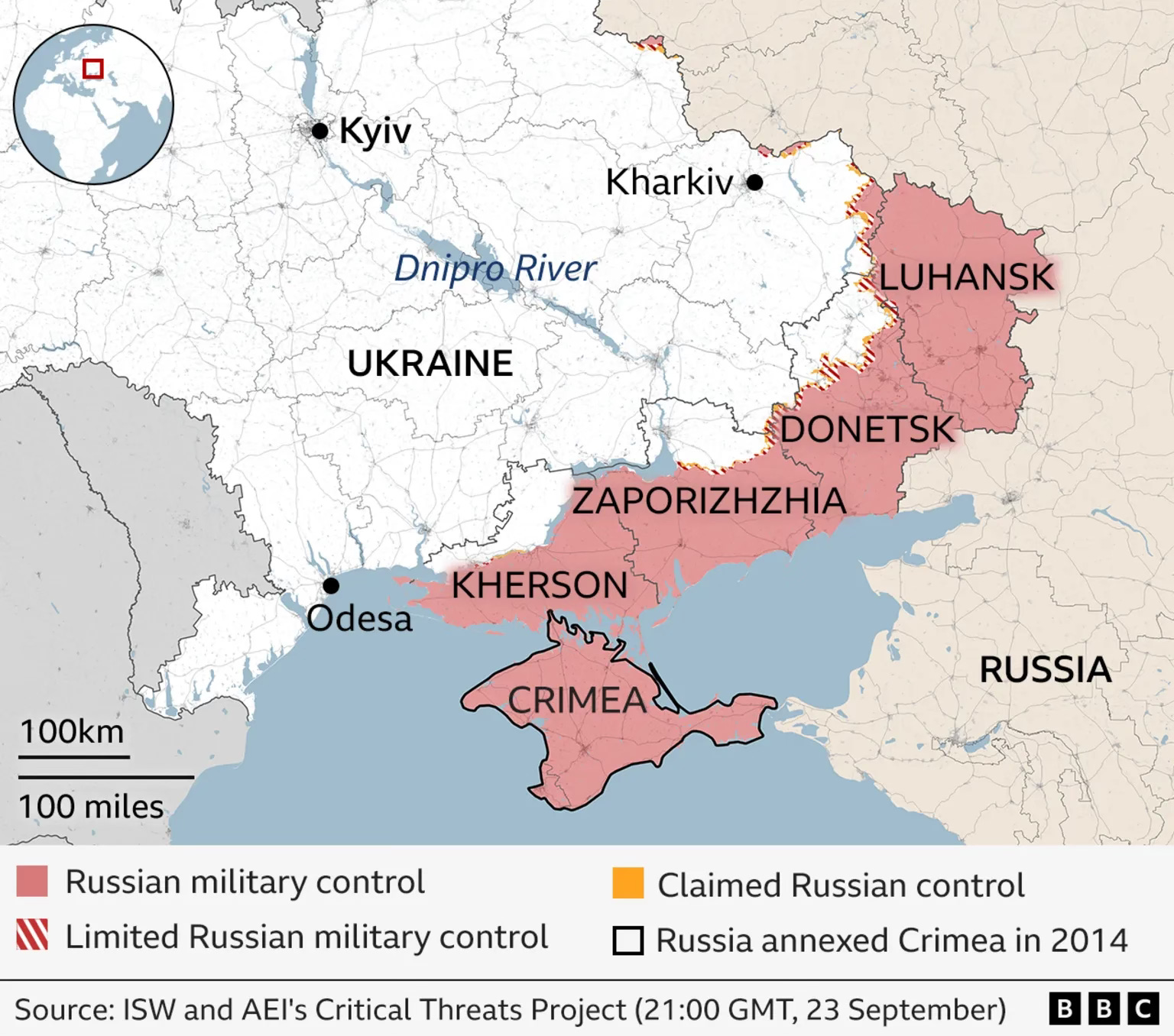
My point here isn’t to celebrate one side as “winning” or “losing.” To my mind, both sides are losing as they wage this devastating war, a war that will enter its fourth year next February. While some commentators see this war as a necessary one for Ukraine, a war for high ideals like democracy and freedom, I see a country that has lost roughly 20% of its territory, a country that suffers because the war is being fought largely on Ukrainian land, a country where roughly 7 in 10 people seek an end to this costly struggle.
A common narrative in the West is that Putin must not be allowed to profit from war, and if he does, the Russian military will next be on the march against NATO countries. This narrative suggests war and more war until either Putin is defeated or Ukraine collapses under the strain.
I would prefer to see negotiations to end the killing, the suffering, and the destruction, allowing Ukraine to recover, even if Ukraine must give up its desire to join NATO. I remain concerned that this war could expand further, as lengthy wars tend to do, becoming a wider regional war that could conceivably escalate toward nuclear weapons.
I wonder why the Trump administration is so interested in Venezuela?
Oh, so that’s why.
A barrel of oil is selling for about $60 this morning. 303 billion barrels at $60 a barrel is more than $18 trillion in future earnings (likely much more than this as the price of oil climbs to $100 per barrel and higher).
Who put America’s oil off the coast of Venezuela? Remember, it’s the Gulf of America, people.
In other news, the admiral in charge of SOUTHCOM is retiring early. Rumor has it he’s objected to the kill and regime change policies of Trump and Hegseth vis-a-vis Venezuela.
President Trump himself recently admitted he’s authorized covert overt CIA activities against the Venezuelan government. A CIA-orchestrated coup combined with U.S. military attacks on Venezuela is likely coming. It’s shrouded in drug war rhetoric, but of course the real goal is control over Venezuela’s oil.
The recent award of the Nobel Peace Prize to a Venezuelan opposition leader is another fig leaf in this operation. Once again, war will be sold to the American people as advancing democracy when it’s really all about the Benjamins.
Trump and Hegseth’s murderous strikes against alleged drug-running boats (at least five already destroyed) is another pretext for regime change. Yet the USA was more than happy to tolerate, even encourage, a massive drug trade in heroin during the Afghan War.
Oh well. War always finds a way, especially when oil is involved. Just think of the Iraq regime change invasion in 2003. That went so well, didn’t it?
This short video by Max Blumenthal sums it up quite well:
Conveniently, the government is still shut down, so I guess Trump can’t ask Congress for a formal declaration of war. Yet another unconstitutional war has already started and Congress is nowhere to be found.
It’s time for regime change for democracy right here in America.
Since the last time (July 19th) I wrote about the Russia-Ukraine War, perhaps the biggest change has been to President Trump’s rhetoric. After being frustrated in his efforts to end the war (and perhaps win a Nobel Peace Prize to boot), Trump effectively washed his hands of the conflict. A Truth Social post was especially surprising, as the BBC reported on 9/24:
US President Donald Trump has said Kyiv can “win all of Ukraine back in its original form”, marking a major shift in his position on the war with Russia.
In a post on his Truth Social platform, he said Ukraine could get back “the original borders from where this war started” with the support of Europe and Nato, due to pressures on Russia’s economy …
Trump has repeatedly expressed his desire to end the war, but has previously warned that process would likely involve Ukraine giving up some territory, an outcome Zelensky hasconsistently rejected.
In his post, Trump added Ukraine could “maybe even go further than that”, but did not specify what he was referring to.
Exactly how Ukraine is going to win back all the land captured by Russia is unclear. Also less than clear is the role of the EU and NATO in this. Trump appears to have said it’s up to the EU and NATO to support Ukraine (as if NATO is not commanded and controlled by America), with the U.S. more than willing to sell weapons to EU and NATO countries to support Ukraine’s efforts.
Trump’s gambit is this: If Ukraine wins, he takes credit for continuing to supply weaponry and for his new vote of confidence. If Ukraine loses, Trump shifts the blame to the EU and possibly to Ukraine and Zelensky too.
It’s a cynical policy—but these are cynical times.
An undeniable truth is that the war grinds on with no end in sight. U.S. aid to Ukraine will soon reach $200 billion. Meanwhile, front lines have stagnated, counteroffensives have stalled, and Ukrainians themselves have grown increasingly weary of war.
Observers in the West point to a weakening Russian economy and high battlefield losses as signs Russia itself may be nearing a tipping point that could lead to collapse and defeat. Both a heavily damaged Ukraine and a destabilized Russia might be the fruits of “victory,” leading to chaos and possible nuclear escalation.
Again, no matter what Trump says, a total victory for Ukraine looks remote. Russia controls about 20 percent of Ukrainian territory, including the industrial Donbas and much of the south. Ukraine’s economy is weakened (as is Russia’s), its army is depleted, and its demographics are unfavorable to success (millions of Ukrainians have sought sanctuary abroad).
The Media’s Role in Perpetuating Illusion
The mainstream media in the U.S. has been partisan since day one. The MSM framed the conflict as a morality play: a heroic democracy versus an evil autocrat.
Meanwhile, the MSM overhyped U.S. weapons as “decisive” and Ukrainian counteroffensives in 2023 as “war-winning.” Media hype distorted expectations and contributed to public fatigue.
Most strikingly, the press has consistently downplayed the risks of escalation with a nuclear power. Ukraine’s use of long-range Western missiles to strike inside Russia carries serious dangers. That Putin will tolerate further provocations without escalating himself is a dangerous bet.
The Case for Diplomacy
Ukraine, no matter Trump’s new faith, cannot win this war in the maximalist sense of regaining all occupied territories and forcing Russia’s surrender. The longer the war continues, the more Ukraine will suffer—physically, economically, and politically.
Wars feed autocracy. Already, Ukraine has postponed elections, banned several opposition parties, and restricted media outlets. These measures may be understandable in wartime, but they belie the notion that Ukraine is a flourishing democracy.
A negotiated settlement is not capitulation. It is recognition of limits. The alternative is indefinite conflict—one that may bleed Ukraine dry even as it edges the world closer to catastrophe.
Dangerous Assumptions
Some policymakers argue a prolonged war will weaken Russia to the point of collapse. But a weakened Russia is not necessarily a safer one. If the Russian state disintegrates, who controls its nuclear arsenal? What if chaos in Moscow produces a more radical, vengeful leader? What if a desperate Kremlin lashes out, or if fighting spills into a NATO country like Poland?
Conversely, what if Ukraine, drained by endless war and reliant on foreign arms, slides toward authoritarianism? Wars have a way of transforming republics into garrison states. The longer the conflict lasts, the greater the risk that Ukraine’s democracy will become a casualty of its own “great patriotic war.”
The Limits of Analogy
Too often, the war is discussed through lazy historical analogies. Putin is Hitler; Zelensky is Churchill; negotiations are “another Munich.” Such framing flatters Western moral vanity but obscures strategic reality. This is not 1938. Putin is not on the verge of conquering Europe, and diplomats are not appeasing him by seeking peace.
Putin may be ruthless, but he is not suicidal. He knows that attacking a NATO member would invite his own destruction. Nuclear deterrence remains real. To suggest otherwise is to indulge in a fever-dream of perpetual conflict, one that justifies limitless military spending and forecloses diplomacy.
The American Connection
For most Americans, the Russia–Ukraine War remains distant and impersonal. We are not threatened by Russian artillery; the war is thousands of miles away. Yet we are paying for it—literally. Every artillery shell, every tank, every missile financed through our taxes contributes to death and destruction abroad. Some justify this as moral duty: helping Ukraine defend freedom. But morality also demands an accounting of consequences.
How many Americans know that 69 percent of Ukrainians report being weary of the war, or that their own government has suspended elections? How many realize that each dollar spent on war is a dollar not spent on schools, infrastructure, or healthcare at home?
We are told the U.S. can afford virtually limitless weapons for Ukraine, but when it comes to social programs, we always hear the same question: How are you going to pay for that? Apparently, there’s always money for war, never for peaceful pursuits.
A Broader Reckoning
The Russia–Ukraine War has become a mirror reflecting America’s own pathologies: our addiction to militarism, our aversion to diplomacy, our willingness to spend without scrutiny when the cause is war, and our moral complacency about the human cost of conflict.
We have turned foreign policy into a morality play, where compromise is dismissed as cowardice and negotiation is treated as akin to sin. Yet history teaches the opposite: the greatest statesmen are not those who glorify war but those who end it.
The Russia–Ukraine War continues, and so does the silence around the most basic of questions: What is America’s endgame? If the answer is “as long as it takes,” we should ask: takes for what? For Ukraine’s victory—or for its ruin? For democracy’s defense—or for another endless war?
It is time to demand accountability, restraint, and above all, diplomacy. Supporting Ukraine should not mean subsidizing endless cycles of death and destruction. How many more must die before this war is finally ended?
Today, I was back on Judge Napolitano’s show, Judging Freedom. We talked about whether Israel is truly a U.S. ally and the increasing illegality of U.S. governmental actions under the Trump administration.
I tend to be more circumspect when I talk, more blunt when I write. The Judge asked me whether I thought the U.S. was a democracy; I suggested we were a quasi-democracy but what democracy was left was shriveling and withering under pressure from Trump and his minions.
Actually, America is an empire; we left our republic ideals behind soon after World War II, which is why President Dwight D. Eisenhower was issuing powerful warnings about the same in 1953 and 1961. America has always been a war-like nation; now we are increasingly consumed by war and its ever-present costs and burdens. I could have said more about that and wish I had.
In the rise, decline, and fall of empires, we are very much on the downslope even as leaders like Trump suggest that the way to make America great again is to win at war (no matter the morality and legality of our actions). In that sense, we have already lost—indeed, our so-called leaders wander, lost, in a grim and increasingly barbaric wilderness of their own making.
Sadly, there’s only one ship of state, and when the captain and most of his mates are lost at sea and reckless to boot, passengers like us are likely to go down with the ship with them.
My fellow Americans, my critical voice has finally been heard inside the Oval Office. No, not my voice against the $1.7 trillion this country is planning to spend on new nuclear weapons. No, not my call to cut the Pentagon budget in half. No, not my imprecations against militarism in America. It was a quip of mine that the Department of Defense (DoD) should return to its roots as the War Department, since the U.S. hasn’t known a moment’s peace since before the 9/11 attacks, locked as it’s been into a permanent state of global war, whether against “terror” or for its imperial agendas (or both).
A rebranded Department of War, President Trump recently suggested, simply sounds tougher (and more Trumpian) than “defense.” As is his wont, he blurted out a hard truth as he stated that America must have an offensive military. There was, however, no mention of war bonds or war taxes to pay for such a military. And no mention of a wartime draft or any other meaningful sacrifice by most Americans.
Rebranding the DoD as the Department of War is, Trump suggested, a critical step in returning to a time when America was always winning. I suspect he was referring to World War II. Give him credit, though. He was certainly on target about one thing: since World War II, the United States has had a distinctly victoryless military. Quick: Name one clear triumph in a meaningful war for the United States since 1945. Korea? At best, a stalemate. Vietnam? An utter disaster, a total defeat. Iraq and Afghanistan? Quagmires, debacles that were waged dishonestly and lost for that very reason.
Even the Cold War that this country ostensibly won in 1991 with the collapse of the Soviet Union didn’t lead to the victory Americans thought was coming their way. After much hype about a “new world order” where the U.S. would cash in its peace dividends, the military-industrial-congressional complex found new wars to wage, new threats to meet, even as the events of 9/11 enabled a surge — actually, a gusher — of spending that fed militarism within American culture. The upshot of all that warmongering was a soaring national debt driven by profligate spending. After all, the Iraq and Afghan Wars alone are estimated to have cost us some $8 trillion.
Those disasters (and many more) happened, of course, under the Department of Defense. Imagine that! America was “defending” itself in Vietnam, Afghanistan, Iraq, Libya, Syria, Somalia, and elsewhere, even as those wars killed and wounded significant numbers of our troops while doing far more damage to those on the receiving end of massive American firepower. All this will, I assume, go away with a “new” Department of War. Time to win again! Except, as one Vietnam veteran reminded me, you can’t do a wrong thing the right way. You can’t win wars by fighting for unjust causes, especially in situations where military force simply can’t offer a decisive solution.
It’s going to take more than a rebranded Department of War to fix wanton immorality and strategic stupidity.
We Need a Return of the Vietnam Syndrome
Hey, I’m okay with the Pentagon’s rebranding. War, after all, is what America does. This is a country made by war, a country of macho men hitching up their big boy pants on the world stage, led by the latest (greatest?) secretary of war, “Pomade Pete”Hegseth, whose signature move has been to do pushups with the troops while extolling a “warrior ethos.” Such an ethos, of course, is more consistent with a War Department than a Defense Department, so kudos to him. Too bad it’s inconsistent with a citizen-soldier military that’s supposed to be obedient to and protective of the Constitution. But that’s just a minor detail, right?
Here’s the rub. As Trump and Hegseth have now tacitly admitted, the national security state has never been about “security” for Americans. Rather, it’s existed and continues to exist as a war state in a state of constant war (or preparations for the same), now stuffed to the popping point with more than a trillion dollars yearly in taxpayer funds. And the leaders of that war state — an enormous blood-sucking parasite on society — are never going to admit that it’s in any way too large or overfed, let alone so incompetent as to have been victoryless for the last 80 years of regular war-making.
And count on one grim reality: that war state will always find new enemies to attack, new rivals to deter, new weapons to buy, and a new spectrum of warfare to try to dominate. Venezuela appears to be the latest enemy, China the latest peer rival, hypersonic missiles and drone swarms the new weaponry, and artificial intelligence the new spectrum. For America’s parasitic war state, there will always be more to feed on and to attempt (never very successfully) to dominate.
Mind you, this is exactly what President Dwight D. Eisenhower warned us against in his 1961 Farewell Address. Sixty-plus years ago, Ike could already see that what he was the first to call the military-industrial complex was already too powerful (as the Vietnam War loomed). And of course, it has only grown more powerful since he left office. As Ike also wisely said, only Americans can truly hurt America — notably, I’d add, those Americans who embrace war and the supposed benefits of a warrior ethos instead of democracy and the rule of law.
Again, I’m okay with a War Department. But if we’re reviving older concepts in the name of honesty, what truly needs a new lease on life is the Vietnam Syndrome that, according to President George H.W. Bush, America allegedly got rid of once and for all with a rousing victory against Saddam Hussein’s Iraq in Operation Desert Storm in 1991 (that would prove to be anything but).
That Vietnam Syndrome, you may recall, was an allegedly paralyzing American reluctance to use military force in the aftermath of disastrous interventions in Vietnam, Laos, and Cambodia in the 1960s and early 1970s. According to that narrative, the U.S. government had become too slow, too reluctant, too scarred (or do I mean scared?) to march speedily to war. As President Richard Nixon once said, America must never resemble a “pitiful, helpless giant.” To do so, he insisted, would threaten not just our country but the entire free world (as it was known then). America had to show that, when the chips were down, our leaders were up for going all-in, no matter how bad our cards were vis-à-vis those of our opponents.
If nothing else, no country had more chips than we did when it came to sheer military firepower and a willingness to use it (or so, at least, it seemed to Nixon and crew). A skilled poker player, Nixon was blinded by the belief that the U.S. couldn’t afford to suffer a humiliating loss on the world stage (especially when he was its leader). But the tumult that resulted from the fall of Saigon to communist forces in 1975 taught Americans something, if only temporarily: that one should hasten very slowly to war, a lesson Sparta, the quintessential warrior city-state of Ancient Greece, knew to be the sign of mature wisdom.
Spartan wannabes like Pete Hegseth, with his ostentatious displays of “manliness,” however, fail to understand the warrior ethos they purport to exhibit. Wise warrior-leaders don’t wage war for war’s sake. Considering the horrific costs of war and its inherent unpredictability, sage leaders weigh their options carefully, knowing that wars are always far easier to get into than out of and that they often mutate in dangerously unpredictable ways, leaving those who have survived them to wonder what it was ever all about — why there was so much killing and dying for so little that was faintly meaningful.
What Will Trump’s “Winning” War Department Look Like?
Perhaps Americans got an initial look at Trump’s new “winning” War Department off the coast of Venezuela with what could be the start of a new “drug war” against that country. A boat carrying 11 people, allegedly with fentanyl supplies on board, was obliterated by a U.S. missile in this country’s first “drug war” strike. It was a case where President Trump decided that he was the only judge and jury around and the U.S. military was his executioner. We may never know who was actually on board that boat or what they were doing, questions that undoubtedly matter not a whit to Trump or Hegseth. What mattered to them was sending an ultimate message of toughness, regardless of its naked illegality or its patent stupidity.
Similarly, Trump has put the National Guard on the streets of Washington, D.C., deployed Marines and the National Guard to Los Angeles, and warned of yet more troop deployments to come in Chicago, New Orleans, and elsewhere. Supposedly looking to enforce “law and order,” the president is instead endangering it, while disregarding the 1878 Posse Comitatus Act that prohibits a president from deploying active-duty troops as domestic law enforcers.
If America isn’t a nation of laws, what is it? If the president is a lawbreaker instead of an upholder of those laws, what is he?
Recall that every American servicemember takes a solemn oath to support and defend the Constitution and bear true faith and allegiance to the same. Warriors are driven by something different. Historically, they often just obeyed their chieftain or warlord, killing without thought or mercy. If they were bound by law, it was most often that of the jungle.
Knowingly or unknowingly, that’s exactly the kind of military Pete Hegseth and the new Department of War (and nothing but war) are clearly seeking to create. A force where might makes right (although in our recent history, it’s almost invariably made wrong).
I must admit that, from the recent attack on that boat in the Caribbean to the sending of troops into Washington, I find I’m not faintly surprised by this developing crisis (that’s almost guaranteed to grow ever worse). Remember, after all, that Donald Trump, a distinctly lawless man, boasted during the Republican debate in the 2016 election campaign that the military would follow his orders irrespective of their legality. I wrote then that, with such a response, he had disqualified himself as a candidate for the presidency:
“Trump’s performance last night [3/3/16] reminded me of Richard Nixon’s infamous answer to David Frost about Watergate: ‘When the president does it, that means it’s not illegal.’ No, no, a thousand times no. The president has to obey the law of the land, just as everyone else has to. No person is above the law, an American ideal that Trump seems neither to understand nor to embrace. And that disqualifies him to be president and commander-in-chief.”
If only.
In retrospect, I guess Trump had it right. After all, he’s won the presidency twice, no matter that his kind of “rightness” threatens the very foundations of this country.
So, color me more than worried. In this new (yet surprisingly old) age of a War Department, I see even more possibilities for lawlessness, wanton violence, and summary executions — and, in the end, the defeat of everything that matters, all justified by that eternal cry: “We’re at war.” At which point, I return to war’s miseries and how quickly we humans forget its lessons, no matter how harsh or painful they may be.
Someday, America’s soon-to-be War Department, led by wannabe warrior chieftains Trump and Hegseth, will perhaps seem like the ultimate blowback from this country’s disastrous wars overseas since its name changed to the Defense Department in the wake of World War II. In places like Iraq and Afghanistan, this country allegedly waged war in the name of spreading democracy and freedom. That cause failed and America’s own grip on democracy and freedom only continues to loosen — perhaps fatally so.
In harkening back to a War Department, perhaps Trump is also channeling a nostalgia for the Old West, or at least the myth of it, where justice was served through personal bounties and murderous violence enforced by steely-eyed men wielding steel-blue pistols. Trump’s idea of “justice” does seem to be that of a hanging judge on a “wild” frontier facing hostile “Injuns” of various sorts. For men like Trump, those were the glory days of imperial expansion, never mind all the bodies left in the wake of America’s manifest destiny. If nothing else, that old imperial Department of War certainly knew what it was about.
Whatever else one might expect from America’s “new” Department of War, you can bet your life (or death) on a whole lot of future body bags. Warriors are, of course, okay with this as long as there are more boats to blow up, more people to bomb, and more foreign resources to steal in the pursuit of a “victory” that never actually arrives. So hitch up those big boy pants, grab a rifle or a Hellfire missile, and start killing. After all, in what might be thought of as a distinctly victoryless culture, it seems as if America is destined to be at war forever and a day.
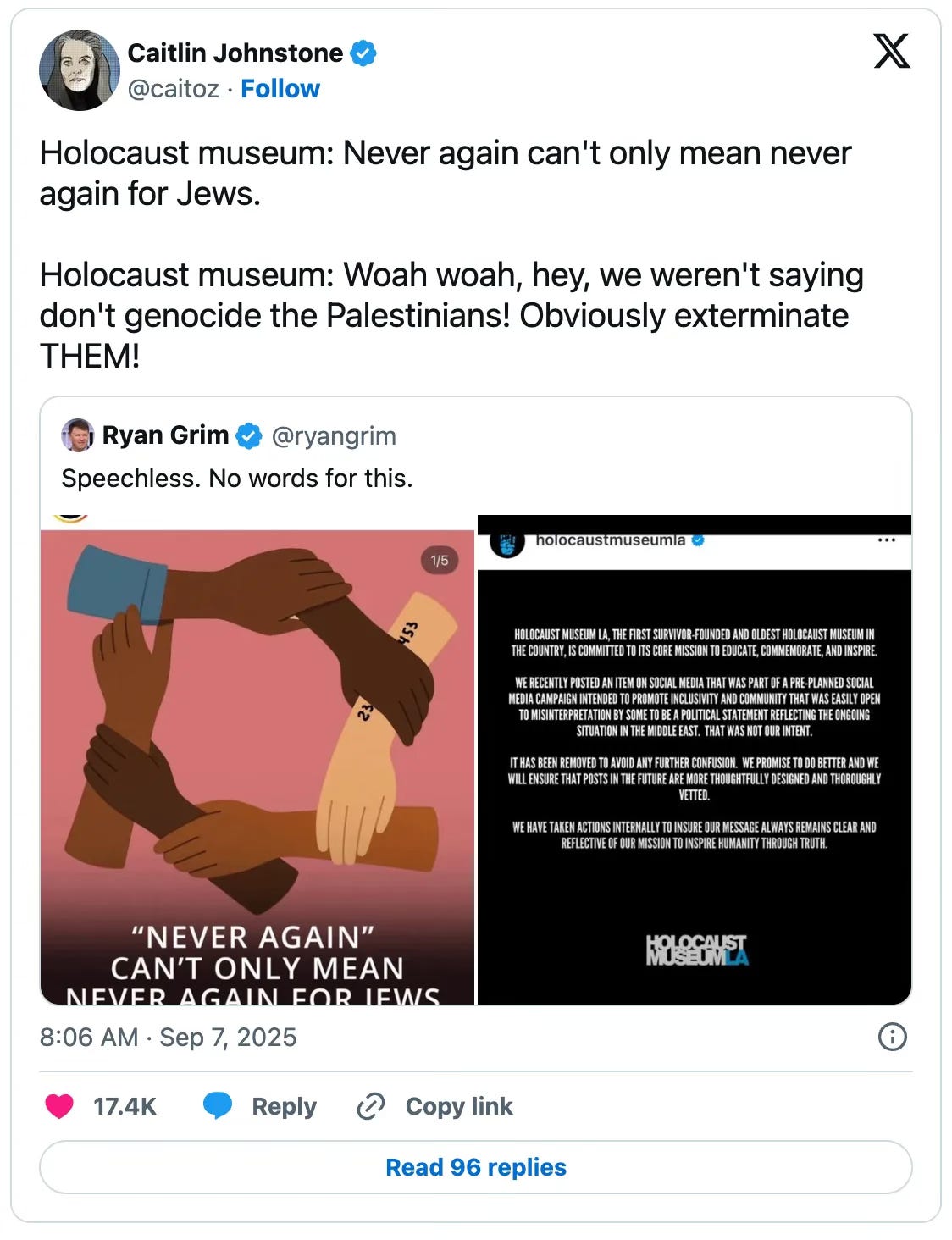
The LA Holocaust Museum recently suggested that “Never Again” is a fundamental lesson of the Holocaust. Then they took it back. Here’s the (almost) inconceivable story from Caitlin Johnstone:
Israel supporters are so crazy and evil that the Los Angeles Holocaust Museum recently retracted a statement saying “Never again can’t only mean never again for Jews” after objections from Zionists.
The museum issued a statement saying, “We recently posted an item on social media that was part of a pre-planned social media campaign intended to promote inclusivity and community that was easily open to misinterpretation by some to be a political statement reflecting the ongoing situation in the Middle East. That was not our intent. It has been removed to avoid any further confusion.”
Think about how gross your position has to be for you to be all hey, let’s say no genocide for ANYBODY, and then immediately have to come back and clarify that you definitely weren’t saying no genocide for the Palestinians.
I’m glad that’s clear! Talk about a profile in cowardice.
Then there are those who get testy about applying the word “genocide” to events in Gaza. Their distorted mouth noises sound something like this: Israel is at war with terrorists (Hamas) and *only* 70,000 or so Palestinians are dead so it’s not really a genocide, is it? Plus it’s all their fault because of October 7th, end of story.
For what it’s worth, I taught the Holocaust as a professor of history after attending a seminar at the US Holocaust Memorial Museum. Also, if it means anything, I’m Catholic, retired military, with no particular axe to grind.
Yes, it’s a genocide in Gaza. A holocaust in slow motion. Heck, Israeli leaders have freely confessed their goal is a final solution to the Gaza question, mainly by killing many Palestinians while forcing the rest to leave. (Whether they’ll have any place to go remains to be seen.)
There is no one model of genocide, and definitions also vary. But if what’s happening in Gaza isn’t a genocide, I don’t know what other word applies. Mass murder, perhaps? Extermination, but slowly? Ethnic cleansing and mass death followed by mass expulsion? That is genocide, plain and simple.
Welcome back, everyone. I hope you enjoyed Labor Day Weekend.
It’s grim times in America. Perhaps grimmest of all is the U.S. government’s support of genocide through mass killing and starvation in Gaza. “Never again” was the message of the Holocaust, not “Yes, again” if it benefits Zionists in Israel.
Americans, in the main, are against mass killing (at least, I hope we are), but what does it matter when all 100 senators take money from AIPAC and the Trump administration is rabidly pro-Israel? “Our” government isn’t ours; the man who gets what he wants with the loudest applause is Bibi Netanyahu. Talk about foreign interference in America’s elections and governance!
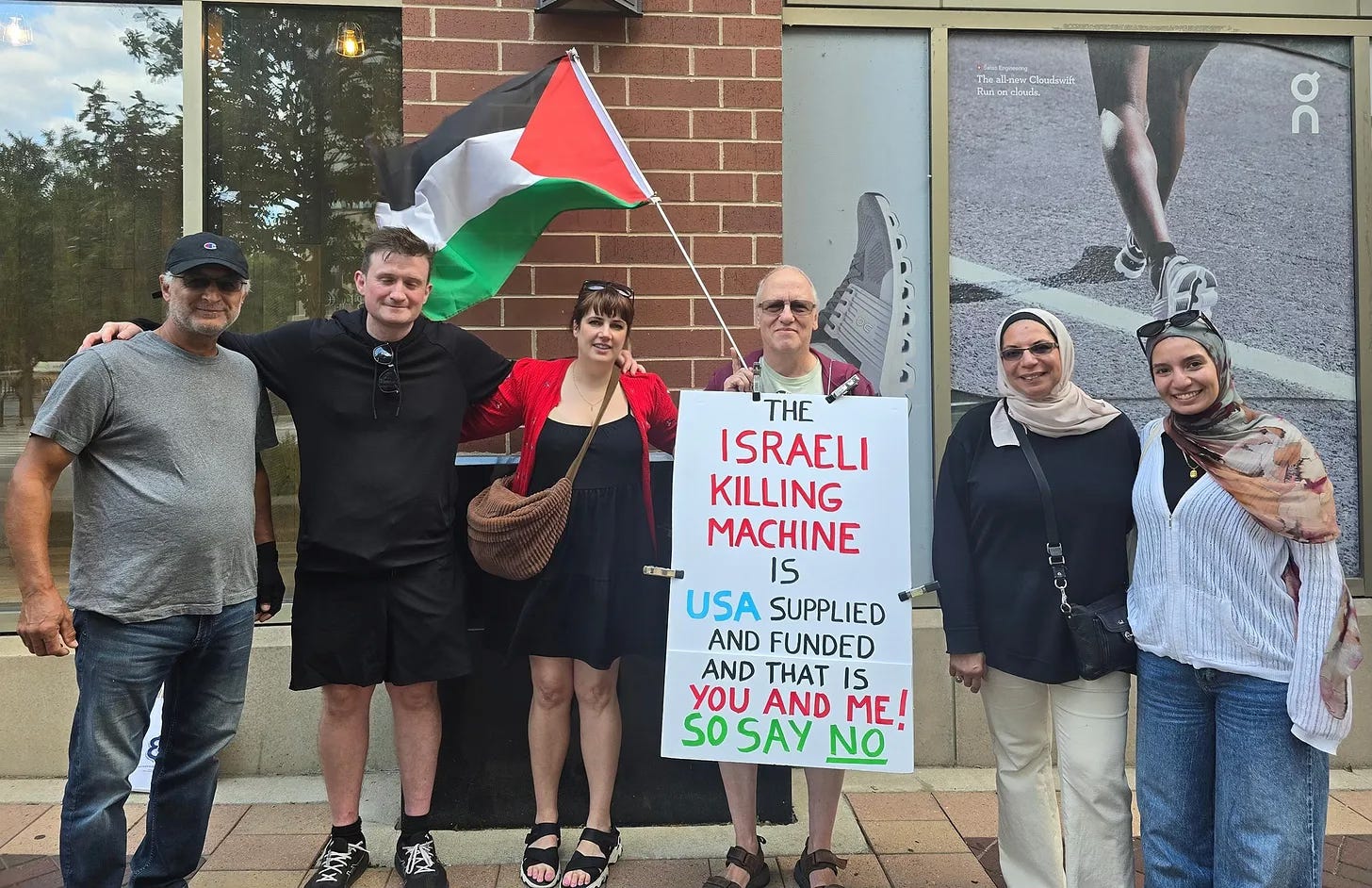
Courtesy of Lisa Savage at her Substack site
Why is it so hard for Americans to come together in sensible ways? A decade ago, I wrote about how we’re kept divided, distracted, and downtrodden. The letter D truly is for defective and deficient—disastrous as well—but permit me a little exercise in alliteration as I expand my D list to seven, as in the 7 habits of a highly defective country.
1. Divided: Are you Republican or Democrat? Red or Blue? MAGA or “libtard”? Woke or Anti-woke? Cis white male or BIPOC? Pro-life or Pro-choice? There are far too many labels and efforts that end in division. And we know how rulers use division to conquer.
2. Distracted: Wherever you look, Americans are bombarded with distractions, starting with the screens we carry everywhere with us. The Romans had bread and circuses; we have junk food, NASCAR, and the NFL. Curl up before that 75-inch TV and chow down.
3. Downtrodden: When you’re working 50+ hours a week, straining to make ends meet, suffering from high health care costs, student loan debt, and so on, it’s hard to pay attention to what’s going on in Washington—and even harder to act against it.
4. Discontented: Paradoxically, the discontentment so many of us feel is not resulting in significant political action. Instead, it’s being channeled in counterproductive ways. Consumer goods and drugs from big pharmaceutical companies are offered as palliatives to “cure” our discontentment. We buy more, or pop more pills, but contentment remains elusive.
5. Duopoly: Sure, Democrats and Republicans aren’t exactly the same. But when it comes to war, foreign policy, weapons sales, serving Israel, favoring billionaires, kowtowing to the big banks and Wall Street, and genuflecting to corporations, both parties are virtually indistinguishable. Both also work together to quash third parties. Small wonder that the largest voting bloc in America is Independent/Non-aligned.
6. Discouragement: Faced with that grim fact—a government completely unresponsive to ordinary people—Americans are discouraged from acting in dynamic and outspoken ways. Also serving to discourage political action is America’s increasingly militarized streets, now occupied with agents from Homeland Security and even armed members of the National Guard.
7. Despair: Remember “hope and change” Barack Obama and the surging idealism of 2008? Those were the days. Now it seems the mantra is “no hope” and change that only makes matters worse. This contributes to despair, our sense of hopelessness and helplessness before impersonal government forces—and this is deliberate. A weaponizing of despair.
So, what is to be done? On the small scale, get involved. Get educated. Follow protesters like Lisa Savage and Clif Brown. Small acts of protest can be contagious.
Clif Brown, taking a stand and sending a message
I do my thing here on Substack and belong to organizations like the Eisenhower Media Network and Space4Peace (The Global Network Against Weapons and Nuclear Power in Space). Since 2007, I’ve written against militarism and war at TomDispatch.com and similar alternative sites. Do what you can, what matches your talents, even if it’s just talking to your family, your friends, your neighbors about your concerns. (Believe me, that isn’t always easy!)
Maybe it’s easier to say where the answer isn’t coming from. It’s not coming from Democrats or Republicans. It’s not coming from Congress. It’s not coming from the richest among us, nor from corporate and financial elites.
Fundamentally, the first big step we need to take as a country is publicly funded elections. No more lobbyists. No more “legal” bribes. That requires a reversal of the SCOTUS Citizens United Decision. It requires legislation or a Constitutional amendment.
How to force that when war and weapons are bipartisan? When the powers that be are more than happy with the status quo? Probably only through mass organizations and protest. Or perhaps the creation of a viable third party–but that will be staunchly resisted by the duopoly (the Dems and Repubs).
The short answer is we need a lot more profiles in courage to counter the profiles in pusillanimity produced and elevated within a corrupt system.
The system as it exists today seems unreformable and unstoppable, but history teaches us that sometimes a crack can widen to a fault that leads to an earthquake quickly and unpredictably. So the only recourse is to keep fighting, to keep the pressure on, hoping those cracks will indeed lead to something greater.
Apathy and surrender are not options. Discouragement and despair mustn’t be our end state. Take inspiration from people like Lisa and Clif, the writing of people like Chris Hedges, and sites like Antiwar.com.
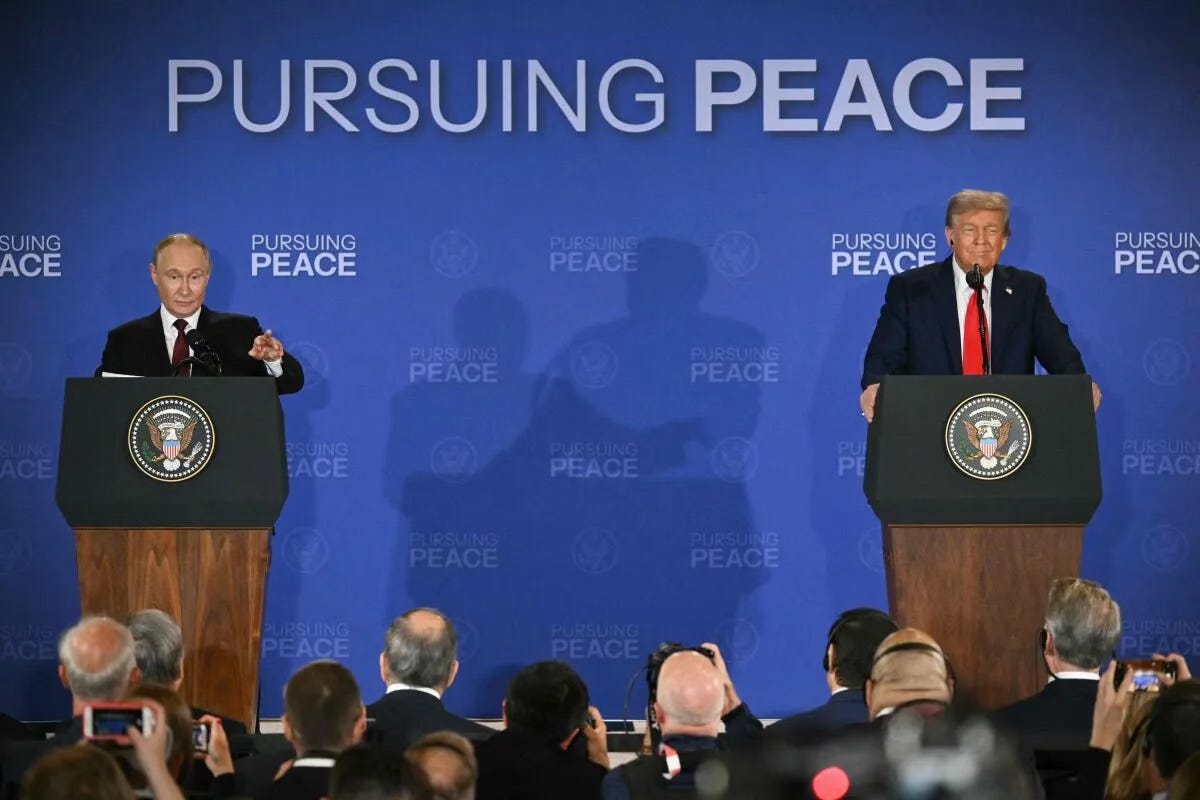
I’m glad President Donald Trump met with his Russian counterpart, Vladimir Putin, in Alaska. No country possesses more nuclear warheads than Russia, so dialogue is essential. As Churchill once allegedly observed, “jaw-jaw” is better than “war-war,” especially when nuclear weapons and humanity’s fate are at stake.
Unsurprisingly, the two leaders announced no breakthrough on ending the Russia-Ukraine War. Still, the fact they were talking matters. They even floated the idea of a second meeting in Moscow. Putin quipped about it; Trump replied that he might “take some heat” for visiting the Kremlin. Innocuous banter, yes—but I’ll take that over nuclear threats any day.
Pursuing peace—but not yet finding it.
The transcript of their closing remarks made for revealing reading. Putin spoke first, striking an amicable and measured tone. He invoked the U.S.-Soviet alliance of World War II, when both nations fought a common enemy. His words were thoughtful, cautious, above all diplomatic. He repeatedly emphasized the “businesslike” nature of the meeting, framing his approach as pragmatic and respectful—an approach likely to resonate with Trump, the self-proclaimed master of “the art of the deal.” Putin’s message, in essence, was: I’m someone you can do business with.
Trump’s remarks, by contrast, were more improvisational, filled with his trademark superlatives. Putin’s words, he said, were “very profound,” the meeting itself “very productive,” and the progress “great.” He even declared his relationship with Putin “fantastic.” That may be fantasy, but better that than animosity and hostility.
One passage from Trump’s comments stood out as both peculiar and revealing:
I would like to thank President Putin and his entire team—faces I know in many cases, faces I see all the time in the newspapers. You’re almost as famous as the boss—especially this one right over here. But we have had good, productive meetings over the years, and I hope to have more in the future.
That offhand line about Putin’s advisers being “almost as famous as the boss,” and about seeing their faces “all the time in the newspapers,” points to Trump’s obsession with fame. For Trump, people seem to matter only if they are celebrities. Recall his boasts about his own face appearing on the cover of Time magazine. His ego and craving for recognition make him vulnerable to manipulation. Unless you’re “famous”—someone whose picture appears regularly in the media—you scarcely exist in his world.
Trump’s deep need to be respected by other famous figures serves as a way to affirm his own worth. The danger, of course, is where that need might lead him—and the country.
America’s war budget now exceeds $1 trillion a year—an almost unimaginable sum.
The Pentagon plans to spend $1.7 trillion “modernizing” a nuclear triad that should instead be downsized. A proposed “Golden Dome” missile defense system may cost $500 billion while making nuclear war more likely. And a “new” Cold War with China and Russia is already underway, with threat inflation as one of its defining features.
With military spending so high—and the military so valorized—Washington offers it as the solution to nearly everything: crime in D.C., eliminating drug cartels south of the border, containing China and Russia, “winning” in Somalia, preventing Iran from acquiring nuclear weapons—the list is endless. Supporting and defending the Constitution, however, is rarely mentioned.
War has become America’s new normal. “Peace” is now a word that dare not speak its name. According to the Pentagon, the only peace worth pursuing is “peace through [military] strength.” A warrior ethos is marketed as if it were synonymous with democratic virtue.
I once called for a 10% reduction in Pentagon spending. That’s no longer enough. We need a 50% cut—we need a military dedicated to genuine national defense, not imperial dominance. Surely we can protect America for $500 billion a year rather than the $1 trillion we’re spending now.
Changing the narrative is crucial. Why do we need 750+ bases overseas? Why expand our nuclear arsenal when we already have 5,000 warheads? We don’t need these things—they are the hallmarks of wasteful militarism. They escalate tensions, endanger us, and drain the nation’s wealth.
And why do we have 17 or 18 intelligence agencies? Despite all that intelligence, we still lost in Vietnam, Iraq, and Afghanistan. Where is the accountability? Why are no generals relieved of command for such failures? In fact, they’re more likely to fail upwards.
“All governments lie,” as I.F. Stone warned. Combine that with the truth that war’s first casualty is truth itself, and you begin to see the rot in America today. Perpetual war fuels deception and government overreach. Almost anything can be justified when the cry is, “We’re at war!”—even when the reasons for going to war are false.
Consider the Gulf of Tonkin incident—revealed later as phony—and the Pentagon Papers during the Vietnam War. Consider Iraq’s mythical WMDs. Consider the lies revealed in the Afghan War Papers. Consider the weasel words of generals like David Petraeus, forever hedging “gains” as “fragile” and “reversible.” Consider the U.S. military’s record since World War II—generally ineffective because there’s been little accountability for failure. (And yes, civilian leaders share the blame.)
The military-industrial complex grows ever more powerful, sidelining the American people while democracy withers.
Something is rotten in the States of America.
Many thanks to Judge Napolitano for asking me to discuss some of these issues on his show, “Judging Freedom.”
With an ongoing genocide in Gaza and a dangerous war between Russia and Ukraine, who has the time to look to Africa? As we said when I was still in the military, I need to get smart on this.
Coverage of America’s military adventurism/fiascos in Africa is difficult to come by. Fortunately, there’s Nick Turse at The Intercept, whose latest article is entitled:
PENTAGON: U.S. COUNTERTERRORISM EFFORTS HAVE FAILED AFRICANS
A new Pentagon report sheds light on AFRICOM’s disastrous counterterrorism campaigns.
I know Nick Turse from his days at TomDispatch, so I sent him this note in response to his article:
Bombing worked so well to win the war in Indochina — so why not bomb in Africa?
It seems like the goal is permanent war — you throw gasoline on it with all the weapons exports and drone strikes. And they work — war continues.
I guess that’s my obvious take — pay no attention to their words, watch instead what they do. It’s just war and more war. Given that AFRICOM is a military command, should we be surprised that the “solutions” are always violent ones?
That seems to be the U.S. “strategy” in Africa: bomb the “terrorists” while exporting more weapons related to military “assistance” (the building of indigenous African forces ostensibly allied to the U.S.). Again, it’s a strategy that worked so well in Indochina in the early 1960s …
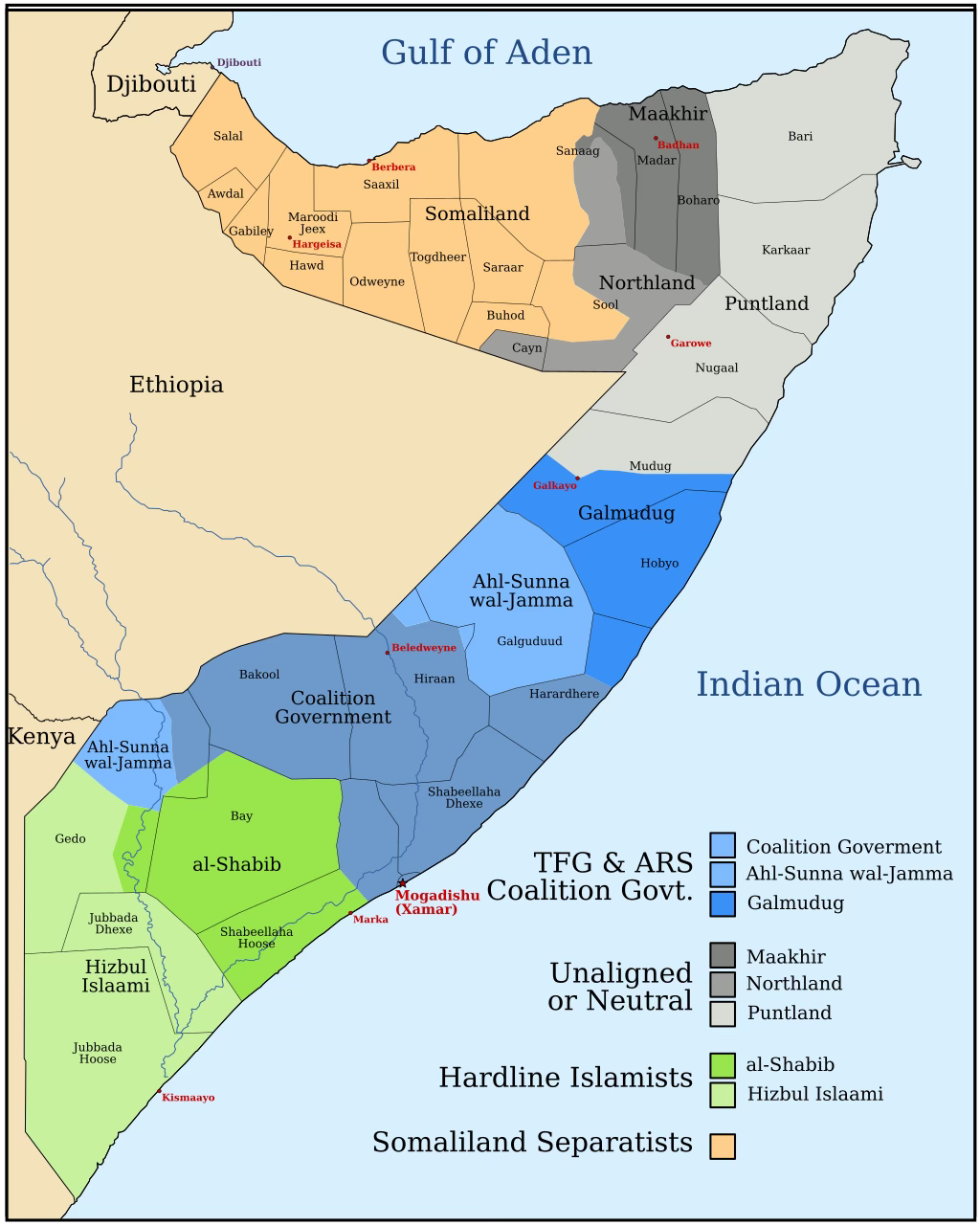
Unfortunately for Somalia, it occupies a strategic position in the Horn of Africa. The U.S. has a major military base in Djibouti.
Besides the perpetuation of war there, I don’t know what the U.S. government is up to in Africa. The mainstream media rarely discusses it. I assume control of scarce resources is a major goal. Also, the military-first AFRICOM approach to the area ensures higher profits for and more power to the military-industrial complex. Geographically, the Horn of Africa is vital to the control of sea and trade routes. Proximity to Yemen, Saudi Arabia, and the Red Sea is obvious.
In short, I’m exposing my own ignorance as a way of encouraging all of us to get a bit smarter about what our government is up to in Africa. According to the Pentagon’s own sponsored report, it’s not going well. Here’s the kicker from Turse’s article:
“Africa has experienced roughly 155,000 militant Islamist group-linked deaths over the past decade,” reads a new report by the Africa Center for Strategic Studies, a Pentagon research institution. “Somalia and the Sahel have now experienced more militant Islamist-related fatalities over the past decade (each over 49,000) than any other region.”
“What many people don’t know is that the United States’ post-9/11 counterterrorism operations actually contributed to and intensified the present-day crisis and surge of violent deaths in the Sahel and Somalia,” Stephanie Savell, director of the Costs of War Project at Brown University, told The Intercept, referencing the frequent targeting of minority ethnic groups by U.S. partners during counterterrorism operations.
The U.S. provided tens of millions of dollars in weapons and training to the governments of countries like Burkina Faso and Niger, which are experiencing the worst spikes in violent deaths today, she said. “In those critical early years, those governments used the infusion of U.S. military funding, weapons, and training to target marginalized groups within their own borders, intensifying the cycle of violence we now see wreaking such a devastating human toll.”
Terrorist groups are also gaining ground at an exponential rate. “The past year has also seen militant Islamists [sic] groups in the Sahel and Somalia expand their hold on territory,” according to the Africa Center. “Across Africa, an estimated 950,000 square kilometers (367,000 square miles) of populated territories are outside government control due to militant Islamist insurgencies. This is equivalent to the size of Tanzania.” And as militant groups have expanded their reach, Africans have paid a grave price: a 60 percent increase in fatalities since 2023, compared with deaths from 2020 to 2022, according to the report.
As Turse notes, U.S. special forces deployed to Somalia soon after 9/11 as part of the global war on terror (or, if you prefer, the global war of terror). More than two decades of U.S. military strikes (and strife) in the area have only made matters worse. Can we as a nation stand for more of this “success”?
I think the U.S. strategy in Africa is to continue on the same course while suppressing the news of our failures there. Our influence in the region, such as it is, is military-driven, i.e. various African leaders want our weapons and money but little else (because we have little else to offer).
So, all our military leaders can boast of in the region is colossal air strikes. Did you know we used 60 tons of bombs to kill 14 militants in Somalia last February? Victory indeed will soon be ours … if you define “victory” as rising profits for the bomb-makers.
Readers, help me out. If any of you are following America’s war in Africa, I welcome your insights.





 Bracing Views