Are We the New Martians?

Heat rays don’t always carry the day. (I used to own this double album, narrated by the great Richard Burton)

W.J. Astore

A few years ago, I picked up H.G. Wells’s classic novel, “War of the Worlds,” and read it in full. I had seen the movies based on it and had also dipped into the book, but I finally read the whole thing, marveling at the suspense Wells created in his classic account of Martians invading our planet, stomping us with their superior technology, only to be overcome by microbes to which they had no resistance.

As I read the book, I asked myself: Are we Americans becoming the new Martians? Warlike ways, superior technology, a predilection to invade and dominate for resources, with no regard for the “primitives” we stomp on or push out of the way in our quest for full-spectrum dominance?

I’m not the only one with questions along these lines. At TomDispatch today, Tom Engelhardt recounts his own affection for “War of the Worlds,” which he avidly read as a boy, and which he recently turned to again in our era of dangerous microbes, incessant war, and a changing climate that is threatening life as we know it on this planet.

Wells, of course, intended his story partly as a critique of the British and Western imperialism of his day, which is why it remains relevant to our imperial world today.

Think about it. America’s leaders, and especially the military-industrial-congressional complex, are in many ways the new Martians. Their god seems to be Mars, the god of war, and the planet they’re remaking is increasingly red, barren, and inhospitable. They’re doing a fair job of emulating those Martians as well, leaving Planet America to attack other lands for their resources, banking on superior technology and “heat rays” (Hellfire missiles!) to win the day.

Yet, like those very same Martians in “War of the Worlds,” Planet America loses its wars to “inferior” peoples, betrayed by “primitive” and hostile environments (the sweltering jungles of Vietnam, the urban jungle and heat of Iraq, the rugged mountains and omnipresent dust of Afghanistan). But do America’s Martians ever quit? Of course not! They keep building new war machines, they keep “investing” in new technologies, they keep advocating dominance through invasion and killing, much like those desperate Martians in Wells’s book, who, faced with a dying planet, decided their only course of action was to invade a different planet and steal its resources for themselves.

In Wells’s book, the Martians reveled in war, shouting “Ulla! Ulla!” as they fired their death rays. Our leaders are doing something similar while many of us shout “USA! USA!” mindlessly.

Wells sought to teach us that war and technology and destruction are just as likely to lead to our demise as to our triumph. The more we make war on ourselves and our planet, the more likely it is that Earth will come to resemble Mars, an inhospitable place for a dying species. Yet, unlike the imaginary Martians of Wells’s book, there’s no other hospitable planet in the neighborhood for us to invade.

Bonus: Here’s an excerpt from Jeff Wayne’s musical version of “War of the Worlds,” featuring Justin Hayward on vocals and Richard Burton as narrator. “The massacre of mankind”: No one says it quite like Burton.

Being Right For the Wrong Reasons

W.J. Astore

Were you against the Afghan War? The Iraq War? Events proved you right, of course, but for the wrong reasons. And if you were pro-war in both cases, you were of course wrong but for the right reasons. Therefore you will still be celebrated and featured on mainstream media outlets, whereas those “right” people will still be ignored because, again, they may have been right about those disastrous wars, but their reasons were all wrong.

I think I heard this formulation first in Jeremy Scahill’s book “Dirty Wars.” An official said opponents of the war on terror had been “right for the wrong reasons,” but that proponents of war, the Kristols and Krauthammers of the necon world, had been “wrong for the right reasons.”

Nick Turse picks up on this theme in his latest for TomDispatch.com. In 2010, Turse edited a book of essays: “The Case for Withdrawal from Afghanistan.” In his latest essay, and with tongue firmly in cheek, Turse asks why he’s not being invited to speak on the mainstream media networks, why he’s not being celebrated for his prescience, why he’s not being lauded for being right. And of course Turse knows the answer: he was right — but for the wrong reasons.

If you’re confused, allow me to translate. It’s OK, even laudable, to argue that the Pentagon will win; that wars should be fought; and that U.S. generals are so many reincarnations of Napoleon and Alexander and Caesar.  Because being “wrong” here means that the Pentagon grows ever more powerful; that the U.S. always looks tough (if perhaps dumb); and that America’s generals are celebrated as the “finest” while never being called to account. Again, all these things are “right,” even when, indeed especially when, they’re so obviously wrong.

But it’s not OK, indeed it’s deplorable, to suggest the Pentagon will lose; that wars should not be fought; that U.S. generals are mostly time-serving mediocrities.  Because being “right” here means a weaker Pentagon; it means America fights fewer wars, an obvious sign of national weakness and a calamity to the military-industrial complex; it means holding generals responsible for their self-serving lies and obfuscations.

Being right about all this weakens militarism in America and could lead to lower “defense” budgets and fewer wars. And we can’t have that in America!

So, remember, in America it’s better to be wrong and thus feed the military-industrial complex than to be right and thus possibly to chart a wiser and less bellicose course. To paraphrase Mister Spock, it is not logical, but it is often true.

Sorry, Nick: You were right but for the wrong reasons

The Biggest Threat to America

W..J. Astore

Aside from climate change (Armageddon in slow motion) and nuclear war (Armageddon in the blink of an eye), the biggest threat to America is perpetual war and preparations for war driven by threat inflation. We’re witnessing it now, before our very eyes, with America’s increasingly polarized relations with China, notes David Vine in his latest effort for TomDispatch.com. Both parties, Republican and Democratic, accuse the other of being “soft” on China, even as the U.S. “defense” budget (meaning the war and weapons budget) soars with bipartisan support in Congress.

It’s folly, of course, and dangerous folly at that. China has roughly four times as many people as the U.S. and a vibrant economy; China is also a leading trading partner and owner of American debt. China, in short, should be a friend, or friendly rival, or a competitor worthy of respect. What China shouldn’t be in American eyes is a manifestation of a new “Yellow Peril,” an inscrutable foe, a soon-to-be enemy. Anything that tips us in that direction is truly folly, since any war with China could end in nuclear catastrophe. And even if such a catastrophe is avoided, war, even a “cold” one, will destroy any chance for concerted action against climate change, imperiling the very planet we live on.

If we want to avoid Armageddon, whether the one in slow motion or the one in the blink of an eye, the USA needs good relations with China, based again on mutual respect and a cooperative spirit. What should unite us (working to mitigate climate change and reduce the threat of nuclear war) is far more important than what is allegedly dividing us.

But threat inflation works, especially for the military-industrial-congressional complex, to justify colossal war budgets to the American people. Here’s the problem, though: When you inflate the threat, in some way you also create it. You instantiate it, at least in your own mind. You give it more and more substance.  And the more weapons you build to meet the threat you created, the more likely it becomes that you’ll choose to use those weapons when push comes to shove — and Americans sure do a lot of shoving in the world.

I just hope the Chinese are wise enough to see that America’s national security state is indeed a big threat — to America.  So they’d be wisest to stand back and let America defeat itself with debilitating wars and profligate spending on costly weaponry.  Meanwhile, they can use their strong economy to dominate trade.  While we build weapons and fight wars, China will defeat us — at capitalism!  Ah, the irony, comrade.

Yet even as China wins the new cold war, the planet itself will lose. Anything that distracts humanity from facing climate change together is folly. It may not seem so at this moment, but check back with the planet in 2031. Another decade lost to military folly is another nail in the coffin to efforts at preserving and restoring life on our planet.

So, as David Vine asks in his article, Do you want a new cold war? Anyone with any sense knows that “No!” is the only possible answer.

Time for a Real Peace Dividend

W.J. Astore

On “Two Minutes to Midnight,” I talk about some of the themes I’ve developed at this site. Produced by Catalysta, the idea behind the series is to encourage fresh thinking on the challenges confronting us in a rapidly changing world.

Here is the Youtube link: https://www.youtube.com/watch?v=JTc7Qj4AXWU&t=59s

In this interview, I explain how and why America spends way too much on weaponry and wars, and how we can shift the narrative and revive the idea of peace. Echoing George McGovern, it’s time to “come home, America,” to invest in our country and ourselves, rather than to fund more weaponry and more overseas wars.

Near the end of the video, I make an appeal to younger generations of America to lift their voices against the military-industrial-Congressional complex. I urge them not to be intimidated and to speak their mind, explaining that many veterans are just as fed up as they are. Collectively, we need to act. And perhaps the first and most critical step is getting big corporate money out of politics even as we work to make major cuts to the U.S. war budget.

Special thanks to Edward Goldberg at Catalysta.net for inviting me and offering me a chance to share my views with a wider audience.

In Praise of Whistleblowers

Julian Assange. The “true” Afghan War was not for us to see, but the truth will out, at least in this case, as total defeat in war is hard to hide

W.J. Astore

Edward Snowden. Daniel Hale. Chelsea Manning. Julian Assange. And of course Daniel Ellsberg. These and other whistleblowers courageously spoke out to reveal the lies the government feeds us to keep us pacified and compliant.

What do whistleblowers do? Some might say they speak truth to power. But power already knows the truth, indeed the powerful manufacture the truth, and they like their near-monopoly on truth and its creation and distribution.

What whistleblowers really do is speak truth to the powerless. They speak truth to us, and their version of the truth is one that reveals the manipulation and mendacity of the powerful. It exposes power to the light, revealing the rot, the greed, the lies, and for this act of defiance and of patriotism, the whistleblower must be punished.

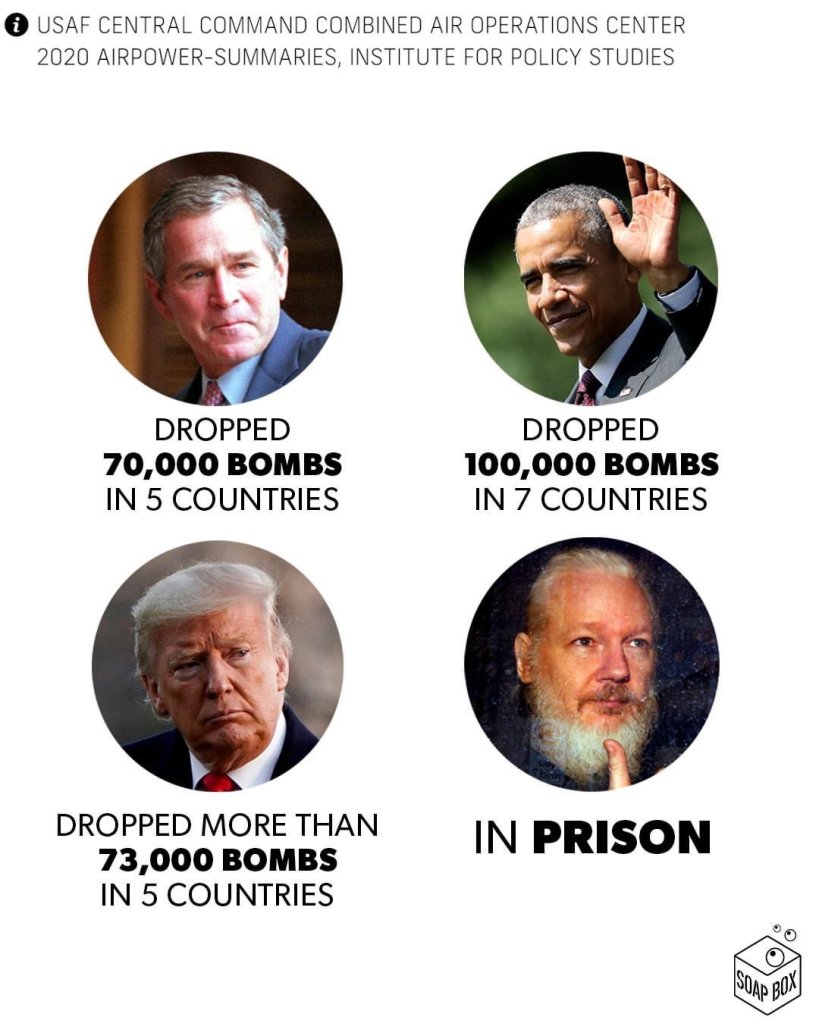
Snowden was forced into exile in Russia. Hale was recently imprisoned for up to four years. Manning spent years in prison under humiliating conditions that included solitary confinement. Assange is still in prison, and the U.S. government still seeks to extradite him and punish him under an espionage act that shouldn’t even apply to a citizen of another country (not to mention a journalist who should be protected in a democracy that allegedly reveres the freedom of the press).

It’s not that the American people can’t handle the truth, to cite the words of Colonel Jessup as played by Jack Nicholson. It’s that the American people can handle the truth, that the truth would empower us while weakening the powers-that-be and their various plots and privileges. That’s why the truth is such a scarce commodity in Washington, D.C. It must be guarded while being massaged and manipulated before its fed to the masses as formless, often truthless, pabulum.

America’s punishment of principled whistleblowers is yet another sign of the death of democracy in America. If President Biden wanted to do something important, something inspiring, something meaningful, he’d permit Snowden to return with no charges, he’d pardon Hale, and he’d stop pursuing the extradition of Assange. But Biden will do none of these. Whistleblowers must be persecuted, must be punished, not because they’ve done something wrong, but because they’ve done something right, something that embarrasses the powerful. And that simply cannot be tolerated.

After all, if Americans in positions to know start speaking the truth to their fellow Americans, where will that end? We might see a resurgence of accountability, of justice, even of democracy in America. And we can’t have that.

Addendum: For a terrific book on whistleblowing that will make you angry indeed, check out Tom Mueller’s “Crisis of Conscience: Whistleblowing In An Age of Fraud” (New York, Riverhead Books, 2019).

War Profits Soar as Diplomacy Sinks

W.J. Astore

I came across a remarkable stat while reading William Hartung’s latest article, “The Profits of War,” at TomDispatch.com. The giant military contractor, Lockheed Martin, received $77 billion in federal funds in FY2020 (Lockheed Martin builds the F-35 fighter jet), almost double the entire budget for the U.S. State Department (roughly $44 billion). So as President Biden gives speeches about favoring diplomacy over military action, he might want to consider how the Pentagon’s budget (and related spending on weaponry, including new nuclear weapons) is roughly 20 times that of the State Department. Biden once said, show me your budget and I’ll tell you what you value. Looks like weaponry and war remains number one and job one. USA! USA!

I had to laugh when I saw this headline from the New York Times in my email this morning: “At U.N., Biden calls for diplomacy, not conflict, but some are skeptical.” Readers, I can’t fathom any skepticism about U.S. intentions, can you? We are a peace-loving nation. We just choose to show it by constantly building new weapons in a febrile quest for “full-spectrum dominance” as we showcase our global reach and global power with assassin drones and endless wars. Does any other country in the world have 750 overseas military bases in 80 countries? Does any other country in the world slice and dice the map into regional commands (Africa Command, Central Command, and so on) led by four-star generals and admirals? Proving the world is not enough, America now seeks to dominate space with our “Space Force” and virtual worlds like cyberspace.

Time to practice some “diplomacy” in space.

Remember how Teddy Roosevelt said to speak softly but also to carry a big stick? That needs to be amended. The U.S. policy for decades has been: Shout loudly and swing a big stick. And that “big stick” is the U.S. military, which routinely gobbles up more than half of the federal discretionary budget.

Let me know when the State Department’s budget soars to $750 billion and the Pentagon’s budget plunges to $44 billion and maybe I’ll believe Joe Biden’s words about the new importance of diplomacy in America.

Twenty Years After 9/11

W.J. Astore

When the first hijacked plane hit the World Trade Center on 9/11/2001, I was at the Air Force Academy in Colorado Springs.  I was in my car, listening to the radio, just outside the North Gate, where a B-52 sits on static display as a symbol of American power. The first reports suggested it was an accident, but it soon became apparent it was a deliberate act.  As a second and then a third plane hit the WTC and the Pentagon, I remember hearing speculation that 9/11 could have a higher death toll than the Battle of Antietam, the single bloodiest day of the U.S. Civil War.  It was bad enough, if not that bad.

I remember confusion and chaos in the government, and the use of the word “folks” by President George W. Bush to describe the hijackers.  Very quickly, his rhetoric changed, and soon America would be launched on a global crusade against terrorists and other evildoers.

The flags came out and America came together, but that team spirit, so to speak, was quickly seized upon and exploited by Bush/Cheney to justify war anywhere and everywhere.  Good will was squandered and wise counsel was rejected in a calculated plot for power-projection disguised as righteous vengeance. Sweep everything up, related and unrelated, go big: those were the sentiments of Donald Rumsfeld, Dick Cheney, and crew.  They had failed so badly at protecting America on 9/11; they were not going to fail to use 9/11 for their own nefarious purposes.

And now, 20 years later, we’re witnessing how badly their hubris and dishonesty have damaged democracy in America, as well as damaging or destroying millions of lives around the globe.

After finishing my tour at the AF Academy in 2002, I became the Dean of Students at the Defense Language Institute at the Presidio of Monterey. I wonder how many of “my” young troops who so proudly crossed the stage with newly acquired language skills in Pashto and Dari and Arabic never made it home from Bush and Cheney’s GWOT, their “global war on terror.”

9/11 remains a traumatic day for America. It’s a day we remember where we were and what we were doing when we first learned of this horrific attack on our country. However briefly, 9/11 brought America together, but militarism and constant warfare along with prejudice and ignorance have served only to weaken our democracy while impoverishing our country.

This madness was on my mind as I recently re-watched “The City on the Edge of Forever,” a classic Star Trek episode in which history’s changed when Dr. McCoy travels back in time to 1930s America.  Here he saves the life of Edith Keeler, a social activist who, in an alternate timeline, delays U.S. entry into World War II, which allows the Nazis to develop the atomic bomb first, thereby winning the war.  Captain Kirk and Mr. Spock learn they must prevent McCoy from saving Keeler, which is complicated by the fact that Kirk falls hard for her.  She’s a visionary who speaks of space travel and a better world.  As Kirk courts her, Keeler says she dreams of a future in which all the money currently spent on war and death … and Kirk completes her thought by saying that that money will be spent instead on life.  Kindred spirits they are, Kirk and Keeler, yet to restore history to its proper place, he must let her die.

Joan Collins as Edith Keeler and William Shatner as Captain Kirk: Reaching for the stars

Keeler’s dream of peace – of all the trillions of dollars spent on weapons and war and death being instead spent on life – is the proper one, the right one, even as it was tragically premature.  For this she must die, forgotten to history, a bit player remembered only for running a small neighborhood mission for those with nowhere else to go.

I’ve always been attracted to science fiction and to plots both utopian, or at least hopeful, and dystopian.  But in the dystopia in which we increasingly find ourselves today, we need hopeful visions.  We need Edith Keelers.  But to use Star Trek-speak again, what I see issuing from the U.S. government is far more consistent with a Klingon Empire driven by war than a peaceful and life-affirming “federation” of planets.  The U.S. empire is not about to go quietly, nor will it go peacefully.

It’s time for a new course, a far less bellicose one, but a no less determined one, where Americans look within rather than without. Echoing Edith Keeler, let’s spend our money and resources on life, not death, love, not war. Let’s try that for the next 20 years. If we do, I bet we’ll be a lot better off in 2041 than we are today.

The Highly Profitable Racket of Building Foreign Militaries

W.J. Astore

Is building effective security forces in Iraq and Afghanistan and elsewhere really what the U.S. military and government is about? Given the total collapse of the Iraqi military in 2014 and its Afghan equivalent in 2021, I’d have to say no. What are these efforts really all about? A few heretical thoughts:

  1. The top priority is profits for America’s military-industrial-Congressional complex. Foreign military forces are always provided with loads of U.S.-built weaponry, much of it unneeded or inappropriate to their capabilities and missions. When these forces collapse, as they did in 2014 and this summer, enemies such as ISIS or the Taliban are the recipients of plenty of new weapons funded by the American taxpayer. In short, the U.S. arms its (failed) proxy armies and its enemies as well, which almost guarantees more fighting and/or bombing in the future. Call it a win/win for weapons makers even when the U.S. loses.
  2. If profit-making is the top priority, so too is making it last. Until they utterly collapse, often without much combat, America’s proxy militaries are never fully ready to stand on their own. They always require more U.S. training and funding, that is until the lie is exposed.
  3. Along with profit-making, it’s important for the U.S. military to look good while providing the training. Looking good requires lying about progress. And so America’s proxy militaries are always making progress (on paper, if nowhere else) which helps everyone involved get promoted while keeping the money flowing.
  4. Along with perpetual profits and promotions, these proxy militaries must never be allowed to become independent from the U.S. military. Sure, the U.S. government says it’s seeking “standalone” forces, but in practice Iraqi and Afghan forces were always dependent on U.S. logistical support as well as air power. Which is just the way the U.S. government wanted it and wants it. Dependency ensures pliability and control (until the inevitable collapse, that is).
  5. In sum, one must always follow the money and ask, who is profiting the most from these “training” efforts? Most of the billions and billions spent on training and equipping these militaries goes to the military-industrial complex and to local warlords. It sure didn’t go to Iraqi or Afghan foot soldiers. Again, failure here is its own success; the longer it takes to build “reliable” proxy armies, the longer the money flows to military contractors in the USA. And if your proxy military collapses, maybe you can even rebuild it (at ever higher costs) or at least fight the enemy that captured the expensive high-tech weapons funded so generously by the U.S. taxpayer.

I hope this list is useful as one reads an article at Foreign Affairs, “Why America Can’t Build Allied Armies,” sent to me by a friend. It’s not that America can’t build them. It’s more that we really don’t want to build them; indeed, that there are perverse incentives to do a half-assed job, making money all the while, until the rot can no longer be hidden.

Allow me to explain. The author of this article assigns blame mainly to the “partner” militaries, suggesting these “partners” in Iraq and Afghanistan weren’t interested in building effective militaries: they’re interested in money and power instead. Displacing blame onto our “partners” is always good fun, but shouldn’t the U.S. government have recognized this dynamic instead of feeding it? (Let’s face it: the U.S. is driven by money and power as well.)

In fairness to the author, she does advise that maybe the U.S. government should smarten up and stop throwing money at foreign militaries. Here’s an excerpt:

But the United States also has another option: it could scale down its train-and-equip efforts altogether. Rather than using advisory missions as the preferred option for addressing local security threats, it could instead reserve such programs for states with strong national institutions and a demonstrated interest in building better militaries. This pathway would lead to the termination of most U.S. security assistance projects, including the ongoing effort to build the Iraqi security forces.

Too often, the United States’ efforts to train and equip foreign militaries have been motivated by bureaucratic logic rather than sound strategy. The fall of Kabul exposed more than the rot within the armies the United States builds. It also exposed the rot within the United States’ approach to building them.

Sound advice, except the author doesn’t discuss how much these “train-and-equip efforts” are really money laundering operations for the military-industrial-Congressional complex. War is a racket, as General Smedley Butler taught us, and building hollow legions overseas, whether in Iraq or Afghanistan or earlier in Vietnam, is a racket that pays very well indeed.

For Most Americans, Afghanistan Never Existed

W.J. Astore

How can you win a war when the country and peoples you’re fighting never existed?

Most Americans have little knowledge of Afghanistan. When we think of it, if we think of it at all, it exists as a battlefield. A place where some of America’s troops serve; a distant and obscure land where more than a few of them come home from with physical and mental wounds that may plague them for the remainder of their lives. Afghanistan, in sum, is an abstraction to most Americans, a “war,” an utterly foreign place where dangerous bearded “terrorists” now rule.

But is Afghanistan really that foreign to us? It shouldn’t be.

A friend sent me a terrific article by Jim Lobe with the title, “Three major networks devoted a full five minutes to Afghanistan in 2020.” You read that right. In 2020 America’s three major networks (ABC, CBS, NBC) spent a total of five minutes (!) covering the U.S. war in Afghanistan. Keep that in mind as you today view blanket coverage of the collapse of America’s position there. What the mainstream media truly cares about is ratings and money, and a military collapse that threatens Americans is sure to glue more than few eyeballs to the screen. The networks can also play a hyper-partisan blame game, pitting Republicans against Democrats as the former accuse the latter of appeasement and weakness of some sort. That “game” is always good for ratings.

Of course America loses in Vietnam, in Iraq, in Afghanistan, and elsewhere. These countries and peoples only exist as a backdrop to our collective national drama. And as soon as the curtain falls on America’s latest dramatic flop, it’s quickly forgotten until the next major flop.

But there’s always money to be made, and the war-show must go on. Which distant nation shall it be next? Somalia? Iran? Somewhere-istan? Does it matter?

Update: When you truly care about something or someone, you care consistently. You pay attention. You devote yourself to it. Certain talking heads are now telling Americans they need to care about Afghanistan after suppressing information about the war for the last two decades. Sorry. You can’t cover up and lie about the U.S. war effort for two decades and then expect Americans deferentially to listen to you.

The Collapse of America’s Position in Afghanistan

W.J. Astore

It didn’t take long, did it? The Taliban are already in Kabul and the American-supported central government has scattered to the winds. What happened? What can we learn from this dramatic collapse?

Images of Saigon in 1975 keep appearing in minds and on TV screens, but let’s not forget the collapse of the American-trained Iraqi military in 2014. It turns out that a special product of America’s military-industrial-Congressional complex is junk militaries, whether in Vietnam in 1975 or Iraq in 2014 or Afghanistan in 2021. As I wrote about in 2014 at TomDispatch.com, the U.S. really knows how to invest in junk armies. And when they inevitably collapse, no one is held responsible, whether in the military or in Congress or in the various mercenary corporations that ostensibly trained and equipped Afghan security forces.

What follows is an excerpt from my article written in 2014 when Iraqi forces collapsed. The lessons I drew from that collapse are applicable to the latest one in Afghanistan. Just substitute “The Taliban” for ISIS and Afghan security forces for Iraqi ones in the paragraphs below.

A Kleptocratic State Produces a Kleptocratic Military

In the military, it’s called an “after action report” or a “hotwash” — a review, that is, of what went wrong and what can be learned, so the same mistakes are not repeated. When it comes to America’s Iraq training mission, four lessons should top any “hotwash” list:

1. Military training, no matter how intensive, and weaponry, no matter how sophisticated and powerful, is no substitute for belief in a cause.  Such belief nurtures cohesion and feeds fighting spirit.  ISIS has fought with conviction.  The expensively trained and equipped Iraqi army hasn’t.  The latter lacks a compelling cause held in common.  This is not to suggest that ISIS has a cause that’s pure or just. Indeed, it appears to be a complex mélange of religious fundamentalism, sectarian revenge, political ambition, and old-fashioned opportunism (including loot, plain and simple). But so far the combination has proven compelling to its fighters, while Iraq’s security forces appear centered on little more than self-preservation. 

2. Military training alone cannot produce loyalty to a dysfunctional and disunified government incapable of running the country effectively, which is a reasonable description of Iraq’s sectarian Shia government.  So it should be no surprise that, as Andrew Bacevich has noted, its security forces won’t obey orders.  Unlike Tennyson’s six hundred, the Iraqi army is unready to ride into any valley of death on orders from Baghdad. Of course, this problem might be solved through the formation of an Iraqi government that fairly represented all major parties in Iraqi society, not just the Shia majority. But that seems an unlikely possibility at this point.  In the meantime, one solution the situation doesn’t call for is more U.S. airpower, weapons, advisers, and training.  That’s already been tried — and it failed. 

3. A corrupt and kleptocratic government produces a corrupt and kleptocratic army.  On Transparency International’s 2013 corruption perceptions index, Iraq came in 171 among the 177 countries surveyed. And that rot can’t be overcome by American “can-do” military training, then or now. In fact, Iraqi security forces mirror the kleptocracy they serve, often existing largely on paper.  For example, prior to the June ISIS offensive, as Patrick Cockburn has noted, the security forces in and around Mosul had a paper strength of 60,000, but only an estimated 20,000 of them were actually available for battle. As Cockburn writes, “A common source of additional income for officers is for soldiers to kickback half their salaries to their officers in return for staying at home or doing another job.”

When he asked a recently retired general why the country’s military pancaked in June, Cockburn got this answer:

“‘Corruption! Corruption! Corruption!’ [the general] replied: pervasive corruption had turned the [Iraqi] army into a racket and an investment opportunity in which every officer had to pay for his post. He said the opportunity to make big money in the Iraqi army goes back to the U.S. advisers who set it up ten years ago. The Americans insisted that food and other supplies should be outsourced to private businesses: this meant immense opportunities for graft. A battalion might have a nominal strength of six hundred men and its commanding officer would receive money from the budget to pay for their food, but in fact there were only two hundred men in the barracks so he could pocket the difference. In some cases there were ‘ghost battalions’ that didn’t exist at all but were being paid for just the same.”

Only in fantasies like J.R.R. Tolkien’s Lord of the Rings do ghost battalions make a difference on the battlefield. Systemic graft and rampant corruption can be papered over in parliament, but not when bullets fly and blood flows, as events in June proved.

Such corruption is hardly new (or news). Back in 2005, in his article “Why Iraq Has No Army,” James Fallows noted that Iraqi weapons contracts valued at $1.3 billion shed $500 million for “payoffs, kickbacks, and fraud.” In the same year, Eliot Weinberger, writing in the London Review of Books, cited Sabah Hadum, spokesman for the Iraqi Ministry of the Interior, as admitting, “We are paying about 135,000 [troop salaries], but that does not necessarily mean that 135,000 are actually working.” Already Weinberger saw evidence of up to 50,000 “ghost soldiers” or “invented names whose pay is collected by [Iraqi] officers or bureaucrats.”  U.S. government hype to the contrary, little changed between initial training efforts in 2005 and the present day, as Kelley Vlahos noted recently in her article “The Iraqi Army Never Was.”    

4. American ignorance of Iraqi culture and a widespread contempt for Iraqis compromised training results.  Such ignorance was reflected in the commonplace use by U.S. troops of the term “hajji,” an honorific reserved for those who have made the journey (or hajj) to Mecca, for any Iraqi male; contempt in the use of terms such as “raghead,” in indiscriminate firing and overly aggressive behavior, and most notoriously in the events at Abu Ghraib prison.  As Douglas Macgregor, a retired Army colonel, noted in December 2004, American generals and politicians “did not think through the consequences of compelling American soldiers with no knowledge of Arabic or Arab culture to implement intrusive measures inside an Islamic society.  We arrested people in front of their families, dragging them away in handcuffs with bags over their heads, and then provided no information to the families of those we incarcerated.  In the end, our soldiers killed, maimed, and incarcerated thousands of Arabs, 90 percent of whom were not the enemy.  But they are now.”

Sharing that contempt was Secretary of Defense Donald Rumsfeld, who chose a metaphor of parent and child, teacher and neophyte, to describe the “progress” of the occupation.  He spoke condescendingly of the need to take the “training wheels” off the Iraqi bike of state and let Iraqis pedal for themselves.  A decade later, General Allen exhibited a similarly paternalistic attitude in an article he wrote calling for the destruction of the Islamic State.  For him, the people of Iraq are “poor benighted” souls, who can nonetheless serve American power adequately as “boots on the ground.”  In translation that means they can soak up bullets and become casualties, while the U.S. provides advice and air support.  In the general’s vision — which had déjà vu all over again scrawled across it — U.S. advisers were to “orchestrate” future attacks on IS, while Iraq’s security forces learned how to obediently follow their American conductors. 

The commonplace mixture of smugness and paternalism Allen revealed hardly bodes well for future operations against the Islamic State.   

What Next?

The grim wisdom of Private Hudson in the movie Aliens comes to mind: “Let’s just bug out and call it ‘even,’ OK? What are we talking about this for?”

Unfortunately, no one in the Obama administration is entertaining such sentiments at the moment, despite the fact that ISIS does not actually represent a clear and present danger to the “homeland.” The bugging-out option has, in fact, been tested and proven in Vietnam.  After 1973, the U.S. finally walked away from its disastrous war there and, in 1975, South Vietnam fell to the enemy.  It was messy and represented a genuine defeat — but no less so than if the U.S. military had intervened yet again in 1975 to “save” its South Vietnamese allies with more weaponry, money, troops, and carpet bombing.  Since then, the Vietnamese have somehow managed to chart their own course without any of the above and almost 40 years later, the U.S. and Vietnam find themselves informally allied against China.

To many Americans, IS appears to be the latest Islamic version of the old communist threat — a bad crew who must be hunted down and destroyed.  This, of course, is something the U.S. tried in the region first against Saddam Hussein in 1991 and again in 2003, then against various Sunni and Shiite insurgencies, and now against the Islamic State.  Given the paradigm — a threat to our way of life — pulling out is never an option, even though it would remove the “American Satan” card from the IS propaganda deck.  To pull out means to leave behind much bloodshed and many grim acts.  Harsh, I know, but is it any harsher than incessant American-led bombing, the commitment of more American “advisers” and money and weapons, and yet more American generals posturing as the conductors of Iraqi affairs?  With, of course, the usual results.

One thing is clear: the foreign armies that the U.S. invests so much money, time, and effort in training and equipping don’t act as if America’s enemies are their enemies.  Contrary to the behavior predicted by Donald Rumsfeld, when the U.S. removes those “training wheels” from its client militaries, they pedal furiously (when they pedal at all) in directions wholly unexpected by, and often undesirable to, their American paymasters.

And if that’s not a clear sign of the failure of U.S. foreign policy, I don’t know what is.