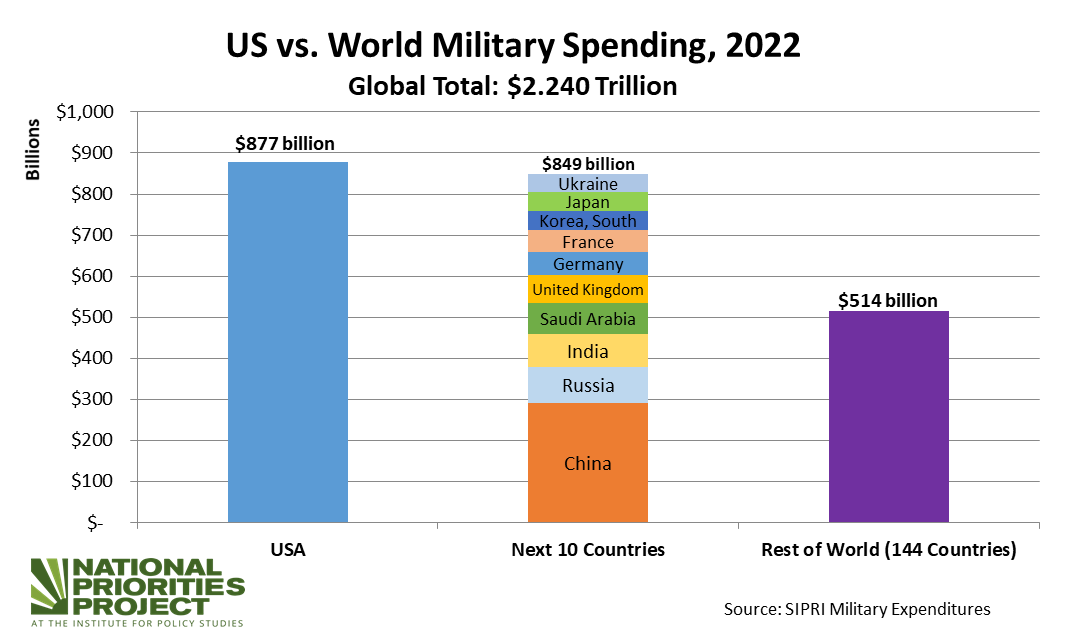
Four days ago, I got a story in my New York Times email feed on “A Turning Point in Military Spending.” The article celebrated the greater willingness of NATO members as well as countries like Japan to spend more on military weaponry, which, according to the “liberal” NYT, will help to preserve democracy. Interestingly, even as NATO members have started to spend more, the Pentagon is still demanding yet higher budgets, abetted by Congress. I thought if NATO spent more, the USA could finally spend less?
No matter. Russia’s invasion of Ukraine, as well as the hyping of what used to be called the “Yellow Peril,” today read “China,” is ensuring record military spending in the USA as yearly Pentagon budgets approach $900 billion. That figure does not include the roughly $120 billion or more in aid already provided to Ukraine in its war with Russia. And since the Biden administration’s commitment to Ukraine remains open-ended, you can add scores of billion more to that sum if the war persists into the fall and winter.
Here’s an excerpt from the New York Times piece that I found especially humorous in a grim way:
[Admittedly,] The additional money that countries spend on defense is money they cannot spend on roads, child care, cancer research, refugee resettlement, public parks or clean energy, my colleague Patricia points out. One reason Macron has insisted on raising France’s retirement age despite widespread protests, analysts believe, is a need to leave more money for the military.
But the situation [in Europe of spending more on butter than guns] over the past few decades feels unsustainable. Some of the world’s richest countries were able to spend so much on social programs partly because another country — the U.S. — was paying for their defense. Those other countries, sensing a more threatening world, are now once again promising to pull their weight. They still need to demonstrate that they’ll follow through this time.
Yes, Europe could continue to invest in better roads, cleaner energy, and the like, but now it’s time to buckle down and build more weapons. Stop freeloading, Europe! Dammit, “pull your weight”! You’ve had better and cheaper health care than Americans, stellar educational systems, child care benefits galore, all sorts of social programs we Americans can only dream of, but that’s because we’ve been paying for it! Captain America’s shield has been protecting you on the cheap! Time to pay up, you Germans, you French, you Italians, and especially you cheap Spaniards.
Look at all those cheap Spaniards. They have good stuff because of Captain America. Freeloaders! (NYT Chart, 7/12/23)
As the NYT article says: NATO allies need to “follow through this time” on strengthening their militaries. Because strong militaries produce democracy. And European “investments” in arms will ensure more equitable burden sharing in funding stronger cages and higher barriers to deter a rampaging Russian bear.
Again, you Americans out there, that doesn’t mean we can spend less on “defense.” What it means is that the U.S. can “pivot to Asia” and spend more on weaponry to “deter” China. Because as many neocons say, the real threat is Xi, not Putin.
We have met the enemy, and he is us. That’s an old saying you won’t see in the “liberal” NYT.
I’m still waiting for the blockbuster Hollywood production that celebrates peace
Last year, “Top Gun: Maverick” was all the rage. It was a silly war flick with a plot ripped from the original “Star Wars” movie featuring plenty of bloodless, high octane action sequences. I enjoyed it in the way I occasionally indulge in unhealthy fast food. The movie was instantly forgettable except for one scene where hotshot pilot Maverick, played of course by Tom Cruise, meets his old rival Iceman, played by Val Kilmer. In real life, Kilmer suffers from throat cancer, and his condition is not hidden in the movie, where Kilmer is now an admiral who still believes in his old friend, Captain Pete “Maverick” Mitchell.
Naturally, Maverick saves the day, pummeling a nameless enemy (most likely Iran) with bombs because that country is developing nuclear weapons. Nothing, of course, is said of the thousands of nuclear warheads and bombs in America’s arsenal, or that the USA is the only country to have used atomic bombs in war (Hiroshima, Nagasaki). But I digress.
Hollywood loves war movies. They sell well. Yet I still await “Top Dove: Peacenik,” in which an intrepid, brave, determined, and charismatic person stops a war without bombing or killing anyone. What a breath of fresh air that would be!
Exactly ten years ago, I posted the article below at Bracing Views. We need peacemakers now more than ever. Sadly, they are still very much forgotten, or ignored, or dismissed as unserious or even delusional.
Forgotten Are the Peacemakers (2013)
Monument to Elihu Burritt in New Marlboro, Mass. (author’s photo)The Plaque in Honor of Burritt (author’s photo)
Being Catholic, I’m a big fan of the Sermon on the Mount and Christ’s teaching that “blessed are the peacemakers.” Yet in American history it seems that “forgotten are the peacemakers” would be a more accurate lesson. We’re much more likely to remember “great” generals, even vainglorious ones like George S. Patton or Douglas MacArthur, than to recognize those who’ve fought hard against long odds for peace.
Elihu Burritt was one such peacemaker. Known in his day as “The Learned Blacksmith,” Burritt fought for peace and against slavery in the decades before the Civil War in the United States. He rose from humble roots to international significance, presiding over The League of Universal Brotherhood in the 1840s and 1850s while authoring many books on humanitarian subjects.
Interestingly, peacemakers like Burritt were often motivated by evangelical Christianity. They saw murder as a sin and murderous warfare as an especially grievous manifestation of man’s sinfulness. Many evangelicals of his day were also inspired by their religious beliefs to oppose slavery as a vile and reprehensible practice.
Christian peacemakers like Burritt may not have had much success, but they deserve to be remembered and honored as much as our nation’s most accomplished generals. That we neglect to honor men and women like Burritt says much about America’s character.
For if we truly are a peace-loving people, why do we fail to honor our most accomplished advocates for peace?
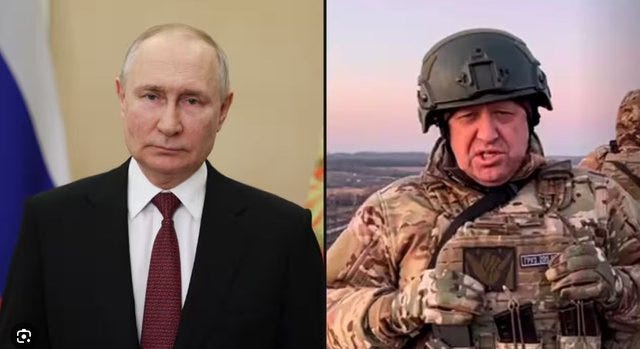
News of the rebellion of the Wagner mercenary group in Russia and the exile of its leader have led to confident announcements of Vladimir Putin’s weakening grip on power. Secretary of State Antony Blinken said the rebellion was “the latest failure” in Putin’s war against Ukraine, and NBC News declared “Putin’s rule is now more uncertain than ever.”
Vladimir Putin and the leader of the Wagner group, Yevgeny Prigozhin
Perhaps so. Wars often act as an accelerant to change, generating political chaos in their wake. The results of chaos, obviously, don’t lend themselves to predictability. Who knew in 1914, when the guns of August sounded, that four years later four empires would have collapsed under the strain of war (the Russian Empire, the Austro-Hungarian Empire, the Ottoman Empire, and the German Second Reich).
President Joe Biden was unusually frank in March of 2022 when he declared that Putin “cannot remain in power” due to his decision to invade Ukraine. Be careful what you wish for, Mr. President. Is overthrowing Putin truly a wise goal for global stability?
I honestly don’t know. A weaker, possibly fragmented Russia could increase the chances of nuclear war. A struggle for power within Russia could lead to the emergence of hardline leader who might make the West nostalgic for the relative predictability of Putin.
Most of us have heard the saying: better the devil you know than the one you don’t know. (This isn’t to suggest Putin is diabolical, of course.) In World War I, many of the allies professed to hate the Kaiser; his eventual successor as leader of the German people was Adolf Hitler. Again, wars may unleash elemental and fundamental changes, and change isn’t always for the better.
So, my position on the Russia-Ukraine War remains unchanged. Negotiate a truce. Use diplomacy to put a permanent end to this war. If Putin is truly weakened, this might be the best of times to seek a diplomatic settlement. After all, if Putin is truly worried about his grip on power within Russia, he might be open to ending the war largely on Ukraine’s terms so he can redirect his attention to consolidating his power base.
War has been given plenty of chances. Why not give peace a chance?
Ukraine’s counteroffensive against Russia appears to be stalling, (See this frank article by Medea Benjamin and Nicolas Davies.) This isn’t surprising.
War is inherently unpredictable, but there are certain ingredients that contribute to the success of counteroffensives. Here are a few:
The element of surprise: Catching the enemy off-guard is always helpful. But everyone knew Ukraine was counterattacking, including roughly where and when.
Superiority at the point of attack: As a rough rule, an attacker needs at least a 3-to-1 superiority in force to prevail against a determined defender, along with a willingness and ability to accept casualties. It’s unclear to me that Ukraine had a clear superiority at their points of attack. Whether Ukraine can continue to sustain high numbers of killed and wounded is also unclear.
The synergy of combined arms: Everything in war is difficult, most especially orchestrating and conducting an offensive. “Combined arms” includes infantry, artillery, and tanks, moving with machine-like precision, supported by airpower, enhanced by intelligence, and kept supplied by adequate logistical chains. Ukrainian forces did well on the defensive in resisting often poorly coordinated Russian attacks, but now the combat boot is on the other foot, and it’s Ukraine that’s having trouble breaking through well-prepared Russian positions.
The importance of training and experience: While Ukrainian troops have gained experience over the last year or so, they have primarily been on the defensive while also assimilating new weapons and related equipment. They arguably lack the experience to launch coordinated offensives against determined resistance.
Effective leadership: It was said the presence of Napoleon Bonaparte on the battlefield was equivalent to the French having an extra army corps, i.e. roughly 30,000 men. Offensives go better when they’re led by skilled generals backed up by effective officers and experienced NCOs. I’m not aware of any Napoleon-types on either side of the Russia/Ukraine War, and I fear Ukraine has suffered too many losses to have a solid core of experienced officers and NCOs.
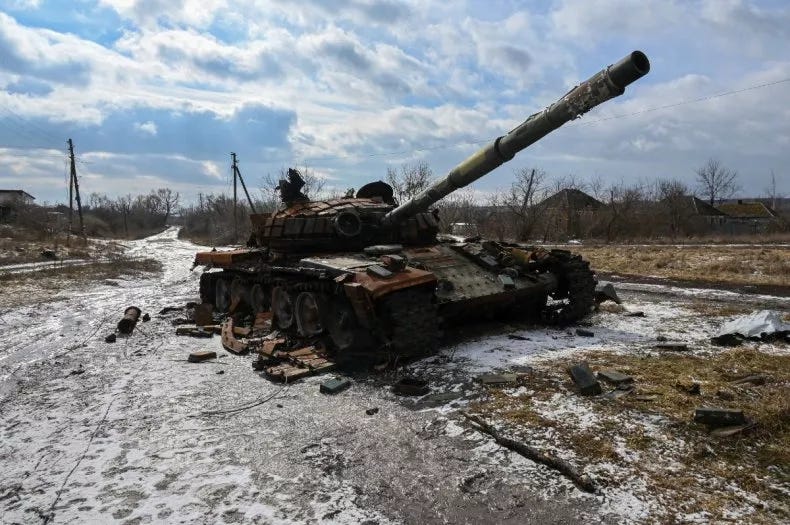
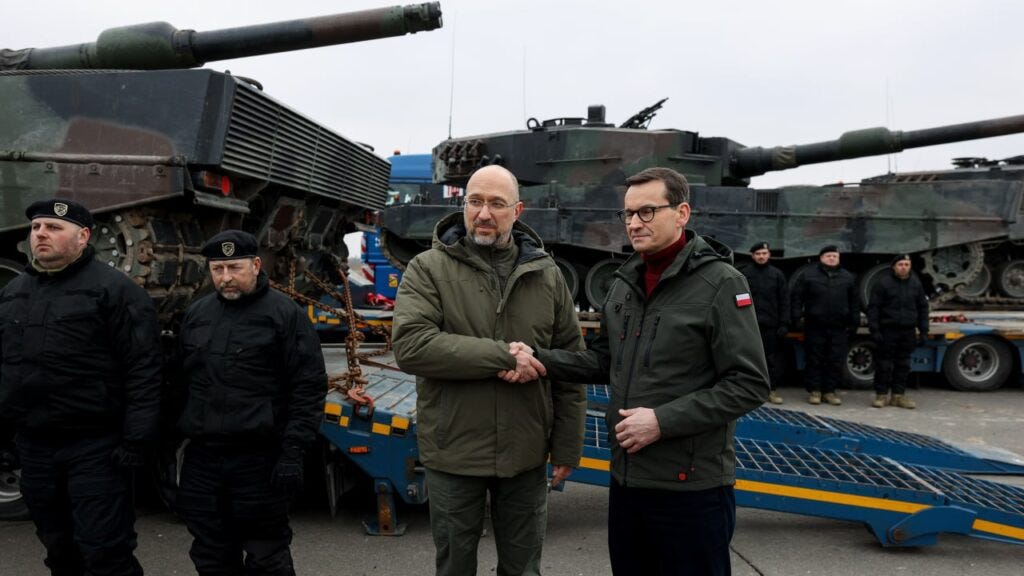
The Western solution to all this appears to be more promises of “magical” weapons like German Leopard tanks and American F-16 fighter jets. But weapons alone are insufficient to provide war-winning advantages. Military history teaches us that the side with superior weapons often loses to the side with superior skill and motivation. Think here of the U.S. experience in Vietnam, for example.
Poland delivers Leopard II tanks to Ukraine. But tanks are not enough.
As I’ve said before, what I fear is that neither side can win this war decisively even as Ukraine suffers most grievously because the war is being fought in their country.
People like Senator Lindsey Graham talk tough about Ukrainians fighting to the last man with U.S. and NATO weaponry. Easy for him to say, since he’s not the one who’s fighting and possibly dying at the front. Meanwhile, U.S. companies profit from the sale of weapons, hence that apt descriptor from the 1930s, “the merchants of death.”
For the sake of argument, let’s say Ukraine is able to make modest territorial gains at high cost. This would be an excellent time to call for a truce and diplomacy. Ukraine can claim a face-saving “victory” (those modest gains) even as the Russians can boast of containing the much-hyped NATO-supported counteroffensive. Let both sides declare victory as they hash out a compromise that ends the killing and destruction.
What’s the real definition of “victory” here? For me, it’s a rapid end to a wasteful war before that war is allowed to escalate in ways that could spark a much wider and potentially catastrophic conflict involving nuclear powers.
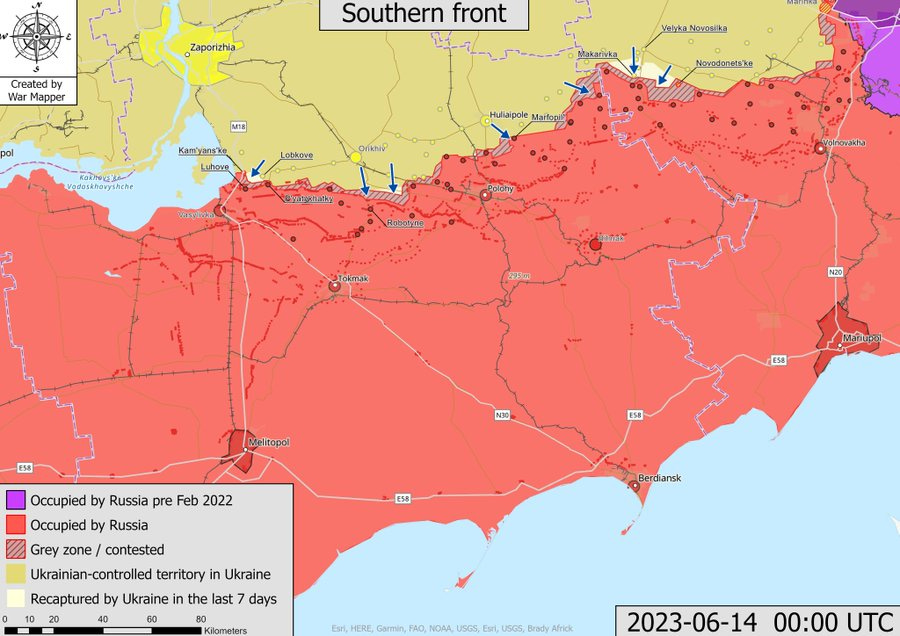
Ukraine’s counteroffensive is in motion; results so far appear to be mixed. Today’s CNN summary had this to say: Ukrainian forces are claiming some success in their offensives in the south and east. Kyiv’s top general said this week that his troops have seen “certain gains.”
“Certain gains.” Not only is the U.S. government sending Ukraine weapons and aid; it also is providing lessons in rhetorical BS. How long before Ukraine speaks of “corners turned” and “the light at the end of the tunnel” in this dreadful war?
“Certain gains”: One thing that is certain is that maps like this are a sterile depiction of the dreadful and ghastly costs of war (Source: War Mapper)
Five days ago, the New York Times provided this short summary of Ukraine’s counteroffensive: As Ukraine Launches Counteroffensive, Definitions of ‘Success’ Vary. Privately, U.S. and European officials concede that pushing all of Russia’s forces out of occupied Ukrainian land is highly unlikely.
What is the definition of “success”? It sounds like a metaphysical puzzle.
Back on May 31st, I spoke with defense journalist Brad Dress at The Hill. This is what I had to say then: “Sometimes, war is sold like a consumer product, where there’s a lot of hype and a lot of hope. That is contrary to the reality we often see.”
In our conversation, I reminded Dress of counteroffensives from military history that went dreadfully wrong. Think of the first day of the Somme in July 1916 during World War I, when the British Army lost 20,000 dead and another 40,000 wounded. Think of the Battle of the Bulge in December 1944 in World War II, when the German Army threw away its strategic reserve in a last gasp counteroffensive that ultimately made it easier for the Allies to defeat them in 1945. History is replete with examples of failed counteroffensives, especially when the opponent is prepared and entrenched.
War is inherently unpredictable (as well as being hellish and horrific), but it does appear that Ukraine’s counteroffensive won’t be decisive. It’s not going to defeat Russia in one fell swoop. Battle lines may move a bit, but the war will continue. And so will the killing—and the profiteering. Is that “success”?
Mostly unseen and unwritten about are all the dead soldiers on both sides, all the environmental destruction. Which likely will produce cries for yet more violence in the cause of vengeance. “Success”?
So far, the Biden administration has used all its influence, indeed all means at its disposal, to continue the war. The only way out, apparently, is over the bodies of dead Ukrainians and Russians. Not surprisingly, then, the U.S. is providing even more deadly weaponry to Ukraine, including depleted uranium ammunition and (eventually) M-1 Abrams tanks and F-16 fighter jets. Escalation, in sum, is America’s sole solution to ending the war.
I implore the U.S. government to pursue diplomacy as a means to ending this awful war. No one is talking about surrendering to Putin. No one wants to abandon Ukraine. Indeed, I’m at a loss when people accuse me of not caring for the people of Ukraine when my goal is to end the killing on both sides.
All wars end. Ukraine and Russia aren’t going anywhere. They share a long border, a longer history, and now a lengthening war. Shouldn’t we be doing everything we can to shorten it?
The people on the receiving end of American bombs don’t care if those bombs are from a “woke” B-52 or a MAGA one, or whether the crews of those planes are diverse. Is it better to be bombed by female or gay or Black air crews?
The comedian Jimmy Dore did a recent segment on the CIA’s celebration of Gay Pride Month. Am I supposed to trust the CIA when they wrap themselves in a rainbow flag?
Regardless of who’s been president and which party he’s been from, U.S. military spending has continued to soar. And while Joe Biden finally ended the disastrous Afghan War, the military-industrial-congressional complex is profiting wildly from the new Cold War with China and Russia.
Americans should be deeply concerned with the increasing likelihood of nuclear war, together with the government’s great affection for building even more nuclear weapons. Yet we are actively discouraged by our government from thinking about the unthinkable, i.e. genocidal nuclear weapons and war. “Trust the experts” is the implicit message, along with “pay no attention” to the trillions being spent on new nuclear bombers, ICBMs, and submarines. After all, they’re job-creators!
Reelecting Trump or Biden, or electing younger tools like Ron DeSantis or Pete Buttigieg, isn’t going to change America’s imperial, militaristic, and rapacious foreign policy. I’d like to elect a president who prefers not to drop bombs, a leader who knows that bombs remain bombs whether they’re “woke” or “MAGA” or decorated with rainbow or “blue lives matter” flags.
All around us things are falling apart. Collectively, Americans are experiencing national and imperial decline. Can America save itself? Is this country, as presently constituted, even worth saving?
For me, that last question is radical indeed. From my early years, I believed deeply in the idea of America. I knew this country wasn’t perfect, of course, not even close. Long before the 1619 Project, I was aware of the “original sin” of slavery and how central it was to our history. I also knew about the genocide of Native Americans. (As a teenager, my favorite movie — and so it remains — was Little Big Man, which pulled no punches when it came to the white man and his insatiably murderous greed.)
Nevertheless, America still promised much, or so I believed in the 1970s and 1980s. Life here was simply better, hands down, than in places like the Soviet Union and Mao Zedong’s China. That’s why we had to “contain” communism — to keep themover there, so they could never invade our country and extinguish our lamp of liberty. And that’s why I joined America’s Cold War military, serving in the Air Force from the presidency of Ronald Reagan to that of George W. Bush and Dick Cheney. And believe me, it proved quite a ride. It taught this retired lieutenant colonel that the sky’s anything but the limit.
In the end, 20 years in the Air Force led me to turn away from empire, militarism, and nationalism. I found myself seeking instead some antidote to the mainstream media’s celebrations of American exceptionalism and the exaggerated version of victory culture that went with it (long after victory itself was in short supply). I started writingagainst the empire and its disastrous wars and found likeminded people at TomDispatch — former imperial operatives turned incisive critics like Chalmers Johnson and Andrew Bacevich, along with sharp-eyed journalist Nick Turse and, of course, the irreplaceable Tom Engelhardt, the founder of those “tomgrams” meant to alert America and the world to the dangerous folly of repeated U.S. global military interventions.
But this isn’t a plug for TomDispatch. It’s a plug for freeing your mind as much as possible from the thoroughly militarized matrix that pervades America. That matrix drives imperialism, waste, war, and global instability to the point where, in the context of the conflict in Ukraine, the risk of nuclear Armageddon could imaginably approach that of the 1962 Cuban Missile Crisis. As wars — proxy or otherwise — continue, America’s global network of 750-odd military bases never seems to decline. Despite upcoming cuts to domestic spending, just about no one in Washington imagines Pentagon budgets doing anything but growing, even soaring toward the trillion-dollar level, with militarized programs accounting for 62% of federal discretionary spending in 2023.
Indeed, an engorged Pentagon — its budget for 2024 is expected to rise to $886 billionin the bipartisan debt-ceiling deal reached by President Joe Biden and House Speaker Kevin McCarthy — guarantees one thing: a speedier fall for the American empire. Chalmers Johnson predicted it; Andrew Bacevich analyzed it. The biggest reason is simple enough: incessant, repetitive, disastrous wars and costly preparations for more of the same have been sapping America’s physical and mental reserves, as past wars did the reserves of previous empires throughout history. (Think of the short-lived Napoleonic empire, for example.)
Known as “the arsenal of democracy” during World War II, America has now simply become an arsenal, with a military-industrial-congressional complex intent on forging and feeding wars rather than seeking to starve and stop them. The result: a precipitous decline in the country’s standing globally, while at home Americans pay a steep price of accelerating violence (2023 will easily set a record for mass shootings) and “carnage” (Donald Trump’s word) in a once proud but now much-bloodied“homeland.”
Lessons from History on Imperial Decline
I’m a historian, so please allow me to share a few basic lessons I’ve learned. When I taught World War I to cadets at the Air Force Academy, I would explain how the horrific costs of that war contributed to the collapse of four empires: Czarist Russia, the German Second Reich, the Ottoman empire, and the Austro-Hungarian empire of the Habsburgs. Yet even the “winners,” like the French and British empires, were also weakened by the enormity of what was, above all, a brutal European civil war, even if it spilled over into Africa, Asia, and indeed the Americas.
And yet after that war ended in 1918, peace proved elusive indeed, despite the Treaty of Versailles, among other abortive agreements. There was too much unfinished business, too much belief in the power of militarism, especially in an emergent Third Reich in Germany and in Japan, which had embraced ruthless European military methods to create its own Asiatic sphere of dominance. Scores needed to be settled, so the Germans and Japanese believed, and military offensives were the way to do it.
As a result, civil war in Europe continued with World War II, even as Japan showed that Asiatic powers could similarly embrace and deploy the unwisdom of unchecked militarism and war. The result: 75 million dead and more empires shattered, including Mussolini’s “New Rome,” a “thousand-year” German Reich that barely lasted 12 of them before being utterly destroyed, and an Imperial Japan that was starved, burnt out, and finally nuked. China, devastated by war with Japan, also found itself ripped apart by internal struggles between nationalists and communists.
As with its prequel, even most of the “winners” of World War II emerged in a weakened state. In defeating Nazi Germany, the Soviet Union had lost 25 to 30 million people. Its response was to erect, in Winston Churchill’s phrase, an “Iron Curtain” behind which it could exploit the peoples of Eastern Europe in a militarized empire that ultimately collapsed due to its wars and its own internal divisions. Yet the USSR lasted longer than the post-war French and British empires. France, humiliated by its rapid capitulation to the Germans in 1940, fought to reclaim wealth and glory in “French” Indochina, only to be severely humbled at Dien Bien Phu. Great Britain, exhausted from its victory, quickly lost India, that “jewel” in its imperial crown, and then Egypt in the Suez debacle.
There was, in fact, only one country, one empire, that truly “won” World War II: the United States, which had been the least touched (Pearl Harbor aside) by war and all its horrors. That seemingly never-ending European civil war from 1914 to 1945, along with Japan’s immolation and China’s implosion, left the U.S. virtually unchallenged globally. America emerged from those wars as a superpower precisely because its government had astutely backed the winning side twice, tipping the scales in the process, while paying a relatively low price in blood and treasure compared to allies like the Soviet Union, France, and Britain.
History’s lesson for America’s leaders should have been all too clear: when you wage war long, especially when you devote significant parts of your resources — financial, material, and especially personal — to it, you wage it wrong. Not for nothing is war depicted in the Bible as one of the four horsemen of the apocalypse. France had lost its empire in World War II; it just took later military catastrophes in Algeria and Indochina to make it obvious. That was similarly true of Britain’s humiliations in India, Egypt, and elsewhere, while the Soviet Union, which had lost much of its imperial vigor in that war, would take decades of slow rot and overstretch in places like Afghanistan to implode.
Meanwhile, the United States hummed along, denying it was an empire at all, even as it adopted so many of the trappings of one. In fact, in the wake of the implosion of the Soviet Union in 1991, Washington’s leaders would declare America the exceptional “superpower,” a new and far more enlightened Rome and “the indispensable nation” on planet Earth. In the wake of the 9/11 attacks, its leaders would confidently launch what they termed a Global War on Terror and begin waging wars in Afghanistan, Iraq, and elsewhere, as in the previous century they had in Vietnam. (No learning curve there, it seems.) In the process, its leaders imagined a country that would remain untouched by war’s ravages, which was we now know — or do we? — the height of imperial hubris and folly.
For whether you call it fascism, as with Nazi Germany, communism, as with Stalin’s Soviet Union, or democracy, as with the United States, empires built on dominance achieved through a powerful, expansionist military necessarily become ever more authoritarian, corrupt, and dysfunctional. Ultimately, they are fated to fail. No surprise there, since whatever else such empires may serve, they don’t serve their own people. Their operatives protect themselves at any cost, while attacking efforts at retrenchment or demilitarization as dangerously misguided, if not seditiously disloyal.
That’s why those like Chelsea Manning, Edward Snowden, and Daniel Hale, who shined a light on the empire’s militarized crimes and corruption, found themselves imprisoned, forced into exile, or otherwise silenced. Even foreign journalists like Julian Assange can be caught up in the empire’s dragnet and imprisoned if they dare expose its war crimes. The empire knows how to strike back and will readily betray its own justice system (most notably in the case of Assange), including the hallowed principles of free speech and the press, to do so.
Perhaps he will eventually be freed, likely as not when the empire judges he’s approaching death’s door. His jailing and torture have already served their purpose. Journalists know that to expose America’s bloodied tools of empire brings only harsh punishment, not plush rewards. Best to look away or mince one’s words rather than risk prison — or worse.
Yet you can’t fully hide the reality that this country’s failed wars have added trillions of dollars to its national debt, even as military spending continues to explode in the most wasteful ways imaginable, while the social infrastructure crumbles.
Clinging Bitterly to Guns and Religion
Today, America clings ever more bitterly to guns and religion. If that phrase sounds familiar, it might be because Barack Obama used it in the 2008 presidential campaign to describe the reactionary conservatism of mostly rural voters in Pennsylvania. Disillusioned by politics, betrayed by their putative betters, those voters, claimed the then-presidential candidate, clung to their guns and religion for solace. I lived in rural Pennsylvania at the time and recall a response from a fellow resident who basically agreed with Obama, for what else was there left to cling to in an empire that had abandoned its own rural working-class citizens?
Something similar is true of America writ large today. As an imperial power, we cling bitterly to guns and religion. By “guns,” I mean all the weaponry America’s merchants of death sell to the Pentagon and across the world. Indeed, weaponry is perhaps this country’s most influential global export, devastatingly so. From 2018 to 2022, the U.S. alone accounted for 40% of global arms exports, a figure that’s only risen dramatically with military aid to Ukraine. And by “religion,” I mean a persistent belief in American exceptionalism (despite all evidence to the contrary), which increasingly draws sustenance from a militant Christianity that denies the very spirit of Christ and His teachings.
Yet history appears to confirm that empires, in their dying stages, do exactly that: they exalt violence, continue to pursue war, and insist on their own greatness until their fall can neither be denied nor reversed. It’s a tragic reality that the journalist Chris Hedges has written about with considerable urgency.
The problem suggests its own solution (not that any powerful figure in Washington is likely to pursue it). America must stop clinging bitterly to its guns — and here I don’t even mean the nearly 400 million weapons in private hands in this country, including all those AR-15 semi-automatic rifles. By “guns,” I mean all the militarized trappings of empire, including America’s vast structure of overseas military bases and its staggering commitments to weaponry of all sorts, including world-ending nuclearones. As for clinging bitterly to religion — and by “religion” I mean the belief in America’s own righteousness, regardless of the millions of people it’s killed globally from the Vietnam era to the present moment — that, too, would have to stop.
History’s lessons can be brutal. Empires rarely die well. After it became an empire, Rome never returned to being a republic and eventually fell to barbarian invasions. The collapse of Germany’s Second Reich bred a third one of greater virulence, even if it was of shorter duration. Only its utter defeat in 1945 finally convinced Germans that God didn’t march with their soldiers into battle.
What will it take to convince Americans to turn their backs on empire and war before it’s too late? When will we conclude that Christ wasn’t joking when He blessed the peacemakers rather than the warmongers?
As an iron curtain descends on a failing American imperial state, one thing we won’t be able to say is that we weren’t warned.
Six days ago, I received an email from the New York Times informing me that “The counteroffensive is coming.” It was all about Ukraine and its plans to take the fight to the Russians. Overall, I’d describe the tone of the article as almost giddy. Isn’t it great that Ukraine will soon be killing more Russians?
Readers here know I’m for diplomacy. Russia and Ukraine share a long border and history. They need to find a way to end this war and live together, and we should be helping them do this. The longer the war lasts, the more bitter it will get, even as events become more unpredictable. Nuclear escalation is quite possible. Yet the New York Times is gushing about Ukraine using the element of surprise and combined arms warfare to teach all those nasty Russians a lesson.
Map from the NYT Newsletter, citing the Institute for the Study of War. Interestingly, the map suggests Crimea as an objective of the promised Ukrainian counteroffensive
I liked this passage from the NYT article/newsletter: “The troops [of Ukraine] have learned a technique known as combined-arms warfare, in which different parts of the military work together to take territory. Tanks punch through enemy lines by rolling over trenches, for example, and infantry then spread out to hold the area.”
It sure sounds nice and clean. Tanks “punch through” and infantry “then spread out.” I’m sure glad the Russians have no tanks of their own, no anti-tank missiles, no machine guns, and no artillery.
Here’s another example from the NYT article of positive thinking and bloodless prose:
In the favorable scenario for Ukraine, a peace deal in which Russia is expelled from everywhere but Crimea and parts of the Donbas region would become plausible. On the flip side, a failed counteroffensive and an unbroken land bridge would provide Putin with a big psychological victory and a foundation from which to launch future attacks.
Only two scenarios? Either the Ukraine counteroffensive is a success, leading to a favorable peace deal, or it stalls, meaning victory for Russia and future Russian assaults? What about a wider war with Russia? Or a wildly successful attack that leads the Russians to deploy tactical nuclear weapons against it? Or an attack that Ukraine can’t sustain, leaving it vulnerable to Russian counterattacks in which Ukraine is convincingly defeated?
No matter what happens, we can count on at least two things as certain: more dead and wounded Russians and Ukrainians, and more profits for all those arms merchants providing weaponry to Ukraine, much of it paid for by American taxpayers, whether they know it or not.
Nowhere in this NYT newsletter is anything mentioned about the human costs of this much-anticipated Ukrainian counteroffensive. There’s only one mention of losses, and that comes with Russia:
Experts have compared the war’s recent months to World War I, with both sides dug into trenches and neither making much progress. Russia lost tens of thousands of troops this year merely to capture Bakhmut, a marginal city in the Donbas.
I’m glad Ukraine “lost” no troops in defending that “marginal city in the Donbas.” And who’s to say which city is “marginal” and which isn’t?
I’ve heard the NYT described as “liberal,” but when it comes to war, the NYT is a bloodthirsty cheerleader. Perhaps that’s the new face of liberalism in America today.
Former President Donald Trump went on CNN last week and said something sensible. When asked if he wanted Ukraine to win the war, Trump replied he didn’t think about the war in terms of winning and losing. His priority was to stop the killing on both sides by ending the war. Naturally, he boasted he could end the war in 24 hours, surely a hyperbolic claim, though if the U.S. ended its massive package of military and financial aid, Ukraine would likely be forced to sue for peace, and quickly.
Interestingly, the CNN anchor badgered Trump, trying to get him to say he favored Ukraine over Russia and that Ukraine had to win. Trump, to his credit, was having none of it. Nor would Trump declare that Putin was a war criminal for the sensible reason that such a declaration would make a diplomatic settlement much more problematic.
Readers here know I’m no fan of Trump. I think he’s a dangerous con man without a clue about what public service is about. But I give him credit for not giving the easy answers, the expected ones, that Ukraine must win, that Russia must lose, that Putin is a war criminal, and that as long as Ukraine wins it really doesn’t matter how many people die in this disastrous war.
Former President Donald Trump at the recent CNN “Town Hall”
The CNN anchor never bothered to define what “winning” looks like for Ukraine. I assume she meant something like this: All Russian troops expelled from Ukraine; democracy flourishing in Ukraine as the country is rebuilt, in part from sanctions put on Russia; Ukraine eventually joining NATO; and perhaps even the end of Vladimir Putin’s power and his possible execution as a war criminal. Such a decisive win for Ukraine is unlikely; what I see is more stalemate, more dead and wounded on both sides, more destruction, and escalatory pressure as the war continues without a clear end in sight.
I can’t fault Trump for wanting to stop the killing in the Russia-Ukraine War. I also can’t fault him for refusing to take the bait and declaring Ukraine must win. It matters because a lot of Americans find Trump attractive because he’s willing to pose as antiwar. Clearly, he’s an alternative to the Democrats and Joe Biden who insist on prosecuting the war for reasons that I believe are largely cynical and self-interested.
Americans are war-weary. Very few Americans, I think, truly want a war with Russia or China. Trump is a serial liar, a venal manipulator, and a selfish braggart, but he doesn’t want World War III. Who knows: that very fact alone might be enough to win him four more years in the Oval Office.
What has America learned from the colossal failure of the Iraq War? Not what it should have learned, notes historian (and retired U.S. Army colonel) Greg Daddis at War on the Rocks. Daddis recently attended a 20-year retrospective symposium on the Iraq War, where he heard two distinctive narratives. As he put it:
Most, if not all, veterans of “Iraqi Freedom” told an inward-facing story focusing on tactical and operational “lessons” largely devoid of political context. Meanwhile, Iraqi scholars and civilians shared a vastly different tale of political and social upheaval that concentrated far more on the costs of war than on the supposed benefits of U.S. interventionism.
In short, the U.S. view of the Iraq War remains insular and narcissistic. The focus is on what U.S. troops may have gotten wrong, and how the military could perform better in the future. It’s about tactical and operational lessons. In this approach, Iraq and the Iraqi people remain a backdrop to American action on the grand stage. Put differently, the Iraqis are treated much like clay for Americans to mould or discard should they refuse to behave themselves under our hands.
So the “lessons” for America focus on how to become better, more skilled, manipulators of the “clay” at hand. Issues of right and wrong aren’t addressed. The morality or legality of war isn’t questioned. And Iraqis themselves, their suffering, their plight, even their say in determining their own futures within their country, is pretty much dismissed as irrelevant. And the same is largely true when considering the Vietnam War or the Afghan War; we matter, they don’t, even when we’re fighting in their country and spreading enormous destruction in undeclared and illegal wars.
As Mike Murry, a Vietnam veteran who comments frequently at this site, has said: you can’t do a wrong thing the right way. America’s Vietnam War was wrong; the Iraq War was wrong. There was no “right” way to do these wars. Yet, far too often, U.S. military officers and veterans, joined by far too many Americans who lack military experience, want to focus on how to wage a wrong war in a better, smarter, often more ruthless, way
Indeed, the narrative at times is reduced to “We lost because we weren’t ruthless enough, or we were about to win until the U.S. military was betrayed.” I wrote about this back in 2007 after I heard Senator John McCain speak on PBS. Basically, his point was that if America lost the Iraq War (which we already had), it wouldn’t be the U.S. military’s fault. It would be the fault of anyone who questioned the war. McCain, in other words, was spouting yet another exculpatory stab-in-the-back myth.
What can we learn from the Iraq War, then? Let’s start with these basic lessons: Don’t fight a war based on governmental lies and unfounded fears. Don’t fight illegal and immoral wars. Don’t fight undeclared wars. Don’t meddle in the societies of other people where you are seen as invaders and about which you are ignorant. Don’t wage war, period, unless the domestic security of the U.S. is truly threatened.
Those seem like the right lessons to me, not lessons about how to recognize insurgencies or how to respond more quickly to asymmetries like IEDs and ambushes.
In sum, learn this lesson: Vietnam, Iraq, Afghanistan, were and are countries with rich pasts and proud peoples who were not about to submit to American invaders and agendas, no matter how well-intentioned those invaders believed or advertised themselves to be.