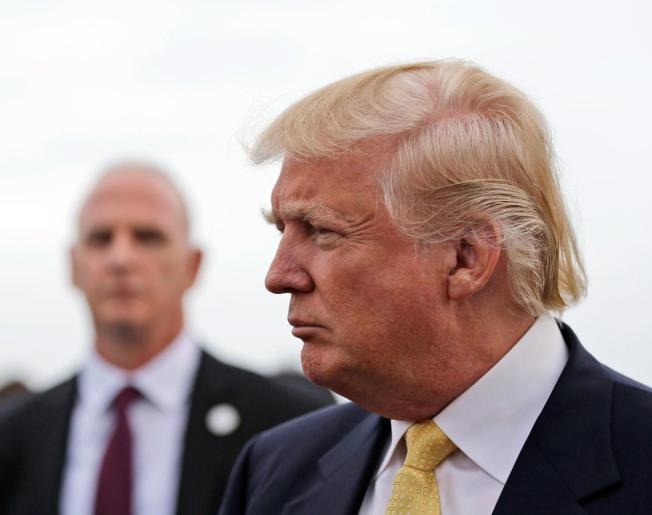
The Donald: Easy to make fun of … too easy (AP/Seth Wenig)
W.J. Astore
A reader wrote to me this morning about Donald Trump and American fascism. Is Trump, with his anti-immigrant posturing and his generally bombastic demeanor, tapping into a “fascist spring” in America?
The question seems unduly alarming as well as absurd. But let’s pause for a moment. I recently saw on TV the results of a poll in which Americans were asked, “Which presidential candidate would best revive the American economy?” The clear winner: Donald Trump. Yes, maybe it’s just name recognition or an association of Trump’s name with money-making, but the result was nevertheless disturbing.
Here’s the thing: It’s easy to view Trump as a joke. His bad hair. His vulgar manner. His obvious bombast.
But guess who else was dismissed as a joke? Adolf Hitler.
Before he got his grip on power, many in Germany thought that Hitler was a joke: bad haircut, ill-fitting clothes, vulgar accent. Hitler was known as the “Bohemian Corporal,” a euphemism which in colloquial American English translates to “Hillbilly Grunt.” As a result, “good” Germans just couldn’t take Hitler that seriously. They underestimated him — and when they tried to move against him, it was far too late.
Of course, I’m not saying that Trump is some kind of Hitler. What I am saying is that popular demagogues are easy to make fun of — easy, that is, until they gain power.
Sinclair Lewis had it right: It Can Happen Here. All it takes is a megalomaniacal and messianic leader, a crisis to make the people desperate (such as the Great Depression that facilitated Hitler’s rise), various elites who cynically and opportunistically throw their support behind the “great leader,” and enough of the rest of us who choose, out of fear or indifference or ignorance, to do nothing.
Update (8/23/15): The Donald is still gaining in the polls, notes the New York Times, despite (or rather because of) the outrageous things he says:
In poll after poll of Republicans, Mr. Trump leads among women, despite having used terms like “fat pigs” and “disgusting animals” to denigrate some of them. He leads among evangelical Christians, despite saying he had never had a reason to ask God for forgiveness. He leads among moderates and college-educated voters, despite a populist and anti-immigrant message thought to resonate most with conservatives and less-affluent voters. He leads among the most frequent, likely voters, even though his appeal is greatest among those with little history of voting.
One thing is certain: Trump draws support from people who are simply tired of traditional candidates like Jeb Bush. But does Trump stand for anything other than himself? He’s notably vague on the issues, perhaps learning from the Obama Campaign in 2008 that it’s far better to sell vague slogans like “hope” and “change” to the American people. Trump’s slogan is “Make America Great Again!” — and that may be all that many Americans want to hear.
During the Roman Empire, chariot races and gladiatorial games served to entertain the people. The U.S. empire’s equivalent, of course, is NASCAR and the NFL. Serve up some bread to go with the circuses and you have a surefire way to keep most people satisfied and distracted.
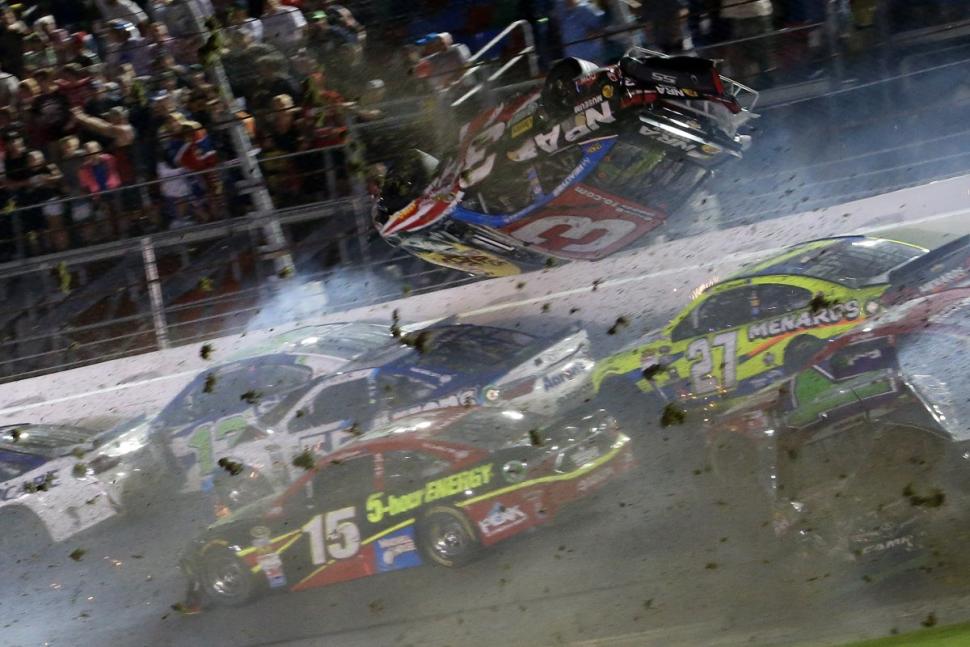
That’s true enough, but let’s dig deeper. NASCAR features expensive, high-tech machinery, heavily promoted by corporate sponsors, with an emphasis on high speed and adrenaline rushes and risk-taking — and accidents, often spectacular in nature. Indeed, turn to the news and you see special features devoted to spectacular crashes, almost as if the final result of the race didn’t matter.
Turn to the NFL and you see it’s about kinetic action — big plays and bigger hits, with players often being carted off the field with concussions or season-ending injuries. The game itself is constant stop and go, go and stop, with plenty of corporate sponsors again.
High-octane violence sponsored by corporations facilitated by high-tech machinery; big hits and repetitive stop-and-go action also sponsored by corporations; spectacular (and predictable) smash-ups and serious injuries, all enfolded in patriotic imagery, with the military along for the ride to do recruitment. Yes, our leading spectator sports do say a lot about us, and a lot about our foreign policy as well.
It used to be said that the Romans fought as they trained: that their drills were bloodless battles, and their battles bloody drills. We conduct foreign policy as we play sports: lots of violence, driven by high technology, sponsored by corporations, with plenty of repetition and more than a few crash and burn events.
A good friend wrote to me to contrast rugby with American football (the NFL). In rugby, he explained, the goal is ball control. Big hits are less important than gaining the ball. The play is hard but is more continuous. Playing as a team is essential. In rugby, there’s far less physical specialization of the players (e.g. no lumbering 350-pound linemen as in the NFL); every player has to run long and hard. There’s far more flow to the game and much less interference by coaches.
We could use more flow and patience to our foreign policy, more “ball control” rather than big hits and kinetic action and quick strikes. Yet, much like NASCAR and the NFL, we prefer high-octane “shock and awe,” the throwing of “long bombs,” with a surfeit of spectacular crashes and collateral damage. All brought to you by your corporate sponsors, naturally, where the bottom line –profit– truly is the bottom line.
Perhaps we should look for new sports. Tennis, anyone?
“Whoever controls the media, controls the mind,” Jim Morrison said, and this is certainly true in America. Consider the lead stories over the July 4th weekend. The first was the threat of terror attacks against America. We were told that law enforcement officials were “in no mood for a national party” — that the threat of an ISIS-inspired terror attack was real. That no attack occurred is of no consequence. Fear was stoked, and that’s what matters. Prepare for the next terror reminder on the anniversary of 9/11, if not sooner.
The second story was shark attacks off the Carolina coast. Unusual, yes, but hardly a threat to America or to the vast majority of its people, even those who chose to go swimming in the ocean. “Shark surge!” “Fear at the beach!” “High alert!” These were common expressions in the media.
Of course, Americans were much more likely to be hurt in fireworks accidents than by terrorists or sharks, but the sensational always takes precedence over the mundane in our media. Indeed, if the goal was to safeguard ordinary Americans, we should have been told to stay off the roads this past weekend, but of course that would hurt tourism and the economy, so you weren’t about to hear that advice coming from America’s talking heads.
It seems nearly impossible to remember that one of FDR’s Four Freedoms was the freedom from fear. FDR knew the paralyzing and stultifying effects of fear, the way it erodes individual autonomy, the way it can be made to serve the powerful. Frank Herbert in Dune captured a powerful truth when he wrote that “Fear is the mind-killer.” The movie Blade Runner echoes the sentiment, with the Replicant Roy Batty (played by Rutger Hauer) explaining that to live in fear is to be a slave.
A media that spreads fear facilitates a government of wolves. Or, put slightly differently by the great Edward R. Murrow, “A nation of sheep will beget a government of wolves.”
There’s a definite method to the media madness, America.
Many people associate the Confederate flag (the “stars and bars”) with the South and the U.S. Civil War (Whoops — I mean “The War of Northern Aggression”). For some people, it’s been a more or less vague expression of Southern heritage, or a symbol of rebellion, a sort of redneck “good ol’ boy” badge of pride. Like any symbol, it is capable of holding multiple meanings. To use academic fancy talk, its semiotics is negotiated and interrogated contextually within contingent cultural settings in which radical interpretive flexibility is possible.
Did you follow that last sentence? If you didn’t, pat yourself on the back, because it’s all BS. The “stars and bars” may have been a Confederate battle flag 150 years ago, but after the Civil War it morphed into a symbol of White supremacy, becoming a symbol of race hatred and violent resistance to integration during the Civil Rights movement.
A little honesty: The Confederate flag is hardly restricted to the South, and therefore it’s not primarily about Southern heritage. In rural Central Pennsylvania, where I recently taught for nine years, the Confederate flag was astonishingly common. It was on license plates; it flew every day at a local gas station; I saw neighbors flying it openly on their flag poles. Why, you might ask?
My wife was very good friends with a Black woman in a local town; the (White) neighbor immediately behind her openly flew a Confederate flag from his flag pole. Remember, this was Pennsylvania, Union country, not the heart of the Confederacy. There was no mistaking this man’s message — his unhappiness that a Black family lived near him, and his decision to make them uncomfortable, to make them squirm, by flying “his” flag.
Think I’m reaching here? My wife’s friend has a son who went to the prom. He complimented a (White) classmate on her prom dress, saying it looked “hot” on her. He got a visit from an off-duty State Trooper who explained to him that Black boys don’t talk to White girls like that. Not around here, son. No, this wasn’t 1963. It was 2013. A half-century after the Civil Rights movement.
It’s good to see that the Confederate flag is finally being taken down from State Capitol buildings; that merchandise featuring it is being pulled from store shelves; that politicians are finally speaking out against it, even Republican candidates for president, who equivocated in such a cowardly manner until even they could no longer resist the pull of public outrage stemming from the latest racial hate crime in Charleston.
The question is: What the hell took them (and us) so long?
The American people are being kept divided, distracted, and downtrodden. Divisions are usually based on race and class. Racial tensions and discrimination exist, of course, but they are also exploited to divide people. Just look at the current debate on the Confederate flag flying in Charleston, South Carolina, with Republican presidential candidates refusing to take a stand against it as a way of appeasing their (White) radical activist base. Class divisions are constantly exploited to turn the middle class, or those who fancy themselves to be in the middle class, against the working poor. The intent is to blame the “greedy” poor (especially those on welfare or food stamps), rather than the greedy rich, for America’s problems. That American CEOs of top companies earn 300 times more than ordinary workers scarcely draws comment, since the rich supposedly “deserve” their money. Indeed, in the prosperity Gospel favored by some Christians, lots of money is seen as a sign of God’s favor.
As people are kept divided by race, class, and other “hot button” issues (abortion and guns, for example), they are kept distracted by insatiable consumerism and incessant entertainment. People are told they can have it all, that they “deserve it” (a new car, a bigger home, and so on), that they should indulge their wants. On HGTV and similar channels, people go shopping for new homes, carrying a long list of “must haves” with them. I “must have” a three-car garage, a pool, a media room, surround sound, and so on. Just tell me what mortgage I can afford, even if it puts me deeply in debt. As consumerism runs rampant, people are kept further distracted by a mainstream media that provides info-tainment rather than news. Ultimately, the media exists to sell product; indeed, it is product itself. No news is aired that will disturb the financial bottom line, that will threaten the corporations that run the media networks, that will undermine the privileged and the powerful.
The people, kept divided and distracted, are further rendered powerless by being kept downtrodden. Education is often of poor quality and focused on reciting rote answers to standardized tests. Various forms of debt (student loan debt, credit card debt, debt from health care and prescription drugs costs, and so on) work to keep the people downtrodden. Even workers with good jobs and decent benefits are worried. Worried that if they lose their jobs, they lose their health care. So much of personal status and identity, as well as your ability to navigate American society, is based on your position. For many it’s lose your job, lose your life, as you’re consumed by debt you can’t repay.
Divided, distracted, and downtrodden: It’s a recipe for the end of democracy in America. But it also serves as a roadmap to recovery. To reinvigorate our democracy, we must fight against divisiveness, we must put distractions behind us, and we must organize to fight for the rights of the people, rights like a better education for all, less debt (a college education that’s largely free, better health care for everyone, and far less emphasis on consumerism as a sign of personal and societal health and wealth), and improved benefits for the workers of America, who form the backbone of our nation.
We can’t wait for the politicians. Most of them are already co-opted by the moneyed interests. Meaningful change will have to come from us. That is, after all, the way democracy is supposed to work.
For George W. Bush, American troops were the greatest force for human freedom in the world. For Barack Obama, the troops represented the world’s finest fighting force, not just in this moment, but in all of human history. What is the reason for such hyperbolic, I’d even say unhinged, praise for our troops? Well, presidents obviously think it is both politically popular with the heartland and personally expedient in making them seem thankful for the troops’ service.
But here’s the problem: We don’t need hyperbolic statements that our military is the “finest fighting force” ever or that our troops are the world’s liberators and bringers of freedom. Such words are immoderate and boastful. They’re also false, or at least unprovable. They’re intended to win favor both with the troops and with the people back home, i.e. they’re politically calculated. And in that sense they’re ill-advised and even dishonest; they’re basically nothing more than flattery.
If I were president, I’d say something like this: “I commend our troops for their dedication, their service, their commitment, their sacrifice. They represent many of the best attributes of our country. I’m proud to be their commander in chief.”
Our troops and most everyone else would be more than satisfied with that statement. Our troops don’t need to hear they’re the best warriors in all of history. At the same time, they don’t need to hear they’re the bringers of freedom (“a global force for good,” to use the U.S. Navy’s slogan, recently dropped as demotivating to sailors and Marines). Let’s pause for a moment and compare those two statements. The toughest warriors and the finest liberators? Life-takers and widow-makers as well as freedom-bringers and world liberators? You think there just might be some tension in that equation?
We need honesty, not immodesty, from America’s presidents. Give me a president who is able to thank the troops without gushing over them. Even more, give me a president who thanks the troops by not wasting their efforts in lost causes such as Afghanistan and Iraq. Give me a president who thanks the troops by downsizing our empire while fully funding benefits and health care for wounded veterans.
That’s the kind of thanks our troops really need – not empty flattery.
About seven years ago, I had an impassioned debate with a conservative friend about whether the U.S. had engaged in torture and, if we had, whether it had been effective. My position was clear: we had engaged in torture, and it was both wrong and counterproductive. My friend was unconvinced. His arguments, which I detail below, provide a contrary perspective on the issue of torture as well as insight into the rationale of those who supported Dick Cheney’s unapologetic stance on torture.
(My friend is now deceased. I don’t believe he would object to having his views outlined here, but I do believe he would wish to remain anonymous. I have edited his comments for clarity, putting them in the form of a list.)
1. Torture. The very word makes us feel a bit uncomfortable. Yet we have yet to come to anywhere near an agreement on exactly what the word means. To some it is hot irons, the rack, and beatings. At the other end are those who maintain the act of keeping prisoners at a facility like Gitmo, or indeed at any facility, is in of itself a form of torture.
I am not in favor of categorically using physical means to obtain intelligence from captives. From the tone of the [White House] memos [on torture], and from what I have read of the views of those in both the White House and the Pentagon, no one there was in favor of that approach either. That is clearly not in the best interests of anyone. At the same time, it is folly to advertise [to the enemy] exactly what we will and will not do.
Clearly, from the very fact that the memos exist at all, and that questions were asked requiring legal answers, this subject was not approached in a cavalier fashion by anyone [in the Bush Administration].
It was St. Augustine who first offered the admonition that you may not do evil that good might come of it. But he also said that it is at time permissible to tolerate a lesser evil to prevent a great evil.
2. Waterboarding did yield results that stopped an attack on US soil. I believe that Cheney is correct in asking that further memos be released that either prove or disprove that point. I also believe that these episodes of waterboarding are being presented [by the media] out of context and without perspective. In sum, if waterboarding resulted in obtaining info that did indeed foil an operation against the U.S., then I see no problem with having used it.
3. The Geneva Conventions [on the treatment of prisoners of war] do not apply here. Terrorists are not soldiers of any state. They do not wear uniforms. We have a new paradigm to which we must adjust, both in the pure military sense, as well as the way we deal with those we capture.
Are such men to be treated as soldiers? Are they to be treated as criminals? Are we to extend such niceties as the Geneva conventions to those who would offer the exact opposite to those who would come under their control?
If we treat all captives as if they were soldiers, under Geneva Convention rules, that would create some problems, and would also effectively end the conversation. There would be no interrogations. On the other hand, if we treat this as a war, and all captives as POWs, then we are well within our rights to keep those same persons under confinement until the war ends.
If we treat these captives as criminals, we have other problems. First, and this may sound silly, but I doubt that they were read their Miranda rights as they were taken prisoner. But if they are to be treated as criminals, then other rules apply as well, and one of those rules is the right for authorities to question them.
As it stands now, how you treat terrorists is open to debate. They are clearly not soldiers. They are also not actually criminals either.
4. The nature of the enemy: What we have now is a very different paradigm. These are not State actors. There is no fear on their part of betraying their “State,” or of facing consequences relating to betraying the State. There is no “State” in the first place. These are Islamo-fascist terrorists, who have no state, only a religious conviction from which they draw their motivation.
We also know that they view cooperation and diplomacy and forbearance as weakness.
We know how totalitarian thugs act and react. We know what drives them, and we know what stops them. We have had ample experience over the centuries.
5. Abu Ghraib in Iraq, while deplorable, also did not represent an attempt to garner intelligence. And its commander was sacked. I take exception to any comparisons with such places as the Hanoi Hilton [in North Vietnam]. The objective there was not information, but rather confession.
And what do we do to detainees who, after being treated as “guests,” respond by throwing feces and attempting to assault US guards? Is no physical response to be permitted at all?
6. This media focus, some would say obsession, with torture is more about attacking the Bush Administration than it is about protecting the rights of prisoners.
7. While I have concerns about the prisoners who are the recipients of torture and abuse, I also worry about those on the other side. The act of abusing another human being is not healthy, and leads to many psychological problems. I worry about the effect any of this activity will have on our own people.
8. The validity of information obtained under torture is always suspect. But we come back then to the very definition of torture. Is the stress of being questioned in of itself a form of torture? And again, we are not talking about soliciting confessions; we are talking about obtaining and confirming information, from various persons and from different sources. If we decide that we cannot in any way, shape, or form question captives, then we might as well just treat them as we would soldiers. And that would mean keeping them locked up for a very long time.”
If I were to summarize my friend’s views, I’d say he believed that torture was regrettable but necessary to keep America safe, that those who were making a big deal about it were motivated by animus against the Bush Administration, and that those who objected to torture in principle didn’t realize the nature of the enemy, i.e. “Islamo-fascist thugs” who had to be “stopped,” even at the cost of committing lesser evils (torture) to prevent greater evils (attacks on innocent Americans).
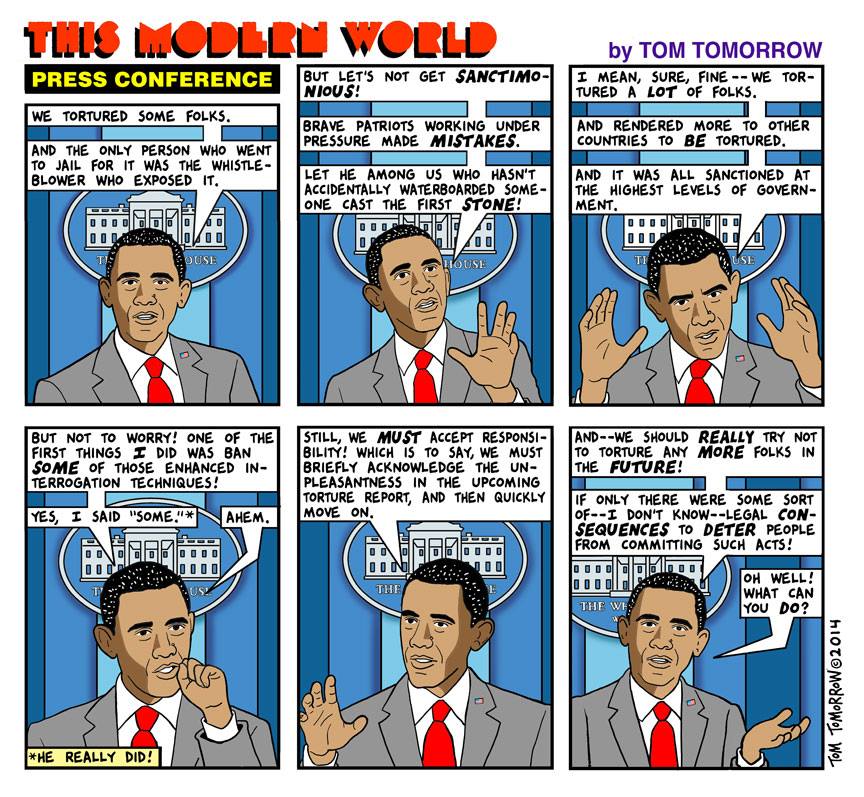
And I’d say his views, politicized and biased as they were, were and are widely held in America, which is exactly why the Obama Administration chose not to prosecute anyone for the crime of torture. “We tortured some folks,” as Obama memorably said, but let’s look forward, not backward. So, in essence, Obama pretty much agrees with my conservative friend.
Update: Another thought: this debate over torture is much like the current debate over the renewal of The Patriot Act. The Obama Administration is trotting out the usual suspects to argue that, to defend ourselves from Islamo-fascist thugs, we must reauthorize the Patriot Act and consent to unlimited surveillance.
It’s yet another version of “we had to destroy the village to save it.” In this case, it’s “we must empower authoritarian and secretive governmental agencies to preserve democracy and freedom in America.” Good luck with that!
Dan White’s article on Admiral (retired) McRaven’s new job as Chancellor of the University of Texas system provides a warning that must be heeded. There is dangerous intent behind the appointment of military flag officers and national security operatives to leading public college and university leadership positions. The political elites, who usually appoint their like-minded allies to the governing boards of these institutions, see students in these public institutions of learning as potential activists against the status quo (as they were during the Vietnam War era). The governing boards usually vet the candidates for this office and thus want the candidate to mirror their own views of “national interests.” Those “interests” don’t include critical thinking or the idea of questioning authority.
Appointing a proven supporter (like McRaven) of the elites’ view of “national interest” in times like these, when their “interest” involves issues at variance with the common good, is looked at as a judicious decision. That means putting people into these offices who support the Patriot Act and its assault on citizens’ rights of free speech and assembly. It also means appointing people who support the government in its pursuit of perpetual war.
McRaven’s appointment to the University of Texas and the ridiculous appointment of Janet Napolitano, former head of the police state agency known as “Homeland Security,” as President of the university system of California are prime examples of this tendency. These selections show absolutely no interest in education but rather in administering and enforcing a sheep-like faculty and student body in these important institutions that otherwise could and should foster the serious questioning of our government and our oligarchical elites.
The elites know that stuffed shirts like McRaven and Napolitano can be counted on to foster bland conformity and blind compliance. That’s exactly why they’re hired for these offices. They work to ensure the subservience of higher education to the national security state. California and Texas are two of the biggest public university systems in the country. Is it any accident they are controlled by Napolitano and McRaven, both former operatives and enforcers in the national security state?
Not only does the national security state conspire to control higher education but national sports as well. Consider the recent revelation of Department of Defense payments to NFL teams for on-field ceremonies in honor of the troops. These ceremonies, used for recruitment and propaganda purposes, were meant to seem free and spontaneous on the part of the participating football teams, even as behind the scenes the Department of Defense was feeding the teams taxpayer money in the millions for these ceremonies. It’s all about extending the reach of the national security state into all realms of life, to include sports. That’s the real NFL scandal of today, not Tom Brady’s “Deflategate.”
Be afraid, America, as the national security state reaches out to control the message of higher education as well as professional sports. High culture, low culture, it doesn’t matter. The power elites want to control it all.
Awaken, patriotic American citizens, and resist. Don’t let the national security state’s tentacles reach into more and more aspects of your and your children’s lives.
The New Yankee Stadium: The House that Corporations Built
W.J. Astore
Back in 2010, I wrote the following article on American sports for Huffington Post. With the end of “March Madness” and the beginning of baseball season, the time seems right to revive it. I love watching my hometown teams and experiencing the vicarious thrill of victory (as well as the agony of defeat), and I’ll never give up sports and the fun of being a fan. But professional sports in America sure make me want to stop watching at times, as you’ll read below:
Been to a major American sporting event lately? If not, consider yourself fortunate. The NFL and NASCAR are already over-the-top when it comes to manufactured noise, exaggerated pyrotechnics, and wall-to-wall corporate advertisements. Even my beloved sport of baseball has fallen victim to sensory saturation and techniques of crowd control that would make a dictator proud. The grace and spontaneity of America’s pastime is increasingly lost in Jumbotrons, overly loud and canned music, and choreographed cheering.
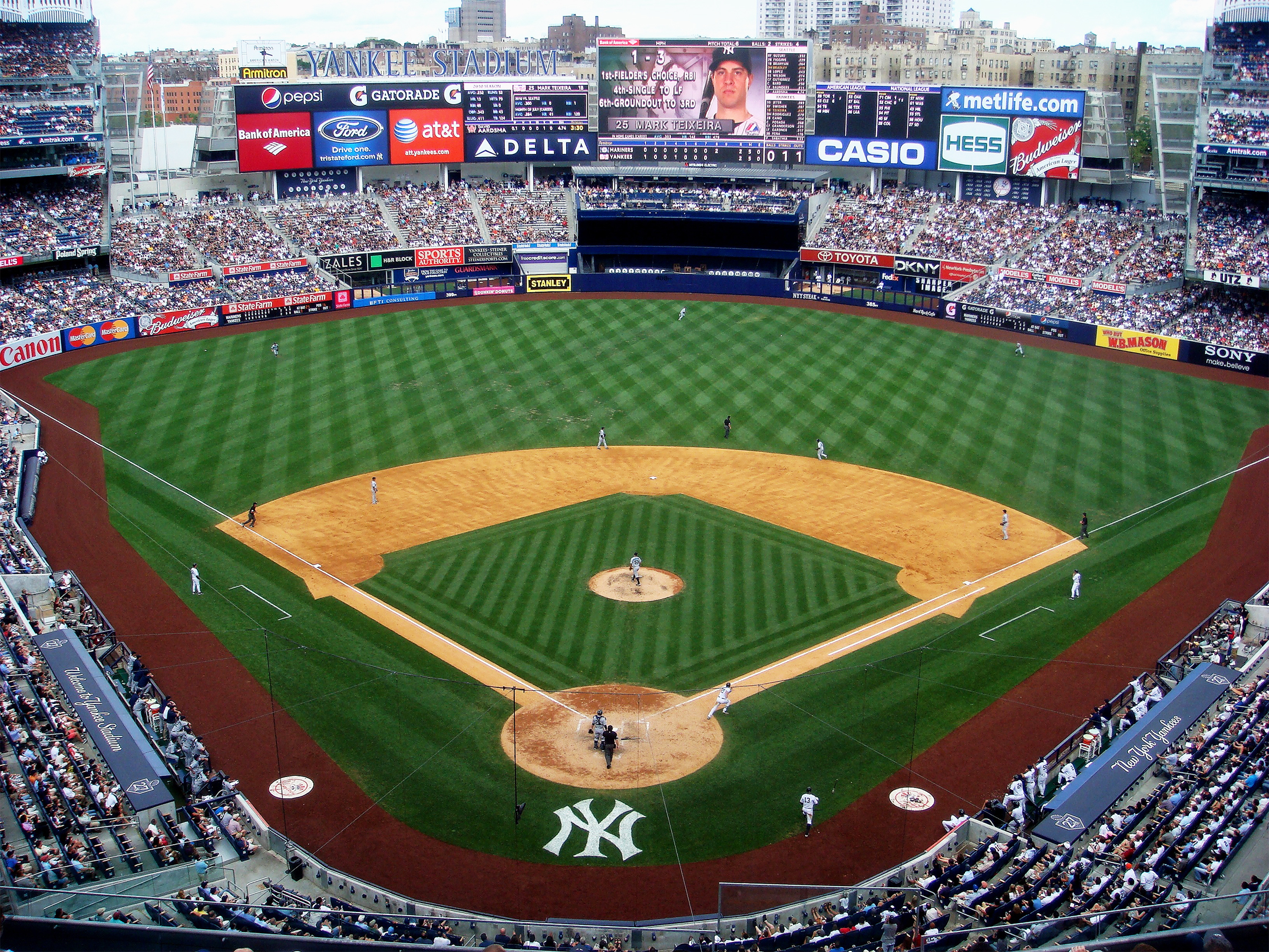
With all the Jumbotrons and other video screens everywhere, people are no longer focused on the game as it takes place on the field, and perhaps turning to their neighbor for an explanation if they miss a play or nuance. Instead, people look to the screens to follow the game. Indeed, sight lines at some seats at Yankee Stadium are so poor that the only way you can watch the action on the field is on video screens posted at strategic locations.
Speaking of Yankee Stadium, last month a friend of mine went to a game there and found the experience “shocking.” In his words:
“The new stadium is flooded with noise from constant speakers as well as screens everywhere. It was so loud that there was really not much independent reaction from the crowd. I got a feeling like I was in a scene from Triumph of the Will. The noise would come out of the speakers and people would chant. When it stopped so did the people. The entire experience left me dying to get out of there!”
Mediocre seats are $110 each, and an $11 beer only compounds the pain. Attending a Yankees game “used to be something of a social leveler, where people of all classes would come and meet to support the team… Although the place was packed for a Red Sox game, it was a largely white crowd, looking nothing like the mix of people who actually inhabit New York,” my friend concluded.
I share my friend’s concerns. I hate being coerced by screens and speakers telling me when to cheer and what to say. Even at my local Single-A baseball games, the post-game fireworks are set to music, usually of a patriotic tenor. I’ve got nothing against music, but why can’t I just enjoy the fireworks? I don’t need “Proud to be an American” blaring to make me proud to be an American.
But it seems like many fans are happy being told when to cheer, what to say, even what to feel. Or they’ve simply become accustomed to being controlled, which has the added benefit to owners of suppressing any inconvenient spontaneity.
More and more, our senses are saturated so we cannot pause to converse or even to think. If the game grows tiresome, people turn to cell phones, palm pilots, and other personal technologies for stimulation. And the phenomenon is hardly limited to sporting events. Today’s version of “Sesame Street” is an exercise in frenetic action and hyperkinetic stimulation; one wonders whether it’s designed for ADHD kids, or to create ADHD kids.
More and more, we’re surrounded by and immersed in near-total sensory saturation; the stifling effect such an environment has on individual spontaneity and thought can’t be disregarded (nor can it be accidental).
And it appears in the most unlikely of places. I used to watch air shows at the U.S. Air Force Academy. Few things are more viscerally thrilling (or chilling) than a formation of F-16s screaming overhead. But that effect apparently wasn’t enough. The powers-that-be “augmented” the air show with loud rock music (call it the “Top Gun” effect) along with an especially annoying (and superfluous) narrator. There was even a proposal to add huge video screens and even bigger speakers to the performance until it got shot down due to charges of contractual cronyism.
In a way, it’s sad to compare today’s thunderingly loud yet sterile air shows to their Depression-era counterparts. The latter, as another friend reminded me, had in his words:
“No concrete runways, no visitor stands, just grass in a field on the edge of town. I loved planes so much that as an eleven year old I would take the two streetcars … then walk a mile to the airport. There was always one or two old biplanes and the small crowd would wait expectantly for the pilots and the daredevils to appear. What excitement just to see those little planes taxing across the grass and getting into position to take off. Gunning their little engines and racing along into the wind. Loops, upside down and then the big thrill, the ‘wing walkers.’ Try that on a jet.”
Bigger, faster, louder doesn’t always mean “better.” Whether it’s an air show or ball game today, we seem saturated by noise, video images, and other sensory distractions, often advertised as “necessary” to broaden the appeal to non-fans or casual spectators who simply want to feel that they’ve witnessed a spectacle, whatever its meaning.
It’s hard to develop an inner life when you’re constantly plugged-in and distracted. It’s also hard to take independent political stances when you’re constantly bombarded by infotainment, not just in the mainstream media but in the sports world as well. I don’t care about off-field shenanigans or contract disputes or manufactured grudges between teams, nor do I want to watch pre-game and post-game shows that last longer than the games: I just want to watch the game and marvel at the accomplishments of world-class athletes while cheering for my home team.
Sports have always been a form of entertainment, of course, but today’s events are being packaged as life-consuming pursuits, e.g. fantasy football leagues. And if we’re spending most of our free time picking and tracking “our” players and teams, it leaves us a lot less time to criticize our leaders and political elites for their exploitation of the public treasury – and betrayal of the public trust. I wonder, at times, if we’re heading in the direction of “Rollerball” (the original movie version with James Caan), in which a few corporations dominate the world and keep the little people (you and me) distracted with ultra-violent sports and hedonistic consumption, so much so that people can’t recognize their own powerlessness and the empty misery of their lives.
Until our sporting events and air shows return to a time when players and fans and enthusiasts collectively showed up simply for the love of the game and the purity of it all (and I can hear my brother mischievously singing, “Until the twelfth of never”), count me out. I can be more spontaneous in my living room with friends — and the beer sure is cheaper.
Update (4/1/2015): Chicago’s Wrigley Field is a vintage ballpark with a lot of character. So how do you ruin some of that? By installing a massive Jumbotron.
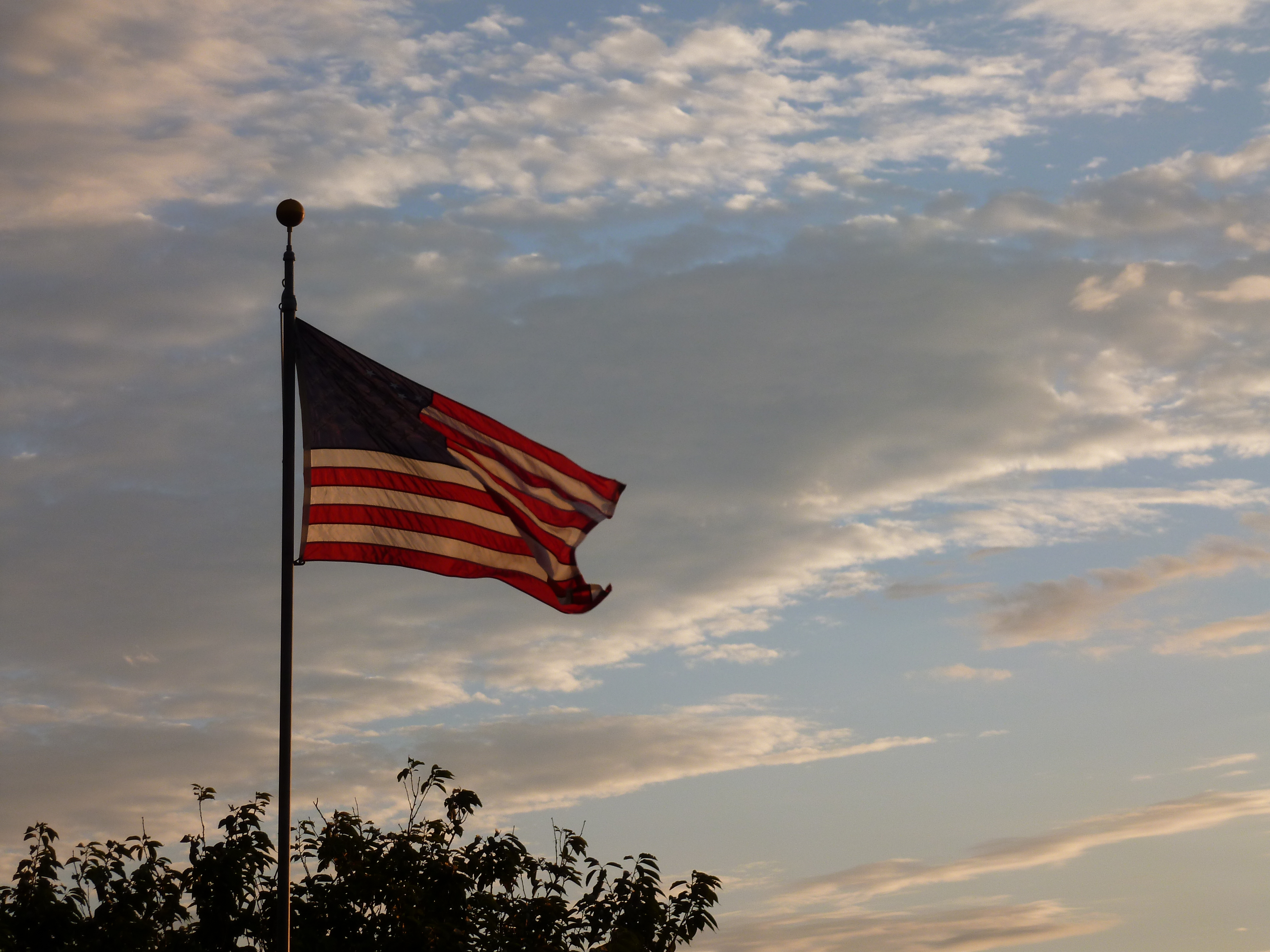
Now this makes me proud to be an American
They still haven’t finished the bleachers, but they have the humongous TV glaring and dominating the skyline in left field. Error, Cubs.
I read old stuff. Heck, I’m a historian: that’s what I’m supposed to do. So I was reading an old pamphlet on “The Indiana World War Memorial” (circa 1940) and came across the Pledge of Allegiance as it was recited before McCarthyism reared its ugly head in the 1950s:
I pledge allegiance to the flag of the United States and to the Republic for which it stands, one nation, indivisible with liberty and justice for all.
You’ll notice what’s missing: that whole idea of “under God.” Those words were added in the early 1950s as a way of contrasting God-fearing (and God-favored, if you’ll recall American exceptionalism) Americans to the godless Communists.
You’ll recall, of course, that our nation was founded in part on religious freedom. The idea you could worship any god or gods you wanted to, or none at all. We should return to the original “godless” pledge. It served us quite well in World War II; it would serve us quite well today.
After all, Americans have no monopoly on God. Furthermore, God does not uniquely bless us. To believe that is to violate the real Ten Commandments, for to believe you are uniquely blessed by God is tantamount to raising yourself to the level of God. No — as Abraham Lincoln wisely said, we must not assume that God is on our side; we must pray that we are on His side.
Speaking of the Ten Commandments, Tom Engelhardt at TomDispatch.com has a compelling list of his “ten commandments” in America’s ongoing war on terror. Like Lincoln, Engelhardt is wise enough not to assume that God is always chanting “USA! USA!”
Here are Engelhardt’s “ten commandments” for America and for a better world. I urge you to read the rest of his article at this link:
1. Thou shalt not torture: Torture of every horrific sort in these years seems to have been remarkably ineffective in producing useful information for the state. Even if it were proved effective in breaking up al-Qaeda plots, however, it would still have been both a desperately illegal (if unpunished) act and a foreign policy disaster of the first order.
2. Thou shalt not send drones to assassinate anyone, American or not: The ongoing U.S. drone assassination campaigns, while killing individual terrorists, have driven significant numbers of people in the backlands of the planet into the arms of terror outfits and so only increased their size and appeal. Without a doubt, such drone strikes represent a global war of, not on, terror. In the process, they have turned the president into our assassin-in-chief and us into an assassin nation.
3. Thou shalt not invade another country: D’oh!
4. Thou shalt not occupy another country: By the way, how did that work out the last two times the U.S. tried it?
5. Thou shalt not upgrade thy nuclear arsenal: The U.S. has now committed itself to a trillion-dollar, decades-long upgrade of its vast arsenal. If any significant portion of it were ever used, it would end human life as we know it on this planet and so should be considered a singular prospective crime against humanity. After years in which the only American nuclear focus was on a country — Iran — with no nuclear weapons, that this has happened without serious debate or discussion is in itself criminal.
6.Thou shalt not intercept the communications of thy citizens or others all over the world or pursue the elaboration of a global surveillance state based on criminal acts: There seems to be no place the NSA has been unwilling to break into in order to surveil the planet. For unimaginable reams of information that have seemingly been of next to no actual use, the NSA and the national security state have essentially outlawed privacy and cracked open various amendments to the Constitution. No information is worth such a price.
7. Thou shalt not be free of punishment for crimes of state: In these years of genuine criminality, official Washington has become a crime-free zone. No matter the seriousness of the act, none — not one committed in the name of the state in the post-9/11 era, no matter how heinous — has been brought into a courtroom.
8. Thou shalt not use a massive system of secret classification to deprive Americans of all real knowledge of acts of state: In 2011, the U.S. classified 92 million documents and the shroud of secrecy over the business of the “people’s” government has only grown worse in the years since. Increasingly, for our own “safety” we are only supposed to know what the government prefers us to know. This represents, of course, a crime against democracy.
9. Thou shalt not act punitively toward those who want to let Americans in on what the national security state is doing in their name: The fierce and draconian campaign the Obama administration has launched against leakers and whistleblowers is unprecedented in our history. It is a growing challenge to freedom of the press and to the citizen’s right to know.
10. Thou shalt not infringe on the rights of the citizenry to life, liberty, and the pursuit of happiness: Need I even explain?”
Why not make a pledge, America, to these “commandments”? For they will help us to ensure liberty and justice for all.





 Bracing Views