Why Do Americans Admire the Military So Much?

wesalute
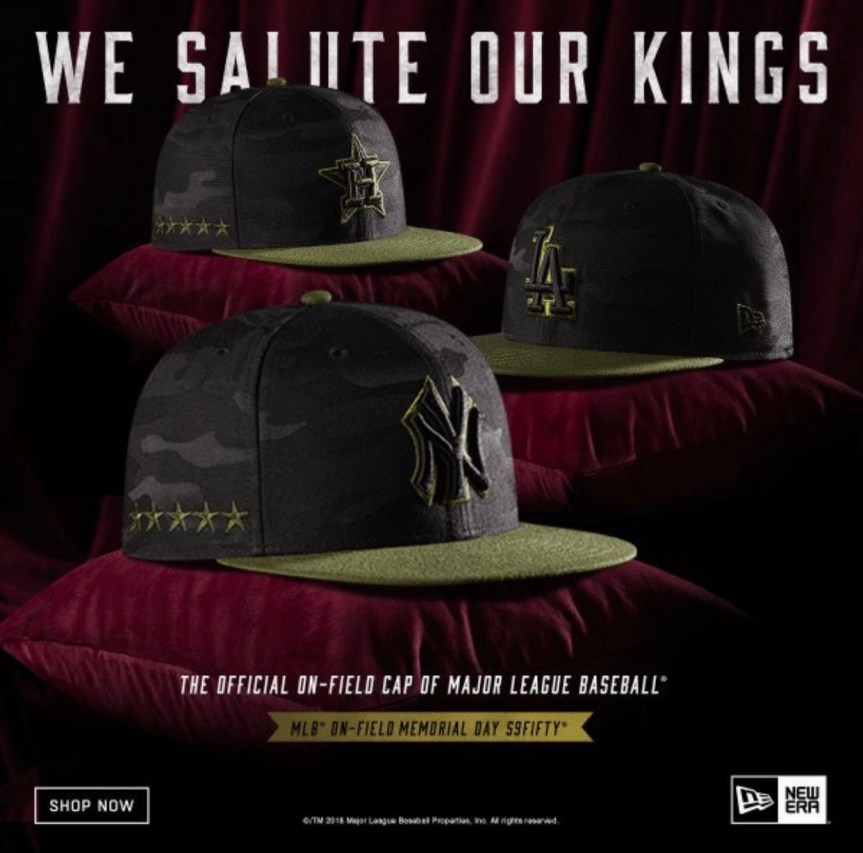
Admiration — or adulation?  An over-the-top “salute” to the troops in a marketing campaign for camouflage baseball caps

W.J. Astore

A reader recently posed a simple question: If the U.S. military hasn’t won a war decisively since 1945, why do Americans continue to place so much faith in it and its leaders?  I’ve tackled this issue before, but it got me to thinking again about the roots of military admiration — and adulation — within our society.

Here are a few reasons I came up with:

1. Although the U.S. military lost in Vietnam, stalemated in Korea, and got bogged down in seemingly endless wars recently in Iraq and Afghanistan, that doesn’t mean it hasn’t won victories in battles, such as Desert Storm in 1991 or the beginning of Afghanistan in 2001 and Iraq in 2003.  Its defeats were not primarily the fault of the troops but of poor leadership at the top (both military and government).  In other words, when Americans say they admire and trust the military, what they mean, perhaps, is they appreciate the spirit of service and sacrifice of the troops, while reserving judgment on presidents and generals.

2. Let’s not forget victory in the Cold War.  The fall of the “Iron Curtain,” the collapse of the Soviet Union, the reunification of Germany, the end of the Warsaw Pact — these were momentous events for the West.

3. The U.S. military may not win wars, but it does accomplish good things, e.g. rescue work, disaster relief, humanitarian missions.  Critics often neglect these non-hostile missions.

4.  Pro-military propaganda.  There are many, many, examples of this, e.g. President Reagan and the myth of the noble cause in Vietnam, or presidents from Bush to Obama to Trump consistently praising the military as the finest fighting force in all of history.  This is supported by Hollywood and TV.  Think of all the movies and television shows that depict the military and war as ennobling and exciting and energizing.

5. The military-industrial complex and its power to control the narrative.  The national security state has become a fourth branch of government with enormous influence and power in society.  The mainstream media, for example, is dominated by pro-military talking heads, most of whom are retired colonels or generals.

6. Guilt.  The U.S. military is “all volunteer.”  The vast majority of Americans not only choose not to serve — they choose not to pay much attention.  And I think many have some guilt for this, which they assuage with “support our troops” bumper stickers and other easy gestures of conformity.

7.  Exposure to the military may be limited, but that doesn’t mean it’s not emotional.  Indeed, when they think of the military, Americans may think of a son or daughter who serves, or granddad who served, or maybe that nice boy or girl down the street in uniform.  They know nothing of the Pentagon, the military-industrial complex, war crimes, and so on.

8.  For many Americans, the military is a point of pride.  A symbol of strength but also a symbol of service and sacrifice.

My point is not to praise the military — it gets plenty of praise already, indeed, way too much praise, so much so that admiration becomes adulation.  My intent here is rather to explicate some of the reasons why Americans continue to place so much confidence in the military, even when the results are disastrous.

One more thought: We live in a “selfie” society, a me-first culture.  Whatever the military is, it’s not typically me-first.  So when people say they respect or trust the military, perhaps they’re thinking of an organization that values teamwork — that puts the many before the few.  In an America marked by divisiveness, it’s an ideal that resonates still.

Readers, what do you think?

Postscript: In my list above, I should have highlighted more strongly the role of lying by the military and government (think of the initial lies/reports about Pat Tillman’s death in Afghanistan, for example).  I’m currently reading Sy Hersh’s new book, “Reporter.”  Hersh’s accounts of systematic lying by the military and government during the Vietnam War are sober reminders to Americans.  Yes, our government and military will often lie to us, sometimes for the most mundane reasons, but often to avoid accountability and to maintain control over the narrative.

When we think of the American press corps in the Vietnam War, names like Hersh and David Halberstam and Neil Sheehan come to mind, hardboiled reporters who sought the truth, no matter how shattering it proved to be.  But these men, and reporters like Izzy Stone, were truly exceptional.  Most reporters were more or less willing to repeat government and military explanations verbatim and without pushback.  Hersh cites Arthur Sylvester, who served as Defense Secretary Robert McNamara’s senior press aide, as describing the Pentagon press corps as “shabby” and gullible.  “Cover stories [lies],” Sylvester wrote, “go down smooth as cream [and for six years], when I thought they would cause a frightful gargle” among reporters.

So, even as the Pentagon fooled many reporters and most Americans about progress in and prospects of the war, they didn’t fool the North Vietnamese themselves, who decisively won the war.  “There was no learning curve among the men in the Pentagon running the war,” Hersh concludes (p. 62).  Perhaps all these men really learned was how to lie better in the future — and how to shift blame from themselves to the usual suspects (hippies, leftists, commies, anti-war protesters, and so on).

Update (8/6/18): For more on U.S. lies and self-deception, see “The American Sea of Deception” by Paul Street at Truthdig.com.

School as Prison

PrisonAir
A blueprint for America’s schools of the future?

W.J. Astore

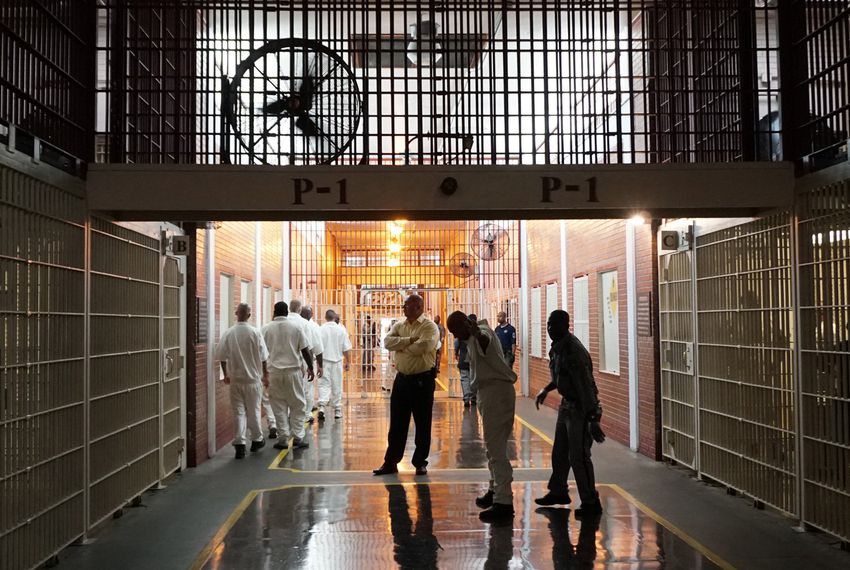
Back in the 1970s, when I was in high school, smart aleck students used to joke about high school as “prison.”  Nowadays, American schools have metal detectors, school police, even armed teachers.  And let’s not forget reinforced doors and lockdown drills–just like real prisons!  And all these guns and security devices and police presence is together touted as “the solution” to school violence.

I thought of this when I read this morning that Marjory Stoneman Douglas High School in Parkland, Florida, where seventeen students were murdered last February, is adding metal detectors to protect students.  (Not that metal detectors would have kept out the former student/shooter, Nikolas Cruz, who murdered all those teenagers in cold blood.)  Perhaps the school is doing this to reassure parents; or to deter copy-cats; or to preempt possible lawsuits in case of future attacks.  Or maybe they really believe that having 3,200 students pass through metal detectors each and every morning is the cost of being “safe.”

One thing is certain: We’re raising our young people with a lockdown mentality.  We’re teaching them the best way to be safe is to submit passively to metal detectors and other forms of security screening.  We’re indoctrinating them with the idea that a guard with a gun is the very best form of security, and that even their teachers, charged with educating them, may be packing heat in the classroom — to keep them safe, naturally.  (These teachers may even be making a few extra bucks after completing gun training.)

Who says American students aren’t learning anything in our schools?  They’re learning every day they pass through a metal detector, or see heavily armed police in school corridors, or their teachers toting firearms.  Every day they have to submit to lockdown drills, they’re learning.

I don’t have a smart aleck observation here.  Just a sad one: that old joke about school as prison isn’t even worth a teenager’s smirk anymore.

The Races of Man

W.J. Astore

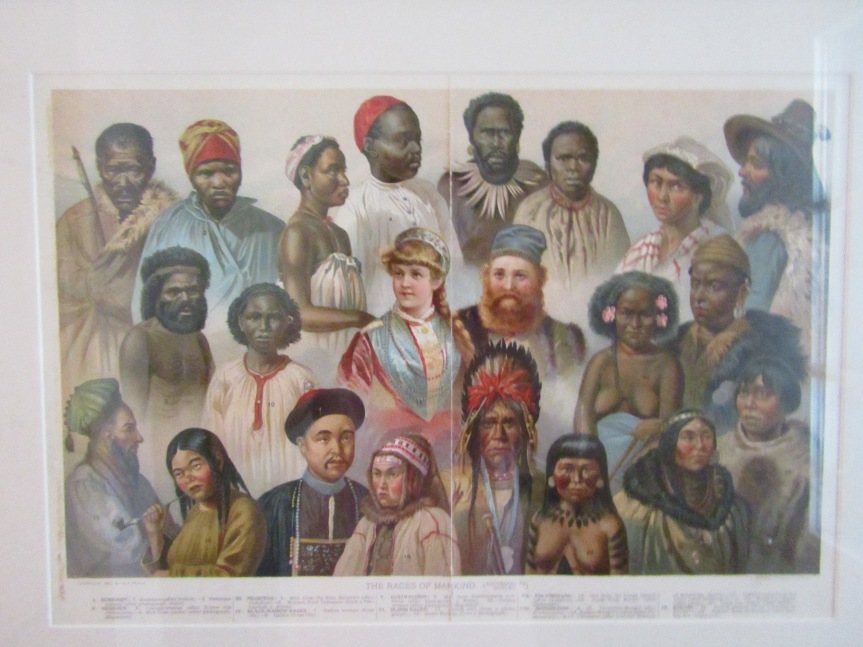
In the 19th century, many people believed in polygenism, and others used the concept of “the races of man,” where by “race” they often meant species.  At home, I have a framed copy of the races of man taken from an encyclopedia published in the 1890s.  Here’s a photo of it:

IMG_1827

Of course, there’s always an assumed hierarchy to the races of man concept.  White Europeans are at the top, since it’s they who defined and ordered the hierarchy.  Surprise!

In my photo, White Europeans take pride of place in the center, with some swarthy Italians at the top right (I’m half-Italian).  Meanwhile, Polynesian (pink flowers in hair) and Indian (from South America) women are shown with bare breasts.  “Primitives” are primitive precisely because they’re “immodest” in dress, a convention that allowed publishers to show nudity in illustrations and photos without being accused of pornography.  You might call this the “National Geographic” dispensation for nudity.

My college students were often amazed when I told them that science shows that all of us — all humans — came out of Africa.  Far too many people today still think of race as both definitive and as a rung on a ladder, and naturally they always place their own “race” on the top rung.

Even more disturbing is the resurgence of racialized (and often racist) thinking in the United States.  The idea of the races of man and the “scientific” ordering of the same was debunked a century ago, yet it’s back with a vengeance in much of the U.S.

Naturally, those who promote racialized thinking always put their own perceived race at the top.  In that sense, nothing whatsoever has changed since the 19th century and the “races of man” concept.

Hollywood Stars and Sports Heroes: Uncle Sam Wants You!

Stewart
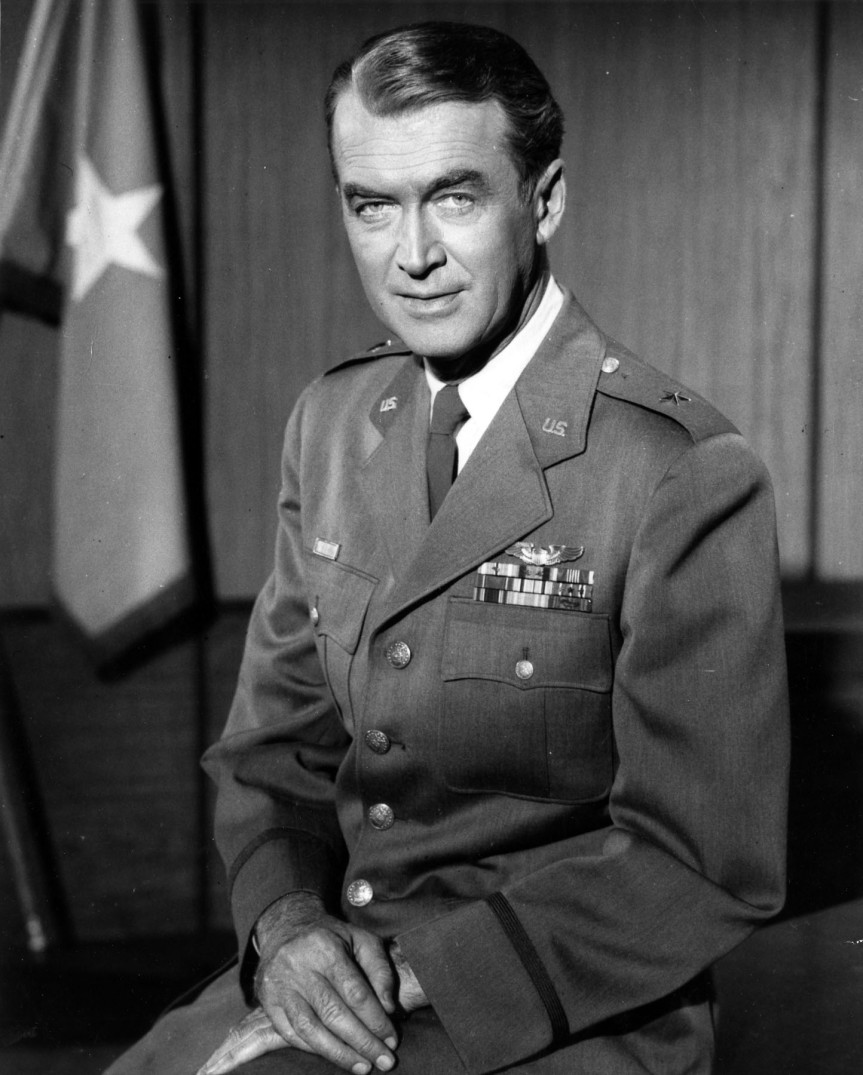
No — Jimmy Stewart is not acting here.  He flew bombers in World War II and rose to the rank of brigadier general in the Air Force

W.J. Astore

Back in 2013, I wrote an article on U.S. wars and the absence of movie and sports stars in the ranks of those who serve.  Hollywood and sports leagues such as the NFL and MLB celebrate the military today, but that celebration does not extend to service and sacrifice.  Indeed, the main service is lip service: basically, cheap words to the effect that we celebrities “support” the troops.  It’s not exactly the kind of service we associate with the Greatest Generation of World War II, is it?

Yet the absence of Hollywood celebrities and sports “heroes” in the ranks may be indicative of another, much more serious, issue.  Maybe America’s wars simply aren’t vital to them — or to us?  And if they’re not vital, why are they still in progress?  Why can’t we end them?

Here is what I wrote in 2013:

The tradition of the citizen-soldier is still alive in this country — just look at our National Guard units. But the burden of military service is obviously not equally shared, with the affluent and famous tucked away safely at home. How many people remember that Jimmy Stewart, legendary Hollywood actor, flew dangerous combat missions in the skies over Europe during World War II? Stewart didn’t flaunt his combat service; in fact, playing against type, he stayed home as the unhallowed George Bailey in It’s A Wonderful Life, a movie that celebrated the heroism of the ordinary citizen. In the movie, Stewart’s quiet, home-based heroism, his powerful sense of fairness and decency, is even allowed to overshadow that of his younger brother, who returns from war with the Medal of Honor.

There’s an interesting lesson there. In World War II, celebrities often risked life and limb in real military service, then after the war played against type to celebrate the virtues of a homespun heroism. Today’s celebrities avoid military service altogether but play tough in action films where they pose as “heroes.”

Other than Pat Tillman, who gave up a promising NFL football career to join the military after 9/11, I can’t think of a single celebrity who answered the call to arms as a citizen-soldier.

Then again, that call was never issued. After 9/11, President George W. Bush famously told us to keep calm and carry on — carrying on shopping and patronizing Disney, that is. He did so because he already had a large standing professional military he could call on, drawn primarily from the middling orders of society. This “all volunteer military” is often described (especially in advertisements by defense contractors) as a collection of “warfighters” and “warriors.” In the field, they are supplemented by privatized militaries provided by companies like Academi (formerly Blackwater/Xe), Triple Canopy, and DynCorp International. In a word, mercenaries. These bring with them a corporate, for-profit, mindset to America’s wars.

If we as a country are going to keep fighting wars, we need a military drawn from the people. All the people. As a start, we need to draft young men (and women) from Hollywood, from the stage and screen. And we need to draft America’s sports stars (I shouldn’t think this would be an issue, since there are so many patriotic displays in favor of the troops at NFL stadiums and MLB parks).

Jimmy Stewart served in combat. So too did Ted Williams. So too did so many of their Hollywood and sporting generation.

Until today’s stars of stage and screen and sports join with the same sense of urgency as their counterparts of “The Greatest Generation,” I’ll remain deeply skeptical of all those Hollywood and sporting world patriotic displays of troop support.

If this whole line of argument sounds crazy to you, I have a modest suggestion. Rather a plea. If our celebrities who profit the most from America are unwilling to defend it the way Stewart and Williams did, perhaps that’s not just a sign of societal rot. Perhaps it’s a sign that our wars are simply not vital to us. And if that’s the case, shouldn’t we end them? Now?

The U.S. Postal Service: Ripe for Privatizing?

download

W.J. Astore

I got involved in a brief discussion on Facebook about privatizing the U.S. postal service.  Briefly, those in favor of privatization argued that the post office is inefficient and costly, and that exposing it to market forces through privatization will result in much improved efficiency at lower cost to the American taxpayer.

First of all, if you’re looking for a wasteful government agency to privatize, why not start with the department of defense, which spends roughly $750 billion a year, and which has never passed an audit?  Leaving that aside, the privatization enthusiasts assume that “market forces” will necessarily generate improvements in efficiency and improved service.  But what if it just monetizes everything, leading to higher prices and poorer service?

Furthermore, why should “efficiency” be the primary goal for a public service? Many small communities and villages rely heavily on local post offices. Under an “efficient” and private system, these local post offices are likely to be closed or consolidated in the name of efficiency, with prices rising for poor and rural communities. Those steps may be “efficient” to private owners, but they won’t be beneficial to all the people who just want mail and related services (and maybe a place to chat with neighbors).

Service to the public should be the primary goal of a public service, not “efficiency.” Sure, efficiency is a good thing, but so too is affordability, convenience, trustworthiness, courteousness, and so on.  When you elevate efficiency as the goal above all others, and measure that by metrics based on money, you are inevitably going to compromise important aspects of public service.

Consider the state of public education. When you privatize it, new metrics come in, driven by profit.  Private (charter) schools, for example, pursue better students and reject marginal ones as they attempt to maximize test scores so as to justify their approach and ranking.  Public schools have to take all students, the good and the bad, the affluent and the disadvantaged, and thus their ratings are often lower.

There’s a myth afoot in our land that government is always wasteful and inefficient, and that unions are always costly and greedy.  Our postal service employs roughly 213,000 people, fellow Americans who work hard and who, when they retire, have earned a pension and benefits.  Why are so many people so eager to attack public postal workers as well as public schoolteachers?

In my 55 years of living in America, I’ve been well served by a public post office and well educated by public schools. I see no compelling reason to privatize public services just because someone thinks a corporation driven by profit can do it more efficiently.

People think that corporations driven by the profit motive will inevitably produce a better system with improved service.  While profit can be made by providing superior service, it can also be made by providing shoddy service or even no service at all, especially in a market resembling a monopoly, or one where corporations are protected by powerful interests.

To recap: public service and efficiency are not identical. Nor should we think of ourselves merely as consumers of a product, whether that product is mail service or education.  We need to think of ourselves as citizens, and the post office as composed of citizens like us providing a public service for us, a service where “efficiency” is only one driver, and not the most important one.

A final, perhaps obvious, point: often those who argue for privatization are also those with the most to gain, financially, from it.  A lot of people are making money from charter schools, for example.  It’s not “efficiency” that’s the driver here: it’s the chance to make a buck, and despite what Gordon Gekko said, greed isn’t always good and right, especially when public service is involved.

What do you think, readers?

On Love

Aunt Mary 007
My Aunt Mary, on the left, with a friend

W.J. Astore

In Memory of My Aunt Mary (died 2012)

When I was in CCD and preparing to be confirmed at St. Patrick’s Church in the late 1970s, our teachers tried to teach us kids what “love” is.  We were asked to give definitions.  As teenagers, we came up with the usual definitions of romantic love, all valentines and holding hands and smooching.

No, our teachers explained, love should be selfless.  It’s not about you.  Love is about giving without expecting anything in return.

Throughout her long life, Aunt Mary demonstrated that kind of love.  She gave to her own mother, caring for her as she aged.  She gave to her sister Corrine through her struggles.  She gave to her brother Gino.  She gave to us all, and she did so with generosity and goodness and grace.  She gave without expecting anything in return.

She loved.

So, if my old CCD teachers asked me today for a definition of love, my answer would be a simple one.  “ ‘Love,’ ” I’d say, “is my Aunt Mary.”

Aunt Mary blessed our lives for 94 years.  Let us give thanks to God that she was with us for so long.  And let us all learn from her shining example the true meaning of love.

Trump and Noxious Notions of Masculinity

Two_complete_science_adventure_books_1951win_n4

W.J. Astore

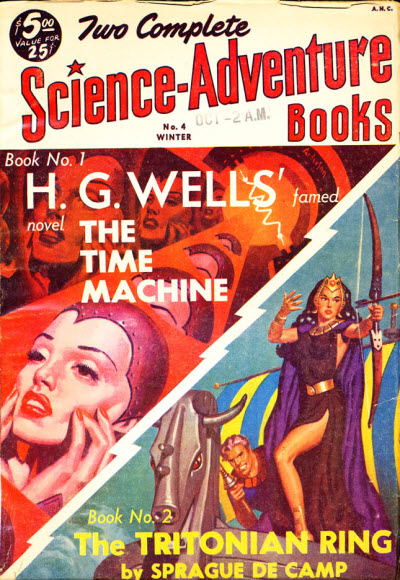
A friend recently sent me a passage from H.G. Wells’ The Time Machine (1895) that resonated with me.  It comes when the main character journeys deep into the future.  He muses about what kind of human beings he will face:

What might not have happened to men? What if cruelty had grown into a common passion? What if in this interval the race had lost its manliness and had developed into something inhuman, unsympathetic, and overwhelmingly powerful? I might seem some old-world savage animal, only the more dreadful and disgusting for our common likeness–a foul creature to be incontinently slain.

Writing in the late Victorian era, Wells put a heavy stress on manliness that is decidedly unfashionable today.  Yet his description of manliness is interesting: he contrasts it to men who are “inhuman, unsympathetic, and overwhelmingly powerful.”  For Wells, true manliness taps humane qualities; it values sympathy; it resists being consumed by a will to power.

And it struck me that in men like Trump, a portion of the dystopic future Wells envisions in The Time Machine is now.  For Trump, being “manly” is about acquiring power, commanding obedience, forcing other men to submit while grabbing pussy whenever you can.  It’s a noxious notion of masculinity, an unsympathetic, even an “inhuman” one.

Another interesting passage I came across this week appears in Robert Ludlum’s The Bourne Identity (1980). The main female character in that book, a Canadian economist by the name of Marie, muses about the men she’s encountered in government employ, at the highest and most secretive levels:

Oh, God, she loathed them all!  Mindless, stupid men.  Playing with the lives of other men, knowing so little, thinking they knew so much.

They had not listened!  They never listened until it was too late, and then only with stern forbearance and strong reminders of what might have been—had things been as they were perceived to be, which they were not.  The corruption came from blindness, the lies from obstinacy and embarrassment.  Do not embarrass the powerful; the napalm said it all.

And again it got me thinking of Trump and men like him.  Trump is all about his “instincts.”  He doesn’t bother to read or study, and he sure as hell is not a listener.  And he lies and lies just to stay in shape.

But Trump is less cause than symptom.  America produced him, and voters voted for him.  Roughly one-third of Americans continue to say they support him, irrespective of his serial lying, serial infidelity, and his greedy and grasping policies that favor the richest few over the poorest many.

As Marie said in The Bourne Identity, America has too many “mindless, stupid men.”  Men whose ideas about masculinity are defined in opposition to that of H.G. Wells’ concept.  Men who are driven by power, who think being manly is about suppressing any sympathy for those less fortunate, men who are proud to be “tough” by being inhumane and nasty.  “Empty souls,” as my wife succinctly said this morning.

Education is Labor, Right?

download

W.J. Astore

So, the Trump Administration wants to merge the Department of Education with Labor.  What a surprise.  According to Mick Mulvaney, the Director of the Office of Management and Budget, “They’re [Education and Labor] doing the same thing.  Trying to get people ready for the workforce, sometimes it’s education, sometimes it’s vocational training – but all doing the same thing, so why not put them in the same place?”

I saw this push for education as workforce development when I was a professor of history in Pennsylvania.  Education was largely reduced to vocational training, in partnership with business and industry.  My classes in history (including the social history of technology) were essentially “filler” classes, and indeed I had a student tell me he might see me again if he needed another “filler” class.  I wasn’t angry; I was amused at how perceptive and honest the student was.

Of course, America will always have the Ivy League.  Education as training for a job won’t really drive the curriculum at Yale or Harvard or Princeton.  You can still get a decent liberal arts education in America, assuming you have money.  But if you don’t, it’s off to “workforce training” for you.

When I was still teaching, I used to argue that my history classes were especially valuable to students at the college where I taught since they might be the only college-level course in history that they’d ever experience.  I’d argue that plumbers and welders and nurses needed to know history too.  Why?  Because they’re not just aspiring plumbers and welders and nurses — they’re American citizens, and the health of our democracy is based on a well-informed and broadly educated citizenry.

The Trump Administration doesn’t want such a citizenry.  Their vision of education is not about creative and critical thinking, and it certainly isn’t about challenging authority.  Rather, it’s about job training, workforce development, preparing people for a lifetime of labor — and supine obedience.

Well, as our “stable genius” president said, “I love the poorly educated.”  Under this latest proposal, he’s putting his “love” into practice.

An Addendum: When you treat education as a business, as administrators have been doing in higher ed, is it any surprise when education is reduced to a feeder and filler for labor, for business and industry, for the workforce?  As a professor, I had plenty of experience with administrators who sold education as a commodity, who talked about students as “customers” and professors as “providers” of a product.  One high-level administrator insisted that we professors meet our students “at their point of need.”  Another big push when I was a professor was on retention.  Keep those students in college!  If only to keep enrollment up and the tuition dollars flowing.

We have reduced education to a business and classes to commodities, so why not combine education with labor?  It makes perfect sense … and supports perfectly authoritarian rule.

The Military and Sports

Back in July 2011, I wrote an article on how sports were being militarized in American life.  On this subject as well as protest by (mostly) Black athletes, there’s a new book out, The Heritage, written by Howard Bryant, a journalist for ESPN.  The book is excellent and is truly required reading for all sports fans, and indeed for all concerned Americans.
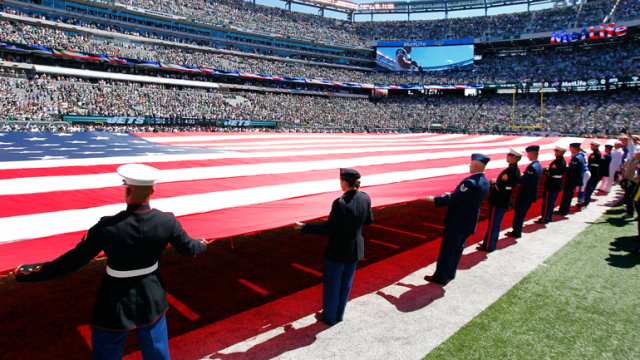
Sports have become infected by often pro forma, often coerced, often empty displays of “patriotism” that consist of gigantic flags, flyovers by combat jets, the wearing of faux camouflage uniforms by players, and similar displays.  (There’s nothing wrong, I should add, with teams and players supporting military charities and the like.)  These so-called patriotic displays are celebrated and applauded even as rare and respectful protests by players are attacked as unpatriotic and un-American.
Every military member knows that our oath of office is to support and defend the U.S. Constitution against all enemies, foreign and domestic.  The enemies of our Constitution are not those players who take a knee in protest when they know it’ll prove unpopular; the enemies are those who attack those players while hiding behind the military and the troops.
Dissent and protest is American; it’s what our founders dared to do against long odds when in 1776 they declared their independence from a powerful empire.  Isn’t it astonishing that in these days so many Americans need to be reminded of this vital fact?  W.J. Astore, 6/10/18

download

The Militarization of Sports — And the Sportiness of Military Service

Originally posted in July 2011.

Connecting sports to military service and vice versa has a venerable history. The Battle of Waterloo (1815) was won on the playing fields of Eton, Wellington allegedly said. Going over the top at the Battle of the Somme (1916), a few British soldiers kicked soccer balls in the general direction of the German lines. American service academies have historically placed a high value on sports (especially football) for their ability to generate and instill leadership, teamwork and toughness under pressure.

But in today’s America, we are witnessing an unprecedented militarization of sports, and a concomitant emphasis on the sportiness of military service. With respect to the latter, take a close look at recent Army recruitment ads (which I happen to see while watching baseball). These ads show soldiers lifting weights, playing volleyball, climbing mountains and similar sporty activities. The voice-over stresses that army service promotes teamwork and toughness (“There’s strong. Then there’s army strong.”) There are, of course, no shots of soldiers under direct fire, of wounded soldiers crying for help, of disabled veterans. Army service in these ads is celebrated as (and reduced to) an action-filled sequence of sporting events.

Today’s militarization of sports is even more blatant. Consider this excellent article by U.S. Army Colonel (retired) Andrew Bacevich, which highlights the “cheap grace” available to crowds at major sporting events. For-profit sports corporations and the Pentagon join hands to orchestrate pageants that encourage (manipulate?) us to cheer and celebrate our flag, our troops and our sports and military heroes, as the obligatory fighter jets roar overhead.

Now, I’m sure there are well-meaning people who see such pageantry as an uncontroversial celebration of love of country, as well as a gesture of generosity and thanks to our military. And this retired veteran admits to feeling my heart swell when I see our flag flying proudly and our troops marching smartly. But the co-joining of corporate-owned sports teams and events (which are ultimately about entertainment and making a buck) with the military (which is ultimately in the deadly business of winning wars) strikes me as more than disturbing.

To cite only one example: The San Diego Padres baseball team takes “tremendous pride” in being “the first team in professional sports to have a dedicated military affairs department,” according to a team press release quoting Tom Garfinkel, the Padres president and chief operating officer. But is it truly “tremendous” for sports teams to be creating “military affairs” departments? As our sporting “heroes” celebrate our military ones, does not a dangerous blurring take place, especially in the minds of America’s youth?

War is not a sport; it’s not entertainment; it’s not fun. And blurring the lines between sport and war is not in the best interests of our youth, who should not be sold on military service based on stadium pageantry or team marketing, however well-intentioned it may be.

We’ve created a dangerous dynamic in this country: one in which sporting events are exploited to sell military service for some while providing cheap grace for all, even as military service is sold as providing the thrill of (sporting) victory while elevating our troops to the status of “heroes” (a status too often assigned by our society to well-paid professional athletes).

Which brings me to a humble request: At our sporting events, is it too much to ask that we simply “Play Ball?” In our appeals for military recruits, is it too much for us to tell them that war is not a sport?

Think of these questions the next time those military warplanes roar over the coliseum of your corporate-owned team.

Anomie and Postmodernism

meaning-of-life

Richard Sahn

These are not exactly happy times. Americans have fewer safeguards for their jobs, financial well-being, and, ultimately, their very lives. Uncertainty and insecurity have become more prevalent than ever I can remember. As a consequence, insomnia, depression, angst seem to be characteristic of an increasing number of people across the country, almost as American as apple pie. Just as being a divorcee in California is nothing to write home about—you’re even considered odd if you have never been divorced—so is the sense that something “bad” can happen at any time, without warning. Sociologists—I am a sociologist–call this condition “anomie,” a concept formulated by one of the founders of sociology, Emile Durkheim. The Trump presidency, it may be argued, exacerbates anomie since we seem to be moving closer to economic nightmares and possibly nuclear holocaust than in recent decades.

What exactly is anomie? Anomie literally means without norms. It’s a psychological condition, according to Durkheim, in which an individual member of a society, group, community, tribe, fails to see any purpose or meaning to his/her own life or reality in general. Anomie is the psychological equivalent to nihilism. Such a state of mind is often characteristic of adults who are unemployed, unaffiliated with any social organization, unmarried, lack family ties and for whom group and societal norms, values, and beliefs have no stabilizing effect.

The last situation can readily be the outcome of exposure to sociology courses in college, providing the student does not regularly fall asleep in class.  I’ve always tried to caution my own students that sociology could be, ironically, dangerous to their mental health because of the emphasis on critical thinking regarding social systems and structures. Overcoming socialization or becoming de-socialized from one’s culture—when one begins to question the value of patriotism, for instance—can be conducive to doubt and cynicism which may give rise to anomie.  Of course, I also emphasize the benefits of the sociological enterprise to the student and to society in general. For example, a sociology major is perhaps less likely to participate voluntarily in wars that only favor special interests and which unnecessarily kill civilians.

Clinical depression is virtually an epidemic in the U.S. these days. Undoubtedly, anomie is a major factor, especially in a culture where meaningful jobs or careers are difficult to obtain.  To a great extent social status constitutes one’s definition of self. In Western societies the answer to the perennial philosophical question, “Who are you?” is one’s name and then job or role in the social structure.  Both motherhood and secure jobs or careers are usually antidotes against anomie. Childless women and unemployed or under-employed males are most susceptible to anomie.

What does postmodernism offer to combat the anomie of modern society and now the Trump era itself? An over-simplification of post-modernism or the postmodern perspective is that there is no fixed or certain reality external to the individual. All paradigms and scientific explanations are social constructs, one model being no more valid than the other. A good example of the application of the postmodern perspective is the popular lecture circuit guru, Byron Katie. Ms. Katie has attracted thousands of followers by proclaiming that our problems in life stem from our thoughts alone. The clutter of consciousness, thoughts, feelings, can simply be recognized as such during meditation and then dismissed as not really being real. Problems gone.

An analogy here is Dorothy Day, the founder of the Catholic worker movement, proclaiming in the 1960s that “our problems stem from our acceptance of this filthy, rotten system.” Postmodernists would claim that our problems stem from our acceptance of the Enlightenment paradigm of reality—the materialist world-view, rationality itself.  Reality, postmodernists claim, is simply what we think it is. There is no “IS” there. Postmodern philosophers claim that all experiences of a so-called outside world are only a matter of individual consciousness.  Nothing is certain except one’s own immediate experience. The German existential philosopher, Martin Heidegger, contributed significantly to the postmodern perspective with his concept, “dasein,” or “there-being.” Dasein bypasses physiology and anatomy by implying that neurological processes are not involved in any act of perception, that what we call “scientific knowledge” is a form of propaganda, that is, what we are culturally conditioned to accept as real. There is no universal right or wrong, good or bad.

The great advantage of adopting the postmodern perspective as a way of overcoming anomie is the legitimacy or validation it gives to non-ordinary experiences. If the brain and nervous system are social constructs then so-called altered states of consciousness such as near death experience (NDE), out-of-body experience, reincarnation, time-travel, spirits, miraculous healing become plausible. Enlightenment science and rationality are only social constructs, byproducts of manufactured world-views. The “new age” idea that we create our own reality rather than being immersed in it has therapeutic value to those suffering from anomie.

Sociologist Peter Berger employs the concept of “plausibility structures” to legitimize (make respectable) views of the “real world” which conflict with the presuppositions of Enlightenment science. Science then becomes “science” or social constructs which may or may not have validity even though they are widely accepted as such.  A good example is the postmodern practice of deconstructing or calling into question empirical science and rational thought itself, disregarding the brain as source of all perceptions, feelings, desires, and ideas. Postmodernists maintain that only individual consciousness is real; the brain is a social construct which doesn’t hold water—no pun intended—as the source of what it means to be human.

CAVEAT

The postmodern perspective may work for a while in suppressing anomie and dealing with the horrors of a hostile or toxic social and political environment. Sooner or later, however, existential reality intervenes. The question is, can postmodernism alleviate physical pain, the death of a loved one, personal injury and illness, the loss of one’s home and livelihood? At this point in the evolution of my philosophical reflections I would argue that postmodernism can reduce or eliminate the depression that inevitably comes from too much anomie–but only temporarily.   The postmodern perspective is not up to the task of assuaging the truly catastrophic events in one’s life. As much as I would like not to believe this, I’m afraid only political and social action can help us out when the going really gets rough, although I don’t recommend sacrificing the teaching of critical thinking, a possible cause of anomie, in regard to society’s values and institutions.

Richard Sahn, a professor of sociology in Pennsylvania, is a free-thinker.