Wise up, America! Only the richest little girls get ponies (Scene from “Gone with the Wind”)
W.J. Astore
The comedian and political commentator Jimmy Dore has a great sketch about Americans not getting a pony. The “pony” in question is taxpayer-funded, single-payer health care. Only the most naive or gullible or spoiled Americans could possibly believe they deserve such a pony — this is an argument advanced by Democratic sages like Hillary Clinton, among many others, like Nancy Pelosi. She’s supported today by “sensible centrists” like Joe Biden and “Mayor Pete” Buttigieg, who argue that Medicare for All is wildly impractical and crazily expensive.
As my wife quipped, for “sensible centrists” and their ilk, we don’t get a pony — but we do get to pony up.
Yes, Americans get to pony up — and up — and up, in the form of high insurance costs, deductibles, co-pays, and the like. And let’s not forget the high cost of life-giving prescriptions, such as insulin, which under our wonderful private systems have soared in price.
Those who attempt to sell Medicare for All in America, like Elizabeth Warren this weekend, are dismissed as delusional. Take this headline at Reuters: Republicans, Democrats, ‘SNL’ attack Warren’s U.S. ‘Medicare for All’ plan.
Wow! Everyone is against her — even liberal comedians at Saturday Night Live (SNL). No pony for us!
Yet, as Jimmy Dore pointed out in his skit, other countries and peoples get ponies. The Canadians do. The British do. The Germans. The French. The Italians. The Japanese. And so on.
Want a pony, America? Better move to Finland. Or Hong Kong. Or Greece. Or New Zealand. Or Tara. Because you’re not getting a “pony” here.
Edward Snowden recently talked to Joe Rogan for nearly three hours. Snowden has a book out (“Permanent Record“) about his life and his decision to become a whistleblower who exposed lies and crimes by the U.S. national security state. As I watched Snowden’s interview, I jotted down notes and thoughts I had. (The interview itself has more than seven million views on YouTube and rising, which is great to see.) The term in my title, “turnkey tyranny,” is taken from the interview.
My intent here is not to summarize Snowden’s entire interview. I want to focus on some points he made that I found especially revealing, pertinent, and insightful.
Without further ado, here are 12 points I took from this interview:
1. People who reach the highest levels of government do so by being risk-averse. Their goal is never to screw-up in a major way. This mentality breeds cautiousness, mediocrity, and buck-passing. (I saw the same in my 20 years in the U.S. military.)
2. The American people are no longer partners of government. We are subjects. Our rights are routinely violated even as we become accustomed (or largely oblivious) to a form of turnkey tyranny.
3. Intelligence agencies in the U.S. used 9/11 to enlarge their power. They argued that 9/11 happened because there were “too many restrictions” on them. This led to the PATRIOT Act and unconstitutional global mass surveillance, disguised as the price of being kept “safe” from terrorism. Simultaneously, America’s 17 intelligence agencies wanted most of all not to be blamed for 9/11. They wanted to ensure the buck stopped nowhere. This was a goal they achieved.
4. Every persuasive lie has a kernel of truth. Terrorism does exist — that’s the kernel of truth. Illegal mass surveillance, facilitated by nearly unlimited government power, in the cause of “keeping us safe” is the persuasive lie.
5. The government uses classification (“Top Secret” and so on) primarily to hide things from the American people, who have no “need to know” in the view of government officials. Secrecy becomes a cloak for illegality. Government becomes unaccountable; the people don’t know, therefore we are powerless to rein in government excesses or to prosecute for abuses of power.
6. Fear is the mind-killer (my expression here, quoting Frank Herbert’s Dune). Snowden spoke much about the use of fear by the government, using expressions like “they’ll be blood on your hands” and “think of the children.” Fear is the way to cloud people’s minds. As Snowden put it, you lose the ability to act because you are afraid.
7. What is true patriotism? For Snowden, it’s about a constant effort to do good for the people. It’s not loyalty to government. Loyalty, Snowden notes, is only good in the service of something good.
8. National security and public safety are not synonymous. In fact, in the name of national security, our rights are being violated. We are “sweeping up the broken glass of our lost rights” in today’s world of global mass surveillance, Snowden noted.
9. We live naked before power. Companies like Facebook and Google, together with the U.S. government, know everything about us; we know little about them. It’s supposed to be the reverse (at least in a democracy).
10. “The system is built on lies.” James Clapper, the director of national intelligence, lies under oath before Congress. And there are no consequences. He goes unpunished.
11. We own less and less of our own data. Data increasingly belongs to corporations and the government. It’s become a commodity. Which means we are the commodity. We are being exploited and manipulated, we are being sold, and it’s all legal, because the powerful make the policies and the laws, and they are unaccountable to the people.
12. Don’t wait for a hero to save you. What matters is heroic decisions. You are never more than one decision away from making the world a better place.
In 2013, Edward Snowden made a heroic decision to reveal illegal mass surveillance by the U.S. government, among other governmental crimes. He has made the world a better place, but as he himself knows, the fight has only just begun against turnkey tyranny.
For most Americans, patriotism means love of country. But I’d like to suggest this “love” is misplaced for three reasons. First, I’d like to suggest that “country” is an imaginary construct. Two, I’d like to show how patriotism is misused and abused by the powerful, most infamously by President Donald Trump. And three, I’d like to suggest a new form of patriotism, the love of the tangible, and by this I mean our fellow human beings.
“Country” as an imaginary construct
“Imagine there’s no countries,” John Lennon wrote nearly fifty years ago. Generally, citizens of a given country insist they love their nation. But can one truly “love America,” or any other country or nation? For that matter can you love any state, city, town, or sports team?
In general semantics, a branch of linguistics which is itself a branch of philosophy, the word is not the thing, the map is not the territory. Canada, France, the Red Sox are only names, concepts, phenomena of consciousness. Or a neurological system in the brain if you adhere to the Western materialist worldview.
Think about it: You can’t see, touch, feel, hear, or taste “France.” But you can taste a French pastry made in “France” and see and touch the Eiffel Tower. ”Vive La France” does not mean that French people collectively are going to live a long life. In fact, the concept of France vanishes if there are no longer any human beings left after, say, France is devastated by a massive nuclear attack.
Now, one can literally love the beauty of the land that comprises the legal territory of a given country. I love the mountains and the deserts of the Western U.S., the woods of northern Maine, the seacoasts of California. I love Fourth of July celebrations, the fireworks and cookouts. I even love the old Frank Sinatra song, “The House I Live In” because it names things in America that you can put your hands on, such as the line “the ‘howdy’ and the handshake.” And then the concluding lyric, “that’s America to me.” (Notice there is no insinuation there is an America out there, only the symbolic meaning of the phrase.)
Love of country, in short, is nonsensical because a country, a nation, is an abstraction, a conceptual phenomenon, a byproduct of mental processes, that has no existence in the material universe. Perhaps Lennon’s dream of “imagine there’s no countries” will only become reality when we no longer perceive people as enemies or opponents merely because they live elsewhere or look different.
The misuse and abuse of patriotism
Politicians and journalists tend to affirm, for obvious reasons, that it’s important to state how much you love America. Not to do so could easily result in your career or ambitions heading south. Still, proclaiming your love of country, whatever country that is, all too often has undesirable and destructive consequences. For instance, it becomes easier to support a government taking the country to war. Or colossal military budgets in the name of “defending” the “country.”
To an unreflective patriot the country is not seen as the sum of its parts but as a reality sui generis, perhaps symbolized by a father figure like Uncle Sam.
You know Uncle Sam isn’t real, right?
If I can make a sweeping generalization, among rural chauvinists “country” is part of the “God, Country, and Guns” trinity. This idea is well captured by the Merle Haggard song from 1970 that “When they’re runnin’ down our country, man/They’re walkin’ on the fightin’ side of me.”
President Trump’s recent call for members of the so-called squad, the four progressive Congresswomen of color, to “go back” to where they came from (a takeoff of “love it or leave it”) is one step away from “I will hurt you if I see you again.” Obviously, there is no place natural-born U.S. citizens can go back to. And even if they were not citizens by birth, why should they have to leave after having become U.S. citizens? Trump’s “patriotism” is racist nationalism – and shamelessly so.
Patriotism, in the narrow Trumpian usage of that word, demands opponents, sides, an “us versus them” mentality. And that’s a mentality calculated for division, distraction, and destruction.
Real patriotism
We humans can’t see national borders from space, but we do see our planet. Our real “homeland.” Nevertheless, the false choice of “America: love it or leave it” has recently been revived from the days when protesters against the Vietnam War were denounced as unpatriotic. In truth, they were performing the most patriotic act imaginable, if patriotism is properly defined as love of one’s fellow human beings. In that sense, real patriotism is humanitarianism. It’s focused on humans and the home where we live, not on constructs that are insensible.
False patriotism may remain “the last refuge of a scoundrel,” as Samuel Johnson, the 18th century British social philosopher, observed. Even so, a literal belief in “my country, right or wrong” could still do us all in some sunny day. A dangerous myth, indeed.
Richard Sahn is a retired professor of sociology. You may also wish to read his article on sports and reification.
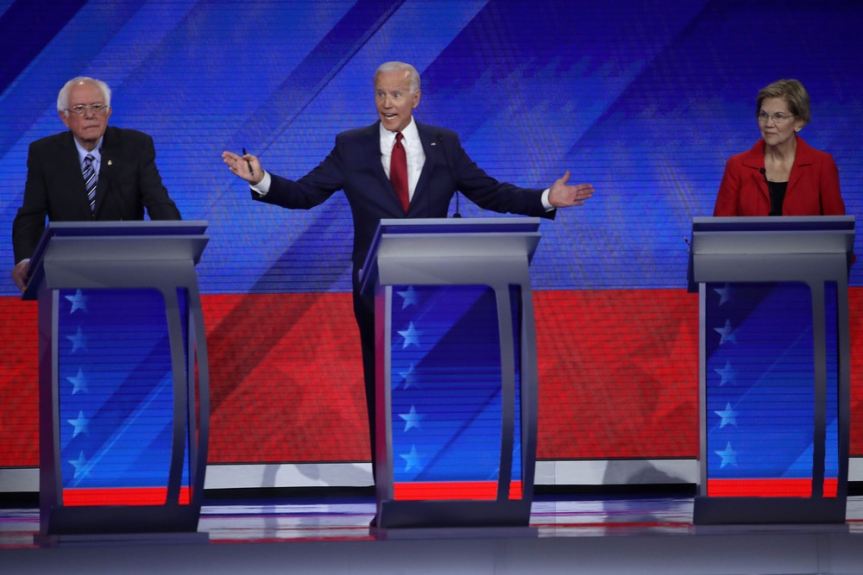
Biden: Nonsense or No Sense? (Photo: Win McNamee/Getty Images)
W.J. Astore
There was another Democratic debate this week, and I have to admit I missed it. I’ve been checking the highlights (or lowlights, if you prefer), and Joe Biden, as usual, figures prominently.
First, here’s his stunningly paternalistic, clueless, and incoherent response to a question on the legacies of slavery, segregation, and racial discrimination:
Well, they have to deal with the — look, there’s institutional segregation in this country. And from the time I got involved, I started dealing with that. Redlining, banks, making sure we are in a position where — look, you talk about education. I propose that what we take the very poor schools, the Title I schools, triple the amount of money we spend from $15 to $45 billion a year. Give every single teacher a raise to the $60,000 level.
Number two, make sure that we bring in to help the teachers deal with the problems that come from home. The problems that come from home. We have one school psychologist for every 1,500 kids in America today. It’s crazy. The teachers are — I’m married to a teacher, my deceased wife is a teacher. They have every problem coming to them. Make sure that every single child does, does in fact, have 3-, 4- and 5-year-olds go to school. Not day care, school.
We bring social workers into homes of parents to help them deal with how to raise their children. It’s not that they don’t want to help, they don’t want — they don’t know quite what to do. Play the radio, make sure the television — excuse me, make sure you have the record player on at night, the phone — make sure that kids hear words. A kid coming from a very poor school — a very poor background — will hear 4 million words fewer spoken by the time they get there.
Make sure you have the record player on at night?
How difficult is it, really, to admit to the legacy of slavery in this country? But Biden would rather jumble a lot of words together, perhaps based on a few ideas that he memorized poorly. So he mentions segregation and the practice of banks redlining predominately black/minority neighborhoods and denying them loans (which he doesn’t explain), then he pivots to education and social workers while suggesting the solution to helping minority kids to learn is for them to hear more words coming from record players and phones at night.
And Democrats think this man is going to defeat Donald Trump in 2020?
Second, Joe Biden was attacking Bernie Sanders on the cost of Medicare for All. When Sanders accurately noted that Americans pay twice as much per capita for health care as Canadians do under their national health care system, Biden’s response was three words: “This is America.”
So apparently it’s the American way to pay twice as much as other countries for equivalent health care. It’s the American way to be denied coverage, to pay large co-pays and deductibles, and to go into bankruptcy because of a serious medical condition.
“This is America.” I feel better already!
Not so incredibly, the Democratic establishment would rather lose to Trump with a candidate like Biden than win with a candidate like Bernie. And so Biden’s non-sequiturs, his gaffes, his prejudices, and indeed his stunning incoherence are shrugged off as “That’s Biden being Biden.”
I may not have watched last week’s debate, but I have a strong sense of who won: Donald Trump.
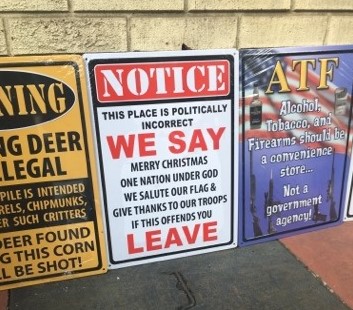
So much of what passes for America’s Kulturkampf (culture struggle) consists of phony, made up, manufactured issues. Consider the following sign, sent to me by a friend as he toured the wilds of Pennsylvania:
It is supposedly “politically incorrect” to say Merry Christmas, to state the Pledge of Allegiance (“one nation under God”), to salute the flag, and to thank the troops. Those who do all these things apparently take pride in their alleged outspokenness and their love of all things American.
Sigh.
Forgive me for stating the obvious, but it’s never been politically incorrect to say Merry Christmas. Virtually all Americans say they believe in God or some higher power. Nearly all Americans respect the flag (even those who kneel in protest, I’d argue), and America’s respect for the military has never been higher.
But this sign with its false narrative encapsulates much of the Republican/Trumpian message: We’re the real Americans. And anyone who says “Happy Holidays” or who suggests separation of church and state or who sees protest as legitimate free speech is obviously un-American and should leave the country.
I just wonder at all those Americans who buy signs like this, thinking that by doing so they’re showcasing their bravery at being non-PC and their pride in being so “American.”
One thing is certain: this manufactured culture war is a great way to distract and divide the commoners as the rich and powerful continue their looting of America.
What can you say about mass shootings in America that hasn’t already been said? El Paso and Dayton (not Toledo, Mr. Trump) are the most recent in a seemingly unending series of shootings in America. A grim statistic:
“Dayton was the 22nd mass killing in America this year, according to an AP/USA Today/Northeastern University mass murder database, which tracks all attacks involving four or more people killed.”
Or, alternatively: “The shooting in Ohio marked the 31st deadly mass shooting in America this year, defined as those where at least three people are killed by gun violence in a single episode.”
“As of today (Aug. 4), we are 216 days into 2019. In the US over that time, more than 1,300 people have been injured or killed in mass shootings, according to data collected by the Gun Violence Archive.
QUARTZ
Injuries and deaths related to mass shootings.
The nonprofit organization, which is based in Washington, DC, defines a mass shooting as an event in which at least four people were shot. By its calculations, that means there have been some 292 mass shootings in the US since the year began.”
In a prepared statement this morning, President Trump came out against white supremacy, racism, and bigotry, but tragically this is a clear case of “Do what I say, not what I do” for Trump. He compounded his hypocrisy by ignoring the ready availability of assault weapons, blaming instead mental illness and violent video games, among other factors.
Firstly, the mentally ill are more likely to be the victims of violence than the perpetrators of it. Secondly, violent video games are a global phenomenon, but I’m not reading about dozens of mass shootings each year in Japan or Korea or Sweden.
Trump’s weak-willed words were thoroughly predictable; he’s closely aligned with the National Rifle Association and its total fixation on gun rights to the exclusion of all others. He’s not alone in this. When I taught in rural Pennsylvania, my students knew all about the Second Amendment. But their knowledge of the First, Fourth, and Fifth Amendments was far weaker. Yes, for many Americans guns really do trump free speech, freedom of the press, and similar rights.
Predictably, Americans search for a magic bullet (pun intended) after these horrifying massacres to put a stop to them. How about better background checks? Eliminating extended magazines for the millions of assault rifles that are already in the hands of Americans? Better databases to track the mentally ill and the criminally violent? And so on. And we should have better background checks before you can buy a gun; we should stop selling military-style hardware; we should keep better track of dangerous people. But steps such as these will only stem the violence (if that). They won’t put an end to it.
Our culture is suffused with violence. At the same time, powerful forces are at play (stoked by our very own president) to divide us, to inflame our passions, to turn us against them, where “them” is some category of “other,” as with the El Paso shooter, who targeted immigrants “invading” America.
To stop mass shootings, we must change our culture of violence. This is made much more difficult by men like Trump, who’ve embraced violent rhetoric for their own selfish purposes. But we must change it nonetheless, else witness more carnage across America.
Note to readers: This is not the first time I’ve written about violence and guns in America. Here are links to a few articles on this subject at Bracing Views:
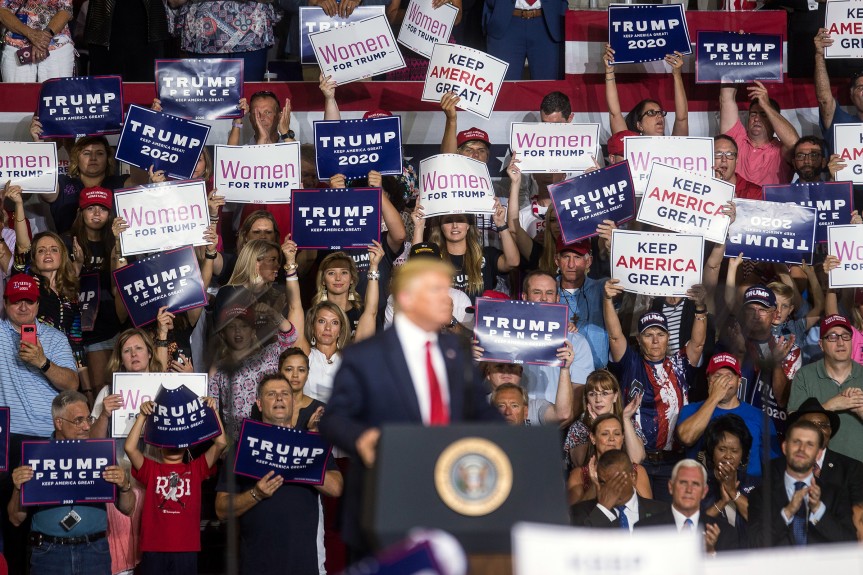
As long as enough Americans keep cheering, Trump will keep ruling through denunciation, disdain, and divisiveness (but note the guy next to Pence, covering his face with his hand, hopefully in disgust)
W.J. Astore
Robert Mueller testified before Congress today (7/24), the big takeaway being that his report didn’t exonerate Trump of, well, something.
From what I’ve seen, there’s no evidence that proves Trump colluded with Russia to influence the presidential election in 2016. There is evidence Trump tried to obstruct Mueller’s inquiry, but his own subordinates disobeyed or ignored him, thereby protecting him from his own stupidity.
So, Trump didn’t collude with Russia and Mueller was able to complete his investigation, therefore Trump is essentially in the clear, especially on the damning charge of treason. Right?
Not so fast. I recently read Sebastian Junger’s fine book, Tribe: On Homecoming and Belonging (2016), and the following passage resonated:
“politicians occasionally accuse rivals of deliberately trying to harm their own country–a charge so disruptive to group unity that most past societies would probably have just punished it as a form of treason. It’s complete madness, and the veterans know this. In combat, soldiers all but ignore differences of race, religion, and politics within their platoon. It’s no wonder many of them get so depressed when they come home.”
Junger nails it. Accusing your political rivals of deliberately trying to harm America, which Trump routinely does when he denounces Democrats at his rallies, could be construed as a form of treason. Seeking to divide Americans on the basis of race, religion, and other qualities, which Trump also routinely does, is another behavior that could be construed as treasonous to American ideals and treacherous to our ability to come together and govern ourselves.
Trump’s treason (if you want to call it that) is in plain sight. It’s in the way he divides Americans and denounces his opponents as putting America (and Israel!) in danger. His treachery is blatant. The problem is that roughly 40% of Americans seem willing either to follow Trump or to look the other way as he rules through denunciation, disdain, and divisiveness.
Trump will use any tactic to protect his power and privilege. He is an unprincipled and rank opportunist who works for his own self-aggrandizement.
Perhaps that’s not the legal definition of treason, but it is the defining characteristic of a man who should be voted out of office in 2020.
Trump on the down escalator toward American carnage, 2015
W.J. Astore
Yes, Donald Trump is a racist. His attacks on four Democratic Congresswomen of color are only the most recent illustration of this. Trump, of course, is also an opportunist. A conniver. An exploiter. Unless it backfires, he’ll keep using racism. It fires up his “base” and distracts from the looting his family and administration are actively engaged in.
Trump intuitively grasped a painful reality that Norman Mailer wrote about in 1968. Inspired by Richard Nixon’s campaign, Mailer wrote that “political power of the most frightening sort was obviously waiting for the first demagogue who would smash the obsession and free the white man of his guilt [of slavery and racism and their legacies]. Torrents of energy would be loosed, yes, those same torrents which Hitler had freed in the Germans when he exploded their ten-year obsession with whether they had lost the war [World War I] through betrayal or through material weakness. Through betrayal, Hitler had told them: Germans were actually strong and good. The consequences would never be counted.”
Immediately after writing this, Mailer said:
“Now if suburban America was not waiting for Georgie Wallace, it might still be waiting for Super-Wallace.”
Enter Candidate Trump on his escalator, railing against Mexicans as rapists and killers. Stoking fear and bigotry against people of color. He did it, guiltlessly, because it worked. And it proved a balm to so many in his base, who could now vent their racism because a rich White man like Trump had given them cover, permission, even a mandate.
Recall Mailer’s words: “The consequences [of unleashing guilt-free racism in America] would never be counted.” We’ve been experiencing these consequences since Trump rode that escalator down and unleashed his own brand of American carnage. We will continue to experience them even when Trump is finally out of office and long dead. Because Trump isn’t guilty alone. He needs followers willing to embrace his lies, his vitriol, his hateful speech.
Isn’t it time we rejected Trump, and all his words and works, and all his empty promises?
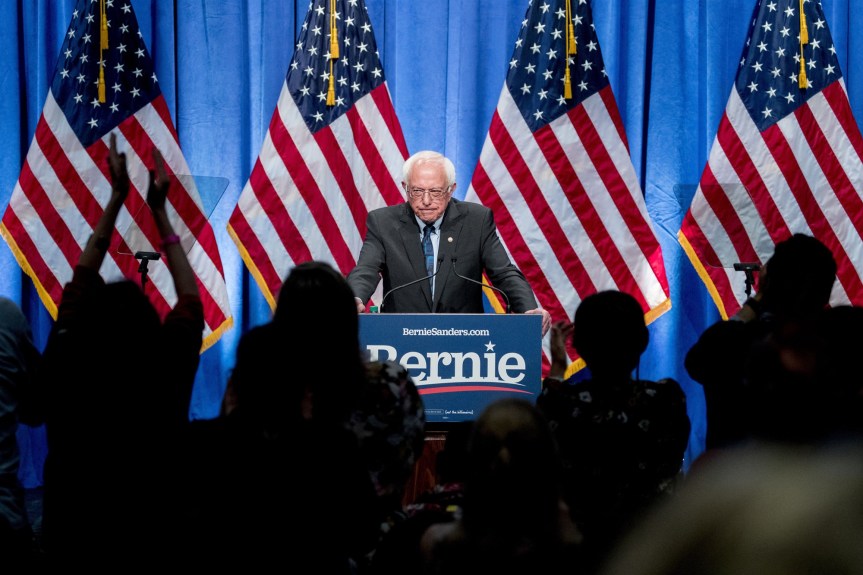
Bernie Sanders at George Washington University: Reshaping America’s political language
M. Davout
In his book, The Politics, Aristotle expressed a famous claim that political science textbooks have been quoting for generations: man is by nature a political animal. Less appreciated has been Aristotle’s follow-up assertion that “man is the only animal that nature has endowed with the gift of speech, [which gift] is intended to set forth the advantageous and disadvantageous, the just and the unjust.”
With these claims Aristotle is reminding us that speech counts for a lot in politics. One need only consider how the language of politics in the post-New Deal, post-Great Society U.S. shifted so that it became a matter of course for millions of modest income Americans to vote for politicians who promised to cut, eliminate, or privatize government programs (e.g., Social Security, Medicare, Medicaid) that have kept so many vulnerable Americans from going under. Foundations such as the American Enterprise Institute, Heritage Foundation, Richard Mellon Scaife Foundation provided financial support for scholars and pundits willing to make the libertarian argument for an every-man-for-himself society for which, to paraphrase Ronald Reagan in his first inaugural address, government is the problem, not the solution.
Funded by wealthy interests and individuals, these foundations and think tanks developed the rhetoric (e.g., “death tax” instead of “estate tax”) and ideas (e.g., cutting taxes increases government revenues) that would be picked up and propagated by conservative politicians across the country. Reagan himself, who began his national political career on the pundit side of conservative politics as a paid spokesman of General Electric giving speeches at GE plants across the country, paid homage to the decades-long conservative struggle to change the political conversation when he said, “The American Enterprise Institute stands at the center of a revolution of ideas of which I too have been a part…”
While it is too early confidently to guess which of the democratic contenders for the presidential nomination will face off against Trump, it is not too early to appreciate how much the speech of a certain senator from Vermont has changed the national conversation. Every time Bernie Sanders appears in public and speaks, whether at a televised debate, on a union picket line, on the stump in Iowa or New Hampshire, or on a college campus, his words serve to enlarge and invigorate the space of political discourse in this country. His relentlessly on-message campaign in 2016 for a $15-dollar-minimum (“living”) wage, Medicare-for-All, tuition-free public colleges and universities, highlighting global warming as an existential threat, a political revolution against a corrupt system, had discernible impacts in local, state and national races in 2018. Consider as well the leftward policy positioning of several of his fellow candidates for the 2020 nomination; their language and positions often echo those of Sanders.
And while it is also too early to tell whether his recent speech at George Washington University successfully immunized the word, socialism, from the taboo status it has labored under in American political culture since at least the post-World War One Red Scare, Bernie Sanders’ evocation of FDR’s “Economic Bill of Rights” and his enlargement of the notion of being free to encompass having adequate health insurance, for example, or having access to a college education without sinking into paralyzing debt continues his crucial efforts to change the language of U.S. politics.
In helping to reshape the language of American politics, Bernie Sanders may go down in U.S. history as the presidential candidate who did not need to win to get his most important work done.
M. Davout, a professor of political science, teaches in the American South.
A good friend of mine, a Kiwi, sent me an update on Jacinda Ardern’s priorities for action in New Zealand. It’s known there as a “Wellbeing Budget.”
* Creating opportunities for productive businesses, regions, iwi and others to transition to a sustainable and low-emissions economy.
* Supporting a thriving nation in the digital age through innovation, social and economic opportunities.
* Reducing child poverty and improving child wellbeing, including addressing family violence.
* Supporting mental wellbeing for all New Zealanders, with a special focus on under 24-year-olds.
* Lifting Māori and Pacific incomes, skills and opportunities.
I know: New Zealand is a small country on the other side of the world; a superpower like the United States has nothing to learn from Kiwis, right?
What struck me about these priorities is, well, that New Zealand has some. That they’re clear and concise and focused on well-being for children and teenagers and families. That they address poverty. And that climate change isn’t forgotten (“sustainable” and “low-emissions” economy).
What about America’s great leader, Donald Trump? What are his priorities for national well-being? Near as I can tell, these are Trump’s priorities:
1. Enriching himself and his family.
2. Avoiding impeachment, or exploiting it if he is impeached.
3. Getting reelected.
4. More golf.
5. Screwing anyone who resists him.
What about issues like “build the wall”? I don’t think Trump cares whether the wall is built; it’s merely a convenient issue to exploit as he rallies his base. What about ending access to abortion? Again, I don’t think Trump cares about this issue, except as it energizes a key component of his base. What about appointing lots of conservative justices and judges? Again, Trump cares only in the sense that such judges and justices will rule in a way that upholds his privileges.
My Kiwi friend’s list got me to reflect on the lack of consensus for action in the USA today among our “leaders”/politicians. (Well, there is bipartisan support for enormous military budgets, but that’s about it.) Put differently, most Americans express support for single-payer health care, a higher minimum wage, higher taxes on the richest Americans, climate-friendly policies, and so on, but our bought-and-paid-for politicians act against the people’s wishes.
Various power brokers may laugh at Trump’s vanities and object to his vulgarity and his selfishness and greed, but they also abet him because he serves to divide people while protecting elite privileges against reformers like Bernie Sanders.
I know one thing: the answer isn’t Joe Biden or any other DNC-approved candidate. The answer is a movement that unites behind a candidate that actually cares for people like us, someone like Bernie Sanders. Short of that, well-being will be in very short supply in America’s future.









 Bracing Views