Hollywood, the Oscars, and America

W.J. Astore

I finally watched the Oscars last night. Of course, I’d heard about Will Smith slapping comedian Chris Rock because of a joke Smith’s wife didn’t like. It was an ugly incident, but fortunately Chris Rock kept his cool. Hollywood loves itself, much like America loves itself, and an A-list actor like Will Smith can pretty much get away with anything, including assaulting one of the hosts for a joke that, though apparently well-intended, obviously miscarried. Smith never apologized during the show, though he finally issued a pro forma apology yesterday once he figured out that public opinion was against him.

I’m a movie buff, and I’ve always enjoyed watching the Oscars, but each year the shows get tackier, sleazier, and more morally repugnant. As my wife said this morning, you see a lot of sick people at the Oscars with no morals and apparently no souls.

I did want to mention one oversight at the Oscars. Now, I have to admit I didn’t listen to every word of every acceptance speech, but those I did hear all had one glaring omission: None of the Oscar winners thanked the fans, the movie-goers, the ones who truly pay them and support them. Instead, the winners thanked the usual suspects: agents, mentors, producers, big companies like Apple and Disney and Netflix, with occasional references to parents and to God. After slapping Chris Rock, Will Smith blubbered on about how he was all about serving God and love, apparently seeing no contradiction between his words and his deeds.

Of course, the Oscars are always a self-indulgent spectacle, always an exercise in narcissism and self-promotion. But would it really hurt the Oscar winners to take a few moments to thank their fans and movie-goers, especially when going to the movies was a bit risky given the Covid-19 pandemic? Instead, I heard talk of how brave they all were for continuing to make movies during the pandemic.

Again, I’m a big movie fan, and I don’t dismiss their artistry and often their cultural significance. At their best, movies can truly inspire us; they can help to open doors to new worlds; they are truly part of the human experience. What’s truly sad is how the Oscars and Hollywood’s yearly celebration of itself actually diminishes the movies rather than showcasing and enhancing them.

The Oscars should go the way of the Emmy Awards — they should simply disappear, having outlived their usefulness and having become something of an embarrassment.

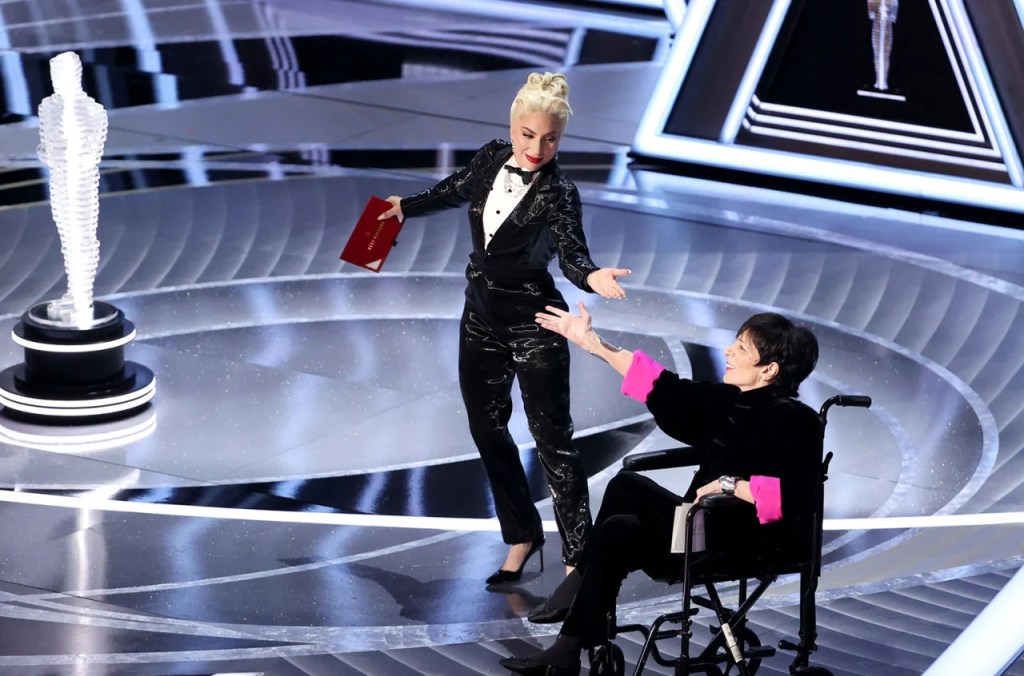
A rare moment of grace at the Oscars, as Lady Gaga helps Liza Minnelli announce the award for best picture (Photo by Christopher Polk)

Critical Media Literacy

W.J. Astore

He who pays the piper calls the tune is a saying I learned from my dad. He also taught me to never believe anything you read and only half of what you see. Direct experience is best, of course, but even when you’re living through an historical event, your perspective is necessarily limited and filtered through your own biases. All my readers, I’m assuming, don’t currently have direct experience of the war in Ukraine. So how do we know what’s really going on? And who’s paying the piper to call the tune on the media coverage of the same?

I was thinking of all this as I watched Briahna Joy Gray talk to Abby Martin on Gray’s show, “Bad Faith.” Both women remind us that major networks like Fox, MSNBC, CNN, PBS and the like are captured by corporations and rely on advertising revenue from Raytheon, Pfizer, and similar powerhouses of the military-industrial complex, big Pharma (drug pushers and dealers), and of course fossil fuel companies. They pay the piper and therefore call the tunes that we hear daily.

The result, as Abby Martin says here, is that the Russia-Ukraine war becomes a “cartoon binary that infantilizes us all,” in which Putin is Sauron and Zelensky is both Gandalf the White and Frodo, sage wizard and plucky underdog, to use characters from Tolkien’s “The Lord of the Rings.”

Is that you, Putin?

Anti-Russian hysteria has grown so common that my local liquor store was at pains to tell me that Stoli vodka comes from Latvia, not Russia, therefore I could still in good conscience purchase it without serving Sauron/Putin.

Mainstream media networks in the U.S. are owned by five major corporations, notes Martin, and their goal is to control the narrative while strengthening their positions and maximizing profits. This is why it might be wise to remember not to believe everything, or anything, that you read, and to remember as well that the pipers we listen to on the air are not free to call their own tunes.

Anyway, I highly recommend Gray and Martin’s interview. Enjoy, readers!

Dissent Is Needed More than Ever

W.J. Astore

Dissent and critical thought are needed most of all in times of war. Yet it’s precisely the time when people are pressured the most to silence their doubts, to mindlessly conform, and to wave the flag and to cheer for the “good” guys against the “bad” ones.

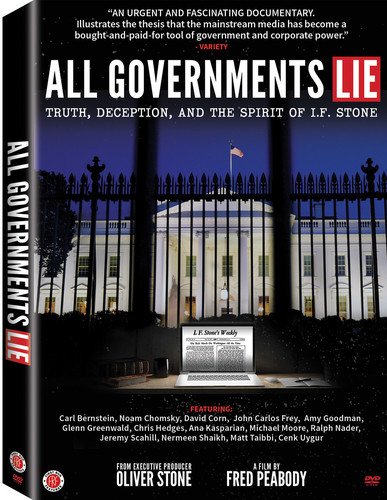
Dissent is easy to tolerate when it’s about trivial matters that don’t challenge or involve prevailing power structures. Chomsky and Herman famously wrote “Manufacturing Consent,” which is another way of saying that dissent itself is manufactured and controlled, providing us with an illusion that democratic debate is allowed and encouraged in America. But of course dissent isn’t tolerated when it threatens power structures, profit margins, and prevailing narratives.

We see this clearly in the amount of dissent policing and information quashing about the Russia/Ukraine war. Look at what happened to the RT (Russia Today) network in the USA (RT America). It was dropped by DirecTV and forced to layoff its staff and cease operations. It’s easy to cheer something like this if you think or have been told everything Russian is evil, but the loss is considerable to democracy and to free speech.

I didn’t watch a lot of RT America, but I appreciated the network’s support of informed critics like Chris Hedges and Jesse Ventura. Hedges and Ventura, both freethinkers, were excluded by the mainstream media in the U.S. Ventura’s case is especially revealing. He had a three-year, multi-million dollar contract with MSNBC for a talk show in 2003 that was cancelled when the network realized he was against the Iraq War. The network honored the contract, paying him roughly $6-8 million while keeping him off the air for three years. Millions in hush money for no work sounds like a good deal, but it’s obviously not in the interest of free speech.

Jesse Ventura on RT: An informative, provocative, and often funny show

When I started writing for TomDispatch.com in 2007, posting articles that called into question the official narrative of “progress” in the Iraq and Afghan Wars, there were exactly two TV networks that asked to interview me: Al-Jazeera and RT America. (I turned them down, mainly because I was working in rural Pennsylvania and had no time to travel to New York City for in-studio interviews.) No mainstream media network showed any interest. I’m not complaining here — I’m just stating facts. Ask yourself how many times you’ve seen and heard antiwar voices and penetrating criticism on NBC, CBS, PBS, CNN, MSNBC, and similar networks. You won’t see and hear it there because it’s considered bad for business.

Why is it bad for business? Advertisers don’t like it. You know: companies like Boeing, Lockheed Martin, and similar bastions of the military-industrial complex. Those same companies are often part of multi-national conglomerates that own the networks. They are not about to sanction shows or grant airtime to well-informed critics like Hedges and Ventura. Why would they? Profit and power trump free speech every time.

Dissenting voices are still out there, but they are kept on platforms where their reach is often limited by computer algorithms that send people to mainstream sites first. For what it’s worth, I look for alternative perspectives at the Jimmy Dore Show, at Useful Idiots, at Breaking Points, and from journalists like Matt Taibbi, Glenn Greenwald, Chris Hedges, and Caitlin Johnstone, among others.

I also continue to check mainstream sources like the New York Times, NBC News, and PBS, as well as subscribing to old-fashioned paper magazines like The Nation, The New Republic, and The Baffler. And I’m not above watching Tucker Carlson when he features important voices like former Congresswoman Tulsi Gabbard.

Americans, citizens of what is allegedly a democracy, deserve access to the widest possible range of sources and critics. Denying the same to us is censorship. It limits thought, it stifles debate, and it makes us much less than what we could be as a democracy and as a people.

The Keyboard Commandos

W.J. Astore

As war in Ukraine drags on, the possibility for dangerous escalation increases. The goal should be the quickest possible ceasefire and a diplomatic solution that puts an end to hostilities. Or, to cite Vera Brittain in “Testament of Youth” again: “No to killing. No to war.”

An obstacle to this are all the keyboard commandos in the West who are recklessly calling for dangerous escalations against Russia. These include a “no-fly” zone above the city of Kyiv enforced in part by the U.S. Air Force, and direct attacks by European air forces against Russian armored columns on their way to Kyiv. Such calls for military action are indeed reckless since Vladimir Putin has issued a none-too-veiled threat of a nuclear response to them. Is he bluffing? I for one do not want to find out.

The West is already providing advanced weaponry to Ukraine such as Stinger anti-aircraft missiles and Javelin anti-tank missiles. EU countries even talked of sending fighter aircraft to Ukraine, but that deal seems to be falling apart. Such weaponry may increase the costs of war to Russia, but weapons alone are not likely to prove decisive in any way.

For all those keyboard commandos out there, safely tweeting about attacks on Russian forces in the cause of “helping” Ukraine, I have a challenge for you. Come out from behind your keyboards, book a flight to Ukraine, grab a Kalashnikov or perhaps even a Stinger, and show how determined you really are to defend Ukraine. Barring that, and assuming you’re of military age and that you’re American, why not take this opportunity to enlist in the U.S. military, as NFL star Pat Tillman famously did in the aftermath of 9/11. Show us how tough you really are; show us how much you truly care.

Because, if you’re not willing to put up, it really is better (and also much more honest) if you shut up.

Condemning War

W.J. Astore

And so the dogs of war are off and running again, this time unleashed by Putin’s Russia against Ukraine. What is Putin up to? Is it a punitive raid against Ukraine, or a general invasion followed by an occupation, or something in between? Time will tell, but wars are unpredictable. Just look at America’s wars. Vietnam was supposed to be over with quickly after the U.S. committed large numbers of troops there in 1965. Afghanistan started as a punitive raid in 2001, then morphed into a wider invasion and occupation that persisted for two decades. Iraq was supposed to be over and done with in a few weeks in 2003, but that general invasion also morphed into an occupation that persisted for nearly a decade.

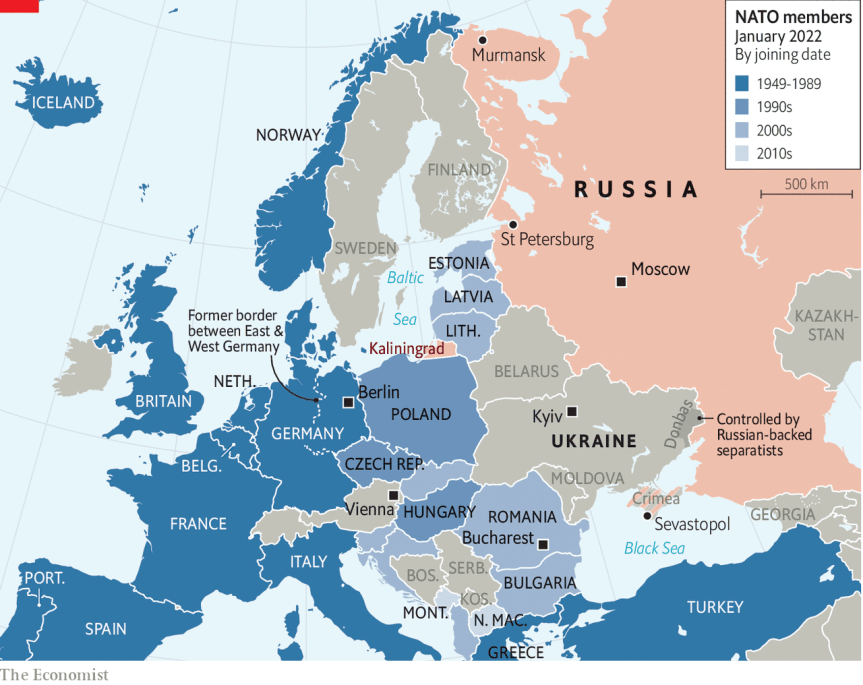
At their best, wars are controlled chaos, and that contradiction in terms is intended. My best guess is that Putin sees this as an extended punitive raid to send a message to Ukraine and to NATO that Russia won’t tolerate NATO expansion into Ukraine. Put bluntly, NATO, led by the USA, got into Putin’s grill on Ukraine, and Putin calculated that drawing his saber was a better choice than simply rattling it. Whether he who lives by the sword will die by it remains to be seen.

In the meantime, I took a quick look at how the mainstream media is covering the Russian invasion. I noted that NBC spoke of Russia’s “terrifying might,” while CBS spoke of “dozens reported dead” in Ukraine. CNN simply said that “Russia invades Ukraine” and that “Ukraine vows defiance.” I have nothing against these headlines, but I wonder if the same coverage would apply to the U.S. military. Would NBC speak of the “terrifying might” of U.S. military attacks? Would our mainstream media mouthpieces report on the deaths of foreigners from those attacks? Did we see terse headlines that read, simply, “U.S. invades Iraq” or “U.S. invades Afghanistan” or “U.S. invades Vietnam”? I can’t remember seeing them, since we like to think of the U.S. military as “liberating” or “assisting” other countries, or, even better, bringing democracy to them with our “freedom” bombs and “liberty” missiles.

U.S. leaders like Antony Blinken and Nancy Pelosi have shown their toughness. Blinken said Putin will “pay for a long, long time” for his actions, and Pelosi said the Russian invasion is an “attack on democracy.” Did Ukraine truly have a functional democracy? For that matter, does the United States have one?

I’m with Ike: I hate war with a passion. Most often it’s the innocent and the most vulnerable who end up dead. Whatever Putin is up to, it’s wrong and he should be condemned. But while condemning Putin for his invasion, we shouldn’t forget America’s wars. Indeed, in condemning Putin for his invasion, it offers us a fresh chance to condemn war in general — even, or especially, America’s own versions.

The U.S. Mainstream Media and War

W.J. Astore

When it comes to war, mainstream media voices in the U.S. are almost always for it, even when it could conceivably escalate to a nuclear exchange.

That’s a disturbing lesson reinforced by recent U.S. media coverage of the Russia-Ukraine crisis. The basic narrative is that Putin’s Russia is the aggressor, the U.S. is the defender of democracy, and that U.S. actions are high-minded even when they involve weapons sales, troop deployments, and draconian economic sanctions.

You don’t get more mainstream than David Brooks and Jonathan Capehart on PBS, so I tuned in to watch their “debate” (2/18) on the issue. Both men expressed their approval of Democrats and Republicans coming together to support the Biden administration’s hardline against Russia. Bipartisan unity is to be celebrated when it comes to warmongering, I suppose. Especially revealing was David Brooks’s quick dismissal of left/right critics of the administration’s policies:

There will be some people who worry on the left that this is part of American imperialism to get involved in Europe. There are some people on the right who like Vladimir Putin. They see him as a manly, socially conservative, authoritarian kind of guy who they kind of like. So, I’m sure, on either end, there will be some [critics]. But, among the mainstream of both parties, I think, right now, there’s strong unity. The Biden administration has done an excellent job of rallying the Western alliance. It’s been a demonstration of why the world needs America to be a leader of the free world.

So, leftist critics are knee-jerk anti-imperialists; rightists critics are authoritarian Putin-lovers. But real Americans in the mainstream support Joe Biden and America as the “leader of the free world.”

What’s amazing about the “mainstream” in America is how narrow that stream is allowed to be. Of course, as Noam Chomsky famously wrote, it’s all about manufacturing consent. But imagine if true diversity of opinion was allowed on PBS. Imagine if someone like Jonathan Capehart said the following:

“The U.S. betrayed its promise not to expand NATO to the borders of Russia. Even worse, the U.S. meddled in Ukrainian politics in 2014, driving a coup and empowering neo-Nazi forces there. Sending weapons to Ukraine is making a bad situation worse, and constant threats are ratcheting up tensions that could lead to war. In war, mistakes are always possible, even common, which could lead to a wider and disastrous war between the world’s two leading nuclear powers. Measured diplomacy is what we need, even as the U.S. should take a step back in a region of the world that is not directly related to our national defense.”

Imagine that statement as a counter-narrative to the idea the U.S. is always in the right (as well as blameless), that more troops and weapons are always the answer, and that Russia has no national defense issues of its own, because NATO obviously poses no military threat to anyone. (Imagine, for one second, seeing the expansion of NATO and U.S. meddling in Ukraine from a Russian perspective, which we should be willing to do because you should always plumb the mindset of your rival or enemy.)

Truly, the lack of diversity of opinion on foreign relations and war is startling in U.S. media. It’s almost as if we have an official state media, isn’t it, comrade? I still remember Tass and Pravda from the days of the Soviet Union; who knew that today the U.S. would have its very own versions of them, while still applauding itself as the unbesmirched leader of the “free” world?

It’s all so saddening and maddening

W.J. Astore

Remember Tass, the state news agency for the former Soviet Union? I was thinking of it as I watched PBS on Friday. Two commentators, David Brooks and Jonathan Capehart, respectively with the New York Times and the Washington Post, covered the leading news items of the week. Of course, there was nothing said about the colossal war budget passed by the House ($778 billion, which is actually an undercount); there was nothing said about the continued persecution of Julian Assange by the U.S. government; and indeed there was nothing said about the sham democracy summit overseen by Joe Biden.

The topics covered were Bob Dole’s death and the good old days of compromise in Washington, a general condemnation of Trump and polarization, and some concern about inflation, which was dismissed as evidence of an expanding economy.

PBS used to be a halfway decent news source; now it relies far too heavily on corporate funding and is afraid of losing its government funding as well. So it’s become a state propaganda network, much like Tass was in the USSR.

With respect to the commentators, David Brooks is the reasonable Republican who speaks calmly about achieving incremental change through the system; Jonathan Capehart is the reasonable Democrat who also speaks calmly about pretty much the same; he adds “diversity” in the sense he’s Black and gay, yet his political views vary little from those of Brooks. Mark Shields, the previous voice opposite Brooks, was occasionally somewhat outspoken and even mentioned unions and workers; he’d worked for Senator William Proxmire and had enlisted in the U.S. Marines. I always sensed Shields hadn’t forgotten his roots, but of course he’s now 84 years old and semi-retired.

The previous week, I listened to Capehart as he talked about the Supreme Court and abortion. He seemed most concerned about the potential for a conservative court to overturn the legitimacy of gay marriage. I understand the personal angle, but I was hoping for a stronger statement in favor of a women’s right to choose — to control her own body and her own life.

To be honest, I don’t watch mainstream media reports that often, but when I do, it’s all so saddening and maddening.

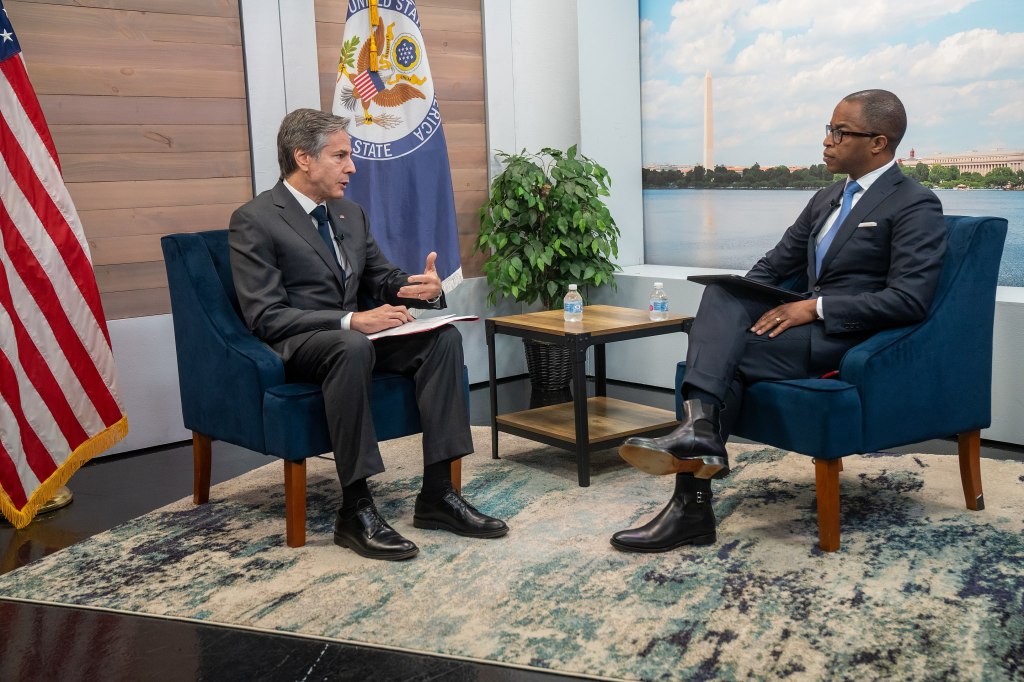
Jonathan Capehart (right) speaks to Secretary of State Antony Blinken. They both know their roles.

Fox News and The New York Times Agree: America is Weak!

W.J. Astore

Did you know that the world’s lone surviving military superpower, the one that spends more than a trillion dollars yearly on all things military, is weak?

Fox News would have you think that. And so too would the New York Times (NYT).

Over at Fox News, the headline suggests Biden’s weakness is inviting “the next Pearl Harbor,” even as the article focuses mainly on alleged weakness vis-a-vis Russia-Ukraine and China-Taiwan. Meanwhile, my daily summary from the NYT agrees that “U.S. weakness emboldens Moscow and Beijing.” So what does the NYT suggest America should do to show strength?

With respect to Russia and Ukraine, this is the sage advice of the New York Times:

On its own, Ukraine’s military seems outmatched by Russia’s. And a full-scale U.S. military response seems doubtful, given a weariness of foreign wars that Biden and many American voters share.
But Biden still has options. The U.S. can increase its military support to Ukraine, which could make a potential invasion look bloodier and more costly for Russia. (The U.S. is pursuing a related strategy in Taiwan.)
Biden can also threaten sanctions on Russia, as he did on the call with Putin yesterday, according to Jake Sullivan, the president’s national security adviser. “He told President Putin directly that if Russia further invades Ukraine, the United States and our European allies would respond with strong economic measures,” Sullivan told reporters. If Russia does attack Ukraine, Biden said that the U.S. would react more strongly than it did to the 2014 takeover of the Crimean Peninsula.
But sanctions might not be enough to deter Putin.

In sum, here’s the tough-minded advice of the “liberal” New York Times: Sell more expensive weaponry to Ukraine (as well as Taiwan). Threaten the most violent economic warfare possible. And, since sanctions “might not be enough” to deter Russia or China, there’s more than a hint that America may need to go to war, despite “weariness” of wars allegedly shared by Biden and “many American voters.”

A show of hands here: How many Americans think it’s wise to risk nuclear war if Russia attacks Ukraine or China attacks Taiwan?

Even if the risk of nuclear war is discounted (which it shouldn’t be), how many Americans think it’s wise for the U.S. military to get involved in a land war in Asia or against Russia in Ukraine?

Maybe patient diplomacy is the answer here? After all, what does the “defense” of Ukraine or Taiwan by U.S. forces have to do with defending our country and our constitution?

America doesn’t lack toughness — it lacks smarts. Selling more weapons to Ukraine or Taiwan isn’t the answer. Nor are constant threats.

Sun Tzu taught that the best way to win is when you can achieve your objectives without even having to fight. Guile is not weakness, nor is restraint. But Fox News, joined by the New York Times, would have us think that toughness is mostly about weaponry and a willingness to wage war. Because, you know, it’s worked so well for America in Vietnam, Afghanistan, Iraq, and so many other places around the globe.

Kamala Harris Is Lost in Space

W.J. Astore

Did you know Vice President Kamala Harris is Chairwoman of the National Space Council? I didn’t — until a friend notified me of a feel-good video featuring Harris and a few earnest and photogenic kids on YouTube. The kids were decidedly diverse: boys and girls, black and brown and white, but they all had something in common. No, it wasn’t their enthusiasm for space — it’s that they were all paid actors.

Here’s the link if you haven’t seen the video: https://www.youtube.com/watch?v=U5PABXXdDwA

As my wife and I watched the video, my better half turned to me and said, “stagey” and “fake.”

I had to laugh as Kamala Harris tried to wow the kids about seeing craters on the moon. My goodness — on a clear night you can see craters with the naked eye. A decent pair of binoculars (I have 10×50 Tasco binoculars) will reveal plenty of gorgeous detail. You don’t exactly have to visit the Naval Observatory to see moon craters.

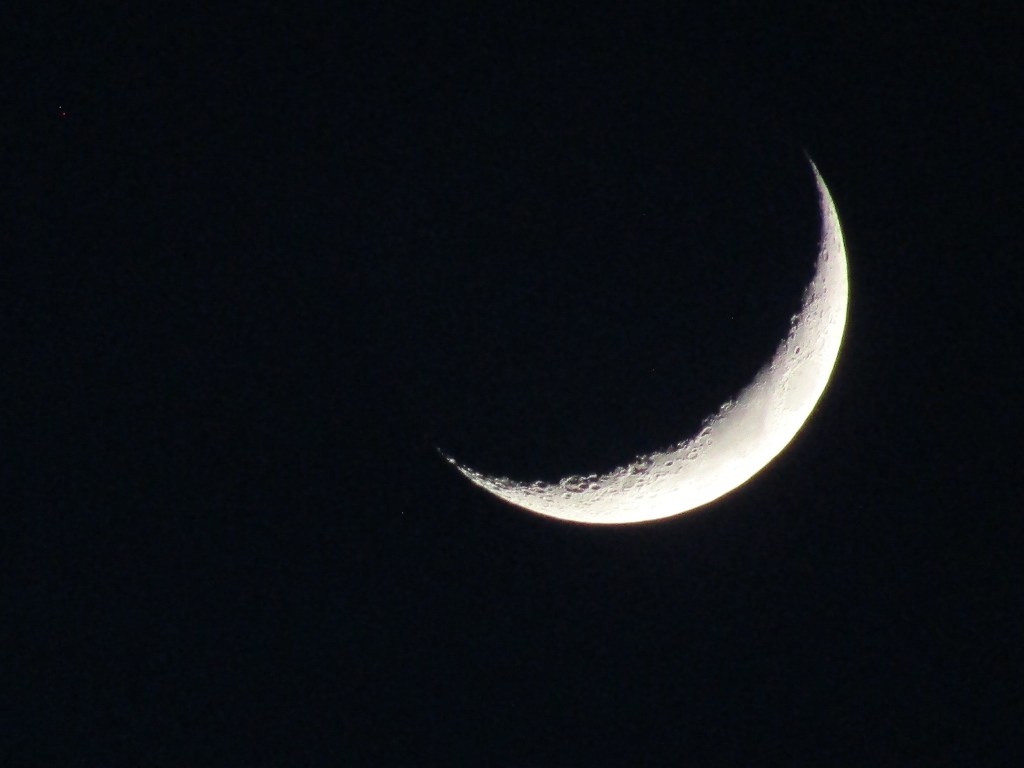
Even through my relatively cheap $200 camera, I can see plenty of detail. Here’s a photo I took of the moon, a handheld shot done quickly and inexpertly:

The Moon by me. Look at the craters!

I have some experience talking to real kids about astronomy. Elementary school kids can be fun. One class I talked to wanted to know all about UFOs. Another wiseguy kid asked about Uranus, pronouncing it “your anus,” of course. I smiled, quietly corrected his pronunciation, and answered his question. We both had a laugh.

Yet apparently Kamala Harris is not to be trusted talking to real kids who might go off-script. Perish the thought of a kid who might make a joke about Uranus. The horror! It doesn’t inspire confidence that she’s only a heartbeat away from the presidency, as the saying goes.

If and when the space aliens come for me, I know what I’m saying: Take me to your leader — mine is lost in space.

We’re Mad As Hell — And Fighting Each Other

Peter Finch in “Network”

W.J. Astore

In the movie “Network” from 1976, a TV news anchor played by Peter Finch builds a mass following by promising to kill himself on the air while declaring that “I’m as mad as hell and I’m not gonna take this anymore!”  The network execs are all too happy to encourage him – as long as his outrage is good for ratings and doesn’t threaten the system.  But when Finch starts to step on corporate agendas, he has the riot act read to him by Ned Beatty, who explains “There is no America.  There is no democracy” and that “The world is a college of corporations.”  A visibly shaken Finch realizes he’s in over his head.

I’ve always liked that catchphrase from the movie, for we the people should be as mad as hell, and we should refuse to take it.  We should act.  But what’s interesting is how our anger is redirected before we can act.    

We’re not supposed to be mad at the oligarchs – that “college of corporations” – who own it all and who push all the buttons. No — our anger is supposed to be tribal. We’re supposed to hate Republicans, or Democrats, or anti-vaxxers, or Trump supporters, or someone — someone ultimately like us, without much power. The anger is ginned up to encourage us to punch down while keeping us disunited.

Being mad can be good if the anger is channeled against the exploiters; it’s not good when it’s exploited by the powerful to keep us divided and weak.

America’s two-party system is designed to deflect anger away from the moneyed interests and toward each other.  What we need is a new political party that truly represents the people rather than the oligarchs.  Neither major party, Republican or Democrat, seems reformable.  Both are captured by moneyed interests.  After all, if money is speech, who can yell louder: you and me, or Lockheed Martin and Amazon? Even the “anti-establishment” voices in either major party have largely been neutralized. Or they get sicced on the enemy of the day, whether it’s evil woke Democrats or evil unwoke Trumpers.

Hence nothing really changes … and that’s the point.

America needs an anti-imperial party, a “Come home, America” party, a party that puts domestic needs first as it works to downsize the military and dismantle the empire.  Yet, in the spirit of Orwell’s 1984 and the Two Minutes’ Hate, Americans are always kept hating some putative enemy.  Russia!  Radical Islamic Terror!  China!  Immigrants at the gate!  Maybe even an enemy within.  We’re kept divided, distracted — and downtrodden

If we continue to be at war with each other while punching down, we’ll never turn righteous anger against the right people.  We’ll never effect meaningful change.

It’s said that power never concedes anything without a demand.  Why do we demand so much from the powerless and so little from the powerful?  Isn’t it high time we reversed that?