Bernie Sanders Won Last Night’s Democratic Debate

bernie
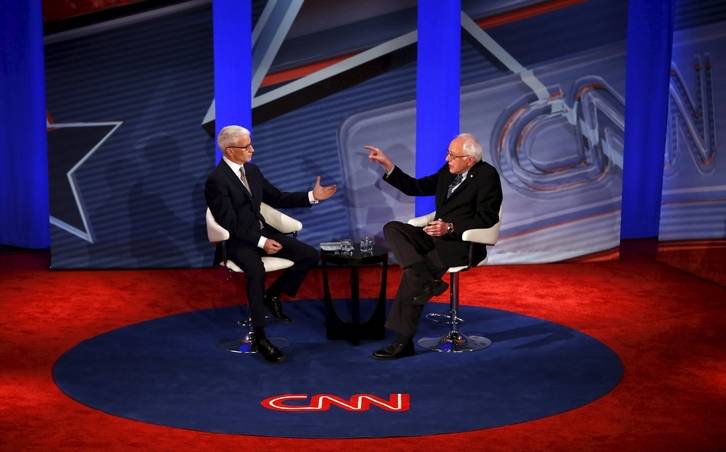
Bernie Sanders makes a point to Anderson Cooper during last night’s debate

W.J. Astore

Last night, Bernie Sanders and Hillary Clinton separately took questions from a “town hall” in Derry, New Hampshire with Anderson Cooper moderating.  Overall, both candidates did well, though I give the edge to Sanders (more on why in a moment).

Sanders came across as passionate on the issues and concerned for ordinary Americans.  He continues to speak of a political revolution, which to him doesn’t mean tumbrels to the guillotine.  It means getting more people involved in the political process, especially youth and the disadvantaged.  He spoke eloquently of helping others.  Memorable to me was his work to desegregate housing owned by the University of Chicago when Sanders was a student.  When asked why he fought against racist policies, Sanders said he’s always hated a bully – and always fought for fairness and equality.  He came across, in short, as an honest and decent man, a man of integrity, which is the word his wife used to describe him (she was sitting in the audience, and was asked to describe her husband with a single word).

Hillary came across as determined and competent and informed.  She tended to meander during her answers, coming across as somewhat of a policy wonk or a technocrat.  She rejected Sanders’ talk of a revolution, preferring to build on President Obama’s (and her own) legacy.  For example, she wants to put the finishing touches to Obamacare, rather than going for Sanders’ idea of a single-payer, “Medicare for all” system.  She spoke briefly of breaking the ultimate glass ceiling for women – her gaining the office of the presidency – and how that would inspire women of all ages.  She took her usual hardline on U.S. foreign policy, making no promises that she would reduce wars or for that matter spending on defense.

In sum, if you’re happy with the status quo, you’ll get plenty of that with Clinton.  If you want change, if you’re tired of a “rigged” economy and a corrupt political process, Sanders is far more likely to act in your favor.

Where I thought Hillary fell down was in her posturing as a progressive.  The millions of dollars she has accepted in speaking fees from banks and investment houses, she suggested, would have no impact on her policy decisions, which is simply implausible.  Powerful organizations don’t give political candidates big money without strings attached to it, and of course Clinton knows this.  It also seemed implausible when Clinton suggested she had not decided to run for president when she accepted those speaking fees.  As if her “doubts” about running absolved her of responsibility for taking big money from Wall Street.  It was all frankly unconvincing.

Hillary Clinton is a fighter.  She came across best when she spoke of the Republican right-wing attacks she’d had to endure over the last 25 years, and what they’d taught her about the political process.  Her footing was less secure when she had to relate to other people.  For example, a man suffering from advanced-stage cancer asked her about dying with dignity.  Bill Clinton, the “natural” as Hillary called him, would have turned this into an empathetic “I feel your pain” moment.  But Hillary got lost in the details, saying she would have to study up on the ethics of terminal care, the laws, the role of medical professionals, what other countries are doing (she mentioned The Netherlands), and so on.  As she tackled the problem in a wonkish way, she seemed to forget the person standing in front her.

In sum, Bernie Sanders is driving the narrative, not Hillary Clinton.  It’s Bernie who’s been talking about a rigged system, about economic fairness, about working for unions, about justice and prison reform, and it’s Hillary who’s been put on the defensive.  So lately Hillary’s been borrowing liberally from Bernie’s script.  She’s now talking about “the deck being stacked” against ordinary people, and how she’s going to fight for workers, and how much Wall Street is supposedly against her candidacy.

As Bernie has gained in the polls, as his message has begun to resonate, Hillary has responded by trying to be more like Bernie.  And it just doesn’t ring true, at least for me.  Advantage, Bernie.


The Media Is the Message, and the Message Is One of Fear

The Replicant Roy Batty knows the score
The Replicant Roy Batty knew the score

W.J. Astore

“Whoever controls the media, controls the mind,” Jim Morrison said, and this is certainly true in America.  Consider the lead stories over the July 4th weekend.  The first was the threat of terror attacks against America.  We were told that law enforcement officials were “in no mood for a national party” — that the threat of an ISIS-inspired terror attack was real.  That no attack occurred is of no consequence.  Fear was stoked, and that’s what matters.  Prepare for the next terror reminder on the anniversary of 9/11, if not sooner.

The second story was shark attacks off the Carolina coast.  Unusual, yes, but hardly a threat to America or to the vast majority of its people, even those who chose to go swimming in the ocean.  “Shark surge!”  “Fear at the beach!”  “High alert!”  These were common expressions in the media.

Of course, Americans were much more likely to be hurt in fireworks accidents than by terrorists or sharks, but the sensational always takes precedence over the mundane in our media.  Indeed, if the goal was to safeguard ordinary Americans, we should have been told to stay off the roads this past weekend, but of course that would hurt tourism and the economy, so you weren’t about to hear that advice coming from America’s talking heads.

It seems nearly impossible to remember that one of FDR’s Four Freedoms was the freedom from fear.  FDR knew the paralyzing and stultifying effects of fear, the way it erodes individual autonomy, the way it can be made to serve the powerful. Frank Herbert in Dune captured a powerful truth when he wrote that “Fear is the mind-killer.”  The movie Blade Runner echoes the sentiment, with the Replicant Roy Batty (played by Rutger Hauer) explaining that to live in fear is to be a slave.

A media that spreads fear facilitates a government of wolves.  Or, put slightly differently by the great Edward R. Murrow, “A nation of sheep will beget a government of wolves.”

There’s a definite method to the media madness, America.

Divided, Distracted, Downtrodden: The Social and Political Reality in America Today

Consumerism1

W.J. Astore

The American people are being kept divided, distracted, and downtrodden.  Divisions are usually based on race and class. Racial tensions and discrimination exist, of course, but they are also exploited to divide people.  Just look at the current debate on the Confederate flag flying in Charleston, South Carolina, with Republican presidential candidates refusing to take a stand against it as a way of appeasing their (White) radical activist base.  Class divisions are constantly exploited to turn the middle class, or those who fancy themselves to be in the middle class, against the working poor.  The intent is to blame the “greedy” poor (especially those on welfare or food stamps), rather than the greedy rich, for America’s problems.  That American CEOs of top companies earn 300 times more than ordinary workers scarcely draws comment, since the rich supposedly “deserve” their money.  Indeed, in the prosperity Gospel favored by some Christians, lots of money is seen as a sign of God’s favor.

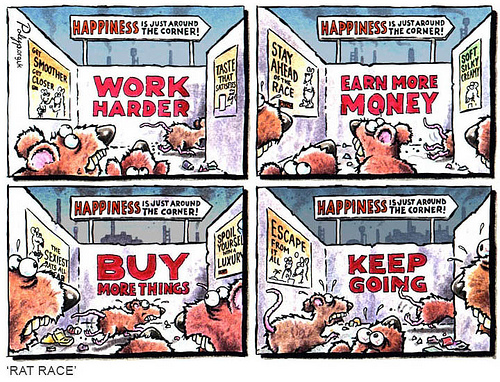
As people are kept divided by race, class, and other “hot button” issues (abortion and guns, for example), they are kept distracted by insatiable consumerism and incessant entertainment.  People are told they can have it all, that they “deserve it” (a new car, a bigger home, and so on), that they should indulge their wants.  On HGTV and similar channels, people go shopping for new homes, carrying a long list of “must haves” with them.  I “must have” a three-car garage, a pool, a media room, surround sound, and so on.  Just tell me what mortgage I can afford, even if it puts me deeply in debt.  As consumerism runs rampant, people are kept further distracted by a mainstream media that provides info-tainment rather than news. Ultimately, the media exists to sell product; indeed, it is product itself.  No news is aired that will disturb the financial bottom line, that will threaten the corporations that run the media networks, that will undermine the privileged and the powerful.

The people, kept divided and distracted, are further rendered powerless by being kept downtrodden.  Education is often of poor quality and focused on reciting rote answers to standardized tests.  Various forms of debt (student loan debt, credit card debt, debt from health care and prescription drugs costs, and so on) work to keep the people downtrodden.  Even workers with good jobs and decent benefits are worried.  Worried that if they lose their jobs, they lose their health care. So much of personal status and identity, as well as your ability to navigate American society, is based on your position.  For many it’s lose your job, lose your life, as you’re consumed by debt you can’t repay.

Divided, distracted, and downtrodden: It’s a recipe for the end of democracy in America.  But it also serves as a roadmap to recovery.  To reinvigorate our democracy, we must fight against divisiveness, we must put distractions behind us, and we must organize to fight for the rights of the people, rights like a better education for all, less debt (a college education that’s largely free, better health care for everyone, and far less emphasis on consumerism as a sign of personal and societal health and wealth), and improved benefits for the workers of America, who form the backbone of our nation.

We can’t wait for the politicians.  Most of them are already co-opted by the moneyed interests.  Meaningful change will have to come from us.  That is, after all, the way democracy is supposed to work.

More on the Torture Report

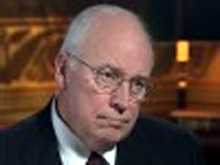
An unrepentant Dick Cheney in 2008

W.J. Astore

Six years ago, Vice President Dick Cheney admitted that he had approved waterboarding as one of the CIA’s “enhanced interrogation techniques.” Waterboarding had been defined as torture by the U.S. during World War II when the Japanese had employed it (although the U.S. had used the so-called water cure during the Filipino Insurrection in the early 1900s). An unrepentant Cheney claimed that torture had been necessary to keep America safe, and that valuable intelligence had been gathered as a result, a conclusion disputed by this week’s Senate report on the CIA and torture.

Since Cheney’s admission, it’s taken six years to render an incomplete accounting of crimes committed by the U.S. government in the name of protecting America. The American people will never receive a complete accounting of these crimes since much of the evidence, including videos of interrogations, has been destroyed. Other evidence is being suppressed (just as the worst photographs from Abu Ghraib were never shown to the American people), ostensibly in the name (yet again) of keeping America safe from the blowback that would result from a complete accounting.

Who is really being protected here? The American people? Or the people who authorized and carried out the torture?

I wrote the following article back in December 2008 on the futility of torture as a technique and also on the need to punish those accountable for ordering it. However, it already appears that the U.S. Department of Justice has no plans to prosecute anyone for these crimes.

So, after a week or so of media grandstanding and manufactured outrage, this story will fade from view, just as our government wishes it to. Look forward, not backward, as President Obama says. And so it is that the crimes will continue without any possibility of atonement or redemption. W.J. Astore

Cheney says he approved waterboarding. Is that the end of the story?

ASK THIS | December 20, 2008

The vice president gave the go-ahead for tactics commonly regarded as torture. Was that a war crime or not? William J. Astore provides some background on the issue and urges the press to show that it too can do aggressive interrogations. And do them now, without waiting for a new administration or a new Congress.

By William J. Astore

Is our sitting vice president a war criminal because he condoned torture?  In an interview on ABC News on December 15th, Dick Cheney coolly admitted he had approved so-called “harsh” and “aggressive” interrogation techniques, notably waterboarding, in an attempt to extract intelligence from known or suspected terrorists, including Khalid Sheikh Mohammed. Vital intelligence gathered about Al Qaeda, Cheney claimed, vindicated his decision, though this is much disputed. Subsequently, Cheney claimed that waterboarding and other harsh techniques did not constitute torture; this categorical denial was balanced by a counterclaim that he would have been remiss had he not authorized aggressive techniques in an attempt to safeguard Americans.

For approving these techniques and for other practices, The New York Times has attacked Cheney, former Secretary of Defense Donald Rumsfeld, and other Bush Administration officials. Calls have been issued for war crimes investigations. Are such calls warranted? Did Cheney, Rumsfeld, and others authorize techniques that constituted torture, and, if so, are they complicit in the crime?

Here, the Holocaust survivor, Jean Améry, and the political philosopher, Hannah Arendt, offer valuable insights. Améry, himself a victim of torture, wrote about it in At the Mind’s Limits (1980). Torture, he observed, was a monstrous immorality because it violated another person’s body, reducing it to a vessel of fear and pain. Under such distress, the victim confesses to anything, even the wildest fictions and fantasies, as Améry himself did when he was tortured.

In its simulation of death by drowning, waterboarding is intended to produce great fear and psychological dislocation. It may perhaps leave no physical traces, but the mental wounds it inflicts are something else altogether. Their insidious effects on victims were captured by Améry in his conclusion on torture:

Whoever has succumbed to torture can no longer feel at home in the world. The shame of destruction cannot be erased. Trust in the world, which already collapsed in part at the first blow, but in the end, under torture, fully, will not be regained …. It is fear that henceforth reigns over him. Fear—and also what is called resentments. They remain, and have scarcely a chance to concentrate into a seething, purifying thirst for revenge.

Torture, in short, alienates its victims from humanity and generates (or strengthens) vengeful resentments. Améry carried his own resentments as a burden to remind himself—and us—of the moral enormity of any attempt to demolish another human being’s will through torture. For Améry, such attempts are both crimes and mistakes because they sow the seeds of future acts of vengeance.

A further disturbing insight comes from Hannah Arendt’s Eichmann in Jerusalem (1964). Adolf Eichmann, desk-bound executioner and “Jewish expert” for the Third Reich, oversaw the deportation of Jews to their deaths during the Final Solution. A bureaucrat who never dirtied his own hands, Eichmann therefore judged himself to be less than fully responsible for the murder of millions. On this point, the judges at Eichmann’s trial reached a far different conclusion: “the degree of responsibility increases as we draw further away from the man who uses the fatal instrument with his own hands.” In crimes against humanity, degrees of separation from the dirty work only add to the offense.

Waterboarding is torture; Cheney and Rumsfeld approved it; and Améry and Arendt’s reflections suggest the immorality of, and culpability for, the crime. What now? Whether we find this distasteful or not, the press needs to show that it too can aggressively interrogate sources. Rather than waiting a month for an Obama Justice Department or a congressional investigation, the press should challenge incoming Obama administration officials now, together with new members of Congress. Outside legal experts should also be consulted. Does Baltasar Garzón—the Spanish judge who pursued Augusto Pinochet relentlessly—have an opinion? These are obvious leads for reporters.

To strengthen America’s moral authority, we need to reject the idea that demolishing our enemies’ resistance through torture is a necessary price of our safety. Let’s not balk at an expeditious and complete accounting of our mistakes—and of crimes committed in our name.

Thanking Our Troops for their Service

Author's photo, July 2014, of the American Flag at Dusk
Author’s photo, July 2014, of the American Flag at Dusk

W.J. Astore

I served for twenty years in the Air Force.  Service in the military involves sacrifice even when combat isn’t involved, but it also conveys privileges and provides opportunity, or at least it did so for me.  I can’t recall people thanking me for my service when I wore a uniform, nor did I expect them to.  I just saw myself as doing my duty to the best of my ability, and therefore deserving of no special thanks or commendation.

At TomDispatch.com, former Army Ranger Rory Fanning talks about his discomfort with the thank you parade directed at “our” troops.  His honest words are a reminder that a thank you repeated again and again loses its meaning, especially when it’s appropriated by megastars and sponsored by corporations.  Think, for example, of that Budweiser ad during last year’s Super Bowl that featured a returning LT.  We see him greeting his pretty wife at the airport, then we cut to a surprise parade in his honor down Main Street USA complete with the Budweiser Clydesdales and teary-eyed veterans.  The sentiment, however honest to many of the celebrants, is cheapened as heart strings are tugged to sell beer.  Or consider those Bank of America ads for wounded warriors airing during this year’s World Series.  Images of wounded troops continuing to triumph in spite of war injuries are appropriated to associate a huge bank with the sacrifices endured by ordinary GIs.  Again, however well-intentioned such ads may be, heart strings are being tugged by a bank with a dubious record of sympathy for the little guy and gal.

As retired Army Colonel Andrew Bacevich has noted, elaborate thank you ceremonies can be a form of cheap grace in which Americans clap themselves on the back in spasms of feel-good celebratory pageantry.  Some of these celebrations are so over the top in their flag-waving thanks that you just can’t help having darker thoughts.  Is this a recruitment video?  Are we even meant to think at all or just gush with pride?  Are we simply meant to bask in the reflected glow of the medals on the chests of our young men and women in uniform?

We thank our troops for complicated reasons as well as simple ones.  The simple are easy to write about: genuine thanks, from one person to another, no megastars, no corporations.  Just a handshake and a nod or a few kind words.  I’ve had people thank me in that way since I retired from service, and I appreciate it and respond graciously.

But the complicated reasons  – well, these reasons are not as easy to write about.  The guilt of those who avoid service.  Pro forma thanks.  The thanks that comes from people who believe their involvement with the military both starts and ends there.  The related idea that if one thanks the troops, one has done one’s bit for the war (whichever war our president says we’re fighting today).

More disturbingly is the thanks that allows us all to deny the reality of America’s wars (the reality of all wars): the sordidness of wartime bungling and mismanagement and violence and murder.  Often the latter is drowned out by the bugle calls of thanks! thanks! thanks! coming from the cheering multitudes.

My father taught me “an empty barrel makes the most noise.”  I think that’s true even when the noise is presented as thanks to our troops.

Hope You’re Enjoying Indigenous Peoples’ Day Weekend

Columbus Day Parade, a traditional celebration of Italian heritage
Columbus Day Parade, a celebration of Italian heritage

W.J. Astore

In 1492, Columbus sailed the ocean blue.  And he discovered a new world.  New to him, of course, and his fellow Europeans, not to the indigenous peoples already living there.  Yes, Columbus gets too much credit for that “discovery.”  Yes, he and his fellow Europeans were incredibly ambitious, often vicious, and not overly interested in the fate of indigenous people.  The three Gs of overseas exploration usually applied — God, Glory, and Gold, often with greed for gold and other valuables taking first priority over spreading the Gospel or winning a reputation (titles and other personal honors).

But are we truly showing sensitivity to Native Americans by changing the name of Columbus Day to Indigenous Peoples’ Day, as the Seattle city council did earlier this week?

For many years, I taught world history.  The key event that touched off the modern world was the Columbian Exchange, the reconnection of the Old and New Worlds and the transfer/diffusion of peoples, animals and plants, products, ideas, and so on between those two worlds.  Of course, this transfer greatly favored Europeans and utterly devastated indigenous people, especially since Europeans brought all of their “old world” diseases with them, such as smallpox, which ripped through Native American populations that lacked immunity to those diseases.  As indigenous people experienced mass death, mainly due to these diseases, Europeans sought another labor source they could exploit for their plantations and mines and farms in the New World, tapping into a preexisting trade in African peoples.  The rapid expansion in exportation of African slaves (more than 12 million being shipped to the New World between Columbus’s voyage and the end of the slave trade in the 19th century) is another ghastly and haunting feature of the Columbian Exchange.

Columbus’s voyage changed the world, usually for the worse for the indigenous peoples of America as well as the peoples of Africa.  But are we truly showing cultural sensitivity and enlightenment by renaming Columbus Day in honor of indigenous people?  By rectifying a name, are we really doing anything to rectify a wrong?

Long ago in the United States, Columbus Day ceased being connected in any solid way to Columbus.  It morphed into a celebration by Italian-Americans of their heritage while much of the rest of America went shopping (at least that’s what we’re told to do by incessant ads and by the media).  Dismissing the celebratory traditions of Italian-Americans in the name of cultural sensitivity for indigenous peoples seems more than a little contradictory.

Want to show sensitivity to indigenous peoples?  Give them back their land.  Treat them with dignity and respect — you know, like they’re human beings just like you and me.

Vigorously patting yourself on the back for your sensitivity in inaugurating an “indigenous peoples’ day” — well, it just seems like another flabby exercise in cheap grace that requires no real sacrifice — and no real penance as well.

Random Thoughts on Death, Dying, and the Reality of America’s Wars

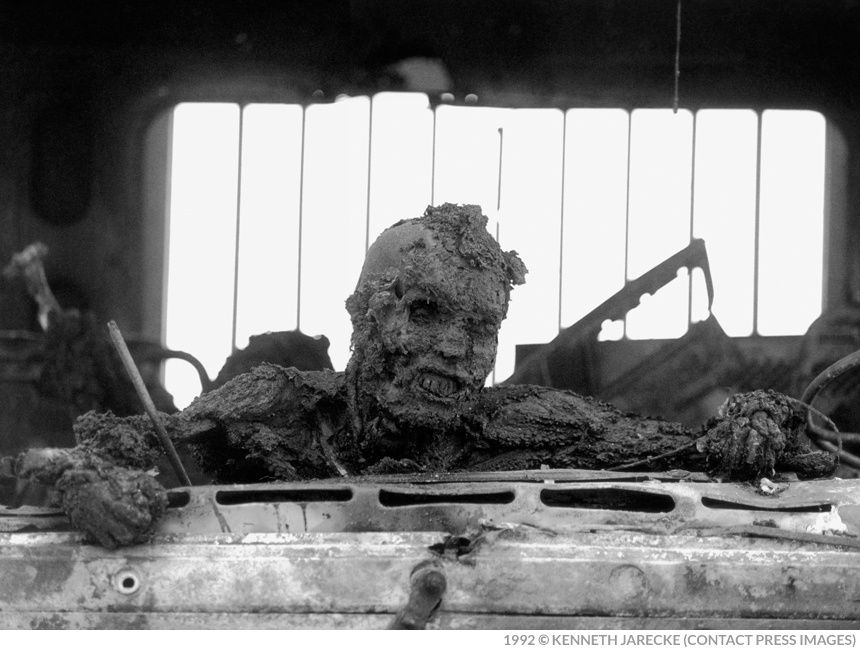
Jarecke's photo of a dead Iraqi was considered too disturbing to publish in America
Kenneth Jarecke’s 1991 photo of a dead Iraqi was considered too disturbing to publish in America

W.J. Astore

Americans tend to fear death.  It makes us uncomfortable.  Yet death is inevitable.  Its inevitability should teach us to revel in the richness of the here and now.  It should also teach us the foolishness of undue pride.

All is vanity, the Bible teaches.  Death reminds us of this — that human vanity, as unavoidable as it may be, is ultimately shallow.  There are riches out there that we should seek away from the glaring and garish light of vanity.  Riches that give deeper meaning to life.

Of all cultures in the world, I wonder if there’s another that ignores or denies death as much as American culture.  We’re the culture of new beginnings, fresh starts, reinvention, and also of the perpetual now, of youth, of defying or denying death through face lifts, cosmetics, adrenalin-driven adventures, and so on.  Technology and consumerism also provide distractions.  After all, how can I be nearing the end if I have the latest iPhone or iPad or if I’m wearing the latest hip fashions?

Our funeral homes seek to deny death with open casket rituals in which the dead person is made up to look alive.  Paul Fussell skewered this cultural tendency in his book, Class.  We use euphemisms like “passed away” or “passed on” for “died”; the descriptive term of “undertaker” has morphed into “funeral home director.”  Our religions stress life after death, not death itself.

We even deny that our wars produce death.  Think of the Bush/Cheney Administration, which refused to show photographs of flag-draped coffins of American troops, ostensibly for “privacy” reasons but mainly to minimize the deadly costs of fighting in Iraq and Afghanistan.  (Indeed, we don’t talk of troops dying in combat; we talk instead of troops “paying the ultimate price” or “making the ultimate sacrifice.”)

In minimizing the cost of war to its troops, the U.S. government and media also seek to deny the reality of death to the enemy.  War coverage in the media is often stock footage showing drones or aircraft firing missiles, enhanced by graphics and music.  You might see an enemy building or truck blowing up, but you’ll never see dead bodies.  Too disturbing, even though violent gun play and bleeding corpses are routinely shown in American crime shows and movies as entertainment.

In the first Iraq war (Desert Storm) in 1991, the photographer Kenneth Jarecke caught a powerful image of a dead Iraqi soldier burnt alive in his truck on the infamous “highway of death.”  Jarecke believed his photo would change America’s vision of the war, which in the U.S. media had been staged like a Hollywood production, neat and sanitary and clean.  But no U.S. media outlet would publish the image.  It was relegated to overseas publications.

What price do we pay as a people by ignoring death?  We lack a certain depth and maturity; put differently, we are callous and shallow.  Death has little meaning to us, especially the deaths of those in other lands.  For in seeking to deny the inevitability of our own deaths, how can we possibly recognize and process the death of others?

A death-denying culture that rains death on others using drones named “Predator” and “Reaper”; a culture that finds images of war dead too disturbing even as its TVs and movies and videos are saturated by bloody murders.  What are we to make of this?

The most powerful speech I’ve seen in any movie is that of Chief Dan George in “Little Big Man.”  In trying to make sense of the White Man’s war on Native Americans, Chief Dan George’s character, Old Lodge Skins, suggests that the White Man kills because he believes everything is dead already.  Lacking a moral center, the White Man has no sense of, or appreciation for, the sanctity of life.

Do we deny death because in some sense we are already dead?  Dead to the richness and sanctity of life?

Random thoughts, as promised.  But I hope they stimulate thought.  What say you, readers?

The Winners of Putin’s Aggression: The U.S. Military-Industrial Complex and Big Oil

There's a bear in the woods ...
There’s a bear in the woods …

W.J. Astore

There’s a new bear in the woods and his name is Vladimir Putin. Remember that Reagan campaign ad from 1984 that showed a menacing, obviously Soviet, bear patrolling the woods, with ominous music in the background? Fast-forward thirty years and a bare-chested Putin is that new bear, marauding in the Crimea and threatening Ukraine.

Our mainstream media has entered a time warp and we’re back to 1984.  No, not the 1984 of George Orwell and of constant monitoring by Big Brother – our media is not concerned by that.  Instead, they’re concerned with a revived Soviet Union, a new Cold War, and the notion that America is unprepared and weak.

The big winner of this collective (and selective) exercise in time travel is obvious: the U.S. Military-Industrial Complex as well as Big Oil and Gas.  We can’t make significant cuts to “defense” spending now that the Russian bear is on the loose again.  Right?  And the best way to neutralize the bear’s threats of cutting off gas shipments to Europe is by surging oil and gas drilling in the U.S., chiefly by hydro-fracturing or fracking.  Right?

Never mind concerns about rising CO2 levels and global warming.  It’s 1984 again, not 2014.  We need to corral that Russian bear before he emasculates us.  Deploy our military!  Drill baby drill!  Show the Russkies who’s boss!  Before they go all “Red Dawn” on us.

red_dawn

And when was the cheesy “Red Dawn” originally released? You guessed it: 1984.

Quick Thoughts on the Oscars

Sally Field in Norma Rae

W.J. Astore

I love movies but I can’t say that I love Hollywood.  My wife and I sat through the interminable Academy Awards last night; we should have received an Oscar for patience.  What amazes me is the lack of thanks the winners express to movie-goers.  You know: the little people who shell out $12 or more a ticket to see roughly two hours of often mediocre entertainment.  Instead of thanking the fans, most Oscar winners celebrate themselves (with perhaps a nod toward their fellow nominees) while thanking their publicists, their agents, various power-brokers in the industry, and so on.

Want the Academy Awards to move faster?  Have the winners take the stage, accept the Oscar, thank the Academy and the fans, and sit down.  And shut up.

Hollywood has a certain contempt for the working classes — you know, the people who keep them in their “Capitol” lifestyle (which is why “The Hunger Games” trilogy truly captures the zeitgeist of the American moment).  I was disgusted in watching the Oscar preview to see ordinary Americans caricatured as crumb-infested, couch-ridden, half-naked, clinically obese morons.  Yes, I’m not immune to humor, but to depict the fans who ultimately pay your salaries and keep you living the high life in such a luridly abusive way shows a contempt that is far too common among our “elites,” Hollywood included.

I enjoy Ellen Degeneres.  She has a light touch, good comic timing, and she knows how to zing the audience.  But her “Who wants pizza” skit was unfunny and ungenerous — no pun intended.  Once again, part of the joke involved whether the assembled Capitol beauties were going to stiff the pizza delivery man.  Ha ha.  Let’s pass the hat and take up a collection to pay for the pizza we ordered.  I’m not surprised many of the assembled elect couldn’t find a dime to kick in — they’re so accustomed to their Oscar freebies.

Hollywood has always catered to narcissists.  Nothing new there.  But there was a time when Hollywood celebrities knew how to accept awards (and their glamorous lifestyle) with a certain amount of class, while thanking, even respecting, the fans who make it all possible.  Last night was not of that time.

I suppose the ultimate measure of Hollywood’s contempt for its paying audience is the poor quality of its movies.  Want to make better movies, Hollywood?  Start by treating the working classes with a measure of common courtesy — along with some empathy based on respect for their challenges and sacrifices.

A last comment: It was nice to see, however briefly, a scene from Norma Rae (1979), featuring the great Sally Field as a factory worker trying to unionize her place of work, a gutsy dynamo fighting for fair wages and safe working conditions.  Where is that movie today, Hollywood?  When was the last time you made a sensitive, sympathetic, and generous movie about the tough struggles of American workers?  There must be a few, but none that stick in my head.  Help me out in the comments section, dear reader, if I’m missing some obvious recent examples.

Is the Digital World Too Ephemeral?

Give me hardcopy!
Give me hardcopy!

W.J. Astore

A concern I have about the new borderless digital world is its ephemeral nature.  Even though I keep a blog and write a lot online, I still prefer books and hardcopy.  I clip newspaper articles.  I file them away and then occasionally resuscitate them and use them in class when I teach.

Hardcopy has a sense of permanence to it.  A certain heft.  Whereas our new digital world, as powerful as it is for instant access and personal customization, seems much more ephemeral to me.

I know similar complaints have been made throughout history.  The proliferation of books was deplored as leading to the decline of visual memory skills.  Television was equated with the end of civilization, with the medium becoming the message.

Perhaps what I’m truly lamenting is the slow decline of context, together with the erosion of deep memory.  The digital world we increasingly inhabit seems to encourage an ephemeral outlook in which history just becomes one damn thing after another.

To switch metaphorical images, the dynamism and flash of the digital world is much like a landscape with lots of beautiful shiny leaves and glistening flowers to attract our attention.

Yet, at least in our minds, the landscape is rootless.  Our gaze is enraptured, our minds are intrigued, but the moment is fleeting, and we fail to act.  We fail to act because we are entertained without being nurtured.

Let’s take smartphones, for example.  With their instant access to data, they seem to make us very smart indeed.  But access to knowledge (data recall) isn’t intelligence.  There’s simply no substitute for deep-seated intellectual curiosity and the desire to learn.

Smart phones are useful tools — a gateway to a dynamic digital world. But they’re not making us any smarter.  Perhaps they’re helping us to connect certain dots a little faster.  But are we connecting them in the right way?  And are they the right dots to connect?

Those are questions that smartphones can’t answer.  Those are questions that require deep, contextual, thinking.  And group discussion. Think Socrates and his followers, debating and discoursing. And acting.

Sometimes it’s best to disconnect from the matrix, find a quiet place for reflection, sink down some roots, and hit the books.  Then find other informed people and bounce your ideas off them.  Collisions of minds in informed discourse. Competing ideas feed the completing of actions for the common good.

As the Moody Blues might say, it’s a question of balance. The astral planes of the digital world can open new vistas, but let’s not forget the need to return to earth and get things done.