War is the business of the state. That can be read in more than one way. Back in the 17th and 18th centuries, many wars were the work of mercenaries and mercenary-captains, often serving, more or less, nobility who thought they could supplant the king or queen, or expand their own turf and power, pursuing plunder all the while. People gave their support to strong leaders and nation-states partly because they were tired of constant warfare and being the victims of mercenaries. In the 18th century, war was said to be “enlightened” because it largely didn’t impact the people directly; warfare was “limited” to otherwise under-employed nobility and the so-called dregs of society. And nation-states profited from being able to control warfare.
The French Revolution and Napoleon unleashed a new phase of increasingly unlimited war inspired by ideology (Liberty! Fraternity! Equality!). Nationalism was heavily tapped. Soldiers were told it was an honor to die for the nation-state rather than for plunder or in the service of some minor nobleman. Sweet and fitting it seemed to die for one’s country, so soldiers were told — and are still told to this day.
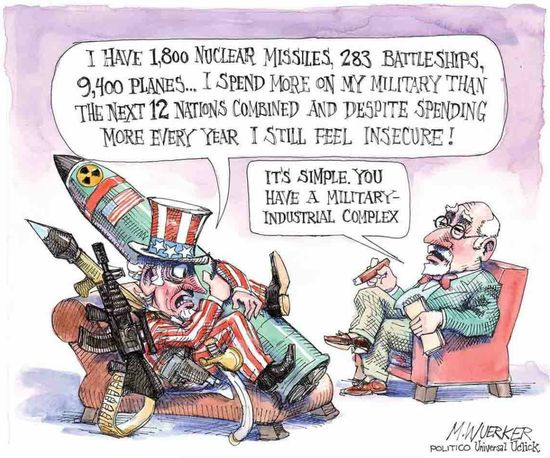
Nowadays, war is the business of the state may be taken literally with war as business. The U.S. federal government spends more than half of its discretionary budget on the military, weaponry, and war, though it’s disguised as a “defense” budget. As long as war remains a business for the U.S., and as long as people are profiting from it, not just in monetary terms but in terms of power, war will remain supreme in U.S. foreign policy.
I remember reading a newspaper from the 1930s that stated clearly that the way to end war was to remove the profit motive. That same decade, the U.S. Senate held hearings to expose the “merchants of death,” the military contractors that had profited so greatly from wholesale death and destruction during World War I. Since the U.S. in those days didn’t have a large standing military and a vast array of private military contractors, those hearings could go ahead in a nation that sought to avoid another world war, especially yet another one in Europe.
Today, the U.S. routinely wages war couched as ever in terms of peace or, if not peace, then security for America. How America is made more secure by troops in Syria helping to facilitate the seizing of oil, or troops in Africa engaging in the latest scramble for that continent’s natural resources, is left undefined. Or perhaps there is a tacit definition: if war is business, America needs (and deserves) access to the best markets, to vital natural resources, to oil and lithium and similar strategic materials, and the way to secure those is militarily, using force.
One thing that amazes me, though it shouldn’t, is the almost complete lack of emphasis in the U.S. on conservation, on limiting resource extraction by cutting demand. Oil companies are bragging how they’re boosting fossil fuel production in the U.S. The message is clear: keep consuming! No need to cut back on your use of fossil fuels. Your overlords will secure — and sell at inflated prices — the fuel you need and want. Just don’t ask any uncomfortable questions.
I suppose it’s all quite simple (and depressing) in its obviousness:
War is the business of the state.
The business of America is business.
The business of America is war.
The nation-state was supposed to corral war, to control it, to “enlighten” it by keeping it limited, a sideshow. Yet war in America has become unlimited, the main show, and very much unenlightened as well. Corralling and controlling it is out of favor. Planning for the next big war is all the rage, perhaps most clearly with China, though Russia factors in as well. A new cold war wins nods of approval from America’s national security state because it most certainly means job security and more power for those who are part of that state.
What is to be done? America needs to remember that war is not the health of any democracy, and that no democracy can survive when it’s constantly engaged in war and preparations for the same. Yet we know America isn’t a democracy, so that argument is effectively moot. Perhaps homespun wisdom can help: those who live by the sword (or the gun) die by the same, though the American response would seem to be: I’ll just buy more swords (or guns), so take that. Or maybe an appeal to Christianity and how blessed the peacemakers are, and how Christ was the prince of peace, except Americans prefer a warrior-Christ who favors his chosen with lawyers, guns, and money.
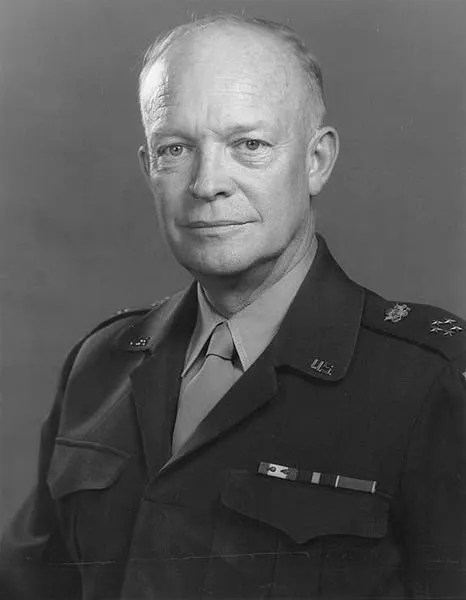
Eisenhower knew war and hated it. He spoke of spending on wars and weapons as humanity crucifying itself on a cross of iron. He warned America in the strongest terms of the perils of the “military-industrial complex.” The Eisenhower Memorial in DC fails to capture his most powerful and memorable sentiments against war
W.J. Astore
Dwight D. Eisenhower’s most famous address was his last one to the nation in January of 1961, when he warned America of what he termed “the military-industrial complex.” It was a warning as powerful as it was prescient, and though Ike achieved much in life, surely this speech and the meaning of his warning deserve to be captured in the boldest terms in the memorial to Ike in Washington, DC.
Sadly, it isn’t. Though I haven’t yet seen the monument in person, images of it are available online with audio commentary. Let’s tackle the audio commentary first. In Part 5, “Leader of the Free World,” the narrator speaks of Ike’s “farewell address,” not his address on the military-industrial complex, and that it included a “caution” (not a “warning”) to the nation. Ike is allowed a few sentences on the military-industrial complex, but the narrator provides no additional context or commentary. The narrator then ends by saying this was Ike’s goodbye speech; again, no mention of how powerful Ike’s speech was in its criticism of a force that Ike declared threatened America’s democracy and our personal liberties. And then the kicker: at the end of the narration, we’re told the audio commentary was made possible by “a generous donation” by Boeing!
I burst out in rueful laughter. Of course Ike’s warning about the military-industrial complex was played down; the military-industrial complex funded the audio commentary! I felt like Ralphie in “A Christmas Story” when he discovers his secret magic decoder ring is only useful for decoding crummy commercials that urge him to drink his Ovaltine.
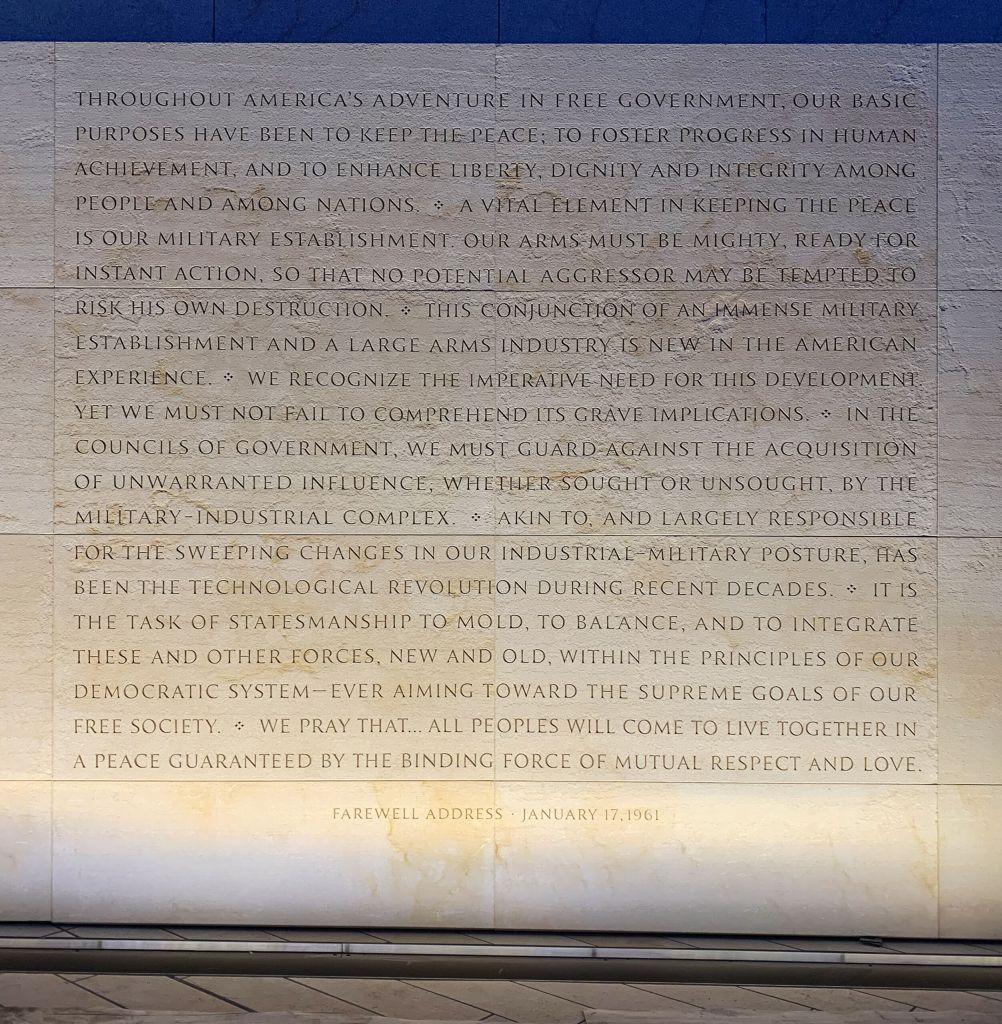
Turning to the memorial inscriptions themselves, here is the one for Ike’s “farewell address”:
Throughout America’s adventure in free government, our basic purposes have been to keep the peace; to foster progress in human achievement, and to enhance liberty, dignity and integrity among people and among nations. A vital element in keeping the peace is our military establishment. Our arms must be mighty, ready for instant action, so that no potential aggressor may be tempted to risk his own destruction. This conjunction of an immense military establishment and a large arms industry is new in the American experience. We recognize the imperative need for this development. Yet we must not fail to comprehend its grave implications. In the councils of government, we must guard against the acquisition of unwarranted influence, whether sought or unsought, by the military-industrial complex. Akin to and largely responsible for the sweeping changes in our industrial-military posture, has been the technological revolution during recent decades. It is the task of statesmanship to mold, to balance, and to integrate these and other forces, new and old, within the principles of our democratic system — ever aiming toward the supreme goals of our free society. We pray that…all peoples will come to live together in a peace guaranteed by the binding force of mutual respect and love.
Farewell Address January 17, 1961
Notice how Ike’s warning (which I’ve bolded) about the military-industrial complex is buried in the text. Even more critically, the very heart of Ike’s warning is torn out. For here are Ike’s words that followed the warning about a military-industrial complex, and which are omitted on the memorial:
The potential for the disastrous rise of misplaced power exists and will persist.
We must never let the weight of this combination endanger our liberties or democratic processes. We should take nothing for granted. Only an alert and knowledgeable citizenry can compel the proper meshing of the huge industrial and military machinery of defense with our peaceful methods and goals, so that security and liberty may prosper together.
Why weren’t these powerful words of Ike also engraved in stone? Could it be because no one in the DC area, especially the military, its many corporations, and the Congress, wants the American people to come to grips with “the disastrous rise of misplaced power” in America?
Putting this memorial together required corporate funding. Congress was also heavily involved. So too was the military. Is it any wonder that Ike’s warning about the military-industrial-Congressional complex has been watered down to a “caution” and buried in the text of a fond “farewell”?
Remember, Ike implored us to be alert and knowledgeable citizens. How can we be when his speeches are bowdlerized at his own memorial and the audio commentary to the same is funded by Boeing?
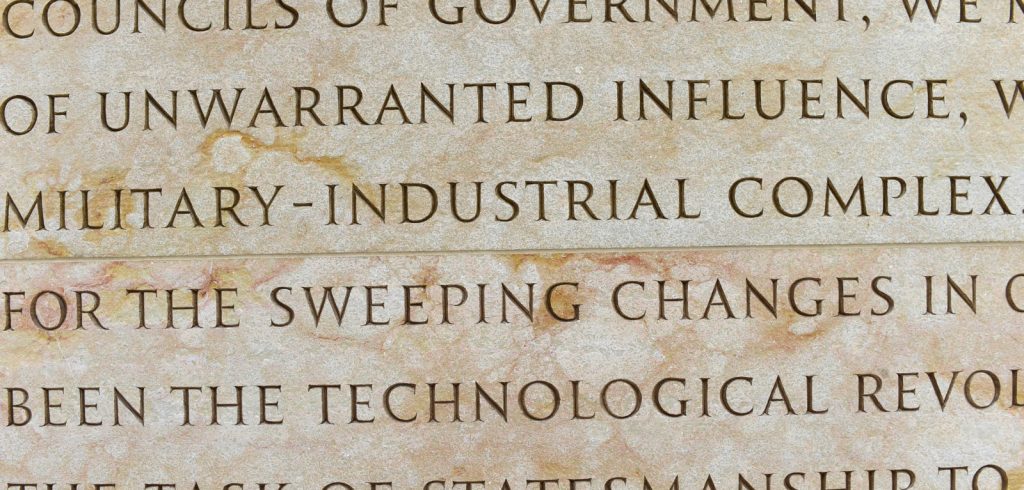
It’s easy to lose the thrust of Ike’s powerful warning about the military-industrial complex when it’s buried in the middle of this monument, and when Ike’s strongest words weren’t even included
You truly need to sharpen your focus if you want to catch a glimpse of what truly worried Ike:
Something tells me that Ike, if he were alive today, would be none too happy about this. Ike’s memorial celebrates his boyhood, his service and great victory in World War II, and his presidency, but it fails to capture his finest speeches against war, against wasteful and immoral spending on deadly weaponry, and against a powerful alliance among the military, its weapons makers, and Congress that Ike saw as a fundamental threat to liberty and democracy.
Our monuments betray us, America, in more ways than one.
My esteemed colleague Davout and I have different ways of looking at the Russia-Ukraine War. We thought it would be a worthwhile exercise to share our differing perspectives here, allowing our readers to think over the merits of our approaches and the validity of our conclusions. Davout has framed the questions and made the initial response; I get the last word, so to speak, for each question. Our mutual intent is not to “win” a pseudo-debate but to pose questions and provide answers that inform and stimulate. To that end, here we go.
What caused the Russian invasion of Ukraine?
Davout: Putin’s desire to reestablish Russian hegemony over Eastern Europe and ensure the stability of his autocratic regime has been the main driver of the invasion. In 2005, Putin declared that the collapse of the Soviet Union was “the greatest geopolitical catastrophe of the century.” What was catastrophic about it for Putin? The eastern flank of the former Soviet Union, including Latvia, Lithuania, Estonia, Moldova, and Ukraine shifted from being an appendage of an authoritarian Soviet regime to being a collection of independent democracies or democracies-in-process. Membership in the European Union and in NATO has either been achieved (the Baltic states) or been pursued (Ukraine pursuing both, Moldova pursuing European Union membership only). None of these countries (not to mention the formerly occupied countries of Poland, Hungary, East Germany, Czechoslovakia) singly or together have the capacity or will to invade Russia or otherwise project military power across Russian borders. The real threat to which Putin is responding is the example set by the people of former Soviet territories opting for more democratic, less corrupt regimes and societies. That example endangers his own hold on power and pushes his own society toward historical irrelevance.
Astore: Putin was obviously the prime mover of the invasion. He chose the military option, and he surely believed it would strengthen his authority over a former Soviet republic that was tracking toward joining NATO.
When we speak of causes, however, it’s often wise to take a broad view over a breadth of time. When the Soviet Union collapsed in 1991, NATO’s reason for being ended with it. Nevertheless, NATO persisted, expanding to the very borders of Russia despite assurances to Russian leaders that the alliance would not expand eastwards beyond a newly unified Germany. Russian leaders, including Putin, had issued clear warnings that NATO expansion into Ukraine would constitute a “red line,” the crossing of which would likely lead to a military response. Putin’s decision to invade, therefore, was eminently predictable, thus it was also potentially preventable. The United States, which leads NATO, could have sent a clear signal to Russia that Ukraine should and would remain a neutral buffer state. The US chose not to do so.
One may question the premise of Ukraine as a “more democratic, less corrupt regime.” In Ukraine, corruption is endemic, exacerbated by extensive U.S. meddling, as in the notorious coup of 2014 orchestrated in part by Victoria Nuland, citing the support of then-Vice President Joe Biden. And while it’s important to recognize Russian regional hegemonic ambitions, one should never forget the global hegemonic ambitions of the U.S. empire. In sum, the US has not been an innocent bystander here.
US proxy war or Ukrainian war of independence?
Davout: A proxy war is a conflict instigated by a state in which it does not directly engage in hostilities. This war was a war of choice on the part of Putin. It has had the unintended result of inspiring patriotic resistance (even amongst Russian-speaking Ukrainians who were formerly pro-Russian like the mayor of Odessa). In the lead up to the invasion, the US and its NATO allies attempted to dissuade Putin from invading. In the invasion’s aftermath, they have provided critical arms and support to Ukraine and have sought economically to undermine Russia’s war-making capacities. While current official US policy may be the crippling of Russia’s capacity to engage in another such invasion in the near future, the US did not instigate this war in pursuit of this aim. While US and NATO armaments are a necessary factor in Ukraine’s continued defense against the Russian invasion, it is Ukrainian solidarity and resolve and Russian refusal to end its invasion that keep this war going.
Astore: Clearly, most Ukrainians believe they are fighting for their independence. Ukraine has no desire to become a Putin puppet state. Nor, however, do they wish to become a puppet state to the USA.
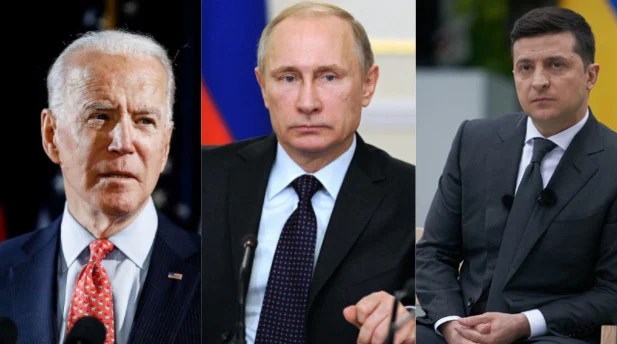
Lloyd Austin, the US Secretary of Defense, spoke clearly that weakening Russia was a key goal of this conflict. To that end, the US government, in a rare show of bipartisan unity, provided $54 billion in largely military aid to a Ukrainian military with a yearly budget of $6 billion. Such profligacy is not an example of generosity driven by disinterested ideals. Clearly, the US sees this war as the latest front in a new cold war, a way to stress Russia to the breaking point. As President Biden openly stated, that man (Putin) must go.
So, it’s worse than a proxy war: it’s yet another US regime-change war. The stated goal is to topple Putin and turn Russia into a divided and dysfunctional state, much like it was in the 1990s when Western corporations and financial institutions invaded Russia and exploited it in the name of capitalism and reform.
Are there any legitimate parallels to draw between Putin and Hitler?
Davout: Yes, though the parallels with Hitler are not the same parallels so often drawn to delegitimize non-interventionists as appeasers. Historian John Lukacs’s various histories of Hitler’s strategizing in that crucial period after the invasion of France to the start of the Battle of Britain paint a picture of Hitler less as the hubristic dictator irrationally striving for world conquest than as a canny but flawed geopolitical strategist, driven by geopolitical grievance and with a large capacity to hate those who opposed him. Lukacs argues that Hitler was prepared to cut a deal with Great Britain on terms that would allow Germany to exercise hegemonic powers on the continent. It was Churchill’s longstanding aversion to Hitler and Hitlerism and his ability to maintain British popular support for the war that blocked Hitler’s strategy to cut a deal. Once his overture was blocked by Churchill, Hitler underestimated British morale in the Battle of Britain. Then, in an effort to circumvent Britain’s resistance, Hitler gambled that he could cripple Stalin’s war making capacity and knock him out of the war and thereby present England with a fait accompli of German hegemony on the continent. The picture of Hitler Lukacs draws can plausibly be applied to Putin—a grievance-driven leader attempting to restore a lost geopolitical sphere of influence, who has miscalculated the resolve of democratic leaders and peoples and has doubled down on violence.
Astore: In a word, no.
Whenever American leaders want to justify military action and high spending on weaponry, they turn to Hitler and World War II. The claim is made that we must stop the “new” Hitler. We must not be appeasers. Saddam Hussein was allegedly the new Hitler in 2003; his WMD was supposed to be a mushroom cloud on our horizon. But there was no WMD and eliminating Saddam by invasion tipped Iraq into a disastrous civil war from which that country has yet to recover.
Putin isn’t the new Hitler, and his invasion of Ukraine doesn’t represent the kind of existential threat the Third Reich presented to democracies in 1938-39.
Hitler had the finest military machine of his day backed by the economic powerhouse that was Germany in the late 1930s. Putin’s military machine is mediocre at best, and Russia’s economy is smaller than that of California. Putin doesn’t appear to be seeking a huge empire or world domination, as Hitler was. And while Hitler may have temporarily played nice with Britain, that didn’t prevent the Nazis from hatching plans to invade and loot Britain and to massacre its Jews as well.
Of course, Putin was wrong to have invaded Ukraine, but George W. Bush was wrong to have invaded Iraq in 2003. Both these leaders have essentially nothing in common with Hitler, who was sui generis–a tyrannical dictator driven by genocidal fantasies of world dominance by a “master race.”
To what extent is US democracy hurt or helped by the Biden Administration’s policy of military support for Ukrainian resistance?
Davout: Seeing his country in hostile competition with western democracies, Putin has deployed various forms of soft power and hard power to undermine confidence in, and injure the working of, democratic regimes. Hackers and internet influencers employed by the Russian state have intervened in the elections of established democracies either to foster social distrust or to promote candidates (e.g., Trump) and policies (e.g., Brexit) that weaken adversary countries. Military interventions are carried out on Russia’s border to maintain regimes favorable to Putin (as was the case when a popular uprising against fraudulent elections in Belarus was put down with the help of Russian soldiers). Meanwhile, as was documented by the Panama and Pandora Papers, the huge amounts of money pilfered from the Russian people by oligarchs moves through the banking, legal, and commercial institutions of democratic countries (including South Dakota!) with corrupting effect on people and officials alike. To be sure, the US has corruption problems of its own. And US military support of Ukraine will have the unfortunate result of strengthening the position of defense contractors and their lobbyists, Pentagon brass, and congressional hawks. However, it would be worst for US democracy if Russian ambitions to occupy or dismember Ukraine succeed. This would undermine European democracies whose continued survival and flourishing provide democratic reformers in the US with critically important role models and partners.
Astore: US democracy hasn’t been hurt or helped by this war because the US is a democracy in name only.
In reality, the US is an oligarchy in which the rich and powerful rule at the expense of the many. The unofficial fourth branch of government is the US National Security State, a leviathan of enormous power. Its biggest component is what President Dwight D. Eisenhower in 1961 termed the military-industrial complex (to which he added Congress as well). This MICC is profiting greatly from this war, not only in the $54 billion in aid provided to Ukraine, but also in the ever-rising Pentagon budget for FY 2023, which will exceed $813 billion, a gargantuan sum justified in part by the Russia-Ukraine War.
The new cold war with Russia, and increasingly with China as well, is strengthening the state of permanent war in America. As James Madison warned, permanent warfare serves autocracy while insidiously destroying democracy. As militarism becomes more deeply entrenched in the US government, and as that same government continues to send more destructive weaponry to Ukraine such as artillery and missile systems, options for de-escalation narrow even as chances for a nightmarish escalation to nuclear war, whether by design or accident, increase.
What would truly strengthen democracy in America, assuming it could somehow be reanimated, is if the USA pressed ahead with all its strength to broker a peace treaty between Russia and Ukraine. Ukraine is getting wrecked by this war, and our aggressive actions, mainly in providing more and more lethal weaponry together with onerous sanctions, are guaranteed to shred more bodies and aggravate economic dislocation both here and in Europe.
Readers, what are your thoughts here?
Coda by M. Davout (6/6/22)
W. J. Astore has asked me to compose a “coda” of sorts, in which I might add some concluding reflections about the commentary provoked by our different views on the war in Ukraine.
Yes, there is a relevant pre-2022 history to the current conflict—decades old promises from US officials to Russian officials about not expanding NATO east of the Oder, a popular pro-West Ukrainian uprising (supported by Western intelligence agencies, some have plausibly argued) against a Ukrainian administration’s decision to reject closer ties with the European Union (as was the will of the Ukrainian parliament) in favor of the Ukrainian president’s decision to push the country toward closer ties with Russia, a counter-uprising in the Donbas that drew Russian political and military support, etc. But there is also the fact of a full-scale military invasion against a country that posed little if any military threat to Russian borders, a military invasion that has led to the needless deaths of tens of thousands of civilians and combatants and the uprooting of millions of Ukrainians.
It is undeniable that the invasion has promoted patriotic solidarity among different language speakers within Ukraine against the invasion, including Russian speaking Ukrainians whose rights Putin’s invasion was presumably intended to defend. It is also undeniable that voter support for Ukraine’s resistance to the invasion is very high in Eastern European countries. More noteworthy is the fact that in Western European countries, governments have been forced to respond to the pro-Ukrainian sentiments of their voters by sending arms to Ukraine and destroying longstanding economic relationships with Russia to the financial detriment of both European businesses and consumers.
So the situation is nowhere near as neat or clear as either my contributions or Astore’s contributions or the contributions of the majority of the commentators would have it be. In this regard, the comments of Denise Donaldson strike me as the most interesting. You can tell that she can see the issue from both sides and is struggling with that ambiguity.
That is the place to be on the Ukraine war, I think: struggling with ambiguity. There is no clearly right answer: the war is not solely a product of American empire, nor is it solely a product of Russian empire. And there are no good outcomes, only bad or worse outcomes.
But, in politics, one has to make choices and, for now, I choose align myself with current US and NATO policy. Not because I am a dupe of the mainstream media or a supporter of the Establishment or the MIC (my earlier posts on this website should put those notions to rest) but because I believe the expulsion of the Russian military from the Ukrainian lands it currently occupies (maybe including Crimea, maybe not) is both possible and more likely to lead to a lasting peace in eastern Europe. And my taking that position does not mean that I do not also see some merit in the points my esteemed colleague WJ Astore (and his many followers) make.
Response by Astore (6/6/22)
I would like to thank M. Davout for his reasoned response and for continuing this important discussion. One thing I can say with certainty: you won’t hear such a nuanced and broad debate in the mainstream media, which basically just sells U.S. weaponry while waving Ukrainian flags in our faces.
Davout suggests that Ukraine posed no threat to Russia. Alone, that is true. But Ukraine was planning to join NATO, a powerful alliance led by the world’s most hegemonic country. Surely, that combination was something for Russia to be wary of, and even to fear.
When Americans think of Russia, many negative images come to mind. The evils of communism. A charging and rampaging Russian bear. But Russia has had its share of devastation. Davout certainly knows the rampage of Napoleon’s empire in 1812. Russia and the Soviet Union were almost destroyed by World Wars I and II. Russian leaders have been reassured by Western leaders before that “we come in peace,” but surely 1812, 1914, and 1941 taught Russia much about trusting Western assurances.
Look at a map. From a Russian perspective, NATO surrounds them. Look at military budgets. The U.S. and NATO combined spend more than 20 times what Russia spends. If the roles were reversed and we were the Russians, might we see this differently?
My point is not to excuse Russia’s invasion but to offer a partial explanation.
I agree with Davout that by this point “there are no good outcomes, only bad or worse outcomes.” Therefore, I choose not to align myself with current US and NATO policy, since I see this as recklessly escalatory and focused primarily on providing more and more weaponry to kill more and more Russians (and Ukrainians too). I propose an immediate cease fire, the end of arms shipments to Ukraine, and negotiation that would end with some territory being ceded to Russia, a promise from NATO and Ukraine that the latter will remain neutral, and a promise from Russia that Ukraine will not be attacked again, and that its territorial integrity will be respected. I would also insist on Russia paying reparations dedicated to rebuilding Ukraine. Finally, the U.S. should end all sanctions on Russia and redirect its aid entirely to rebuilding Ukraine rather than to more weaponry.
I think this approach would save lives and restore equilibrium to Europe while avoiding dangerous escalation that could conceivably end in nuclear war. It’s time for statesmanship and compromise, rather than militaristic grandstanding and mendacious obstinacy.
Sadly, I see no one in the US government with the sagacity and cojones to join Putin and Zelensky in working to stop this war reasonably and quickly.
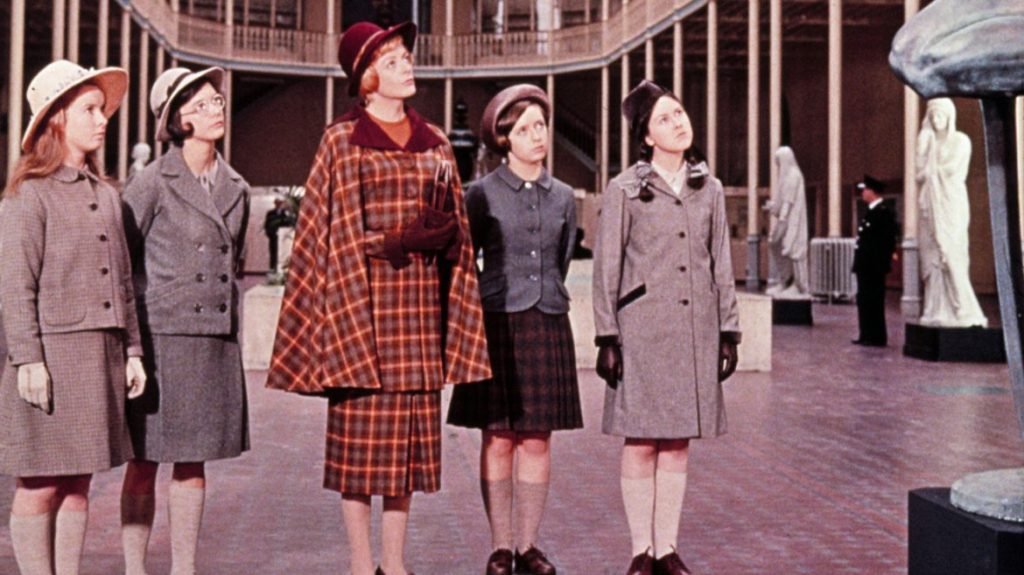
“The Prime of Miss Jean Brodie” (1969) starring Maggie Smith, who won the academy award for best actress that year, challenges, at least for a moment, pedagogical orthodoxy. In this fictitious story Jean Brodie is a teacher in a private secondary school for girls in 1932 Edinburgh. From the beginning it is obvious she is the most popular as well as the most controversial teacher in the school. The rigorously traditional head mistress regards Miss Brodie as a maverick who has consistently demonstrated that her methods over the years of her tenure are starkly incompatible with the goals and values of the school. Jean nurtures a romantic attraction to social, political, and military upheavals. In her classes she avoids talking about the political and moral ramifications of historical events, seeing them as obstacles to her view of history as drama. Showing her students projected slides of classical architectural structures and paintings to engage their capacity for aesthetic appreciation is also a major feature of Miss Brodie’s classes. Engaging her students’ emotions is more important to Jean than detailed historical facts.
In first day of class for the new semester Miss Brodie describes an imaginary scene of a former lover dying on the battlefield in World War I. She seems to delight in exposing her girls (her students are “my girls”) to the emotional realities of war by providing them with the opportunity to romanticize death. Listening to the description of the former lover’s death in battle one of her students bursts into tears. At that moment, the head mistress enters the classroom to see how the first day is going. She is perplexed by the student crying, declaring: “You shouldn’t cry during a history lesson.”
“Truth and beauty” is what Jean Brodie claims she is teaching her students. To challenge her students to appreciate the romantic qualities of even ghastly historical events seems to be a goal. But what she means by “truth” is not necessarily empirical facts. Beauty is truth, Miss Brodie adamantly believes. Even war is an aspect of “beauty” because people die heroically. It doesn’t matter what the reason or cause is as long as passionate feelings can be engaged in the presentation of the lesson.
At one point in the film Jean is called to the head mistress’s office to explain her teaching methods. The head mistress suspects—and rightly so—that Jean is not giving her students the standard information regarding the subject matter. Miss Brodie argues that the meaning of education comes from the Latin word “e-ducare” which means to lead out of. Her job, she believes, is to elicit her students’ inherent love of learning. She seeks to stimulate her students’ inherent capacity to see macro and micro events, especially of war, as an art form. A scene on the battlefield in Spain is to be admired as one appreciates a Giotto painting.
Throughout the movie Jean keeps telling her students they are the “crème de la crème.” When she asks Mary, a new student at the beginning of the semester what her interests are the student says she doesn’t have any. Miss Brodie promptly tells her she will give her interests. Later in the school year that same student goes off to fight for Franco in the Spanish Civil War after Jean had told the class that one is not fully living until one is engaged in major social and political events, events which elicit passionate responses. The student drops out of school and join’s Franco’s fascist army. She gets killed before the school year is over. (Jean has obviously omitted discussing with her students the moral purpose of the war in the first place.)
So, what can educators learn from the character of Miss Jean Brodie? Jean’s teaching style—you have to see the movie to really appreciate it–surely leaves something to be desired. But Miss Brodie’s love of teaching itself and her desire to engage her students’ emotions in the learning process is to be taken seriously. After all, her students love and respect her highly, as almost every scene in the film demonstrates. But Jean’s failure to acknowledge important facts in favor of the aesthetic and the romantic aspects of political events—Mussolini is a beautiful leader, she proclaims–is what brings her down. She is ultimately dismissed from her teaching post.
The film raises an important question in liberal arts education, both on secondary and post-secondary levels. Do teachers and professors need to engage students’ capacity to become emotional, even passionate, about the subject matter? Should the role of the educator be to provide students with interests, as Jean insists her purpose is, at the expense of factual information? Put simply, does the story of Miss Jean Brodie have something significant to offer educators despite Jean’s playing fast and loose with empirical reality?
For myself—I’ve been a professor of sociology for decades–the importance of emotive anecdotal examples throughout the teaching process when the subject matter pertains particularly to human behavior and socio-historical events can’t be overstated. The teacher of social sciences and history as artist and poet is a very plausible mixture. At any rate I felt very much inspired by the Jean Brodie character. She genuinely wanted to reach her students to inspire them to live passionately.
Yet, as the movie suggests, passions unguided by a sound moral compass may prove deadly.
Richard Sahn is a sociology professor who challenged and inspired his students to think differently in and out of the classroom for more than four decades.
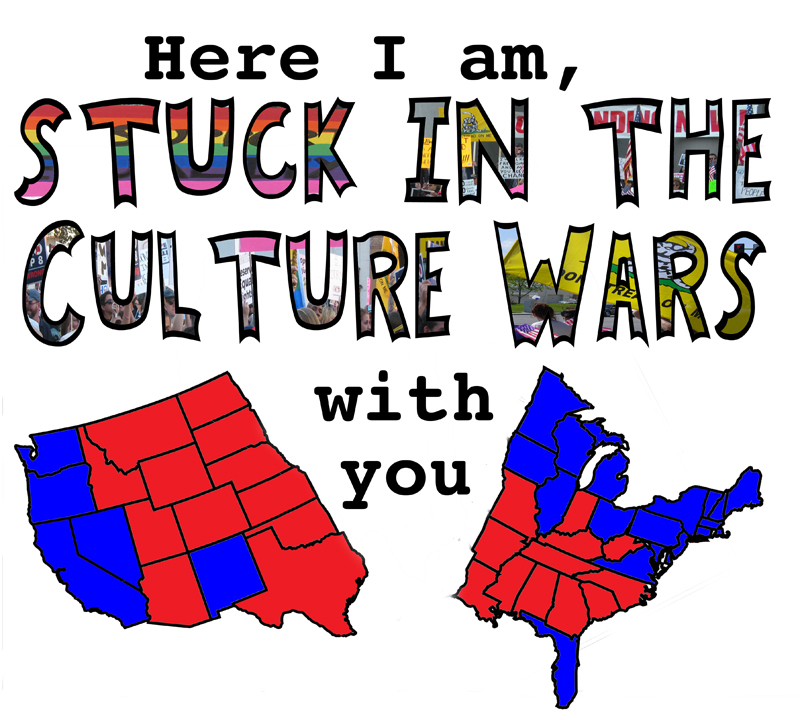
I saw another article this weekend about culture war in America. Supposedly, America is deeply divided, and I’m not denying there are divisions. But when you ask Americans what they want, what’s surprising is how united we are, irrespective of party differences. For example, Americans favor a $15 minimum wage. We favor single-payer health care. We favor campaign finance reform that gets big money donors and corporations out of government. Yet our government, which is bought by those same donors, refuses to give Americans what we want. Division is what they give us instead, and even then it’s often a sham form of division.
What do I mean by “sham”? Well, our so-called divided government is strongly united in support of huge war budgets and endless war. Strongly united in support of Israel. Strongly in favor of, and obedient to, special interests and big money in politics. Strongly in favor of business as usual (with a stress on “business”), with sham elections every four years between the center-right Democrats and the increasingly unhinged-right Republicans. Sadly, when it comes to policy that impacts the working classes, there isn’t much difference between Nancy Pelosi and Mitch McConnell. They are unified in what they deny us.
It’s a war of the have-mores versus the haves and especially the have-nots, and the have-lots-more are winning. Why? Because they’ve bought the government too.
Of course, we do see examples of so-called culture war in the U.S. Consider in the realm of history the “battle” between the 1619 Project and the 1776ers. The 1619ers want to stress the many violent and tragic legacies of slavery to America’s history. (1619 was the first year an African slave was brought to the colonies.) The 1776ers want to stress the ideals of the American Revolution, the proud legacy of George Washington and other founders, the Declaration of Independence and the U.S. Constitution, and so on.
What’s the solution to this “culture war” between the 1619ers and the 1776ers? I’m a historian, and I’ve taught U.S. history. The solution is easy. You teach both. America is a land of contradictions. Any U.S. historian worth her salt is going to talk about genocide and the Native Americans; is going to talk about the violent and bitter legacies of slavery; and is also going to talk about the ideals and idealism of the founders, however imperfectly they put them into practice, and the promise of the Constitution and the spirit of liberty. To ignore slavery while singing the praises of the founders would be as flawed and one-sided as focusing entirely on slavery without ever mentioning the proud achievements of those same founders.
America is a complex and contradictory place — and any historian is going to address those complexities and contradictions because that’s precisely what makes history interesting, fascinating, enthralling. Few students want to be comforted by feel-good history or assaulted by feel-bad history. They want to know the good, the bad, and the ugly, and historians should be able to teach the same. There’s simply no need for a culture war here over the content of history.
I said there’s no need, but that doesn’t mean a culture war isn’t wanted. Polemicists love culture wars, and so too do the already privileged and the powerful. For if we’re fighting each other, if we perceive we’re divided and simply can’t find common ground, we’ll forget we have so much in common, like our desire for a living wage, affordable health care, and politicians who’d actually represent us instead of the special interests.
Forget culture war. Let’s make war on those who keep us apart and who refuse to work for those so desperately in need.


 Bracing Views