The Calamitous 21st Century

tuchman

W.J. Astore

We’re only sixteen years into the 21st century, but it seems like a “best of times, worst of times” kind of epoch.  It’s the best of times for the aristocracy of the rich, and the worst of times for the poor and disadvantaged, especially when they live close to or in war zones.

Perhaps that’s a statement of the obvious, except the gap between the richest and poorest continues to grow.  Their worlds, their realities, are so different as to be virtually disconnected.  This is a theme of several recent science fiction films, including the “Hunger Games” series (the Capitol versus the Districts) and “Elysium,” in which the privileged rich literally live above the sordid earth with its teeming masses.

Some of the big fears of our present century include the emergence of a “super bug,” a contagion that is highly resistant to traditional drugs.  We’ve overused antibiotics and are slowly breeding new strains of bacteria that modern medicine can no longer defeat.  Meanwhile, many people in the U.S. still lack health care, or they’re reluctant to use it because it’s too expensive for them.  And then there are the workers who lack sick leave.  They force themselves to go to work, even when sick, because they need the money.  How long before inadequate health care and sick workers facilitate the conditions for the spread of a plague?

And then there’s the contagion of violence and war.  America’s wars in places like Iraq, Afghanistan, and Africa are basically open-ended.  They are today’s version of the “Hundred Years’ War” between England and France, an on-again, off-again struggle for dominance that sprawled across two centuries.  In fact, America’s “war on terror,” with its “surgical strikes” and reliance on technology as a quasi-panacea, seems to be breeding new types of “super-bug” terrorists who are highly resistant to traditional techniques of policing and war.

In this effort, one thing is certain: No U.S. president will be declaring “peace” or even “normal” times for the next decade or two (or three).

Finally, let’s not forget global warming.  The Pentagon and the CIA haven’t.  Republicans may have their share of climate change deniers, but when it comes to the U.S. national security state, contingency plans are already in place for the disasters awaiting us from global warming.  Competition for scarce resources (potable water especially, but food and fuel as well) combined with more intense storms, widespread flooding, and much warmer temperatures, will generate or aggravate wars, famines, and plagues.

Are we living in a failed or failing world?

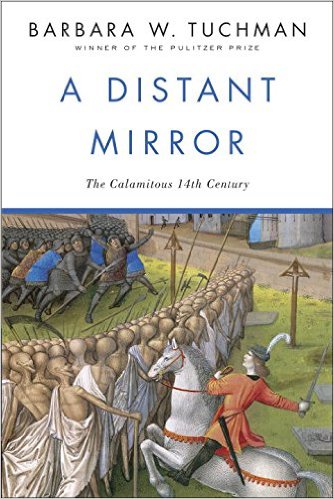
In “A Distant Mirror,” the historian Barbara Tuchman wrote about the calamitous 14th century of plagues and wars and a mini-ice age in the northern hemisphere. We seem to be facing a calamitous 21st century of plagues and wars and a mini-hothouse age.  It’s a grim prospect.

The question is: Can we act collectively to avert or avoid the worst of these calamities?  Or are we fated to dance our very own 21st-century danse macabre?

Mother Nature: It’s Really Not Nice to Fool with Her

earth
Guess What?  There’s Only One Earth

W.J. Astore

The other day, I was watching a typical truck commercial on TV. It showed trucks literally tearing up the backroads, along with ATVs spinning and jumping and chewing up the countryside, all synonymous with “adventure” and “freedom.”

I remember those old Coors commercials featuring Mark Harmon. They were set in Colorado (I think) and featured him quietly extolling the virtues of barley and clean water. Now most Coors commercials are about self-indulgent partying (but please drink responsibly).

My point? We need a change in mindset — one that values nature and its preservation. We’re doomed if we keep selling the idea “you can have it all,” so go party and tear up nature — who cares as long as you’re having fun?

We act as if we have many planet earths, but we have only one.  And we’re slowly and surely making our planet less habitable for humans.

Our planet is already having its revenge.  As Tom Engelhardt wrote about in a recent article about “Emperor Weather,”

Of course, his [Emperor Weather’s] air power — his bombers, jets, and drones — would be superstorms; his invading armies would be mega-droughts and mega-floods; and his navy, with the total or partial melting of the Greenland and Antarctic ice sheets, would be the rising seas of the planet, which would rob humanity of its coastlines and many of its great cities. His forces would occupy not just one or two countries in the Greater Middle East or elsewhere, but the entire planet, lock, stock, and barrel.

Emperor Weather’s imperial realms would be global on an awe-inspiring scale and the assaults of his forces would fragment the present planet in ways that could make much of it, in human terms, look like Syria. Moreover, given how long it takes greenhouse gases to leave the atmosphere, his global rule would be guaranteed to last an inhumanly long period of time unchallenged.

Heat (think burning Australia today, only far worse) would be the coin of the realm. While humanity will undoubtedly survive in some fashion, whether human civilization as we now know it can similarly survive on a planet that is no longer the welcoming home that it has been these last thousands of years we have no way of knowing.”

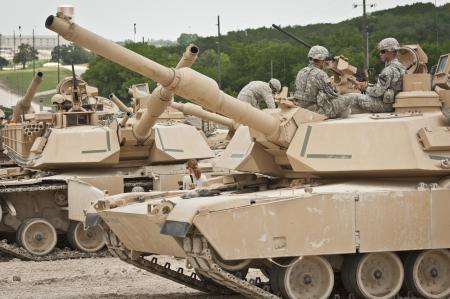
Wars will doubtless follow in the wake of disruptions by Emperor Weather, which will only make matters worse for humanity.  Think of all those weapons that run on fossil fuels — ships, planes, and tanks.  All those weapons that pollute the earth while consuming valuable resources that could be used for alternative energies (solar panels, for example).

It’s time to beat our weapons into wind turbine blades, and to make war no more, either on ourselves or on nature.

The Nuclear Triad Is Not the Holy Trinity

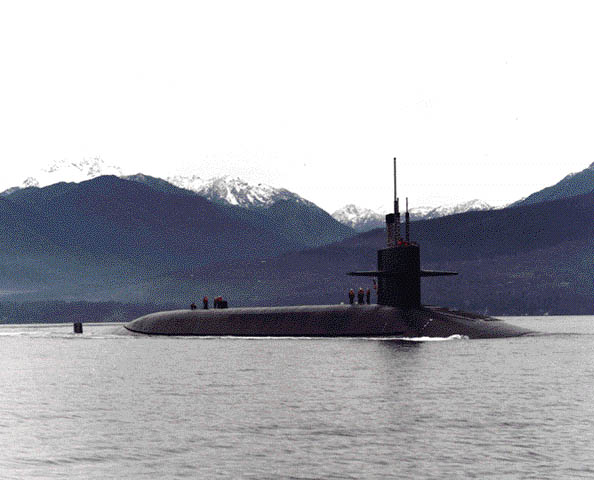
An Ohio-Class Submarine, armed with Trident nuclear missiles

W.J. Astore

America’s nuclear triad of land-based intercontinental ballistic missiles (ICBMs), sub-launched ballistic missiles (Ohio-class nuclear submarines), and nuclear-capable bombers is a relic of the Cold War.  The triad may have made some sense in a MAD (as in mutually assured destruction) way in the 1960s and 1970s, at the height of the Cold War with the USSR.  But it makes no strategic or financial (or moral) sense today.  Nevertheless, the U.S. is investing $10 billion over the next six years to update land-based ICBMs, missiles that should be decommissioned rather than updated precisely because they are both outdated and redundant.

The most survivable leg of the nuclear triad remains the U.S. Navy’s nuclear submarines, which carry Trident II missiles with multiple warheads.  These submarines are virtually impossible for any potential American foe to locate and sink in any timely fashion, therefore ensuring a survivable nuclear deterrent that is more than sufficient in any conceivable crisis.

Indeed, it’s arguable whether the U.S. needs any nuclear deterrent, given the size of the U.S. military and the power of its conventional military forces.  Even old Cold War warriors like Henry Kissinger have come out in favor of eliminating nuclear weapons from the earth, as did Barack Obama when he first ran for president in 2008.

But morality and common sense quickly disappear when politics and fear-mongering intervene.  States where nuclear missiles are currently based, such as North Dakota and Wyoming, want to keep them in their silos so that federal dollars continue to flow into local and state economies.  Fearful “hawks” point to the existence of nuclear missiles in China or Russia (or even Pakistan!) as the reason why the U.S. needs to maintain nuclear superiority, even though no country comes close to the power and survivability of the U.S. Navy’s Trident submarines.

And let’s not, of course, forget morality.  With Christmas coming, I recall something about “Thou Shall Not Kill” and loving thy neighbor.  Spending scores of billions (maybe even a trillion dollars!) to update America’s nuclear arsenal, an arsenal that has the capacity to unleash genocide against multiple enemies while plunging the planet into nuclear winter, seems more than a little contrary to the Christian spirit, whether at Christmas or indeed any time of the year.

The decision to “invest” in outdated and redundant land-based ICBMs says much about the American moment.  It’s almost as if our government believes the nuclear triad really is the Holy Trinity.  Heck — why else did our country choose to anoint genocidal nuclear missiles as “Peacekeepers“?

It should sadden us all that some American leader of the future may yet utter the line, “We had to destroy the planet to save it.”  Such is the horrifying potential and maddening logic of our nuclear forces.


What Americans Value

There's no shortage of tanks in the USA
There’s no shortage of tanks in the USA

W.J. Astore

A sentiment attributed to Vice President Joe Biden is, Show me what’s in your budget, and I’ll tell you what you value.  These words resonate with me whenever I consider the yearly budget for the Department of Defense (DoD), Homeland Security, the Department of Energy (which handles nuclear weapons), and the various intelligence agencies (roughly 17; that’s why they form a community).

When you add up what we spend on defense, homeland security, “overseas contingency operations” (wars), nuclear weapons, and intelligence and surveillance operations, the sum approaches $750 billion dollars each and every year, consuming more than two-thirds of the federal government’s discretionary spending.

Here are some figures for Fiscal Year 2015 (FY15):

Defense: “Base” budget of $496 billion

Afghan War (not part of “defense”): $85 billion

VA: $65 billion

Homeland Security: $38 billion

Nuclear Weapons: $12 billion

FBI and Cyber Security (part of Justice Department budget): $18 billion

Total: $714 billion

Some of the budget of the State Department and for foreign aid supports weapons and training (“foreign military sales”), bringing us to roughly three-quarters of a trillion dollars, each and every year, on the military, intelligence, security, weapons, and wars.

How much do we spend at the federal level on education, interior, and transportation?  Roughly $95 billion.

When a government spends almost eight times as much on its military, security, wars, weapons, and the like as it does on educating its youth, fixing its roads and bridges and related infrastructure, and maintaining its national parks and land, is there any question what that country ultimately values?

Show me your budget and I’ll tell you what you value.  Sobering words. Sobering — and scary.