Creator of Bracing Views. Contributor to TomDispatch, Truthout, HNN, Alternet, Huffington Post, Antiwar, and other sites. Retired AF lieutenant colonel and professor of history. Senior fellow, Eisenhower Media Network
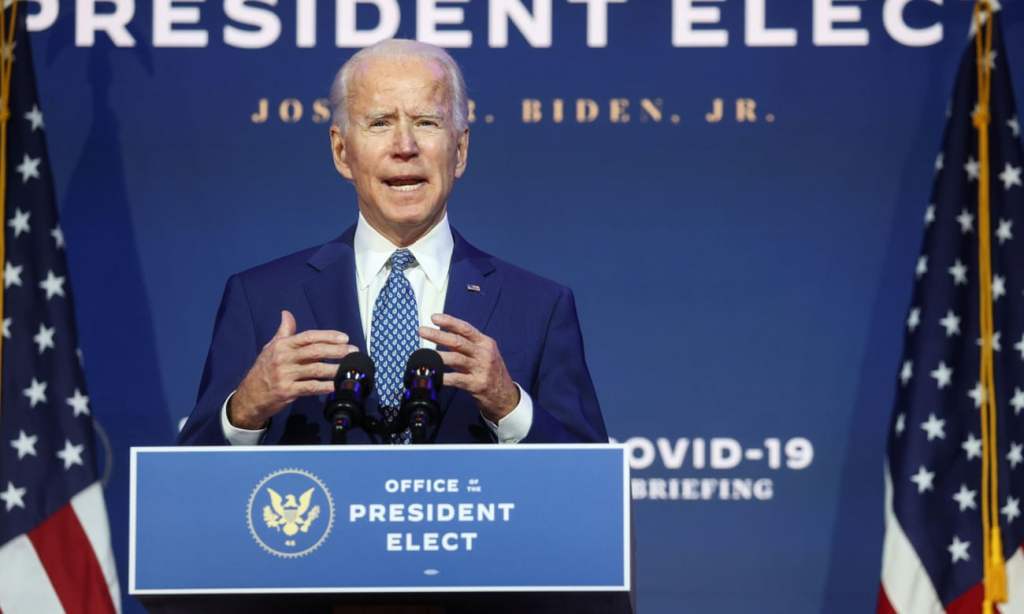
The predictable headlines are here: “Biden plans to reach across the aisle” to solicit Republican support. Even though he just won the popular vote by more than five million and a clear electoral victory as well, Biden must compromise with Republicans. Just because.
Remember when Donald Trump lost the popular vote by nearly three million in 2016? And eked out electoral victories in three states? Did he feel the need “to reach across the aisle” to Democrats? Of course not. Trump and the Republicans took no prisoners. They got the tax cut they wanted. They did their best to overturn Obamacare. They got three supreme court justices. No reaching across the aisle required.
If Biden were a real Democrat, and the Democratic Party a real party, there’d be no premature talk of aisle-reaching and bipartisan handshaking. But Biden and the DNC are essentially moderate Republicans, as Barack Obama himself admitted in an interview. You might say they’re DINOs: Democrats in name only. Dinosaurs.
Speaking of dinosaurs, remember when Americans made fun of the aging leaders of the Soviet Union in the 1970s and 1980s? “Gerontocracy” is the word I remember back then. Joe Biden will be 78 when he takes office; Mitch McConnell, likely to remain the Senate majority leader will also be 78, and Nancy Pelosi, the Speaker of the House, is 80. I have nothing against senior citizens, but it’s not a coincidence that the three most powerful people in U.S. government are 80 or pushing 80. They are all creatures of a system that is all about sustaining a status quo. A status quo in which two parties, one that’s center-right and the other far-right, work to ensure that money keeps flowing into the usual pockets, irrespective of world-changing events like climate change.
With respect to Biden’s cabinet, early reports are that we’ll see a lot of Obama and Clinton retreads espousing the usual neoliberal or neoconservative positions. They’ll be more “diverse” voices,” i.e. more women, more people of color, even an openly gay guy (Mayor Pete!), but the song will remain the same. I’m guessing not a single prominent progressive voice will be added to Biden’s cabinet. None.
With respect to action, I don’t see Biden even trying to expand the Supreme Court. I see a lot of half measures: a weak attempt at a “green” economy, a weak attempt at reforming Obamacare, perhaps an expansion of Medicare to cover people 60 and older, and so on. These and similar half measures will be consistent with what the donors and owners want. And if Biden fails even with this tepid plan, he can always blame Mitch McConnell and those obstinate Republicans who just can’t seem to reach across that same aisle that Biden is so eager to cross.
Of course, there is no “aisle” to reach across. There’s plenty of bipartisan consensus already in Washington. One clear example is at the Pentagon and the Defense budget, which continues to soar no matter which party is in power.
The only “aisle” Biden truly needs to reach across is the progressive one within his own party — and I can almost guarantee you it’s the one he’s least likely to cross.
Perhaps my favorite biblical verse comes from the New Testament in Luke 17:21 when Christ says to the Pharisees, “The kingdom of God is within you.” You could spend a lifetime thinking about that.
Recently, I googled it and discovered the Catholic church has tried to demystify it, retranslating it as “the Kingdom of God is in the midst of you” and suggesting Christ here is trying to awaken the Pharisees to his presence and to recruit more apostles. So much for looking within at this most profound of Christ’s teachings.
I have many gripes with “modern” translations of the Bible, which largely diminish, even despoil, the poetry of older translations like the KJV (King James Version) or the even earlier translation by William Tyndale.
So I broke out my Catholic Bible from 1962; it renders the passage as “For behold, the kingdom of God is within you.” My NIV Bible from 1984 is the same, except there’s a footnote that says “within” could be translated as “among.” Is nothing sacred, all you wannabe translators and all you organized church tools?
Christ’s teaching that the kingdom of God is within you is a mystery. What does it mean? This is what it means to me. In trying to understand God, I think we humans are really trying to understand ourselves. The vast power of our own minds and imaginations. It’s not God that’s limitless: it’s our conceptions of what god (or gods) can be. But even as we humans imagine and conceive of god, we become jealous of our mental creations and then start lording them over others. We conceive of god(s) as jealous and vindictive and violent because we are.
Some will immediately say that I blaspheme; that I’m saying that humans are really god in the sense we create god. Of course, the Bible teaches the opposite: that God created us.
It is of course a matter of faith but think about this. We’re told we’re made in God’s image (even though we’ve been so busy creating him in our image). Surely this doesn’t refer to our bodies, which age and decay. Surely this refers to our minds, our dreams, our imaginations, which viewed in the aggregate across humanity continue to grow, to discover new things, to conceive of new ideas. To create. As humans, we create. And when we create, we ignite the divine spark within us.
Yet we are obviously not god. For I was taught God is good. God is love. And we humans are definitely not consistently good or loving. Quite the opposite. But of course we can displace our sins onto a fallen angel who corrupts us: Lucifer. It’s not our fault, or not entirely ours, right? The devil made me do it.
I prefer to think of god as the absolute best of us, the most mysterious part of us, our ability to create, to conceive of new things, to dream, to imagine. That human ability seems god-like in the sense it’s truly unlimited. And if it’s not unlimited, how would we know it wasn’t?
It’s not time to worship ourselves in place of god. Rather, as Abraham Lincoln said in a different context, it’s time to start looking to the better angels of our nature. It’s time to tap the kingdom of God within us. And to share it without jealousy or rancor or exclusivity.
And not only within us; the kingdom of God is also all around us. Humans are an incredibly destructive lot. We must not think much of God when we’re so busy despoiling and destroying her creation.
The sacred is within and without. And if we start thinking that way, and have a proper reverence for the sacred, we can focus on being constructive rather than destructive. We can honor the god within us by cherishing and saving the god without us. That means putting life first, all forms of life, including our own, as manifestations of the divine spark.
Postscript 1: I hope God forgives my random capitalization of her/his name.
Postscript 2: A friend notes how much ink’s been spilled throughout history contemplating God’s nature, the lives of saints, and so on. Theology used to be “the queen of the sciences.” I sent this back to him:
One thing about studying theology with such fervor — you probably won’t invent weapons to blow the world into a literal Armageddon from above. No — you’ll just imagine Armageddon coming from above. That said, it’s also true that religion can be used so powerfully to condone the murderous mistreatment of others. Knowledge is power, after all, even (especially?) knowledge of god [whatever “knowledge of god” means]. God is good, but humanity? Not so much.
In Christianity, God sent a Gospel or “good news.” He told us to love one another. How has such a simple message of goodness and giving become so badly twisted and so often ignored?
My 1st trip to the Continental Divide, about 35 years ago
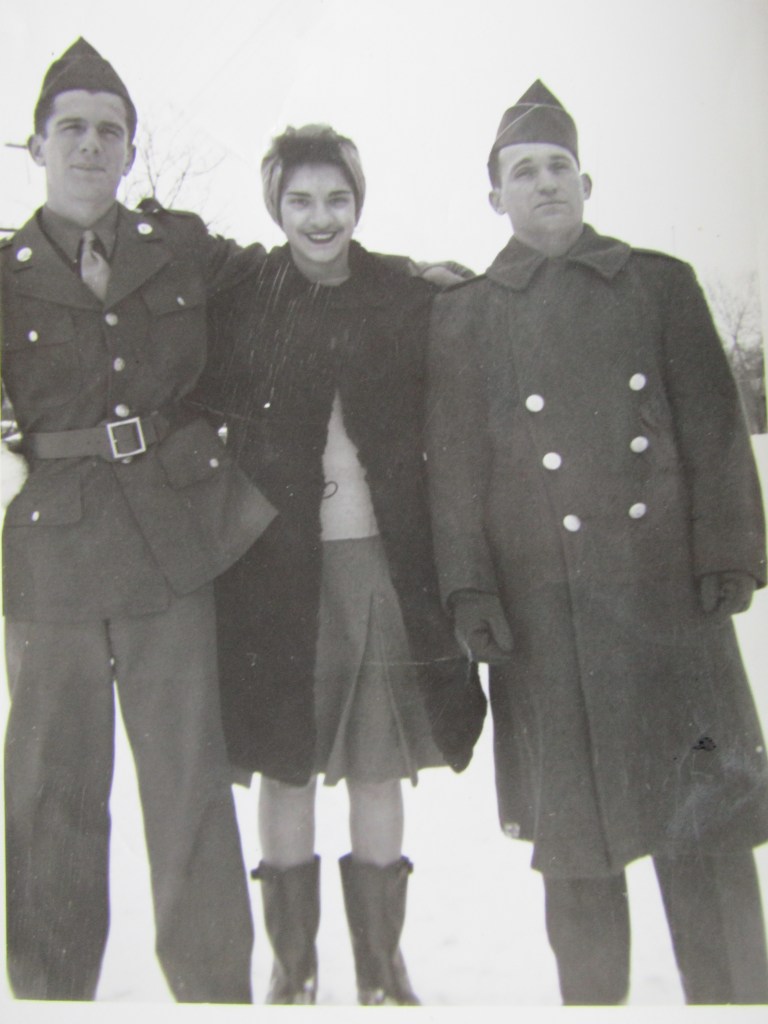
My dad (R) home on leave with his brother Gino, c. 1944
W.J. Astore
I come from a family of veterans. My father and his two brothers served in the military during World War II. My mother’s brother fought at Guadalcanal against the Japanese and was awarded the Bronze Star. Later, my eldest brother enlisted in the Air Force at the tail end of the Vietnam War, which my brother-in-law had fought in as a radio operator attached to the artillery. Their service helped to inspire my decision to become an officer in the U.S. Air Force.
Military service is honorable, not because of wars waged or lives taken, but because of its purpose: to support and defend the Constitution of the United States. And this should be the purpose of Veterans Day: to take note of our veterans and their service in upholding the ideals of our Constitution, including freedom of speech and assembly, freedom of the press, a right to privacy, and most of all a government that is responsive to our needs and accountable to our oversight.
Yet since World War II America has fought wars without formal Congressional declarations. The Korean War, the Vietnam War, wars in Afghanistan and Iraq and elsewhere, have lacked the wholehearted support of the American people. They were arguably unnecessary wars in the sense these countries and peoples posed no direct threat to America and our Constitution. Indeed, prosecuting these wars often posed more of a threat to that very Constitution.
Naturally, America associates veterans with wars and combat, and we say the dead made “the ultimate sacrifice,” which indeed they did. But for what purpose, and to what end? We owe it to veterans to ask these questions: for what purposes are we risking their lives, and to what end are these wars being waged? If we can’t answer these simple questions, in terms intimately associated with our Constitution and the true needs of national defense, we should end these wars immediately.
Unending wars are the worst enemy of freedom and liberty. This isn’t just my sentiment. As James Madison put it, “Of all the enemies of true liberty, war is, perhaps, the most to be dreaded … No nation can preserve its freedom in the midst of continual warfare.” America once knew this; we were once a nation that was slow to anger and with little taste for large military establishments.
A few years ago, I stumbled across old sheet music in a bookstore. Catching my eye was the title of the song: “I Didn’t Raise My Boy to be a Soldier,” respectfully dedicated to “Every Mother – Everywhere.” From 1915, this popular song captured American resistance to the calamitous “Great War” that we now call World War I. Anti-war sentiment was strong that year in America, and indeed Woodrow Wilson would be reelected president in 1916 in large part because he had kept Americans out of the war. The lyrics put it plainly: a mother who’d brought her son up “to be my pride and joy” didn’t want to see that same son having “to shoot some other mother’s darling boy.”
The contrast in these lyrics to recent U.S. military recruitment commercials couldn’t be starker. In a new Department of Defense advertising campaign, featuring the catchphrase “Their success tomorrow begins with your support today,” mothers are shown incongruously in military settings asking their sons why they wanted to sign up. Weapons are featured prominently in these ads, but no combat. There’s much talk of teamwork and being part of something larger than yourself but no talk of the U.S. Constitution. At the end of these spots, the young men depicted have convinced their mothers that it’s desirable indeed to have your boy become a soldier.
Recruitment ads, of course, have never been at pains to show the true costs of war. When I was a teen, the Army’s motto was “Be all that you can be.” For the Navy, service was about “adventure.” For the Air Force, it was about “a great way of life.” These ads, by ignoring or eliding war’s costs, have contributed to America’s tighter embrace of war on the world stage and its severe impact, not only on our veterans but on our democracy. America’s strategy of “global reach, global power” has embroiled us in wars of choice that we increasingly choose not to end. Surely, it’s time to chart a more pacific path.
Sometimes the best offense is a good defense. On this Veterans Day, let’s remind ourselves that veterans exist to defend our Constitution and our country, but that endless warfare, and intensifying militarism, are in fact among the most pressing dangers to our democracy.
William Astore, a retired lieutenant colonel (USAF) and history professor, is a senior fellow at the Eisenhower Media Network (EMN), an organization of critical veteran military and national security professionals.
I started writing for TomDispatch.com in 2007. I really thought I had one article to write, focusing on the disastrous Iraq War and the way in which the Bush/Cheney administration was hiding its worst results behind the bemedaled chest of General David Petraeus. Here we are, in 2020, and my latest article is my 75th contribution to the site, which truly amazes me. Special thanks to Tom Engelhardt for publishing my first piece back in 2007 and for setting a stellar example of what alternative freethinking media can be.
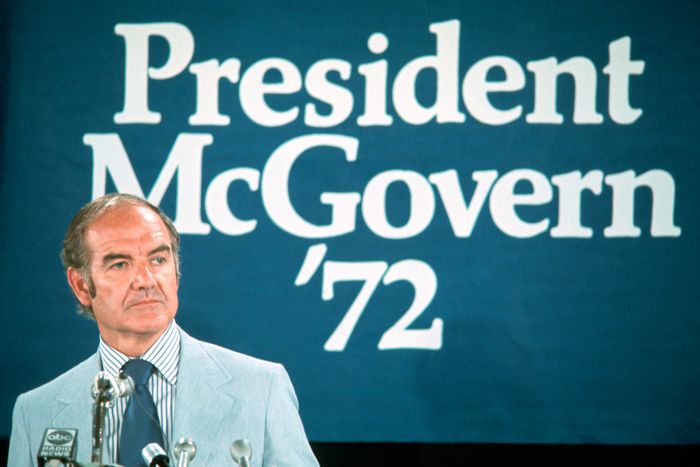
We Could Use A Leader Like George McGovern Again By William J. Astore
As I lived through the nightmare of the election campaign just past, I often found myself dreaming of another American world entirely. Anything but this one.
In that spirit, I also found myself looking at a photo of my fourth-grade class, vintage 1972. Tacked to the wall behind our heads was a collage, a tapestry of sorts that I could make out fairly clearly. It evoked the promise and the chaos of a turbulent year so long ago. The promise lay in a segment that read “peace” and included a green ecology flag, a black baseball player (Brooklyn Dodgers second baseman Jackie Robinson, who had died that year), and a clenched fist inside the outline of the symbol for female (standing in for the new feminism of that moment and the push for equal rights for women).
Representing the chaos of that era were images of B-52s dropping bombs in Vietnam (a war that was still ongoing) and a demonstration for racist Alabama governor and presidential candidate George Wallace (probably because he had been shot and wounded in an assassination attempt that May). A rocket labeled “USA” reminded me that this country was then still launching triumphant Apollo missions to the moon.
How far we’ve come in not quite half a century! In 2020, “peace” isn’t even a word in the American political dictionary; despite Greta Thunberg, a growing climate-change movement, and Joe Biden’s two-trillion-dollar climate plan, ecology was largely a foreign concept in the election just past as both political parties embraced fracking and fossil fuels (even if Biden’s embrace was less tight); Major League Baseball has actually suffered a decline in African-American players in recent years; and the quest for women’s equality remains distinctly unfulfilled.
Bombing continues, of course, though those bombs and missiles are now aimed mostly at various Islamist insurgencies rather than communist ones, and it’s often done by drones, not B-52s, although those venerable planes are still used to threaten Moscow and Beijing with nuclear carnage. George Wallace has, of course, been replaced by Donald Trump, a racist who turned President Richard Nixon’s southern strategy of my grade school years into a national presidential victory in 2016 and who, as president, regularly nodded in the direction ofwhite supremacists.
Progress, anyone? Indeed, that class photo of mine even featured the flag of China, a reminder that Nixon had broken new ground that very year by traveling to Beijing to meet with Chinese Communist leader Mao Zedong and de-escalate the Cold War tensions of the era. Nowadays, Americans only hear that China is a military and economic threat; that Joe Biden and some Democrats are allegedly far too China-friendly (they aren’t); and that Covid-19 (aka the “Wuhan Flu” or “Kung Flu”) was — at least to Donald Trump and his followers — a plague sent by the Chinese to kill us.
Another symbol from that tapestry, a chess piece, reminded me that in 1972 we witnessed the famous Cold War meeting between the youthful, brilliant, if mercurial Bobby Fischer and Soviet chess champion Boris Spassky in a match that evoked all the hysteria and paranoia of the Cold War. Inspired by Fischer, I started playing the game myself and became a card-carrying member of the U.S. Chess Federation until I realized my talent was limited indeed.
The year 1972 ended with Republican Richard Nixon’s landslide victory over Democratic Senator George McGovern, who carried only my home state of Massachusetts. After Nixon’s landslide victory, I remember bumper stickers that said: “Don’t blame me for Nixon, I’m from Massachusetts.”
Eighteen years later, in 1990, I would briefly meet the former senator. He was attending a history symposium on the Vietnam War at the U.S. Air Force Academy and, as a young Air Force captain, I chased down a book for him in the Academy’s library. I don’t think I knew then of McGovern’s stellar combat record in World War II. A skilled pilot, he had flown 35 combat missions in a B-24 bomber, winning the Distinguished Flying Cross for, at one point, successfully landing a plane heavily damaged by enemy fire and saving his crew. Nixon, who had served in the Navy during that war, never saw combat. But he did see lots of time at the poker table, winning a tidy sum of money, which he would funnel into his first political campaign.
Like so many combat veterans of the “greatest generation,” McGovern never bragged about his wartime exploits. Over the years, however, that sensible, honorable, courageous American patriot became far too strongly associated with peace, love, and understanding. A staunch defender of civil rights, a believer in progressive government, a committed opponent of the Vietnam War, he would find himself smeared by Republicans as weak, almost cowardly, on military matters and an anti-capitalist (the rough equivalent today of democratic-socialist Bernie Sanders).
Apparently, this country couldn’t then and still can’t accept any major-party candidate who doesn’t believe in a colossal military establishment and a government that serves business and industry first and foremost or else our choice in 2020 wouldn’t have been Trump-Pence versus Biden-Harris.
Channeling Lloyd Bentsen
As I began writing this piece in late October, I didn’t yet know that Joe Biden would indeed win the most embattled election of our lifetime. What I did know was that the country that once produced (and then rejected) thoughtful patriots like George McGovern was in serious decline. Most Americans desperately want change, so the pollsters tell us, whether we call ourselves Republicans or Democrats, conservatives, liberals, or socialists. Both election campaigns, however, essentially promised us little but their own versions of the status quo, however bizarre Donald Trump’s may have been.
In truth, Trump didn’t even bother to present a plan for anything, including bringing the pandemic under control. He just promised four more years of Keeping America Trumpish Again with yet another capital gains tax cut thrown in. Biden ran on a revival of Barack Obama’s legacy with the “hope and change” idealism largely left out. Faced with such a choice in an increasingly desperate country, with spiking Covid-19 cases in state after state and hospitals increasingly overwhelmed, too many of us sought relief in opioids or gun purchases, bad habits like fatty foods and lack of exercise, and wanton carelessness with regard to the most obvious pandemic safety measures.
Since the presidencies of Richard Nixon and Ronald Reagan, and especially since September 11, 2001, it’s amazing what Americans have come to accept as normal. Forget about peace, love, and understanding. What we now see on America’s streets aren’t antiwar protesters or even beat cops, but Robocops armed to the teeth with military-style weaponry committing indefensible acts of violence. Extremist “militias” like the Proud Boys are celebrated (by some) as “patriots.” Ludicrous QAnon conspiracy theories are taken all too seriously with political candidates on the Republican side of the aisle lining up to endorse them.
Even six-figure death tolls from a raging pandemic were normalized as President Trump barnstormed the country, applauding himself to maskless crowds at super-spreader rallies for keeping Covid-19 deaths under the mythical figure of 2.2 million. Meanwhile, the rest of us found nothing to celebrate in what — in Vietnam terms — could be thought of as a new body count, this time right here in the homeland.
And speaking of potential future body counts, consider again the Proud Boys whom our president in that first presidential debate asked to “stand back and stand by.” Obviously not a militia, they might better be described as a gang. Close your eyes and imagine that all the Proud Boys were black. What would they be called then by those on the right? A menace, to say the least, and probably far worse.
A real militia would, of course, be under local, state, or federal authority with a chain of command and a code of discipline, not just a bunch of alienated guys playing at military dress-up and spoiling for a fight. Yet too many Americans see them through a militarized lens, applauding those “boys” as they wave blue-line pro-police flags and shout “all lives matter.” Whatever flags they may wrap themselves in, they are, in truth, nothing more than nationalist bully boys.
Groups like the Proud Boys are only the most extreme example of the “patriotic” poseurs, parades, and pageantry in the U.S.A. of 2020. And collectively all of it, including our lost and embattled president, add up to a red-white-and-blue distraction (and what a distraction it’s been!) from an essential reality: that America is in serious trouble — and you can take that “America” to mean ordinary people working hard to make a living (or not working at all right now), desperate to maintain roofs over their heads and feed their kids.
It’s a distraction as well from the reality that America hasn’t decisively won a war since the time George McGovern flew all those combat missions in a B-24. It’s a distraction from some ordinary Americans like George Floyd, Breonna Taylor, and Jacob Blake being not just manipulated and exploited, but murdered, hence the need for a Black Lives Matter movement to begin with. It’s a distraction from the fact that we don’t even debate gargantuan national security budgets that now swell annually above a trillion dollars, while no one in a position of power blinks.
Today’s never-ending wars and rumors of more to come remind me that George McGovern was not only against the Vietnam conflict, but the ones in Afghanistan and Iraq, too. Joe Biden, meanwhile, voted for the Iraq War, which Donald Trump also spoke in favor of, then, only to campaign on ending this country’s wars in 2016, even if by 2020 he hadn’t done so — though he had set up a new military service, the Space Force. Feeling the need to sharpen his own pro-war bona fides, Biden recently said he’d raise “defense” spending over and above what even Trump wanted.
If you’ll indulge my fantasy self for a moment, I’d like to channel Lloyd Bentsen, the 1988 Democratic vice presidential nominee who, in a debate with his Republican opposite Dan Quayle, dismissed him as “no Jack Kennedy.” In that same spirit, I’d like to say this to both Trump and Biden in the wake of the recent Covid-19 nightmare of a campaign: “I met George McGovern. George McGovern, in a different reality, could have been my friend. You, Joe and Donald, are no George McGovern.”
Prior military service is not essential to being president and commander-in-chief, but whose finger would you rather have on America’s nuclear button: that of Trump, who dodged the draft with heel spurs; Biden, who dodged the draft with asthma; or a leader like McGovern, who served heroically in combat, a leader who was willing to look for peaceful paths because he knew so intimately the blood-spattered ones of war?
A Historical Tapestry for Fourth Graders as 2020 Ends
What about a class photo for fourth graders today? What collage of images would be behind their heads to represent the promise and chaos of our days? Surely, Covid-19 would be represented, perhaps by a mountain of body bags in portable morgues. Surely, a “Blue Lives Matter” flag would be there canceling out a Black Lives Matter flag. Surely, a drone launching Hellfire missiles, perhaps in Somalia or Yemen or some other distant front in America’s endless war of (not on) terror, would make an appearance.
And here are some others: surely, the flag of China, this time representing the growing tensions, not rapprochement, between the two great powers; surely, a Trump super-spreader rally filled with the unmasked expressing what I like to think of as the all-too-American “ideal” of “live free and die”; surely, a vast firenado rising from California and the West, joined perhaps by a hurricane flag to represent another record-breaking year of such storms, especially on the Gulf Coast; surely, some peaceful protesters being maced or tased or assaulted by heavily armed and unidentified federal agents just because they cared about the lives of George Floyd and Breonna Taylor, among others.
And I suppose we could add something about sports into that collage, maybe an image of football players in empty stadiums, kneeling as one for racial equality. Look, sports used to unite us across race and class lines, but in his woebegone presidency, Donald Trump, among others, used sports only to divide us. Complex racial relations and legacies have been reduced to slogans, Black Lives Matter versus blue lives matter, but what’s ended up being black and blue is America. We’ve beaten ourselves to a pulp and it’s the fight promoters, Donald Trump above all, who have profited most. If we are to make any racial progress in America, that kind of self-inflicted bludgeoning has to end.
And what would be missing from the 2020 collage that was in my 1972 one? Notably, clear references to peace, ecology, and equal rights for women. Assuming that, on January 20th, Joe Biden really does take his place in the Oval Office, despite the angriest and most vengeful man in the world sitting there now, those three issues would be an ideal place for him to start in his first 100 days as president (along, of course, with creating a genuine plan to curb Covid-19): (1) seek peace in Afghanistan and elsewhere by ending America’s disastrous wars; (2) put the planet first and act to abate climate change and preserve all living things; (3) revive the Equal Rights Amendment and treat women with dignity, respect, and justice.
One final image from my fourth-grade collage: an elephant is shown on top of a somewhat flattened donkey. It was meant, of course, to capture Richard Nixon’s resounding victory over George McGovern in 1972. Yet, even with Joe Biden’s victory last week, can we say with any confidence that the donkey is now on top? Certainly not the one of McGovern’s day, given that Biden has already been talking about austerity at home and even higher military spending.
Sadly, it’s long past time to reclaim American idealism and take a stand for a lot less war and a lot more help for the most vulnerable among us, including the very planet itself. How sad that we don’t have a leader like George McGovern in the White House as a daunting new year looms.
William Astore, a retired lieutenant colonel (USAF) and professor of history, is a TomDispatch regular. His personal blog is Bracing Views.
I’ll admit it: I never saw Joe Biden as president. Not when I remembered his abortive presidential run in 1988, when he lied about his college record and plagiarized speeches of Bobby Kennedy and Neil Kinnock.
He made an effective vice president for Barack Obama, mainly at first because he reassured White America that the Black guy was OK. Being vice president is an “It must have been cold there in my shadow” kind of job, but Joe handled it pretty well, and even catastrophically deferred to Hillary Clinton as Obama’s rightful successor in 2016.
After that debacle, Joe persisted, and in the campaign of 2020 he found a Democratic establishment that loved his pro-business and pro-banking record, his strong support of high military spending and overseas wars, and his past calls for cuts to Social Security as well as his steadfast opposition to Medicare for all. Our kind of Democrat, the owners and donors said, and with a big push from Obama, Biden found himself anointed as the candidate to defeat the Orange Ogre.
But Biden didn’t defeat Trump; Trump defeated Trump. Trump’s response to Covid-19 was so incompetent, so reckless, and so tone-deaf to lives lost that even the usual spin about fake news and alternative facts didn’t work. Indeed, Trump first said the pandemic would magically disappear, then tried to blame it all on China, then said the media was covering it only because it hurt his chances for reelection, then persisted in holding rallies that turned into super-spreader events for the virus.
Despite all of Trump’s flaws, despite all of his lies, he still almost defeated Biden, a stunning achievement when you really think about it. To my mind, the closeness of this election, the narrowness of Biden’s victory, is as much a reflection of the weaknesses of Joe Biden as it is the strength of the Trump cult.
What kind of president can we expect Biden to be? He won’t be anything like Trump, which in some ways is a bad thing. What I mean is this: Trump turned the narrowest of victories over Hillary Clinton into mandate-level deeds. He got the big tax cut Republicans covet. He got to pick three Supreme Court justices and to redefine lower-level courts for a generation. He served his base and made no apologies.
What is the likelihood that Biden adopts a progressive agenda? That he takes no prisoners, that he rides roughshod over Republicans, that he calls them traitors and dictates terms to them? Unlikely indeed. Even if Democrats win a majority in the Senate, which we won’t know until January and runoff elections in Georgia, Biden will likely position himself as a centrist, i.e. a moderate Republican, a man willing to reach across the aisle for bipartisan accord.
It’s likely Biden will even appoint Republicans to his cabinet. I’m betting we’ll see more Republicans in his cabinet than progressive Democrats.
I won’t shed any tears when Trump departs, perhaps into a new self-named media empire. Because for Trump it’s Trump now, Trump tomorrow, Trump forever. Biden, unlike Trump, has at least some experience with public service, and that can’t be a bad thing.
The question is: Which publics will Joe Biden serve with the most passion?
For several years I’ve been using the Facebook page for The Contrary Perspective to post BV articles, links to other articles, cartoons, photos, opinions, and the like, all related to what I write about here. But with the growth of Bracing Views to nearly 1000 followers, it’s time I created a unique page for it.
If you’d like to stay abreast of articles, ideas, and so on that are related to what I write about here, and you can endure belonging to Facebook (All hail Lord Zuck!), please follow or like the new page. Many thanks!
And many thanks again to all the people who read and comment here. I’m sure I learn more from you than you do from me.
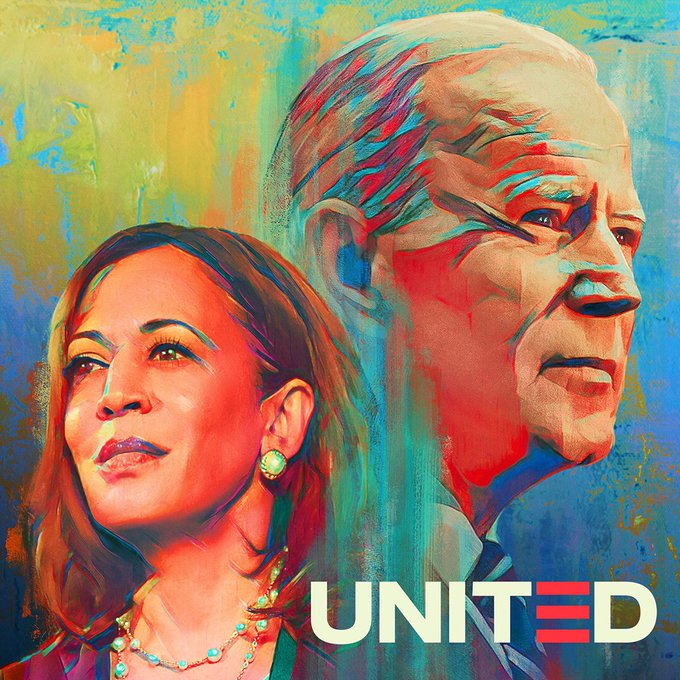
Who knew that choosing Joe Biden and Kamala Harris, two pro-business, pro-establishment, anti-progressive tools with limited charisma, would result in an election that is currently too close to call?
Meanwhile, Trump has made his own call. He won! Here’s what he had to say earlier this morning:
Trump falsely declared himself the winner around 2:30 a.m. Eastern. He said he would call on the Supreme Court to stop counting ballots in states where he led, while urging more counting in states where he was behind. He claimed “fraud” (for which there is no evidence) and he called the election an “embarrassment to the country.”
My wife and I had a good if grim laugh at this. Trump is like that ten-year-old bully in a class election who says: “Let’s count the vote until I’m winning, then we’ll stop.” Every kid would shout that that’s unfair and wrong, until the bully threatened to slug them.
It’s truly astounding that so many Americans think Trump is a competent and desirable president. Again, though, it didn’t help matters when the DNC tilted the table in Biden’s favor, then picked Kamala Harris as his running mate, another establishment tool who faded fast after her fifteen minutes of post-debate, that-little-girl-was-me, fame.
Of course, Biden/Harris may yet prevail, assuming Americans can muster some patience and that the Trump-leaning Supreme Court doesn’t intervene. But if they lose, the loss is truly on them and the DNC operatives who went all-in on them.
Trump isn’t running against Biden/Harris. He’s running against a caricature of the Democratic Party. The usual lies: the “radical left” is coming to take your guns; they hate America; they want open borders so that America will be flooded with non-white foreigners; they’re godless socialists; they favor abortion on demand; they want to turn your kids against you by controlling education; and so on. The truth is entirely the opposite: Biden/Harris are in fact the darlings of Wall Street and are without a radical bone in their bodies.
Trump and the Republicans are running without a platform. It’s rather remarkable that the Republican Party is totally subservient to Trump. Meanwhile, Trump’s “platform” is more of the same, including yet another capital gains tax cut. And if Trump wins, you can count on the “radical” Democrats approving that tax cut.
Trump still wants to overturn Obamacare during a pandemic, which could lead to 20 million people losing their health care coverage. It’s no surprise that repealing the Affordable Care Act (ACA) helps the rich the most, as their taxes will decrease. (As an aside, polls show Americans favor the ACA more than they do Obamacare: they are, of course, the exact same thing.)
Trump’s rallies have served as super-spreader events for Covid-19. In short, the president is a pandemic vector, yet his supporters continue to love him and defend him. Death cult?
Way back in April 2019, I picked Biden/Harris as the Democratic dream ticket. You know: an elder white guy balanced by a younger black woman, sort of like a network news team that is supposed to show inclusion and diversity while broadcasting steadiness. Yes, the fix was in from the beginning. Biden has said nothing will fundamentally change under his administration, the one promise he will be certain to keep.
Compared to Biden supporters, Trump supporters are more fired up, more committed to their man and how he makes them feel. Meanwhile, Trump is at pains to show how many people cheer for him at his rallies. If Trump loses, how will these supporters process that loss?
I can’t remember a presidential election in which foreign policy has been so infrequently discussed. Presidents possess the most latitude in dealing with other countries, yet rarely did Biden or Trump answer any questions in detail about world affairs. The impression from their “debates” is that China and Russia are enemies and that a new cold war is essentially inevitable. Neither candidate talked about defense spending except to stress it probably would go up. The U.S. dominance of the world’s trade in weapons went unremarked upon. America’s wars they pretty much ignored.
A final thought: If you think your vote is worthless, you’re wrong. If it was worthless, various forces wouldn’t be trying to buy it, or block it, or otherwise restrict it. The choices may be depressing, but I’ve found voting itself to be uplifting. Get out there and vote!
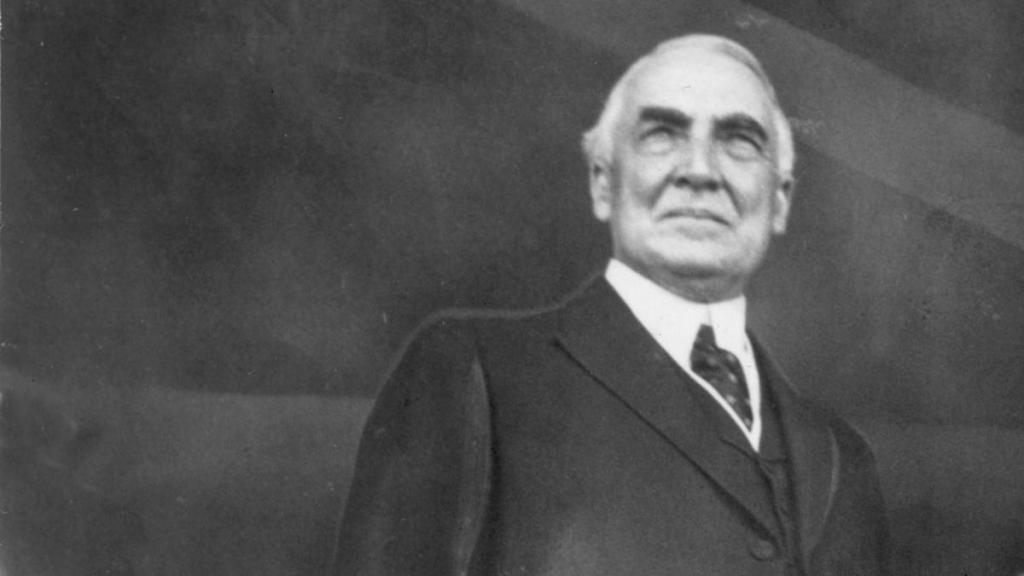
A century ago, Warren Harding bloviated about normalcy.
W.J. Astore
About forty years ago, I took undergraduate courses in U.S. History, where I first learned about “normalcy.” Normalcy came from the (successful) presidential campaign of Warren G. Harding in 1920. After World War I’s devastation and Woodrow Wilson’s attempt at internationalism, what Americans wanted most of all, according to Harding, was a “return to normalcy.” Harding, running against Wilson’s record though not Wilson himself, won the presidency.
Wilson himself favored a sort of high-minded preaching when he addressed Americans; in his own way, he may have been as narcissistic as Trump, and probably more racist. Again, while Harding didn’t run against Wilson, he did run against his legacy, and to many Americans he seemed like a good and decent man and was considered handsome to boot.
Another word associated with Harding’s campaign a century ago was “bloviate,” which basically means BS. A quick Google search confirms that bloviation is “a style of empty, pompous, political speech which originated in Ohio and was used by US President Warren G. Harding.” I guess I did learn something in those history classes.
I mention these two words, normalcy and bloviate, because in many ways they sum up Joe Biden’s strategy in 2020. He’s promised a return to normalcy, i.e. a return to the Obama/Biden years, and this does hold some appeal to Americans who are sick and tired of Trump’s lies and incompetence. But Biden himself has told us little about what he hopes to achieve, preferring to bloviate, which suggests he won’t be doing much to improve the lives of ordinary working Americans, assuming he wins.
The presidency of Warren G. Harding was an ill-starred one. He surrounded himself with corrupt cronies and was humiliated by the Teapot Dome Scandal. Harding died at the comparatively young age of 57 in 1923; his vice president, Calvin Coolidge, took over and led the country until 1928. Interestingly, Coolidge had made his reputation putting down the Boston police strike in the name of preserving “law and order” during the Red Scare of 1919. Perhaps his most famous sentiment as president was the idea that the business of the American people is business. It seemed to make sense during the Roaring Twenties until the Wall Street Crash of 1929.
History, as they say, doesn’t repeat itself but it does echo. Biden/Harris in 2020 is a little like Harding/Coolidge in 1920. Biden is the normalcy guy who bloviates; Harris is the VP who may well have to step in as president, but who as a “top cop” in California was no friend of labor but very much pro-business. Naturally, judging by our history, whether in 1920 or 2020, you can forget about any progressive policies unless and until we experience a cosmic crunch like the Great Depression of 1929. Even then, FDR and the New Deal didn’t come along until 1933.
History can be a depressing subject to take — a record of crimes, follies, and disasters of the past. We’re supposed to learn from it so as to avoid repeating the same. Assuming Biden/Harris win this week, we shall see if there’s any substance to them, or whether it’s just normalcy, bloviation, scandal, and business-friendly policies all over again.
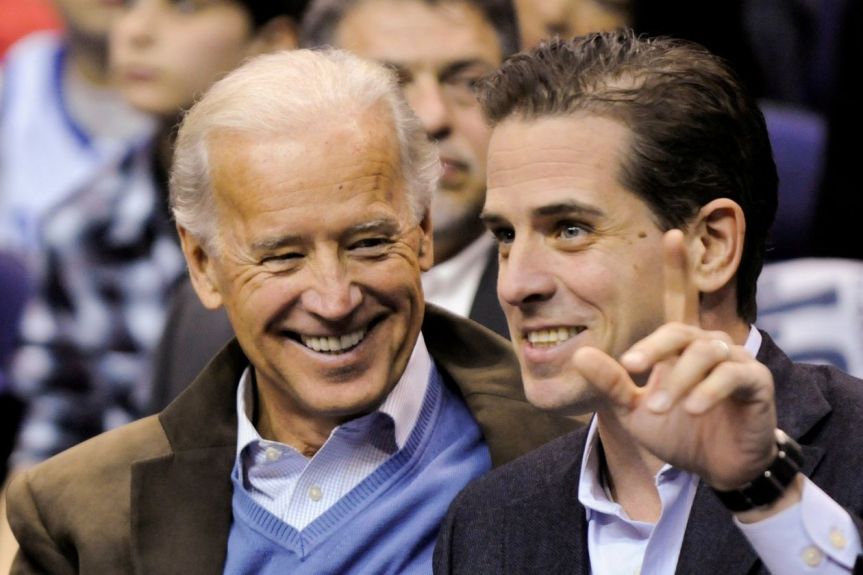
In trying to cover the Hunter Biden email story with his usual zest, honesty, and outspokenness, Glenn Greenwald ran afoul of the bosses at The Intercept and issued his resignation. Matt Taibbi covers Greenwald’s resignation here, and Greenwald himself has posted the article that got him into trouble here. At her own site, Caitlin Johnstone cites Greenwald’s resignation as exposing the rot in mainstream media outlets. As Johnstone puts it:
I don’t know that the Hunter Biden October surprise shows anything more scandalous than you’d expect for any major US presidential nominee. I do know that the uniform conspiracy of silence and obfuscation from the mass media about it is uniquely scandalous and says bad things about the future of journalism in western news media.
The Bidens have yet to deny the authenticity of these emails. Even so, the mainstream media, joined by digital powerhouses like Facebook and Twitter, have worked to minimize the story. In some cases, not just minimize but to misdirect, as in suggesting the emails are part of a Russian disinformation campaign in favor of Trump, even though there’s no evidence of this.
As one Washington Post article bizarrely put it: “We must treat the Hunter Biden leaks as if they were a foreign intelligence operation — even if they probably aren’t.” [emphasis added]
Come again? Obviously no Vulcans work at the Post, since there’s a complete lack of logic in that statement.
I think what’s going on here is obvious. For the mainstream media, it’s payback time for Donald Trump. Trump has described journalists as “the enemy of the people,” and don’t think that scarily intimidating statement has been forgotten by the press. Also, there is a modicum of guilt within the media, I think, for their role in facilitating Trump’s rise in 2015-16. They never took him seriously in the sense of believing he could win, but they did love all the high ratings (and money!) he generated.
Readers here know that I reject both Trump and Biden as viable presidential candidates. Trump is a narcissist, a liar, and an incompetent leader; Biden is a fading bureaucrat who’s thoroughly compromised by his business, industry, and banking ties. Arguably, Biden is the lesser of two evils, but that certainly shouldn’t mean that the media should protect him from Hunter’s sad record of influence-peddling in the Biden name.
More so than most people, I imagine, journalists are tired of Trump. They want things to go back to “normal.” But censorship in the cause of normalcy is too high a price to pay, especially for the lesser of two evils.





 Bracing Views