Creator of Bracing Views. Contributor to TomDispatch, Truthout, HNN, Alternet, Huffington Post, Antiwar, and other sites. Retired AF lieutenant colonel and professor of history. Senior fellow, Eisenhower Media Network
I’m a big sports fan. I grew up in the Boston area and loved my local teams. When I was a kid, I had two big posters of Bobby Orr, the famed defenseman of the Boston Bruins, on my wall. I had a Boston Red Sox uniform. When I threw a baseball around, I imagined I was Luis Tiant, the mercurial and entertaining pitcher for the Red Sox, or Dwight Evans, the team’s rocket-armed right fielder. I collected baseball cards and studied the stats on the back for hours on end.
But I was also a kid who kept a scrapbook on the Yom Kippur War of 1973. I was ten years old yet I was attracted to war and its nitty-gritty details as much as I was to the sporting world. Who knows why. Temperament, I suppose. As I grew older, I built lots of military models and read more and more books about the military even as I kept an interest in sports (more as a fan than a participant, since my talent level was modest at best).
This was on my mind this AM as I read a detailed article on Red Sox second baseman Dustin Pedroia, whose stellar career was cut short by injuries. The article focused on whether Pedroia deserved election to the Baseball Hall of Fame.* Highly detailed, well written, and showing an estimable command of statistics, the article impressed me even as it got me to thinking. What if Americans examined wars like they studied sports? What if Afghanistan was covered with the same detail as the forthcoming NFL draft? What if there was a channel like ESPN devoted to wars 24/7 rather than to sports? And what if the reporting was objective and honest?
You can’t fool a sophisticated sports fan with a bunch of home-team boosterism that’s disconnected from the facts on the ground (or on the baseball diamond, the football field, the ice hockey rink, etc.). Why are so many people so easily fooled about the need to continue the Afghan War, which is now in its 20th year and where the U.S.-led coalition is losing more than ever?
If the Afghan War were a U.S. sports team, it would be a team that spent more money than any other team even as it lost more games, cycling through a new losing coach every year and an unmemorable cast of players that changed each season. Despite the hiring of much-hyped “coaches” like David Petraeus and Stanley McChrystal, despite promises of pennant-winning “surges” by team presidents like Barack Obama, our imaginary Afghan War sports team was and remains a cellar dweller, forever mired in last place.
What red-blooded American sports fan would tolerate more of the same from such a loser team? What fan would keep cheering for such a team? What fan would say, “let’s stay the course,” even as more and more losses piled up?
Consider this article from yesterday’s New York Times:
*****
The Taliban Close In on Afghan Cities, Pushing the Country to the Brink
The Taliban have positioned themselves around several major population centers, including the capital of Kandahar Province, as the Biden administration weighs whether to withdraw or to stay.
*****
What should Team Biden do? “To stay” is to stay on the same losing course we’ve been on for 20 years. “To withdraw” is a new course that has the virtue of ending the bleeding (at least for the U.S.). Which action would you choose?
Any sports fan worth his or her salt would know the answer here. Call withdrawal a “rebuilding” year and most sports fans would accept it. It’s a far better choice than staying and losing with the same old tactics and cast of characters.
Just about every American sports fan has heard the saying: Winning isn’t everything–it’s the only thing. Well, we’re not winning in Afghanistan and we never will. So the only smart thing left to do is to leave.
*Pedroia gets my vote for the Hall of Fame. It’s not simply about stats. Pedey was a winner, a leader, a gutsy overachiever who played the game the right way. Rookie of the year, MVP, World Series winner, he gave it his all on every play. Sometimes, the so-called intangibles matter.
Trump’s motto: In generals I trust. It didn’t work out so well for him. Or the country.
W.J. Astore
As the Senate prepares to acquit Donald Trump in his second impeachment trial, I thought it would be a good time for a quick look at his legacy on war and militarism. Trump’s fans like to say he started no new wars. But he was hardly a man of peace, and his legacy on war and militarism is almost entirely negative. Here, in no particular order, are my quick thoughts on this subject:
He boosted military spending and weapons sales. Trump basically bought off the military-industrial-congressional complex by throwing scores of billions of dollars its way while selling weapons around the world. It’s an old formula for U.S. presidents and it worked.
He boosted a militant nationalism vis-a-vis rivals and even traditional allies. Trump was no friend to Russia and aggravated relations with China. Relations with NATO allies were also aggravated as he pressured them to spend more on weapons and wars.
He boosted militarism at home and specifically with police forces. Trump supported and encouraged violent police crackdowns of BLM activists. He called for the deployment of active duty military in the streets of Washington, DC. He even called for a massive military parade (which never happened).
He boosted overseas bombing and drone strikes. Recall the use of MOAB in Afghanistan, or Trump’s missile strike against Syria, and increased bombing in Afghanistan.
He boosted tensions with Iran nearly to the breaking point. Trump’s drone strike against Iranian general Qasem Soleimani was an act of war; harsh economic sanctions and withdrawal from the Obama-era nuclear treaty with Iran also heightened tensions.
He boosted the chances of nuclear war in the future. Trump was a fan of nuclear weapons; he seems to think of them simply as bigger, mightier bombs. His pursuit of “smaller” tactical nuclear warheads and their deployment on Trident-class nuclear submarines increase the possibility of nuclear war in the future.
He boosted economic sanctions against Venezuela while pursuing a coup. Trump knows Venezuela has vast oil reserves. Why not overthrow their government and take their oil? That was Trump’s policy, more or less. (It doesn’t appear to have changed under Joe Biden.)
Creation of a Space Force. Yet another military competitor for U.S. taxpayer dollars, even as space itself becomes another sphere for the U.S. military to “dominate.”
Failure to end wars that he promised to end. Trump was talked out of ending the war in Afghanistan by generals like James Mattis and H.R. McMaster. Ending such wars was a promise Trump foolishly abandoned.
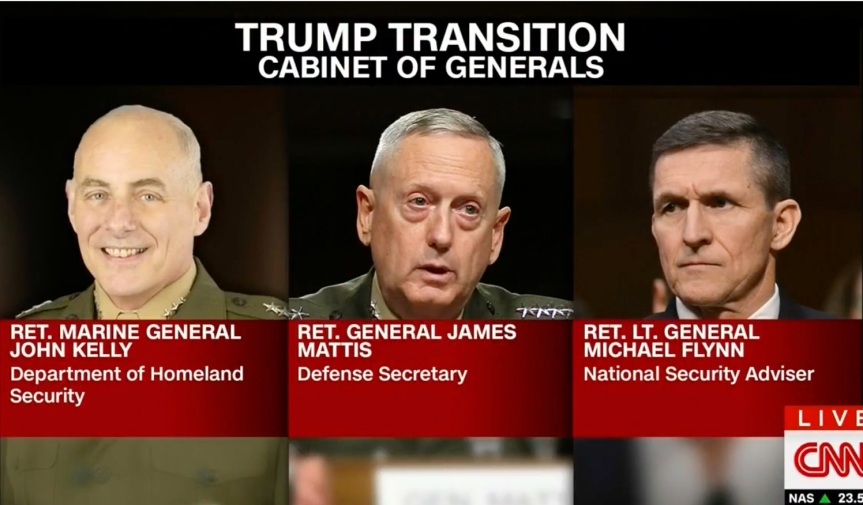
Reliance on Generals as wise men. Trump, overall a weak and vainglorious man, surrounded himself with generals like Mattis, McMaster, John Kelly, and (briefly) Michael Flynn. Thus he got narrow-minded war-mongering advice.
Seeing the world as a zero-sum game of winners and losers and debasing the art of diplomacy. Putting Mike Pompeo in charge of the State Department was a new low in the pursuit of peace through diplomacy.
Aiding genocide in Yemen while kowtowing to Israel and Saudi Arabia: Trump was a willing participant to genocide in Yemen while pursuing a “peace” plan with Israel that was totally one-sided vis-a-vis the status and rights of Palestinians.
Off the top of my head, that’s my top twelve of Trump’s legacies in this arena. What do you think, readers? Can you think of others? And will any of this really change under Joe Biden?
Binary logic is common in America. Us versus them. Republican versus Democrat. BLM versus BLM (that’s Black lives versus blue lives). Love it or leave it.
I remember as a teenager reading a coda to that saying: Or change it. If you don’t “love” America, you shouldn’t have to leave it. Indeed, if you truly “love” America, you’d want to change it to make it even better.
This idea was on my mind as a I watched a couple of videos on YouTube by Americans who’ve been living overseas for many years, only to return recently and reflect on how life in America seemed to them after being away for so long. Here are a few notes I jotted down:
Features of America: Consumerism. Materialism. Advertising everywhere, especially for prescription drugs. Fast pace of life and a stress on competition. A mainstream media that’s propagandistic — and that pushes fear and outrage. Only two major political parties that stifle debate and change. Constant divisiveness.
Features of Americans: Stress on individualism and ethnocentrism. Empathy and our common humanity is downplayed. Sense of entitlement. Lack of curiosity about the wider world. A lack of purpose in the sense of living a life of meaning. Lack of integrity, especially at the higher levels of government and the corporate world.
These observations reminded me of Michael Moore’s “Where to Invade Next” (2015). Moore goes to various countries (Germany, France, Italy, and so on), looking for ideas Americans can steal as they “invade.” I recall German workers who only had to work one job to make ends meet (roughly 37 hours a week, if memory serves), and also German workers who served by law on the board of major companies like Mercedes; I recall school lunches made for French kids by chefs using local ingredients (the contrast with American school lunches was stomach-turning); I recall Italian workers with six weeks of paid vacation per year, as opposed to American workers who are lucky to get two weeks. Why can’t America change to be more worker- and kid-and family-friendly?
The female leaders of Iceland, if memory serves, put it well near the end of Moore’s excursions. They said America is a me-me-me society, whereas Iceland prefers “we” to “me.”
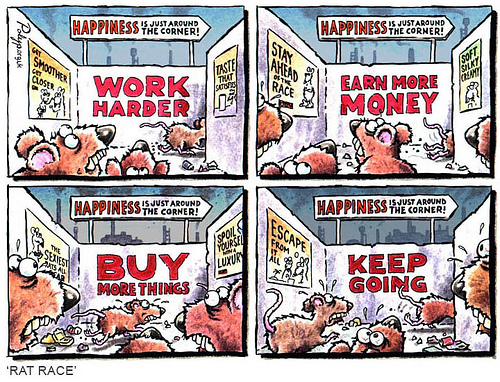
I’ve written before about how Americans are kept divided, distracted, and downtrodden as a way of preventing meaningful, organized, societal change. Another “d” word related to this is discontent. Americans are often discontented in ways that inhibit change. It’s something Tana French touched on in her novel, “The Likeness,” from 2008. Here’s an excerpt:
Our entire society’s based on discontent: people wanting more and more and more, being constantly dissatisfied with their homes, their bodies, their décor, their clothes, everything. Taking it for granted that that’s the whole point of life, never to be satisfied. If you’re perfectly happy with what you’ve got—specially if what you’ve got isn’t even all that spectacular—then you’re dangerous. You’re breaking all the rules, you’re undermining the sacred economy, you’re challenging every assumption that society’s built on. By being content, you become a subversive. A traitor.
To which another character replies: “I think you’ve got something there. Not jealousy, after all: fear… Throughout history—even a hundred years ago, even fifty—it was discontent that was considered the threat to society, the defiance of natural law, the danger that had to be exterminated at all costs. Now it’s contentment.”
There’s a potential paradox here. Won’t the discontented favor positive change, whereas the contented will favor the status quo?
But French’s insight suggests otherwise. The discontented are so busy trying to become contented, most often through a me-first consumerism and materialism, that they can’t come together and mobilize for change. Fear drives them to pursue what their “betters” have, and to admire those people as well. It’s the contented who are dangerous, the ones who’ve left consumerism and materialism behind, the ones with the confidence, time, and independence of thought to contemplate a changed world, a better world. Perhaps even a better America.
The Senate Trial of Donald Trump begins today, though the outcome seems clear: Trump will be exonerated for his alleged role in inciting the Capitol riot.
Democrats will do their best to put all the blame for this riot on Trump. They would be better advised to focus on why Americans stormed the Capitol to begin with, and why 74 million voters chose Trump — despite all his flaws — as their champion back in November.
Trump voters shouldn’t be shoved en masse into a basket of deplorables. Nor should they be dismissed as being beyond redemption, as Hillary Clinton did in 2016. That an incompetent buffoon like Trump could win so many votes says as much about the (lack of) appeal of the Democratic Party as it says about the grifter skills of Trump.
If Democrats want to continue winning elections while actually doing their jobs as public servants, they’d advance policies that would help ordinary Americans. So far, signs that the Democrats understand this are few. Joe Biden has already said the Covid relief package may not advance the policy of a $15 minimum wage. Covid relief checks, promised at $2000 and pronto, are already reduced and delayed until March at the earliest. Medicare for all is dead; so too is a single-payer option. Biden and Pelosi have promised only extra funds for people to buy high-priced private health care coverage in Obamacare markets.
Americans support Medicare for all. Americans support a higher minimum wage. Americans desperately need Covid relief now. And so far Biden and his establishment Democrats are failing on all of these. This isn’t a bug or glitch in the Democratic matrix, it’s a feature. “Nothing will fundamentally change,” Biden said before his election, and that’s the one promise he may well keep.
Joe Bageant knew the score. A self-confessed “Appalachian native who grew up dirt-eating poor,” Bageant explained how he’d “managed to live a couple of decades in the middle class as a news reporter, magazine editor, and publishing executive.” He also knew to keep his eyes and ears open, writing in September 2008 that “the liberal middle class is condescending to working-class redneck culture–which is insulting, but not a crime. The real crime is the way corporate conservatives lie to my people, screw us blind, kill us in wars, and keep us in economic serfdom.”
If you read “corporate conservatives” as Republicans, you’d be only half-right. As a term, “corporate conservatives” includes Joe Biden, Kamala Harris, and most of the people around them inside the Washington Beltway. That doesn’t bode well for “redneck culture”–and it most certainly doesn’t bode well for the country.
Americans are tired of being lied to and disrespected and mistreated. They are also in many cases desperate for help. Angry and desperate people do not make for normalcy. Nor are they an obliging audience for the tepid and often phony acts of corporate politicians, whether Democrat or Republican.
Reading an article by historian Dennis Showalter*, a friend and mentor, reminded me of how the Nazis mobilized “the petty spite and everyday resentment” of “frustrated little men and good Germans” of the early 1930s. About these people Showalter wrote: “They wanted help. They wanted to voice grievances. They wanted to be heard. They turned to the Nazis because the Nazis expressed sympathy for their problems and implied the possibility of solutions in the framework of a new order.”
Trump’s appeal, of course, was to an old order (Make America Great Again). But it wasn’t entirely retrograde or racist. Trump succeeded in showing sympathy for ordinary Americans, e.g. their loss of jobs due to trade deals that favored the richest of Americans, and he did promise solutions even as he failed to deliver on them. Even after all his debacles and disasters, 74 million Americans still voted for him instead of the Democrats.
A few days ago, I was watching an interview of Ralph Nader as he described the powerbrokers of the Democratic Party. A few of his choice words about them: arrogant, bureaucratic, decrepit, exclusive, and indentured (to corporations and special interests). I don’t think Nader is wrong here.
So, as the Democratic Party postures and sputters against Trump this week, they’d best remember that the real issue is helping ordinary Americans, including those in “redneck culture.” People want to be heard, and if Democrats are unwilling to hear them, others will.
* Showalter, “Letters to Der Sturmer: The Mobilization of Hostility in the Weimar Republic,” Modern Judaism, 3 (May 1983), 173-87.
P.S. If you liked this article, perhaps you’ll consider chipping in $12 as a donation. The PayPal button in the sidebar makes it easy. Thank you.
If Bruce Springsteen can make a commercial for Jeep aired during the Super Bowl, I can start accepting a few dollars for content at Bracing Views. (Donations are voluntary.)
Seriously, I’ve been running Bracing Views for five years, and before that I ran The Contrary Perspective, without ever asking for donations or bothering readers with ads.
But site costs are rising, and I suppose I should be open to earning some money for the site.
So I’ve added a PayPal button for $12.00 donations (a buck a month: what a deal!), but it’s purely voluntary. Many thanks if you choose to donate, but no worries if you don’t. These are tough times for many people.
Also, you may now see some ads when you visit the site.
Again, many thanks to all of you for following the site, and for reading and commenting as well.
P.S. I’m just another sellout like Bruce. 🙂
Update (3/29/21): The great donation/ad experiment is over. First, I’d like to thank everyone who chipped in $12.00. Enough people contributed to pay for my site fees and domain registration for the next two years. Hooray!
The ads are another story. Since my site is small, I was lucky to earn $10 a month from ads. And they’re annoying. So I got rid of them. I also removed the PayPal button. Feel free to reach out to me if you wish to contribute. I especially like gold and other precious metals, rare stamps, antique chess sets, fine watches, and bitcoin. Surely my writing is worth it? 🙂
A B-2, a B-1, and a B-52. And I’m proud to be an American …
It’s Super Bowl Sunday — time to gather together and party responsibly, i.e. don’t turn your party into a Covid super-spreader event.
You can always learn a lot about America by watching the Super Bowl — and I’m not talking about football. Pregame ceremonies are telling, as are the elaborate halftime shows. This year, I noted how the Air Force is selling the story of a female pilot, Captain Sarah Kociuba, who will pilot a B-2 stealth bomber to open the festivities. She’ll be joined by a B-1B Lancer and a B-52 Stratofortress. The message, of course, is “pride” in America.
And I thought only the quarterbacks would be throwing bombs.
Seriously, these bombers are all about mass destruction. Possibly even nuclear mass destruction. Why I should feel “pride” in weapons of mass destruction (WMD) is beyond me.
Look! Up in the sky! It’s American-made WMD. Led by a highly-qualified female pilot. Diversity! America!
Today, I was reading some stats about guns in America in The Nation. Did you know gun sales went up 40% in 2020 when compared to 2019? Did you know 3.9 million guns were sold in America in a single month (June 2020), at the height of the BLM protests? Did you know that, according to the trade association for the U.S. firearms industry, Americans own roughly 434 million guns, including 20 million AR-15s and its variants? Did you know that roughly 43% of U.S. households have one or more guns, and that the U.S. has “the most heavily armed civilian population in the world”?
An old joke says that lots of guns make for a polite society, but I haven’t seen much politeness lately. I’ve seen plenty of guns, though.
Even as America dominates the world in gun ownership, we continue to have the world’s largest and potentially cataclysmic array of nuclear weapons. Nuclear deterrence allegedly requires more than five thousand (5000!) nuclear warheads in the U.S. military’s inventory. (It’s quite possible that a mere fifty nuclear explosions could be enough to trigger a global nuclear winter.)
America is indeed exceptional: exceptional in its pursuit of overkill.
I know some might ask: What do guns have to do with nuclear warheads? I’d say that the gun has become the nuclear option in the home. Dead men tell no tales, whether shot or nuked.
Why do Americans feel so safe with so many guns? Why do they feel so safe with so many nuclear warheads? Why do we continue to buy more and more?
It’s a uniquely American form of madness. Or MADness, as in mutually assured destruction.
Look, before the 2nd Amendment crowd comes, packing heat, I’ve owned guns myself and have no objection to anyone who’s a hunter, or anyone who truly needs a gun and gets properly trained in its use. But what we’ve witnessed with the proliferation of guns in America over the last two decades is inexplicable in terms of sport hunting or any real need.
It’s been said we can’t allow the smoking gun to become a mushroom cloud. What if there is, in essence, no difference? Dead is dead, whether shot or nuked, and 434 million guns have a “throw weight” and a “fallout” of their own.
Isn’t it time that Americans found a way to destroy their own weapons of mass destruction? At least we won’t have far to look for them.
I came across this quotation yesterday: “I am worried about the state of the readiness of the nuclear triad,” Deputy SecDef nominee Kath Hicks tells the Senate Armed Services Committee this morning, “and, if confirmed, that is an area I would want to get my team in place and start to look at right away.”
The U.S. military plans to spend well over a trillion dollars over the next thirty years to “modernize” the nuclear triad of land-based ICBMs, nuclear-capable bombers, and sub-launched ballistic missiles. Long ago, I remember reading (from December 1982) that Charles Bennet, a Democratic Congressman, had said “The triad is not the Trinity.” But the Pentagon treats it as if it is a (un)Holy Trinity, shoveling money to build even more nuclear weapons to devastate and destroy humanity. I don’t use the concept of evil lightly, but I can’t think of policies much more evil than developing yet more genocidal weaponry at enormous cost.
We desperately need new thinking in America, which is why I wrote the following article for TomDispatch. Maybe some of these are pipe dreams; then again, maybe we should all be smoking peace pipes more often.
The Power of America’s Example
When it comes to war, if personnel is policy, America is yet again in deep trouble.
As retired Army Major Danny Sjursen recently pointed out at TomDispatch, when it comes to foreign policy, President Joe Biden’s new cabinet and advisers are well stocked with retired generals, reconstituted neocons, unapologetic hawks, and similar war enthusiasts. Biden himself has taken to asking God to protect the troops whenever he makes a major speech. (How about protecting them by bringing them home from our pointless wars?) “Defense” spending, as war spending is generally known in this country, remains at record levels at $740.5 billion for fiscal year 2021. Talk of a new cold war with Russia or China (or both) paradoxically warms Pentagon offices and corridors with yet more funds. The only visible dove of peace at Biden’s inaugural was the giant golden brooch worn by Lady Gaga. So what exactly is to be done?
Peace-driven progressive policies will not emerge easily from the rainbow kettle of hawks Biden has so far assembled, but his inaugural speech did mention leading and inspiring others globally “not merely by the example of our power but by the power of our example.” It would have been an apt rhetorical flourish indeed, if not for this country’s “forever wars” in Afghanistan, Iraq, Libya, Syria, Yemen, and elsewhere across the Greater Middle East and Africa. America’s harsh war-fighting reality suggests that “the example of our power” still remains standard operating procedure inside the Washington Beltway. How could this possibly be changed?
I have a few ideas for Biden — a 10-point plan, in fact, for turning his softball rhetoric into hardball reality. Consider, Mr. President, the following powerful examples you could set as America’s latest commander-in-chief:
1. Stop the U.S. from building new generations of nuclear weapons and downsize the vast existing American arsenal, while launching global negotiations to work toward the elimination of all such arsenals. The U.S. military is set to spend well over a trillion dollars in the coming decades to “modernize” its nuclear triad of bombers and land-based and submarine-launched missiles. Such a staggering “investment” can only move the world closer to nuclear Armageddon. If America is to lead by example when it comes to the ultimate power on this planet, why not begin by cancelling this trillion-dollar-nightmare as part of a new global anti-nuclear initiative? Why not commit us, long term, to the elimination of all nuclear weapons everywhere, while moving to adopt a “no-first-use” policy?
2. When it comes to President Biden’s commitment to slow climate change and clean up the environment, why not do something in military terms? America’s armed forces have an enormous appetite for fossil fuels. The Pentagon also has a sordid record when it comes to the poisoning of the environment. (Consider the legacy of Agent Orange in Vietnam, or the military’s burn pits in Iraq and Afghanistan, or the birth defects and severe health problems that were linked to the munitions its forces used in assaulting the Iraqi city of Fallujah in 2004.) If the president wants to set an example when it comes to demilitarizing this over-armed, over-polluted planet of ours, reducing both the military’s fossil-fuel emissions and its poisonous munitions would be a powerful way to start.
3. End this century’s forever wars and radically downsize this country’s unprecedented global network of military bases. Driving the colossal size of today’s military is what my old service, the Air Force, likes to call its “global reach, global power” mission. At least in theory, that mission, in turn, helps justify the sprawling network of 800 or so overseas bases, a network that costs more than $100 billion a year to maintain. Such bases not only consume resources needed here in the U.S. and help stoke those forever wars, but they present high-value targets to opponents and incite ill-feeling and resistance from “host” countries. So, downsizing that global base structure would be an act of peace — and fiscal sanity.
4. Make major cuts in the country’s war budget. Fewer bases and fewer or no wars should translate into a far lower defense budget. Somewhere in the neighborhood of $400 billion annually to defend this country and cover its real “national security” interests seems reasonable for the self-styled lone superpower. The money saved (roughly $340 billion based on this year’s budget) could then perhaps be partly rebated directly to American families in need in this pandemic. Perhaps every American family earning less than $50,000 a year could see a rebate on their taxes directly attributable to downsizing that budget and America’s imperial footprint overseas. Taking a page from Donald Trump, President Biden, as America’s thrifty and giving commander-in-chief, could even have his name put on those rebate checks. Call it a long-delayed peace dividend. Regular Americans, after all, need such “dividends” far more than giant defense contractors like Boeing or Raytheon. And don’t get me started on the need to invest in rebuilding this nation’s infrastructure at a moment when the extremities associated with climate change threaten to devastate parts of the country.
5. Create a Department of Peace (here’s looking at you, Dennis Kucinich) with influence at least approaching that of the so-called Department of Defense. Currently, the U.S. military is all about power projection, domination of the global battlespace, and similar buzzwords that add up to exporting violence abroad, special op by special op, drone by drone. You are what you do and the U.S. military does permanent war with plenty of “collateral damage.” (Picture mutilated black and brown bodies and flattened and poisoned cities and towns.) If the U.S. government can create a Space Force just to fulfill the fantasies of Donald Trump, then why not a peace force, too? (America’s current, humble Peace Corps asked for $401 million for Fiscal Year 2021, roughly the cost of four underperforming F-35 jet fighters.) Peace, much like war, doesn’t just happen. You have to work at it — and that would be precisely the mission of the Department of Peace.
6.Pay attention, for once, to President Dwight D. Eisenhower’s 1961 farewell address and exert rigorous oversight and zealous control over the military-industrial complex. That means ending the 2001 AUMF, the authorization for use of military force that Congress passed in a climate of panic and revenge in the immediate aftermath of 9/11 (though it was only to be against those associated in some fashion with those terror attacks), and the second one Congress authorized in 2002 in preparation for the Bush administration’s invasion of Iraq. They have been misused and abused by presidents ever since. Furthermore, end any conflict that hasn’t been authorized by a direct Congressional declaration of war. That means withdrawing all U.S. troops from Iraq, Afghanistan, Syria, and elsewhere across the Greater Middle East and Africa. America’s security is not, in fact, directly threatened by those countries. As a self-declared democracy, the United States should set an example by not fighting wars disconnected from the people’s will and the true needs of national defense.
7. And speaking of President Eisenhower, America needs to embrace his lesson that military spending represents a theft from Americans who are hungry, sick, and need help. For its “national security,” this country needs more hospitals, better education, safer food, a cleaner environment, and, most of all, clean water and fresh air. Eisenhower knew that warships and warplanes were simply not the answer to the American people’s real and pressing needs.
8. Reject threat inflation, including the heightening talk of a “new cold war” with Russia or China or of an ongoing “generational” war on terror. Eliminate talk of a new Red Menace, of likely wars with Iran or North Korea, or of America’s backwardness in cyberwarfare research and development. Terrorism is nothing new and will always be with us in one form or another (including, vis-a-vis the Capitol on January 6th, domestic terrorism). Indeed, since war is terror, a war on terror should truly be considered an oxymoron. Terrorist acts are mostly the recourse of the weak when taking on the strong. The United States isn’t going to stop them by getting stronger yet. Nor are China and Russia about to invade this country. (This isn’t Red Dawn.) Iran is not coming to impose Sharia law and North Korea is not about to launch nukes against us. As for cyber-attacks, don’t worry: no matter what you’ve heard, no country does cyberwarfare better than the U.S.A.
9. End the practice of foreign aid taking the form of military aid. When taxpayers give aid to foreign countries, it should be in the form of food, medicine, and other essentials, not cluster bombs, F-16s, and Hellfire missiles.
10. Learn from Abraham Lincoln. In President Biden’s recent Inaugural Address, as a call to national unity, he made reference to Lincoln’s initial inaugural appeal to “the better angels of our nature.” But he should have focused on Lincoln’s Second Inaugural Address, the finest speech ever given by any president. As Lincoln put it then, when it came to ending the American Civil War:
“With malice toward none; with charity for all; with firmness in the right, as God gives us to see the right, let us strive on to finish the work we are in; to bind up the nation’s wounds; to care for him who shall have borne the battle, and for his widow, and his orphan — to do all which may achieve and cherish a just, and lasting peace, among ourselves, and with all nations.”
Lincoln was unafraid of speaking of and seeking a just and lasting peace. In this century, until at least the Trump years, Americans often heard their leaders speak of this nation’s “exceptional” nature. What could be more exceptional, more laudable, than seeking a lasting global peace?
Biden, like me, is Roman Catholic. My Catholic bible (Matthew 5:9) tells me that Christ said, “Blessed are the peacemakers, for they shall be called children of God.” Instead of beseeching God to protect the troops that American presidents have continually sent into harm’s way, Joe Biden might ask for blessings for America’s peace activists. To echo Lincoln again, that would indeed be a case of right making might, instead of the might-making-right vision that a militaristic America has grown far too comfortable with.
An Alert and Knowledgeable Citizenry
So long ago, President Eisenhower spoke of the importance of having an “alert and knowledgeable citizenry.” Isn’t it time for mainstream media outlets to foster real, critical, investigative journalism that would truly inform those very citizens about America’s wanton military spending and endless wars, while providing educators with crucial material to teach their students about the horrific costs of militarism? This country needs to free its collective mind from the prevailing forever-war narrative. To paraphrase Crosby, Stills, and Nash, if we teach the children well, perhaps they won’t repeat their father’s hell.
In his song “Imagine,” John Lennon asked us all to imagine a different world and said that it’s easy if you try. Lennon got the first and most important part right, but the second part sadly doesn’t apply, at least to this country in this century. Nowadays, Americans are so immersed in a culture driven by war, profit, and exploitation that it’s no longer easy to imagine anything but war. If Americans truly paid attention to war, up close and as personal as they could get, they’d begin to grasp the folly and wickedness of it and so perhaps relinquish what I’ve come to think of as their prisoner-of-war mentality in relation to it. They might actually begin breaking down mental barriers to peace.
Don’t count on Congress doing it, though. Congress is incestuously part of what should be renamed the military-industrial-congressional complex. Don’t count on the military doing it either. Its most senior men and women have been carefully selected, groomed, and promoted because they believe in the system, which includes incessant lobbying for more weaponry and exaggerating the threats to this country to get it. They exist to wage war; the rest of us should be willing to fight for peace.
Change, if and when it comes, will have to be driven by people like us.
It won’t be easy, but it is necessary for America’s survival. And it’s unlikely to come without campaign finance reform and the public funding of elections. In a “pay-to-play” oligarchy disguised as a democracy, the giant weapons-making corporations simply pay much more than you do and so speak through megaphones, leaving you with a dead mic. Unless the corporate dominance of our politics is curtailed, ordinary Americans will continue to be outshouted and overwhelmed by the bellicose and the greedy, leaving the country forever at war.
It won’t be easy to work for peace, but it sure is worth the try. It sure as hell beats the alternative of guns, bombs, and missiles being produced like so many sausages in a militaristic country that ever more resembles George Orwell’s nightmarish image of the future as “a boot stamping on a human face — forever.”
America’s new president has called for us to lead with the power of our example rather than just the example of our power. I can’t think of anything more exemplary and powerful than a strong commitment to making war no more.
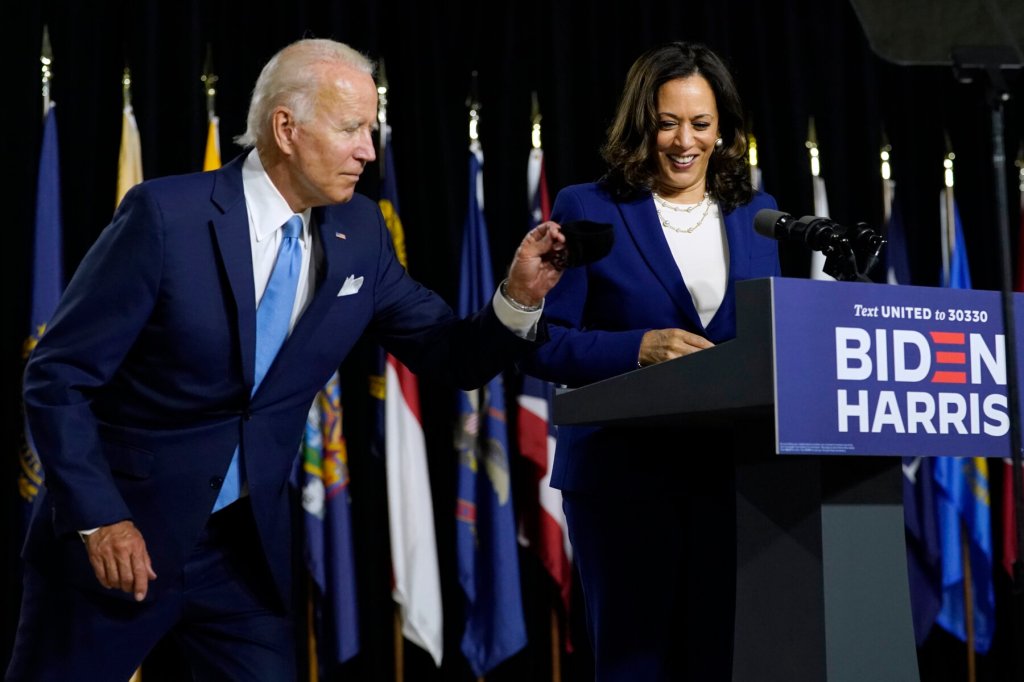
Remember when Joe Biden promised a $2000 Covid relief check if the Democrats won both senatorial races in Georgia? He said they’d “go out the door immediately.” Well, immediately has turned into weeks and probably will turn into months. First, the Democrats reduced the amount to $1400, saying they’d meant all along that the previous $600 check had been included in Biden’s promise. OK–I almost believe that. Now the $1400 amount has shrunk to $1000, if the wishes of “moderate” Republican senators are upheld. Biden and Kamala Harris are meeting with these moderate Republicans today, seeking “bipartisan” accord on a much smaller relief package ($600 billion versus $1.9 trillion). It’s now all about “targeted” relief, based on family income as reported to the IRS.
Let’s think back, way into the past, when Donald Trump was president. Do you recall the Republicans meeting with Democrats to secure bipartisan support for what they wanted to do? Me neither. I recall Trump and Republicans doing pretty much what they wanted, with most Democrats along for the ride.
So, how does a $2000 relief check become $1400 become $1000 become nothing (if your income exceeds $50K, or $100K as a family)? When you have miserly and dishonest politicians in charge.
Democrats could have moved immediately (there’s that word again) to pass a simple Covid relief bill for $2000 checks, instead of trying to pass a complex relief package that’s scheduled for next month at the earliest. But simplicity would not allow room for pork-barrel politics as usual, hence the complicated course we’re now on. Meanwhile, struggling Americans wait … and wait … and wait.
Joe Biden is a business as usual president — emphasis on “business.” As Chris Hedges recently wrote, he’s papering over the cracks in a rotting edifice, doing the job he was hired to do by his paymasters. But bipartisan accord will mean less than nothing when the whole rotting building crashes down around us.












 Bracing Views