U.S. Power Sets All the Wrong Examples to the World

W.J. Astore

An Open Letter from the Eisenhower Media Network

I’m a member of the Eisenhower Media Network, or EMN. We’re a small network of retired military types and former U.S. government officials who are openly critical of the military-industrial-congressional complex, America’s open-ended forever wars (the global war on terror; the cold war against Russia and China), and rising militarism within and across our society.

Recently, EMN issued a new letter in opposition to the Washington bipartisan consensus for war and more war. I’m proud to say I had a hand in writing it, as did Matthew Hoh and other members of EMN. Here’s what we had to say:

Military and Foreign Policy Experts Open Letter on U.S. Diplomatic Malpractice

Does America inspire the world by the power of its example or the example of its power? Far too often, and despite President Joe Biden’s words during his inaugural address, America’s overmilitarized power and diplomatic malpractice are its examples to the world.

We must change that. To make America truly essential and indispensable, we must not remain the world’s leading arms maker and weapons exporter. We must instead become the world’s greatest and most committed peacemaker and diplomat.

The problem is that America continues to make war, continues being “essential” only as the world’s leading merchant of death, and continues seeking dominance through military supremacy that ends, in places like Afghanistan, Iraq, and earlier in Vietnam, in mass death and colossal folly.

In our first open letter last spring in The New York Times, we, the undersigned, argued that a thoroughly militarized U.S. foreign policy would generate ruinous and worsening consequences and increasingly limited options for the U.S. and the world. Recent events bear this out.

The results of U.S. diplomatic malpractice are cruelly displayed in Eastern Europe, the Middle East and the Indo-Pacific. Risks of further escalation and a world war are rising. Predictably, a militarized foreign policy characterized by rejecting or ignoring international laws and treaties and by disingenuous negotiations and talks has offered no solutions to volatile wars in Eastern Europe and the Middle East while making war more likely in the Indo-Pacific.

Militarized solutions breed and feed more war. Earnest and deliberate diplomacy is the best hope to bring peace, stability and reconciliation to the world.

We chose Ike as our inspiration because he warned Americans of the dangers of the military-industrial complex and because he rejected a world dedicated to manufacturing weapons to commit mass murder. 

War in Ukraine

The failure to pursue diplomacy in Eastern Europe, both before and after Russia’s invasion of Ukraine, has resulted in a costly and destructive stalemate for which there are two likely futures:

  1. The collapse of the Ukrainian state due to a deteriorating economic and military situation hastened by corruption.Here, Ukraine’s fragility resembles that of previous houses of cards built by the U.S. in Afghanistan, Iraq, and Vietnam.
  2. A harrowing and bloody stalemate in Ukraine where firepower, made more lethal by technological advances, rules a battlefield where neither side can achieve decisive tactical or operational gains. The pursuit of ways out of this stalemate likely entails horizontal and vertical escalation, neither of which offers solace to those seeking an end to death and destruction in Ukraine and the establishment of peace and stability.

Horizontal escalation sees the war extending further to civilian population centers and infrastructure and includes the possibility of other nations joining the conflict. Vertical escalation sees the expansion of arsenals to weapons of greater range, lethality, and consequence, including nuclear weapons. These two forms of escalation may be intertwined and reinforcing. So, as the war may expand horizontally to resemble The War of Cities between Iran and Iraq in the 1980s, it may expand vertically as well with more powerful weapons being introduced by both sides. The use of nuclear weapons is increasingly conceivable under these conditions.

These two likely futures may intersect. For example, a Ukrainian collapse could see NATO forces, likely Polish and Romanian, marching into western and central Ukraine to counter a Russian push to fill a collapsing Ukrainian state. Such an event could lead to a war between NATO and Russia, a war that conceivably could go nuclear.

Hamas, Israel and the Middle East

The Russia-Ukraine War now rages concurrently with the war between Hamas and Israel. This war, too, is born of a U.S. refusal to foster diplomacy. Unlike the conventional war between Russia and Ukraine, we are witnessing an asymmetrical conflict more akin to the wars of insurgency many of us experienced in Vietnam, Afghanistan, and Iraq.

Worse, the Hamas/Israel bloodletting in Gaza is characterized by an ethnic cleansing campaign that would be impossible without U.S. diplomatic, economic, media, military and political support. We are disgusted by and find repugnant the brazen and bipartisan support by the U.S. government for rampant violations of international law by Israel. Ethnic cleansing in Gaza, long planned by senior members of the Israeli government and powerful elements of Israel’s reactionary right wing, follows in the ghastly wake of Hamas atrocities against civilians on October 7.

Here, the U.S. government isn’t just passively witnessing war crimes; it is enabling them. With the frightening possibility of escalation to a regional or even a world war, the violence in Gaza has fed and feasted upon decades of deliberate diplomatic malpractice in America. Decades of putting Israel first, second, and last while ignoring the plight and pleas of Palestinians have made political settlements to the blockade of Gaza and the occupation of East Jerusalem and the West Bank nearly impossible.

Whereas a month ago, we lived with the risk of nuclear war as an outcome of escalating conflict in Ukraine, we now face the elevated risk of a rightfully feared world war as a consequence of entangling alliances between nuclear-armed Moscow and Washington in the Middle East.

China and the Path Ahead

To this, we must add the dangers of war with China, something hyped by leading U.S. politicians; the still unpaid costs of the $8 trillion wars in Afghanistan and Iraq; a militarized federal budget for which 60% of discretionary spending goes to war and all its wounds; and a hollowed American economy.

Decades of reckless U.S. war-making, both direct and via proxies, while coddling corrupt, ruthless, and unjust foreign governments has, not surprisingly, made the world more dangerous and less stable. Failure to invest in and maintain our country has weakened and corroded America’s infrastructure, institutions, and industries. A hypocritical flaunting of international law and an espousal of an ethereal rules-based order, coupled with an arrogant disregard for past U.S. crimes and blunders, have caused dozens of nations to flock to competitors – a movement away from America that will undoubtedly accelerate if we remain on our current militaristic path.

Moreover, decades of colossal military spending have witnessed few strategic gains for the U.S. Our military, often saluted as the world’s greatest by politicians, hasn’t won a major war since World War II. That same military annually faces significant recruiting shortfalls that cast considerable doubt on the integrity and staying power of the All-Volunteer Force. America’s legacy of failed wars is not redeemed by ongoing displays of vacuous military boosterism. Feel-good patriotism can’t suppress the bitterness many of us military veterans feel toward the past, nor does it calm the worries we have about our nation’s future.

Pope Francis has spoken of a “famine of peace” that exists in the world today. In this spirit, we call for immediate ceasefires, without conditions, in Gaza and Ukraine.

The surest way to prevent wars from exploding into uncontainable wildfires is to starve them of fuel. To think or speak that these conflagrations can be managed, adjusted as if by damper or thermostat, is a fool’s conceit or a liar’s word. We have been burned too many times in our professional lives to believe hot wars can be “won” by throwing more gasoline on them, whether rhetorically or in the form of cluster munitions, depleted uranium shells, and similar forms of “aid.”

A better path ahead is clear. Peace, not war, must be fostered. In embracing peace through diplomacy conducted in good faith, America would indeed exhibit the power of its example, becoming essential to a world that cries out for liberty and justice for all.
The Obliteration of Gaza

W.J. Astore

AIPAC and the MICC as Mechagodzilla

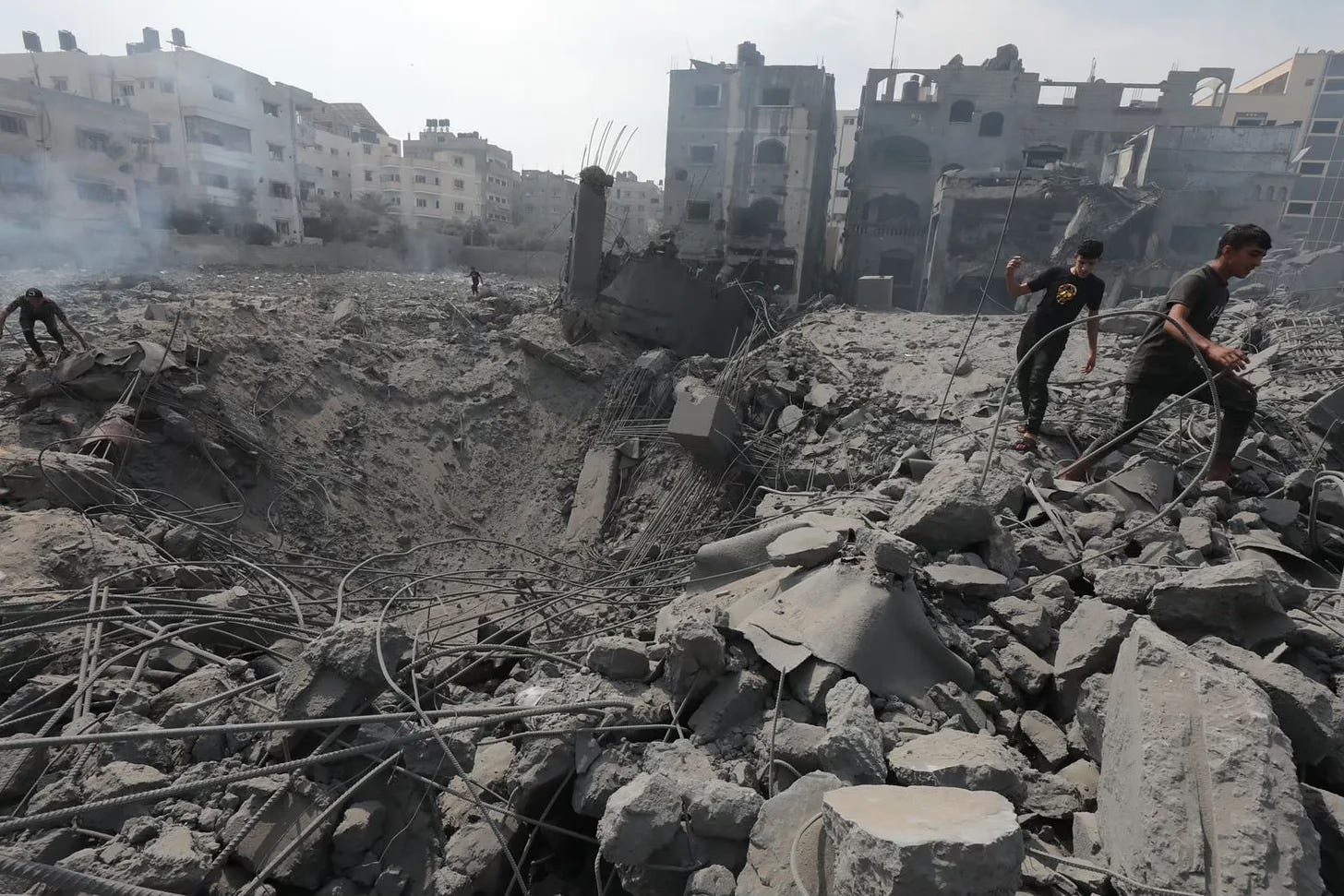
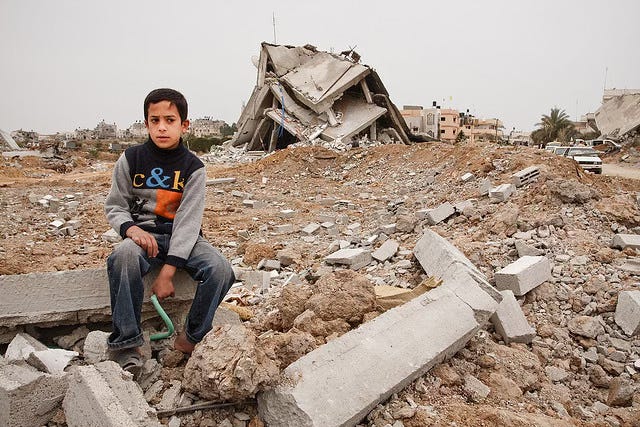
We are witnessing the obliteration of Gaza. The death toll has already surpassed 16,000 as Israel continues to pummel targets with American-made bombs and missiles. Even CNN is worried (from my email update this AM):

Top UN officials are warning of an “apocalyptic” situation in Gaza with “no place safe to go” for civilians as the deepening humanitarian crisis sparks international concern. Israel is expanding ground operations to the entire territory to “eliminate” Hamas and has told Palestinians to flee large swaths of southern Gaza, where many had previously sought refuge. But the war-torn region is in the midst of a near-total internet blackout as the last major telecommunications operator said services are completely cut off. This means many Palestinians are unable to communicate with one another or call for help while evacuating, and emergency workers can’t coordinate their responses.

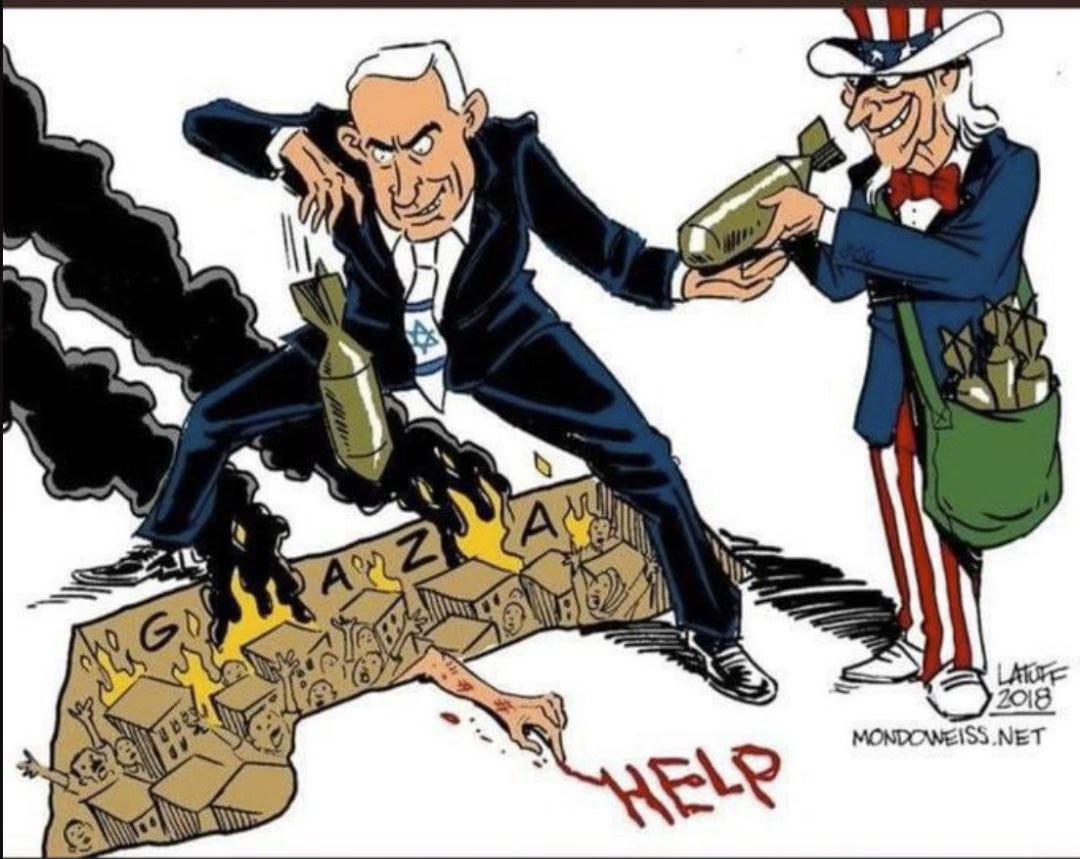
Caitlin Johnstone has a telling article in which she states an important truth: Israel couldn’t be doing this without generous U.S. support. Israel is dropping the bombs, firing the missiles, and shooting the artillery rounds and bullets, but the U.S. is largely serving as the merchant of death for all this, though “merchant” is the wrong word. The U.S. is giving all this deadly weaponry to Israel as “aid,” even as there’s much rhetorical gnashing of teeth in Washington about Israel’s “indiscriminate” bombing and wanton killing of Palestinian innocents, including thousands of children. I say “rhetorical” because as Johnstone notes, the U.S. government could curtail Israeli military action by turning off the spigot of arms flowing from U.S. arsenals and warehouses to Israel.

But that’s not going to happen. AIPAC has a hammerlock on Congress; those few members of Congress who’ve called for a ceasefire in Gaza are already being targeted by the powerful pro-Israel lobby, with AIPAC promising to spend upwards of $100 million to unseat those politicians who aren’t consumed by bloodlust against Gaza. The power of AIPAC is reinforced here by the MICC, the military-industrial-congressional complex that Ike warned us about in 1961, which stands to profit immensely from more war in the Middle East as well as Ukraine. The combination of AIPAC with the MICC is akin to Mechagodzilla, an almost unstoppable monster of immense power.

They create a desert and call it “peace”: Gaza turned to rubble

Godzilla in its various incarnations would be hard-pressed to duplicate the scenes of devastation we’re seeing in Gaza. Israel is practicing its own version of the infamous statement from America’s war against Vietnam: “It became necessary to destroy the town to save it.”

The Israeli version: We had to destroy Gaza to save it from Hamas.

It made no sense in Vietnam, and it makes no sense today in Gaza. But this is not about making sense: it’s about power and vengeance and profit.

Is the Russia-Ukraine War Sputtering to an End?

W.J. Astore

Let the killing stop and the healing begin

A report from Sy Hersh today (12/1/23) suggests that the Russia-Ukraine War may finally be sputtering to a diplomatic conclusion. The senior generals on both sides seem to be the main actors, but who really cares as long as the killing stops and the healing begins?

Remember when we were told that all Ukraine needed was a few good Western tanks to turn the tide in its favor?

Conflicts and wars often exhibit a horrifying form of logic. Military hardliners, convinced of their own righteousness, claim that victory will come only on the battlefield when the enemy is totally defeated by force of arms. Armchair warriors at home and abroad glom on to this, cheering for their side and calling for no compromises, no negotiations, just more killing.  Think here of “bomb’em back to the stone age” slogans heard in America during the Vietnam War, or expressions of apocalyptic destruction like “make the rubble bounce.”

Call it a total war fixation, the idea that victory can only be achieved by erecting one’s flag on a mountain of skulls. Here, anyone arguing for ceasefires or peace must be an agent or sympathizer for the bad people, in this case a “Putin puppet.”

To armchair warriors, the idea that people might simply prefer peace to war seems unfathomable. This is often true of wars everywhere. Those furthest from danger, those from whom no sacrifice is required or even asked, are those most likely to bray the loudest for more killing and more war. To the warmongers, they are the tough ones, the hardheaded realists, and those who disagree with them are disreputable and weak.

Here in the USA, there’s another element to this: the fact that the U.S. government, in the people’s name, has provided massive amounts of weaponry to Ukraine in a pursuit of decisive victory. Many still favor a Ukrainian fight to the death against Russia, though America in general is showing growing reluctance to pay for it all.

Is Ukraine’s senior general naive in supporting a ceasefire and negotiations? Allegedly, evil Putin will take advantage of any ceasefire to rearm and prepare yet more devastating attacks. Yet this “logic” of war could be applied to any conflict at any time in history. At some point, all wars come to an end.

After almost two years of fighting and hundreds of thousands of casualties, it’s high time to give peace a chance in Ukraine. War, as we can see from current events in Gaza, has no lack of chances to thrive in this world.

The U.S. Military’s Alleged Recruiting Crisis Isn’t the Problem

W.J. Astore

America Must Reignite Its Distrust of Large Standing Militaries

recent article by Major General (ret.) Dennis Laich and Colonel (ret.) Lawrence Wilkerson notes a crisis in military recruitment in America. Here’s how their article begins:

The U.S. military’s all-volunteer force (AVF) model is an abject failure. Last year, the active Army fell 15,000 recruits short of its goal. This year, it was 10,000, and the Army Reserve fell 40% short of its goal. This year, the active Navy fell 7,000 short, and the Navy Reserve was 33% short. Finally, the active Air Force fell 3,000 recruits short, and the Air Force Reserve and Air National Guard each fell 30% short of their goals. 

There is no reason to believe these trends won’t continue, and even less reason to believe they will not get worse. In the past 10 years, the propensity to serve has fallen from 15% to 9%, and the portion of the recruiting-age population qualified to serve has dropped from 30 % to 23%. The number of children 5 and under in the United States is 12% smaller than the 15- to 25-year-old cohort, presenting a grim demographic reality.  

Our national security crisis is part of a broader civic rot that plagues our democracy. Ultimately, the AVF’s failure could lead to war if the U.S. appears weak to a potential adversary.

Laich and Wilkerson would like to see a return of a lottery-based military draft for young men and women in America. I respect these men; we are part of the same organization, the Eisenhower Media Network. Yet I see this issue in a different light.

In essence, young Americans are voting with their feet by not joining the military in the numbers the AVF desires. This is not a bad thing. The U.S. military, if it was focused truly on national defense, would and should be considerably smaller. What enlarges our military (and its recruitment quotas) is imperial sprawl. Does the U.S. truly need to garrison roughly 800 military bases overseas? Does the U.S. Army truly need big brigades and battalions to fight conventional wars in Asia? Why does the Air Force need so many people? Why must the Navy have so many ships? Why do we need a growing Space Force?

A recruiting crisis even with Tom Cruise making two-hour commercials for the U.S. Navy? (Cruise attends the London premiere of “Top Gun: Maverick.” Karwai Tang | Wireimage | Getty Image)

I don’t see America appearing “weak” to potential adversaries. If anything, potential adversaries look at the U.S. as an overly strong and often unpredictable bully. Every country in the world knows the U.S. puts its military first, that the U.S. is the only nation to have used nuclear weapons in war, that the U.S. never met a war it didn’t like, even though it hasn’t won a major war since World War II. Military weakness is not a problem America is ever likely to have. Even when the empire eventually collapses, the military will still be the last American institution that will be fully funded. (Indeed, huge sums of money spent on the military is contributing to that collapse.)

We don’t need a revival of the draft. We need a revival of sanity. We need a foreign policy in which we mind our own business. In which we don’t dispatch military forces to every hotspot in the world. In which we don’t pummel other countries into submission, as we attempted to do with countries like Vietnam, Laos, and Cambodia. (The death of Henry Kissinger the Pummeler at age 100 shows that only the good die young.)

A smaller military might mean fewer foreign entanglements for America as well as far less global destruction (think of Southeast Asia as well as Iraq, Afghanistan, Libya, Syria, Somalia, and so on). That wouldn’t be a bad thing.

Of course, the U.S. military’s answer to its alleged recruiting crisis is to hire an expensive advertising agency, giving it more than $450 million in taxpayer money to craft new ways of enticing young Americans to join the AVF. It just goes to show how much money the Pentagon has to throw (or throw away) at perceived problems.

If America faced a true and immediate threat (a clear and present danger, as the saying goes) to its national security, I don’t doubt young Americans would step up. But I see no foreign enemy seeking the military conquest of Topeka or Tampa or Tucson, nor do I see a pressing need for a super-sized military that still retains a Cold War mentality of full-spectrum dominance against the Reds (China and Russia remain the bogeymen for most in the U.S. military and Congress as well.)

As one major general once told me, less money for the U.S. military, along with fewer troops, might have the salutary effect of forcing the brass to think for once before invading another country or threatening yet another war. Wouldn’t that be something.

Throughout most of our history, America had a profound distrust of large standing militaries and the mayhem and mischief they so often cause. It’s time to reignite that distrust.

Operation Ongoing Bullshit

W.J. Astore

Yes, Right and Left Can Come Together in America

I had a great time this weekend with family, including my brother-in-law who’s a combat veteran of the Vietnam War. If I’m on the left, he’s on the right (whatever those often vague political labels may mean). Guess what we agree on? A lot, actually:

+ We both agreed the Iraq and Afghan Wars were disasters.

+ We both agreed $105 billion in more weapons and “aid” to Ukraine, Israel, Taiwan, etc. is a complete waste of money. We’d both rather see that money spent here in the USA, especially on America’s crumbling infrastructure. (“Crumbling” as a descriptor is inseparable from infrastructure here in America.)

+ We both agreed the government response to Covid was badly botched and that Anthony Fauci often lied to the American people. We both agreed government experts should have treated us like adults, admitting they couldn’t answer all the questions about Covid. We both think it’s more likely than not that Covid was a man-modified virus that leaked from a lab in China.

+ We both agreed Joe Biden isn’t the answer in 2024. My brother-in-law is open to Trump; I can’t vote for Trump for so many reasons. A minor disagreement, though we’d both like to see more and younger candidates, not a Biden-Trump rematch.

+ We both agreed a ban on assault weapons would do little or nothing to stop gun violence and mass shootings in America. There are already 20 million AR-15-type assault weapons in America; sorry, a ban won’t fix anything.

+ We both agreed the New England Patriots suck this year, but that Mac Jones isn’t solely to blame for an offense that simply can’t score points.

+ We both agreed Budweiser went well with our turkey and sausage gumbo. 

+ We both agreed “White Heat” (1949) with Jimmy Cagney is one of the greatest movies ever made.

Top of the world, Ma. Jimmy Cagney at the explosive conclusion to “White Heat”

+ Finally, we both agreed we are immersed in Operation Ongoing Bullshit, a felicitous phrase my brother-in-law came up with. We are constantly being bullshitted by “our” government. I put “our” in scare-quotes because we agreed we have a pay-to-play government. Pay a lot, as in millions of lobbying dollars, you get to play a lot. Can’t pay? Too bad. You have no say.

Operation Ongoing Bullshit is one of the more honest names I’ve heard to describe what the U.S. government is usually up to. Right and left can heartily agree on this, I think.

Far too often, we’re told there are unbridgeable differences between right and left in America. Differences exist, of course, yet there’s so much Americans can and do agree on. To cite only one example, I think most Americans agree with James Madison that ongoing war (and ongoing BS, for that matter) contributes to the death of democracy. And also to our colossal national deficit, now in the neighborhood of $34 trillion.

It’s time to come together, America. It beats being divided, distracted, and downtrodden.

15,000 Bombs Equivalent to Two Hiroshimas

W.J. Astore

The Israeli Annihilation of Gaza

After dropping 6000 bombs in six days, the Israeli Air Force has now reached the staggering sum of at least 15,000 bombs dropped on densely populated areas of Gaza. The bomb tonnage is already equivalent to two Hiroshimas, notes Joshua Frank at TomDispatch. As he puts it:

[W]ell over 25,000 tons of bombs had already been dropped on Gaza by early November, the equivalent of two Hiroshima-style nukes (without the radiation). Under such circumstances, a nuclear-capable Israel that blatantly flouts international law could prove a clear and present danger, not only to defenseless Palestinians but to a world already in ever more danger and disarray.

Israel is the only power in the Middle East with nuclear weapons; it’s not beyond the realm of possibility that the right-wing government of Netanyahu would choose to use one or more if cornered.

Netanyahu’s goal seems clear: make Gaza uninhabitable to Palestinians through a combination of massive bombing, blockades (water, food, medical supplies, and other essentials), and invasion and occupation. Palestinians are to be “pushed” into the Sinai Desert, with Gaza absorbed into Israel. All this is being justified in the name of neutralizing Hamas, a terrorist organization that has no ability to hurt Israel in a major way. (The brutal attacks of October 7th were a one-off made more brutal by Israeli helicopter gunships whose counterattacks killed friendlies as well as the Hamas attackers.)

In the name of destroying Hamas, Israel is ethnically cleansing Gaza so it can be absorbed into Israel. Apparently, there are enormous gas reserves off Gaza, possibly worth $500 billion, which were to be shared between Israel and the Palestinians in Gaza. With the Palestinians either dead, severely wounded, or evicted from Gaza, Israel will likely claim total ownership over those gas fields. Israel may yet become a major gas supplier to Europe, replacing much of the gas lost when Putin blew up his own gas pipelines to Germany. (Just kidding: America did that, as President Biden promised he would.)

Meanwhile, Joe Biden penned an op-ed to the Washington Post equating Hamas with Putin as “pure, unadulterated evil.” Hamas is allegedly trying to wipe Israel off the map with its “ideology of destruction,” but of course Hamas has no military ability to do this, whereas Israel does indeed have the power to wipe Gaza off the map. So where does Biden see the future heading? Consider this passage:

There must be no forcible displacement of Palestinians from Gaza, no reoccupation, no siege or blockade, and no reduction in territory. And after this war is over, the voices of Palestinian people and their aspirations must be at the center of post-crisis governance in Gaza.

As we strive for peace, Gaza and the West Bank should be reunited under a single governance structure, ultimately under a revitalized Palestinian Authority, as we all work toward a two-state solution.

He may as well wish for puppies and unicorns for everyone. Israel doesn’t want a two-state solution with a thriving Palestinian state. Netanyahu’s goal, to repeat myself, is clear: Gaza absorbed into Israel, with Palestinians displaced in another Nakba, along with the West Bank slowly absorbed into Israel as illegal Jewish settlements are extended.

This is, essentially, what Thucydides meant when he said: the strong do what they will; the weak suffer what they must.

What Biden’s op-ed was really about was justifying his $105 billion package in giveaways, mainly for Ukraine and Israel, with more than half that money flowing to U.S. weapons makers, the merchants of death or, as Biden calls them, job creators. In short, Biden celebrates the creation of a few jobs in America in the name of killing tens of thousands of Russians and Palestinians with American-made weaponry paid for by U.S. taxpayers.

Biden calls that “democracy” in action, the work of the world’s “essential nation” in contrast to the “murderous nihilism” of Hamas.

“Murderous nihilism”? Well, as we used to say as kids, it takes one to know one.

Speaking of murderous nihilism …

Liberty at the Point of a Sword

W.J. Astore

Lessons from Napoleon and Hitler

There’s a man who famously crowned himself emperor rather than submit to the otherworldly power of a pope. A new movie will soon be out on his “glories.” Napoleon Bonaparte, a military genius, embraced war and drove for total victory until his empire collapsed on him and the French people. Napoleon’s Waterloo came in 1815, a decade after perhaps his greatest victory at Austerlitz in 1805. Empires—they often seem to decline slowly before collapsing all at once, though the Napoleonic version flared so brightly that it burned out quickly.

I once studied the military glories of Napoleon, enthusiastically playing war-games like Waterloo and Empire in Arms, where this time maybe I could win a great victory for the emperor. More than a few books on my shelves cover the campaigns of Napoleon. But as my dad quipped to me, Napoleon wanted to give people liberty, equality, and fraternity at the point of his sword.  And that, my dad would say, is an intolerable price to pay for one’s freedom.

Win one for the Emperor

Endless war is, as often as not, the final nail in an empire’s coffin. Early in 1943, after defeat at Stalingrad, which came as a profound shock to a German public sold on the idea it possessed the finest fighting force in history (such rhetoric should sound familiar to Americans today), Joseph Goebbels, the infamous Nazi propaganda minister, gave a fanatical speech calling for “total war” from the German people. Despite disaster at Stalingrad, despite visible and widening cracks in the alleged superiority of the Thousand Year Reich, the German people largely cheered or echoed the cry for more and more war. Two years later, they witnessed total defeat as Germany surrendered unconditionally in May 1945.

As led by Adolf Hitler and his henchmen, Nazi Germany wasn’t interested in peace. These men knew only the feverish pursuit of total victory until it ended in their deaths and total disaster for Germany.  They were the original seekers of “full spectrum dominance” as they asserted Germany was the exceptional and essential nation.

We Americans were supposed to learn something from megalomaniacs like Napoleon and Hitler. Committed to democracy, we were supposed to reject war, to repudiate militarism and the warrior mystique, and to embrace instead diplomacy and the settlement of differences peacefully through international organizations like the United Nations.

America today, however, is busy beating plowshares into swords and sending them to global hotspots like Gaza and Ukraine. What gives?

Endless wars can exhaust even the richest and wisest of empires, and America isn’t as rich or wise as it used to be.  Interestingly, ordinary Americans haven’t been overcome with bloodthirst. Roughly two-thirds of Americans, for example, support a ceasefire in Gaza. But they are a silent majority compared to the loud minority flowing through the halls of power in DC lobbying for war and more war.

The U.S., which largely created the UN in the immediate aftermath of World War II, now does everything it can to block UN calls for ceasefires, whether in Ukraine or Gaza. The U.S., while allegedly manifesting its allegiance to Judeo-Christian values, embraces war and distributes weaponry like the devil while rejecting calls for peace by church leaders such as Pope Francis.

The U.S. is an empire in serious decline because it devotes so much money to wars and more wars.  Military budgets now approach $1 trillion yearly even as the Pentagon just announced it failed its sixth audit in a row.  These repetitive failures provoke a bizarre response from Congress and the President: yet more money for war and dominance.

Whether measured in blood or treasure or both, seeking to dominate the world through military hegemony is a surefire recipe for imperial collapse.  It’s a lesson taught by the fates of Napoleon and Hitler, one U.S. leaders have dismissed as they’ve been caught up in a belief one can be a superpower, a global hegemon, totally dominant, while remaining a beacon of freedom.

Like Napoleon, U.S. leaders sell the idea they’re giving people liberty at the point of a sword.  My dad taught me something about the fallacy and folly of this.

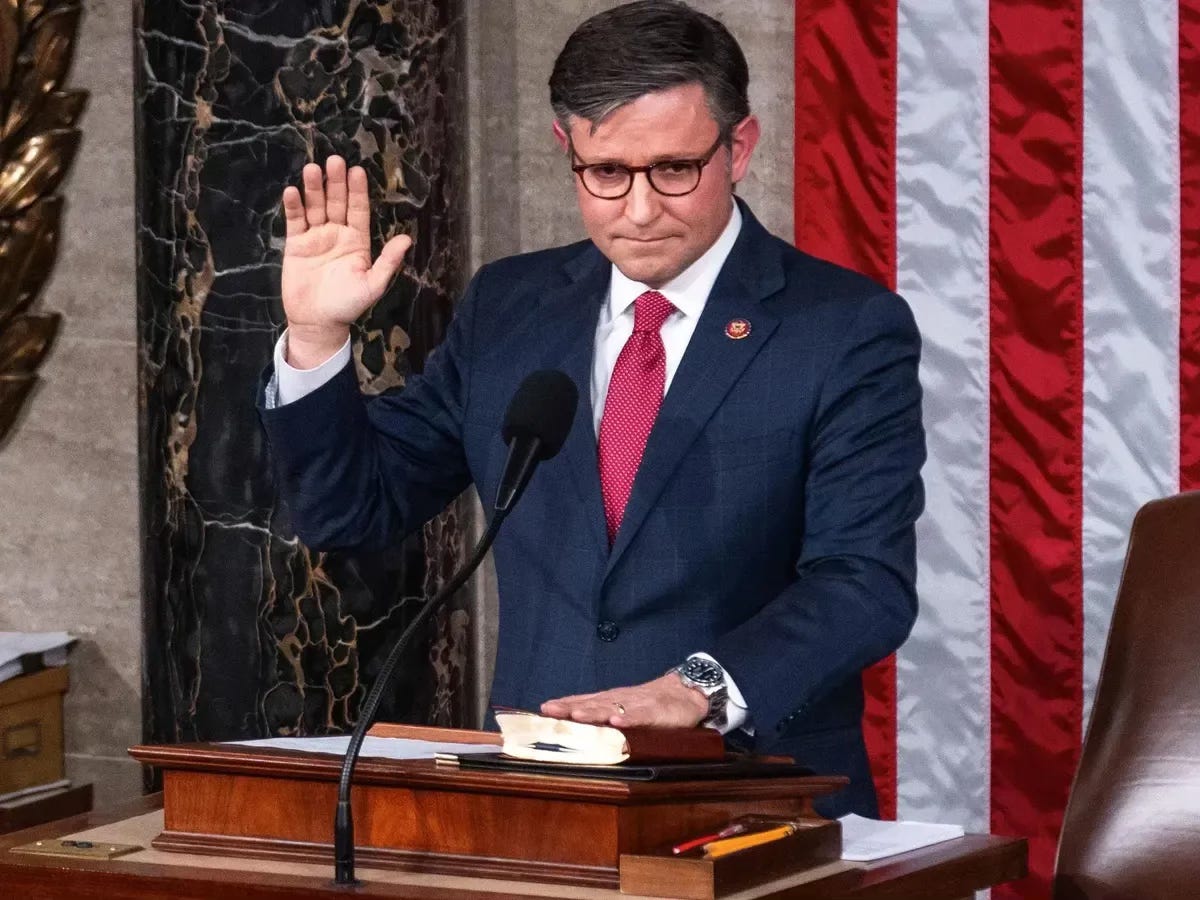
Mike Johnson, Preacher of the House

W.J. Astore

There shall be no wall between the state and (my) church

Speaker of the House Mike Johnson made news again by claiming the idea of a wall between religion and state in America is a “misnomer.” Johnson blamed Thomas Jefferson for the misnomer, stating that there is no Constitutional injunction separating church and state.

Of course, by “church,” Speaker Johnson means his church, a Christian one that is evangelical and nationalist. He didn’t mention freedom of religion in America, or Muslims or Hindus or atheists or Wiccans. Johnson, who’s said that the Christian Bible is his operating manual and his belief system, has only one church in mind.

Preacher Mike Johnson

Johnson sees himself as a Christian preacher. He should resign his position, take up the Bible and cross, and preach. Because he totally misunderstands the intent of the founders.

From its earliest days, the colonies were a haven for Christian dissenters, meaning those who didn’t kowtow to the establishment Church of England, which indeed was and is a state church. Among the founders were deists like Thomas Jefferson and non-theists like Thomas Paine. Not surprisingly in the “rational” Age of Enlightenment, America was founded on the notion of freedom of belief and tolerance of others and their beliefs, however imperfectly that tolerance was often practiced. (Few Americans, even today, for example, cop to being atheists, especially if they’re in politics.)

The colonists recognized that the conjunction of state power with organized religion corrupted both. They knew history, including their own, hence that “wall” that Thomas Jefferson spoke of. That wall wasn’t anti-church or anti-religion. It was erected to protect religion and personal beliefs from being tainted by state interests and power.

Preacher Mike Johnson wants to tear down that wall—as long as the state embraces and advances his version of Christianity and not any other version, or for that matter any other religion.

It’s a sign of the times that when America most needs talented and skilled leaders, it gets instead a self-admitted Christian zealot who takes his guidance from his particular reading of the Bible.

Can someone please tell Mike Johnson he’s Speaker, not Preacher, of the House?

Shameless Secrecy by the Biden Administration

W.J. Astore

Don’t worry, be happy about unaccountable weapons exports to Israel

Just in case you missed this story (courtesy of ReThink Roundup):

Biden’s secrecy on arms transfers to Israel unnerves some Democrats. As Palestinian civilian deaths mount, President Biden faces growing pressure from Congressional Democrats to publicly disclose the scope of U.S. arms transfers to Israel. Contrary to Ukraine military aid, for which the Pentagon releases recurring fact sheets about the U.S. arms transfers, the administration has not made public the quantities of weapons it is sending to Israel. The administration is also pushing for the authority to bypass notification requirements to Congress that apply to every other country receiving military financing, a move members of Congress and advocates have criticized.

I think Biden’s secrecy on arms transfers to Israel should unnerve all Americans, don’t you?

And why should Israel be the only country in the world where weapons can be shipped, funded by U.S. taxpayers, where Congress won’t be notified?

What is it about this shameless kowtowing to a far-right government in Israel? A government that is bitterly resisted by many Israelis? One led by Bibi Netanyahu, who has said that the idea for killing all Jews in the Holocaust came from an Arab leader rather than Adolf Hitler? Seriously, he said that.

Strangely, Netanyahu is a Holocaust denier in the sense he claims the idea came from Arabs rather than Hitler and the Nazis.

Meanwhile, Donald Trump, Biden’s mostly likely opponent in 2024, is arguably even more virulent in his support of Israel and its attacks on Gaza.

All these U.S. government officials and candidates who love Israel so passionately should grab assault rifles, head to Gaza, and go down into the tunnels and root out Hamas. Put your mouth where you’re sending America’s money.

More bombs? Sure!

Why I’m A Lapsed Catholic

W.J. Astore

Too many Church positions trouble me, as does the awful legacy of sexual abuse

I was raised Catholic and attended church well into my twenties until I began to lose interest in the ritual and repetition.  Still, I did my master’s thesis on American Catholic responses to evolution, polygenism, and geology in the 19th century, a version of which was published when I was in my early thirties.  To this day, I continue to read the New Testament and am still inspired by the teachings of Jesus Christ.  As a popular ad campaign puts it, He (Jesus Christ) gets us.  Or at least he gets me, or I get him.

Yet I am seriously out of step with today’s Catholic church.  I believe priests should be able to marry if they so choose.  I believe women who have a calling should be ordained as priests.  I believe the Church’s position on abortion is absolutist and wrong.  More than anything, I believe the Church is too concerned with itself and its own survival and therefore is alienated from the true spirit of Christ, a spirit of compassion and love.

Yes, I still have a rosary

Scandals involving the Church contributed to my loss of commitment to the Church and especially its patriarchal hierarchy, which was so intimately involved in the coverups of crimes committed against innocents.  The betrayal struck close to home.  In my hometown, the Church assigned a known predatory priest. His name was Robert F. Daly.  He abused minors and was eventually defrocked by the Church, but far too late and more than thirty years after his abusive behavior.

Fortunately, I was never abused.  I had a scheduled meeting with him, alone, when I was about fifteen, but fortunately it was cancelled at the last minute.  So many other children and teens were not so fortunate. To be blunt, I remain thoroughly disgusted by the moral cowardice exhibited by the Church in confronting fully its painful legacy of failing to protect vulnerable children against predatory priests.  Shame on the Church.

The Bible says that all sins may be forgiven except those against the Holy Spirit.  This is supposed to refer to a stubborn form of blasphemy.  Yet I truly can’t think of a worse sin committed by the Church than to allow innocent children to suffer at the hands of predators disguised as “fathers.”

I have written to the Church and have heard from prominent leaders that the Church takes these crimes seriously and can now police itself in the matter of predatory priests.  I’m sure these officials are sincere, but the idea of a self-policing church is a self-serving one.

As I wrote to one Catholic bishop, who assured me the Church now “gets it”:

Skeptics would reply that it took a huge scandal with major financial implications to force the Church to do the right thing.

For too long, the Church tolerated these crimes.  The Church is hardly unique here. Think of sexual assaults within the military (notably during basic training), or think of the Sandusky scandal at Penn State, where Joe Paterno clearly knew of (some) of Sandusky’s abuse yet chose not to take adequate action.  (I was at Penn College when that scandal broke.)

The challenge, as you know, is that the Church is supposed to be a role model, an exemplar of virtue.  Priests hold a special place of trust within communities and are therefore held in especially high regard.

As my brother-in-law, who’s now 76, explained to me, if a young boy or girl accused a priest of assault in the 1950s or 1960s, few if any people would have believed them. Indeed, the youngster was likely to be slapped by a parent for defaming a priest.  That moral authority, that respect, was earned by so many priests who had done the right thing, set the right example.  It was ruined by a minority of priests who became predators and a Church hierarchy that largely looked the other way, swept it under the rug, or otherwise failed to act quickly and decisively.

As you say, the Church has learned.  It is now better at policing itself.  The shame of it all is that it took so much suffering by innocents, and the revelations of the same and the moral outrage that followed, to get the Church to change.

I’m encouraged by the example set by Pope Francis and especially his commitment to peace, but I don’t believe I will ever be a practicing Catholic again.  Too many church policies still trouble me, as does the awful legacy of the sexual abuse scandal.