Creator of Bracing Views. Contributor to TomDispatch, Truthout, HNN, Alternet, Huffington Post, Antiwar, and other sites. Retired AF lieutenant colonel and professor of history. Senior fellow, Eisenhower Media Network
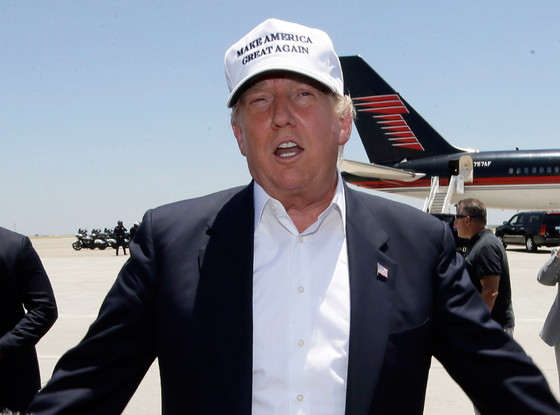
Donald Trump is a tacky, classless, and vulgar man. Recall back in April that he sent a tweet, since deleted, saying that “If Hillary Clinton can’t satisfy her husband what makes her think she can satisfy America?” Back in December, he wrote that Hillary “got schlonged” by Obama when they ran against one another back in 2008. (“Schlong” is Yiddish for penis; I recall hearing it as a teenager without ever knowing its Yiddish origins, not that etymology mattered much to teens in a locker room context.)
I’m no fan of Hillary Clinton, and indeed I’ve criticized her at this site for her establishment ties, her warmongering, her acceptance of big money from banks, her incrementalism, her lack of generosity toward the working classes when compared to Bernie Sanders, her lack of judgment when it came to her vote on the Iraq War or the intervention in Libya. And that’s my point: there are plenty of legitimate issues on which to criticize Hillary. Just think of her unsecure private email server, for example, which she used while leading the State Department. Hillary and her husband Bill have often acted as if one set of rules applied to them and another set applied to “everyday people” like you and me; call it the hypocrisy of the privileged, a common enough trait in America.
There are so many substantive and important issues to criticize Hillary and Bill on that it’s truly revealing when Trump stoops to attack Hillary just because she’s a woman, just because “she yells,” just because her husband cheated on her (Trump also claimed she “enabled” Bill’s cheating), and just because she lost a previous primary to a man with a penis. Recall as well when Trump criticized Hillary by saying that if she “were a man, I don’t think she’d get 5 percent of the vote. The only thing she’s got going is the women’s card.”
Politics is the land of the rough and tumble, but Trump’s attacks on his opponent that center on her gender and her husband’s cheating are beyond rough. They are the actions of a crude, tacky, boorish, and classless person, a person whose behavior is uncivil, behavior that would make even teenage boys in a locker room squirm.
The news out of Orlando is shocking. Another mass shooting in America. Another 50+ people dead with an additional 50+ wounded. And then I saw this headline:
“America has 4.4% of the world’s population, but almost 50% of the civilian-owned guns around the world”
The ready availability of guns in America, to include military-style assault weapons with 30-round clips, makes it far easier for shooters bent on murder to kill large numbers of people. It doesn’t matter what you call these shooters, whether you label them terrorists or lone wolves or crazed lunatics or whatever. Apparently the latest shooter bought his guns legally, had a grievance against gay people, expressed some last-minute allegiance to ISIS, and then started blasting away at innocent people in a club that was friendly to gays.
Sure, guns alone are not to blame. The primary person to blame is the shooter/murderer himself. But (to repeat myself) the guns sure make it a lot easier to kill, and in large numbers.
We live in a sick society, often a very violent one, certainly a disturbed one, one that places enormous stress on people. Another exceptional headline that I first heard on Bill Maher is that America, again with 4.4% of the world’s population, takes 75% of the world’s prescription drugs.
Guns and drugs – the two don’t mix, even when they’re legal. Americans are over-armed and over-medicated. Add to that mix the fact that Americans are under-educated, at least compared to our peers in the developed world, and you truly have a toxic brew.
Over-armed, over-medicated, and under-educated: surely this is not what our leaders have in mind when they call us the exceptional nation, the indispensable one, the greatest on earth. Is it?
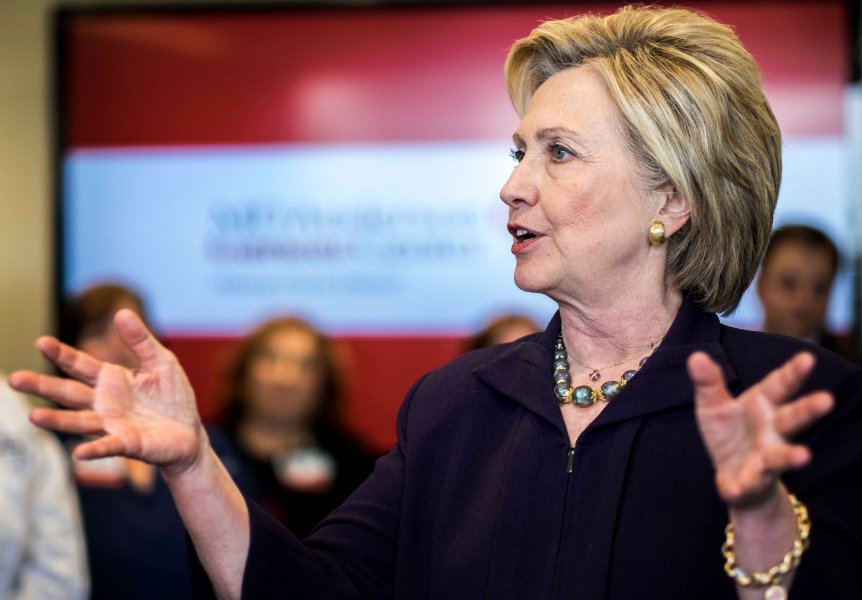
What does she really stand for? (Photo by Melina Mara/The Washington Post)
W.J. Astore
What does Hillary Clinton stand for? It’s a serious question. Sure, she’s given a lot of speeches, but without saying much. I’ve watched the debates and have listened to her speak, and the best I can come up with is this:
She’s continuing the legacy of Obama. For example, Obamacare will be extended to cover all Americans.
She’s going to break the glass ceiling that has blocked a woman from being president.
She loves Israel and will support whatever the Israeli government wants.
She’s going to work to raise the minimum wage for workers — $12.00 is the goal.
She’s going to work against the TPP (after she was initially for it).
She’s against the Keystone Pipeline (after initially supporting it).
She’s fully for equality for the LGBT community (after initially being against it).
She’s for an aggressive U.S. military posture and fully supports enormous defense budgets.
She’s not going to do dumb things like that scary Donald Trump.
She’s got a lot of experience in government. The length of her resume alone qualifies her to be president.
That’s the gist of her message as far as I’ve been able to discern. Of course, there are other messages for her followers. Surely Hillary will support reproductive rights, to include access to abortion. Surely she will appoint justices to the Supreme Court that are somewhere to the left of Antonin Scalia. Such considerations shouldn’t be dismissed out of hand.
But a new path for our country? Fresh ideas? They’re not coming from Hillary. Important issues like campaign finance reform, reforming banks and other powerful financial institutions, reducing income inequality in the United States, and similar issues of reform and fairness are dead on arrival if she’s elected president.
Also, Hillary’s embrace of Henry Kissinger as well as neo-conservative principles in foreign policy ensures a continuation of wars in Afghanistan, Iraq, and locations throughout the Greater Middle East. (When I first typed that, I unconsciously wrote, Greater Military East, because America’s engagement with the region is almost exclusively conducted in military terms, via bombing, drone strikes, and special ops raids).
The Clinton Campaign’s strategy of being fuzzy about specifics while vilifying her chief opponent (admittedly not difficult to do if your opponent is Trump) reminds me of a book I read many, many moons ago: “The Selling of the President 1968,” by Joe McGinniss. What I recall from that book was the cynical process of triangulation and secrecy as well as the tight control of “the message” by Candidate Nixon and his cronies, the cagey and sleazy way Nixon and his campaign refused to engage honestly with the American people. His campaign in 1968 foreshadowed the crimes of Nixon and his administration to come, most infamously Watergate. At the root was an attitude of privilege, superiority, and entitlement, a sense that Nixon had paid his dues and deserved to be president. Dammit, it was HIS turn. And look at the length of his resume!
Much can be said about comparing Hillary to “Tricky Dick.” Long political careers tainted by scandal. High negative ratings. A tendency by each to see vast right wing (or left wing) conspiracies, and therefore to compensate by surrounding themselves with trusted operatives, sycophants, and strap-hangers. A desire to appear tough, whether it’s about standing up to terrorists or communists.
After eight years of “No drama Obama,” perhaps the American people prefer a return to the paranoid style of politics of Richard Nixon — and Hillary Clinton. A style that’s economical with the truth, led by a person who believes himself — or herself — to be the smartest and toughest person in the room.
But I already saw how that ended in 1974; I’m not voting for a repeat, even if the dramatic lead this time around is female.
Well, she’s won. Hillary Clinton’s victories in last night’s presidential primaries have clearly put her over the top, clinching the Democratic nomination. Facing the loudmouthed bigotry and ignorant blustering of Donald Trump this fall, Hillary has an excellent chance of being elected as America’s first female president.
I’ve already written a lot of articles at this site on why I find both Hillary and The Donald to be poor choices as president. I won’t repeat those arguments here. But I do want to talk about Hillary’s campaign, and what it says about her candidacy.
I remember the first commercial Hillary made, the announcement of her candidacy. A tedious spot, it focused on her grandmotherly qualities. It had no vision, no bite, and little hope. It was about trying to make us feel comfortable with Hillary. Hey, she’s a mom and a grandma! Other women like her! She’s just like us!
It went downhill from there. Hillary’s campaign has been carefully scripted and modulated, the opposite of impassioned. Vapidness replaced vision. That’s why a democratic socialist Jew from Vermont via Brooklyn gave her a run for her money, because she had no passion or vision and he did (and does).
For me, the defining moment of their debates came when Bernie argued strongly for a $15.00 minimum wage for workers and Hillary was content with offering workers a $12.00 wage. (More than enough, peasants!) Combine that moment with her infamous statement about the gobs of money she made in three speeches to Goldman Sachs (“Well, that’s what they offered”) and you get a clear sense of who she is and what she’s about.
A quick note: A nursing aide making Hillary’s generous $12.00 hourly wage at 40 hours a week would take 28 years to earn the $675,000 that Clinton “earned” in a few short hours giving those speeches.
Her campaign claims she’s “fighting for us.” But I see Hillary as fighting for herself — and her circle of privileged cronies. There’s nothing new about this in American politics, of course. It’s just terribly disappointing for America that two narcissists, two voices of the privileged, will be vying for the presidency this fall.
One thing I would like to see (and it won’t happen): I’d like to see Trump and Hillary debate with Green and Libertarian candidates. I’d like to hear some real alternative views and how the “major” candidates respond to them. But even though the media found room for up to seventeen Republican primary candidates on the stage, you can bet the house that Trump and Hillary will share a stage alone together.
Alone together — get ready for gratuitous insults and sound bites, America. One thing is certain: neither candidate is fighting for us, and both are not about making America great again.
On this 72nd anniversary of D-Day, the Allied invasion at Normandy in France during World War II, it’s high time we thought about what is truly weakness versus strength in U.S. foreign policy.
There’s no doubt that in World War II American leaders demonstrated strength. Nazi Germany and Imperial Japan had to be defeated, and the means had to be military. Our leaders mobilized the nation and the deed was done by men and women of my parent’s generation.
What about today? Is our nation truly mobilized for war? Are threats like ISIS truly the equivalent of militarized nation-states like Nazi Germany and Imperial Japan? Are we truly engaged in wars of necessity, in wars of self-defense, or are our wars those of choice? The lack of any Congressional declarations of war, of any effort at national mobilization or shared sacrifice, suggests the latter. Our leaders choose to wage them – a choice that showcases weakness rather than strength.
How so? “Strength” is shown not by committing troops to quagmires; not by escalating wars; not by buying, sending or selling more weaponry; not by more and more bombing; not by drone assassinations. Indeed, weakness is shown in embracing these steps as providing “solutions.”
How “tough” do you really have to be to commit other people’s sons and daughters to war? How tough do you have to be to bomb foreigners without risk to yourself, to buy and sell weapons at healthy profits, to send in the B-52s or the drones or the privatized militaries? For Washington today, these are the easy steps to take, the expected ones, the expedient ones, the predictable ones. They are not evidence of “toughness” — rather the reverse.
So, what is really “tough” for today’s DC crowd? Patient diplomacy, quiet resolve, a willingness to withdraw from unwinnable wars, the resolve to retrench and rethink militarized positions. Being a peacemaker instead of a war-bringer – that is what is really tough in today’s hyper-violent America. But in “exceptional” America, war means never having to say you’re sorry.
The corporate media also has its categories of “weakness” and “strength” exactly backwards, hence the praise of Hillary Clinton for her toughness. Her embrace of Henry Kissinger is generally applauded, and if Henry wasn’t so old, one could imagine the media applauding her if she made him her VP. Donald Trump, of course, is riding a wave of (trumped up) toughness. He’s presented as a “Go ahead—make my day” kind of guy, as if attacking marginalized groups for political advantage is the height of manly courage. In polarized America, how tough do you have to be to criticize Muslims, immigrants of color, and other victimized or vulnerable groups? Trump would be truly tough if he took on racism, if he fought for justice, if he adopted positions based on democratic principles rather than his own biases and resentments.
The ass backwards nature of “strength” versus “weakness” is mirrored in America’s movies and TV shows. In my dad’s day (the 1930s and 1940s), America’s good guys didn’t obsess about weapons. Generally, it was gangsters who relied on them. Men of weak character played with guns. Truly tough men duked it out with fists when they weren’t otherwise facing each other down. Think Humphrey Bogart, unarmed, facing down the gangster Johnny Rocco and his gun-toting stiffs in “Key Largo” (1948).
Think too of Gary Cooper in “High Noon” (1952). He’s not spoiling for a fight, but he’s ready to endure one if it’s unavoidable. His main “weapon” is his decency, his nerve, his courage, his character. Today’s “heroes” in movies and TV are all about kinetic action, amped-up violence, and big guns. Violence and mayhem dominate, just as in America’s overseas wars of choice. Art imitates life while reinforcing it. As a result, Americans don’t even blink when they hear about the latest drone assassination in Where–is-it-stan. It’s happening off-stage, so who cares?
Even our war movies aren’t what they used to be. Think Gary Cooper (again) playing Sergeant Alvin C. York, the World War I hero who was a conscientious objector due to his religious views. Nowadays, our war movies celebrate gung-ho “American snipers” for their kill totals.
What is truly weakness and what is truly strength? And why are America’s leaders, leaders of the sole superpower with the self-avowed “best” military ever, so very, very afraid of being perceived as “weak”?
Wrapping herself in the flag: Hillary talks foreign policy in San Diego, Calif. (AP Photo/John Locher)
W.J. Astore
Yesterday, Hillary Clinton gave a foreign policy speech in San Diego that was notably flat and misleading. It’s been getting decent reviews in the mainstream media for the zingers she tossed at Donald Trump. But when you listen to the speech (you can watch it here) and think about it, you realize how insipid and unoriginal it really was.
Here are my thoughts on Clinton’s speech:
1. The speech featured the usual American exceptionalism, the usual fear that if America withdraws from the world stage, chaos will result. There was no sense that America’s wars of choice in Iraq, Afghanistan, Libya, etc. have greatly contributed to that chaos. Oh, there was also the usual boast that America has the greatest military. That’s what Imperial and Nazi Germany used to boast — until the Germans lost two world wars and smartened up.
2. Hillary mentioned we’re electing “our” next commander-in-chief. No, we’re not. The president is a public servant, not “our” commander-in-chief. The president serves as the civilian commander-in-chief of the military, and the military alone.
3. Hillary mentioned the US has a “moral obligation” to defend Israel. Why is this? Sure, Israel is an American ally, but why is Israel the one country we’re “morally” obligated to defend? There’s only one country we’re morally obligated to defend, and that’s the USA, assuming our government is actually honoring the US Constitution.
4. The speech had no new ideas. It was a laundry list of neo-conservative principles about making America stronger, safer, and so on. As a friend of mine put it, “Nothing that I heard her say deviated in any way from her hawkish record of recommending bombing at every opportunity.”
5. Hillary seems to have two speech-giving styles: a somewhat bored monotone and a somewhat agitated yell. A line like, “this isn’t reality TV, it’s reality,” should have been a big applause line, but her delivery was flat and her timing was off. In this case, style and substance met as one.
Hillary Clinton reminds me of the grey leaders in the USSR before Gorbachev. She’s like a Brezhnev or an Andropov. A cookie-cutter product of the system with no fresh ideas.
For many people who are leery of a Trump presidency, Hillary’s hawkish and colorless conformity to the Washington system is more than enough to qualify her. If she wins the presidency, she will be much like Brezhnev and Andropov, senior apparatchiks of an empire in denial of its own precipitous decline.
In a notorious night raid near Gardez in Afghanistan in February 2010, a US Special Ops team apparently hit the wrong suspect’s house, resulting in the deaths of innocents to include pregnant women. It was further alleged that US troops dug bullets out of the bodies of these women. Jeremy Scahill’s recent article at The Intercept reviews the US military’s investigation into these allegations, an investigation that cleared the troops involved of any wrongdoing. Scahill’s article is here and warrants careful reading.
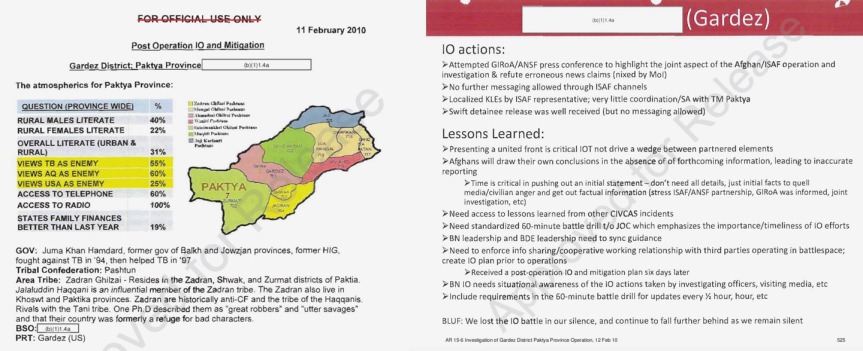
I want to focus on a piece of evidence that Scahill obtained: the U.S. military’s evaluation of the Afghan province and its after-action report about the failure of its IO (information operations) “battle.” Here is the document in question:
First, I want to focus on the BLUF at the bottom right. In the Army, it stands for bottom line up front. Most senior commanders will read this first; in some cases, the BLUF will be all they read (and remember). What does the BLUF conclude?
It says the US military “lost the IO battle in our silence,” and that it’s only getting worse as the military remains silent. It sounds vaguely reassuring: at least the military realizes it bungled the “information operations” job. But it’s a bureaucratic message in bureaucratic language. It reduces the objective to winning the “information” war, which the military says it’s not winning because of poor coordination with Afghan and other forces, lack of responsiveness, and so on.
How about some honesty? Here’s my BLUF: The US military is losing because it often misidentifies the enemy and misunderstands the culture, leading to the deaths of innocents and the estrangement of even those Afghans who are initially open to American influence. And no matter how hard you try to spin those facts, you can’t hide that cold truth from the Afghan people. (You can hide it from the American people, but that’s another story.)
As General Stanley McChrystal himself said about Afghanistan in 2010: “We have shot an amazing number of [Afghan] people [often at checkpoints], but to my knowledge, none has ever proven to be a threat.”
Tell me again how you win “information operations” by shooting “an amazing number” of innocent people?
I want to focus on a second aspect of the US military’s document from Scahill’s article: the illusion of data substituting for real knowledge. Here’s the document again:
Look at the left column. It has “atmospherics” for the province, to include percentages for literacy, support for the Taliban and Al Qaeda (as if those are fixed in place), access to radio and telephone, and so on. Is this knowledge? Or a masquerade for it?
Interestingly, a quarter of the people are viewed as hostile to the USA. One assumes this percentage went up significantly after the raid in question.
My point is these maps and charts and slides give an illusion of data-driven competence, but when you read Scahill’s article, you realize American forces were totally ignorant of basic Afghan customs, such as rituals to prepare bodies for burial. That ignorance seems to have driven the initial confused and inaccurate account of honor killings of females, an account that was repeated widely (and wrongly) in the Western media.
Another minor yet telling point: An unnamed Ph.D. describes some of the Afghan peoples of the region as “great robbers” and “utter savages.” Think about how that description would color the attitudes of US troops assigned to the region. “Here we go, men. Time to kill us some robbers and savages.”
Scahill’s article and the document he provides is a microcosm of the wider failure of US operations in Afghanistan. The war, already in its 15th year, promises to be never-ending unless and until the US finally withdraws. In a profile not of courage but of pusillanimity, Obama has punted the decision to the next president, which doubtless means another 2-4 years of war, mistakes and misunderstandings and more deaths of innocents included.
Andrew Bacevich has a new article at TomDispatch.com in which he highlights the bankruptcy of US strategy in the Greater Middle East. Here’s an excerpt: “We have it on highest authority: the recent killing of Taliban leader Mullah Akhtar Muhammad Mansour by a U.S. drone strike in Pakistan marks ‘an important milestone.’ So the president of the United States has declared, with that claim duly echoed and implicitly endorsed by media commentary — the New York Times reporting, for example, that Mansour’s death leaves the Taliban leadership ‘shocked’ and ‘shaken.’
“But a question remains: A milestone toward what exactly?
“Toward victory? Peace? Reconciliation? At the very least, toward the prospect of the violence abating? Merely posing the question is to imply that U.S. military efforts in Afghanistan and elsewhere in the Islamic world serve some larger purpose.
“Yet for years now that has not been the case. The assassination of Mansour instead joins a long list of previous milestones, turning points, and landmarks briefly heralded as significant achievements only to prove much less than advertised.”
He concludes this way: “Try this thought experiment. Imagine the opposing candidates in a presidential campaign each refusing to accept war as the new normal. Imagine them actually taking stock of the broader fight that’s been ongoing for decades now. Imagine them offering alternatives to armed conflicts that just drag on and on. Now that would be a milestone.”
But we won’t be seeing that milestone. Why? One word: hubris. Like a bunch of bad actors, US leaders will continue to hog the world stage, hamming it up even as they bomb (pun intended). No matter what, they can’t vacate the stage until they’re thrown off of it. They are as delusional as Gloria Swanson in “Sunset Boulevard,” but without her style.
Like Gloria Swanson in “Sunset Boulevard,” Our Hubristic Leaders Are Always Ready for their Close-up
W.J. Astore
When Hannah Arendt, the famous German-American political philosopher, criticized American involvement in the Vietnam War, she said that our foreign policy “experts” fell prey to using excessive means to achieve minor aims in a region of marginal interest to the United States. You could say the same of most of America’s foreign interventions since 1945. We are a superpower with a boundless propensity for meddling in world affairs. We waste enormous amounts of money and resources intervening in areas that are of marginal importance to our national security.
There are many reasons for these wasteful interventions, of course. The military-industrial-Congressional complex plays its role. Presidents love to intervene as a sign of “strength.” Natural resources, especially oil, are usually in play. The usual motives, in short: profit, power, greed.
Nuclear proliferation and global warming are two big issues that Donald Trump is wrong about. They’re also the two biggest threats to our planet. Nuclear war followed by nuclear winter could end most life on earth within a matter of weeks or months. Global warming/climate change, though not as immediate a threat as nuclear war and its fallout, is inexorably leading to a more dangerous and less hospitable planet for our children and their children.
What does “The Donald” believe? On nuclear proliferation, which only makes nuclear war more likely, Trump is essentially agnostic and even in favor of other nations joining the nuclear club, nations like Japan, South Korea, even Saudi Arabia. When all countries should be earnestly working to reduce and then eliminate nuclear stockpiles, Trump is advocating their expansion. (An aside: recall in a previous debate that Trump had no idea what America’s nuclear triad is; add intellectual sloth to his many sins.)
On global warming, Trump is essentially a skeptic on whether it exists (“hoax” and “con job” are expressions of choice), even as he seeks to protect his resorts from its effects. Along with this rank hypocrisy, Trump is advocating an energy plan that is vintage 1980, calling for more burning of fossil fuels, more drilling and digging, more pipelines, as if fossil fuel consumption was totally benign to the environment and to human health.
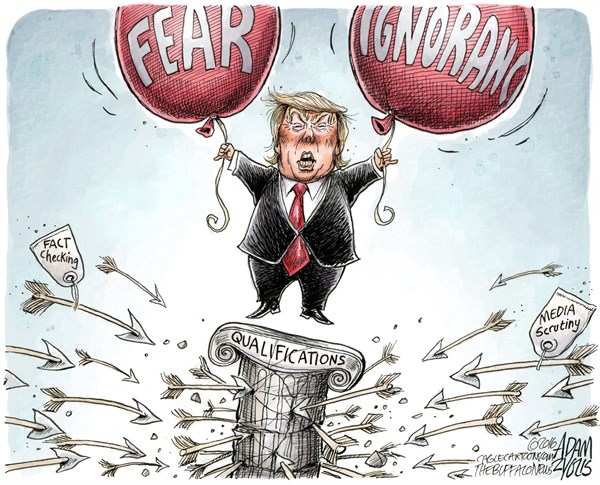
Along with his tyrannical and fascist tendencies, Trump is wrong on two of the biggest issues facing our planet today. His ignorance and recklessness render him totally unfit to be president.
My dad was in the Army in World War II. He was a dental technician in an armored headquarters group and never went overseas. But many of his friends did go overseas and saw combat. What follows are some excerpts from letters sent to my dad.
Bill Zerby was attached to the 781 Tank Battalion, 7th Army, in France and Germany. In December 1944, just before the Battle of the Bulge, Zerby wrote to my dad that:
“Here we have plenty of mud and rain and 24 hours a day the field artillery lays down a barrage with everything they have. The outfit is making out pretty well so far. One good thing these boys don’t believe in taking prisoners…. We all live in houses and have lanterns for lights. Everything is blacked out at 5 P.M. till dawn.”