Creator of Bracing Views. Contributor to TomDispatch, Truthout, HNN, Alternet, Huffington Post, Antiwar, and other sites. Retired AF lieutenant colonel and professor of history. Senior fellow, Eisenhower Media Network
The U.S. Empire, Thrashing and Lashing Out as It Declines
President Donald Trump has promised to bomb Yemen for a “long time.” Trump is a real president now. Presidents become “real” when they bomb something. Remember how Trump was praised by the U.S. mainstream media when he launched missiles against Syria in 2017?
Back in 2017, I wrote this: The launch of 59 expensive cruise missiles against a Syrian airfield did little to change the actions of the Assad government. Nor did it knockout the airfield. Yet it was spun by Trump as a remarkable victory. In his words, “We’ve just fired 59 missiles, all of which hit, by the way, unbelievable, from, you know, hundreds of miles away, all of which hit, amazing. It’s so incredible. It’s brilliant. It’s genius. Our technology, our equipment, is better than anybody by a factor of five. I mean look, we have, in terms of technology, nobody can even come close to competing.”
“Only we can bomb it” should replace “In God we trust” as the U.S. national motto.
America’s best and brightest (who were never quite that) have become the worst and dimmest. And that’s true whether the president is blue or red, Biden or Trump. The problem is our “leaders” have no moral principles. No integrity. No sense of right and wrong. They’re all about power and sending “messages” through bombing. Or sending tons and tons of bombs to Israel so that the Zionists can send “messages” to the Palestinians. The main message: begone or be dead.
Even as our “leaders” do this, they seek to solidify a mythic history of the U.S. (see video above) where America is exceptional in its rightness and where they (the leaders) are the ones who grant us our rights (such as freedom of speech) when these rights are inalienable. Indeed, rather than protecting our rights, they want to control them, limit them, and make them obedient and subservient to power.
Rulers’ ideas rule. And our rulers’ ideas are increasingly toxic.
With democracy already deeply compromised in America, we’re witnessing and experiencing the thrashing and lashing out of a declining American empire, not only externally but in the “homeland.”
The so-called SignalGate scandal centered on the bombing of Yemen is highly revelatory. First, some resources. CNN has a useful annotated account of the chats exchanged at the highest levels of the Trump administration. At their respective Substacks, Lenny Broytman and Caitlin Johnstone have telling dissections of these chats as well. At Jacobin, Branko Marcetic has an important article that reminds us of the illegality of the attacks. As the article’s subheading puts it: The press [mainstream media] is mostly framing the Yemen group chat scandal as a story of incompetence. There’s little attention being paid to the deadliness, illegality, and ineffectiveness of the strikes themselves.
To me, among the most telling “chats” came from Secretary of Defense Pete Hegseth. It highlights the “exceptional” nature of America:
*****
Pete Hegseth to Vice President JD Vance: I fully share your loathing of European free-loading. It’s PATHETIC.
But Mike [Waltz, the National Security Adviser] is correct, we are the only ones on the planet (on our side of the ledger) who can do this. Nobody else even close. Question is timing…
*****
This is precisely the problem for America since the Vietnam War, if not before then. We’ve created a monster military, a “global strike” force, that is capable of destroying any target anywhere around the globe. “Nobody else even close,” SecDef Hegseth correctly says. And because we can do it, because we are exceptional in military force, our leaders believe we should do it, even if it’s only to send a “message” to the world how tough we are, how committed we are to killing others.
Other countries—like those “free-loading” European ones—are PATHETIC because they don’t have America’s military might. Only we can smite evildoers around the globe, only we can do so while also arming Israel to the teeth and covering its flanks while it continues its annihilation of Gaza, and this is something we are immensely proud of.
My fellow Americans, this is not something to be proud of. Consider if America’s military in the 1960s had lacked the ability to deploy over half a million troops to Vietnam while also facing down the Warsaw Pact in Europe. Consider if America’s military had lacked the ability to invade Iraq in 2003 while also waging war in Afghanistan and garrisoning the globe with roughly 800 military bases. Consider how much blood would not have been spilled, and treasure wasted, if the U.S. military was smaller, focused on defense, and led by people who didn’t put muscle and flame emojis in their chats to celebrate U.S. military prowess at killing people in Yemen.
That U.S. military forces are the only ones who can kill globally with such comparative ease, that “nobody else even close,” is exactly what is wrong with our government. We place far too much faith and pride in military prowess, so much so that the Pentagon becomes the Pentagod, something we worship, something we make immense sacrifices to, as in budgets that approach $1 trillion yearly.
Not for nothing did President Dwight D. Eisenhower say in 1953 that this is no way of life at all—that we are crucifying ourselves on a cross of iron. Tell me again, who are the pathetic ones?
We must end our intoxication with military power before it ends us.
Officially, the U.S. has the DOD, the department of defense. But when was the last time the U.S. military was primarily oriented toward defense of the CONUS? (CONUS is a military acronym for continental United States.)
My old service, the U.S. Air Force, is far more open about its true aims. It boasts assertively of “global reach, global power” and notably of “global strike.” Not to be outdone, the U.S. Navy has “carrier strike groups,” what used to be termed carrier task forces when they fought real battles in World War II.
Here’s a recent official description: “A Carrier Strike Group (CSG) is a highly powerful, self-contained naval force, capable of projecting power globally, with an aircraft carrier as its core, supported by cruisers, destroyers, submarines, and an air wing, making it a formidable force capable of striking targets 1,000 miles away.”
Doesn’t sound defensive, does it? And of course the U.S. Marines are defined as “expeditionary” forces that are “forward-deployed” for all sorts of expected “contingencies” overseas.
The U.S. military is not about defense. It’s about “full-spectrum dominance.” That means dominance of the land, sea, air, space, cyber, information in all its forms, indeed just about any realm you can think of. No other military, moreover, divides the world into global commands (CENTCOM, AFRICOM, etc.) for the application of U.S. military power. This is not about defending America. It’s about dominating the world. Such a grandiose vision of defense dominance is partly what drives colossal Pentagon budgets that are climbing toward a trillion dollars a year.
SecDef Pete Hegseth, always talking warrior-tough (Doug Mills/NYT)
Consider here the recent kerfuffle about leaked U.S. strike plans for Yemen, which were inadvertently shared with the editor-in-chief at The Atlantic. Here’s an excerpt from those plans:
From Secretary of Defense Offense Pete Hegseth
“1215et: F-18s LAUNCH (1st strike package)”
“1345: ‘Trigger Based’ F-18 1st Strike Window Starts (Target Terrorist is @ his Known Location so SHOULD BE ON TIME – also, Strike Drones Launch (MQ-9s)”
“1410: More F-18s LAUNCH (2nd strike package)”
“1415: Strike Drones on Target (THIS IS WHEN THE FIRST BOMBS WILL DEFINITELY DROP, pending earlier ‘Trigger Based’ targets)”
Note the repetition of the word “strike” and the closing prayer to America’s “warriors.” And ask yourself: Is this truly what national defense should look like? Prayerful appeals to “warriors” as they strike weak and poor countries thousands of miles away in undeclared (and therefore unconstitutional) wars?
Coming soon to a Kindle store near you: all my articles for TomDispatch, with a new introduction by me and a foreword by Tom Engelhardt. You can preorder it by clicking on this link. Thanks!
Speaking of American militarism on steroids:
It’s been called the “House of War” by esteemed author James Carroll. Within the military, it’s jokingly referred to as the five-sided puzzle palace on the Potomac. It’s a monetary black hole that consumes eagerly and without bounds (in light of seven failed audits in a row) roughly a trillion dollars in yearly military expenditures. It’s a place where full-bird colonels, who should be leading regiments in the field, become errand boys and girls to a grossly inflated number of generals. Yes, it’s America’s very own Pentagon, built in record time in the early months of World War II to manage that colossal war—and never shuttered since because perpetual global war is very much fundamental to the American way of life.
If there’s a symbol of America that captures current and past governmental budgetary priorities and foreign policy commitments, it’s the Pentagon. Forget the Statue of Liberty. Never mind Freedom Towers and national parks and bald eagles and the like. Increasingly, the Pentagon is America, a highly militarized version of our country, which is precisely why it needs to be closed down. Where’s Elon Musk and the DOGE wunderkinds when you need them?
Nearly 30,000 people work in the Pentagon on a daily basis. It makes for some crowded parking lots—and cramped offices even for those aforementioned bird colonels. It’s a hotbed of intrigue and competition among the services for money and resources. It’s depressingly short on natural light. It’s a repository for hidebound thinking, a place where good ideas go to die. A line from the original “Star Wars” has been used more than once to describe it: “You will never find a more wretched hive of scum and villainy.”
And (again) it’s time to shut it down.
Here’s an idea to make the U.S. military far more efficient. Empty the Pentagon of all its worker-bees and from them create infantry battalions. An average battalion consists of roughly 800 “effectives,” so demobbing the Pentagon work force and mobilizing them instead for action in the field would create roughly 35 battalions. Send these battalions to all combat zones where U.S. troops are deployed today. Does Ukraine need more troops at the front? Does Israel need more stormtroopers in Gaza? We’ve got some Pentagon legions for you, Bibi.
Of course, I jest. I want to close the Pentagon to weaken militarism, not to wage war and genocide. Nevertheless, I’m guessing putting the entire Pentagon workforce at the point of the spear might serve to dull it a bit. Perhaps war boosterism might decrease if the cheerleaders were sent directly into the trenches instead of remaining safely on the sidelines?
A Pilot in the Cockpit Is a Major Win for My Old Service
Recent Air Force projects have not been entirely successful, to put it gently. The F-22 Raptor was never built in the quantities the Air Force desired, nor was the B-2 stealth bomber. The F-35 has proven to be a disappointment, an overpriced “Ferrari” by the Air Force’s own admission that spends too much time in the shop even as its price over time continues to soar. The less said about the KC-46 tanker the better, as its future remains very much up in the air (or stuck on the ground, leaking fuel).
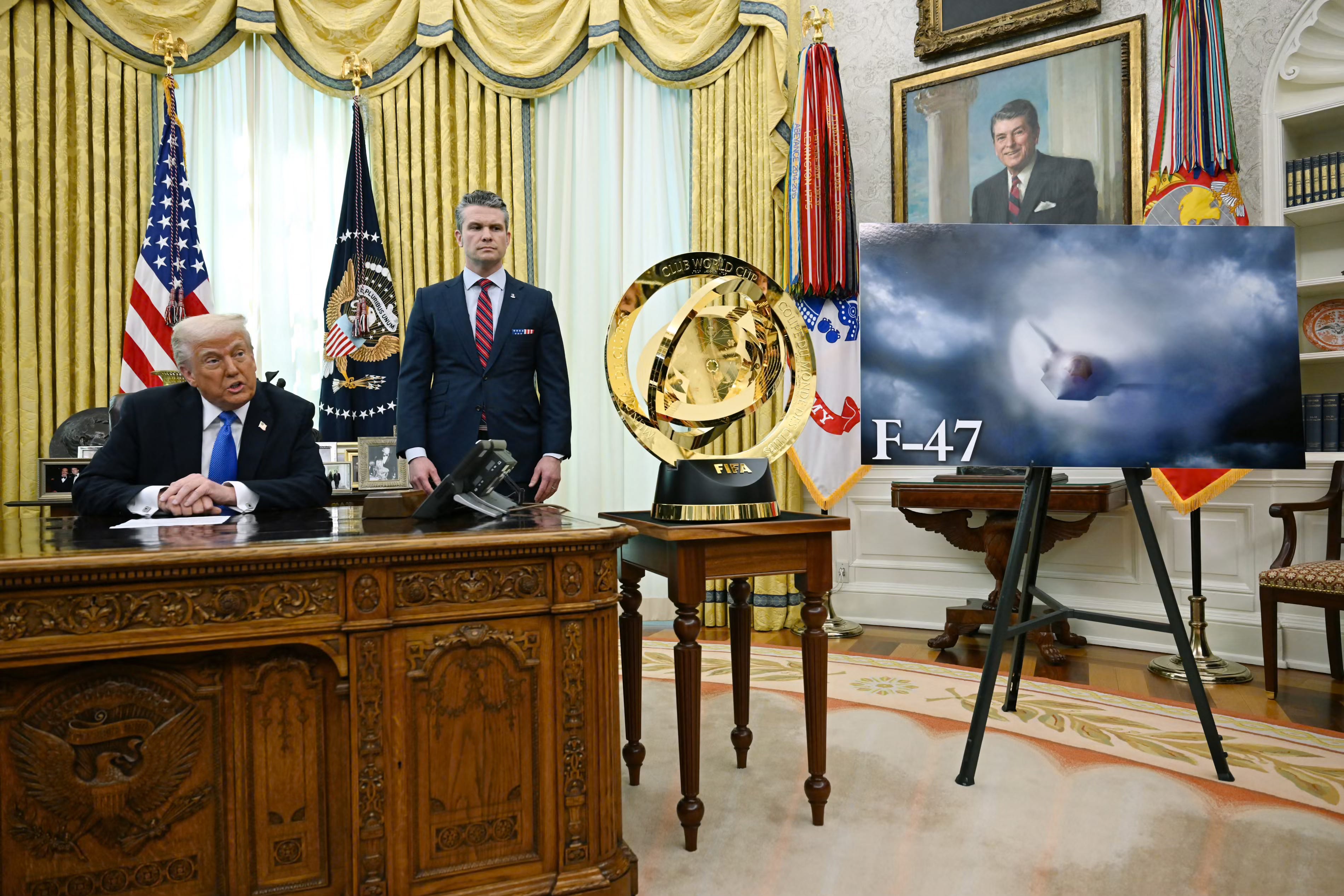
No worries. The Air Force and Boeing have been rewarded for their stellar performance with a new jet announced by President Trump yesterday, the F-47. (I don’t know what happened to the F-36 through 46 models.)
Look how badass that F-47 “bird” looks in that artist’s depiction!
Its key attribute, besides the usual hype about stealth and ultra-powerful engines and super-sensors and the like, is that it’s got a human pilot in the cockpit. This wasn’t a foregone conclusion, given Elon Musk’s belief in drones, whether fully automated or flown by pilots on the ground, at a distance. Keeping men and women in the cockpit was, is, and will always remain the most important goal of the Air Force, built as it is around the allure of pilots as masters of the air.
An interesting feature of this “6th generation” program is that the pilot will allegedly be able to control autonomous drones acting as “loyal wingmen” to the piloted F-47. That complexity should add scores of billions to the eventual price tag.
Trump always likes to boast that stealth planes like the proposed F-47, which have a low RCS, or radar cross section, will literally be invisible. The enemy will never see the F-47 coming, Trump said, jumping on board the hype train. Meanwhile, Boeing, the main contractor for the F-47, is already reaping rewards as its stock price has climbed at Mach 2 in the aftermath of Trump’s announcement.
The initial budget request of $20 billion will soon rocket skyward as the usual cost overruns kick in their afterburners. The Air Force promises the F-47 will cost less than the F-22 per unit, but if you believe that, take a look at the rising costs of the B-2, or the F-35, or the KC-46.
America may be a shitstorm today, but no other country burns through money for needless warplanes than the great USA. You may have stellar bullet trains, China, but do you have invisible 6th generation air supremacy jets? I thought not. USA! USA!
I’ve been reading John Ketwig’s memoir “…and a hard rain fell: A GI’s true story of the War in Vietnam,” and it’s reminding me just how plain dumb, destructive, and duplicitous America’s wars have been since World War II.
America’s wars are always dressed up with a necessary, even allegedly noble, cause. In Vietnam, we had to stop communism and all those dominoes from falling. In Iraq, it was about WMD and stopping Saddam Hussein, “the next Hitler.” In Afghanistan, it was about vengeance for 9/11, then creating democracy and even helping women. (How about helping women in America? Never mind.)
Vietnam is nominally communist today—and a big trading partner of the U.S. and an ally of sorts against China. No dominoes fell. Iraq didn’t have WMD and Saddam wasn’t the next Hitler; he was merely a regional strongman and a former U.S. ally who got a little too big for his britches, especially for Israel. Afghanistan was a war in search of a clear mission and attainable goals. After twenty years of effort and roughly $2 trillion in expenditures, the U.S. replaced the Taliban with—the Taliban. (I heard Norman Finkelstein say this first.)
We’re always told versions of the same lie: We need to fight them over there so that we don’t have to fight them here. Communism had to be rolled back in Vietnam else commies would be landing in Manhattan. Iraq had to be pummeled and Saddam overthrown before WMD landed in Boston. Afghanistan had to be pacified and modernized before the Taliban enforced conservative Sharia law in Biloxi.
None of this was true. The United States would have been perfectly safe without committing any troops to Vietnam, Iraq, and Afghanistan. In fact, the U.S. would have been far better off if those wars had never been fought. Certainly Vietnam, Iraq, and Afghanistan would have been far better off if they’d never become free-fire zones for American munitions (including the poisonous Agent Orange in Vietnam and, more recently, depleted uranium and other poisons in Iraq and Afghanistan).
Now we’re hearing about a possible U.S. war with Iran, allegedly to stop that country from acquiring an atomic bomb. It’s OK for the U.S. to have more than 5000 nuclear warheads and for Israel to have 200 or so, but it’s not OK for Iran to have even one, because reasons.
The U.S. military, vast as it is, with a vision of global dominance, always needs enemies. Of course, it’s not simply the military but the whole military-industrial complex, the MICIMATT,* which needs war and conflict to sustain itself.
I recently read “American War,” a powerful novel by Omar El Akkad. It imagines a second U.S. civil war starting roughly 50 years from now. It’s a fascinating book, well worth reading because it captures the horror of war, with all its atrocities, its massacres, its war crimes, and the deep wounds war leaves behind even among the most resolute survivors. John Ketwig’s book does the same as he recounts the fears and horrors of his year in Vietnam and the personal struggles he endured in coming to terms with what he’d seen and endured.
So, count me among those who are already against the next war, whether against Iran, China, or for that matter any other country. Sure, I think America needs to defend itself; I don’t think peace is going to break out spontaneously around the world; but I know for a fact that fighting constant wars is not a way toward greater peace and prosperity. Quite the opposite.
If you want to know what desperate and profoundly wounded war survivors are capable of, read “American War.” If you want to know what desperate and profoundly confused troops are capable of, read “…and a hard rain fell.” And ponder the continued propaganda here of the “good war,” the wonders of warriors and warfighters, and the repetition of slogans like “peace through strength,” a specific form of strength measured in kilotons and megatons of explosives, in massive body counts and military production figures.
Ask yourself: Is that “strength”? Are constant wars truly the path toward peace? How can we possibly be so dumb as to believe this?
MICIMATT: military-industrial-congressional-intelligence-media-academe-think-tank complex. It employs millions of people and spends more than a trillion dollars a year. It’s not easily confronted. Nor is it easily contained, let alone curtailed.
Yesterday, I awoke to grim news that Israel is bombing Gaza yet again, killing a few hundred people, even as the U.S. targets Yemen with “precision” bombs and strikes, apparently to intimidate Iran as well—and perhaps to provoke a war, as Israeli jets escort U.S. B-52 bombers in “exercises.”
War is in the news, incessantly, with Congress sidelined and feckless as usual.
The constant drumbeat of war—the never-ending concussion of bombs in the Middle East—put me to mind of Orwell’s 1984. Nothing favors authoritarian states more than a constant state of war. If you truly want to weaken the Trump administration, reject their “warrior” and “war fighting” rhetoric and their selling of “peace through strength,” by which they mean peace through bombing and killing. Some “peace,” right? They may as well go full Orwell and declare that “war is peace” while making the Pentagon the “Ministry of Peace.”
Speaking of Orwell, and needing a break from death and mayhem, I remembered this piece that I wrote in 2018. Citizens, you had best police not only your words and actions, but the faces you make as well, especially when our Dear Leader is talking.
Written in September 2018
Facecrime!
W.J. Astore
We’re truly living in Orwellian times. A 17-year-old high school student, now known as #plaidshirtguy due to his choice of wardrobe, was removed from a Trump rally in Montana because of the faces he was making as Trump spoke. You can read all about here, and watch an interview with him at CNN.
Not surprisingly, people who stand behind Trump are selected ahead of time and told to clap and cheer. This young man did that, but he also chose to look quizzical, skeptical, and bemused at times. This is not allowed! A Trump staffer eventually intervened to remove him from the audience due to his “face crime.” To make matters worse, he was then held by the Secret Service for ten minutes, after which he was asked to leave the event.
Leave the event? For making skeptical and quizzical facial expressions?
You may recall from George Orwell’s “1984” that “Facecrime” existed. Anyone making skeptical or otherwise unacceptable faces when the Party announced bogus victories, production figures, and so forth opened himself or herself up to serious punishment.
Thanks to plaid shirt guy, we now know that facecrime has come to America. Just remember, fellow citizens, always to smile and cheer in the presence of Our Dear Leader. Unless you want to be detained and sent away — perhaps next time to the cornfield.
*From my copy of “1984”: “In any case, to wear an improper expression on your face (to look incredulous when a victory was announced, for example) was itself a punishable offense. There was even a word for it in Newspeak: facecrime, it was called.” (From the end of Chapter 5.)
Forget about peace or reductions to military spending
According to an NBC News poll, America is rooting for Ukraine but Trump prefers Russia. Seriously. That’s the gist of the headline.
The intent of this poll wasn’t to analyze how Americans think about the Russia-Ukraine War or Trump or military strength. It was to control how they think by giving them only the most constrained choices.
Let’s take a close look at the results and the NBC headline. According to NBC News:
When asked where they believe Trump’s sympathies are, 49% choose Russia, 40% say they think Trump favors neither side, and 8% choose Ukraine. Another 3% say they are not sure.
So, a majority of Americans, 51%, believe Trump is either carefully neutral on the war, a Ukraine supporter, or they don’t know. A minority (49%) believes he sympathizes with Russia. But the headline says Americans believe “Trump prefers Russia.”
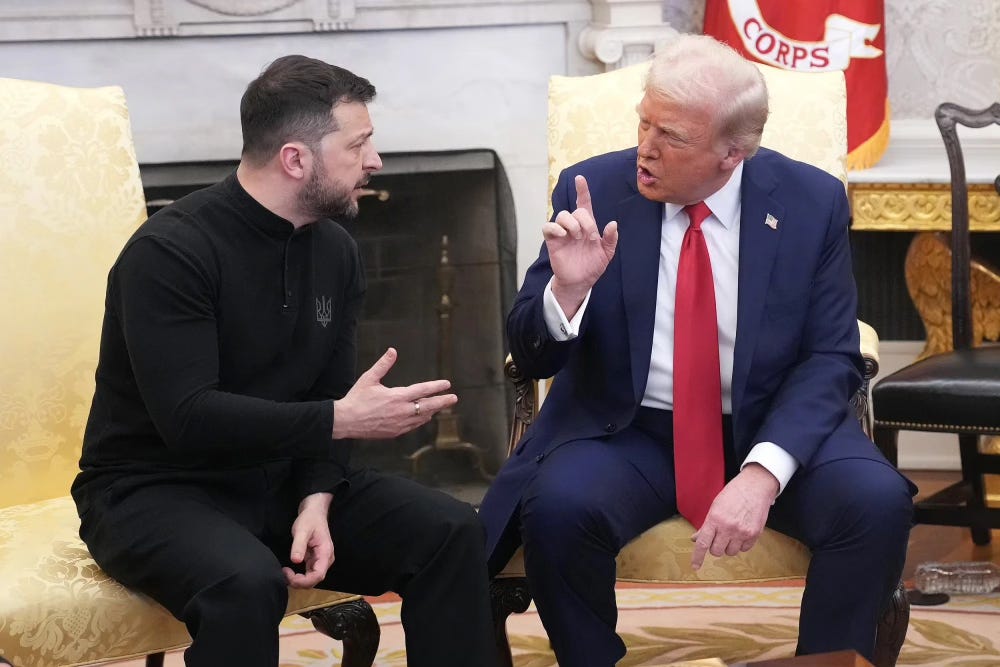
The photo that accompanies the NBC article shows Trump lecturing Zelensky.
Interestingly, I see no question about whether the Russia-Ukraine War should end after three long and bloody years so that lives are saved, or whether the U.S. should stop sending billions in weaponry to Ukraine with virtually no oversight as to where the weapons end up.
Further on, Americans are asked whether we should focus more on domestic affairs or whether we haven’t been strong enough globally. A majority of Americans believe we should focus on domestic affairs. But note how there’s no choice given for opposing war and preferring peace. Americans aren’t asked if they think the government is relying too much on military force. You have only two options: focus more at home, or strengthen the U.S. position abroad.
Interestingly, it’s Democrats who are most concerned with strengthening America’s position abroad, with nearly six out of ten taking this position, whereas six out of ten Republicans want to focus on domestic affairs. That is a remarkable result, as Democrats have supplanted Republicans as the party of military interventionism and “strength.”
Again, NBC didn’t bother to ask directly whether Americans would prefer peace and substantial reductions to military spending. You are not supposed to have those preferences, so you’re not asked about them.
The bottom line of this poll and article is simple: Real Americans support Ukraine. Only 2% of Americans support Russia. Trump is overly sympathetic to Russia.
Apparently, real Americans can’t support peace nor are they allowed to consider significant reductions to spending on wars and weapons. To do so would be un-American, or so NBC News seems to suggest.
As a retired U.S. military officer, I’m appalled at the notion of “peace through strength.” You may as well say “war is peace.” Peace is achieved through dialogue. Diplomacy. Engagement. A spirit of good will. It isn’t achieved by brandishing weapons while selling the same around the globe. (The U.S. dominates the global arms trade, accounting for nearly half of it.)
I’m also outraged by the ongoing militarism of this moment, whether it’s Kamala Harris celebrating military lethality and embracing the Cheneys in 2024 or the Trump crowd that embraces “warriors” and “warfighters.” The solemn tradition of the citizen-soldier has long been abandoned in the U.S., replaced as it has been by a mercenary mindset that sees war as permanent and therefore “normal,” even admirable.
Even as we’re essentially being told and sold “war is peace,” we’re also being told and sold that ethnic cleansing in Gaza is urban renewal, a prelude to a new Riviera, a new playground for the rich, even if it’s erected on the bones of millions of Palestinians. Obviously, this cleansing of genocide using the imagery of crass and vulgar tourism must be condemned in no uncertain terms.
Put colloquially, I often wonder, Dude, where’s my country?
Explore Gaza, by Mr. Fish (at Chris Hedges’ Substack)
Remember in February of 2021 when Democrats said they were going to raise the federal minimum wage to $15 an hour? That raise would have lifted nearly a million workers out of poverty while placing Democrats firmly on the side of working-class Americans.
You may recall the “Senate Parliamentarian,” an obscure official, ruled that the pay raise couldn’t be included in the proposed bill, a decision that Democrats said they oh-so-reluctantly respected. And so the federal minimum wage still sits at $7.25 an hour (the last time it was raised was in 2009).
Vice President Kamala Harris, presiding over the Senate, could have simply overruled the Parliamentarian, but she and the Biden administration chose not to.
Think about that. Biden/Harris ran on a platform of raising that wage to $15. Biden himself promised it and promoted it. But when push came to shove, they didn’t shove, nor did they even push. They just caved to their corporate overlords.
A counterfactual: What if the Democrats had done what they’d promised? What if Harris had run in 2024 on a proven record of delivering higher wages to workers? What if she’d said she was going to raise it even higher, say to $20 an hour, when she became president? My guess is that she would have fared far better with workers and may in fact have won the election.
Elections have consequences, Democrats like to say. So too does a broken promise.








 Bracing Views