

Kakistocracy at the Department of War
MAR 27, 2026
I was reading an article today about Pete Hegseth, self-styled Secretary of War, and his decision to remove four officers from the Brigadier General-select list. Turns out the four officers were either Black or female, but I’m sure that was a coincidence.
Anyhow, the article referenced this pearl of wisdom from Hegseth from last September:
“The leaders who created the woke department have already driven out too many hard chargers. We reverse that trend right now.”
For those of you who don’t know military jargon, “hard charger” is a term of approval. And that’s been Trump and Hegseth’s approach to war with Iran. Call it the bull in the china shop approach. Charge in hard, kill people, break things. Drop enough bombs, kill enough people, and obviously victory must follow.
Hard chargers are what we want in this man’s military, so might Pete Hegseth say. I’ve heard Hegseth’s nickname at the Pentagon is “Dumb McNamara,” apparently for his slicked-back hair together with his, well, lack of intelligence. (Robert McNamara was Secretary of Defense during the disastrous Vietnam War.)
Of course, the military needs its share of Type A, Can-do, mission-driven, hard charging men and women. It also needs its share of skilled, knowledgeable, and smart people as well. And there’s nothing that says that a “hard charger” can’t also be a thinker, especially as that can-do type learns from experience that not every problem can be solved with bullets and bombs.
Deep thinkers are especially needed at strategic levels, else wars go nowhere and are quickly lost. One thing is certain: the so-called Department of War isn’t being led by a deep thinker.
Hegseth, surely a leading member of the kakistocracy, prefers pushups to planning and bombs to diplomacy. He’ll keep charging hard, or, more accurately, he’ll order others to charge hard into harm’s way, all in a quest to drive out “wokeness” and win wars through maximum violence and minimal thought.
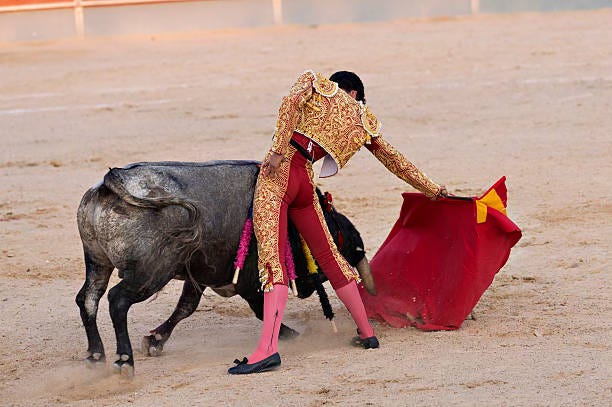
Any enemy wanting to fool Pete Hegseth should invest in a red cape and start waving it smartly.
 Bracing Views
[From my entry on the Substack version]
The included picture of the toreador is of the “worth a thousand words” variety in this context. Kakistocracy should now also become part of the vernacular.
Despite the virtues, even necessities, of the deep thinkers being laid out here, nonetheless they are not the ones to advance to the top echelons of military command. It’s just the way the game is rigged. And hard charges need not just be operational, combat types – they are also found, even more numerous, in “project managing” grossly expensive, poorly performing “weapons systems,” just two examples being the F-35 and the LCSs (Little Crappy Ships), although in the latter case it was the Navy that didn’t want them, or so many of them, after it was found out how truly crappy they were. They then became the product of the MICIMATT-SH, and, well, what more need be said?
Getting back to that top echelon, current Chair of the Joint Chiefs of Staff is General Dan Caine, since April 11, 2025. Undoubtedly I’m sitting on a very high horse, as there’s virtually the certainty I would not have had the courage, for him to do in his statements with Trump at the start of the attack on Iran what Colin Powell said at the UN before the Dumbya’s attack on Iraq: “I’m not reading this crap. I resign.” In each case then we would have had more of the much needed deep, and moral, thinker than exemplar of the go-along-to-get-along type. Again, I’m on a high horse, but it’s not as if without precedent. General Eric Shinseki who, among other things, was Army Chief of Staff.
[From Wikipedia] “Shinseki publicly clashed with Secretary of Defense Donald Rumsfeld during the planning of the war in Iraq over how many troops the United States would need to keep in Iraq for the postwar occupation of that country. As Army Chief of Staff, Shinseki testified to the United States Senate Committee on Armed Services on 25 February 2003, that ‘something in the order of several hundred thousand soldiers’ would probably be required for postwar Iraq. This was an estimate far higher than the figure being proposed by Secretary Rumsfeld in his invasion plan, and it was rejected in strong language by both Rumsfeld and his Deputy Secretary of Defense, Paul Wolfowitz, who was another chief planner of the invasion and occupation… When the insurgency took hold in postwar Iraq, Shinseki’s comments and their public rejection by the civilian leadership were often cited by those who felt the Bush administration deployed too few troops to Iraq. On 15 November 2006, in testimony before Congress, CENTCOM Commander General John Abizaid said that Shinseki had been correct that more troops were needed.”
LikeLike