

Serious Conflicts of Interest for America’s War Salesmen and Cheerleaders
MAR 14, 2026
Back in 2008, I wrote an article for Neiman Watchdog calling for war salesmen and cheerleaders on the mainstream media to be replaced. Of course, nothing of the sort happened, and today I saw a new article by Ken Klippenstein: “The TV Generals Have Something to Sell You About Iran,” and that something is war and more war (and weapons too).
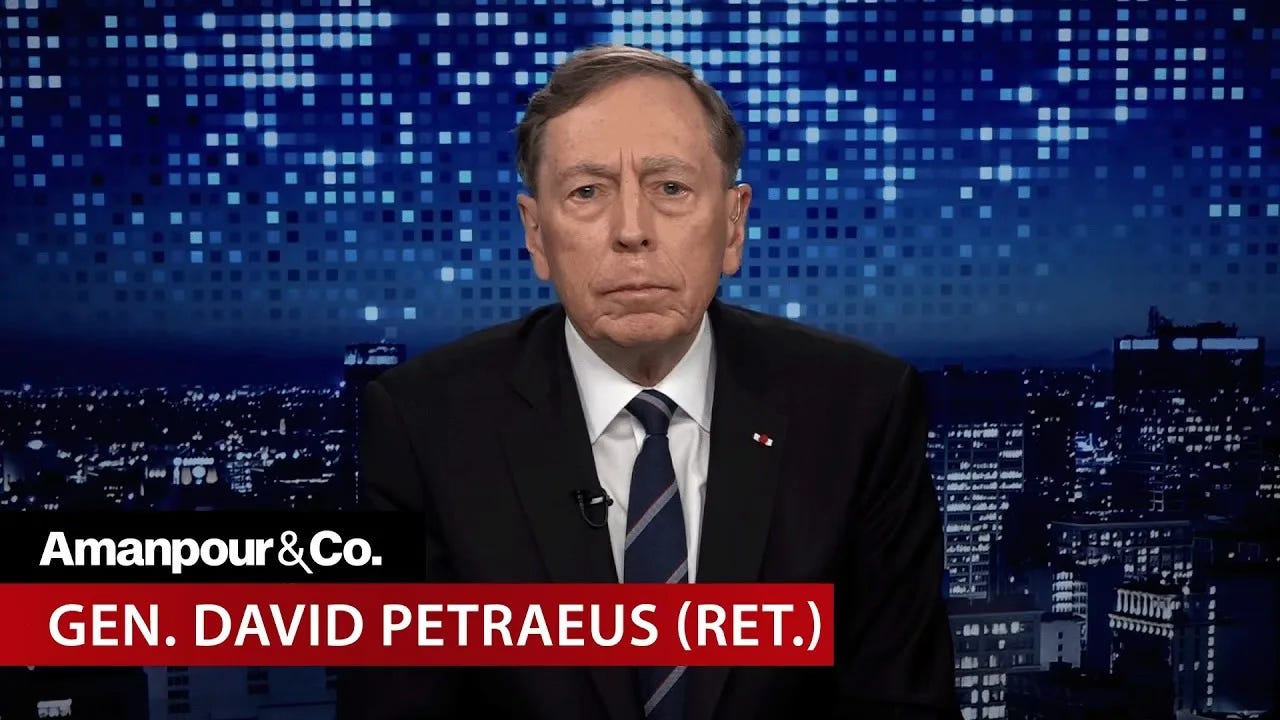
In the article, Klippenstein has a great line about retired general David Petraeus: “Can anyone fit more stars up their asses?” Clearly not.
Anyhow, here’s my article from 2008, unchanged because the dynamic of TV and cable networks using retired senior military officers to sell wars and weapons also remains unchanged.
Networks should replace Pentagon cheerleaders with independent military analysts
COMMENTARY| December 04, 2008
Even without special Pentagon briefings and corrupting financial relationships, former top military brass simply are too conflicted to be relied upon for tough-minded analysis, writes a former Air Force officer.
By William J. Astore
Media outlets must develop their own, independent, military analysts, ones not beholden to the military-industrial complex, ones whose very sense of self is not defined, nourished, and sustained by the U.S. military.
In separate exposés in The New York Times (April 20 and November 30), David Barstow showed how major media outlets came to rely on retired generals like Barry McCaffrey for analysis. Predictably, many of these men (they were all men) continued as paid advisors to defense contractors even as they appeared on TV. They also often accepted favors from the Pentagon, to include special, often classified, briefings; overseas junkets; and, most valuable of all, access to the Office of the Secretary of Defense.
But such influence-peddling and collusion are hardly surprising. Relying on high-ranking, retired military officers to serve as frank and disinterested critics is a bit like inviting Paul von Hindenburg, ex-Field Marshal of the German Army, to testify in 1919 on why his army lost World War I. You’ll get some interesting testimony — just don’t expect it to be critical or for that matter even true.
So why did the networks hire so many retired colonels and generals? Perhaps they followed a rationale analogous to that used in hiring retired professional athletes to cover sports — to provide hard-earned, technical commentary, leavened with occasional anecdotes.
But in the “forever war” in which we became engaged, these retired military officers soon provided not just the color commentary but the play-by-play. And network anchors, lacking first-hand military experience, were reduced to bobble-heads, nodding in respectful agreement.
But war is not a sport. Nor should we cover it as such. We need tough-minded military analysts, not “Team America” boosters and Pentagon spin-meisters.
Why Relying on Senior Military Officers Is Wrongheaded
Our media’s concept of relying on retired senior colonels and generals for frank and unbiased analysis was deeply flawed from the beginning. Let’s consider five facets to the problem:
- Despite their civilian coat-and-tie camouflage, these officers are not ex-generals and ex-colonels: they are retired generals and colonels. They still carry their rank; they still wear the uniform at military functions; they’re still deferentially called “sir” by the rank-and-file. They enjoy constant reminders of their privileged military status. It’s not that these men over-identify with the U.S. military — they are the military.
- The senior colonels and generals I’ve known despise Monday-morning quarterbacks. Loath to criticize commanders in the field, they tend to defer to the commander-in-chief. Putting on mufti doesn’t change this mindset. Rather than airing their most critical thoughts, they tend to keep them private, especially in cases where service loyalty is perceived to be involved.
- Military officers are especially averse to airing criticism if they perceive it might undermine troop morale in the field. Related to this is the belief that “negative” media criticism led to America’s defeat in Vietnam, the hoary but nevertheless powerful “stab-in-the-back” myth. Thus, these men see Pentagon boosterism as a service to the nation — one that they believe is desperately needed to redress the balance of negatively-charged, “liberal,” anti-war coverage.
- Paradoxically, that the “War on Terror” has gone badly is a reason why some retired military officers believe we can’tafford serious criticism. If you believe the war can and must be won, as most of them do, you may suppress your own doubts, fearing that, if you air them, you’ll be responsible for tipping the balance in favor of the enemy.
- The fifth, perhaps most telling, reason why networks should not rely on retired colonels and generals is that it’s extremely difficult for anyone, let alone a die-hard military man, to criticize our military because such criticism is taken so personally by so many Americans. When you criticize the military, even abstractly, people hear you attacking Johnny or Suzy — their son or daughter, or the boy or girl next door, who selflessly enlisted to defend America. Who wants to hear that Johnny or Suzy may possibly be fighting (even dying) for a mistake? And, assuming he believed it, what senior military man wants to appear on TV to pass along thatmessage to America’s mothers and fathers?
The Next Step
It’s not that retired colonels and generals lack integrity [well, some do, I’d add in 2026], but they are often deeply conflicted and lacking in self-awareness. And you certainly can’t profess to be an objective media analyst while representing contractors vying for funding from the Pentagon.
So what should the media do? Since it will take time for networks to develop their own corps of independent military analysts, they should consider hiring junior officers and NCOs, with recent combat experience, who have left the military after a few years of honorable service. Civilian military historians could also provide critical commentary. Even foreign military officers might be queried; at least they need not worry about their patriotism being impugned each time they hazard a criticism of the Pentagon.
French premier Georges Clemenceau famously noted that “War is too important to be left to generals.” So too is the TV and cable networks’ analysis of our wars.
*****
Quick comment in 2026: I wasn’t critical enough in 2008. Some of these “cheerleaders” are shameless sales- and pitchmen who are profiting from war.
 Bracing Views
[From my entry on Substack]
First, pardon the length. I too subscribe to Ken Klippenstein, he does a top notch job, I saw the headline to that piece you refer to and meant to get to it, but I sometimes get overloaded with my news feeds. With the one line from him on Patraeus maybe all I need do now is to give it a quick read.
Eighteen(!) years ago you wrote this. Wish I had been more attuned to things back then, although was well on the way given the stench of Dumbya still in the air. More to the present, specifically since Oct. 7th, I have become increasingly, imperatively more skeptical and distrustful of America mainstream journalism regardless of its medium, instead finding perceptive news, analysis, and commentary from sources such as this, Drop Site News, Breaking the Grip of Zionism, Electronic Intifada… (you can see how I get overloaded). It all comes under the overarching issue of a democracy, in order to function, requires an informed citizenry served not only by a free, but I would add an enterprising press (journalism) whose first obligation is “to seek the truth, and report it” as the first tenet of the Code of Ethics of the Society of Professional Journalists calls for, which then leads to “holding the powerful accountable.”
We don’t have that, at least not to the extent necessary, in this society, Herman & Chomsky’s “Manufacturing Consent” one, if not “the” reason why. And with the decimation of local news reporting; the example of moguls like Bezos and the Washington Post; the infiltration if not outright takeover of national newspaper and broadcast news sources by Zionist interests such as the Ellisons; and other forces blending – or subverting – news to entertainment, democracy stands to fail.
I have had, or have tried to have, contact with I think to be a decent reporter at the Boston Globe, as well as with a media watchdog and professor of journalism at Northeasthern University. In general I have found the questions and issues I have raised, I think direct and reasonable, have gone either ignored, or met with a “yes, but that’s a familiar criticism, don’t care to spend any more time on it” response. Really? If it’s familiar, and yet repeats, doesn’t that mean it should be called out, so that maybe it doesn’t repeat?
Taking this a bit further… Continuing education (CE) is familiar in many professions, in some such as medicines a requirement for continued license to practice. I don’t know, and highly doubt, whether such exists in journalism. Yet it should. I first noticed the Globe reporter for a decent, and rather revelatory, article he did relating to antisemitism. In subsequent e-mail exchanges with him I asked if was familiar with the “hasbara” strategy. Replied that he wasn’t. Which left me gobsmacked. How could journalists not be aware of one of the major forces shaping the way news is portrayed and then disseminated throughout society? It’s somewhat akin to not having advisories from the CDC on salmonella outbreaks or what the flu season will be like (okay, the besieged, dismantled CDC may not be such a great example, but you get the gist).
And as to the professor of journalism, he’s a regular on “Beat the Press,” once a staple on a Boston PBS station, then axed and moved online. I follow it fairly regularly, but I have yet to detect any discussion of the media and retired military brass. Does that mean that Eisenhower’s warning is only regarded as a historical footnote from 1961, to say nothing of presenting to the public that what Eisenhower was describing back then has morphed into the more pervasive, insidious MICIMATT-SH? A simple online search, not even bothering with AI, promptly led to this from https://thefreethoughtproject.com/the-state/pr-budget-penagon-war-propaganda:
• “60% of the US Govt’s Billion Dollar PR Budget Goes to the Pentagon to Sell You War — And It’s Working”
• In the latest report on Public Relations Spending from the Government Accountability Office (GAO), the United States’ government PR apparatus has been revealed to spend over $1 billion annually — $626 million of which the Department of Defense allots to employ a massive propaganda army constituting roughly 40 percent of the more than 5,000-strong federal public relations workforce.
While some noteworthy analytical and investigative work is being done by mainstream journalism, overall I find that sphere of the profession to be too stuck on itself to deliver what the public is owed. That obligation has been ceded to sites such as this, and its retired military founder.
[With this further comment]
Here’s a comforting update from the NYT (updated 3-15-2026), “F.C.C. Chair Threatens to Revoke Broadcasters’ Licenses Over War Coverage.”
“Brendan Carr, the chairman of the Federal Communications Commission, threatened on Saturday to revoke broadcasters’ licenses over their coverage of the war with Iran, his latest move in a campaign to stomp out what he sees as liberal bias in broadcasts.”
LikeLiked by 1 person
No point in listening to the colonels/generals cheerleaders as they are being paid handsomely by the networks as well as receiving a hefty military pension. I immediately change the channel as soon as one appears. PS we certainly didn’t lose in Vietnam due to media coverage. We lost in Vietnam because is was an immoral war which we should have never gotten into.
LikeLiked by 1 person