News that President Trump may yet gain control over the Oregon National Guard despite the opposition of Oregon’s governor, mainly for the purpose of intimidating the City of Portland reminds us that our National Guard is worth protecting from power-hungry egotists scheming for war on enemies without and “within.”
In my home state of Massachusetts, I recently supported legislation to “Defend the Guard.” It seeks to prohibit the Massachusetts National Guard from being deployed into active combat without a formal declaration of war from the U.S. Congress.
Here’s the letter I wrote to “Defend the Guard.” There may be similar efforts in your home state; I urge you to support them.
Photo by Richard Cheek
*****
I’m a retired Air Force lieutenant colonel who grew up in Brockton. Members of the MA National Guard included my neighbors and members of my family.
Since 9/11/2001 and the AUMF that followed it, Guard units across the country have been deployed to overseas wars (Afghanistan and Iraq most notably) without Congressional Declarations of War. Guard units have further been deployed to faraway conflict zones such as Africa. They are deployed for months at a time for missions unrelated to the defense of the United States. Hardships to Guard members and their families are considerable.
During the War on Terror, more than 40% of U.S. forces in Iraq and Afghanistan were Guard and Reserve units. Under Presidents Trump and Biden (2017-24), the bulk of U.S. forces in Syria and Iraq have often been National Guard units. Many state legislators do not know their NG units are deployed in this manner. Furthermore, those units are then unavailable to respond to local and state-wide disasters such as hurricanes, floods, wildfires, and other contingencies.
The bill before the Senate does not restrict the use of Guard units in a legal war declared by Congress. It does, however, protect the Guard from being abused by irresponsible leaders who refuse to obey and follow the U.S. Constitution, the law of the land. For that reason, I strongly support this bill.
Please vote “yes” to protect your family, friends, and neighbors who serve honorably and selflessly in the Guard here in Massachusetts. The Guard defends us—please help defend the Guard.
Thank you.
*****
The bill itself is still pending in the Massachusetts State Legislature.
America’s overseas wars, with all their capricious and vicious violence, have indeed come home. For decades, our leaders projected power abroad under the banner of fighting evil — whether Communism, terrorism, or tyranny. Yet in doing so, they helped cultivate an authoritarian mindset that has now turned inward. The “enemy” is no longer some distant foe in a foreign land; it is “the enemy within.” For Donald Trump, that means the mythical “radical left,” a variation of the 1950s fantasy that a Communist was hiding under every bed. The irony, of course, is that the real danger then, as now, comes not from a phantom leftist menace but from a radical right-wing movement willing to strip Americans of their rights in the false name of security, safety, and patriotism.
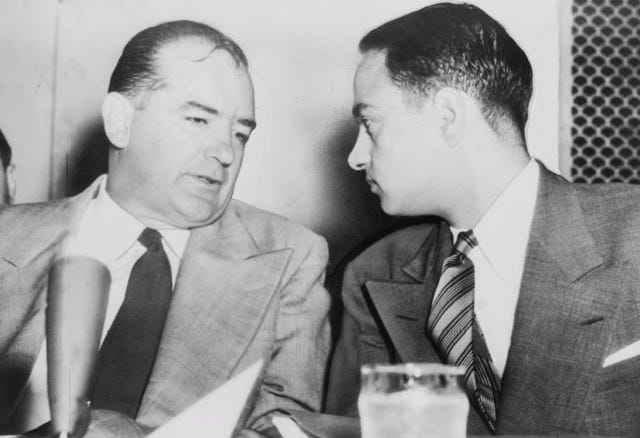
Joe McCarthy (L) with Roy Cohn
Today’s moment is more perilous than the McCarthy era. In the 1950s, Senator Joe McCarthy could destroy reputations and careers, but he was still just one senator. Today, we face a president who channels McCarthy’s demagoguery from the Oval Office, using the full power of the executive branch to punish dissent and reward loyalty. He is surrounded by a coterie of opportunists, lackeys, and lickspittles who feed his vanity, echo his grievances, and amplify his baseless conspiracy theories. The machinery of government — the same machinery once used to surveil and target foreign “enemies” — is now being aimed at our fellow citizens.
The global war on terror, it seems, has finally gone global in the truest sense — extending to America’s own streets, courthouses, and universities. Trump and his allies portray Democratic cities and progressive movements as breeding grounds of chaos and sedition. In his mind, anyone who resists his will — even through the most lawful and constitutional means — is an “insurrectionist.” He has long shown contempt for the Constitution he swore to uphold. Trump is often exactly what he appears to be: a dangerous blowhard with a vindictive streak, ignorant of the limits and responsibilities of his office. Yet others in his orbit, people like Stephen Miller, harbor more deliberate and insidious designs on American democracy.
What is to be done? Congress is paralyzed, fragmented, and largely disempowered. The Supreme Court is dominated by ideologues nursing grievances and eager to reshape the nation along reactionary lines. Who, then, will check a president determined to rule rather than govern?
The American experiment in self-government has endured many crises but rarely has it seemed so fragile. As journalist Nick Turse recently wrote in TomDispatch, the United States now stands on the precipice of authoritarian rule. Many Trump loyalists appear eager to leap — to wage an internal war against their fellow citizens under the guise of saving the nation.
Never has Dwight D. Eisenhower’s warning, “Only Americans can hurt America,” been more prescient or more tragic. The enemy within is not a phantom of the left or right — it is the creeping authoritarianism that grows when fear conquers freedom.
As Master Po reminded us in Kung Fu, “fear is the only darkness.” My fellow Americans, we are in a very dark place.
I wonder why the Trump administration is so interested in Venezuela?
Oh, so that’s why.
A barrel of oil is selling for about $60 this morning. 303 billion barrels at $60 a barrel is more than $18 trillion in future earnings (likely much more than this as the price of oil climbs to $100 per barrel and higher).
Who put America’s oil off the coast of Venezuela? Remember, it’s the Gulf of America, people.
In other news, the admiral in charge of SOUTHCOM is retiring early. Rumor has it he’s objected to the kill and regime change policies of Trump and Hegseth vis-a-vis Venezuela.
President Trump himself recently admitted he’s authorized covert overt CIA activities against the Venezuelan government. A CIA-orchestrated coup combined with U.S. military attacks on Venezuela is likely coming. It’s shrouded in drug war rhetoric, but of course the real goal is control over Venezuela’s oil.
The recent award of the Nobel Peace Prize to a Venezuelan opposition leader is another fig leaf in this operation. Once again, war will be sold to the American people as advancing democracy when it’s really all about the Benjamins.
Trump and Hegseth’s murderous strikes against alleged drug-running boats (at least five already destroyed) is another pretext for regime change. Yet the USA was more than happy to tolerate, even encourage, a massive drug trade in heroin during the Afghan War.
Oh well. War always finds a way, especially when oil is involved. Just think of the Iraq regime change invasion in 2003. That went so well, didn’t it?
This short video by Max Blumenthal sums it up quite well:
Conveniently, the government is still shut down, so I guess Trump can’t ask Congress for a formal declaration of war. Yet another unconstitutional war has already started and Congress is nowhere to be found.
It’s time for regime change for democracy right here in America.
Back in June of 2023, I wrote a letter to my archdiocese in response to a request for money. (I am a lapsed Catholic who has in the past given money to the Church.) Here is the letter I wrote, with some follow-on thoughts:
*****
June 2023
Most Reverend ***
Archdiocese of Boston
Dear Reverend ***
I received your Catholic Appeal funding letter dated June 1st. I won’t be contributing…
[Well into the 1990s,] I took my Catholic faith seriously; in fact, my master’s thesis at Johns Hopkins, which examined Catholic responses to science in the mid-19th century, especially Darwinism, geology, and polygenism, was published in the Catholic Historical Review. But scandals involving the Church drove me to question my commitment to Catholicism and especially its patriarchal hierarchy, which was so intimately involved in the coverups of crimes committed against innocents.
I grew up in Brockton, Mass., where the archdiocese assigned a predatory priest to our church of St. Patrick’s. His name was Robert F. Daly. He abused minors and was eventually defrocked by the Church, but far too late. (See the Boston Globe, 6/14/11.)
When I attended St. Patrick’s in the 1970s, Father Daly was teaching CCD. A sexual predator was attempting to teach young people the meaning of Christian love. He had a decent definition for love, something like “giving, without expecting anything in return.” Selfless love, I suppose. Tragically, he obviously failed catastrophically to practice what he preached.
Fortunately, I was never abused. I was supposed to have one meeting with him, alone, that was cancelled at the last minute. I’d like to imagine God was looking out for me on that day, but that’s absurd. Why wasn’t God looking out for all those children abused by Catholic clergy like Father Daly?
To be blunt, I am thoroughly disgusted by the moral cowardice of the archdiocese in confronting fully its painful legacy of failing to protect vulnerable children against predatory priests like Father Daly. Shame on the Church.
The Bible says that all sins may be forgiven except those against the Holy Spirit. This is supposed to refer to a stubborn form of blasphemy. Yet I truly can’t think of a worse sin committed by the Church than to allow innocent children to suffer at the hands of predators disguised as “fathers.”
I sincerely hope you are doing something to change the Church, to reform it, to save it. I fear the Church has not fully confessed its sins, and in that sense it truly does not deserve absolution from the laity. Far too often, the Church has placed its own survival ahead of Truth, ahead of Christ as the Way and the Truth, and thus the Church has washed its hands of its crimes, as Pontius Pilate did.
I am staggered by this betrayal.
Perhaps you have truly fought to reform the Church. If you have not yet done so, perhaps you will soon find the moral courage. I pass no judgment on you. Judge not, lest you be judged. But I do find the Church to be wanting.
Recalling scripture, if the Church does not abide in Christ, should it not be cast into the fire and be consumed?
I am sorry to share such a bleak message with you. I find the Church’s decline to be truly tragic because we need high moral standards now more than ever. Yet the Church is adrift, consumed by petty concerns and obedience to power. Just one example: The U.S. Church cannot even clearly condemn the moral depravity of genocidal nuclear weapons!
I realize I am seriously out of step with today’s Catholic church. I believe priests should be able to marry if they so choose. I believe women who have a calling should be ordained as priests. I believe the Church’s position on abortion is absolutist and wrong. More than anything, I believe the Church is too concerned with itself and its own survival and therefore is alienated from the true spirit of Christ, a spirit of compassion and love.
Unlike you, I cannot in good conscience claim to be “devotedly yours in Christ.” But I am sincere in wishing you the moral courage you will need to manifest your devotion in directions that will help the least of those among us the most. For I well recall the song we sang in our youth: Whatsoever you do for the least of my brothers, that you do unto Me.
Sincerely yours
*****
I’m happy to say I get a thoughtful response from a local bishop, who assured me the Church was serious about reform, was doing all that it could to eliminate pedophilia and to punish those who were guilty of it, and that therefore the Church no longer needed outside policing.
It was the last statement that puzzled me. The Church disgraced itself precisely because it had swept decades of crimes under the rug. Hadn’t the Church learned that earnest attempts at reform by insiders were necessary but not sufficient?
So I wrote back these comments to the bishop:
I will say this as well: I don’t think the Church can police itself from within. That’s what produced the scandals to begin with. It’s like asking the Pentagon to police itself, or police forces with their “internal affairs” departments.
The Church has to open itself to being accountable to the laity, not just to reformers like yourself. Thus the Church has to cede power and a certain measure of autonomy, and institutions are loath to do this, for obvious reasons. Meanwhile, the Church is being weakened by lawsuits, as people seek compensation (and perhaps a measure of vengeance) for sins of the past.
Skeptics would reply that it took a huge scandal with major financial implications to force the Church to do the right thing.
For too long, the Church tolerated these crimes. The Church is hardly unique here. Think of sexual assaults within the military (notably during basic training), or think of the Sandusky scandal at Penn State, where Joe Paterno clearly knew of (some) of Sandusky’s abuse, yet chose not to take adequate action. (I was at Penn College when that scandal broke.)
The challenge, as you know, is that the Church is supposed to be a role model, an exemplar of virtue. Priests hold a special place of trust within communities and are therefore held in especially high regard.
Image courtesy of the Mormon (LDS) Church
As my older brother-in-law explained to me, if a young boy or girl accused a priest of assault in the 1950s or 1960s, few if any people would have believed them. Indeed, the youngster was likely to be slapped by a parent for defaming a priest. That moral authority, that respect, was earned by so many priests who had done the right thing, set the right example. It was ruined by a minority of priests who became predators and a Church hierarchy that largely looked the other way, swept it under the rug, or otherwise failed to act quickly and decisively.
As you say, the Church has learned. It is now better at policing itself. The shame of it all is that it took so much suffering by innocents, and the revelations of the same and the moral outrage that followed, to get the Church to change.
*****
Friends of mine who are still firm believers tell me, correctly, that the Church is much more than the hierarchy. It certainly shouldn’t be defined by the grievous sins of a few. Still, I can’t bring myself to rejoin a Church that so grievously failed the most innocent among us.
There’s a passage in the New Testament where Christ says: “Suffer little children to come unto me.” As in, let the children come, I will bless them, for they in their innocence and humility are examples to us all. He didn’t teach, let the children suffer, molest them and exploit them, then cover it all up.
I still have respect for priests who exhibit the true fruits of their calling. I still find the teachings of Christ to be foundational to my moral outlook. But I find the Church itself to be unnecessary to the practice of my faith, such as it is. I do hope the Church truly embraces transparency and service; I hope it recalls as well its need to preach life and love and peace, as we need these now more than ever.
How can Democrats win in 2028? Not by doing what the Democratic National Committee (DNC) has been doing—chasing corporate money, currying favor with AIPAC, and catering to the donor class. That may enrich the DNC, but it’s not a winning strategy.
Winning elections requires inspiring people to vote for you—to believe you’ll actually fight for them. Kamala Harris lost in 2024 because too many people stayed home. Many of those same voters had once turned out enthusiastically for Joe Biden in 2020 and Barack Obama before him.
Nominating “Cheney-adjacent” Democrats—candidates who sound like Republican-lite fiscal conservatives and foreign policy hawks—hasn’t worked. These are candidates who embrace militarism, defend Israel no matter what, and cater to big money interests. That’s the path Kamala Harris chose in 2024, and even she later admitted it likely cost her the election. Establishment Democrats keep chasing the mythical “moderate Republican” who dislikes Donald Trump but could be persuaded to vote blue. It didn’t work for Hillary Clinton in 2016, and it failed again in 2024.
The reasons for the 2024 loss aren’t mysterious. Democratic leaders lied about Biden’s fitness for another term. They betrayed their base. They allowed the party to be captured by moneyed interests. And they ran a hollow campaign—focused on the “joy” of Kamala rather than on real issues like raising the federal minimum wage, reducing student debt, or protecting workers and the middle class.
Today’s Democratic leadership—an aging, entrenched gerontocracy—is out of touch. Obsessed with fundraising and self-preservation, they offer no charisma, no moral courage, and no compelling vision. Yet America desperately needs a strong, principled Democratic Party to counter Trumpism. What we have instead is a party that’s too old, too corrupted, and too timid to resist it effectively.
Democrats need to rediscover the spirit of Robert F. Kennedy Sr., George McGovern, and yes, Bernie Sanders. Remarkably, Trump now seems to many voters more “worker-friendly” than the average Democrat politician. He’s seizing traditional Democratic issues like lowering prescription drug prices while Democrats, paralyzed by caution, are doing little to challenge him.
Sanders himself has said the Democratic primary process is rigged against candidates like him. Voters recognize when they’re being sold a false bill of goods. When they feel manipulated, they stay home—or worse, cast protest votes for demagogues who seem more “authentic.” Sanders has also called both major parties “largely corrupt,”and sadly, the Republicans—corrupt as they are—are currently better at winning than the Democrats.
For his honesty, Sanders deserves respect. He’s one of the few major politicians willing to say plainly that the Democratic Party has become an obstacle to genuine democracy—rigging its own primaries and processes to favor establishment figures like Hillary Clinton and Kamala Harris, while marginalizing the progressives who actually energize voters.
As Sanders noted in a recent interview (see above, after the 40-minute mark), the Democratic Party would rather lose an election than risk upsetting the status quo. Which brings us to 2028: it’s easy to imagine the DNC once again anointing someone like Gavin Newsom (handsome but hollow), Pete Buttigieg (a corporate technocrat who happens to be gay), or Josh Shapiro (a reliable Zionist), all while ignoring the lessons Sanders tried to teach.
And when President J.D. Vance takes office in 2029, Democratic leaders will once again blame the voters—never themselves.
Senator Elissa Slotkin (D-Michigan) is a rising star in the Democratic Party. In July she denied Israel’s genocidal intent in Gaza and deflected criticism of AIPAC and its role in American politics. Earlier in March, she gave the Democratic response to Trump by citing with approval, I kid you not, Ronald Reagan and George W. Bush. In the early weeks of Russia’s invasion of Ukraine in 2022, she called for increases to Pentagon spending and more U.S. troops to be committed to Europe.
Elissa Slotkin: Let’s criticize Trump by praising Ronald Reagan and George W. Bush
Slotkin checks just about every box the Democratic establishment loves: a woman, Jewish, former CIA officer, veteran of the National Security Council and State Department. She’s the military-industrial complex softened by a woman’s touch—a reassuring smile masking a hardened national-security mindset. I can easily imagine her as vice-presidential material in 2028.
And who might lead that ticket? My bet is on Josh Shapiro, Pennsylvania’s governor. Like Slotkin, he’s Jewish, firmly pro-Israel, and rooted in a swing state Democrats must win. A Shapiro-Slotkin ticket—lawyer and intelligence officer, both hawkish, both “safe” for the donor class—would symbolize how far the party has drifted from its old progressive soul (think here of FDR and George McGovern).
Shapiro–Slotkin: the likely face of Democratic centrism in 2028.
And I know what my Democratic friends will tell me in 2028: No matter how pro-Israel and pro-Pentagon these Democrats are, they’re better than Trump or his successor. So hold your nose and vote blue no matter who.
Let’s not forget the time Josh Shapiro signed an artillery shell to be used against Russia. From Pennsylvania with love?
Israel, Gaza, and Moral Collapse
The Democratic establishment’s moral confusion (and collusion) over Gaza’s destruction is a measure of serious moral drift. Previous talk of a “partial offensive weapons boycott” against Israel was pure political theater, since Israel defines every weapon it uses as defensive. Even Iron Dome missiles—marketed as purely protective—provide cover for Israel’s ongoing offensive operations.
Let’s be honest: even Israeli human-rights organizations now call what’s happening in Gaza a genocide. The term “war crime” implies a conventional war, with atrocities committed in battle’s chaos. But Gaza isn’t a battlefield—it’s an occupied territory subjected to systematic destruction. Israel’s goal is transparently obvious: mass death and displacement. How can mainline Democrats support this? In fact, how can anyone with a heart support this?
A Party I Once Belonged To
I say this as someone who once called himself a Democrat. I voted for Obama twice and stayed registered with the party until 2016. I even received my share of glossy mailers from the Biden campaign in 2020 and 2024 before it all went down in flames.
So yes, I’m a winnable voter—someone who could still be moved by a Democratic candidate like Bernie Sanders, Dennis Kucinich, George McGovern, or RFK Sr. But that kind of Democrat, a principled progressive, a friend to the working classes, has vanished from the party’s upper ranks.
Since the Clinton years, the DNC has courted and served Wall Street, Silicon Valley, and the Pentagon with equal zeal. The result is a party that preaches “diversity” while funding foreign wars, that champions “equity” while enabling wanton Israeli aggression.
If Democrats nominate yet another national security hawk in 2028—someone who kneels before Netanyahu and calls it diplomacy—I’ll vote third party again. But if they rediscover their moral compass and nominate a candidate with real progressive convictions, I’ll be the first to sign up.
Remembering What Democrats Once Were
I invoke names like Geroge McGovern and RFK Sr. not out of nostalgia, but to remind us that the Democratic Party once stood (however shakily) for peace, diplomacy, and courage. These were leaders who challenged militarism and believed America could be a force for good. Think of JFK’s brilliant peace speech in 1963.
Today’s Democrats, with few exceptions, are indistinguishable from John McCain when it comes to their enthusiasm for war and weapons. They celebrate “defense spending” as if it were a patriotic sacrament, while the Pentagon drains over a trillion dollars a year from our treasury.
I’ve supported Bernie Sanders since 2015 and still respect his attempt to challenge this militaristic drift, though I’ve been disappointed by his compromises. Sanders in particular has been slow to denounce Israel’s genocidal crimes in Gaza. I find myself in broad agreement with commentators like Caitlin Johnstone, who call out Israel’s genocide and the U.S. government’s bipartisan complicity here. Her critique of American empire resonates because I still believe in a constitutional republic with a citizen-soldier military focused on defense and domestic health.
That vision once animated much of the Democratic Party. Today, it feels like a very distant memory.
Should senior military officers consider resigning?
The short answer is yes—if they believe the orders they are given violate their oath to the U.S. Constitution.
In practice, however, resigning for cause is exceedingly rare. The military is a culture of conformity and hierarchy, where resignation is often seen as an act of rebellion—a threat to cohesion and discipline. Officers are taught to work quietly within the system, to suppress doubts, and to remain “loyal” to superiors and to the institution itself. Few are willing to resign openly on moral or legal grounds.
For senior officers, the decision to resign in protest is especially difficult. Colonel David Hackworth, one of the most decorated soldiers of the Vietnam era, resigned after concluding the war was unwinnable—not because he viewed it as unconstitutional. Earlier, General Harold K. Johnson, the Army Chief of Staff under President Lyndon Johnson, considered resigning in protest of the administration’s Vietnam policies but ultimately stayed, hoping to influence policy from within. He later regretted that decision, admitting he had lacked the moral courage to resign.
Both Hackworth and Johnson objected to how the war was fought, not to whether it was lawful. That distinction is crucial.
Senior officers today may likewise convince themselves that remaining in uniform allows them to do the most good—to temper reckless orders from within the system. Resignation, after all, feels like quitting. And there’s an unspoken incentive to stay: the lucrative post-retirement opportunities awaiting those who keep faith with the military-industrial complex.
Given the recent clownish and dangerous behavior of Trump and his defense war secretary, Pete Hegseth, one hopes that senior military leaders are at least preparing for the possibility of resignation—keeping their powder dry until a clear line is crossed. Arguably, that line may already have been crossed.
One resignation might not change much. But several coordinated resignations—anchored in principle—could. The question is whether today’s generals and admirals have the moral courage to do so when the moment arrives.
Trump and Hegseth appear to have neutralized much of the brass by flooding the Pentagon with money. But will those same leaders, drunk on budgets and contracts, have the courage to resist illegal orders and yet another series of wars launched on dubious grounds?
Already, Trump and Hegseth have issued extrajudicial orders—such as the recent killings of suspected smugglers on three speedboats in the Caribbean, ostensibly part of the “war on drugs.” They have deployed active-duty troops to U.S. cities under partisan pretexts that appear to violate the spirit, if not the letter, of the Posse Comitatus Act of 1878. And more attacks on Iran—without any declaration of war—may be imminent.
Given all this, there is ample reason for senior officers to consider coordinated resignations in protest. The question is whether they will summon the moral courage to do what is right—to uphold their oath by walking away.
Perhaps they could call it Operation Just Cause—an operation without bombs or killing, requiring that rarest of things: moral courage.
Since the last time (July 19th) I wrote about the Russia-Ukraine War, perhaps the biggest change has been to President Trump’s rhetoric. After being frustrated in his efforts to end the war (and perhaps win a Nobel Peace Prize to boot), Trump effectively washed his hands of the conflict. A Truth Social post was especially surprising, as the BBC reported on 9/24:
US President Donald Trump has said Kyiv can “win all of Ukraine back in its original form”, marking a major shift in his position on the war with Russia.
In a post on his Truth Social platform, he said Ukraine could get back “the original borders from where this war started” with the support of Europe and Nato, due to pressures on Russia’s economy …
Trump has repeatedly expressed his desire to end the war, but has previously warned that process would likely involve Ukraine giving up some territory, an outcome Zelensky hasconsistently rejected.
In his post, Trump added Ukraine could “maybe even go further than that”, but did not specify what he was referring to.
Exactly how Ukraine is going to win back all the land captured by Russia is unclear. Also less than clear is the role of the EU and NATO in this. Trump appears to have said it’s up to the EU and NATO to support Ukraine (as if NATO is not commanded and controlled by America), with the U.S. more than willing to sell weapons to EU and NATO countries to support Ukraine’s efforts.
Trump’s gambit is this: If Ukraine wins, he takes credit for continuing to supply weaponry and for his new vote of confidence. If Ukraine loses, Trump shifts the blame to the EU and possibly to Ukraine and Zelensky too.
It’s a cynical policy—but these are cynical times.
An undeniable truth is that the war grinds on with no end in sight. U.S. aid to Ukraine will soon reach $200 billion. Meanwhile, front lines have stagnated, counteroffensives have stalled, and Ukrainians themselves have grown increasingly weary of war.
Observers in the West point to a weakening Russian economy and high battlefield losses as signs Russia itself may be nearing a tipping point that could lead to collapse and defeat. Both a heavily damaged Ukraine and a destabilized Russia might be the fruits of “victory,” leading to chaos and possible nuclear escalation.
Again, no matter what Trump says, a total victory for Ukraine looks remote. Russia controls about 20 percent of Ukrainian territory, including the industrial Donbas and much of the south. Ukraine’s economy is weakened (as is Russia’s), its army is depleted, and its demographics are unfavorable to success (millions of Ukrainians have sought sanctuary abroad).
The Media’s Role in Perpetuating Illusion
The mainstream media in the U.S. has been partisan since day one. The MSM framed the conflict as a morality play: a heroic democracy versus an evil autocrat.
Meanwhile, the MSM overhyped U.S. weapons as “decisive” and Ukrainian counteroffensives in 2023 as “war-winning.” Media hype distorted expectations and contributed to public fatigue.
Most strikingly, the press has consistently downplayed the risks of escalation with a nuclear power. Ukraine’s use of long-range Western missiles to strike inside Russia carries serious dangers. That Putin will tolerate further provocations without escalating himself is a dangerous bet.
The Case for Diplomacy
Ukraine, no matter Trump’s new faith, cannot win this war in the maximalist sense of regaining all occupied territories and forcing Russia’s surrender. The longer the war continues, the more Ukraine will suffer—physically, economically, and politically.
Wars feed autocracy. Already, Ukraine has postponed elections, banned several opposition parties, and restricted media outlets. These measures may be understandable in wartime, but they belie the notion that Ukraine is a flourishing democracy.
A negotiated settlement is not capitulation. It is recognition of limits. The alternative is indefinite conflict—one that may bleed Ukraine dry even as it edges the world closer to catastrophe.
Dangerous Assumptions
Some policymakers argue a prolonged war will weaken Russia to the point of collapse. But a weakened Russia is not necessarily a safer one. If the Russian state disintegrates, who controls its nuclear arsenal? What if chaos in Moscow produces a more radical, vengeful leader? What if a desperate Kremlin lashes out, or if fighting spills into a NATO country like Poland?
Conversely, what if Ukraine, drained by endless war and reliant on foreign arms, slides toward authoritarianism? Wars have a way of transforming republics into garrison states. The longer the conflict lasts, the greater the risk that Ukraine’s democracy will become a casualty of its own “great patriotic war.”
The Limits of Analogy
Too often, the war is discussed through lazy historical analogies. Putin is Hitler; Zelensky is Churchill; negotiations are “another Munich.” Such framing flatters Western moral vanity but obscures strategic reality. This is not 1938. Putin is not on the verge of conquering Europe, and diplomats are not appeasing him by seeking peace.
Putin may be ruthless, but he is not suicidal. He knows that attacking a NATO member would invite his own destruction. Nuclear deterrence remains real. To suggest otherwise is to indulge in a fever-dream of perpetual conflict, one that justifies limitless military spending and forecloses diplomacy.
The American Connection
For most Americans, the Russia–Ukraine War remains distant and impersonal. We are not threatened by Russian artillery; the war is thousands of miles away. Yet we are paying for it—literally. Every artillery shell, every tank, every missile financed through our taxes contributes to death and destruction abroad. Some justify this as moral duty: helping Ukraine defend freedom. But morality also demands an accounting of consequences.
How many Americans know that 69 percent of Ukrainians report being weary of the war, or that their own government has suspended elections? How many realize that each dollar spent on war is a dollar not spent on schools, infrastructure, or healthcare at home?
We are told the U.S. can afford virtually limitless weapons for Ukraine, but when it comes to social programs, we always hear the same question: How are you going to pay for that? Apparently, there’s always money for war, never for peaceful pursuits.
A Broader Reckoning
The Russia–Ukraine War has become a mirror reflecting America’s own pathologies: our addiction to militarism, our aversion to diplomacy, our willingness to spend without scrutiny when the cause is war, and our moral complacency about the human cost of conflict.
We have turned foreign policy into a morality play, where compromise is dismissed as cowardice and negotiation is treated as akin to sin. Yet history teaches the opposite: the greatest statesmen are not those who glorify war but those who end it.
The Russia–Ukraine War continues, and so does the silence around the most basic of questions: What is America’s endgame? If the answer is “as long as it takes,” we should ask: takes for what? For Ukraine’s victory—or for its ruin? For democracy’s defense—or for another endless war?
It is time to demand accountability, restraint, and above all, diplomacy. Supporting Ukraine should not mean subsidizing endless cycles of death and destruction. How many more must die before this war is finally ended?
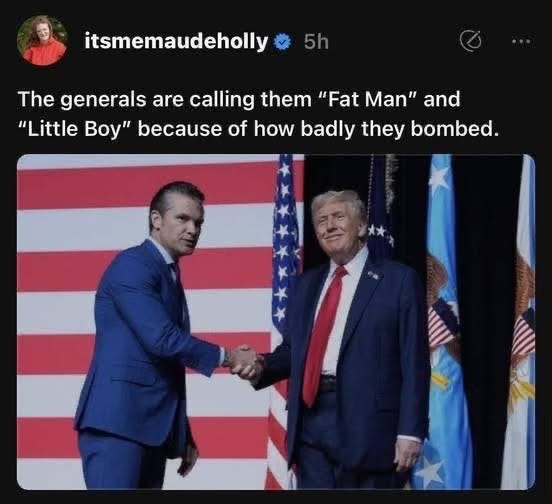
The military historian Dennis Showalter once told me that he didn’t care about the amount of fat around a general’s belly—he cared about the fat between a general’s ears. It was a telling quip, and one that highlights the shortsighted nature of Pete Hegseth’s emphasis on fitness and military bearing to the generals and admirals he assembled yesterday.
(By the way, what about Trump as commander-in-chief. Is he going to exercise and lose weight? Good luck with that one, Pomade Pete.)
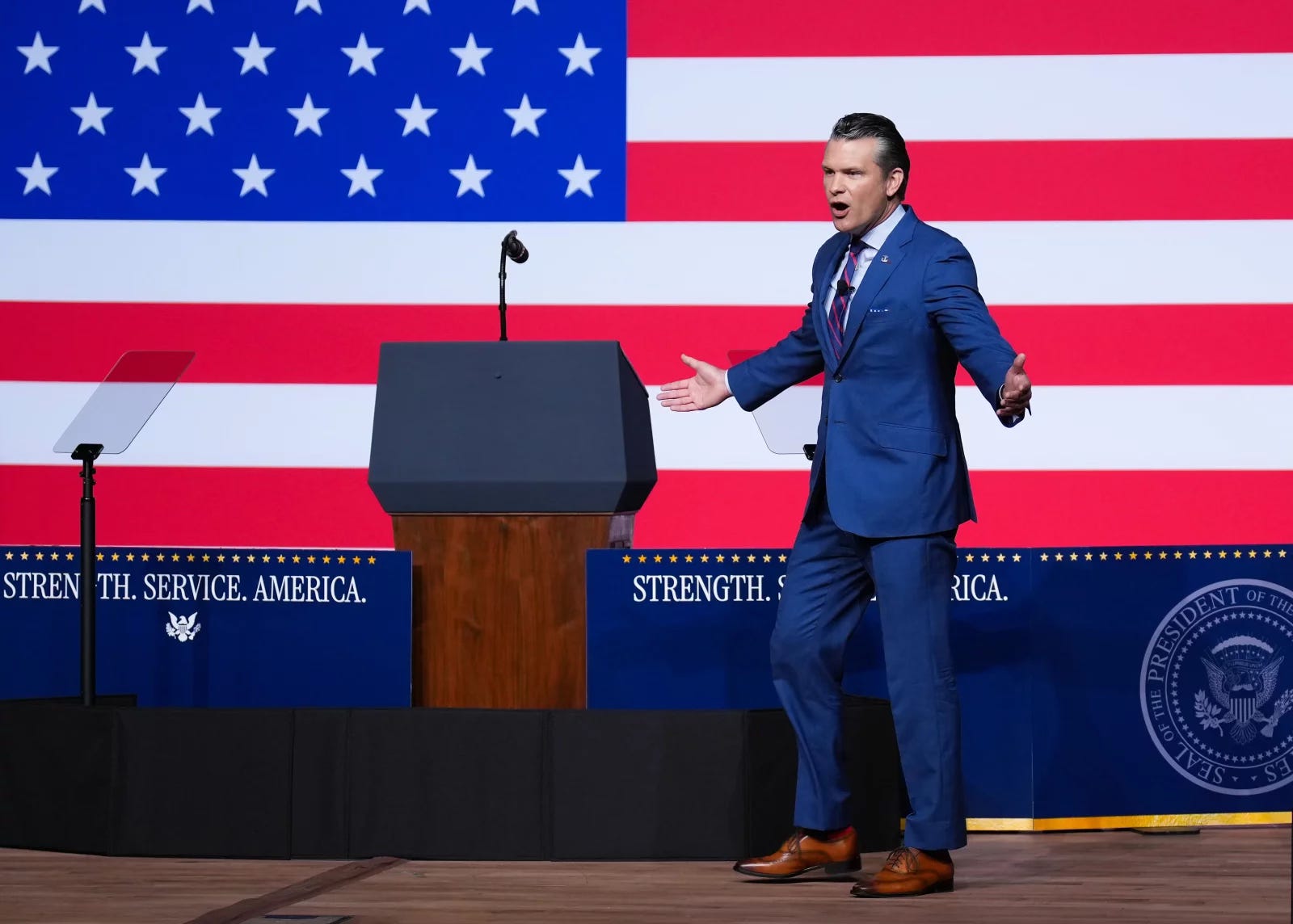
Pomade Pete Hegseth, Self-declared Secretary of War
Of course, physical fitness is important in military settings, especially if you’re at the pointy end of the spear, as they say in the military. But America’s senior leaders today are not “boy generals” like George Armstrong Custer in the U.S. Civil War. They are men and women in their fifties and early sixties, presumably promoted for their integrity, knowledge, insight, skill, and experience, not because they can still run sub-six minute miles or perform 100 pushups.
(Aside: It might be time to buy stock in Ozempic and similar drugs used for weight loss.)
Recall all the media praise showered on William Westmoreland, David Petraeus, and Stanley McChrystal. These three generals were lauded for their physical fitness and military bearing, their “spartan” qualities as warriors. And they all demonstrated strategic mediocrity in fighting and losing the Vietnam, Afghan, and Iraq Wars. They may not have had flabby bellies, but they had flabby minds.
Hegseth is all about “warrior” image over substance. Don’t get me wrong: I think everyone should exercise if they can, and being substantially overweight isn’t healthy. When I was in my early forties and a lieutenant colonel, I ran with the troops and did pushups and sit ups. But there’s a lot more to military effectiveness than being “a lean mean fighting machine.”
But I’ll admit I’m burying the lede here. Trump and Hegseth’s message to senior leaders was far more disturbing than complaints about a fat and woke military. Here’s what I sent to a friend about this:
The “national security” state has kept our country in a state of permanent war since 1947. Trump and Hegseth are just ripping the facade of “security” away and replacing it with “war.”
“Peace” is the word that dare not speak its name. And “war,” of course, has come to the streets of America, with troops deployed to Portland next. Add that to the many police who got their initial training in the military and the rapid expansion of ICE along with detention centers and it’s obvious how the war on terror has truly become global since now the focus is on terror in America.
We are reaping what we sowed …
I was then asked for a more formal comment and came up with this:
The statements of Trump and Hegseth show that the “global” war on terror was and is truly global (as well as permanent) because that war has now come home to America’s cities. Now places like LA and Portland are to be pacified by American “warriors” and warfighters, with detention centers (concentration camps) for those who resist. President Dwight D. Eisenhower was never more right or prescient when he noted, “Only Americans can hurt America.”
Trump and Hegseth see America’s streets as a battleground for the U.S. military against “the enemy within.” The real enemy to democracy, of course, is the very deployment of troops to the streets. American colonists launched a revolution 250 years ago partly because they didn’t want the king’s troops among them as enforcers.
Anyone who doesn’t see the fundamental dangers of Trump and Hegseth’s actions to democracy and our Constitutional rights truly has some flab between their ears.







 Bracing Views