Recently, I jotted down some qualities of good leadership. Of course, the importance of specific traits depends on context—a leader who is overly cautious may be a liability in a crisis requiring quick action, though less so in a college faculty meeting. That said, here are thirteen attributes I consider essential, in no particular order:
· Decisiveness balanced with care: the ability to decide informed by experience and consultation.
· Integrity and character.
· Bringing people together–motivating and inspiring them.
· Calmness under pressure.
· Leading by example, or “walking the walk.”
· Honor and trustworthiness.
· A commitment to fairness. Setting high standards that apply equally to all.
· Selflessness. A belief in service.
· Compassion. A hard-ass shouldn’t have a hard heart.
· Open-mindedness. A willingness to listen.
· Humility. A willingness to admit no one knows everything or always gets it right.
· Experience (again). While people want to know a leader cares, they also expect competence. Confidence erodes quickly if a leader doesn’t grasp the fundamentals of the job and mission.
· A commitment to ethics, or “doing the right thing.”
That’s my baker’s dozen. Sadly, when I measure Donald Trump against these qualities, I don’t see him embodying any of them with consistency. Yet his supporters insist he is not only effective but “great.” In Trump’s case, does he have the integrity to support and defend the U.S. Constitution? Does he realize that no man is above the law? Is the example he sets a selfless one? Does he bring people together for the greater good?
In business and the military, leadership is often judged narrowly by results—profits earned, battles won. But that standard can elevate sociopaths, people who care only about themselves and about producing results at any cost. Such leaders may achieve short-term gains, like higher profits, but at immense costs to those beneath them. Ultimately, a self-absorbed, “results-at-any-cost” leader drives organizations into the ground.
Leadership can be lonely, in the sense of “uneasy lies the head that wears a crown.” True leaders must sometimes accept unpopularity, stand firm, and take responsibility—“the buck stops here.” Leadership is both privilege and burden, which is why many shy away from it. Sociopaths, by contrast, don’t hesitate; they feel no weight from the consequences of their actions.
So, America, are we doing our best to identify the right—truly qualified—leaders? Evidence suggests we are not.
A final thought. I was once asked, as a young lieutenant competing for “Company Grade Office of the Quarter,” to explain the difference between management and leadership. For management, I said something about teamwork, smarts, effectiveness—taking on a project and bringing it to fruition. For leadership, I remember saying something like the ability to make good things happen. Here I was inspired by Chief Dan George in “Little Big Man” when he asks the Great Spirit “to grant me my old power—to make things happen.” And I remember a friend of mine, another lieutenant, saying the selection board loved short snappy answers. Maybe it was true—I won the award for that quarter.
Competition can be a good thing. Think of sports, for example. Would victory have any meaning without competition? If we just randomly selected a winner each year of the Super Bowl or the World Series, who would care?
Competing is completing—a way to motivate oneself, to better oneself. That said, “victory” is more than just lifting a trophy in triumph. How you got there—how you treated your fellow competitors along the way—matters too.
I remember a saying—If you’re not enough before the gold medal, you won’t be enough with it. Competing honorably, giving your very best, is really what it’s about, not just shiny medals and trophies. If your soul is empty, if your heart is cold, the glow from even the highest accolade will fade—and quickly.
Too often in our society, competition is embraced for the sake of dominance. For some, winning has no meaning unless others suffer by losing. A real winner, however, lifts up others even as she or he is competing to be the very best.
This is a lengthy prelude to an article I thought I would write about Americans competing for everything. Cooperation? Fuhgeddaboudit! Competition for everything, always, calls to mind a cutthroat world in which only the fittest—or the most ruthless, the nastiest—survive and thrive.
Far too often, competition in America is further expressed through materialism, buying, and display. Competitive consumption, if you will. Over-the-top displays of dominance: having the biggest yacht, the loudest stereo system, the largest truck, the most expensive SUV, the most exotic pets, you name it.
America, let us say, is not a country known for its restraint. But as I thought about consumption as a national pastime, I recalled the great monologue on America by comedian George Carlin, who in less than eleven minutes dissected the American way with more power and wit than just about anyone else I’ve heard. His lessons were grim, but Carlin spoke from his heart and warned us we were losing our way in mindless consumption.
Every now and then, I rewatch the 11-minute clip below to give myself a cold slap of reality. Believe me, there’s a lot in his monologue to digest. And a lot of profanity as well—consider yourself warned.
Today, I was back on Judge Napolitano’s show, Judging Freedom. We talked about whether Israel is truly a U.S. ally and the increasing illegality of U.S. governmental actions under the Trump administration.
I tend to be more circumspect when I talk, more blunt when I write. The Judge asked me whether I thought the U.S. was a democracy; I suggested we were a quasi-democracy but what democracy was left was shriveling and withering under pressure from Trump and his minions.
Actually, America is an empire; we left our republic ideals behind soon after World War II, which is why President Dwight D. Eisenhower was issuing powerful warnings about the same in 1953 and 1961. America has always been a war-like nation; now we are increasingly consumed by war and its ever-present costs and burdens. I could have said more about that and wish I had.
In the rise, decline, and fall of empires, we are very much on the downslope even as leaders like Trump suggest that the way to make America great again is to win at war (no matter the morality and legality of our actions). In that sense, we have already lost—indeed, our so-called leaders wander, lost, in a grim and increasingly barbaric wilderness of their own making.
Sadly, there’s only one ship of state, and when the captain and most of his mates are lost at sea and reckless to boot, passengers like us are likely to go down with the ship with them.
If there’s one thing we’ve learned (or re-learned, again and again) from the Pentagon it’s that all governments lie and that the first casualty of war is truth. From the Pentagon Papers in the Vietnam War to the Afghan War Papers and the lies about WMD in Iraq, the American people have been deliberately and maliciously lied to about America’s wars and their true causes and purposes. And you can go back further to the infamous “Remember the Maine!” cry that touched off the Spanish-American War of 1898. When it comes to war, America’s leaders have always been economical with the truth.
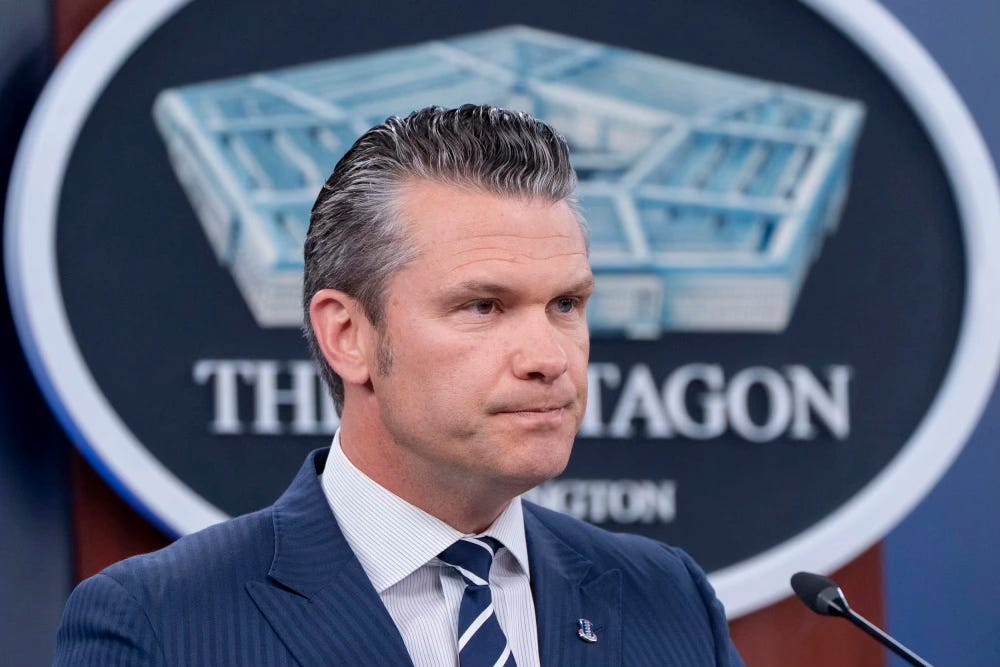
At the Pentagon, Pomade Pete Strikes Again!
But wait, today’s Pentagon is about to outdo that! As usual with nefarious government decisions, it was announced on Friday when people are most distracted. A short summary from NBC News:
Journalists who cover the Defense Department at the Pentagon can no longer gather or report information, even if it is unclassified, unless it’s been authorized for release by the government, defense officials announced Friday. Reporters who don’t sign a statement agreeing to the new rules will have their press credentials revoked, officials said.
Multiple press associations quickly condemned the new rules and said they will fundamentally change journalists’ ability to cover the Pentagon and the U.S. military. They called for the Trump administration to rescind the new requirements, arguing they inhibit transparency to the American people.
The National Press Club denounced the requirement as “a direct assault on independent journalism at the very place where independent scrutiny matters most: the U.S. military.”
Remember that old saw that, “If you’ve done nothing wrong, you have nothing to hide” from your friendly government surveillance program? Looks like the Pentagon has decided it’s got plenty to hide, meaning it’s done and is planning to do a lot of wrong, and thus only government-approved information will be allowed to be released.
Any journalist worth her or his salt will never agree to this. Journalists who do agree, who sign the Pentagon statement, should just become paid spokespeople for the U.S. military (as indeed many of them already essentially are).
We’ve created a monstrous military, America, one that believes it should be completely unaccountable to us even as we feed it over a trillion dollars a year.
America, there’s only one way to rein in the military: cut the Pentagon budget in half. Show them who’s boss. Of course, Congress controls the purse strings, and Congress, as Ike noted, is intimately intertwined with the military-industrial complex, so it’s not going to be easy to do it.
But no one ever said it’ll be easy: it’s just necessary for the survival of our country as a quasi-democracy.
My fellow Americans, my critical voice has finally been heard inside the Oval Office. No, not my voice against the $1.7 trillion this country is planning to spend on new nuclear weapons. No, not my call to cut the Pentagon budget in half. No, not my imprecations against militarism in America. It was a quip of mine that the Department of Defense (DoD) should return to its roots as the War Department, since the U.S. hasn’t known a moment’s peace since before the 9/11 attacks, locked as it’s been into a permanent state of global war, whether against “terror” or for its imperial agendas (or both).
A rebranded Department of War, President Trump recently suggested, simply sounds tougher (and more Trumpian) than “defense.” As is his wont, he blurted out a hard truth as he stated that America must have an offensive military. There was, however, no mention of war bonds or war taxes to pay for such a military. And no mention of a wartime draft or any other meaningful sacrifice by most Americans.
Rebranding the DoD as the Department of War is, Trump suggested, a critical step in returning to a time when America was always winning. I suspect he was referring to World War II. Give him credit, though. He was certainly on target about one thing: since World War II, the United States has had a distinctly victoryless military. Quick: Name one clear triumph in a meaningful war for the United States since 1945. Korea? At best, a stalemate. Vietnam? An utter disaster, a total defeat. Iraq and Afghanistan? Quagmires, debacles that were waged dishonestly and lost for that very reason.
Even the Cold War that this country ostensibly won in 1991 with the collapse of the Soviet Union didn’t lead to the victory Americans thought was coming their way. After much hype about a “new world order” where the U.S. would cash in its peace dividends, the military-industrial-congressional complex found new wars to wage, new threats to meet, even as the events of 9/11 enabled a surge — actually, a gusher — of spending that fed militarism within American culture. The upshot of all that warmongering was a soaring national debt driven by profligate spending. After all, the Iraq and Afghan Wars alone are estimated to have cost us some $8 trillion.
Those disasters (and many more) happened, of course, under the Department of Defense. Imagine that! America was “defending” itself in Vietnam, Afghanistan, Iraq, Libya, Syria, Somalia, and elsewhere, even as those wars killed and wounded significant numbers of our troops while doing far more damage to those on the receiving end of massive American firepower. All this will, I assume, go away with a “new” Department of War. Time to win again! Except, as one Vietnam veteran reminded me, you can’t do a wrong thing the right way. You can’t win wars by fighting for unjust causes, especially in situations where military force simply can’t offer a decisive solution.
It’s going to take more than a rebranded Department of War to fix wanton immorality and strategic stupidity.
We Need a Return of the Vietnam Syndrome
Hey, I’m okay with the Pentagon’s rebranding. War, after all, is what America does. This is a country made by war, a country of macho men hitching up their big boy pants on the world stage, led by the latest (greatest?) secretary of war, “Pomade Pete”Hegseth, whose signature move has been to do pushups with the troops while extolling a “warrior ethos.” Such an ethos, of course, is more consistent with a War Department than a Defense Department, so kudos to him. Too bad it’s inconsistent with a citizen-soldier military that’s supposed to be obedient to and protective of the Constitution. But that’s just a minor detail, right?
Here’s the rub. As Trump and Hegseth have now tacitly admitted, the national security state has never been about “security” for Americans. Rather, it’s existed and continues to exist as a war state in a state of constant war (or preparations for the same), now stuffed to the popping point with more than a trillion dollars yearly in taxpayer funds. And the leaders of that war state — an enormous blood-sucking parasite on society — are never going to admit that it’s in any way too large or overfed, let alone so incompetent as to have been victoryless for the last 80 years of regular war-making.
And count on one grim reality: that war state will always find new enemies to attack, new rivals to deter, new weapons to buy, and a new spectrum of warfare to try to dominate. Venezuela appears to be the latest enemy, China the latest peer rival, hypersonic missiles and drone swarms the new weaponry, and artificial intelligence the new spectrum. For America’s parasitic war state, there will always be more to feed on and to attempt (never very successfully) to dominate.
Mind you, this is exactly what President Dwight D. Eisenhower warned us against in his 1961 Farewell Address. Sixty-plus years ago, Ike could already see that what he was the first to call the military-industrial complex was already too powerful (as the Vietnam War loomed). And of course, it has only grown more powerful since he left office. As Ike also wisely said, only Americans can truly hurt America — notably, I’d add, those Americans who embrace war and the supposed benefits of a warrior ethos instead of democracy and the rule of law.
Again, I’m okay with a War Department. But if we’re reviving older concepts in the name of honesty, what truly needs a new lease on life is the Vietnam Syndrome that, according to President George H.W. Bush, America allegedly got rid of once and for all with a rousing victory against Saddam Hussein’s Iraq in Operation Desert Storm in 1991 (that would prove to be anything but).
That Vietnam Syndrome, you may recall, was an allegedly paralyzing American reluctance to use military force in the aftermath of disastrous interventions in Vietnam, Laos, and Cambodia in the 1960s and early 1970s. According to that narrative, the U.S. government had become too slow, too reluctant, too scarred (or do I mean scared?) to march speedily to war. As President Richard Nixon once said, America must never resemble a “pitiful, helpless giant.” To do so, he insisted, would threaten not just our country but the entire free world (as it was known then). America had to show that, when the chips were down, our leaders were up for going all-in, no matter how bad our cards were vis-à-vis those of our opponents.
If nothing else, no country had more chips than we did when it came to sheer military firepower and a willingness to use it (or so, at least, it seemed to Nixon and crew). A skilled poker player, Nixon was blinded by the belief that the U.S. couldn’t afford to suffer a humiliating loss on the world stage (especially when he was its leader). But the tumult that resulted from the fall of Saigon to communist forces in 1975 taught Americans something, if only temporarily: that one should hasten very slowly to war, a lesson Sparta, the quintessential warrior city-state of Ancient Greece, knew to be the sign of mature wisdom.
Spartan wannabes like Pete Hegseth, with his ostentatious displays of “manliness,” however, fail to understand the warrior ethos they purport to exhibit. Wise warrior-leaders don’t wage war for war’s sake. Considering the horrific costs of war and its inherent unpredictability, sage leaders weigh their options carefully, knowing that wars are always far easier to get into than out of and that they often mutate in dangerously unpredictable ways, leaving those who have survived them to wonder what it was ever all about — why there was so much killing and dying for so little that was faintly meaningful.
What Will Trump’s “Winning” War Department Look Like?
Perhaps Americans got an initial look at Trump’s new “winning” War Department off the coast of Venezuela with what could be the start of a new “drug war” against that country. A boat carrying 11 people, allegedly with fentanyl supplies on board, was obliterated by a U.S. missile in this country’s first “drug war” strike. It was a case where President Trump decided that he was the only judge and jury around and the U.S. military was his executioner. We may never know who was actually on board that boat or what they were doing, questions that undoubtedly matter not a whit to Trump or Hegseth. What mattered to them was sending an ultimate message of toughness, regardless of its naked illegality or its patent stupidity.
Similarly, Trump has put the National Guard on the streets of Washington, D.C., deployed Marines and the National Guard to Los Angeles, and warned of yet more troop deployments to come in Chicago, New Orleans, and elsewhere. Supposedly looking to enforce “law and order,” the president is instead endangering it, while disregarding the 1878 Posse Comitatus Act that prohibits a president from deploying active-duty troops as domestic law enforcers.
If America isn’t a nation of laws, what is it? If the president is a lawbreaker instead of an upholder of those laws, what is he?
Recall that every American servicemember takes a solemn oath to support and defend the Constitution and bear true faith and allegiance to the same. Warriors are driven by something different. Historically, they often just obeyed their chieftain or warlord, killing without thought or mercy. If they were bound by law, it was most often that of the jungle.
Knowingly or unknowingly, that’s exactly the kind of military Pete Hegseth and the new Department of War (and nothing but war) are clearly seeking to create. A force where might makes right (although in our recent history, it’s almost invariably made wrong).
I must admit that, from the recent attack on that boat in the Caribbean to the sending of troops into Washington, I find I’m not faintly surprised by this developing crisis (that’s almost guaranteed to grow ever worse). Remember, after all, that Donald Trump, a distinctly lawless man, boasted during the Republican debate in the 2016 election campaign that the military would follow his orders irrespective of their legality. I wrote then that, with such a response, he had disqualified himself as a candidate for the presidency:
“Trump’s performance last night [3/3/16] reminded me of Richard Nixon’s infamous answer to David Frost about Watergate: ‘When the president does it, that means it’s not illegal.’ No, no, a thousand times no. The president has to obey the law of the land, just as everyone else has to. No person is above the law, an American ideal that Trump seems neither to understand nor to embrace. And that disqualifies him to be president and commander-in-chief.”
If only.
In retrospect, I guess Trump had it right. After all, he’s won the presidency twice, no matter that his kind of “rightness” threatens the very foundations of this country.
So, color me more than worried. In this new (yet surprisingly old) age of a War Department, I see even more possibilities for lawlessness, wanton violence, and summary executions — and, in the end, the defeat of everything that matters, all justified by that eternal cry: “We’re at war.” At which point, I return to war’s miseries and how quickly we humans forget its lessons, no matter how harsh or painful they may be.
Someday, America’s soon-to-be War Department, led by wannabe warrior chieftains Trump and Hegseth, will perhaps seem like the ultimate blowback from this country’s disastrous wars overseas since its name changed to the Defense Department in the wake of World War II. In places like Iraq and Afghanistan, this country allegedly waged war in the name of spreading democracy and freedom. That cause failed and America’s own grip on democracy and freedom only continues to loosen — perhaps fatally so.
In harkening back to a War Department, perhaps Trump is also channeling a nostalgia for the Old West, or at least the myth of it, where justice was served through personal bounties and murderous violence enforced by steely-eyed men wielding steel-blue pistols. Trump’s idea of “justice” does seem to be that of a hanging judge on a “wild” frontier facing hostile “Injuns” of various sorts. For men like Trump, those were the glory days of imperial expansion, never mind all the bodies left in the wake of America’s manifest destiny. If nothing else, that old imperial Department of War certainly knew what it was about.
Whatever else one might expect from America’s “new” Department of War, you can bet your life (or death) on a whole lot of future body bags. Warriors are, of course, okay with this as long as there are more boats to blow up, more people to bomb, and more foreign resources to steal in the pursuit of a “victory” that never actually arrives. So hitch up those big boy pants, grab a rifle or a Hellfire missile, and start killing. After all, in what might be thought of as a distinctly victoryless culture, it seems as if America is destined to be at war forever and a day.
I’ve taught military history “from Plato to Nato,” as we used to joke, but my expertise focused on technology and warfare. Along with “revolutions” and “transformations” in weaponry, I probably spent too much time focusing on “decisive battles” and “great captains” in history. When you look at the course of military history, most deaths from war didn’t come in battle. They came from hunger and disease, from famine and pestilence. Sometimes, mass starvation and pandemics were unintentional byproducts of chaos and societal disruption caused by war, and sometimes starvation and disease were intentional weapons and products of war.
And behold a pale horse, and his name that sat on him was Death
You might call this apocalyptic war, from the Bible and the Four Horsemen of the Apocalypse, which included famine and pestilence among the death riders.
An apocalyptic fate seemingly awaits Palestinians in Gaza. I’ve written about Gaza as a genocide, the mass bombing by Israel, the mass killing, with the apparent goal of forcing Palestinians out of Gaza, but I haven’t given enough thought to the use of mass starvation and diseases as weapons in this genocide.
A reader, Dan White, brought this lesson home to me, and I’d like to quote his message to me at length:
I can’t think of a better word than the etiology of starvation. It hasn’t been adequately addressed by the snoozemedia. Starvation death rates have a funny shaped curve. During the first stages of starvation–can’t give any figures on a time period for this or any other part of the process/curve, due to there being varying levels of food deprivation–there are few deaths, generally (but not always) those persons with compromised health/preexisting health problems that make them more susceptible to death than others in the population. After some (varying length) period of starvation, people start to die in larger numbers, and then all of a sudden, everyone is dying, and then everyone is dead. This period of death is fairly short compared to the period of starvation. Again, due to varying levels of starvation and varying levels of preexisting health and varying levels of surplus consumable body tissue in the starved group, this period has no fixed length, but it happens all of a sudden, and it doesn’t take long for everyone to die once it starts–couple of weeks seems common.
The starving residents of Gaza haven’t reached the mass-death stage of starvation, but it could well start happening tomorrow. I can’t say because I don’t know the food reserves preexisting, the food delivery figures since the ‘war’ started, and nobody in the news biz has bothered to look for them, either. There really should have been some government or multistate agency who has looked for them and published them, but nobody has.
When the mass-death stage hits, people in Gaza will be dying by the tens of thousands a week. Stopping the mass-death by all of a sudden providing food isn’t going to work very well, on account of logistical delivery problems and the medical problems of alleviating starvation at this advanced stage–folks’ digestive tracts may well not work well enough even if they get food. That will be the real genocide, and I’d bet money it happens, and bet more money that this is the real objective of Israel’s ‘war’ in Gaza. The notion of Israel’s war objective is displacement of Gazans is an absurdity–you want someone to leave, well they have to be able to walk, right? And they have to have a place to go. Israel is counting on the rest of the world to all of a sudden do a mass-evacuation of Gazans combined with a mass feeding and mass medical intervention all at the same time in order to prevent this mass death of Gazans from occurring? NFW–Israel’s leaders have accepted mass killing as an official state policy, and have commenced doing it, and do it as we speak. And Israeli hasbara [propaganda] will blame us for it, and a whole lot of whored-out American and European politicians, as well as Israel-worshipping American Jews, will go along with it.
What Dan White posits here is horrifying—and increasingly likely. Of course, as people are weakened through starvation, they become more susceptible to various diseases associated with famine and unsanitary conditions.
These “old” weapons of war—starvation and disease—will serve as the grimmest of reapers among the Palestinians in Gaza.
The “mass-death stage” of starvation is nearing, unless the U.S. and other countries intervene to force Israel to allow adequate food and medical supplies into Gaza. A failure to act will only spur the pale horse on whose back Death sits.
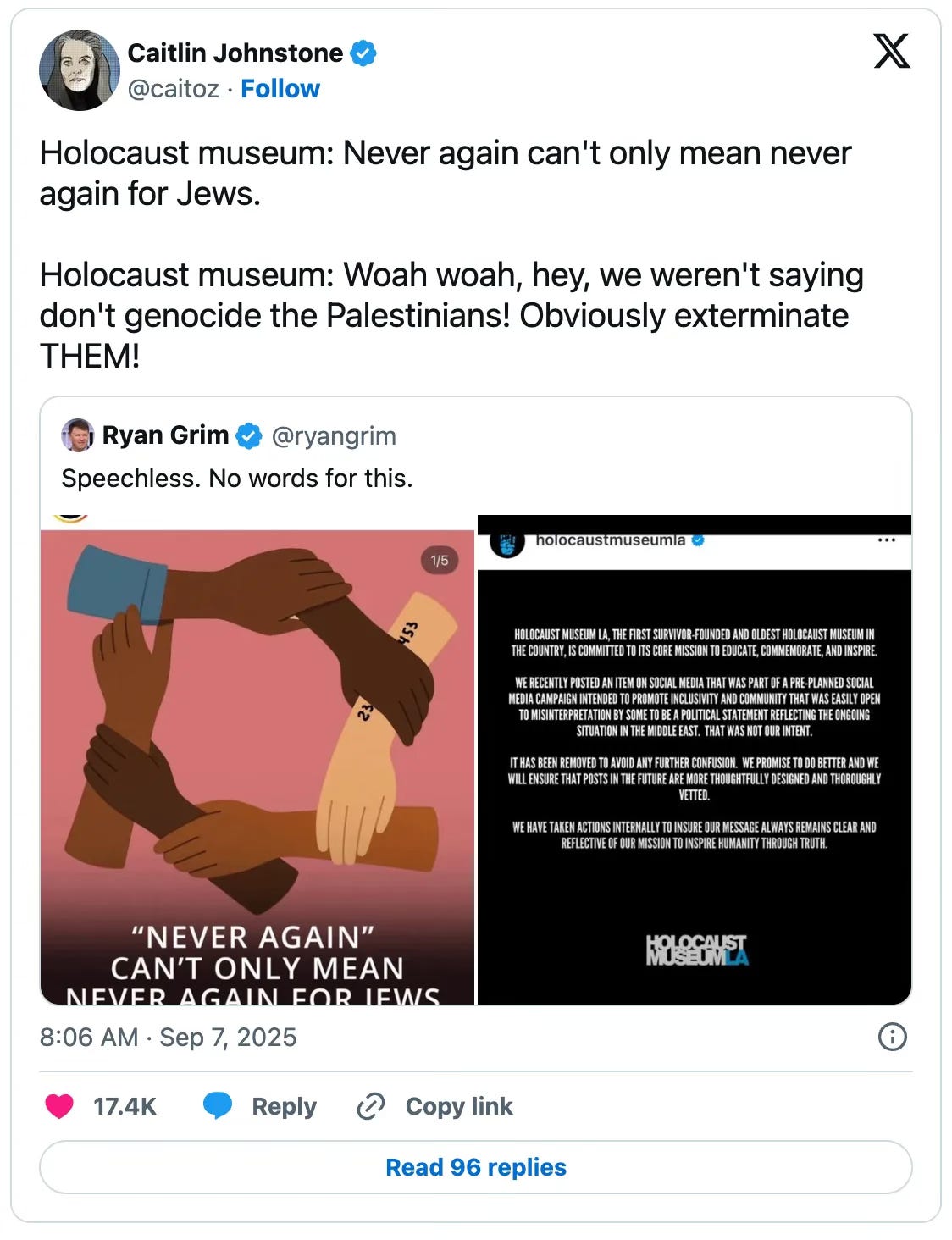
The LA Holocaust Museum recently suggested that “Never Again” is a fundamental lesson of the Holocaust. Then they took it back. Here’s the (almost) inconceivable story from Caitlin Johnstone:
Israel supporters are so crazy and evil that the Los Angeles Holocaust Museum recently retracted a statement saying “Never again can’t only mean never again for Jews” after objections from Zionists.
The museum issued a statement saying, “We recently posted an item on social media that was part of a pre-planned social media campaign intended to promote inclusivity and community that was easily open to misinterpretation by some to be a political statement reflecting the ongoing situation in the Middle East. That was not our intent. It has been removed to avoid any further confusion.”
Think about how gross your position has to be for you to be all hey, let’s say no genocide for ANYBODY, and then immediately have to come back and clarify that you definitely weren’t saying no genocide for the Palestinians.
I’m glad that’s clear! Talk about a profile in cowardice.
Then there are those who get testy about applying the word “genocide” to events in Gaza. Their distorted mouth noises sound something like this: Israel is at war with terrorists (Hamas) and *only* 70,000 or so Palestinians are dead so it’s not really a genocide, is it? Plus it’s all their fault because of October 7th, end of story.
For what it’s worth, I taught the Holocaust as a professor of history after attending a seminar at the US Holocaust Memorial Museum. Also, if it means anything, I’m Catholic, retired military, with no particular axe to grind.
Yes, it’s a genocide in Gaza. A holocaust in slow motion. Heck, Israeli leaders have freely confessed their goal is a final solution to the Gaza question, mainly by killing many Palestinians while forcing the rest to leave. (Whether they’ll have any place to go remains to be seen.)
There is no one model of genocide, and definitions also vary. But if what’s happening in Gaza isn’t a genocide, I don’t know what other word applies. Mass murder, perhaps? Extermination, but slowly? Ethnic cleansing and mass death followed by mass expulsion? That is genocide, plain and simple.
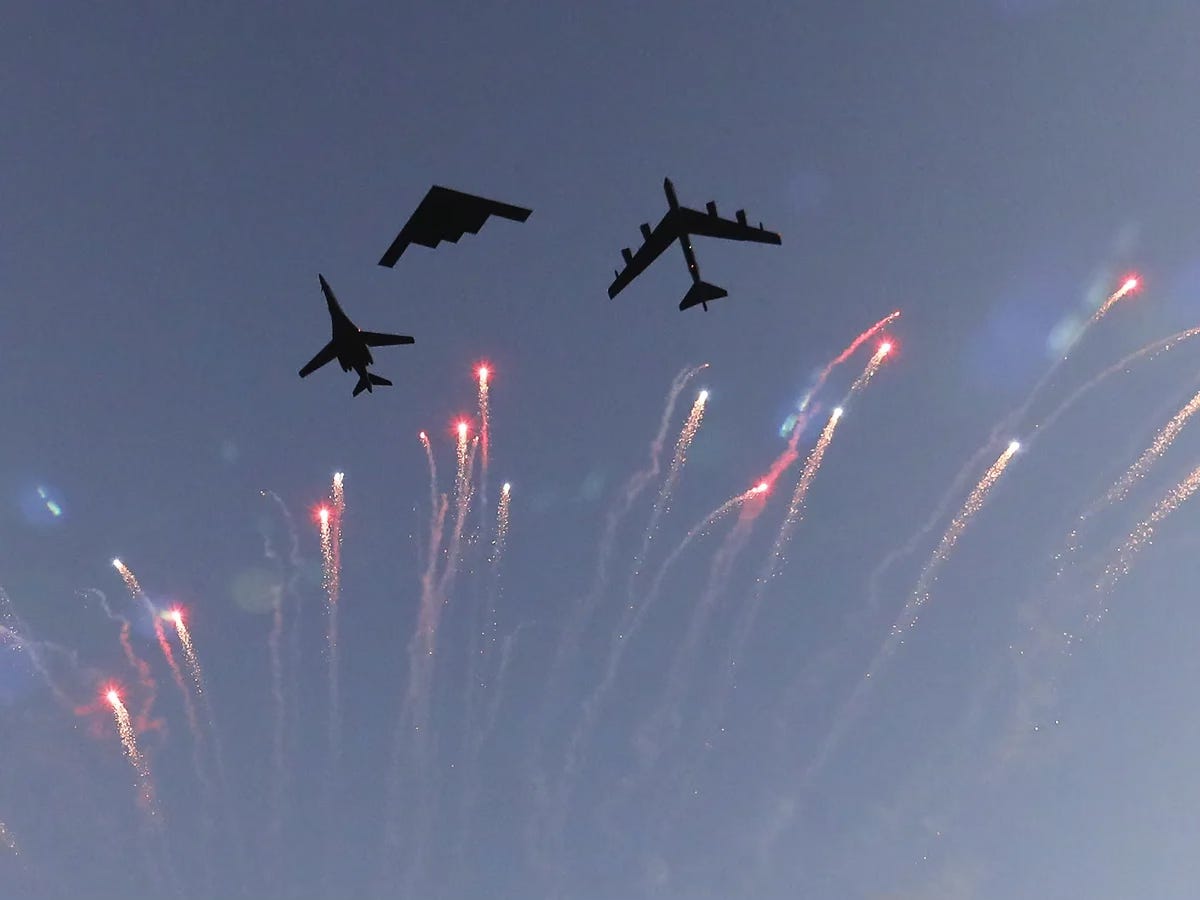
There’s a full slate of NFL football games today, meaning there’ll be a full slate of military flyovers and similar ceremonies to “support” our troops. The militarization of sports in America is something to behold, and a new report that tackles the issue is available from a series on “Consuming War” at Brown University. Here’s the link.
It put me to mind of an article I wrote for Huff Post back in 2011. Fourteen years later, the unholy alliance between sports and the military has only deepened.
Here’s what I wrote in 2011. What do you think, readers? Will we ever learn to play ball again without all the military trappings?
America!
The Militarization of Sports — And the Sportiness of Military Service
The co-joining of corporate-owned sports teams and events with the military strikes me as more than disturbing. We’ve created a dangerous dynamic in this country: one in which sporting events are exploited to sell military service for some while providing cheap grace for all.
Writer, History Professor, Retired Lieutenant Colonel (USAF)
Jul 28, 2011, 01:19 PM EDT
Updated Sep 27, 2011
Connecting sports to military service and vice versa has a venerable history. The Battle of Waterloo (1815) was won on the playing fields of Eton, Wellington allegedly said. Going over the top at the Battle of the Somme (1916), a few British soldiers kicked soccer balls in the general direction of the German lines. American service academies have historically placed a high value on sports (especially football) for their ability to generate and instill leadership, teamwork and toughness under pressure.
But in today’s America, we are witnessing an unprecedented militarization of sports, and a concomitant emphasis on the sportiness of military service. With respect to the latter, take a close look at recent Army recruitment ads (which I happen to see while watching baseball). These ads show soldiers lifting weights, playing volleyball, climbing mountains and similar sporty activities. The voice-over stresses that army service promotes teamwork and toughness (“There’s strong. Then there’s armystrong.”) There are, of course, no shots of soldiers under direct fire, of wounded soldiers crying for help, of disabled veterans. Army service in these ads is celebrated as (and reduced to) an action-filled sequence of sporting events.
Today’s militarization of sports is even more blatant. Consider this excellent article by U.S. Army Colonel (retired) Andrew Bacevich, which highlights the “cheap grace” available to crowds at major sporting events. For-profit sports corporations and the Pentagon join hands to orchestrate pageants that encourage (manipulate?) us to cheer and celebrate our flag, our troops and our sports and military heroes, as the obligatory fighter jets roar overhead.
Now, I’m sure there are well-meaning people who see such pageantry as an uncontroversial celebration of love of country, as well as a gesture of generosity and thanks to our military. And this retired veteran admits to feeling my heart swell when I see our flag flying proudly and our troops marching smartly. But the co-joining of corporate-owned sports teams and events (which are ultimately about entertainment and making a buck) with the military (which is ultimately in the deadly business of winning wars) strikes me as more than disturbing.
To cite only one example: The San Diego Padres baseball team takes “tremendous pride” in being “the first team in professional sports to have a dedicated military affairs department,” according to a team press release quoting Tom Garfinkel, the Padres president and chief operating officer. But is it truly “tremendous” for sports teams to be creating “military affairs” departments? As our sporting “heroes” celebrate our military ones, does not a dangerous blurring take place, especially in the minds of America’s youth?
War is not a sport; it’s not entertainment; it’s not fun. And blurring the lines between sport and war is not in the best interests of our youth, who should not be sold on military service based on stadium pageantry or team marketing, however well-intentioned it may be.
We’ve created a dangerous dynamic in this country: one in which sporting events are exploited to sell military service for some while providing cheap grace for all, even as military service is sold as providing the thrill of (sporting) victory while elevating our troops to the status of “heroes” (a status too often assigned by our society to well-paid professional athletes).
Which brings me to a humble request: At our sporting events, is it too much to ask that we simply “Play Ball?” In our appeals for military recruits, is it too much for us to tell them that war is not a sport?
Think of these questions the next time those military warplanes roar over the coliseum of your corporate-owned team.
Welcome back, everyone. I hope you enjoyed Labor Day Weekend.
It’s grim times in America. Perhaps grimmest of all is the U.S. government’s support of genocide through mass killing and starvation in Gaza. “Never again” was the message of the Holocaust, not “Yes, again” if it benefits Zionists in Israel.
Americans, in the main, are against mass killing (at least, I hope we are), but what does it matter when all 100 senators take money from AIPAC and the Trump administration is rabidly pro-Israel? “Our” government isn’t ours; the man who gets what he wants with the loudest applause is Bibi Netanyahu. Talk about foreign interference in America’s elections and governance!
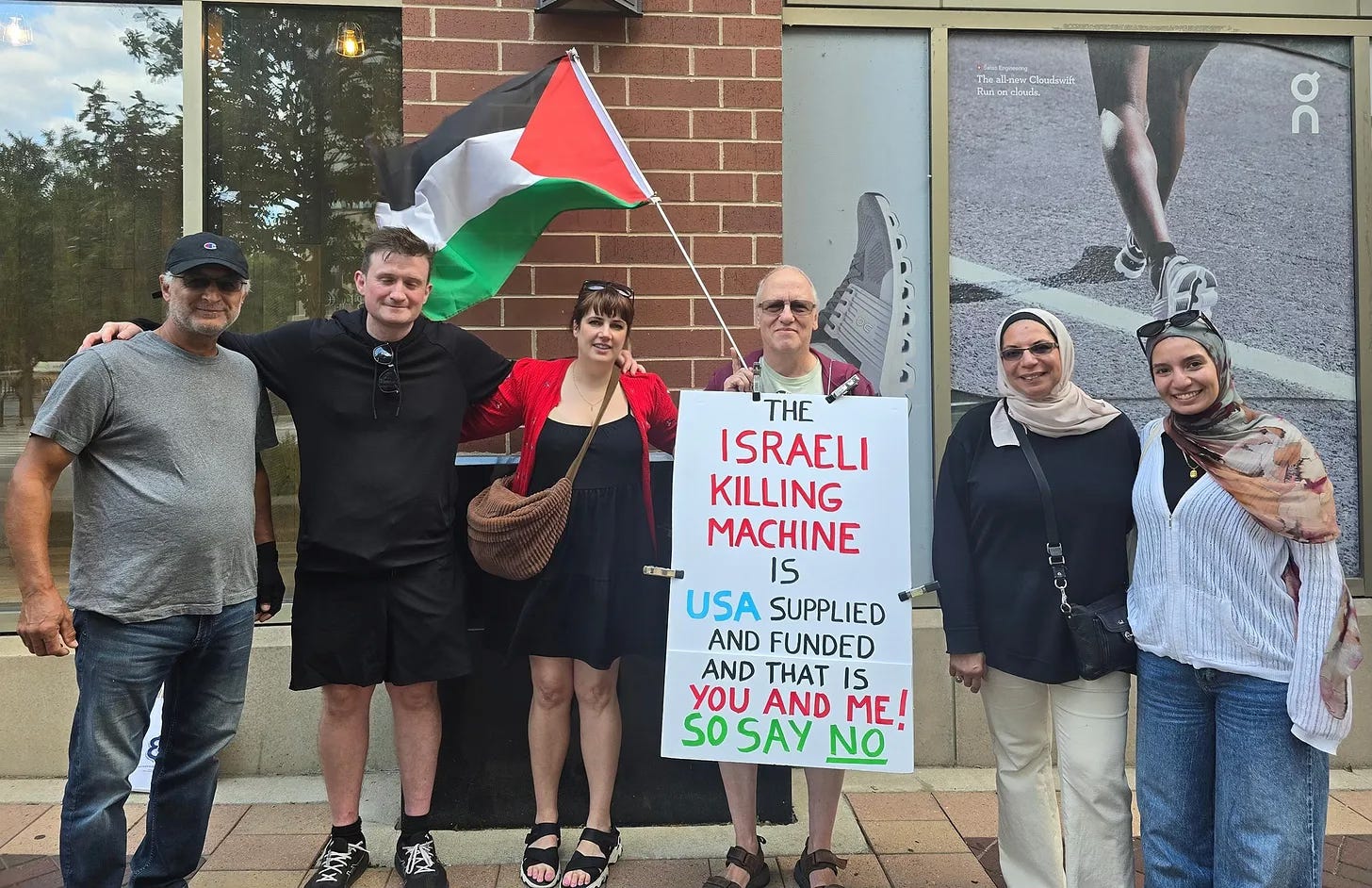
Courtesy of Lisa Savage at her Substack site
Why is it so hard for Americans to come together in sensible ways? A decade ago, I wrote about how we’re kept divided, distracted, and downtrodden. The letter D truly is for defective and deficient—disastrous as well—but permit me a little exercise in alliteration as I expand my D list to seven, as in the 7 habits of a highly defective country.
1. Divided: Are you Republican or Democrat? Red or Blue? MAGA or “libtard”? Woke or Anti-woke? Cis white male or BIPOC? Pro-life or Pro-choice? There are far too many labels and efforts that end in division. And we know how rulers use division to conquer.
2. Distracted: Wherever you look, Americans are bombarded with distractions, starting with the screens we carry everywhere with us. The Romans had bread and circuses; we have junk food, NASCAR, and the NFL. Curl up before that 75-inch TV and chow down.
3. Downtrodden: When you’re working 50+ hours a week, straining to make ends meet, suffering from high health care costs, student loan debt, and so on, it’s hard to pay attention to what’s going on in Washington—and even harder to act against it.
4. Discontented: Paradoxically, the discontentment so many of us feel is not resulting in significant political action. Instead, it’s being channeled in counterproductive ways. Consumer goods and drugs from big pharmaceutical companies are offered as palliatives to “cure” our discontentment. We buy more, or pop more pills, but contentment remains elusive.
5. Duopoly: Sure, Democrats and Republicans aren’t exactly the same. But when it comes to war, foreign policy, weapons sales, serving Israel, favoring billionaires, kowtowing to the big banks and Wall Street, and genuflecting to corporations, both parties are virtually indistinguishable. Both also work together to quash third parties. Small wonder that the largest voting bloc in America is Independent/Non-aligned.
6. Discouragement: Faced with that grim fact—a government completely unresponsive to ordinary people—Americans are discouraged from acting in dynamic and outspoken ways. Also serving to discourage political action is America’s increasingly militarized streets, now occupied with agents from Homeland Security and even armed members of the National Guard.
7. Despair: Remember “hope and change” Barack Obama and the surging idealism of 2008? Those were the days. Now it seems the mantra is “no hope” and change that only makes matters worse. This contributes to despair, our sense of hopelessness and helplessness before impersonal government forces—and this is deliberate. A weaponizing of despair.
So, what is to be done? On the small scale, get involved. Get educated. Follow protesters like Lisa Savage and Clif Brown. Small acts of protest can be contagious.
Clif Brown, taking a stand and sending a message
I do my thing here on Substack and belong to organizations like the Eisenhower Media Network and Space4Peace (The Global Network Against Weapons and Nuclear Power in Space). Since 2007, I’ve written against militarism and war at TomDispatch.com and similar alternative sites. Do what you can, what matches your talents, even if it’s just talking to your family, your friends, your neighbors about your concerns. (Believe me, that isn’t always easy!)
Maybe it’s easier to say where the answer isn’t coming from. It’s not coming from Democrats or Republicans. It’s not coming from Congress. It’s not coming from the richest among us, nor from corporate and financial elites.
Fundamentally, the first big step we need to take as a country is publicly funded elections. No more lobbyists. No more “legal” bribes. That requires a reversal of the SCOTUS Citizens United Decision. It requires legislation or a Constitutional amendment.
How to force that when war and weapons are bipartisan? When the powers that be are more than happy with the status quo? Probably only through mass organizations and protest. Or perhaps the creation of a viable third party–but that will be staunchly resisted by the duopoly (the Dems and Repubs).
The short answer is we need a lot more profiles in courage to counter the profiles in pusillanimity produced and elevated within a corrupt system.
The system as it exists today seems unreformable and unstoppable, but history teaches us that sometimes a crack can widen to a fault that leads to an earthquake quickly and unpredictably. So the only recourse is to keep fighting, to keep the pressure on, hoping those cracks will indeed lead to something greater.
Apathy and surrender are not options. Discouragement and despair mustn’t be our end state. Take inspiration from people like Lisa and Clif, the writing of people like Chris Hedges, and sites like Antiwar.com.






 Bracing Views