Just what we need: autonomous killer drone swarms powered by algorithms and AI.
Part 3 of the excellent Al Jazeera documentary The Business of War focuses on Israel’s use of killer drones in Gaza. The trend is toward “fully autonomous weapons”—drone swarms that rely on algorithms to identify targets to hit and humans to kill. Officially, a human is still supposed to make the final decision to strike, but in some cases the operator has only 20 seconds to give a “go” or “no go.” And, let’s be honest, the system drives operators toward “go.”
The documentary is especially powerful in showing the devastation in Gaza (images of Stalingrad in World War II come to mind), the deliberate killing of journalists (a war crime), and how drones are used not just for killing but as tools of intimidation and control.
Images of AI-enabled drone swarms chasing and killing people recall scenes from the Terminator films. But as the documentary notes, the danger right now isn’t some future Skynet—it’s how these drones have already emerged as “new forms of domination and oppression.”
Almost as troubling is the military-corporate fusion as these drone swarms are supported by “cloud” resources supplied by Amazon, Google, and Microsoft. A new conceit boasts of Israel as an “AI superpower,” even as corporations make a killing in profits.
All this technology, all this high-tech prowess, is fueling a holocaust in Gaza. Eisenhower warned us in 1953 that humanity might crucify itself on a cross of iron. Looking at today’s autonomous weapons, perhaps we’ve chosen a different cross—one made of silicon.
Last Tuesday, I appeared again on Judge Napolitano’s show. We talked about the Russia-Ukraine War and President Trump’s efforts to foster a peace deal, as well as the so-called Deep State and (briefly) the CIA.
The show’s lede raises a provocative question: Can America be rid of the CIA? Anything is possible in theory; the problem is the sprawling size and enormous power of the so-called intelligence community, or IC. (This idea of “community” was already a euphemism in the 1970s, as the movie “Three Days of the Condor” reveals; I’ve always liked how Robert Redford’s character scoffs at the “community” conceit.)
There are eighteen (18!) agencies that make up the IC with a combined yearly budget just north of $100 billion. For all that spending on intelligence, America has not fared well in recent wars in places like Iraq and Afghanistan. A bureaucracy of that size and reach is difficult to corral and control, especially since its budget keeps rising. Threat inflation is a major component of these rising budgets; you’re not going to get a threat assessment from the IC that says, well, actually, America’s pretty safe, let’s spend money on infrastructure, education, and social uplift.
As Chuck Schumer once said about Trump’s efforts to challenge the IC, the community has “six ways from Sunday” to get back at the president. That is, of course, more than worrisome. POTUS is supposed to command the IC; the IC is supposed to serve the president while upholding the U.S. Constitution. The IC shouldn’t scheme to “get back” at the president—any president.
My guess is that Trump has learned that lesson from Schumer. He’s appeasing the IC by giving it more and more money. Meanwhile, a Trump loyalist, Tulsi Gabbard, is trying to exert a measure of control as DNI, or Director of National Intelligence. I can’t imagine the in-fighting going in within the “community” as Gabbard releases files that suggest elements within the IC put their thumbs on the scale against Trump’s runs for president.
Eighteen agencies, $100 billion, and less than impressive results suggest a deep state that is out of control and in urgent need of major reform. Meanwhile, Edward Snowden’s revelations show a power structure that is more than willing to illegally spy on and surveil Americans.
For democracy to prosper, Americans need privacy and the government should be transparent to and controllable by the people. Instead, the IC is shrouded in secrecy and Americans are the ones whose lives are transparent to and controllable by the IC.
Of course, I’m not suggesting the IC is peeking under every door—unless you’re some kind of crazy dissident who believes genocide is wrong and the military-industrial complex is dangerous. You know—someone like Dwight D. Eisenhower.
The business of nuclear weapons is booming in the U.S., as Part II of a documentary on the military-industrial complex reveals. It’s well worth a few minutes of your time:
The documentary is especially strong in its focus on the Sentinel ICBM program, the least survivable leg of the nuclear triad. I didn’t know, for example, that Northrop Grumman has already spent $220 million lobbying for the Sentinel. Meanwhile, the projected cost of the Sentinel system, the documentary points out, has mushroomed from $78 billion to $140 billion. And I see estimates today have risen to $160 billion. All this for a system that’s not needed. Land-based ICBMs should be retired, not replaced.
Because land-based ICBMs represent a fixed target (unlike bombers and submarines, the other two legs of the triad), they are likely to be attacked first in a nuclear war, contributing to a “launch on warning (of attack)” mentality. But with warnings of nuclear attacks being both uncertain (false alarms have occurred in the past) and “time-sensitive,” i.e. urgent and pressure-packed, it’s likely a U.S. president, faced with a crisis, would only have 5-10 minutes to decide whether to launch ICBMs.
As the U.S. prepares to spend as much as $1.7 trillion on upgrading the triad, more money is also being dedicated to low-yield nuclear weapons, lowering the threshold for going nuclear. An escalatory spiral could follow from any use of nuclear weapons, but that concern doesn’t seem to trouble advocates for so-called tactical nukes.
Even as President Trump in the past has bragged about the size of his nuclear button, he does appear to view nuclear weapons as awful things, which they are. They are genocidal weapons. In essence, America is “investing” $1.7 trillion in weapons that are genocidal, indeed ecocidal, for any “general exchange” of nuclear weapons in a future war would destroy most life on earth (blast and heat, followed by radiation and nuclear winter).
As the Outlaw Josey Wales once mused, “Dyin’ ain’t much of a living.” The same applies to mass dying.
AI, of course, stands for artificial intelligence, and I’ve played with it here at Bracing Views. I’ve used ChatGPT and DeepSeek to write critical essays on the military-industrial complex, critiquing the results in my posts. Overall, I was impressed—and glad that I no longer have to wade through student essays completed outside of class.
I stopped teaching eleven years ago, before AI was available. Of course, the Internet was, and I did have students who cut and paste from sources online. Usually, I could tell; I would do a search using a “student” passage that just sounded a bit too good, and often whole paragraphs would come up that the student lazily cut and pasted into an assignment as their own work. Those were easy papers to grade. F!
Today’s AI programs make this more difficult. If I were teaching today, I’d assign fewer essays outside of class, and I’d probably bow to reality and allow students to use AI to help clarify their arguments.
The challenge remains: In this new world of AI, how do you evaluate student performance in a humanities course where research and writing skills are important, along with some command of the facts and an ability to think critically about them?
I’d likely employ a mix of the old and new. Standard exams—the usual multiple choice, short answer, written essay, all completed in the classroom—still have a role. But I’d incorporate AI too, especially for class discussion.
Consider, for example, debating the merits (and demerits) of the military-industrial complex. AI can easily write short essays both in favor and against (or even an essay that examines the pros and cons of the MIC). Those essays could then be used in class to tease out the complexities of the MIC, and how evidence can be used (manipulated?) to tell vastly different stories.
Another example: Should atomic bombs have been used at Hiroshima and Nagasaki? Again, AI can easily write essays in favor, or against, or “neutral” (pros and cons again). Those short essays could then form the basis for class discussion and further debate.
In a way, AI is a selective manifestation of evidence that is already out there. And there’s the rub. Who’s doing the selecting? Who’s writing the algorithms? Which evidence is being favored and which is being suppressed or disregarded?
AI, as I understand it, uses algorithms that favor certain kinds of evidence over other kinds. Generally speaking, AI favors “official” sources, e.g. government documents, mainstream media reporting, scholarly think tanks with credentials, and so on.
Alternatively, it’s possible AI could gather information from less than reputable sources. Again, what algorithms are being used? What are the agendas of those behind the AI in question?
To students, AI is something of a black box. It spits out answers without a lot of sourcing (unless you specifically ask for it). Students in a hurry may not care—they just want answers. But as Tom Cruise demands In A Few Good Men: “I want the truth.” What happens when AI Colonel Jessup decides, “You can’t handle the truth” and feeds us convenient half-truths and propaganda. Will students even care? Will they have the skills to recognize they’re being misled? Or that they’re not getting the full story?
That’s what I worry about. Students who simply accept what AI has to say. Not that they learned nothing—but that they learned exactly what they were programmed to learn. Strangely, in this scenario, the students themselves are reduced to automatons. And I don’t think most students want to be unthinking robots for the Man.
Or do they?
Postscript: Over at his new Substack site, Mike Neiberg is tackling AI and the humanities. Check it out at michaelneiberg.substack.com.
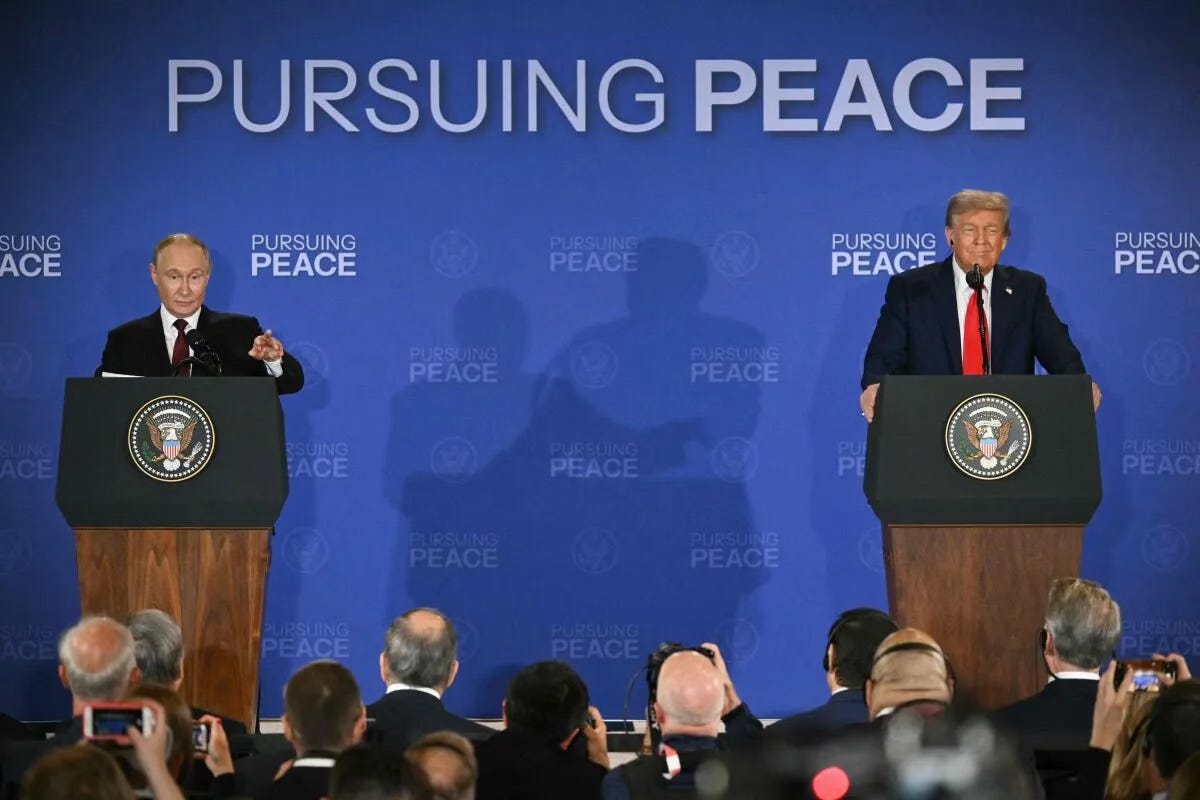
I’m glad President Donald Trump met with his Russian counterpart, Vladimir Putin, in Alaska. No country possesses more nuclear warheads than Russia, so dialogue is essential. As Churchill once allegedly observed, “jaw-jaw” is better than “war-war,” especially when nuclear weapons and humanity’s fate are at stake.
Unsurprisingly, the two leaders announced no breakthrough on ending the Russia-Ukraine War. Still, the fact they were talking matters. They even floated the idea of a second meeting in Moscow. Putin quipped about it; Trump replied that he might “take some heat” for visiting the Kremlin. Innocuous banter, yes—but I’ll take that over nuclear threats any day.
Pursuing peace—but not yet finding it.
The transcript of their closing remarks made for revealing reading. Putin spoke first, striking an amicable and measured tone. He invoked the U.S.-Soviet alliance of World War II, when both nations fought a common enemy. His words were thoughtful, cautious, above all diplomatic. He repeatedly emphasized the “businesslike” nature of the meeting, framing his approach as pragmatic and respectful—an approach likely to resonate with Trump, the self-proclaimed master of “the art of the deal.” Putin’s message, in essence, was: I’m someone you can do business with.
Trump’s remarks, by contrast, were more improvisational, filled with his trademark superlatives. Putin’s words, he said, were “very profound,” the meeting itself “very productive,” and the progress “great.” He even declared his relationship with Putin “fantastic.” That may be fantasy, but better that than animosity and hostility.
One passage from Trump’s comments stood out as both peculiar and revealing:
I would like to thank President Putin and his entire team—faces I know in many cases, faces I see all the time in the newspapers. You’re almost as famous as the boss—especially this one right over here. But we have had good, productive meetings over the years, and I hope to have more in the future.
That offhand line about Putin’s advisers being “almost as famous as the boss,” and about seeing their faces “all the time in the newspapers,” points to Trump’s obsession with fame. For Trump, people seem to matter only if they are celebrities. Recall his boasts about his own face appearing on the cover of Time magazine. His ego and craving for recognition make him vulnerable to manipulation. Unless you’re “famous”—someone whose picture appears regularly in the media—you scarcely exist in his world.
Trump’s deep need to be respected by other famous figures serves as a way to affirm his own worth. The danger, of course, is where that need might lead him—and the country.
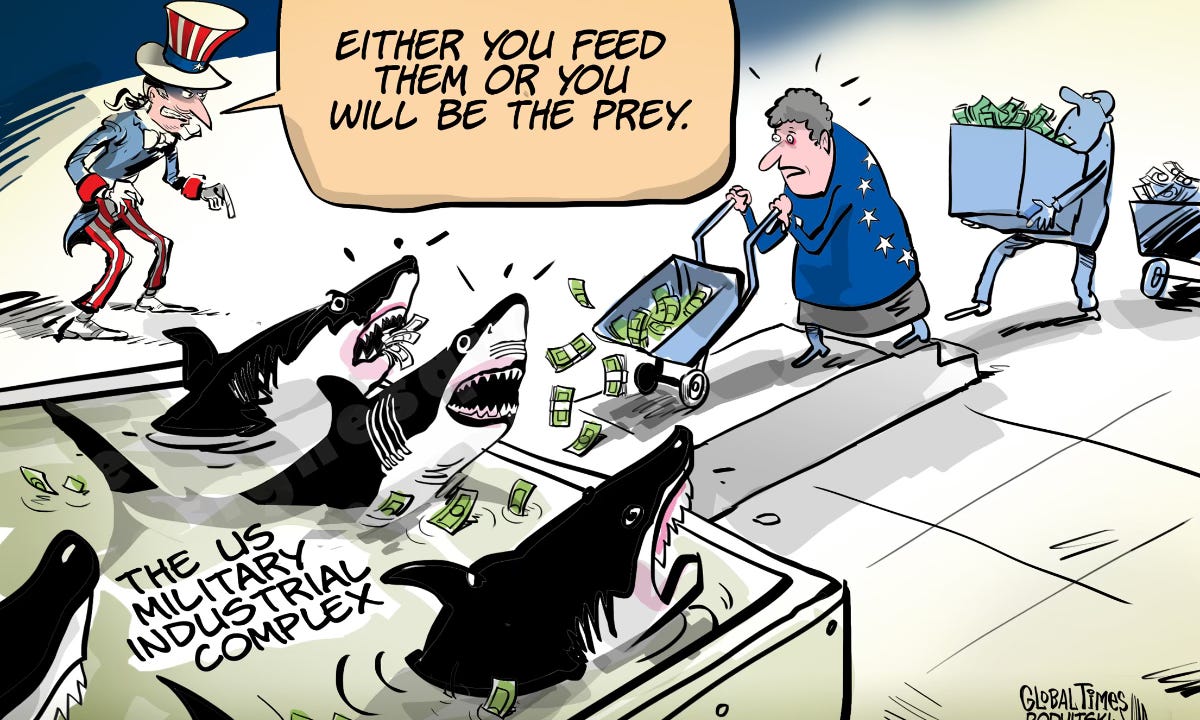
America’s war budget now exceeds $1 trillion a year—an almost unimaginable sum.
The Pentagon plans to spend $1.7 trillion “modernizing” a nuclear triad that should instead be downsized. A proposed “Golden Dome” missile defense system may cost $500 billion while making nuclear war more likely. And a “new” Cold War with China and Russia is already underway, with threat inflation as one of its defining features.
With military spending so high—and the military so valorized—Washington offers it as the solution to nearly everything: crime in D.C., eliminating drug cartels south of the border, containing China and Russia, “winning” in Somalia, preventing Iran from acquiring nuclear weapons—the list is endless. Supporting and defending the Constitution, however, is rarely mentioned.
War has become America’s new normal. “Peace” is now a word that dare not speak its name. According to the Pentagon, the only peace worth pursuing is “peace through [military] strength.” A warrior ethos is marketed as if it were synonymous with democratic virtue.
I once called for a 10% reduction in Pentagon spending. That’s no longer enough. We need a 50% cut—we need a military dedicated to genuine national defense, not imperial dominance. Surely we can protect America for $500 billion a year rather than the $1 trillion we’re spending now.
Changing the narrative is crucial. Why do we need 750+ bases overseas? Why expand our nuclear arsenal when we already have 5,000 warheads? We don’t need these things—they are the hallmarks of wasteful militarism. They escalate tensions, endanger us, and drain the nation’s wealth.
And why do we have 17 or 18 intelligence agencies? Despite all that intelligence, we still lost in Vietnam, Iraq, and Afghanistan. Where is the accountability? Why are no generals relieved of command for such failures? In fact, they’re more likely to fail upwards.
“All governments lie,” as I.F. Stone warned. Combine that with the truth that war’s first casualty is truth itself, and you begin to see the rot in America today. Perpetual war fuels deception and government overreach. Almost anything can be justified when the cry is, “We’re at war!”—even when the reasons for going to war are false.
Consider the Gulf of Tonkin incident—revealed later as phony—and the Pentagon Papers during the Vietnam War. Consider Iraq’s mythical WMDs. Consider the lies revealed in the Afghan War Papers. Consider the weasel words of generals like David Petraeus, forever hedging “gains” as “fragile” and “reversible.” Consider the U.S. military’s record since World War II—generally ineffective because there’s been little accountability for failure. (And yes, civilian leaders share the blame.)
The military-industrial complex grows ever more powerful, sidelining the American people while democracy withers.
Something is rotten in the States of America.
Many thanks to Judge Napolitano for asking me to discuss some of these issues on his show, “Judging Freedom.”
President Trump’s decision to federalize the police in DC and to deploy National Guard troops there is in keeping with creeping authoritarianism—and just plain creepiness as well. Increasingly, Trump seems to think he can rule by emergency decree—where have I seen this before in history? One example: Weimar Germany followed by Hitler’s assumption of power in 1933, which led to more emergency decrees in the alleged cause of law and order.
I was asked for a comment this AM about Trump’s decision and I came up with this:
Trump is an authoritarian. We knew this in 2016 when he said during a debate he expected the military to follow his orders irrespective of their legality. Trump is also an opportunist. He knows “tough action” against crime will play with his base, even though crime rates in DC have been declining. He’s manufacturing a crisis to consolidate his power.
Finally, this is what happens when you spend $1 trillion on the military. It becomes the “solution” to every problem, whether it’s crime in DC, drug cartels south of the border, civil strife in Somalia, or potential nuclear proliferation with Iran. Yet history shows the deployment of military forces, especially in situations for which they’re not trained, aggravates problems instead of alleviating them.
Readers, what do you make of all this? One thing is certain: Before exporting more “democracy” to the rest of the world, America would do well to address its own shrinking and disappearing version of the same.
Soon, America’s democracy may well be invisible—vanished. Poof!
It’s well worth a few minutes of your time to watch the first episode of this series on the military-industrial complex and its enormous reach and power, especially in American society.
I remember when I used to see thoughtful series like this on Frontline. Occasionally, you’d see critical reports on the mainstream media: I’m referring here to the 1970s and 1980s and shows like “60 Minutes” and “20/20.” Those days, dear reader, are long gone.
It’s rather amazing that Americans have to look to Al Jazeera for critical and sensible reporting on our very own military-industrial complex. Remember what Ike warned us about in 1961? Remember when he challenged us to remain alert and knowledgeable? America, we have a trillion-dollar “pentagon of power” to monitor—and we’re not doing the greatest job at it, are we? In fact, that pentagon of power is doing a far better job at monitoring us.
Indeed, when our mainstream media covers the Pentagon, it usually relies on retired generals and admirals, who often have unreported conflicts of interest (they may sit on corporate boards of weapons contractors, for example, or even get their talking points handed to them by the Pentagon). Let’s just say you rarely hear a negative word about the MIC in this very much unbalanced and biased coverage.
I see that YouTube is cautioning us that Al Jazeera is partially funded by the Qatari government. The horror!
Anyway, Al Jazeera is promising three more episodes in the series, the next one on America’s $1.7 trillion “investment” in new nuclear weapons. Should be sobering.
With an ongoing genocide in Gaza and a dangerous war between Russia and Ukraine, who has the time to look to Africa? As we said when I was still in the military, I need to get smart on this.
Coverage of America’s military adventurism/fiascos in Africa is difficult to come by. Fortunately, there’s Nick Turse at The Intercept, whose latest article is entitled:
PENTAGON: U.S. COUNTERTERRORISM EFFORTS HAVE FAILED AFRICANS
A new Pentagon report sheds light on AFRICOM’s disastrous counterterrorism campaigns.
I know Nick Turse from his days at TomDispatch, so I sent him this note in response to his article:
Bombing worked so well to win the war in Indochina — so why not bomb in Africa?
It seems like the goal is permanent war — you throw gasoline on it with all the weapons exports and drone strikes. And they work — war continues.
I guess that’s my obvious take — pay no attention to their words, watch instead what they do. It’s just war and more war. Given that AFRICOM is a military command, should we be surprised that the “solutions” are always violent ones?
That seems to be the U.S. “strategy” in Africa: bomb the “terrorists” while exporting more weapons related to military “assistance” (the building of indigenous African forces ostensibly allied to the U.S.). Again, it’s a strategy that worked so well in Indochina in the early 1960s …
Unfortunately for Somalia, it occupies a strategic position in the Horn of Africa. The U.S. has a major military base in Djibouti.
Besides the perpetuation of war there, I don’t know what the U.S. government is up to in Africa. The mainstream media rarely discusses it. I assume control of scarce resources is a major goal. Also, the military-first AFRICOM approach to the area ensures higher profits for and more power to the military-industrial complex. Geographically, the Horn of Africa is vital to the control of sea and trade routes. Proximity to Yemen, Saudi Arabia, and the Red Sea is obvious.
In short, I’m exposing my own ignorance as a way of encouraging all of us to get a bit smarter about what our government is up to in Africa. According to the Pentagon’s own sponsored report, it’s not going well. Here’s the kicker from Turse’s article:
“Africa has experienced roughly 155,000 militant Islamist group-linked deaths over the past decade,” reads a new report by the Africa Center for Strategic Studies, a Pentagon research institution. “Somalia and the Sahel have now experienced more militant Islamist-related fatalities over the past decade (each over 49,000) than any other region.”
“What many people don’t know is that the United States’ post-9/11 counterterrorism operations actually contributed to and intensified the present-day crisis and surge of violent deaths in the Sahel and Somalia,” Stephanie Savell, director of the Costs of War Project at Brown University, told The Intercept, referencing the frequent targeting of minority ethnic groups by U.S. partners during counterterrorism operations.
The U.S. provided tens of millions of dollars in weapons and training to the governments of countries like Burkina Faso and Niger, which are experiencing the worst spikes in violent deaths today, she said. “In those critical early years, those governments used the infusion of U.S. military funding, weapons, and training to target marginalized groups within their own borders, intensifying the cycle of violence we now see wreaking such a devastating human toll.”
Terrorist groups are also gaining ground at an exponential rate. “The past year has also seen militant Islamists [sic] groups in the Sahel and Somalia expand their hold on territory,” according to the Africa Center. “Across Africa, an estimated 950,000 square kilometers (367,000 square miles) of populated territories are outside government control due to militant Islamist insurgencies. This is equivalent to the size of Tanzania.” And as militant groups have expanded their reach, Africans have paid a grave price: a 60 percent increase in fatalities since 2023, compared with deaths from 2020 to 2022, according to the report.
As Turse notes, U.S. special forces deployed to Somalia soon after 9/11 as part of the global war on terror (or, if you prefer, the global war of terror). More than two decades of U.S. military strikes (and strife) in the area have only made matters worse. Can we as a nation stand for more of this “success”?
I think the U.S. strategy in Africa is to continue on the same course while suppressing the news of our failures there. Our influence in the region, such as it is, is military-driven, i.e. various African leaders want our weapons and money but little else (because we have little else to offer).
So, all our military leaders can boast of in the region is colossal air strikes. Did you know we used 60 tons of bombs to kill 14 militants in Somalia last February? Victory indeed will soon be ours … if you define “victory” as rising profits for the bomb-makers.
Readers, help me out. If any of you are following America’s war in Africa, I welcome your insights.
Hello Everyone: Here’s my latest article at TomDispatch.com. Whereas my articles for BV are usually 400-600 words, my articles for TomDispatch are usually just over 2000 words, which allows me to develop my points further, supported by plenty of links. Oh, and my wife and I really do use the expression, “But Bibi needs bombs,” whenever the government says it can’t fund something for the American people. It’s funny but I’ve never heard anyone in Congress ask: Bombs for Bibi—how are you going to pay for that? America’s bipartisan warmongers always find plenty of money for weapons and war, even as money for health care and other needs evaporates. It’s almost as if America has a powerful military-industrial complex combined with pushy lobbying groups like AIPAC.
*****
As a retired U.S. Air Force officer, I firmly believe in civilian control of our military. This country should be a nation of laws — not of special interests, oligarchs, or kings. Before committing our forces to battle, Congress should always declare war in the name of the people. Our military should indeed be a citizen-soldier force, not an isolated caste driven by a warrior ethos. And above all, the United States should be a republic ruled by law and shaped by sound moral values, not a greed-driven empire fueled by militarism.
Yet when I express such views, I feel like I’m clinging to a belief in the tooth fairy, the Easter Bunny, and Santa Claus. It feels idealistic, naïve, even painful to think that way. Yes, I served this country in uniform for 20 years, and now, in the age of Donald Trump, it has, as far as I can tell, thoroughly lost its way. The unraveling began so long ago — most obviously with the disastrous Vietnam War of the 1960s and 1970s, though in truth this country’s imperial desires predated even the Spanish-American War of 1898, stretching back to the wanton suppression of indigenous peoples as part of its founding and expansion.
A glance at U.S. history reveals major atrocities: the displacement and murder of Native Americans, slavery, and all too many imperial misadventures abroad. I knew of such realities when I joined the military in 1985, near the end of the Cold War. Despite its flaws, I believed then that this country was more committed to freedom than the Soviet Union. We could still claim some moral authority as the leader of what we then referred to as “the free world,” however compromised or imperfect our actions were.
That moral authority, however, is now gone. U.S. leaders fully support and unapologetically serve an ongoing genocide against the Palestinian people in Gaza. They sell weapons to nearly every regime imaginable, irrespective of human rights violations. They wage war without Congressional approval — the recent 12-day assault on Iran being just the latest example. (The second Trump administration has, in fact, launched almost as many air strikes, especially in Yemen and Somalia, in its first five months as the Biden administration did in four years.) Those same leaders have been doing a bang-up job dismantling the America I thought I was serving when I took that oath and put on second lieutenant’s bars four decades ago. That America — assuming it ever existed — may now be gone forever.
FUBAR: A Republic in Ruins
My fellow citizens, America is FUBAR (a term that dates from World War II). We are not faintly who we claim to be. Rather than a functioning republic, we are an ailing, flailing, perhaps even failing empire. We embrace war, glorify warriors, and profit mightily from the global arms trade, no matter the civilian toll, including tens of thousands of dead and wounded children in Gaza, among the latest victims of U.S.-made bombs, bullets, and missiles.
Signs of moral rot are everywhere. Our president, who would like to be known for his budget cuts, nonetheless giddily celebrates a record trillion-dollar war budget. Our secretary of defense gleefully promotes a warrior ethos. Congress almost unanimously supports or acquiesces in the destruction of Gaza. Images from the region resemble bombed-out Stalingrad in 1942 or Berlin in 1945. Meanwhile, for more than two decades now, America’s leaders have claimed to be waging a successful global “war on terror” even as they fuel terror across the globe. What do they think all those U.S. weapons are for — spreading peace?
My wife and I cope through dark humor. We see news on cuts to Medicaid, the mentally ill in the streets, and crumbling infrastructure, and quip: “But Bibi [Netanyahu] needs bombs. Or Ukraine does. Or the Pentagon needs more nukes.” That’s why Americans can’t have nice things like health care. That’s why all too many of us are unhoused, in debt, out of work, and desperate. In 1967 — yes, that’s almost 60 years ago! — Martin Luther King warned of exactly this: America’s approaching spiritual death through militarism (aggravated by extreme materialism and racism). That death is visibly here, now.
Washington is not even faintly committed to “peace through strength,” a vapid slogan touted by the Trump administration, and an unintentional echo of George Orwell’s dystopian “war is peace.” It is committed instead to what passes for dominance through colossal military spending and persistent war. And let’s face it, that warpath may well end in the death of the American experiment.
The Mediocrity of Our Generals
In this era of creeping authoritarianism and mass surveillance, perhaps the U.S. is lucky that its generals are, by and large, so utterly uninspired. Today’s American military isn’t open to the mercurial and meteoric talents of a Napoleon or a Caesar. Not in its upper ranks, at least.
One struggles to name a truly great American general or admiral since World War II. That war produced household names like George C. Marshall, Dwight D. Eisenhower, George S. Patton, and Chester W. Nimitz. In contrast, America’s recent generals — Norman Schwarzkopf and Colin Powell of Desert Storm fame, Tommy Franks in Iraq in 2003, David Petraeus and Stanley McChrystal of the “fragile” and “reversible” Iraq and Afghan “surges” — have left anything but a legacy of excellence or moral leadership, not to speak of decisive victory. At best, they were narrowly competent; at worst, morally compromised and dangerously deluded.
Mind you, this isn’t a criticism of this country’s rank-and-file troops. The young Americans I served with showed no lack of courage. It wasn’t their fault that the wars they found themselves in were misbegotten and mismanaged. Twenty years have passed since I served alongside those young troops, glowing with pride and purpose in their dedication, their idealism, their commitment to their oath of service. Many paid a high price in limbs, minds, or lives. Too often, they were lions led by donkeys, to borrow a phrase once used to describe the inept and callous British leadership during World War I at bloody battles like the Somme (1916) and Passchendaele (1917).
Today, I fear that America’s lions may, sooner or later, be led into even deeper catastrophe — this time possibly a war with China. Any conflict with China would likely rival, if not surpass, the disasters produced by World War I. The world’s best military, which U.S. presidents have been telling us we have since the 9/11 attacks of September 2001, stands all too close to being committed to just such a war in Asia by donkeys like Donald Trump and Secretary of Defense Pete Hegseth.
And for what? The island of Taiwan is often mentioned, but the actual reason would undoubtedly be to preserve imperial hegemony in the service of corporate interests. War, as General Smedley Butler wrote in 1935 after he retired from the military, is indeed a racket, one from which the rich exempt themselves (except when it comes to taking profits from the same).
A disastrous conflict with China, likely ending in a U.S. defeat (or a planetary one), could very well lead to a repeat of some even more extreme version of Trump’s Make America Great Again campaign, amplified and intensified by humiliation and resentment. From the ashes of that possible defeat, an American Napoleon or Caesar (or at least a wannabe imitator) could very well emerge to administer the coup de grace to what’s left of our democracy and freedom.
Avoiding a Colossal Act of Folly
War with China isn’t, of course, inevitable, but America’s current posture makes it more likely. Trump’s tariffs, his bombastic rhetoric, and this country’s extensive military exercises in the Pacific contribute to rising tensions, not de-escalation and rapprochement.
While this country invests in war and more war, China invests in infrastructure and trade, in the process becoming what the U.S. used to be: the world’s indispensable workhorse. As the 10 BRICS countries, including China, expand and global power becomes more multipolar, this country’s addiction to military dominance may drive it to lash out. With ever more invested in a massive military war hammer, impetuous leaders like Trump and Hegseth may see China as just another nail to be driven down. It would, of course, be a colossal act of folly, though anything but a first in history.
And speaking of folly, the U.S. military as it’s configured today is remarkably similar to the force I joined in 1985. The focus remains on ultra-expensive weapons systems, including the dodgy F-35 jet fighter, the unnecessary B-21 Raider bomber, the escalatory Sentinel Intercontinental Ballistic Missile, and Trump’s truly fantastical “Golden Dome” missile defense system (a ghostly rehash of President Ronald Reagan’s “Star Wars” proposal, vintage 1983). Other militaries, meanwhile, are improvising, notably in low-cost drone technology (also known as UAS, or uncrewed autonomous systems) as seen in the Russia-Ukraine War, a crucial new arena of war-making where the U.S. has fallen significantly behind China.
The Pentagon’s “solution” here is to continue the massive funding of Cold War-era weapons systems while posing as open to innovation, as an embarrassing video of Hegseth walking with drones suggests. America’s military is, in short, well-prepared to fight a major conventional war against an obliging enemy like Iraq in 1991, but such a scenario is unlikely to lie in our future.
With respect to drones or UAS, I can hear the wheels of the military-industrial complex grinding away. A decentralized, low-cost, flexible cottage industry will likely be transformed into a centralized, high-cost, inflexible cash cow for the merchants of death. When the Pentagon faces a perceived crisis or shortfall, the answer is always to throw more money at it. Ka-ching!
Indeed, the recent profit margins of major military contractors like Lockheed Martin, Boeing, and RTX (formerly Raytheon) have been astounding. Since 9/11, Boeing’s stock has risen more than 400%. RTX shares are up more than 600%. Lockheed Martin, maker of the faltering F-35, has seen its shares soar by nearly 1,000%. And Northrop Grumman, maker of the B-21 Raider bomber and Sentinel ICBM, two legs of America’s “modernized” nuclear triad, has seen its shares increase by more than 1,400%. Who says that war (even the threat of a global nuclear war) doesn’t pay?
Meanwhile, the Pentagon’s war budget, soaring to unprecedented levels, has been virtually immune to DOGE cuts. While Elon Musk and his whiz kids searched for a few billion in savings by gutting education or squelching funding for public media like PBS and NPR, the Pentagon emerged with about $160 billion in new spending authority. As President Biden once reminded us: Show me your budget and I’ll tell you what you value. Far too often, America’s leaders, whatever they’ve said in their election campaigns, have valued weapons and wars over almost anything else.
What Is To Be Done
I’ve written against warriors, warfighters, and U.S. militarism since 2007. And yes, it often feels futile, but silence means surrender to warmongering fools like Hegseth, Senator Tom Cotton, and the farrago of grifters, clowns, toadies, con men, and zealots who inhabit the Trump administration and much of Congress as well. The fight against them must go on.
All leaders, military and civilian, must remember their oath: loyalty to the Constitution, not to any man. Illegal orders must be resisted. Congress must impeach and remove a president who acts unlawfully. It must also reassert its distinctly lost authority to declare war. And it must stop taking “legal” bribes from the lobbyists/foot soldiers who flood the halls of Congress, peddling influence with campaign “contributions.”
For tyranny to be stopped, for a catastrophic war with China (and who knows what else) to be avoided, America must have profiles in courage, not cowardice. Yet even despair is being weaponized. As a retired colonel and friend of mine wrote to me recently: “I don’t even know where to start anymore, Bill. I have no hope for anything ever improving.”
And don’t think of that despair as incidental or accidental. It’s a distinct feature of the present system of government.
Trump and Hegseth are not faintly what the founders of this country envisioned when they placed the military under civilian control. Yet power ultimately resides in the people (if we remember our duties as citizens). Isn’t it high time that we Americans recover our ideals, as well as our guts?
After all, the few can do little without the consent of the many. It’s up to the many (that’s us!) to reclaim and restore America.





 Bracing Views