If you have to kill 274 people to free four others being held hostage, is that a “successful” military operation? According to the Israeli and U.S. governments, it is.
Israel, apparently with some U.S. help, attacked the Nuseirat Camp in Gaza and freed four hostages seized by Hamas. In doing so, however, Israeli forces killed and wounded hundreds of unarmed men, women, and children.
It’s a brutal calculus that sees Palestinians as being “in the way” and essentially worthless and therefore expendable. Put differently, Israel sees all Palestinians in Gaza as “guilty,” as “terrorists,” therefore there are no innocent Palestinians and Israel can kill as many as they need to, without guilt or remorse, to achieve a desired end.
Coverage by the mainstream media in the West generally has been glowing, praising Israel for rescuing four hostages while downplaying the Palestinian dead as collateral damage that’s hardly worth noticing.
Here’s an example from the BBC:
You see a happy young woman freed by Israeli forces, but you don’t see any images of the more than 200 Palestinians killed by Israel in this “special military operation.” And note how the Palestinian dead are consigned to a sub-heading and a smaller font, using the passive voice (“were killed”), as if it’s unclear who killed them and why.
Yes, it’s good to see four hostages freed. But if hundreds of other innocent people must die or suffer grievous wounds in the process, that’s not a “successful” operation. It’s a massacre.
As a late-stage baby boomer, a child of the 1960s, I grew up dreaming about America’s nuclear triad. You may remember that it consisted of strategic bombers like the B-52 Stratofortress, land-based intercontinental ballistic missiles (ICBMs) like the Minuteman, and submarine-launched ballistic missiles (SLBMs) like the Poseidon, all delivery systems for what we then called “the Bomb.” I took it for granted that we needed all three “legs” — yes, that was also the term of the time — of that triad to ward off the Soviet Union (aka the “evil empire”).
It took me some time to realize that the triad was anything but the trinity, that it was instead a product of historical contingency. Certainly, my mind was clouded because two legs of that triad were the prerogative of the U.S. Air Force, my chosen branch of service. When I was a teenager, the Air Force had 1,054 ICBMs (mainly Minutemen missiles) in silos in rural states like Montana, North Dakota, and Wyoming, along with hundreds of strategic bombers kept on constant alert against the Soviet menace. They represented enormous power not just in destructive force measured in megatonnage but in budgetary authority for the Air Force. The final leg of that triad, the most “survivable” one in case of a nuclear war, was (and remains) the Navy’s SLBMs on nuclear submarines. (Back in the day, the Army was so jealous that it, too, tried to go atomic, but its nuclear artillery shells and tactical missiles were child’s play compared to the potentially holocaust-producing arsenals of the Air Force and Navy.)
When I said that the triad wasn’t the trinity, what I meant (the obvious aside) was this: the U.S. military no longer needs nuclear strategic bombers and land-based ICBMs in order to threaten to destroy the planet. As a retired Air Force officer who worked in Cheyenne Mountain, America’s nuclear redoubt, during the tail end of the first Cold War, and as a historian who once upon a time taught courses on the atomic bomb at the Air Force Academy, I have some knowledge and experience here. Those two “legs” of the nuclear triad, bombers and ICBMs, have long been redundant, obsolete, a total waste of taxpayer money — leaving aside, of course, that they would prove genocidal in an unprecedented fashion were they ever to be used.
Nevertheless, such thoughts have no effect on our military. Instead, the Air Force is pushing ahead with plans to field — yes! — a new strategic bomber, the B-21 Raider, and — yes, again! — a new ICBM, the Sentinel, whose combined price tag will likely exceed $500 billion. The first thing any sane commander-in-chief with an urge to help this country would do is cancel those new nuclear delivery systems tomorrow. Instead of rearming, America should begin disarming, but don’t hold your breath on that one.
A Brief History of America’s Nuclear Triad
It all started with atomic bombs and bombers. In August 1945, the Japanese cities of Hiroshima and Nagasaki were obliterated by two atomic bombs carried by B-29 bombers, ending World War II. However, in the years that followed, as the Cold War with the Soviet Union heated up, the only “delivery system” the military had for its growing thermonuclear arsenal was the strategic bomber. Those were the glory days of the Strategic Air Command, or SAC, whose motto (believe it or not) was “Peace Is Our Profession” — the “peace” of a mass nuclear grave, had those hydrogen bombs ever been dropped on their intended targets in the Soviet Union and China.
However, as this country’s weapons makers produced ever more powerful hydrogen bombs and strategic bombers, a revolution was afoot in missile technology. By the late 1950s, missiles tipped with nuclear warheads became a practical reality. By the 1960s, the Air Force was already lobbying for 10,000 ICBMs, even if my old service had to settle for a mere thousand or so of them during the administration of President John F. Kennedy. Meanwhile, the Navy was maneuvering its way into the act by demonstrating that it was indeed possible for mobile, difficult-to-detect submarines to carry nuclear-tipped missiles.
By the late 1960s, that triad of potentially ultimate nuclear death had become so sacrosanct that it was untouchable. More than half a century later, America’s nuclear triad has endured and, all too sadly, is likely to do so far longer than you or me (if not, of course, used).
You might wonder why that should be so. It’s not for any sensible military or strategic reason. By the 1980s, if not before, bombers and ICBMs were obsolete. That was why President Jimmy Carter canceled the B-1 bomber in 1977 (though it would be revived under President Ronald Reagan, with the Air Force buying 100 of those expensive, essentially useless aircraft). That was why the Air Force developed the “peacekeeper” MX ICBM, which was supposed to be mobile (shuffled around by rail) or hidden via an elaborate shell game. Such notions were soon abandoned, though not the missiles themselves, which were stuffed for a time into fixed silos. The endurance of such weapons systems owes everything to Air Force stubbornness and the lobbying power of the industrial side of the military-industrial complex, as well as to members of Congress loath to give up ICBM and bomber bases in their districts, no matter how costly, unnecessary, and omnicidal they may be.
In that light, consider the Navy’s current force of highly capable Ohio-class nuclear submarines. There are 14 of them, each armed with up to 20 Trident II missiles, each with up to eight warheads. We’re talking, in other words, about at least 160 potentially devastating nuclear explosions, each roughly five to 20 times more powerful than the Hiroshima bomb, from a single sub. In fact, it’s possible that just one of those submarines has an arsenal with enough destructive power not just to kill millions of us humans, but to tip the earth into a nuclear winter in which billions more of us could starve to death. And America has 14 of them!
Why, then, does the Air Force argue that it, too, “needs” new strategic bombers and ICBMs? The traditional arguments go like this: bombers can be launched as a show of resolve and, unlike missiles, recalled. They are also allegedly more flexible. In Air Force jargon, they can be rerouted against “targets of opportunity” in a future nuclear war. Of course, generals can always produce a scenario, however world-ending, to justify any weapons system, based on what an enemy might or might not do or discover. Nonetheless, strategic bombers were already nearing obsolescence when Stanley Kubrick made his classic antinuclear satire, Dr. Strangelove (1964), so prominently featuring them.
And what about land-based ICBMs? Once the claim was that they had more “throw-weight” (bigger warheads) than SLBMs and were also more accurate (being launched from fixed silos rather than a mobile platform like a submarine). But with GPS and other advances in technology, submarine-launched missiles are now as accurate as land-based ones and “throw-weight” (sheer megatonnage) always mattered far less than accuracy.
Worse yet, land-based ICBMs in fixed silos are theoretically more vulnerable to an enemy “sneak” attack and so more escalatory in nature. The U.S. currently has 400 Minuteman III ICBMs sitting in silos. If possible incoming enemy nuclear missiles were detected, an American president might have less than 30 minutes — and possibly only 10 or so — to decide whether to launch this country’s ICBM force or risk losing it entirely.
That’s not much time to determine the all-too-literal fate of the planet, is it, especially given the risk that the enemy attack might prove to be a “false alarm“? Just before I arrived at Cheyenne Mountain, there were two such alarms (one stemming from a technical failure, the other from human error when a simulation tape was loaded into computers without any notification that it was just a “war game”). Until they were found to be false alarms, both led to elevated DEFCONs (defense readiness conditions) in preparation for possible nuclear war.
New ICBMs will only add “use them or lose them” pressure to the global situation. Mobile, elusive, and difficult to detect, the Navy’s submarine force is more than sufficient to deter any possible enemy from launching a nuclear attack on the United States. Strategic bombers and ICBMs add plenty of bang and bucks but only to the Air Force budget and the profits of the merchants of mass nuclear death who make them.
A Sane Path Forward for America’s Nuclear Force
I still remember the nuclear freeze movement, the stunningly popular antinuclear protest of the early 1980s. I also remember when President Reagan and Soviet leader Mikhail Gorbachev met in 1986 and seriously discussed total nuclear disarmament. I remember Barack Obama, as a 2008 presidential candidate, being joined by old Cold War stalwarts like Henry Kissinger and Sam Nunn in calling for the eventual elimination of nuclear weapons.
Today, we’re not supposed to recall any of that. Instead, we’re told to focus on the way a developing “new cold war” with Russia and China is driving a “requirement” for a “modernized” U.S. nuclear triad that could cost $2 trillion over the next 30 years. Meanwhile, we’re discouraged from thinking too much about the actual risks of nuclear war. The Biden administration, for example, professes little concern about the possibility that arming Ukraine with weaponry capable of hitting deep inside Russia could lead to destabilization and the possible use of nuclear weapons on the battlefield (something Vladimir Putin has threatened to do). Nor are we to fret about surrounding China with ever more U.S. military bases and sending ever more weaponry to Taiwan, while the Chinese are enlarging their own force of ICBMs; or, for that matter, about the fact that the last nuclear agreement limiting the size of the American and Russian arsenals will run out in less than 1,000 days.
To such issues, the only response America’s “best and brightest” ever have is this one: give us more/newer strategic bombers, more/newer ICBMs, and more/newer nuclear submarines (whatever the cost)! To those men, it’s as if nuclear war were a theoretical (and distinctly money-making) chess match — and yes, they are indeed still mostly men! — a challenging game whose only components are profits, jobs, money, and power. Yet when the only story to be told is one featuring more nuclear warheads and more delivery systems, it’s hard not to conclude that, in some horrific fashion, nuclear Armageddon is indeed us (or at least them).
And though few spend much time thinking about it anymore, that’s madness personified. What’s needed instead is a new conviction that a nuclear Armageddon must not be our fate and, to make that so, we must act to eliminate all ICBMs, cancel the B-21 bomber, retire the B-1s and B-2s, work on global nuclear disarmament, start thinking about how to get rid of those nuclear subs, and begin to imagine what it would be like to invest the money saved in rebuilding America. It sure beats destroying the world.
And again, in the most practical terms possible, if we’re set on preserving Armageddon, America’s existing force of Ohio-class nuclear submarines is more than enough both to do so and undoubtedly to “deter” any possible opponent.
There was a time, in the early stages of the first Cold War, when America’s leaders professed fears of “bomber” and “missile” gaps vis-à-vis the Soviet Union — gaps that existed only in their minds; or rather only in the reverse sense, since the U.S. was ahead of the Soviets in both technologies. Today, the bomber and missile “gaps” are, in fact, gaps in logic wielded by a Pentagon that insists strategic bombers and ICBMs remain a “must” for this country’s safety and security.
It’s all such nonsense and I’m disgusted by it. I want my personal thermonuclear odyssey to come to an end. As a kid in the 1970s, I built a model of the B-1 bomber. As a ROTC cadet in the early 1980s, I made a presentation on the U.S./Soviet nuclear balance. As a young Air Force officer, I hunkered down in Cheyenne Mountain, awaiting a nuclear attack that fortunately never came. When I visited Los Alamos and the Trinity Test Site at Alamogordo, New Mexico, in 1992, I saw what J. Robert Oppenheimer’s original atomic “gadget” had done to the tower from which it had been suspended. When the Soviet Union collapsed, I genuinely hoped that this country’s (and the world’s) long nuclear nightmare might finally be coming to an end.
Tragically, it was not to be. The gloomy Los Alamos of 1992, faced with serious cuts to its nuclear-weapons-producing budget, is once again an ebullient boom town. Lots of new plutonium pits are being dug. Lots more money is flooding in to give birth to a new generation of nuclear weapons. Of course, it’s madness, sheer madness, yet,this time, it’s all happening so quietly.
Even as the nuclear clock ticks ever closer to midnight, nobody is ducking and covering in America’s classrooms anymore (except against mass shooters). No one’s building a nuclear bomb shelter in their backyard (though doomsday shelters for the ultra-rich seem to have become status symbols). We’re all going about our business as if such a war were inconceivable and, in any case, akin to a natural disaster in being essentially out of our control.
And yet even as we live our lives, the possibility of a nuclear Armageddon remains somewhere in our deepest fears and fantasies. Worse yet, the more we suppress the thought of such horrors and the more we refuse even to think about acting to prevent them, the more likely it is that such an Armageddon will indeed come for all of us one day, and the “trinity” we’ll experience will be a horrific version of the blinding flash of light first seen by J. Robert Oppenheimer and crew at that remote desert site nearly 80 years ago.
Even as the Military-Industrial Complex Becomes Ever Stronger and More Dangerous, We Must Keep Fighting Against It
In today’s article, I’d like to feature insights from friends and colleagues.
At TomDispatch, Tom Engelhardt takes on man’s seemingly endless addiction to war, an addiction most certainly manifested by the US of A, where bumper stickers tell me peace comes through superior firepower. Check out Tom’s article here. Not only do we wage war on each other, Tom notes, we wage war on the planet. In fact, few things degrade the environment more than war and all the destruction it brings with it.
John Rachel, a peace activist, has a telling theme: War is making us poor. He’s been making short punchy videos to hammer home the point. Check out his latest here:
Why are wars so persistent in the U.S., despite their stupidity, their destruction, their waste? One of my readers put it well in a comment to me:
The endless wars without a traditional definition of success have not been failures to those who have profited. For them, the only war that is lost, is the one that ends. God forbid one should be won under the standard definition and profits then ended.
Cynical? Not when you measure that statement against the U.S. experience of war since 1945.
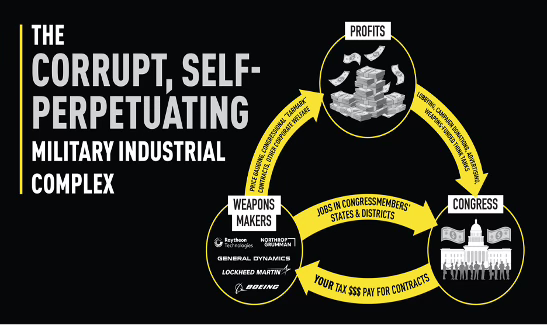
Finally, also at TomDispatch, David Vine and Theresa Arriola have an article: “The Military-Industrial Complex Is Killing Us All,” which is what Ike warned us about in 1961 if we refused to act as alert and knowledgeable citizens to keep that complex in check. Their article features clear and insightful charts on the basic features of the MIC and the dangers it poses. Here’s an example:
Vine and Arriola are part of an effort whose goal it is to dismantle, or very much to downsize, that complex. (I’ve been involved in their efforts.) Here’s the website:
Meanwhile, last week the “liberal” New York Times posted an article ostensibly written by Senator Roger Wicker calling for even more military spending by the U.S.
Here’s how The New York Times introduced Wicker’s op-ed on May 29th:
In a guest essay today, Senator Roger Wicker writes that we are approaching a version of that moment [a major war crisis] “faster than most Americans think.” Worse, he argues, the U.S. military is unprepared to meet the moment. After decades of underfunding, the American military lacks the strength or the equipment to deal with the wide range of new threats coming from our nation’s adversaries, including Iran, China, Russia and North Korea, he writes.
The answer to this problem, Wicker says, is a short-term “generational investment” in the U.S. military — and a national conversation on how to create a safer future for America. In a new white paper, he lays out a road map to “rebuild” the military, starting with an additional $55 billion in military spending in the 2025 fiscal year and an increase of annual military G.D.P. spending from its current projected level of around 3 percent to 5 percent over the next five to seven years.
That’s a serious amount of money that will inevitably raise big questions about where it will come from — and at the expense of what — at a moment when voices all along the political spectrum are questioning both U.S. military spending overseas and the role of the American military in the world today.
Wicker makes the case that the cost of a war with an increasingly powerful adversary like China would be far higher. “Regaining American strength will be expensive,” he writes. “But fighting a war — and worse, losing one — is far more costly.”
Readers, isn’t that inspiring? A “generational investment” in more guns, more bombs, and, as likely as not, more war? What a great idea!
Apparently, the only way to prevent a war is to prepare mightily for one, according to Senator Wicker. Wicker has apparently never heard, or read, or understood the words of Ike.
Senator Wicker is a shining example of the military-industrial-congressional complex that perpetuates war to the detriment of us all, indeed to all life on our planet. But it’s his words that are amplified by the “liberal” New York Times, not the wise words of my friends and colleagues here.
And so it goes, unless we act to put an end to it. We must be the alert and knowledgeable citizens that Ike implored us to be.
The vacuity of Democratic strategy is astonishing if you take at face value the claim that a Trump victory this November will “end democracy.” Apparently, Trump paying Stormy Daniels $130K in hush money, after which some creative accounting obscured the source of the payoff, renders him “unfit for office.” And that claim is now a “top 2024 issue” for Democrats, as The New York Times notes here:
Democrats Push Biden to Make Trump’s Felonies a Top 2024 Issue
Interviews with dozens of Democrats reveal a party hungry to tell voters that Donald Trump’s conviction makes him unfit for office, and hopeful that President Biden will lead the way.
Meanwhile, this was the lead headline in the NYT “top news” send-out this morning:
A Felon in the Oval Office Would Test the American System
Some are wondering how the Constitution’s checks and balances, meant to hold presidents accountable, would work if the next president elected were already a felon.
“Some are wondering”: What a vapid phrase!
I think there are more severe “tests” of the “American system.” How about a president enabling a genocide in Gaza, for example?
If you want to beat Donald Trump this November, how about running a more attractive, more dynamic, more charismatic, more populist and popular, candidate? Whatever else Biden is, he is very much lacking in dynamism even as his actions render him increasingly unpopular among key segments of the Democratic base.
My wife jokingly said today: Just what we need, another election featuring two tired and seriously old white guys. She has a point. It’s not that Trump is now a felon that renders him allegedly unfit. Trump is, in my view, constitutionally unsuited for the presidency. Biden, in contrast, is a fading political hack who will be 82 years of age at the end of this year. Yet, this is what the “American system” produces. Maybe that “system” needs an overhaul?
So, which tired and seriously old white guy do you want to vote for this year?
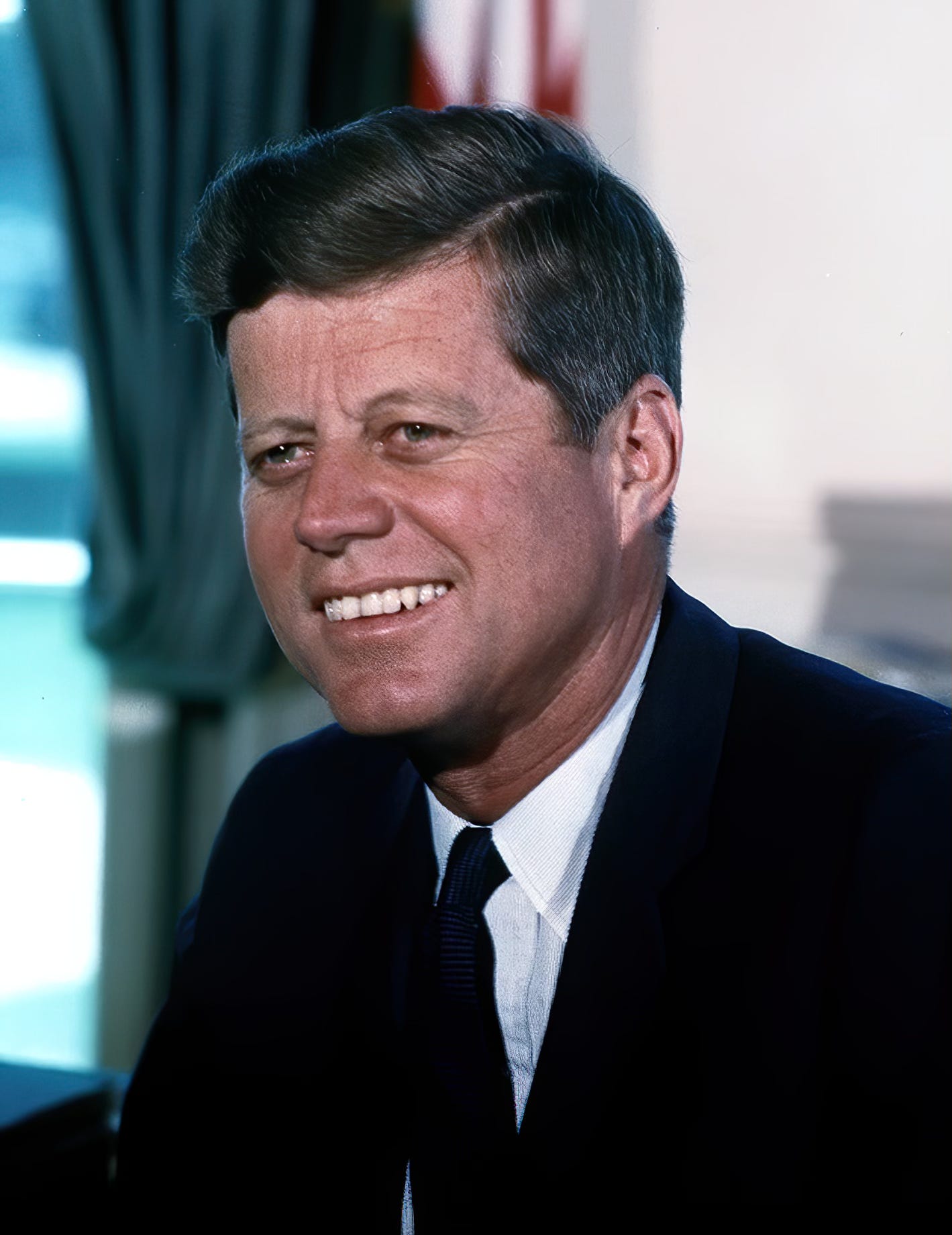
JFK in 1963. Read his famous “peace speech” at American University
It seems hard to believe that in my lifetime we had a young, dynamic, and visionary president, JFK, who was 43 years of age when elected. A president who grew in office, rather than fading. A president who in 1963 made a commitment to pursuing peace with the Soviet Union. A man with flaws, but also one with potential.
Of course, the DNC with its superdelegates has created a system to deny anyone like a JFK (or even RFK Jr.) any chance at securing the nomination. Only corporate stooges need apply. That has allowed a populist-fraud like Trump to emerge from the right, a billionaire who poses as a man of the people. That Trump’s claim is plausible to so many is a measure of how far the Democratic Party has fallen.
It’s already been a very long election cycle, and it’s only early June. Five more months of total BS to go, America.




 Bracing Views