There is a famine of peace in the world today. I came across that phrase, “famine of peace,” in an article in the New Yorker that reported on a papal envoy sent to advocate for a truce and diplomacy to President Joe Biden. Biden, a practicing Catholic, gave the envoy a hearing, but as yet I’ve heard no change from the White House with respect to sending more weapons to Ukraine and maximum support for the war effort.
Pope Francis, working for peace, is exactly what I’d expect from Christ’s representative here on earth. Indeed, it is what I’d expect from all Christians everywhere. Yet we continue to have a glut of war in the world, with plenty of war pigs feeding at the trough.
Cardinal Matteo Maria Zuppi brought a message of peace to President Biden.
I’m a lapsed Catholic, but I have nothing but respect when the Church does its best to embody, obey, and manifest Christ’s two commandments: love God, love thy neighbor. Being faithful to these commandments is everything for Christians.
War is a terrible sin that enables and empowers so many other sins. Meanwhile, a famine of peace and a glut of war means terrible suffering for the world’s most vulnerable. War is thus to be avoided or averted under nearly all circumstances; indeed, Christ implored us to turn the other cheek when we are struck.
I’ve read enough “just war” theory to see how almost any war can be twisted as “defensive” and “necessary.” And I believe in rare circumstances the evil of war may be necessary to stop or prevent even worse evils, e.g. World War II put a stop to Nazi domination and the enslavement and massacre of millions of people, most especially Jews and gypsies, among other “undesirables” and “lesser humans” according to Nazi ideology.
The Pope in those days, Pius XII, did not speak forcibly enough to condemn the crimes of the Nazis. In Francis it is good to have a pope who’s willing to speak of today’s famine of peace. All Christians everywhere should look within to consider why peace is dying and war is thriving. Under these conditions, if we fail to act, do we dare even call ourselves “Christian”?
Time for Glasnost, Perestroika, and a New Generation of Leaders in America
A year ago, I asked whether Joe Biden and Donald Trump were too old to serve as president. Recently, concerns about advanced age and failing health have come to the fore in Congress. Senator Diane Feinstein, 90 years old, recently had to be told by her aides to vote “aye.” Senator Mitch McConnell, 81 years old, recently froze mid-sentence at a press conference; he may have suffered a mini-stroke, possibly related to a bad fall he had previously that resulted in a concussion. Meanwhile, concerns about President Biden’s age and declining health are being openly aired even among Democrats, with Hillary Clinton opining that Joe’s age is a legitimate campaign issue. At the young age of 75, is she angling to ride to the rescue in the 2024 election?
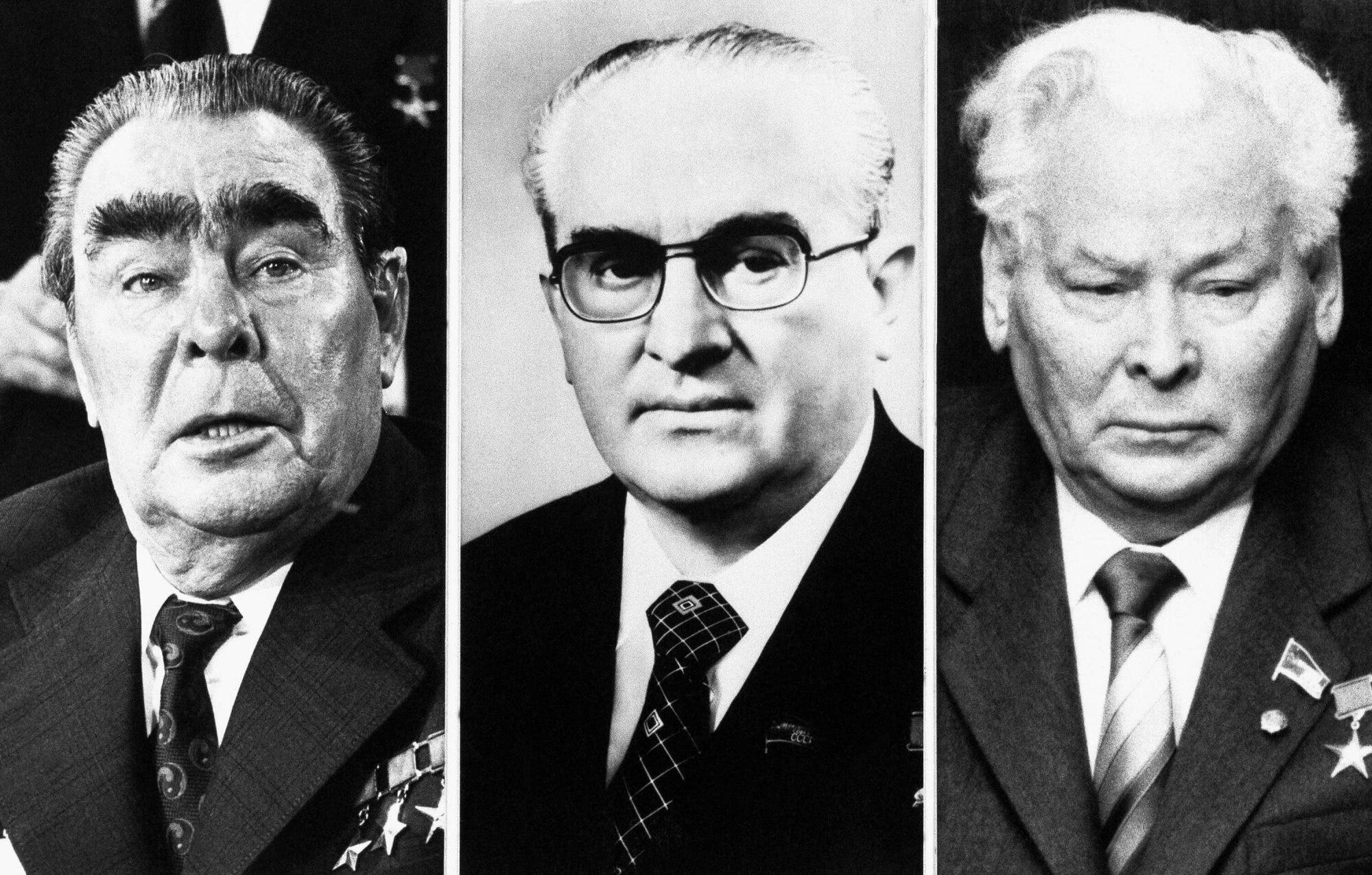
Glenn Greenwald did a long segment on Washington’s gerontocracy that is well worth watching. A point he made is one that I echoed in my article from a year ago. Back in the 1970s, the U.S. pointed to an alleged gerontocracy in the Soviet Union to criticize the hidebound nature of the Communist party there and the way its leaders were holding back much-needed reforms.
Americans made fun of “old” Soviet leaders of the 1970s and early 1980s. They were younger than Biden, Trump, Feinstein, McConnell, and the U.S. gerontocracy of today
The same, of course, is now true of the U.S. empire and its uniparty of Republican and Democrat enablers. An American gerontocracy with a near-death grip on power are holding back much-needed reforms here, especially reductions to the enormous sums of money being spent on weapons and warfare by the federal government.
Much like the former Soviet Union, the United States is a declining empire that’s been debilitated by constant and unnecessary wars and wanton spending on weaponry. Fresh thinking is needed. Remember glasnost and perestroika? Openness and restructuring? They were ushered in by Mikhail Gorbachev in the 1980s, who at age 54 was relatively young when he assumed the reins of power in the USSR.
I still remember when Americans made fun of “old guard” Soviet leaders and used words like “sclerotic” to describe them. They were a visible symbol of Soviet tiredness and decline, the refuse of the past when compared to a younger, more vigorous, United States with its dominant and thrusting world economy.
Who’s laughing now?
Surely, America needs a new generation of leaders who are willing to fight for glasnost (much greater openness and transparency in government) and perestroika (a restructuring of government away from imperialism, weapons, and war). The collapse of the Soviet Union should teach us something about the fate of sclerotic empires that refuse to change.
Reason and Rationality Have Little to Do with Them
It is often hard to understand the reasons for America’s wars, especially since World War II, but they always have a rationale backed up by lies. The rationale for Vietnam was the containment of communism and the domino theory. The lie was that U.S. naval ships had been attacked at Tonkin Gulf. The rationale for Iraq was overthrowing a ruthless dictator and spreading “freedom.” The lie was that he had WMD and that he was somehow connected to the 9/11 attacks.
Nations and peoples are not dominoes
The real reasons for America’s many disastrous wars are opaque. Domestic politics are almost always paramount. No U.S. president wants to be accused of losing a war or appearing to be weak, so starting or continuing a war is considered as “strength.” Congress doesn’t want to be accused of “tying the hands of the president” or of “betraying the troops,” so most members happily go along with wars. The military, of course, always thinks it can win, and wars are good for promotions and power. And military contractors, the “merchants of death,” are even more happy to make money off war. Not surprisingly, perhaps, President Dwight D. Eisenhower’s farewell speech in 1961 warned America of the military-industrial complex, to which Ike had added Congress in an earlier draft. Ike’s warning has been largely forgotten; even his own monument in DC obscures it.
In Washington today, the Democrats accuse the Republicans of being weak on Russia; the Republicans return the favor by accusing the Biden administration of being weak on China. Military and industry are happy to play this blame game, knowing the Pentagon budget will soar as a result, as it has. And thus a dangerous “new cold war” appears to be a certainty.
The folly and fallaciousness of America’s wars, along with their carnage, are enough to make any rational human angry, especially one who has served in one of these wars. Mike Murry, a Vietnam War veteran, is angry, and so am I. Back in 2017, I wrote a piece on the atrociousness of the Vietnam War, to which Mr. Murry appended this comment. It merits consideration by all thinking Americans.
The ”Rationale” of America’s Wars. Comment by Mike Murry in 2017.
An excellent choice of words, “rationale.” Not the reason for doing something in the first place, but a conscious lie made up beforehand just to get things started, or an excuse invented afterwards to avoid accountability and, where required, the necessary punishment that true justice occasionally administers. Marine Corps General Smedley Butler once said that we have only two acceptable reasons for going to war: to defend our homes or defend the Constitution. In not a single case after World War II has either of these conditions applied, so that none of the pointless and ruinous fighting — I won’t dignify these Presidential/Career Military misadventures by calling them “war” — has had any justifiable reason or purpose. Not surprisingly, no Congress has declared war on another nation state since 1941 because no nation state on planet earth has attacked either American homes or America’s Constitution. The United States has not just “gone abroad in search of monsters to destroy,” as our sixth President, John Quincy Adams, warned us against foolishly doing, but has invented imaginary hobgoblins at home before even setting out to vanquish them on the far side of the globe.
Of course, Smedley Butler only made his remarks after serving for thirty years as an admitted “gangster for capitalism,” probably the best summary description of the U.S. military offered to date by one who ought to know. Today, as for the past seventy-plus years, the U.S. military simply fights — aimlessly and disastrously — for the sake of fighting. The fighting has no “reason” other than to provide a steady stream of outrageous corporate CEO bonuses, stockholder dividends, and the pensions and perquisites of retired senior military officers. This Warfare Welfare and Make-work Militarism has secondary beneficiaries, of course, most notably the hothouse orchids, special snowflakes and privileged peacock pugilists known as United States as “political leaders.” Naturally, the feeding and maintenance of this system of corrupt cronyism requires a death grip on over half the nation’s discretionary budget. As George Orwell wrote in “The Theory and Practice of Oligarchical Collectivism” (the book-within-a-book from 1984):
“The primary aim of modern warfare (in accordance with the principles of doublethink, this aim is simultaneously recognized and not recognized by the directing brains of the Inner Party) is to use up the products of the machine without raising the general standard of living.”
In other words, the entire U.S. military/security monstrosity — which I like to call the Lunatic Leviathan — has only one purpose: to suck the life out of the domestic economy so that the productivity of the people’s labor will not result in the betterment of their station in life, which might in due course result in the discarding of America’s useless parasitic economic and political “elites.” Any transparent euphemism designed and deployed to disguise this ugly, fundamental truth properly deserves the label “rationale.” In no way do the usual and time-dishonored obfuscations amount to a reason. Reason has fled the United States, replaced by a deserved and rancid Ridicule. The country now consumes itself, lost in its own vicarious fears and fantasies featuring the celluloid exploits of our vaunted Visigoths vanquishing visions of vultures somewhere, someplace, at some time, until … eventually … after some “progress” and “fragile gains” … as T.S. Eliot wrote of The Hollow Men:
This is the way the world ends This is the way the world ends This is the way the world ends Not with a bang but a whimper.
Men and women so hollow that you can hear their own bullshit echoing in them even before they start moving their jaws and flapping their lips to begin lying.
The U.S. Mainstream Media Finally Admits to a Costly Stalemate
It can’t be coincidence. In the past few days, I’ve seen articles at mainstream media outlets like the New York Times and Wall Street Journal that the much-hyped and much-delayed Ukrainian “spring” counteroffensive has stalled, and at high cost to Ukrainian troops. Here’s a quick online headline from the NYT on Monday:
The war is approaching a violent stalemate. Ukraine has made only marginal progress lately and is deploying less experienced soldiers after heavy casualties.
And here’s what the WSJ had to say (intro here from an article by Caitlin Johnstone):
In a new article titled “Ukraine’s Lack of Weaponry and Training Risks Stalemate in Fight With Russia,” the Wall Street Journal’s Daniel Michaels reports that western officials knew Ukrainian forces didn’t have the weapons and training necessary to succeed in their highly touted counteroffensive which was launched last month.
Michaels writes:
“When Ukraine launched its big counteroffensive this spring, Western military officials knew Kyiv didn’t have all the training or weapons — from shells to warplanes — that it needed to dislodge Russian forces. But they hoped Ukrainian courage and resourcefulness would carry the day.
“They haven’t. Deep and deadly minefields, extensive fortifications and Russian air power have combined to largely block significant advances by Ukrainian troops. Instead, the campaign risks descending into a stalemate with the potential to burn through lives and equipment without a major shift in momentum.”
So: We have both the NYT and WSJ admitting the war is likely to be stuck in a destructive stasis for the foreseeable future. This isn’t that surprising. Russia is deploying “defense in depth” tactics with minefields and other traps. Ukrainian forces try bravely to advance, they get stuck, and Russia replies with withering artillery fire.
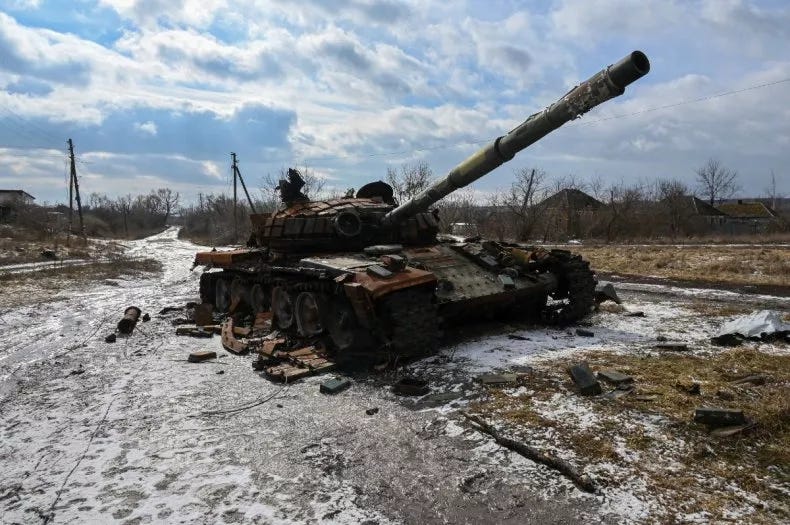
A destroyed Russian tank from March 2023, part of the poisonous detritus of war
There’s much of World War I here. WWI only ended when Germany collapsed from exhaustion after four terribly long and incredibly costly years of war.
I don’t know if Russia or Ukraine will collapse first. Certainly, Ukraine would collapse quickly without massive infusions of U.S./NATO aid.
What’s striking to me is how the MSM hyped the “decisive” spring counteroffensive, and how that narrative is now largely forgotten as a new narrative is rolled out, one where the course must be stayed until all those new U.S. weapons turn the tide, like M-1 tanks and F-16 jets.
Only time — and lots more dead — will tell. Supporters of Ukraine allege that progress is being made, that Russia is suffering more dearly, and that U.S./NATO aid must continue at the highest possible level to ensure that the forces of democracy will prevail against those of authoritarianism. These same supporters reject calls for diplomacy as misguided at best and at worst treasonous to Ukraine and appeasement to Putin. As long as Ukraine is apparently willing to fight to the last Ukrainian, the U.S./NATO should help them to do so.
I confess I don’t support this idea, which I hope doesn’t imply I’m a Putin puppet. Sorry, I don’t want to see Ukraine destroyed in a lengthy, murderous, and destructive war fought on their turf. Assuming this war is truly stalemated or otherwise bogged down, what better time for both sides to come together for a truce and some wheeling and dealing? The worst that could happen if talks bore no fruit, i.e. more killing, more war, is already happening and will continue to do so.
And indeed there are much worse things than a costly stalemate here: an expanded war that goes nuclear.
Interestingly, so far the mainstream sources I’ve read may be admitting to a stalemate but they’re not suggesting diplomacy in earnest. When they start doing that, I suppose that’ll mean things have truly gone bad for the embattled people of Ukraine.
A blast from my past, vintage 2009, with a postscript
Back in 2009, when President Barack Obama was debating a new “surge” in Afghanistan, I wrote an article for TomDispatch that urged him to reconsider, citing the words of Norman Mailer that he applied against the Vietnam War. Naturally, my article had no impact whatsoever on policy, though it was picked up by many outlets, including Salon. I was checking something else today at Salon and came across my old piece. I hope you enjoy reading (or re-reading) it.
This was that rare article I wrote that was actually excerpted at the New York Times. My article is mentioned at the end if you follow this link.
After this piece appeared, I had an opportunity to write a chapter for a book on “Star Wars and History.” Through the grapevine I heard George Lucas wasn’t too sure he wanted a retired military officer to write for a book in his “Star Wars” universe until he heard I’d recommended Norman Mailer (or someone like him) for Secretary of Defense. That seemed to persuade Lucas that my contribution might be acceptable.
POSTSCRIPT: In retrospect, I got one big thing right and one wrong here. I was right: the Afghan surge was doomed to fail. But what I didn’t realize was that its failure didn’t matter. What mattered was that Obama showed his obedience to Washington rules. He showed he’d largely defer to the Pentagon and the generals. His deference, his willingness to play the game rather than trying to end it, probably ensured his second term as president.
Yes, the surge was a failure, and the Afghan War would last another 12 years. But Obama easily won a 2nd term by showing he could wage war just like his predecessors, Bush/Cheney.
So, how was Joe Biden finally able to end the Afghan War in 2021? Two reasons. He could blame the Trump administration for putting him in an untenable position, and he could neutralize Pentagon opposition by giving them even more money even as he pulled troops from Afghanistan. Instead of the Pentagon budget decreasing by roughly $50 billion, the yearly cost of the Afghan War, it increased by that amount even as that war finally crashed and burned. There was never, ever, any talk of peace dividends, and once Russia invaded Ukraine early in 2022, vast increases in U.S. and NATO military spending were guaranteed. And so today’s Pentagon budget soars toward $900 billion, which doesn’t even include aid to Ukraine.
If Biden wins a 2nd term in 2024, it may be largely because he’s shown himself to be a slavish servant of the military-industrial-congressional complex and the national security state.
Anyhow, from October of 2009:
Norman Mailer for secretary of defense
On Afghanistan, Obama needs the input of freethinking outsiders, not generals. What if LBJ had listened to Mailer?
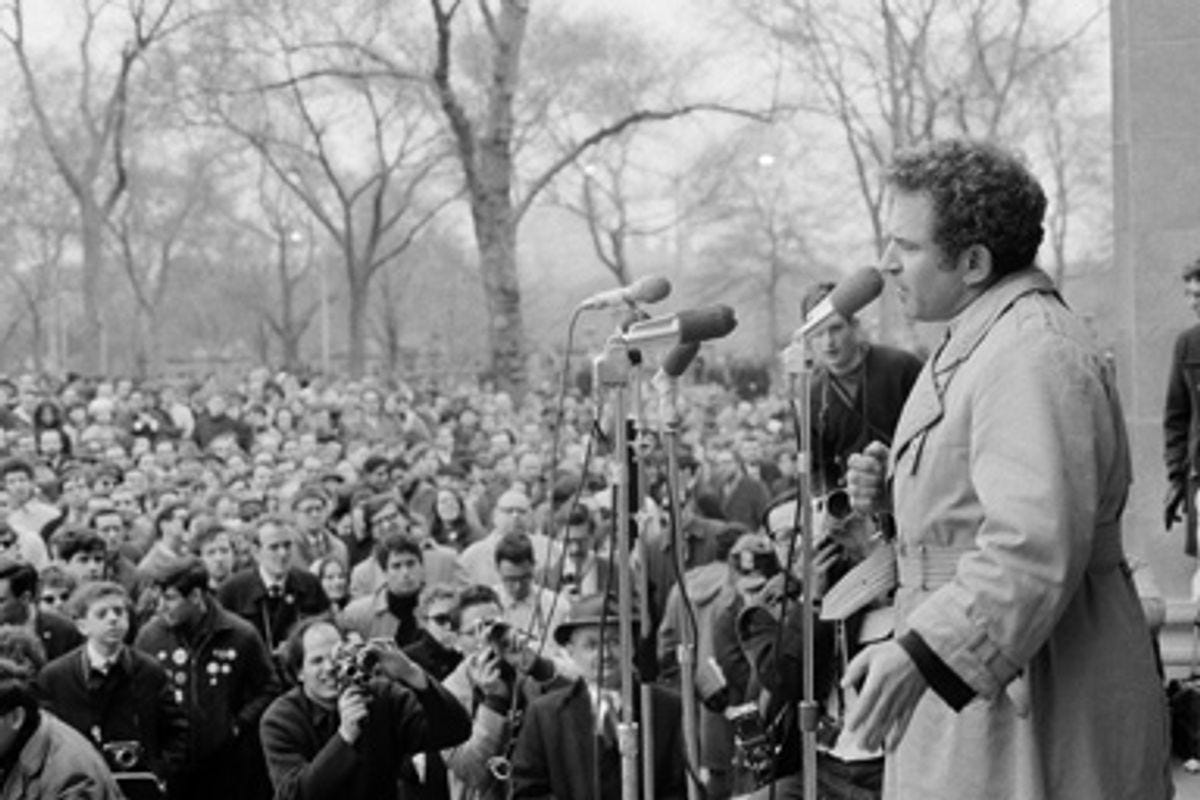
Author Norman Mailer speaks at an anti-war rally at the bandshell in New York’s Central Park, March 26, 1966.
It’s early in 1965, and President Lyndon B. Johnson faces a critical decision. Should he escalate in Vietnam? Should he say “yes” to the request from U.S. commanders for more troops? Or should he change strategy, downsize the American commitment, even withdraw completely, a decision that would help him focus on his top domestic priority, “The Great Society” he hopes to build?
We all know what happened. LBJ listened to the generals and foreign policy experts and escalated, with tragic consequences for the United States and calamitous results for the Vietnamese people on the receiving end of American firepower. Drawn deeper and deeper into Vietnam, LBJ would soon lose his way and eventually his will, refusing to run for reelection in 1968.
President Obama now stands at the edge of a similar precipice. Should he acquiesce to General Stanley A. McChrystal’s call for 40,000 to 60,000 or more U.S. troops for Afghanistan? Or should he pursue a new strategy, downsizing our commitment, even withdrawing completely, a decision that would help him focus on national healthcare, among his other top domestic priorities?
The die, I fear, is cast. In his “war of necessity,” Obama has evidently already ruled out even considering a “reduction” option, no less a withdrawal one, and will likely settle on an “escalate lite” program involving more troops (though not as many as McChrystal has urged), more American trainers for the Afghan army, and even a further escalation of the drone war over the Pakistani borderlands and new special operations actions.
By failing his first big test as commander-in-chief this way, Obama will likely ensure himself a one-term presidency, and someday be seen as a man like LBJ whose biggest dreams broke upon the shoals of an unwinnable war.
The conventional wisdom: Military escalation
To whom, we may ask, is Obama listening as he makes his decision on Afghanistan strategy and troop levels? Not the skeptics, it’s safe to assume. Not the freethinkers, not today’s equivalents of Mary McCarthy or Norman Mailer. Instead, he’s doubtless listening to the generals and admirals, or the former generals and admirals who now occupy prominent “civilian” positions at the White House and inside the beltway.
By his actions, Obama has embraced the seemingly sober conventional wisdom that senior military officers, whether on active duty or retired, have, as they say in the corridors of the Pentagon, “subject matter expertise” when it comes to strategy, war, even foreign policy.
Don’t we know better than this? Don’t we know, as Glenn Greenwald recently reminded us, that General McChrystal’s strategic review was penned by a “war-loving foreign policy community,” in which the usual suspects — “the Kagans, a Brookings representative, Anthony Cordesman, someone from Rand” — were rounded up to argue for more troops and more war?
Don’t we know, as Tom Engelhardt recently reminded us, that Obama’s “civilian” advisors include “Karl W. Eikenberry, a retired lieutenant general who is the U.S. ambassador to Afghanistan, Douglas Lute, a lieutenant general who is the president’s special advisor on Afghanistan and Pakistan (dubbed the “war czar” when he held the same position in the Bush administration), and James Jones, a retired Marine Corps general, who is national security advisor, not to speak of Secretary of Defense Robert Gates, a former director of the Central Intelligence Agency”? Are we surprised, then, that when we “turn crucial war decisions over to the military, [we] functionally turn foreign policy over to them as well”? And that they, in turn, always opt for more troops, more money and more war?
One person unsurprised by this state of affairs would have been Norman Mailer, who died in 2007. War veteran, famed author of the war novel “The Naked and the Dead” (1948) as well as the Pulitzer Prize-winning report on Vietnam-era protests, “The Armies of the Night” (1968), self-styled tough guy who didn’t dance, Mailer witnessed (and dissected) the Vietnam analog to today’s Afghan events. Back in 1965, Mailer bluntly stated that the best U.S. option was “to get out of Asia.” Period.
The unconventional wisdom: Military extrication
Can Obama find the courage and wisdom to extricate our troops from Afghanistan? Courtesy of Norman Mailer, here are three unconventional pointers that should be driving him in this direction:
1. Don’t fight a war, and clearly don’t escalate a war, in a place that means so little to Americans. In words that apply quite readily to Afghanistan today, Mailer wrote in 1965: “Vietnam [to Americans] is faceless. How many Americans have ever visited that country? Who can say which language is spoken there, or what industries might exist, or even what the country looks like? We do not care. We are not interested in the Vietnamese. If we were to fight a war with the inhabitants of the planet of Mars there would be more emotional participation by the people of America.”
2. Beware of cascading dominoes and misleading metaphors, whether in Southeast Asia or anywhere else. The domino theory held that if Vietnam, then split into north and south, was united under communism, other Asian countries, including Thailand, the Philippines, perhaps even India, would inevitably fall to communism as well, just like so many dominoes toppling. Instead, it was communism that fell or, alternately, morphed into a version that we could do business with (to paraphrase former British Prime Minister Margaret Thatcher).
We may no longer speak metaphorically of falling dominoes in today’s Af-Pak theater of operations. Nevertheless, our fears are drawn from a similarly misleading image: If Afghanistan falls to the Taliban, Pakistan will surely follow, opening a nuclear Pandora’s box to anti-American terrorists in which, in our fevered imaginations, smoking guns will once again become mushroom clouds.
Despite the fevered talk of falling dominoes in his era, Mailer was unmoved. Such rhetoric suggests, he wrote in 1965, “that we are not protecting a position of connected bastions so much as we are trying to conceal the fact that the bastions are about gone — they are not dominoes, but sand castles, and a tide of nationalism is on the way in. It is curious foreign policy to use metaphors in defense of a war; when the metaphors are imprecise, it is a swindle.”
To this I’d add that, in viewing countries and peoples as so many dominoes, which by the actions — or the inaction — of the United States are either set up or knocked down, we vastly exaggerate our own agency and emphasize our sense of self-importance. And before we even start in on the inevitable argument about “Who lost Afghanistan?” or “Who lost Pakistan?” is it too obvious to say that never for a moment did we own these countries and peoples?
3. Carrots and sticks may work together to move a stubborn horse, but not a proud people determined to find their own path. As Mailer put it, with a different twist: “Bombing a country at the same time you are offering it aid is as morally repulsive as beating up a kid in an alley and stopping to ask for a kiss.”
As our Predator and Reaper drones scan the Afghan terrain below, launching missiles to decapitate terrorists while unintentionally taking innocents with them, we console ourselves by offering aid to the Afghans to help them improve or rebuild their country. As it happens, though, when the enemy hydra loses a head, another simply grows in its place, while collateral damage only leads to a new generation of vengeance-seekers. Meanwhile, promised aid gets funneled to multinational corporations or siphoned off by corrupt government officials, leaving little for Afghan peasants, certainly not enough to win their allegiance, let alone their “hearts and minds.”
If we continue to speak with bombs while greasing palms with dollars, we’ll get nothing more than a few bangs for our $228 billion (and counting).
What if LBJ had listened to Mailer in ’65?
Not long before LBJ crossed his Rubicon and backed escalation in Vietnam, he could have decided to pull out. Said Mailer:
The image had been prepared for our departure — we heard of nothing but the corruption of the South Vietnam government and the professional cowardice of the South Vietnamese generals. We read how a Viet Cong army of 40,000 soldiers was whipping a government army of 400,000. We were told in our own newspapers how the Viet Cong armed themselves with American weapons brought to them by deserters or captured in battle with government troops; we knew it was an empty war for our side.
Substitute “the Hamid Karzai government” for “the South Vietnam government” and “Taliban” for “Viet Cong” and the same passage could almost have been written yesterday about Afghanistan. We know the Karzai government is corrupt, that it stole the vote in the last election, that the Afghan army is largely a figment of Washington’s imagination, that its troops sell their American-made weapons to the enemy. But why do our leaders once again fail to see, as Mailer saw with Vietnam, that this, too, is a recognizably “empty war for our side”?
Mailer experienced the relentless self-regard and strategic obtuseness of Washington as a mystery, but that didn’t stop him from condemning President Johnson’s decision to escalate in Vietnam. For Mailer, LBJ was revealed as “a man driven by need, a gambler who fears that once he stops, once he pulls out of the game, his heart will rupture from tension.” Johnson, like nearly all Americans, Mailer concluded, was a member of a minority group, defined not in racial or ethnic terms but in terms of “alienat[ion] from the self by a double sense of identity and so at the mercy of a self which demands action and more action to define the most rudimentary borders of identity.”
This American drive for self-definition through constant action, through headlong acceleration, even through military escalation, the novelist described, in something of a mixed metaphor, as “the swamps of a plague” in which Americans had been caught and continued to sink. He saw relief of the desperate condition coming only via “the massacre of strange people.”
To be honest, I’m not sure what to make of Mailer’s analysis here, more emotionally “Heart of Darkness” than coolly rational. But that’s precisely why I want someone Mailer-esque — pugnacious, free-swinging, and prophetical, provocative and profane — advising our president. Right now.
As Obama’s military experts wield their battlefield metrics and call for more force (to be used, of course, with ever greater precision and dexterity), I think Mailer might have replied: We think the only thing they understand is force. What if the only thing we understand is force?
Mailer, I have no doubt, would have had the courage to be seen as “weak” on defense, because he would have known that Americans had no dog in this particular fight. I think he would intuitively have recognized the wisdom of the great Chinese strategist Sun Tzu, who wrote more than 2,000 years ago in “The Art of War” that “to win one hundred victories in one hundred battles is not the acme of skill. To subdue the enemy without fighting is the acme of skill.” Our generals, by way of contrast, seem to want to fight those 100 battles with little hope of actually subduing the enemy.
What Obama needs, in other words, is fewer generals and ex-generals and more Norman Mailers — more outspoken free-thinkers who have no interest in staying inside the pentagonal box that holds Washington’s thinking tight. What Obama needs is to silence the endless cries for more troops and more war emanating from the military and foreign policy “experts” around him, so he can hear the voices of today’s Mailers, of today’s tough-minded dissenters. Were he to do so, he might yet avoid repeating LBJ’s biggest blunder — and so avoid suffering his political fate as well.
In 1998, as an Air Force major, I attended a military history symposium on coalition warfare that discussed the future of NATO. One senior officer present, General Sir Anthony Farrar-Hockley, spoke bluntly in favor of NATO expansion. From my notes taken in 1998:
Farrar-Hockley took the position that to forego expansion because of Russian concerns would be to grant Russia a continuing fiefdom in Eastern Europe. Russia has nothing to fear from NATO, and besides, it can do nothing to prevent expansion. If the Soviet Union was an anemic tiger, Russia is more like a circus tiger that may growl but won’t bite.
That sums up the Western position vis-a-vis NATO expansion and Russia: too bad. You lost the Cold War. There’s nothing you can do.
Until the “circus tiger” finally bit back.
The U.S. and NATO calculated that Russia, now led by Vladimir Putin, wouldn’t bite back. It did so in 2022.
Even circus tigers may do more than growl
Now, you might argue it’s the tiger’s fault for biting; you might say Ukraine didn’t deserve to be bitten. But I don’t think you can say that U.S. and NATO actions were entirely guiltless or blameless in provoking the tiger. At the very least, the actions were misjudged (assuming there wasn’t a plot to provoke Putin and Russia into attacking).
Ukraine is central to Russia’s concerns. Both countries share a long common border and an even longer history. By comparison, Ukraine, I think, is peripheral to U.S. concerns, just as Afghanistan and Vietnam ultimately proved peripheral. Here I recall the critique of political scientist Hannah Arendt that, with respect to America, the Vietnam War was a case of using “excessive means to achieve minor aims in a region of marginal interest.” Whether in Vietnam or more recently in Afghanistan, the U.S. could always afford to accept defeat, if only tacitly, by withdrawing (even though die-hard types at the Pentagon always want to keep fighting).
All this is to say Russia’s will to prevail may prove more resilient than the current U.S. commitment to Ukraine of “blank check” support.
Ukraine resistance to Russia has indeed been strong, backed up as it has been by bountiful weapons and aid from the U.S. and NATO. Faced by an invasion, they are defending their country. But a clear victory for Ukraine is unlikely in the short term, and in the long term will likely prove pyrrhic if it is achieved.
No one in the U.S. thought that a punitive raid against the Taliban in 2001 would produce an Afghan War that would last for 20 years. When the U.S. committed troops in big numbers to Vietnam beginning in 1965, most at the Pentagon thought the war would be over in a matter of months. How long is the U.S. and NATO truly prepared to support Ukraine in its war against Russia?
In the 17 months or so since the Russian invasion, the U.S. has already committed somewhere between $115-$200 billion to Ukraine and the war. Should that commitment remain open-ended at that level until Ukraine “wins”? What of legitimate fears of regional escalation or nightmare scenarios of nuclear exchanges?
Long wars usually don’t end with a healthier democracy. Indeed, wars most often generate censorship, authoritarianism, suppression of dissent, and many other negative aspects. Think of the enormous burden on Russia and Ukraine due to all the wounded survivors, the grieving families, the horrendous damage to the environment. The longer the war lasts, the deeper the wounds to society.
Scorched by decades of war, areas of Afghanistan are wastelands. Vietnam, Laos, and Cambodia are still recovering from America’s orgy of violence there. What will Ukraine have to recover from, assuming it’s fortunate enough to “win”?
I don’t see a quick victory for either side in the immediate weeks and months ahead. Channeling John F. Kennedy’s famous “peace” speech of June 10, 1963, I do believe that peace need not be impractical, and war need not be inevitable. As JFK also cautioned, forcing a nuclear power into a humiliating retreat while offering no other option is dangerous indeed.
Recent attention has focused on the Biden administration’s decision to provide cluster munitions to Ukraine. Russia can, and likely will, match Ukraine’s use of U.S.-provided cluster munitions. Earlier, the U.S. claimed Russia was guilty of war crimes for using these munitions. Now it’s all OK since Ukraine needs them. When they kill Russians, they’re “good” bombs?
I also hear U.S. commentators speaking of “terror bombing campaigns” by Russia. Perhaps so, but when U.S. commentators use that expression, they should fully acknowledge what the U.S. did in Japan, North Korea, Vietnam, Laos, Cambodia, Iraq, Afghanistan, and elsewhere. No country in the world comes close to the number and amount of bombs, defoliants, cluster munitions, DU shells, and napalm that the U.S. has used in various wars in the last 80 years. When it comes to terror bombing, the U.S. is truly the exceptional nation.
But can the U.S. be exceptional at peace? The U.S. should and must wage diplomacy with the kind of fervor that it usually reserves for war.
A popular song of defiance that came soon after the Pearl Harbor attack on December 7, 1941 was “Praise the Lord and Pass the Ammunition.” Today, that song title must be amended: Praise the Lord and pass the cluster munitions.
From its stockpiles, the U.S. is providing cluster munitions to Ukraine, munitions that have been banned by more than 100 countries. It appears that Russia has already used cluster munitions in the war, which Biden administration spokesperson Jen Psaki denounced as a potential war crime. Ukraine, of course, will only use cluster munitions in a godly way, so no worries there. It’s a crime when Russia does it but they are freedom munitions when Ukraine uses them.
They’ll free you of your legs, your arms, and maybe your life
Naturally, Putin and the Russians have promised to respond with more of their own cluster munitions, assuming Ukraine uses its American-made bombs and bomblets. Basically, the Biden administration is sending cluster munitions as a stopgap since the U.S./NATO is running short of conventional high explosive (HE) artillery shells. HE shells are more effective against fixed fortifications and trenches than cluster shells (the latter is a higher-tech variant of shrapnel shells). But in the absence of HE shells, cluster munitions will have to do, even though the “dud” bomblets will persist in the environment for years, if not decades, killing and maiming anyone unlucky enough to come across them.
Supporters of sending cluster munitions to Ukraine, including most members of Congress, are essentially saying that just about any weapon of any brutality is OK if it theoretically helps Ukraine. Short of poison gas and nuclear weapons, I’m not sure there are any weapons they wouldn’t send to Ukraine in the name of “democracy.”
With respect to progress in this war, I’ve read conflicting reports that say that Russia is winning by grinding up Ukrainian forces and vice-versa. I’ve read where Ukraine will soon reach a “tipping point” and breakthrough Russian defense lines, driving toward Crimea, but such optimism isn’t shared by some U.S. experts. For example, John Kirchhofer of the U.S. Defense Intelligence Agency recently said the war is “at a bit of a stalemate” and that “magical” weapons like Leopard and Challenger tanks are not “the holy grail that Ukraine is looking for” and that a breakthrough in the near-term is unlikely.
So, “praise the Lord and pass the cluster munitions” is likely to be a very long funereal dirge rather than an exultant victory anthem.
Four days ago, I got a story in my New York Times email feed on “A Turning Point in Military Spending.” The article celebrated the greater willingness of NATO members as well as countries like Japan to spend more on military weaponry, which, according to the “liberal” NYT, will help to preserve democracy. Interestingly, even as NATO members have started to spend more, the Pentagon is still demanding yet higher budgets, abetted by Congress. I thought if NATO spent more, the USA could finally spend less?
No matter. Russia’s invasion of Ukraine, as well as the hyping of what used to be called the “Yellow Peril,” today read “China,” is ensuring record military spending in the USA as yearly Pentagon budgets approach $900 billion. That figure does not include the roughly $120 billion or more in aid already provided to Ukraine in its war with Russia. And since the Biden administration’s commitment to Ukraine remains open-ended, you can add scores of billion more to that sum if the war persists into the fall and winter.
Here’s an excerpt from the New York Times piece that I found especially humorous in a grim way:
[Admittedly,] The additional money that countries spend on defense is money they cannot spend on roads, child care, cancer research, refugee resettlement, public parks or clean energy, my colleague Patricia points out. One reason Macron has insisted on raising France’s retirement age despite widespread protests, analysts believe, is a need to leave more money for the military.
But the situation [in Europe of spending more on butter than guns] over the past few decades feels unsustainable. Some of the world’s richest countries were able to spend so much on social programs partly because another country — the U.S. — was paying for their defense. Those other countries, sensing a more threatening world, are now once again promising to pull their weight. They still need to demonstrate that they’ll follow through this time.
Yes, Europe could continue to invest in better roads, cleaner energy, and the like, but now it’s time to buckle down and build more weapons. Stop freeloading, Europe! Dammit, “pull your weight”! You’ve had better and cheaper health care than Americans, stellar educational systems, child care benefits galore, all sorts of social programs we Americans can only dream of, but that’s because we’ve been paying for it! Captain America’s shield has been protecting you on the cheap! Time to pay up, you Germans, you French, you Italians, and especially you cheap Spaniards.
Look at all those cheap Spaniards. They have good stuff because of Captain America. Freeloaders! (NYT Chart, 7/12/23)
As the NYT article says: NATO allies need to “follow through this time” on strengthening their militaries. Because strong militaries produce democracy. And European “investments” in arms will ensure more equitable burden sharing in funding stronger cages and higher barriers to deter a rampaging Russian bear.
Again, you Americans out there, that doesn’t mean we can spend less on “defense.” What it means is that the U.S. can “pivot to Asia” and spend more on weaponry to “deter” China. Because as many neocons say, the real threat is Xi, not Putin.
We have met the enemy, and he is us. That’s an old saying you won’t see in the “liberal” NYT.
I’m still waiting for the blockbuster Hollywood production that celebrates peace
Last year, “Top Gun: Maverick” was all the rage. It was a silly war flick with a plot ripped from the original “Star Wars” movie featuring plenty of bloodless, high octane action sequences. I enjoyed it in the way I occasionally indulge in unhealthy fast food. The movie was instantly forgettable except for one scene where hotshot pilot Maverick, played of course by Tom Cruise, meets his old rival Iceman, played by Val Kilmer. In real life, Kilmer suffers from throat cancer, and his condition is not hidden in the movie, where Kilmer is now an admiral who still believes in his old friend, Captain Pete “Maverick” Mitchell.
Naturally, Maverick saves the day, pummeling a nameless enemy (most likely Iran) with bombs because that country is developing nuclear weapons. Nothing, of course, is said of the thousands of nuclear warheads and bombs in America’s arsenal, or that the USA is the only country to have used atomic bombs in war (Hiroshima, Nagasaki). But I digress.
Hollywood loves war movies. They sell well. Yet I still await “Top Dove: Peacenik,” in which an intrepid, brave, determined, and charismatic person stops a war without bombing or killing anyone. What a breath of fresh air that would be!
Exactly ten years ago, I posted the article below at Bracing Views. We need peacemakers now more than ever. Sadly, they are still very much forgotten, or ignored, or dismissed as unserious or even delusional.
Forgotten Are the Peacemakers (2013)
Monument to Elihu Burritt in New Marlboro, Mass. (author’s photo)The Plaque in Honor of Burritt (author’s photo)
Being Catholic, I’m a big fan of the Sermon on the Mount and Christ’s teaching that “blessed are the peacemakers.” Yet in American history it seems that “forgotten are the peacemakers” would be a more accurate lesson. We’re much more likely to remember “great” generals, even vainglorious ones like George S. Patton or Douglas MacArthur, than to recognize those who’ve fought hard against long odds for peace.
Elihu Burritt was one such peacemaker. Known in his day as “The Learned Blacksmith,” Burritt fought for peace and against slavery in the decades before the Civil War in the United States. He rose from humble roots to international significance, presiding over The League of Universal Brotherhood in the 1840s and 1850s while authoring many books on humanitarian subjects.
Interestingly, peacemakers like Burritt were often motivated by evangelical Christianity. They saw murder as a sin and murderous warfare as an especially grievous manifestation of man’s sinfulness. Many evangelicals of his day were also inspired by their religious beliefs to oppose slavery as a vile and reprehensible practice.
Christian peacemakers like Burritt may not have had much success, but they deserve to be remembered and honored as much as our nation’s most accomplished generals. That we neglect to honor men and women like Burritt says much about America’s character.
For if we truly are a peace-loving people, why do we fail to honor our most accomplished advocates for peace?
News that the Biden administration is sending cluster munitions to Ukraine highlights the dangerous escalatory nature of wars. These are special bombs and artillery shells with hundreds of “bomblets” that disperse to kill or maim as many people as possible. They persist in the environment; children have been known to pick them up and to be killed or grievously wounded as a result.
The apparent rationale behind this decision is that cluster munitions will help Ukraine in its counteroffensive against Russia. While these munitions will certainly increase the body count, probably on both sides, they are unlikely to be militarily decisive.
There are other issues as well, notes Daniel Larison at Eunomia:
The decision also opens the U.S. up to obvious charges of hypocrisy. U.S. officials have condemned the Russian use of these weapons and said that they have no place on the battlefield, but now the administration is saying that they do have a place. Providing cluster munitions to Ukraine makes a mockery of the administration’s earlier statements and creates more political problems for its effort to rally support for Ukraine. Many states in Latin America, Africa, and Asia are parties to the treaty banning the use, transfer, and stockpiling of cluster munitions, and now they will have one more reason to dismiss U.S. appeals to defending the “rules-based order” as so much hot air. The decision will probably embarrass and antagonize some of our allies in Europe, as most members of NATO are also parties to the treaty.
It’s rather amazing to think about the incredible variety of weaponry being sent to Ukraine in the name of “victory.” At first, the Biden administration spoke only of providing defensive weaponry. Biden himself declared that sending main battle tanks, jet fighters, and the like was tantamount to provoking World War III. More than a year later, the U.S. has committed to sending Abrams tanks, F-16 fighter jets, and offensive weapons of considerable potency like depleted uranium shells and now cluster munitions. And always with the same justification: the new weapons will help break the stalemate and lead to total victory for Ukraine.
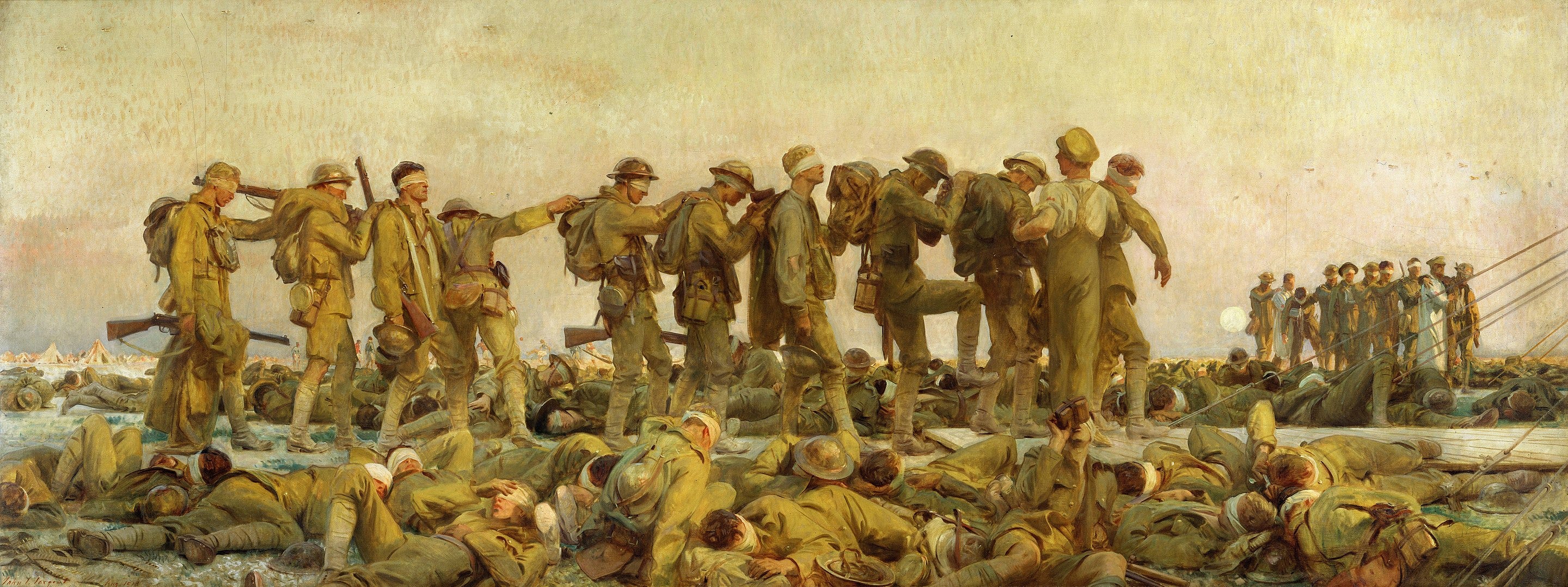
John Singer Sargent, “Gassed” (1919). Gas in World War I produced a million casualties—only aggravating the horrors of trench warfare
This is nothing new, of course, in military history. Think of World War I. Poison gas was introduced in 1915 in an attempt to break the stalemate of trench warfare. It didn’t. But it did stimulate the production of all sorts of dangerous chemical munitions and agents such as chlorine gas, phosgene, and mustard. Tanks were first introduced in 1916. Stalemate persisted. Flamethrowers were introduced. Other ideas to break the stalemate included massive artillery barrages along with “creeping” barrages timed to the advancing troops.
But there was no wonder weapon that broke the stalemate of World War I. After four years of sustained warfare, the German military finally started to falter in the summer of 1918. The Spanish Flu, the contagion of communism from Russia, and an effective allied blockade also served to weaken German resolve. The guns finally fell silent on November 11, 1918, a calm that wasn’t produced by magical weapons.
I wonder which weapon will next be hailed as crucial to Ukrainian victory? Who knows, maybe even tactical nukes might be on the minds of a few of the madmen advising Biden.









 Bracing Views