
The Madness of U.S. Militarism

W.J. Astore

Where are today’s Eisenhowers, Butlers, and Shoups?

As a teenager in the 1970s, I recall talking to my dad about fears of nuclear war between the United States and the Soviet Union. My dad took a broad view, suggesting that if U.S. and Soviet leaders were stupid enough to blow each other to smithereens, a billion Chinese people would be left to pick up the slack and move the world forward.

My dad was right about many things, but what he didn’t realize was that U.S. nuclear war plans (known as SIOPs) often called for the elimination of the USSR and China, even if China had had no involvement in events leading up to the war. Basically, the ruling U.S. nuclear war philosophy was: If you’re red, you’re dead.

Daniel Ellsberg wrote about this in his book, The Doomsday Machine. As I wrote in my review of that book:

“U.S. nuclear war plans circa 1960 envisioned a simultaneous attack on the USSR and China that would generate 600 million deaths after six months.  As Ellsberg notes, that is 100 Holocausts.  This plan was to be used even if China hadn’t directly attacked the U.S., i.e. the USSR and China were lumped together as communist bad guys who had to be eliminated together in a general nuclear war.  Only one U.S. general present at the briefing objected to this idea: David M. Shoup, a Marine general and Medal of Honor winner, who also later objected to the Vietnam War.”

What’s truly startling is that only one U.S. military leader present, General David Shoup, objected to the SIOP that would lead to the death of 600 million people in six months. A decade later, scientists learned that such a huge nuclear exchange would likely cause a nuclear winter that would kill billions due to famine. Truly, the (few) living would envy the (many) dead.

Mention of David Shoup’s name leads me to this fine article: “The Marine Corps legend who tried to stop the Vietnam War,” by James Clark. Shoup was a remarkable American who helped to prevent the Cuban Missile Crisis of 1962 from escalating to a nuclear war. Once he retired from the Marines, he became a vocal opponent of the Vietnam War and militarism in general, a worthy successor to General Smedley Butler.
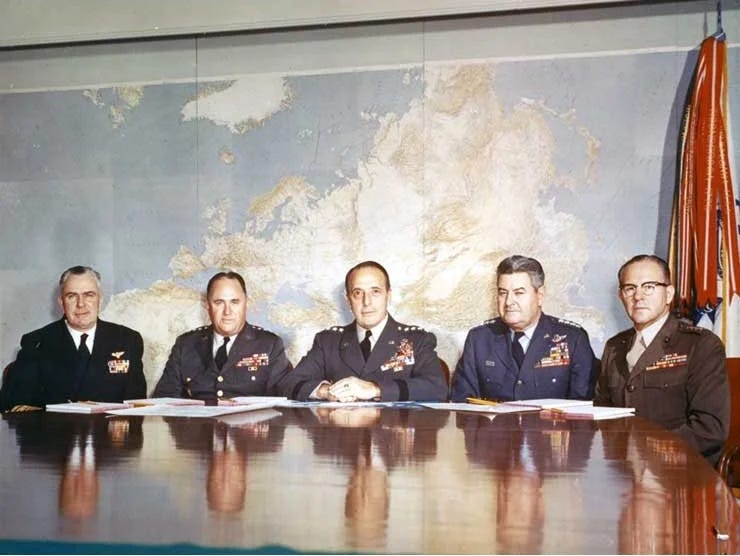
The Joint Chiefs in 1961. General Shoup is on the far right, next to General Curtis LeMay, architect of SAC and of a possible nuclear doomsday

I urge you to read Clark’s article on Shoup, who quotes Shoup’s hard-won wisdom here:

About the Vietnam War, Shoup said “I believe that if we had and would keep our dirty, bloody, dollar-crooked fingers out of the business of these nations so full of depressed, exploited people, they will arrive at a solution of their own.”

In the Atlantic Monthly, Shoup, echoing the warning of Eisenhower about the military-industrial complex, wrote bluntly about America’s war culture and its anti-democratic nature:

Somewhat like a religion, the basic appeals of anti-Communism, national defense and patriotism provide the foundation for a powerful creed upon which the defense establishment can build, grow, and justify its cost. More so than many large bureaucratic organizations, the defense establishment now devotes a large share of its efforts to self-perpetuation, to justifying its organizations, to preaching its doctrines, to self-maintenance and management.

You would think that a Medal of Honor recipient who’d proved his bravery and patriotism at Tarawa during World War II would be immune from charges of being unpatriotic or weak on defense, but you’d be wrong.

Where are today’s Shoups among the U.S. military brass? Where are the leaders who are against genocidal nuclear war and who are willing to speak out against it? Where are the leaders who reject a new cold war with China and Russia? Where are the leaders with the courage to advocate for peace whenever possible in place of more and more war?

Have we fallen so far under the spell of militarism that America no longer produces leaders like Dwight Eisenhower, Smedley Butler, and David Shoup, generals who truly knew war, despised it, and wanted above all to put an end to it?

Talking About War, War Culture, Police, and the U.S. Military

W.J. Astore

On finding a better way forward for America

I recently sat down with Jim Wohlgemuth and Harvey Bennett with Veterans for Peace. We talked for about an hour and covered many topics I’ve written about here at Bracing Views and also at TomDispatch.com. Here is the link:

Or, if it’s easier, click here.

I’d like to thank Jim and Harvey for inviting me on their show and for their interest in my writing, but most especially for their work on promoting peace and sanity. Special bonus song at the end of the interview!

The Fight Over the Speaker of the House

W.J. Astore

If only Progressive Democrats had fought at all when they had the chance in 2021

There is no Left in America, not in Congress, at least. Whenever the so-called Left, or Progressives, or the Squad have an opportunity to drive policy changes, they cave to the corporate centrists within the Democratic Party. Which is why I laugh, however ruefully, when Republicans warn about the “radical left” and how powerful it allegedly is in America. What “radical left”?

Two years ago, before Nancy Pelosi was yet again elected Speaker of the House, so called Progressives (perhaps we should call them PINOs, or progressives in name only) had a rare opportunity to drive change by withholding their votes for Pelosi as Speaker, just as Republicans are doing now for Kevin McCarthy as Speaker. Like today’s Republicans, the PINOs could have extracted concessions from Pelosi, including a House vote on Medicare for all, for a $15 federal minimum wage, and similar policies the PINOs claim are at the top of their agenda. They chose to do nothing. They got no concessions. They drove no change. And thus the centrist/corporate Democrats continue to ride roughshod over them.

Remember this, Democrats? Force the vote was a rare opportunity to drive change, but the PINOs caved to Pelosi and got nothing in return

Which is why I salute the Republicans who are holding up McCarthy’s appointment as Speaker. They have convictions and are willing to fight for them. They are extracting concessions from McCarthy. Meanwhile, all the PINOs are doing is posing for selfies while poking fun at alleged Republican disorder.

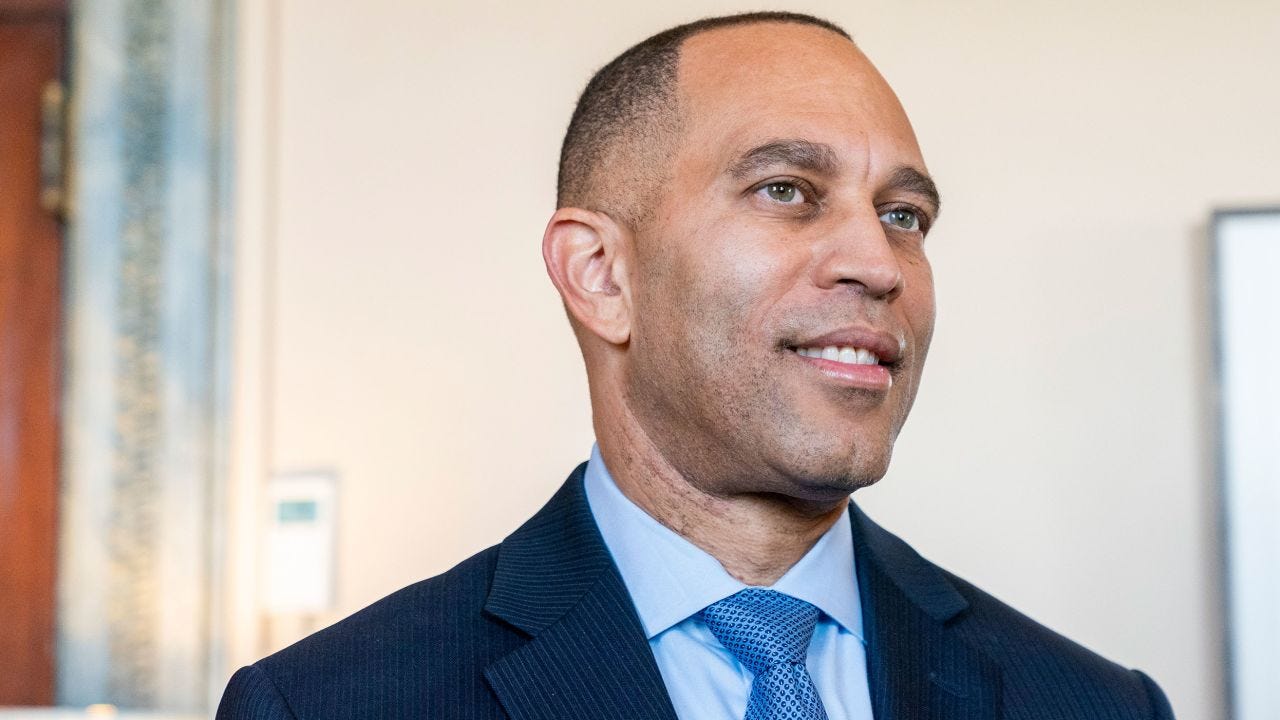
No, you PINOs. This is what true democracy looks like. It’s messy. It involves in-fighting. You have to be willing to get bloodied, at least figuratively speaking. And if you’re unwilling to fight, to “bring the ruckus” to your own party, as AOC claimed she wanted to do, party rulers like Pelosi and current House Minority Leader Hakeem Jeffries will diss, dominate, and demote you, as they did and do. 

Let’s take a quick look at the new House Minority Leader.  CNN praised Jeffries as “the first Black lawmaker to lead a party in Congress.” That’s truly what matters, right? Diversity. More Black faces in high places. Or more women at the top. Or more LGBTQ+ and so on.

But what if “diversity” results in no meaningful policy changes? What if diversity, as my wife puts it, is mainly an optical illusion?

Jeffries, as Sabby Sabs of RBN (the Revolutionary Blackout Network) notes here, is just another corporate Democrat who’s especially skilled at fundraising for the Party. He’s against Medicare for all, he despises the Squad, he’s a fervid supporter of Israel (the “sixth borough of New York City,” he quipped), and his resume includes Georgetown University and (of course) a law degree.

Hakeem Jeffries, House Minority Leader

Can we expect progressive policies from Jeffries? Is he a radical leftist? Of course not! He’s a younger version of Pelosi, a corporate shill who’s sold as a change agent because he’s the first Black party leader in Congress, just as Pelosi was praised for the “change” she represented as the first Madam Speaker.

Don’t get me wrong. It’s generally a good thing when more women, more BIPOC, and other traditionally underrepresented groups attain positions of power. But if their ideas, policies, commitments, and practices are basically the same as those old white fat tomcats who preceded them, where’s the progress? Where’s the change?

In so many ways, today’s Democrats are yesterday’s Republicans. They are pro-war, pro-military, pro-business, and thoroughly corporate. Their alleged diversity is mostly optical. Meanwhile, the Republicans, whatever else they may be, are showing true diversity of views, as manifested by Kevin McCarthy’s messy fight for votes from his own party.

All those corporate Democrats and PINOs in Congress should take a very long look in a truth-telling mirror before crowing about how dysfunctional the Republicans allegedly are. If dysfunction means fighting for change that’s consistent with your principles and campaign promises, the Democrats could truly use some of that “dysfunction.” So too could America.

History Is Un-American

W.J. Astore

Real Americans Create Their Own Futures

I was bantering online with an old friend and fellow historian and I hit him with my best shot: history is un-American. If you think like an historian, and especially if you think America and its future actions should be informed, or possibly even constrained, by history, you are clearly un-American. History is more or less bunk, Henry Ford famously said, and Americans can safely ignore it. We are like gods, creating our own futures out of nothing, imposing our will on everything around us.

Henry Ford, American god

This attitude, this hubris, explains much about the U.S. military’s woeful record since 1945. The French lost in Indochina? No matter. Americans will prevail in Vietnam, Laos, and Cambodia because we’re not the French. The Soviet Union lost in Afghanistan? No matter. Americans will prevail there because we’re not the Russians. Overthrowing Saddam Hussein and his minority Sunni government will unleash chaos that strengthens Shia forces in Iraq, aligning that country more closely with Iran? No matter. America will bring order and the blessings of democracy to Iraq at the point of gun or a Hellfire missile.

Karl Rove, a major player in the Bush/Cheney administration, summed up this hubris in this now-infamous passage:

“We’re an empire now, and when we act, we create our own reality. And while you’re studying that reality — judiciously, as you will — we’ll act again, creating other new realities, which you can study too, and that’s how things will sort out. We’re history’s actors . . . and you, all of you, will be left to just study what we do.”

That man did not want for confidence.

Related to the idea of history being un-American is the business- and management-oriented nature of the officer corps in the U.S. military. To be promoted to field-grade (major or lieutenant commander), you almost have to have a master’s degree or be close to finishing one. But rarely do officers choose to pursue a master’s in history or any other subject related to the humanities. The master’s of choice is in business administration or some type of management.

By pursuing MBAs and management degrees, officers show their practical nature. They also set themselves up well for future careers once they retire or separate from the military. After all, who needs to know history, even military history? The U.S. military will simply act, creating its own realities, which feckless historians will then passively study as America’s real actors get on with the job of remaking the world in America’s image.

We live in the United States of Amnesia, Gore Vidal quipped, and history is part of that amnesia. Who remembers that America was at war in Afghanistan as late as 2021? It’s on to new “great power” struggles with China and Russia. Look forward, not backward, Barack Obama said when he became president, meaning there was no need to hold the Bush/Cheney administration responsible for anything, including torture and other war crimes. “We tortured some folks” — time to move on!

An expression I learned in the U.S. military is “analysis paralysis,” as in don’t overthink the problem. Act! But if America’s military record since World War II proves one thing, it’s that ignoring history because it’s “bunk” or less practical than another business or management course is a very unwise idea.

Acting should be informed by thinking. Dare I say, historically-informed thinking. Even for America’s wannabe gods.