
Which Corporate Party Will Win on Tuesday?

W.J. Astore

It’s been a depressing election season but the end is finally near (hopefully not THE END). The Democrats tell me I must vote blue no matter who because democracy is at stake and only they can save it from the fascist Republicans. The Republicans tell me to vote for them because Biden the radical socialist/liberal is out to groom our kids, take away our guns, and disrespect our religion (it’s assumed here that your religion is Christianity). Both parties are hyping fear of the other as a motivating force. It’s not a shooting civil war; we don’t have a Bleeding Florida (yet) like we had in the 1850s in Bleeding Kansas; but the stoking of divisions in this country for electoral gains is truly dispiriting.

After reviewing my state’s ballot online and looking over the choices, I expect I’ll be voting mostly for Democrats, not because I want to but because the third-party choices are either uninspiring or non-existent. I live in a solidly blue state, so I don’t really have to worry about a red tide of Republicans surging across my little corner of this earth. Elsewhere in America, I expect Republicans will do quite well.

The reason is simple: The Democrats’ message, like Biden himself, is old, corporate-centered, and uninspiring. I can’t name one policy the Democrats are truly embracing to help ordinary Americans. A $15 federal minimum wage? Nope. Single-payer health care? Nope. A firm commitment to getting big/corporate money out of politics? Nope. Reductions to Pentagon spending and a peace dividend to those in need? Nope. I could go on and on. Just about the only clear Democratic message is “vote for us because the Republicans are going to destroy democracy.”
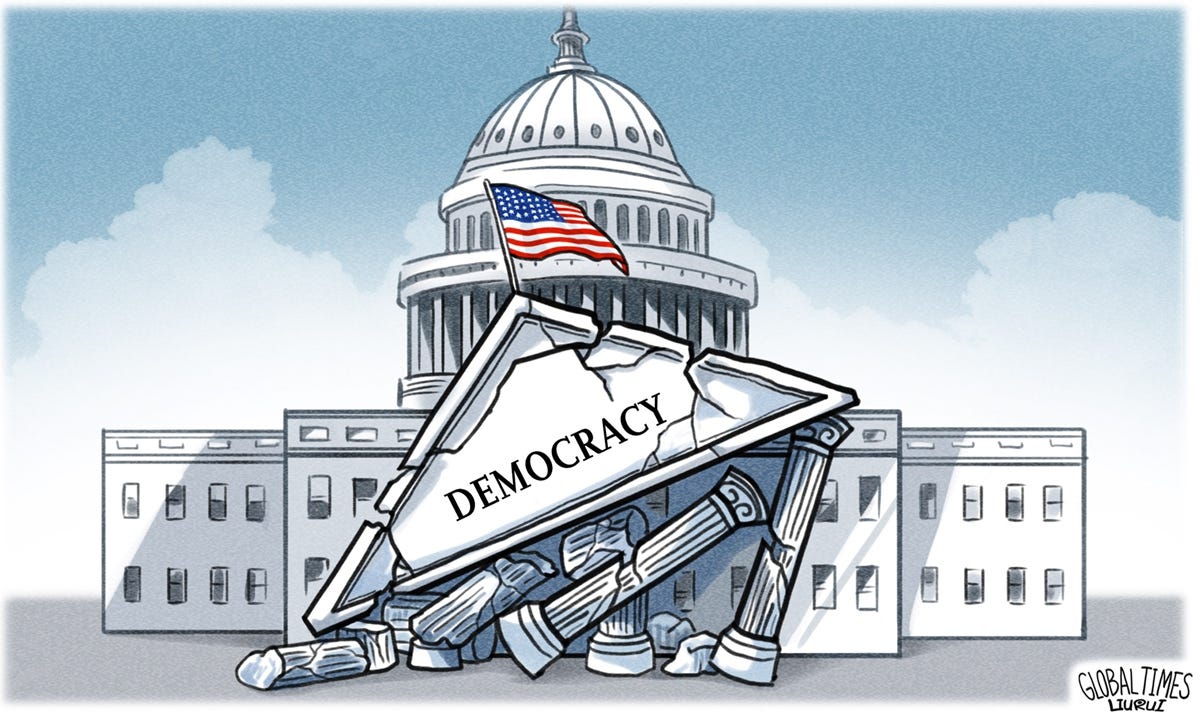
Of course, Democracy is already destroyed in America. Both parties are corporate-dominated. They obey the owners and donors and ignore us. The people who need the most help in America are those with the weakest voices; those who are dominant keep scheming successfully to get more and more even while loudly crying “foul.” It’s socialism for the corporate rich, dog-eat-dog capitalism for everyone else, and both parties are firmly committed to keeping it that way.

So why do I vote? I truly believe it’s one of my civic duties. Besides, there are issues/questions on the ballot that do matter in my state, and I want to have my say.

So, my fellow Americans, don’t despair at tomorrow’s results. Don’t become fearful about one party or the other winning followed by democracy’s destruction. For that happened decades ago, and we’re still chugging along, even though I’m seeing more black smoke billowing from the engine compartment.

My dad knew the score, and his words haunt me. He survived poverty, the Great Depression, World War II, and low-paying factory work before securing a decent civil service job that kept us solidly in the middle class. In the 1990s, he told me he’d had it tough in the beginning of his life but easy at the end; but he predicted the reverse would be true for me: relatively easy at the beginning but tough at the end. I hope he’s wrong, but I fear he’s right. The proof is evident at every election. Sigh.


Political Illogic in America

W.J. Astore

Don’t tell me I voted for the very bad guy when I voted for a very good one

Let’s look at a political ballot with three candidates. (I use “guy” without a specific gender in mind.)

Candidate (R): Very Bad Guy

Candidate (D): Bad Guy

Candidate (G): Very Good Guy

I only have one vote. I choose Candidate (G).

But wait, the critics scream. (G) doesn’t have a chance. Only (D) can win against (R). You must vote for (D) or children and democracy will die!

As Mr. Spock would say, this is highly illogical.

If (R) wins the election, the voters who cast their ballots for the Very Bad Guy are responsible. Not me.

If (D) loses, i.e. failed to win enough votes, then Party (D) should have nominated a better, more attractive, candidate, instead of a Bad Guy.

If (D) does win, and remember he’s a Bad Guy, his party will feel vindicated and will likely keep nominating bad guys. Why change a winning formula?

Logically, if I want a Very Good Guy to win, I have to vote for him. And if I want to drive Party (D) to nominate better candidates, I can’t do that by giving their bad guys my vote. I have to incentivize Party (D) to change, and they won’t change if I just roll over and vote for them because Party (R) is allegedly even worse.

So, if lots of Very Bad Guys win on Tuesday, blame those who voted for them. Prod those voters who stayed home and didn’t vote (perhaps by fielding better candidates in the future). Ponder why the big “choice” was between Very Bad Guy and Bad Guy. Just don’t blame me for voting for the Very Good Guy.

In 2022, What Are the Democrats For?

W.J. Astore

Tuesday’s elections won’t be kind to the aimless Democrats

President Joe Biden is not a message guy. Nor is Nancy Pelosi. Nor is Chuck Schumer. The senior leaders of the Democratic Party lack charisma, lack communication skills, and seemingly have no compelling core principles except the usual ones for politicians (raise money, stay in power). I’ve seen plenty of political ads, heard plenty of speeches, read plenty of articles, and what I’ve gathered is that I should vote Democrat because the Republicans are dangerous to democracy and beholden to Trump. And that’s about it for a “message.”

My guess is that this magnet is selling well

Oh, there is one thing. Biden promised he’d attempt to codify Roe v Wade into law if the Democrats can somehow keep control of the House and Senate, which at this point is unlikely for the House and dodgy as well for the Senate. Here’s the problem with that “promise.” In 2007, Barack Obama promised to codify Roe v Wade if he won the presidency, saying it would be his top priority. After he was elected, he changed his mind and did nothing. In 2020, Joe Biden made a similar promise; he has also done nothing in the last two years. Yet now we’re supposed to believe Biden’s new “promise,” even though it’s an obvious and desperate ploy to rally pro-choice forces to vote blue no matter who on Tuesday.

That Democrats are not Republicans is enough for more than a few voters, and I get that. What’s truly shocking is that’s pretty much the Democrats’ message. And it simply isn’t persuasive enough to appeal to undecided voters. More and more voters, fed up with both parties, are “independents” or otherwise unaffiliated, and you have to give them a reason to vote for you other than “the other guy (or gal) is worse.”

Consider, for example, the Democrats and war. Democrats fully support massive budgets for the Pentagon; Democrats fully support $100 billion or more for Ukraine in its war against Russia; Democrats fully embrace the “new Cold War” and aggressive support of Taiwan. Recall that Biden suggested “Putin must go” as a goal of the Ukraine war, and that Nancy Pelosi, that skilled and deft diplomat, traveled to Taiwan to stir up anti-American sentiment in China. If you’re at all interested in slightly downsizing the Pentagon budget, of ratcheting down tensions with Russia and China, of pursuing diplomacy with words instead of weapons, of occasionally fostering the idea of “peace,” today’s Democratic Party is not for you.

As inflation continues to rise, hollowing out the working and middle classes even more, the Democrats have no solutions except higher interest rates and a bit more government aid here and there so that you can keep making (barely) your rent or mortgage payments while putting food on the table and paying for heat. Forget about a higher federal minimum wage. Forget about single-payer health care. Even student loan debt relief is very limited (it may go away completely if the courts rule Biden exceeded his executive authority).

As Democrats lecture people about saving democracy, Americans wonder where democracy went. Obviously, both political parties are beholden to big money, the owners and the donors, and ordinary people have no say, except on Tuesday when we’re each allowed to cast one vote.

I will be voting, of course. As the saying goes, my vote must have some value or the powers that be wouldn’t be spending so much money to buy it. Where possible, I’ll be voting for candidates whose values most closely align with mine. That often means I’ll be voting third party, which my critics tell me is a vote for Trump and his evil minions. Sure, keep on scolding me for wanting honest and principled candidates like Matt Hoh, who’s running for the Senate in North Carolina for the Green Party. It’s all my fault for wanting candidates who truly offer hope and change, instead of more of the same.

Blame the voters, Democrats! It’s a surefire way to victory, if “victory” means another shellacking at the midterms by the Party of Trump. Sigh.

Whatever else is true, it’s not morning again in America.

Time to Study War Some More

W.J. Astore

There’s more to military history than decisive battles, great captains, and sexy weapons 

We sure could use honest and critical teaching about military history and war in America.

I don’t mean celebratory BS. I don’t mean potted histories of the American Revolution and its freedom fighters, the Civil War and its freeing of the slaves, World War II and America’s greatest generation and so on. I mean history that highlights the importance of war together with its bloody awfulness.

Two books (and book titles) come to mind: “War is a force that gives us meaning,” by Chris Hedges, and “A country made by war,” by Geoffrey Perret. Hedges is right to argue that war often provides meaning to our lives: meaning that we often don’t scrutinize closely enough, if at all. And Perret is right to argue that America was (and is), in very important ways, made by war, brutally so in fact.

Why study war? Shouldn’t we affirm that we ain’t gonna study war no more? Well, as Leon Trotsky is rumored to have said: You may not be interested in war, but war is interested in you. Among other reasons, students of history should study war as a way of demystifying it, of reducing its allure, of debunking its alleged glories. War is always a bad choice, though there may be times when war is the least bad in a series of bad choices. (U.S. involvement in World War II was, I believe, less bad than alternatives like pursuing isolationism.)

How are we to make sense and reach sound decisions about war if we refuse to study and understand it? A colleague sent along an interesting article (from 2016) that argues there’s not enough military history being taught in U.S. colleges and universities, especially at elite private schools. Here’s the link: https://aeon.co/ideas/the-us-military-is-everywhere-except-history-books

Visit your local bookstore and you’ll probably see lots of military history — it’s very popular in America! — but critical military history within college settings is much less common.  This is so for a few reasons, I think:

1. Many professors don’t like the “stench” of military history. When I was at Oxford in the early 1990s, I had a professor who basically apologized for spending so much time talking about mercenary-captains and war in early modern Europe. Yet war and controlling it was a key reason for the growth of strong, centralized nation-states in Europe in the 17th and 18th centuries.

2. Many professors simply have no exposure to the military — they’re ignorant of it, almost proudly so. Having taught college myself for fifteen years, including survey subjects like world history, I know the difficulty of teaching topics and subjects where your knowledge is shallow or dodgy. Far easier to stand on firm ground and teach what you know and ignore what you don’t know — or don’t like. But the easier road isn’t always the best one.

3. Critical military history suggests lack of patriotism.  I taught college as a civilian professor for nine years, and I was once told to “watch my back” because I wrote articles that were critical of the U.S. military’s wars in Iraq and Afghanistan. And I’m a retired Air Force officer!

So, with history professors often preferring to ignore or elide military subjects, military history is left to buffs and enthusiasts who focus on great captains, exciting battles, and famous weapons (often featured in glossy coffee-table books) like Tiger tanks and Spitfire fighters.  Such books often sell well and make for exciting reads. What they don’t do is to make us think critically about the costs of war and how disastrous wars often prove.

My own book on Paul von Hindenburg is a critical account of his life, including his complicity in the “stab in the back” myth and the rise of Adolf Hitler to power

A subject I taught at the USAF Academy was technology and warfare, and one of my concerns was (and remains) America’s blind faith in technology and the enormous sums of money dedicated to the same.  The Pentagon will spend untold billions on the latest deadly gadgets (actually, as much as $1.7 trillion alone on the F-35 jet fighterthroughout its lifespan) but academia won’t spend millions to think and teach more critically about war.

As an aside, weapons alone don’t make an effective military. It’s not the gladius sword that made Rome dominant but the citizen-soldier wielding it, empowered by republican ideals, iron discipline, and a proven system of leadership by example.

When the principled citizen-soldier ideal died in Rome, a warrior ideal consistent with a hegemonic empire replaced it. There’s much for Americans to learn here, as its own military today identifies as warriors and finds itself in the service of a global empire.

There’s more to military history than drums and trumpets — or bullets and bombs. For better or for worse, and usually for worse, we as a people are made and defined by war. We would all do well to study and understand it better.

(If you’d like to comment, please visit Bracing Views on Substack.)

Thinking About the Russia-Ukraine War

W.J. Astore

Shooting for total victory for Ukraine may only lead to total war for the world

Recently, I’ve been discussing the Russia-Ukraine War with a friend.  He sees it as a “war of national liberation” for Ukraine and fully supports extensive U.S. military aid in weaponry, intelligence, and logistics. Supporters of Ukraine, he said, are much like those who supported republican Spain against the fascist forces of Franco in the 1930s.  Vladimir Putin is a dangerous dictator bent on Ukraine’s total subjugation.  He must be stopped, and the best way to ensure that is total military victory for Ukraine.  He also opined that Ukraine is winning the war and that the $100 billion or so that the U.S. government has pledged is money well spent.

Once Ukraine wins the war, he concluded, it should be fully integrated into NATO, still a vitally important alliance against Russian imperial expansion and exploitation.  Ukraine only seeks to protect its own sovereignty and to join European democracies and the EU, a goal the U.S. should actively seek to facilitate.  

I wish I could be as confident and certain as my friend of the nobility of both Ukraine’s cause and U.S. participation in Ukrainian politics and the war.  Why am I more skeptical than my friend?  For several reasons:

  1. The U.S. government has done nothing to facilitate diplomacy and negotiation between Ukraine and Russia.  Indeed, the Biden administration has worked to discourage diplomacy.
  2. Ukraine may see itself as engaged in a “war of national liberation,” but for U.S. officials it’s more of a proxy war to weaken Russia.  Various sanctions and the destruction of the Nord Stream pipelines suggest powerful economic and financial motives that have nothing to do with safeguarding Ukrainian territory or its “democracy.”
  3. Undeniably, U.S. aid to Ukraine, commitments of which have already exceeded $100 billion, are a major boon to the military-industrial complex in America.  When people profit massively from war and death, it’s reasonable to question their motives.
  4. The U.S. military/government exists to safeguard national security and the U.S. Constitution.  In that context, the territorial integrity of Ukraine is not a vital concern.
  5. The danger of military escalation in Europe is real.  A longer war means more dead and wounded soldiers on both sides; more destruction and collateral damage; and more inflammatory rhetoric about nuclear red lines, dirty bombs, and the like. The longer the war lasts, the more inflamed passions will become, and the more likely efforts “to end Russian occupation” of Ukraine will escalate into something far more ambitious — and likely far deadlier.
  6. To me, neither side appears to be clearly winning and neither is on the verge of victory.  If the war lasts another year, or two, or three, any kind of Ukrainian “victory” may be pyrrhic indeed if the country is a blasted husk as a result.
War is ugly. Long wars are uglier still.

As I explained to my friend, I deplore Putin’s decision back in February to invade.  I hope Ukraine prevails.  But I believe Russia, Ukraine, and indeed the world would be better off if the war ends via negotiated settlement, the sooner the better.  History teaches us that wars often spin out of control when estranged sides insist on total victory.

I added that I’d be careful indeed in placing faith in the wisdom of U.S. leaders or in appeals to ideals of the Lincoln Brigade of the Spanish Civil War of the 1930s.  Recent wars (Vietnam, Iraq, Afghanistan, etc.) should teach us how frequently U.S. leaders lie, and how willing they are to wage long and disastrous wars that compromise U.S. security.

Also, talk of “facilitating Ukraine’s liberation” is both open-ended and ill-defined. For the U.S., is that limited to weaponry and training and the like?  Or does “facilitating” mean much more than that, including combat by U.S. troops and the risk of dying or being grievously wounded in the cause of Ukraine’s liberation?  If the latter, would you send your sons and daughters to fight in such a war?

Talking about Ukrainian national liberation and protecting democracy seems unproblematic, but, as I asked my friend, are you and yours willing to fight and die for it?  When did Ukrainian “liberation” become so vitally important to U.S. national defense?  So much so that $100 billion or more of your money is sent there, so much so that the 101st Airborne Division is deployed to Romania as a form of tripwire or deterrent, so much so that plans to deploy upgraded U.S. tactical nuclear weapons to Europe are being accelerated even as recent exercises featured dry runs of nuclear weapons attacks.

Already the Russia-Ukraine War has lasted far longer than experts predicted.  Already it has cost far more than anyone expected.  Shooting for total victory for Ukraine may only lead to total war for the world.

(Please go to Bracing Views on Substack if you’d like to comment.)