Mothers Against Drunk Driving (MADD) is an organization that’s helped to change the narrative on drinking and driving. Could a new organization like Mothers Against War (MAW) do the same for the world’s endless cycles of war?
In an antiwar movement that’s often fragmented and something less than the sum of its parts, a movement that unites women (and, of course, sympathetic men) in a dedicated push against war makes a lot of sense, argues Andre Sheldon. As he pointed out to me in our conversation yesterday, women united in the #MeToo movement against sexual violence; women marched on Washington in the aftermath of Trump’s election, donning pussy hats to remind us of his wanton and casual sexism (see Linda Roller’s account here for Bracing Views); Black women created the Black Lives Matter movement; and women helped to drive a movement against gun violence in the “Moms Demand Action” movement.
One thing we all have in common: we all have mothers. And there’s another thing that’s true for most of us (especially for us men): We should have listened to our mothers more, especially as a counterpoint to macho pro-war narratives being driven by powerful state and corporate interests.
As retired Army Colonel Ann Wright so eloquently put it recently: “For God’s Sake Boys, Stop this War S**t!!!”
In one of my favorite “Calvin & Hobbes” comic strips (from 1987), Calvin is shown comparing art projects with his friend, Susie. While Susie is content with a “tidy little domestic scene,” Calvin has something more ambitious in mind:
Something tells me we need more Susies and fewer Calvins.
For some reason, certain men, especially those who wear suits in the government, seem to think that toughness is all about putting on “big boy pants” and waging war. Of course, these same men usually don’t go to war themselves; they send other “boys” to fight and die for them. Macho posturing is common to both political parties in the United States, and it’s not just restricted to men. Perhaps the worst offenders were George W. Bush and Dick Cheney, who also both avoided the Vietnam War, but women like Hillary Clinton and Condoleezza Rice have shown no remorse in waging disastrous wars. Think here of Hillary’s infamous comment, “We came, we saw, he died” in the aftermath of the death of Qaddafi and the collapse of Libya into chaos.
Obviously, the answer isn’t as simple as putting women like Clinton or Rice in command. What we need instead are courageous and outspoken women like Barbara Lee and Dorothy Day. For, as Dorothy Day put it, “Our problems stem from our acceptance of this filthy, rotten system.”
Too many men have the emotional maturity of eight-year-old boys still seeking to knock each other over as they play “king of the hill.” But when the hill is Planet Earth and the toys they play with are nuclear missiles, the stakes are somewhat higher than bragging rights at the local playground.
Instead of “Jesus, take the wheel,” maybe it’s high time that women do. Something tells me we’d be better off as a people and as a planet.
Addendum: For more information on Andre Sheldon’s proposal, please check out his Facebook page.
Dissent and critical thought are needed most of all in times of war. Yet it’s precisely the time when people are pressured the most to silence their doubts, to mindlessly conform, and to wave the flag and to cheer for the “good” guys against the “bad” ones.
Dissent is easy to tolerate when it’s about trivial matters that don’t challenge or involve prevailing power structures. Chomsky and Herman famously wrote “Manufacturing Consent,” which is another way of saying that dissent itself is manufactured and controlled, providing us with an illusion that democratic debate is allowed and encouraged in America. But of course dissent isn’t tolerated when it threatens power structures, profit margins, and prevailing narratives.
We see this clearly in the amount of dissent policing and information quashing about the Russia/Ukraine war. Look at what happened to the RT (Russia Today) network in the USA (RT America). It was dropped by DirecTV and forced to layoff its staff and cease operations. It’s easy to cheer something like this if you think or have been told everything Russian is evil, but the loss is considerable to democracy and to free speech.
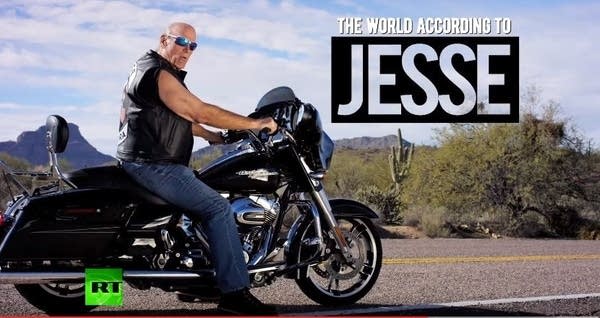
I didn’t watch a lot of RT America, but I appreciated the network’s support of informed critics like Chris Hedges and Jesse Ventura. Hedges and Ventura, both freethinkers, were excluded by the mainstream media in the U.S. Ventura’s case is especially revealing. He had a three-year, multi-million dollar contract with MSNBC for a talk show in 2003 that was cancelled when the network realized he was against the Iraq War. The network honored the contract, paying him roughly $6-8 million while keeping him off the air for three years. Millions in hush money for no work sounds like a good deal, but it’s obviously not in the interest of free speech.
Jesse Ventura on RT: An informative, provocative, and often funny show
When I started writing for TomDispatch.com in 2007, posting articles that called into question the official narrative of “progress” in the Iraq and Afghan Wars, there were exactly two TV networks that asked to interview me: Al-Jazeera and RT America. (I turned them down, mainly because I was working in rural Pennsylvania and had no time to travel to New York City for in-studio interviews.) No mainstream media network showed any interest. I’m not complaining here — I’m just stating facts. Ask yourself how many times you’ve seen and heard antiwar voices and penetrating criticism on NBC, CBS, PBS, CNN, MSNBC, and similar networks. You won’t see and hear it there because it’s considered bad for business.
Why is it bad for business? Advertisers don’t like it. You know: companies like Boeing, Lockheed Martin, and similar bastions of the military-industrial complex. Those same companies are often part of multi-national conglomerates that own the networks. They are not about to sanction shows or grant airtime to well-informed critics like Hedges and Ventura. Why would they? Profit and power trump free speech every time.
Dissenting voices are still out there, but they are kept on platforms where their reach is often limited by computer algorithms that send people to mainstream sites first. For what it’s worth, I look for alternative perspectives at the Jimmy Dore Show, at Useful Idiots, at Breaking Points, and from journalists like Matt Taibbi, Glenn Greenwald, Chris Hedges, and Caitlin Johnstone, among others.
I also continue to check mainstream sources like the New York Times, NBC News, and PBS, as well as subscribing to old-fashioned paper magazines like The Nation, The New Republic, and The Baffler. And I’m not above watching Tucker Carlson when he features important voices like former Congresswoman Tulsi Gabbard.
Americans, citizens of what is allegedly a democracy, deserve access to the widest possible range of sources and critics. Denying the same to us is censorship. It limits thought, it stifles debate, and it makes us much less than what we could be as a democracy and as a people.
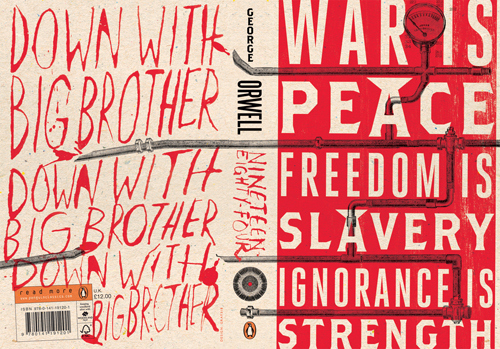
Anybody attempting to understand what is unfolding in Ukraine and over in the South China Sea and Taiwan should read George Orwell’s 1984. When you do, you will recognize and realize the following.
To use Orwell’s terms: What we have here and now is a Eurasia with its Putin and an Eastasia with its Xi. All that is lacking is an Oceania with its Big Brother. And we have a whole gaggle of folks on the American political landscape ~ on the Left and on the Right ~ who would love to have the chance to fill that slot.
America’s twenty year “Forever War” after 9/11 was, is, and ever will be a half-time show designed to keep the troops occupied, the defense contractors profitable, and the American people comfortably numb to protracted conflicts in places many of them cannot find on a map of the world.
For now, Russia has recovered from the disintegration of European Communism and the USSR ~ and China has recovered from the madness of Mao ~ sufficiently for either [or especially both] to present viable, credible “threats” to America’s 30-year reign of global, unipolar hegemony since the end of Cold War I in December, 1991.
For now looms Cold War II, with Ukraine, the South China Sea, and/or Taiwan set to kick it off in fine fashion.
And to understand what is happening in Ukraine, in particular, one must also be familiar with the history of Russia’s interaction with Western Europe over the past 200 years. Napoleon and Hitler both tried to bring the “blessings” of the West to Mother Russia, and failed at terrible cost, particularly to the Land, Country, Nation, and People that was ~ and still is ~ Russia.
NATO is hard on all of Russia’s borders except in Ukraine; and, given that history spanning over two centuries, it is not at all difficult to understand why Russia wants to keep it that way. This in no way justifies, excuses, or exonerates Putin and his illegal, immoral, and quite insane invasion of Ukraine. It merely speculates on a very real possible motive.
And beyond all that is the fact that a major force at work here in the United States is the possibility of a War, and the effect that that can have on the Citizens of a nation already hammered by a failed national response to a pandemic, inflation kicking in big time, a national Debt that just broached $30 trillion, a crumbling infrastructure increasingly vulnerable to disruptions by weather, cyber attack, and social unrest, and the disintegration of anything even close to a national consensus on virtually every hot-button issue: from vaccine and mask mandates, voting rights, and critical race theory, to gun control, police violence, and crimes against persons and property, to drug overdoses, suicides, and vehicular deaths, abortion, wokeness and cancel culture, “domestic terrorism,” and so forth.
So that’s the “long answer” to what’s up in Ukraine and East Asia.
The short, bottom-line, bullet-hits-the bone answer is that it is a very convenient distraction for Putin, Xi, and Biden [ie, his owners, operators, and script writers, America’s Ruling Elite] as they each attempt to deal with very serious economic and social problems within their own kingdoms.
While the wings haven’t fallen off quite yet, rivets are popping loose and hydraulic fluid is streaming back across the wing tops. And the folks up in the cockpit are very aware that it is increasingly visible to the other folks back in 1st, Business, and especially Tourist Class.
Add all that to the fact that this is an election year in the US, and this is shaping up to be a very interesting Chinese “Year of the Black Water Tiger,” indeed.
Note: One of the biggest differences between 1984 and today is that we all carry our very own portable, personal telescreen around with us. Certainly makes the job of the Thought Police a whole lot easier, eh?
Jeffrey Moebus, a retired U.S. Army Master Sergeant, spent two years in Vietnam in the 1960s and two years in the pre-Operation Desert Storm Middle East in the 1980s. He lives in Sitka, Alaska on the sailboat he brought up from San Francisco Bay ten years ago this summer, and is the POC for Veterans Against War [Sitka Platoon] at vaw.sitka@gmail.com.
Despite the possibility that what a deranged Vladimir Putin planned as a small war against Ukraine could morph into a nuclear catastrophe capable of engulfing us all, the United States is still the most warlike nation on earth.
Wars don’t come cheap these days, so it shouldn’t come as a surprise that the only truly non-partisan issue in Congress is the Pentagon budget. Democrats and Republicans alike, neither of whom expect to get shot at, vie with one another to show how resolute they are in keeping America strong no matter what the cost, even in human lives, though preferably those of foreigners.
The Pentagon budget, now creeping toward $800 billion, is more than three times that of China, our closest rival, a country that had the effrontery to build an aircraft carrier of its very own to challenge our eleven. The generosity of Congress enriches people who in the 1930s were stigmatized as “merchants of death,” but the latter have since learned the value of public relations. America’s military-industrial complex, as might be expected, led the way in recruiting the very best PR talent. The war to liberate Kuwait (Desert Storm) came to us thanks in part to the creativity of Hill & Knowlton (known in the trade as the Torture Lobby). Wars have persisted even as critical domestic problems continue to go unaddressed, such as American school children suffering brain damage due to lead-contaminated drinking water.
There is something immoral about all this. To be fair, the Catholic Church in the United States, for which morality is presumed to be a major concern despite some very public failings, does take notice of war now and then. Or rather it used to. It hasn’t done so lately.
The United States Council of Catholic Bishops meets twice a year, which you’d think would give a troubled bishop the opportunity to call into question the morality of much of what our armed forces have been up to. But you’d think wrong. Successive cliques of ill-educated, narrow-focused reactionaries—Burke, Gomez, Lori, Cordileone, Kurtz, and Dolan the most prominent among the current crop—have succeeded in keeping the topic of war off the agenda for more than thirty years. Nor have they seemed to have had much trouble doing so.
Recently, however, two bishops have spoken up in their own dioceses. Bishop Stowe of Lexington and Archbishop Wester of Santa Fe have pleasantly surprised Catholics like me by issuing pastoral letters calling for the abolition of nuclear weapons. Unfortunately, my pleasure is diminished by the realization that such efforts, however welcome, will do little to stave off a nuclear Armageddon after which, in the words of Nikita Khrushchev, the living will envy the dead.
The Vatican—even during the imperious reign of John Paul II, whose attention was fixed upon restoring freedom to his native land (which is now on the road to dictatorship)—has been forever calling for nuclear disarmament. But how has it called? In what tone of voice? That’s the key question.
Forty years ago, and far too long after the nuclear massacres of Hiroshima and Nagasaki—atrocities that the Catholic Church in America, like its government, has yet to condemn—the bishops of the United States, prodded, I’m sure, by Ronald Reagan’s missile-rattling rhetoric, surprised everybody by announcing that they were going to prepare a pastoral letter on war.
The deliberations of the committee, headed by Cardinal Bernardin of Chicago, got off on the wrong foot when Bernardin was forced to announce at the first meeting that they were by no means to condemn the possession of nuclear weapons, an edict from Rome that slammed the door in the face of the Holy Spirit, whose guidance they presumably would be imploring.
But the bishops labored on and brought forth “The Challenge of Peace.” It was a good but compromised document. Not compromised enough, however, for John Paul II and Cardinal Joseph Ratzinger. After the first draft was scrutinized in Rome, Bernardin and Archbishop John Roach, chairman of the U.S. Council of Bishops, were called on the carpet in Rome to defend it to the “NATO bishops” (a Vatican dicastery previously unknown to me), who were more concerned about a Soviet armor thrust through the Fulda Gap than anything that Jesus might have said.
Bernardin and Roach duly met with their critics, and the NATO bishops came away content. The concessions were major. One, for example, was purging a declaration of “no first use” of nuclear weapons in response to an attack with conventional weapons. The first draft had not done anything quite so bold. It merely proposed that any circumstances in which a first use would be morally acceptable would be difficult to imagine. Well: Ratzinger and the NATO bishops had no problem imagining one.
When the final version of The Challenge of Peace came out in May of 1983, the Pentagon, which had been a bit worried, and hawks everywhere—especially devout Catholic hawks like William F. Buckley Jr—breathed a sigh of relief. It was obvious to all who cared to read it that the bishops had waffled. With all due modesty—well, some anyway—the title of a subsequent article of mine in Commonweal, “Sidestepping The Challenge of Peace,” summed it up. (Commonweal disagreed with me, and still does, but that’s another story.)
Whatever the case, the Peace Pastoral is gone and forgotten, a failure that casts a pall to this day over subsequent (and toothless) Vatican statements on how nice peace is and how bad war is.
What do I want the Church to do? Let me quote somebody else, somebody who answered that question far better than I ever could.
In 1948 the Dominicans of Paris invited Albert Camus to address them about what he and other non-believers wanted to hear from the Catholic Church in the wake of the horrors of World War II, their hope being that they could unite to confront the horrors that yet impended.
Camus, who described himself and others like him as “isolated individuals,” was quite willing to challenge the Church. He did not share the beliefs of the Dominicans, he said, but neither did he dismiss them. He recounted how during the war he, even as a non-believer, had looked to Rome. He wanted to hear a “great voice” raised to condemn the monstrous evil of the war, but he failed to hear it. There were those who said that they had heard it, but what little the world heard from Rome was the Church speaking in what he dismissed, not without cause, as its “encyclical voice,” a form of speech that was prolix, abstract, and devoid of inspiration for all those not attuned to it. (The word “Jew,” incidentally, did not make the cut.)
The Dominicans wanted to know what the world expects of Christians. He gave them his answer:
What the world expects of Christians is that Christians should speak out loud and clear and proclaim their condemnation in such a way that never a doubt, never the slightest doubt, could rise in the heart of the simplest man. Christians must get away from abstraction and confront the bloodstained face that history has taken on today.
And what happens, Camus went on to ask, if Christianity doesn’t rise to the challenge? And here Camus shows a prescience that eludes the U.S. Council of Catholic Bishops. For it was a question quite pertinent to our own era, marked as it is by empty churches and tepid bishops.
If Christianity does turn away from the challenge, Camus told the Dominicans,
Christianity will lose once and for all the virtue of revolt and indignation that belonged to it long ago. In that case self-proclaimed Christians may still be among us, but Christianity itself will die, and world will suffer greatly for its loss.
In the spirit of Camus, here’s my recommendations. However reluctant our bishops might be to confront the blood-stained face of history, they could make a start by talking to people who know more than they do and have experienced more than they have.
In his book The Doomsday Machine, Daniel Ellsberg, working for RAND, tells how he was shocked to see an unguarded fighter plane on the tarmac armed with a nuclear bomb. (This was more than 60 years ago, but even today nuclear surety remains less than sure.). A drunken pilot could jump into the cockpit and be off to Beijing to set off World War III just like that. In any case, Ellsberg took the opportunity to place his hand on the bomb and feel the heat of radiation. I’m sure he would be happy to share his feelings at the next USCCB conference if invited.
Then there’s Bishop Botean, who leads the Romanian eastern rite Church in the United States. He’s the only Catholic bishop who issued a letter condemning the Iraq invasion, calling it an unjust war in which Catholics may in nowise participate. If the USCCB was willing to hear what he had to say, it would give some of the disgruntled brethren an opportunity to ask what prompted him to be such a spoilsport.
There’s also Andrew Bacevich, a retired colonel and veteran of the Vietnam war, who is the head of the Quincy Institute for Responsible Statecraft. He’s a conservative Catholic who is a severe critic of American foreign policy, especially in the Middle East.
Finally, Archbishop Wester had the grace to praise the late Sr. Megan Rice who appeared on the front page of the New York Times after, at age 82, invading the Holy of Holies of nuclear weaponry in Oakridge, Tennessee. The USCCB could follow up on the incredible feat that she and her two companions carried off by recognizing and commending the Plowshares Movement, founded by the Berrigans, a group of heroic men and women who have borne witness against nuclear weapons and suffered greatly for it. They have heeded Jesus’ command to shout what he taught them from the rooftops, instead of keeping their mouths shut about anything that might disturb major donors. (Those big churches and episcopal palaces aren’t going to maintain themselves!)
The bishops have much to learn from talking to people like the ones I’ve listed here. They might even learn to denounce the abomination of genocidal nuclear weapons—and especially any idea that a “first use” policy of the same is in any way morally defensible.
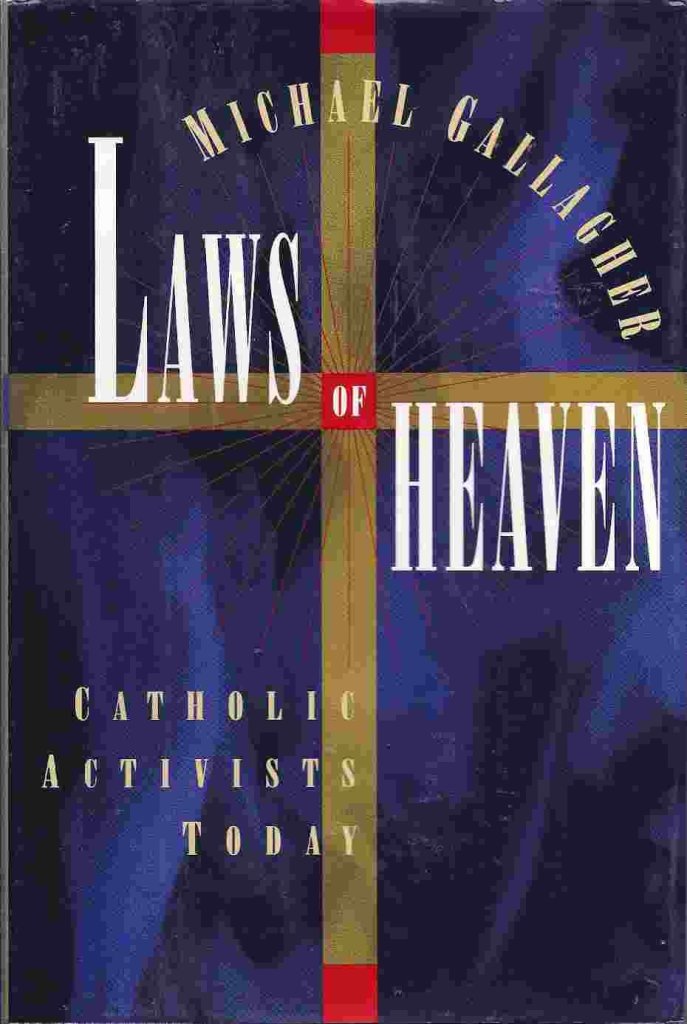
Michael Gallagher served as a paratrooper during the Korean War. His book on Catholic activists, Laws of Heaven, won the National Jesuit Book Award in theology, and his translation of Yukio Mishima’s Spring Snow was a finalist for a National Book Award.
As war in Ukraine drags on, the possibility for dangerous escalation increases. The goal should be the quickest possible ceasefire and a diplomatic solution that puts an end to hostilities. Or, to cite Vera Brittain in “Testament of Youth” again: “No to killing. No to war.”
An obstacle to this are all the keyboard commandos in the West who are recklessly calling for dangerous escalations against Russia. These include a “no-fly” zone above the city of Kyiv enforced in part by the U.S. Air Force, and direct attacks by European air forces against Russian armored columns on their way to Kyiv. Such calls for military action are indeed reckless since Vladimir Putin has issued a none-too-veiled threat of a nuclear response to them. Is he bluffing? I for one do not want to find out.
The West is already providing advanced weaponry to Ukraine such as Stinger anti-aircraft missiles and Javelin anti-tank missiles. EU countries even talked of sending fighter aircraft to Ukraine, but that deal seems to be falling apart. Such weaponry may increase the costs of war to Russia, but weapons alone are not likely to prove decisive in any way.
For all those keyboard commandos out there, safely tweeting about attacks on Russian forces in the cause of “helping” Ukraine, I have a challenge for you. Come out from behind your keyboards, book a flight to Ukraine, grab a Kalashnikov or perhaps even a Stinger, and show how determined you really are to defend Ukraine. Barring that, and assuming you’re of military age and that you’re American, why not take this opportunity to enlist in the U.S. military, as NFL star Pat Tillman famously did in the aftermath of 9/11. Show us how tough you really are; show us how much you truly care.
Because, if you’re not willing to put up, it really is better (and also much more honest) if you shut up.



 Bracing Views