Comey is terminated. An ineffective leader? It takes one to know one.
W.J. Astore
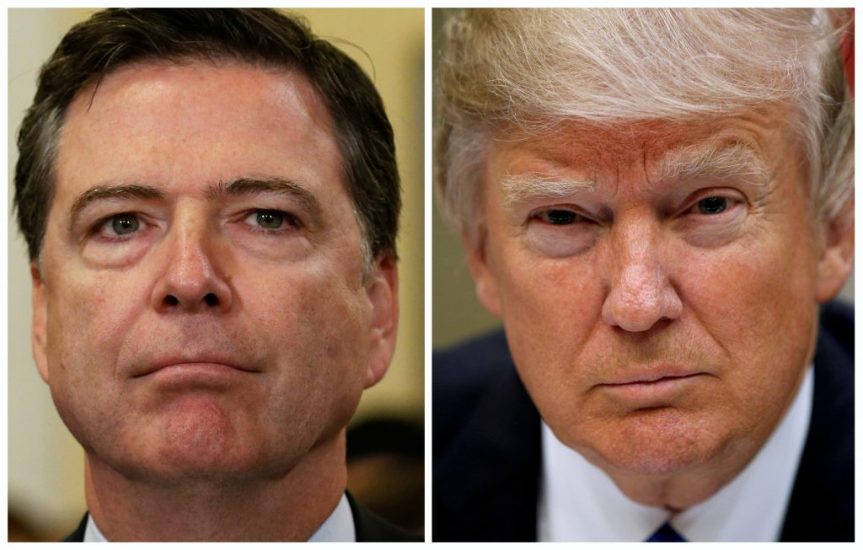
Sometimes it’s necessary to state the obvious. The firing of FBI Director James Comey is not about his job performance and especially his handling of Hillary Clinton’s emails. It’s all about Donald J. Trump.
While I greatly appreciate you informing me, on three separate occasions, that I am not under investigation, I nevertheless concur with the judgment of the Department of Justice that you are not able to effectively lead the Bureau.
The bolded phrase is remarkable. Trump is at pains to suggest that Comey is not investigating him, yet the FBI is indeed looking into Russian influence in the 2016 election, including ties between the Trump campaign and Russian officials.
Whether you believe the whole Russian influence dispute is a made-up scandal, a red herring, so to speak, the fact is that Trump sees it as a major threat to his prerogatives and power. That’s why he’s at pains to state bluntly that Comey is not investigating him. Comey, Trump says, told him three times — three times! — he’s not under investigation.
The president doth protest too much. If you think Comey is unable to lead effectively, fire him for that reason. You don’t need to include a self-aggrandizing statement of how blameless or innocent you are in the ongoing Russian investigation.
Trump’s firing of Comey, moreover, displays his petulance, his impetuousness, and indeed his nervousness about the trajectory of his presidency.
As the CEO of a family business, Trump is used to firing people who don’t kowtow to him. Running a nation, however, is not like running a family business. Right?
Will Trump prevail? Time will tell. One thing is certain: American democracy — what’s left of it — suffered another body blow yesterday.
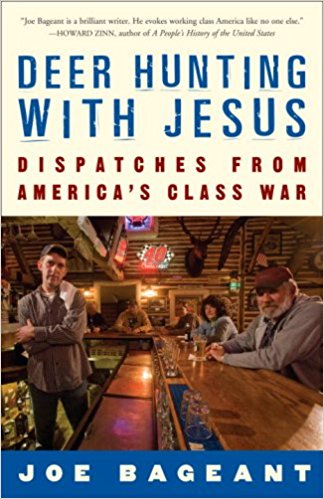
Joe Bageant was a remarkable writer, the author of “Deer Hunting with Jesus” as well as “Rainbow Pie.” A self-confessed “redneck,” he worked his way into the middle class as an editor, but he never forgot his roots in Appalachia and the subsistence farming of his Scots-Irish family. Bageant had a brutally honest and unadorned way of speaking and writing, and also a great affection and deep respect for traditional communal values in America.
The other day, I was reading an old essay Bageant wrote, “Live from Planet Norte” (June 2010), long before Donald Trump was even remotely considered to be presidential material. As usual, Joe nailed it:
[I]n the process of building our own gilded rat-cage, we have proven that old saw about democracy eventually leading to mediocrity to be true. Especially if you keep dumbing down all the rats. After all, Dan Quayle, Donald Trump and George W. Bush hold advanced degrees from top universities in law, finance and business.
The head rats, our “leaders” (if it is even possible to lead anybody anywhere inside a cage), have proven to be as mediocre and clueless as anyone else. Which is sort of proof we are a democracy, if we want to look at it that way. While it is a myth that virtually anybody can grow up to be president, we have demonstrated that nitwits have more than a fighting chance. During my 40 years writing media ass-wipe for the public, I have interviewed many of “the best of my generation,” and, believe me, most of them were not much.
Naturally, they believe they are far superior by virtue of having made it to an elevated point in the gilded cage, closer to the feed, water and sex. Because they believe it, and the media–sycophants waiting for quotes–echoes their belief, discussing their every brain fart, we tend to believe it, too. Nothing shakes our belief, not even staring directly into the face of a congenital liar and nitwit like Sarah Palin, or a careening set of brainless balls like Donald Trump or a retarded jackal like George W. Bush.
Americans are unable to explain why such people “rise to the top” in our country. We just accept that they do, and assume that America’s process of natural selection – the survival of the wealthiest – is at work. These people are rich; therefore, they should run the country. God said so. It’s a uniquely American principal of governance, which in itself, makes the case for our stupidity.
Donald Trump is best at selling a certain image of himself: the self-made billionaire, the savvy deal-maker, the populist patriot who sides with the little guy. But Joe Bageant had him pegged: a careening set of brainless balls is maybe the best, and certainly the most colorful, descriptor I’ve come across for Trump.
Bageant’s larger question is clear: How did Americans come to value such nitwits, halfwits, and dimwits? Just because they have money? Just because they have a veneer of “success” about them, when this “success” is evidenced by nothing more than money or fame and the sly charm of grifters?
Americans, who worship at the altar of success as measured by the almighty dollar, are kneeling to pray before the empty suits of men like Donald Trump. Bageant knew better than to join that mindless cult; so should we all.
Memories of War: So powerful yet often so fragmentary
W.J. Astore
Memories of war are powerful and fragmentary. At a national level, we do best at remembering our own war dead while scarcely recognizing the damage to others. This is one cost of nationalism. Nationalism is violent, bigoted, and discriminatory. It elevates a few at the expense of the many. It fails fully to recognize common human experience, even one as shattering as war.
One example. I’ve visited the Vietnam War Memorial in Washington, D.C. In seeing all those names of American dead on the wall, I was moved to tears. It’s a remarkable memorial, but what it fails to capture is any sense of the magnitude of death from that war visited upon Vietnam, Laos, and Cambodia. As I wrote for Alternet, to visualize the extent of death from America’s war in Southeast Asia, the Vietnamese would need a wall that would be roughly 20 to 50 times as long as ours.
Think about that for a moment. A wall perhaps 50 times as long as our Vietnam memorial wall. It’s a staggering mental image. Sadly, today in America the only wall garnering much media interest is Trump’s wall along our border with Mexico, yet another manifestation of nationalist bigotry and bias.
John Dower challenges us to think differently. To explore our common humanity. To remember the war dead of other nations and peoples, and to record the true cost of America’s wars, both to others and to ourselves. His latest article at TomDispatch.com explores how Americans both remember and forget their wars. Here’s an excerpt:
While it is natural for people and nations to focus on their own sacrifice and suffering rather than the death and destruction they themselves inflict, in the case of the United States such cognitive astigmatism is backlighted by the country’s abiding sense of being exceptional, not just in power but also in virtue. In paeans to “American exceptionalism,” it is an article of faith that the highest values of Western and Judeo-Christian civilization guide the nation’s conduct — to which Americans add their country’s purportedly unique embrace of democracy, respect for each and every individual, and stalwart defense of a “rules-based” international order.
Such self-congratulation requires and reinforces selective memory. “Terror,” for instance, has become a word applied to others, never to oneself. And yet during World War II, U.S. and British strategic-bombing planners explicitly regarded their firebombing of enemy cities as terror bombing, and identified destroying the morale of noncombatants in enemy territory as necessary and morally acceptable. Shortly after the Allied devastation of the German city of Dresden in February 1945, Winston Churchill, whose bust circulates in and out of the presidential Oval Office in Washington (it is currently in), referred to the “bombing of German cities simply for the sake of increasing the terror, though under other pretexts.”
Too often, Americans believe they’re waging a war on terror, forgetting that war itself is terror. That war itself is evil. That doesn’t mean that war is never justified, as it was, I believe, in the struggle against Nazi tyranny in World War II. Even in justifiable wars, however, we need to recognize that war breeds corruption; that war, in essence, is corruption, a corruption of the human spirit, of a humanity which should be held in common and nourished, but which during war is degraded if not destroyed.
John Dower recognizes this. It’s a theme he explores in his new book, The Violent American Century: War and Terror Since World War Two. Consider it a primer on war’s many corruptions, and a precis of America’s tendency toward a nationalism of callous indifference when it comes to the damages we inflict on others. It’s not happy reading, but then again wars shouldn’t be a subject for happiness.
A remarkable primer and meditation on America’s endless wars
Wars and rumors of war seem always to be with us. Some would say they’re an inevitable part of the human condition. Our historical record seems to support that grim conclusion. Yet there is another way, a more pacific path, a path toward peace. But to walk that path, we must first fully recognize the tangled undergrowth of war that imperils our every footstep. Dower’s latest book helps us to do just that.
News this week that 300 Marines have returned to Helmand Province in Afghanistan recalls the failed surge of 2009-10, when roughly 20,000 Marines beat back the Taliban in the region, only to see those “fragile” gains quickly turn to “reversible” ones (to cite the infamous terms of General David Petraeus, architect of that surge).
While fragility and reversibility characterize American progress, the Taliban continues to make real progress. According to today’s report at FP: Foreign Policy, “the Taliban controls or contests about 40 percent of the districts in the country, 16 years after the U.S. war there began.” Meanwhile, in January and February more than 800 Afghan troops were killed fighting the Taliban, notes Foreign Policy, citing a report by the Special Inspector General for Afghan Reconstruction. That’s a high figure given that fighting abates during the winter.
Besides committing fresh U.S. Marines to more Afghan security forces “training,” the U.S. military has responded with PR spin. For example, when friendly Afghan forces abandoned a district and police headquarters, a U.S. spokesman claimed it had been “repositioned.” According to FP: Foreign Policy, “U.S. forces helped in ferrying [Afghan] government troops and workers out, and American jets came back to destroy the rest of the buildings and vehicles left behind.” Literally, the old district center and its resources had to be destroyed, and a new one created, for the Afghan position to be “saved.”
Destroying things to “save” them: Where have we heard that before? The Vietnam War, of course, a lesson not lost on Aaron O’Connell, a U.S. Marine who edited the book “Our Latest Longest War: Losing Hearts and Minds in Afghanistan.” O’Connell’s recent interview with NPR cites the Vietnam example as he explains the one step forward, two steps back, nature of America’s Afghan War. In his words:
So we’ve spent billions building roads in Afghanistan, but we then turned the roads over to the Afghans in 2013. We trained up a maintenance unit so that it could provide for road maintenance, and nothing has happened since then. Now, today, more than half of the roads are deemed unfit for heavy traffic. And as one taxi driver put it in 2014 – things have gotten so much worse, now if we drive too fast, everyone in the car dies.
So it’s – really, we have to think about the things that are sustainable.
Americans have spent an enormous amount of money in Afghanistan without thinking about how to sustain the improvements we’ve funded. Meanwhile, as O’Connell notes, the security situation (as in lack of security) in Afghanistan undermines those infrastructure efforts.
With respect to U.S. efforts to create a viable Afghan Army, O’Connell doesn’t mince words about its failings:
[T]he massive assembly-line attempt to produce capable, professional national security forces has not worked well, and it’s been at tremendous cost. And for all those who say we should just keep doing what we’re doing in Afghanistan, let me explain why that’s not sustainable. Every year, between a quarter and a third of the Afghan army and the police desert. Now, these are people that we have armed and trained. We’ve given weapons to them. We’ve given them basic military training. And every year, a third of them disappear [with their guns].
Here’s the grim reality: U.S. military efforts to take charge and win the war, as in “winning hearts and minds” (known as WHAM) in 2009-10, proved unsustainable. Follow-on efforts to turn the war over to the Afghan government (analogous to LBJ and Nixon’s “Vietnamization” policy in the waning years of the Vietnam War) are also failing. Yet America’s newest commanding general in Afghanistan wants yet more troops for yet more “training,” effectively doubling down on a losing hand.
Required reading for those with eyes to see and ears to hear
The logical conclusion – that’s it’s high-time U.S. forces simply left Afghanistan – is never contemplated in Washington. This is why Douglas Wissing’s book, “Hopeless But Optimistic: Journeying through America’s Endless War in Afghanistan,” is so immensely valuable. Wissing is a journalist who embedded with U.S. forces in Afghanistan in 2013. His book consists of short chapters of sharply drawn vignettes focusing on the street and grunt level. Its collective lesson: Afghanistan, for Americans, doesn’t really exist as a country and a people. It exists only as a wasteful, winless, and endless war.
What is Afghanistan to Americans? It’s an opportunity for profit and exploitation for contractors. It’s a job as well as a personal proving ground for U.S. troops. It’s a chance to test theories and to earn points (and decorations) for promotion for many officers. It’s hardly ever about working closely with the Afghan people to find solutions that will work for them over the long haul.
A telling example Wissing cites is wells. Americans came with lots of money to drill deep water wells for Afghan villagers and farmers (as opposed to relying on traditional Afghan irrigation systems featuring underground channels that carry mountain water to the fields with minimal evaporation). Instead of revolutionizing Afghan agriculture, the wells drove down water tables and exhausted aquifers. As the well-digging frenzy (Wissing’s word) disrupted Afghanistan’s fragile, semiarid ecosystem, powerful Afghans fought to control the new wells, creating new tensions among tribes. The American “solution,” in sum, is exacerbating conflict while exhausting the one resource the Afghan people can’t do without: water.
Then there’s the “poo pond,” a human sewage lagoon at Kandahar Air Field that was to be used as a source for organic fertilizer. I’ll let Wissing take the tale from here:
But instead of enriching Afghan soil, the U.S.-led coalition forces decided to burn the mountains of fertilizer with astronomically expensive imported gasoline. The [U.S. air force] officer reminded me that the Taliban got $1500 in protection money for each U.S. fuel tanker they let through, so in the process the jihadists were also able to skim the American shit [from the poo pond].
Walking back, I spot a green metal dumpster stenciled with a large sign that reads, “General Waste Only.” At that moment, it seems to sum up the whole war.
Wissing’s hard-edged insights demonstrate that America is never going to win in Afghanistan, unless “winning” is measured by money wasted. Again, Americans simply see Afghanistan too narrowly, as a “war” to won, as a problem to be managed, as an environment to be controlled.
Indeed, the longstanding failure of our “answers” is consistent with the military’s idea we’re fighting a generational or “long” war. We may be failing, but that’s OK, since we have a “long” time to get things right.
After sixteen years and a trillion dollars, the answer in Afghanistan is not another sixteen years and another trillion dollars. Yet that’s exactly what America seems prepared to do in the endless war that to us defines Afghanistan.
Update (5/5/17): According to FP: Foreign Policy, “‘More conventional forces that would thicken the ability to advise and assist Afghan forces — that would absolutely be to our benefit,’ said Gen. Tony Thomas, head of U.S. Special Operations Command who testified alongside Whelan. President Trump is attending a NATO summit in Brussels on May 25, and a decision is expected by then.”
I love that word: thicken. The general refuses to say “improve.” And that’s probably because more U.S. troops really won’t improve training, in the sense of enhancing Afghan forces’ effectiveness. As FP reports, “Washington has spent about $71 billion training and equipping the Afghan army over the past 16 years, and despite that investment, the Taliban remains in control of large areas of the country and outside terrorist groups like the Islamic State have moved in.”
But not to worry: More “thickening” is coming in the form of more U.S. troops and money.
Insanity: repeating the same course of action again and again and yet expecting different results.






 Bracing Views