My Dad’s Silver Dollars

W.J. Astore

My dad left me two silver dollars.  They’re worth much in sentimental value (I’ll explain in a moment), but they also teach us something about how America has changed.

Here’s a photo of them.  Lady Liberty is on the front, an eagle is on the back.

IMG_1681

These were “peace” dollars issued in the aftermath of World War I.  (Note the word “peace” under the eagle.)  Imagine that: a coin issued by the USA dedicated to and celebrating peace!  It’s truly hard to imagine such a coin being issued today, and not only because our currency is now made only with base metal (a debased currency?).

In keeping with U.S. foreign policy today, an equivalent 2018 (faux silver) dollar would doubtless feature the god of war on the front with a menacing eagle clutching missiles, drones, and bombs on the back.

Anyway, I promised a story about my dad’s silver dollars, and I’m going to let him tell it:

“I have a silver dollar in my coin collection. Helen and I were courting at the time. At Nantasket beach [in Massachusetts] there was a glass container with prizes, candy, coins, etc. Also a crank on the unit which when turned controlled a flexible scoop. The idea was to work the scoop to pick up something of value. Well, I took a chance. It was like magic; the scoop just went down and picked up the silver dollar. I gave it to Ma as a remembrance. We’ve had it ever since.”

“The other silver dollar has a story also. A buddy in the service [Army] gave it to me for a birthday present [during World War II].”

After my dad died, these coins passed to me.  One is from 1922, the other from 1924.  I love the “peace” eagle they feature, though we know peace was not in the cards for long after the Great War.  And of course I love my dad’s stories of how he came to possess them.

When will America’s coinage next feature a tribute to the end of war and the promise of peace?

The Disastrous Italian War Against Austria-Hungary (1915-18), the Rise of Fascism, and Trump’s Victory in 2016

W.J. Astore

My father’s family was Italian, and his relatives fought, suffered, and died in Italy’s wars before and during World War I.  In his diary, my dad recounted these relatives and their fates:

My mother as far as I can recall had two brothers in the [Italian military] service. One brother had an exploding shell land near him.  He was highly agitated.  A doctor who knew my mother’s family saw that he got a medical discharge.

His brother had a much more dangerous career in the Italian Army.  He was a forward observer for an artillery unit.  He was severely gassed on the Austrian front.  He survived the war but had a premature death from the effects of the gas.

Luigi, Uncle Louie, Astore had quite a career in the Italian Army.  My mother used to call him El Sargento.

Uncle Louie fought three years in the Turkish War [1911-12] and four years in World War 1.  He was a prisoner of war in Germany for a year.  I overheard a conversation and he remarked that things were tough as a prisoner and food was a scarce item.  He never told me about his experiences in World War 1.

So, my grandmother had one brother who had shell-shock (PTSD) and another who died prematurely from poison gas.  My grandfather had a brother (Luigi) who was a POW who nearly starved and who didn’t talk about his war experiences. (I am too young to have clear memories of Luigi, but photos show an unsmiling man, which is not surprising given his war experiences.)

War is all hell, as General William Sherman said, and my father’s family’s experience in Italy illustrates the truth of that.

A childhood friend of mine, who also had Italian parents, sent along a book recommendation to me: The White War: Life and Death on the Italian Front, 1915-1919 by Mark Thompson.  My friend wrote a nice little review of it in an email to me, which follows below:

The White War (about Italy’s WWI fight against the Austro-Hungarians) has been fascinating but also depressing.  The insistence of Italian staff officers to send poorly armed and trained men into a battlefield even more deadly than the western front (the Italians had to scale hills and mountains in the face of withering machine gun and artillery fire) boggles the mind.  The Italian high command also had the dubious distinction of ordering more summary executions of the rank and file than the Brits, French, Germans, and Austrians.  Illiterate peasants needlessly sent to their deaths in the hundreds of thousands with Italian military policemen stationed with machine guns to their rear with orders to fire on them in case they did not show the requisite élan.  (My mother’s paternal uncle fell in that war–I wonder what horrors he saw and experienced.)  If it did not already exist, surely the stereotypical Italian cynicism toward governmental authority resulted from the incompetence and brutality of Italian military leadership in WWI.  

With respect to Italian POWs and food scarcity during captivity, my friend noted the following startling fact that he gleaned from reading The White War:

Italian authorities made it a policy to prevent food packages from being sent to Italian POWs in Austrian control as part of their strategy to deter Italian soldiers from surrendering.  Many POWs died as a result.  Unbelievable.

So much for the alleged glories of war.  Italy’s war against Austria-Hungary, fought under bitterly cold conditions in the torturous terrain of the alps, is little known in the United States.  It was a disastrous struggle that consumed nearly a million men for little reason, and the frustrations of that war – the betrayal of common soldiers by societal elites – contributed to estrangement, bitterness, and the embrace of fascism in the 1920s as an alternative to the status quo.

In U.S. politics today, with the backdrop of President Donald Trump’s strong man posturing that recalls the thrusting belligerence of the Italian fascist dictator Benito Mussolini, are we witnessing something similar?  Recall that Trump in 2016 garnered  a lot of support in rural areas by taking a position against America’s wasteful wars, even as he beckoned to an unspecified “great” past.  Mussolini, who railed against Italy’s “mutilated victory” in World War I, also won support by calling for societal revival, even as he beckoned to the greatness of Italy’s imperial past.

Like Mussolini, Trump wasn’t (and isn’t) against war.  Rather, both men were against losing wars.  Appealing to tough-guy generals like George Patton and Douglas MacArthur, Trump promised Americans who had suffered they’d “win” again.  Like Mussolini, he promised a brighter future (endless victories!) through higher military spending and aggressive military action.  No more shame of “mutilated” victories — or so Mussolini and Trump promised.

Screen-Shot-2017-07-06-at-1.46.30-PM-1499363261
Did Trump win because he had the nerve to highlight the “mutilated victory” nature of America’s wars?  (Note that the caption here, from the Krinera/Shen study and the Zaid Jilani article, is unclear.  The intent is to show that higher casualty rates favored Trump, and, if rates had been lower, Hillary Clinton may have won instead.)

Trump tapped the anger and resentments of American families who’d borne the sacrifices and suffering of the mutilated victories of Afghanistan and Iraq.  He did this so well that, according to Zaid Jilani at The Intercept, citing a study by Boston University political science professor Douglas Krinera and University of Minnesota Law professor Francis Shen, it may have provided his winning margin of victory in 2016.  As the study notes (also see the illustration above):

“[The] three swing states — Wisconsin, Pennsylvania, and Michigan — could very well have been winners for [Hillary] Clinton [in 2016] if their war casualties were lower.”

Like rural Italian families in the aftermath of World War I, American rural families in the Bush-Obama “war on terror” rejected the status quo posturing of establishment politicians (e.g. Hillary Clinton), turning instead to the anger-driven nationalism (Italy first!  America first!) of self-styled strong men like Mussolini and Trump.

The question is, as America’s fruitless wars persist, and as rural American families continue to bear a disproportionate share of the burden of these wars, will “strong” men like Trump continue to prosper?  Put differently, will the Democratic Party finally have the guts to offer an alternative vision that rejects forever war across the planet?

We know what happened to Mussolini’s quest to make Italy great again — total defeat in World War II.  Will a similar fate befall Trump’s quest?

Time will tell.

From Deterrence to Doomsday?

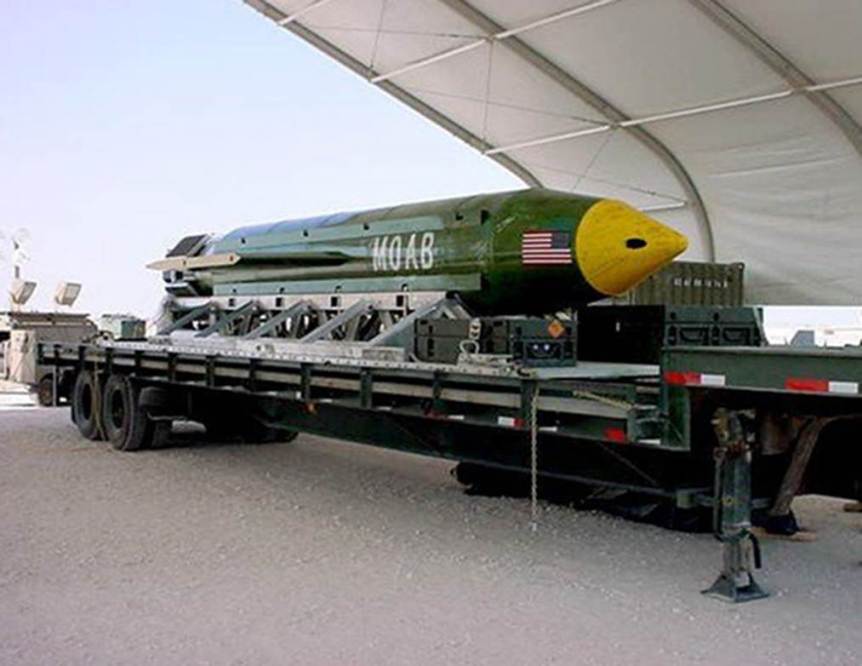
moab
A harbinger of bigger bombs and missiles to come?

W.J. Astore

In my latest article for TomDispatch.com, I investigate what an “America first” foreign policy actually means in practice.  What follows is an extract from the article in which I consider whether the U.S. military has morphed from a deterrent force (at least in its own eyes) to a doomsday machine.  This idea is inspired in part by an article that Dennis Showalter, a fine historian and an even better friend, wrote back in 2000 about the German military prior to World War I.  Excerpt follows:

Deterring Our Way to Doomsday

Who put America’s oil under all those Middle Eastern deserts?  That was the question antiwar demonstrators asked with a certain grim humor before the invasion of Iraq.  In Trump’s oft-stated opinion, the U.S. should indeed have just taken Iraq’s oil after the 2003 invasion.  If nothing else, he said plainly what many Americans believed, and what various multinational oil companies were essentially seeking to do.

Consider here the plight of President Jimmy Carter.  Nearly 40 years ago, Carter urged Americans to scale back their appetites, start conserving energy, and free themselves from a crippling dependency on foreign oil and the unbridled consumption of material goods.  After critics termed it his “malaise” speech, Carter did an about-face, boosting military spending and establishing the Carter Doctrine to protect Persian Gulf oil as a vital U.S. national interest.  The American people responded by electing Ronald Reagan anyway.  As Americans continue to enjoy a consumption-driven lifestyle that gobbles up roughly 25% of the world’s production of fossil fuels (while representing only 3% of the world’s population), the smart money in the White House is working feverishly to open ever more fuel taps globally.  Trillions of dollars are at stake.

Small wonder that, on becoming president, Trump acted quickly to speed the building of new pipelines delayed or nixed by President Obama while ripping up environmental protections related to fossil fuel production.  Accelerated domestic production, along with cooperation from the Saudis — Trump’s recent Muslim bans carefully skipped targeting the one country that provided 15 of the 19 terrorists in the 9/11 attacks — should keep fuel flowing, profits growing, and world sea levels rising.

One data point here: The U.S. military alone guzzles more fossil fuel than the entire country of Sweden.  When it comes to energy consumption, our armed forces are truly second to none.

With its massive oil reserves, the Middle East remains a hotbed in the world’s ongoing resource wars, as well as its religious and ethnic conflicts, exacerbated by terrorism and the destabilizing attacks of the U.S. military.  Under the circumstances, when it comes to future global disaster, it’s not that hard to imagine that today’s Middle East could serve as the equivalent of the Balkans of World War I infamy.

If Gavrilo Princip, a Serbian “Black Hand” terrorist operating in a war-torn and much-disputed region, could set the world aflame in 1914, why not an ISIS terrorist just over a century later?  Consider the many fault lines today in that region and the forces involved, including Russia, Turkey, Iran, Israel, Saudi Arabia, and the United States, all ostensibly working together to combat terrorism even as they position themselves to maximize their own advantage and take down one another.  Under such circumstances, a political temblor followed by a geo-political earthquake seems unbearably possible.  And if not an ISIS temblor followed by major quake in the Middle East, there’s no shortage of other possible global fault lines in an increasingly edgy world — from saber-rattling contests with North Korea to jousting over Chinese-built artificial islands in the South China Sea.

As an historian, I’ve spent much time studying the twentieth-century German military.  In the years leading up to World War I, Germany was emerging as the superpower of its day, yet paradoxically it imagined itself as increasingly hemmed in by enemies, a nation surrounded and oppressed.  Its leaders especially feared a surging Russia.  This fear drove them to launch a preemptive war against that country.  (Admittedly, they attacked France first in 1914, but that’s another story.)  That incredibly risky and costly war, sparked in the Balkans, failed disastrously and yet it would only be repeated on an even more horrific level 25 years later.  The result: tens of millions of dead across the planet and a total defeat that finally put an end to German designs for global dominance.  The German military, praised as the “world’s best” by its leaders and sold to its people as a deterrent force, morphed during those two world wars into a doomsday machine that bled the country white, while ensuring the destruction of significant swaths of the planet.

Today, the U.S. military similarly praises itself as the “world’s best,” even as it imagines itself surrounded by powerful threats (China, Russia, a nuclear North Korea, and global terrorism, to start a list).  Sold to the American people during the Cold War as a deterrent force, a pillar of stability against communist domino-tippers, that military has by now morphed into a potential tipping force all its own.

Recall here that the Trump administration has reaffirmed America’s quest for overwhelming nuclear supremacy.  It has called for a “new approach” to North Korea and its nuclear weapons program.  (Whatever that may mean, it’s not a reference to diplomacy.) Even as nuclear buildups and brinksmanship loom, Washington continues to spread weaponry — it’s the greatest arms merchant of the twenty-first century by a wide mark — and chaos around the planet, spinning its efforts as a “war on terror” and selling them as the only way to “win.”

In May 1945, when the curtain fell on Germany’s last gasp for global dominance, the world was fortunately still innocent of nuclear weapons.  It’s different now.  Today’s planet is, if anything, over-endowed with potential doomsday machines — from those nukes to the greenhouse gas emissions that cause global warming.

That’s why it’s vitally important to recognize that President Trump’s “America-first” policies are anything but isolationist in the old twentieth century meaning of the term; that his talk of finally winning again is a recipe for prolonging wars guaranteed to create more chaos and more failed states in the Greater Middle East and possibly beyond; and that an already dangerous Cold War policy of “deterrence,” whether against conventional or nuclear attacks, may now have become a machine for perpetual war that could, given Trump’s bellicosity, explode into some version of doomsday.

Or, to put the matter another way, consider this question: Is North Korea’s Kim Jong-un the only unstable leader with unhinged nuclear ambitions currently at work on the world stage?

Surging to Defeat: Learning from the Germans

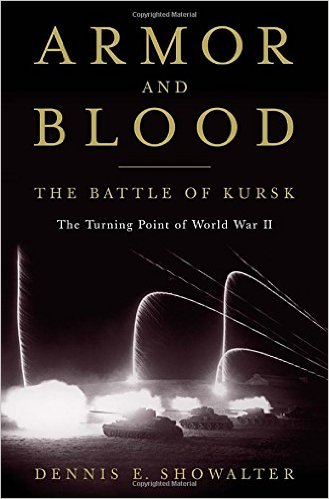
armor show

W.J. Astore

I recently read “Armor and Blood” by Dennis Showalter.  It’s about the Battle of Kursk in July of 1943, the massive, last-ditch offensive by the Nazis on the Eastern Front, and how the Soviet Army was able to stymy it, seize the initiative, and take the offensive for good.  As Showalter notes, the Nazi offensive at Kursk in 1943 was much like the Ludendorff Offensives in the Spring of 1918 near the end of World War I.  They were offensives of desperation.  As General Ludendorff said in 1918, first we’ll punch a hole in the enemy’s lines, and then we’ll see.  Tactical zeal (and wishful thinking) took the place of careful strategic calculation.

In 1918 as well as in 1943, the German military was given free rein to pursue a military solution when there wasn’t one to be had.  Germany simply didn’t have the military means for the strategic end they sought to achieve.  In 1918, Ludendorff believed he could defeat the Entente forces (the French, British, and other allies, to include the rapidly arriving Americans) on the Western Front, but his offensives only served to weaken his own army, ensuring its exhaustion and defeat by that November.  In 1943, Hitler gambled he could defeat the Soviet Army at Kursk, but his massive offensive only weakened his own army, ensuring its exhaustion and eventual defeat in the spring of 1945.  Both times, more military action only precipitated defeat and disaster.

Is the United States the inheritor of this Germanic bias?  Instead of punching a hole, the U.S. military speaks of “surges.”  It surged in Iraq in 2007.  It surged in Afghanistan in 2010-11.  But after each “surge,” the situation in those countries was basically the same – and, over time, grew worse.

Of course, U.S. “surges,” in each case involving roughly 30,000 additional troops, were in scale dwarfed by the German offensives in 1918 and 1943, involving millions of men and the movement of entire armies.  But scale is less important than process.  In each case, “victory” was staked on more military action, in part because both Germans and Americans believed themselves to be in the possession of “the finest fighting forces in the history of the world.”  Neither, of course, would admit that they were fighting on foreign soil, that the enemy had agency too, and that the longer the fighting continued, the weaker they grew as the enemy grew stronger.  So, in the name of “victory” the German and American “surges” played themselves out, and nothing changed strategically – there were no victories to be had.

The Germans, of course, drove themselves to utter collapse, both in 1918 and especially in 1945, after which they could no longer fool themselves as to the success of their “surges.”  A superpower with enormous resources, the United States is not yet on the verge of collapse.  But enormous budgetary deficits, driven in part by endless wars and a plethora of imperial commitments and overseas bases, are gradually eating away at the sinews of American strength, even as militarism eats away at the marrow of democracy.

After their utter defeat in 1945, the Germans learned to avoid endless war and the seductions of militarism.  The question is: Will it require a total collapse of the American Empire before its leaders learn the same lesson?

Defeating ISIS: Do We Even Have A Strategy?

AP_jihadi_john_cf_160119_12x5_1600
Image showing Jihadi John.  Apparently killed, then quickly replaced by a new “Jihadi John” — a visual metaphor of “progress” in the war on ISIS (AP photo)

W.J. Astore

An overarching strategy for defeating ISIS is simple enough to state:  A concerted effort by regional power brokers to tamp down Islamic extremism while reducing the violent and chaotic conditions in which it thrives.  Regional power brokers include the Israelis, the Saudis, the Iranians, and the Turks, joined by the United States and Russia.  They should work, more or less cooperatively, to eliminate ISIS.

Why?  Because you never know when a spark generated by extremists will ignite an inferno, especially in a tinderbox (a fair description of the Middle East).  We know this from history.  Consider the events of the summer of 1914.  A Serbian “Black Hand” extremist assassinates an archduke of the Austro-Hungarian Empire in the Balkans (that era’s tinderbox of extremism).  Most of Europe yawned, at least initially.  A small brush fire between the Serbs and the Empire, easily containable, people said.  Yet within weeks European troops were marching in the millions to their deaths in what became World War I.

In today’s Middle East, we’ve been lucky (so far) to avoid the kind of provocation and miscalculation that led to World War I.  But consider the actions of a new president, say a Chris Christie.  During a presidential debate, Christie promised to declare a no-fly zone over Syria and to shoot down any Russian plane that violated it.  It’s the kind of ultimatum that very well could lead to another world war.

Provocations and ultimatums can rapidly spiral among nations that lack uniformity of purpose.  For many of the power brokers engaged in the Middle East, defeating ISIS is either not the goal, or it’s not the primary one. Put differently, there are too many forces involved, working to discordant ends.  Their actions, often at cross-purposes, ensure that entities like ISIS survive.

Let’s take the United States, for example.  Every American politician says he (or she) wants to destroy ISIS.  Yet in spite of this nation’s enormous military strength, we seem to be too weak, psychologically as well as culturally, to deal with Russia, Iran, et al. as diplomatic equals.  The “exceptional” country thinks it must “lead,” and that means with bombing, drone strikes, troops on the ground, and similar “kinetic” actions.  Rather than dousing the flames, such actions fuel the fire of Islamic extremism.

Consider America’s domestic political scene as well.  ISIS is incessantly touted as a bogeyman to fear, most notably by Republican presidential candidates seeking to draw a contrast between themselves and Barack Obama, the “feckless weakling” in the words of Chris Christie.  But the Republican “alternative” is simply more bombing and more U.S. troops.  Making the sand glow is no strategy, Ted Cruz.

Strategy is a synthesis of means, ends, and will.  Currently, the means is military force, with a choice of more (from Obama) or even more (from Republicans).  Our leaders have no idea of the ends at all, other than vague talk of “destroying” ISIS.  The will they exhibit is mostly bombast and fustian.

A nation lacking will, with no clear vision of means and ends, is a nation without a strategy.  And a nation without a strategy is one that’s fated to fail.

I Didn’t Raise My Boy to be a Soldier: A Mother’s Plea for Peace

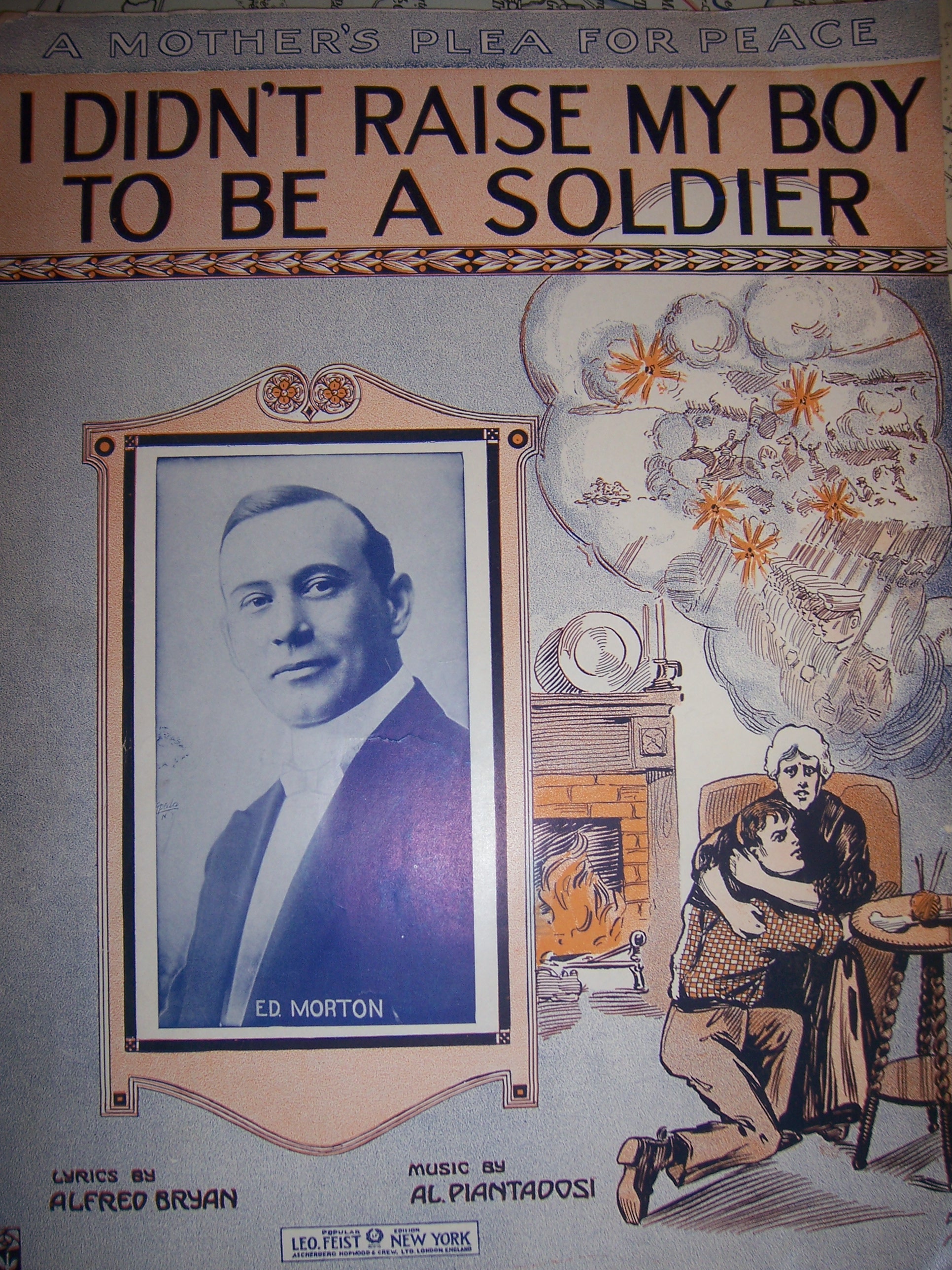
My copy of the sheet music (1915)

W.J. Astore

The year was 1915.  Europe, indeed much of the world, was embroiled in the devastating Great (or World) War.  Under President Woodrow Wilson, the United States was proud to have stayed out of the war, the massive bloodletting of which seemed peculiarly European, an “Old World” form of militarized madness that most Americans wanted no part of.  In fact, in 1916 Wilson would be reelected in large part because he had kept America out of Europe’s great war.  (Of course, the very next year the United States did choose to join the war effort against Germany.)

Yet in 1915 the idea of celebrating the military, nobilizing the military experience, finding higher purpose and meaning in war, was the furthest thing from the minds of most Americans.  Unlike the America of 2015, there was no mantra of “support our troops,” no publicity campaigns that encouraged citizens to “salute” the troops.  What publicity existed discouraged Americans from getting involved in war, a fact exhibited by some old sheet music that I recently ran across in a local thrift shop.

“I Didn’t Raise My Boy to be a Soldier,” copyright 1915 and “respectfully dedicated to Every Mother – Everywhere,” shows a mother protectively holding her grown son as visions of battle assault her mind near the family hearth.  It was a popular song; you can listen to an old Edison recording here.

The lyrics are as simple as they are telling:

Ten million soldiers to the war have gone,

Who may never return again.

Ten million mothers’ hearts must break,

For the ones who died in vain.

Head bowed down in sorrow in her lonely years,

I heard a mother murmur thro’ her tears:

Chorus:

I didn’t raise my boy to be a soldier,

I brought him up to be my pride and joy,

Who dares to put a musket on his shoulder,

To shoot some other mother’s darling boy?

Let nations arbitrate their future troubles,

It’s time to lay the sword and gun away,

There’d be no war today,

If mothers all would say,

I didn’t raise my boy to be a soldier.

(Chorus)

What victory can cheer a mother’s heart,

When she looks at her blighted home?

What victory can bring her back,

All she cared to call her own.

Let each mother answer in the years to be,

Remember that my boy belongs to me!

Nowadays, such lyrics seem hopelessly quaint and naïve, or even cowardly and defeatist.  America must stand up to evildoers around the world.  We must fight ISIS and other elements of radical Islam.  We must “stay the course” in Afghanistan.  We must maintain large and deadly military forces, ever ready to slay other mothers’ sons and daughters in the name of making peace.  Or so we are told, almost daily, by our leaders.

Indeed, our new national chorus goes something like this:  Let’s have another drink of war!  We haven’t had too many.  Keep the bullets coming and the blood flowing.  That is the way to victory!

But as we dream about “victory” by arms, we should recall the line from “I didn’t raise my boy to be a soldier”:

What victory can bring her back, All she cared to call her own.

Unlike in 1915, that’s a question that’s never asked in today’s America.

World War I: The Paradox of Semi-Modern War

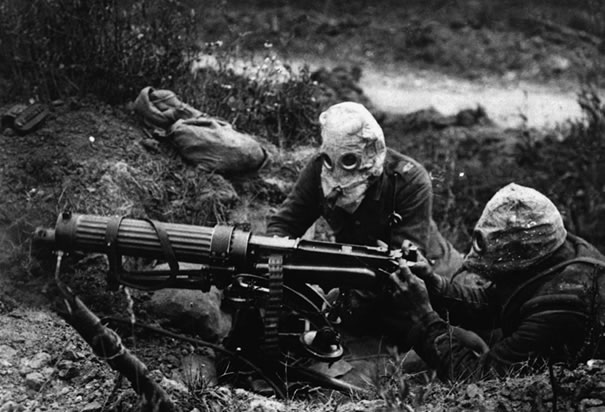
British Machine Gun Team in World War I
British Machine Gun Team, 1916

Dennis Showalter.  Introduction by William Astore.

Over the next four years, historians around the world will grapple with the meaning and legacies of the “Great War” fought one hundred years ago (1914-1918).  An epochal event in world history, World War I has as many meanings as it has had historians.  Among those historians, Dennis Showalter is one of the very best.  In this article, Showalter argues that the war was, in many ways, not “modern” at all.  The enormity of the war, to include its enormous wastage, generated primitivism as much as it stimulated innovation.  On the Western Front, site of industrialized mass destruction, troops fought with modern machine guns and chemical weapons even as they revived maces and mail armor of medieval vintage.

Most remarkable, as Showalter notes, was the resilience of home front support.  As dreams of quick, decisive battles turned into long, murderous slogs of nightmarish proportions, control of events was ceded to military men who saw only one way to victory — exhaustion through attrition and economic warfare.  When Germany finally collapsed near the end of 1918, few people were as surprised as the victors or as shocked as the losers.  As the victors exulted, the losers licked wounds — and vowed vengeance.

So it was that the “war to end all wars” became just one major act in a never-ending tragedy in a century dominated by war.  Even today, warfare in places like the Middle East reflects the poor choices and conflicting promises made during the Great War by the major powers.  In fact, what was perhaps most “modern” about World War I was the blowback that plagued its putative victors.  Consider, for example, France’s decision to ignore requests in 1919 by a young Ho Chi Minh for greater autonomy to be granted to Vietnamese in French Indochina.  France had leaned on Vietnamese labor during the Great War (with as many as 140,000 Vietnamese doing grunt work such as digging trenches), and the Vietnamese expected something in return.  They got nothing, a decision that set the stage for Vietnam’s revolt and France’s eventual defeat at Dien Bien Phu in 1954.  W.J. Astore

Dennis Showalter on the Paradox of World War I: A Semi-Modern War

The looming centennial of the Great War has inspired a predicable abundance of conferences, books, articles, and blog posts. Most are built on a familiar meme: the war as a symbol of futility. Soldiers and societies alike are presented as victims of flawed intentions and defective methods, which in turn reflected inability or unwillingness to adapt to the spectrum of innovations (material, intellectual, and emotional) that made the Great War the first modern conflict. That perspective is reinforced by the war’s rechristening, backlit by a later and greater struggle, as World War I—which confers a preliminary, test-bed status.

Homeward bound troops pose on the ship's deck and in a lifeboat, 1919. The original image was printed on postal card ("AZO") stock. Public Domain
Homeward bound troops pose on the ship’s deck and in a lifeboat, 1919. The original image was printed on postal card (“AZO”) stock. Public Domain via Wikimedia Commons.

In point of fact, the defining aspect of World War I is its semi-modern character. The “classic” Great War, the war of myth, memory, and image, could be waged only in a limited area: a narrow belt in Western Europe, extending vertically five hundred miles from the North Sea to Switzerland, and horizontally about a hundred miles in either direction. War waged outside of the northwest European quadrilateral tended quite rapidly to follow a pattern of de-modernization. Peacetime armies and their cadres melted away in combat, were submerged by repeated infusions of unprepared conscripts, and saw their support systems, equine and material, melt irretrievably away.

Russia and the Balkans, the Middle East, and East Africa offer a plethora of case studies, ranging from combatants left without rifles in Russia, to the breakdown of British medical services in Mesopotamia, to the dismounting of entire regiments in East Africa by the tsetse fly. Nor was de-modernization confined to combat zones. Russia, Austria-Hungary, the Ottoman Empire, and arguably Italy, strained themselves to the breaking point and beyond in coping with the demands of an enduring total war. Infrastructures from railways to hospitals to bureaucracies that had functioned reasonably, if not optimally, saw their levels of performance and their levels of competence tested to destruction. Stress combined with famine and plague to nurture catastrophic levels of disorder, from the Armenian genocide to the Bolshevik Revolution.

Semi-modernity posed a corresponding and fundamental challenge to the wartime relationship of armed forces to governments. In 1914, for practical purposes, the warring states turned over control to the generals and admirals. This in part reflected the general belief in a short, decisive war—one that would end before the combatants’ social and political matrices had been permanently reconfigured. It also reflected civil authorities’ lack of faith in their ability to manage war-making’s arcana—and a corresponding willingness to accept the military as “competent by definition.”

Western Battle Front 1916. From J. Reynolds, Allen L. Churchill, Francis Trevelyan Miller (eds.): The Story of the Great War, Volume V. New York. Specified year 1916, actual year more likely 1917 or 1918. Public Domain via Wikimedia Commons.

The extended stalemate that actually developed had two consequences. A major, unacknowledged subtext of thinking about and planning for war prior to 1914 was that future conflict would be so horrible that the home fronts would collapse under the stress. Instead, by 1915 the generals and the politicians were able to count on unprecedented –and unexpected–commitment from their populations. The precise mix of patriotism, conformity, and passivity underpinning that phenomenon remains debatable. But it provided a massive hammer. The second question was how that hammer could best be wielded. In Russia, Austria-Hungary, the Ottoman Empire, neither soldiers nor politicians were up to the task. In Germany the military’s control metastasized after 1916 into a de facto dictatorship. But that dictatorship was contingent on a victory the armed forces could not deliver. In France and Britain, civil and military authorities beginning in 1915 came to more or less sustainable modi vivendi that endured to the armistice. Their durability over a longer run was considered best untested.

Even in the war’s final stages, on the Western Front that was its defining theater, innovations in methods and technology could not significantly reduce casualties. They could only improve the ratio of gains. The Germans and the Allies both suffered over three-quarters of a million men during the war’s final months. French general Charles Mangin put it bluntly and accurately: “whatever you do, you lose a lot of men.” In contemplating future wars—a process well antedating 11 November 1918—soldiers and politicians faced a disconcerting fact. The war’s true turning point for any state came when its people hated their government more than they feared their enemies. From there it was a matter of time: whose clock would run out first. Changing that paradigm became—and arguably remains—a fundamental challenge confronting a state contemplating war.

Dennis Showalter is professor of history at Colorado College, where he has been on the faculty since 1969. He is Editor in Chief of Oxford Bibliographies in Military History, wrote “World War I Origins,” and blogged about “The Wehrmacht Invades Norway.” He is Past President of the Society for Military History, joint editor of War in History, and a widely-published scholar of military affairs. His recent books include Armor and Blood: The Battle of Kursk (2013), Frederick the Great: A Military History (2012), Hitler’s Panzers (2009), and Patton and Rommel: Men of War in the Twentieth Century (2005).

Article used by permission of the author. See more at http://blog.oup.com/2014/06/first-world-war-paradox-of-semi-modern-war/#sthash.opNivppW.dpuf

A Century of Mass Slaughter

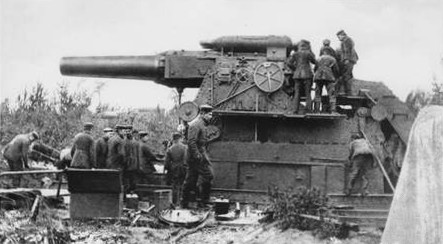
Big Bertha (wiki)
Big Bertha (wiki)

W.J. Astore.  Also featured at Huffington Post.

This August marks the 100th anniversary of the start of World War I. That “Great War” was many things, but it was most certainly a war of machines, of dreadnought battleships and “Big Bertha” artillery, of newfangled airplanes and tortoise-like tanks. Industrial juggernauts like Great Britain, France, and Germany succeeded more or less in mobilizing their economies fully for war; their reward was reaping the horrors of death-dealing machinery on a scale theretofore thought impossible.

In that summer of 1914, most experts expected a short war, so plans for sustaining machine-age warfare through economic mobilization were lacking. Confronted by trench warfare and stalemate on the Western Front which owed everything to modern industrialism and machinery, the “big three” antagonists strove to break that stalemate using the means that had produced it: weapons and munitions. Those empires caught up in the war that were still industrializing, e.g. Russia, Austria-Hungary, the Ottoman Empire, found themselves at a serious disadvantage.

Together, Britain and France forged an industrial alliance that proved (with help from the U.S.) to be a war-winning “arsenal of democracy.” Yet this alliance contributed to an overvaluing of machines and munitions at the soldiers’ expense. For Entente leaders — even for old-school cavalry officers like Britain’s Field Marshal Sir Douglas Haig — new artillery with massive stockpiles of shells promised to produce the elusive breakthrough and a return to mobile warfare and glorious victory.

Thus it was that at the Battle of the Somme that began on July 1, 1916, British soldiers were reduced to trained occupiers. Lengthy pre-battle artillery barrages, it was believed, would annihilate German defenders, leaving British troops to slog uncontested across no-man’s land to occupy the enemy’s shattered and empty trenches.

But those trenches were not empty. Germany’s defenses survived Britain’s storm of steel largely intact. And Britain’s soldiers paid the price of misplaced faith in machine warfare: nearly 20,000 dead on that first day, with a further 40,000 wounded.

The Somme is but one example of British and French commanders being overwhelmed by the conditions of machine warfare, so much so that they placed their faith in more machines and more munitions as the means to victory. After underestimating the impact of technology on the battlefield up to 1914, commanders quickly came to overestimate it. As a result, troops were inadequately trained and tactics inadequately developed.

As commanders consumed vast quantities of machinery and munitions, they became accustomed to expending lives on a similarly profligate scale. Bodies piled up even as more economic means were tapped. Meanwhile, the staggering sacrifices required by destructive industrialism drove nations to inflate strategic ends. Industrialized warfare that spat out lead and steel while consuming flesh and bone served only to inflame political demands, negating opportunities for compromise. Total victory became the only acceptable result for both sides.

In retrospect it’s remarkable how quickly leaders placed their faith in the machinery of war, so much so that military power revved uncontrollably, red-lined, then exploded in the faces of its creators. Industrialized destruction and mass slaughter were the predictable outcomes of a crisis whose resolution was driven by hardware — more weaponry, more machinery, more bodies. The minds of the men who drove events in that war could not sanction negotiation or compromise; those were forms of “weakness” that neither side could accept. Such murderous inflexibility was captured in the postwar observation of novelist Virginia Woolf that “It was a shock to see the faces of our rulers in the light of the shell fire. So ugly they looked — German, English, French — so stupid.” Note how she includes her own countrymen, the English, in the mix of the ugly and the stupid.

In World War I, Carl von Clausewitz’s dictum of war as an extreme form of politics became tragically twisted to war as the only means of politics, with industrialized mass destruction as the only means of war. The resulting failure to negotiate a lasting peace came as no surprise since the war had raced not only beyond politics, but beyond the minds of its military and political leaders.

The Great War had unleashed a virus, a dynamic of destruction, that would only be suppressed, and even then only imperfectly, by the wanton destruction of World War II. For what was Auschwitz but a factory of death, a center for mass destruction, a mechanized and murderous machine for efficient and impersonal slaughter, a culmination of the industrialized slaughter (to include mass gassing) of World War I?

The age of mass warfare and mass destruction was both catalyst for and byproduct of the age of machinery and mass production. Today’s age is less industrial but no less driven by machinery and mass consumption (which requires a form of mass destruction inflicted largely on the environment).

Aerial drones and cyber warfare are already providing disturbing evidence that the early 21st century may yet echo its predecessor in introducing yet another age of misplaced faith in the machinery of warfare. The commonality remains the vulnerability of human flesh to steel, as well as human minds to manipulation.

A century has passed, yet we’re still placing far too much faith in the machinery of war.

World War I, the Death of Chivalry, and the False End of War

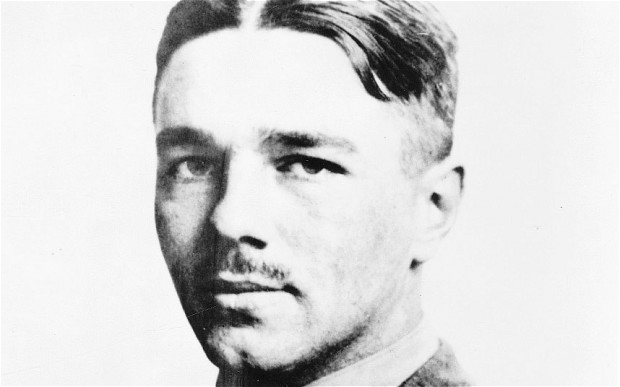
Wilfred Owen
Wilfred Owen

W.J. Astore

This summer marks the 100th anniversary of World War I.  Today in my daily “alert” from The New York Times, there are five articles related to the war.  Steven Erlanger writes about how the war brought fundamental changes to the world; Jim Yardley writes about the Yanks in the Second Battle of the Marne in 1918; Alison Smale recounts the costs of German militarism, then and today; John F. Burns raises the specter of Gavrilo Princip’s assassination (on June 28th, 1914) of the Archduke Franz Ferdinand and its legacies in the Balkans and specifically in Bosnia; and Tim Arango recaptures the Gallipoli Campaign of 1915 and how it forged national identities among the Turks and Australians.

An immensely destructive war, World War I saw the full application of mass production and the machine age applied to warfare.  Mass production enabled mass mobilization as well as mass destruction; the machine age enabled the machine gun and automated death on such a massive scale that bodies were collected in ossuaries, boneyards of doomed youth.

Four decades ago, Paul Fussell famously captured the loss of idealism that accompanied mass death on an industrial scale in his book The Great War and Modern Memory (1975).  As Fussell noted in a separate essay on “The Fate of Chivalry,” idealistic codes of chivalry, popular in the Victorian age, became “ludicrously inappropriate” in World War I, defeated entirely by “poison gas, zeppelin raids on civilians, the machine gun, and unrestricted submarine warfare, not to mention such very unchivalric experiences as soldiers’ passively trembling under artillery shelling hour after hour or soiling their trousers for weeks with acute dysentery (sometimes requiring the cutting of large holes in the rear of their clothing), or milking down their penises monthly before the eyes of bored and contemptuous medical officers alert for unreported gonorrheal discharges.”

Wilfred Owen, a British officer and war poet, condemned the “old lie” of Horace, Dulce et decorum est pro patria mori (Sweet and fitting it is to die for one’s country), in his famous poem, which concludes:

If you could hear, at every jolt, the blood
Come gargling from the froth-corrupted lungs,
Obscene as cancer, bitter as the cud
Of vile, incurable sores on innocent tongues,
My friend, you would not tell with such high zest
To children ardent for some desperate glory,
The old Lie; Dulce et Decorum est
Pro patria mori.

Amazingly, the ideal of military service and war as ennobling, even liberating, survived World War I and is thriving today, most notably in the United States.  The “doomed youth” of World War I, marching off to mass death, have become the universal heroes of the American moment, to be sent to places like Iraq as liberators.

We would do well to recall that World War I, a “war to end all wars,” has led only to new wars, with today’s unrest in the Middle East connected to the fall of the Ottoman Empire in 1918 and conflicting agreements made at the time by manipulative power players like Great Britain and France.

Once again, at least in the United States, the cry is for more military action in the Middle East – more killing – as a solution to complex political, social, economic, and religious problems.  Those who are most strident in sending in more bombs, if not more troops, are usually those “donkeys” who are well past military age themselves, and most concerned about appearing tough and decisive.  Great believers in the utility of war, they seem to have no regard for the big lesson of World War I: the utter unpredictability as well as the horrifying destructiveness of modern, machine-age war.

All sides marched to war in the summer of 1914 looking ahead to decisive victories.  The fighting was supposed to be over by Christmas, and it was: well, not 1914, but 1918.  The result?  Four empires in ruin, ten million dead, and legacies of massive destruction and revolutionary change that we’re still coming to grips with.

And yet despite all this there are still those who call for more weapons and more war.  In the U.S. they are held up as serious and respectable statesmen.  Yet they are merely old men propagating old lies.

If they are so ardent for some desperate glory, let them take up the lance and charge forth in foreign fields.  Until they do, let’s hear no talk of more weapons and more war.

The Great War: Why the Germans Lost World War I

trench

W.J. Astore

To mark the 100th anniversary of World War I, which began in the summer of 1914, I’m posting this essay, which I wrote as a graduate student in 1992.  I’ve decided not to edit it since I believe my general conclusions remain sound.  Germany may have had the best military during World War I, but that wasn’t enough for the Kaiser and crew to win the war.

Today, the U.S. should learn from Germany’s mistakes, especially since we are as fond in 2014 of boasting about having the world’s greatest military as the Kaiser was of boasting about his a century ago in 1914.

Strategy is the relationship between national means, ends, and will.  Given the results of the Great War, one might question whether any country followed a sound strategy.  As J.F.C. Fuller observed, at war’s end “Britain was bankrupted and France bled white; Russia and Germany were in the throes of revolution; the Austro-Hungarian Empire had vanished; the Ottoman Empire had been dismembered; Italy was distraught; and every other country in Europe was scorched by the fiery blast – an epoch had gone up in flames.”  However, there were – at least in the short term – winners and losers.  The winners prevailed because their strategies were sounder in balancing means and will with ends than those of their opponents.

Strategies at Sea During the Great War

Britain’s strategic ends in 1914 were to maintain the balance of power in Europe and her hold over her Empire.  Her chief means were the ships of the Royal Navy.  A German victory on the continent threatened these ends and means.  A victorious Germany would dominate Europe, and she might build an even larger navy, one which would threaten the Empire or even Britain itself.  With her will fortified by news of Germany’s violation of neutral Belgium, Britain declared war on Germany on 5 August 1914.

At the outset of the war, the Royal Navy gained command of the sea and never lost it.  Enforcing a loose or distant blockade against German merchant shipping, the Royal Navy slowly constricted the economies (the means) of the Central Powers.  Meanwhile, Britain’s command of the sea ensured that supplies, and eventually troops, came safely from her Empire and America.

As elaborated by Admiral Jellicoe, the navy’s strategy was: 1) neutralize any hostile action of the German High Seas Fleet; 2) protect Entente trade, while blockading German trade; 3) protect Great Britain from invasion.  In brief, the navy’s strategic ends were to prevent the German fleet from affecting the war’s course, and through blockade, to erode Germany’s means and will to fight.

The Royal Navy has been criticized for not doing more with its command of the sea, but Jellicoe and Beatty were understandably cautious.  They had the German fleet encircled, and they controlled the choke points to the Atlantic and Mediterranean.  With excellent intelligence of German fleet movements, they stymied German attempts to break-out.  While the Royal Navy might have preferred to fight another Trafalgar, a battle of annihilation between dreadnoughts, they never took risks that threatened naval supremacy in the home waters.  They triumphed by putting political ends first, and by using their means – the superior fleets of the Royal Navy – to erode the economic means of Germany and the will of her people.  Their “indirect approach” contributed significantly to the collapse of the German homefront in October 1918.

In contrast to the British, who balanced naval means with national ends, the Germans wasted their High Seas Fleet.  The wisdom of building such a fleet was questionable to begin with.  Despite Mahan’s warning that it was probably impossible for a land power to divert enough human and material resources to challenge the Royal Navy’s command of the sea, Tirpitz and Kaiser Wilhelm II persisted.  For them, a navy was a way to gain influence and win friends.  They saw their imitation of the Royal Navy as the sincerest form of flattery, but the British were not appreciative.  Germany was living in a fool’s paradise, believing she could have a fleet that rivaled Britain’s without making Britain a rival.

The resulting rivalry polluted German naval strategy.  Expecting the Royal Navy to mount a close blockade or launch a preemptive strike against her bases, the High Seas Fleet sat put and lost the initiative.  Forced to fight with an inferior fleet at Jutland, Scheer tried to steer Jellicoe’s dreadnoughts onto a series of submarine-laid minefields, hoping thereby to destroy the Grand Fleet’s cohesiveness and defeat it in detail.  He failed, and the Germans never broke the blockade which eventually sapped their will.  Surprised that war had been declared, left without a role to play in the Schlieffen Plan due to poor interservice cooperation with the army, the High Seas Fleet was a means whose main end became self-preservation, its only goal being to intimidate Britain during peace negotiations (to be held after the German army won the war on land).

German naval strategy reflected the defects of strategic mirror-imaging.  To challenge the Royal Navy, the German navy believed it had to be just like it. Billions were spent from 1895-1914 on a surface fleet, devouring funding for innovations like the submarine (only 25 seagoing subs were ready for service in August 1914).  In the end, the Germans only drove the British to improve; even worse, by allocating a large percentage of her industrial resources towards naval production, Germany fatally weakened herself on land.  She tried to be a great land and sea power simultaneously, but the only country in history able to afford the exorbitant costs has been the United States during, and perhaps after, World War II.

Another country whose strategic mirror-imaging absorbed scarce resources to little end was the Soviet Union in the 1970s and 1980s.  The Soviet naval push only spurred the US Navy to improve, which surged to 600 ships under John Lehman.  A bankrupt strategic policy led to a bankrupt Soviet economy.  Today, the Soviet aircraft carrier Admiral Kuznetsov sits in drydock, a second big carrier is up for sale, apparently to China or Iran, and a third was scrapped before completion.  According to the London Times (Oct 1992), there are no Russian naval ships presently in the Indian Ocean or the Mediterranean.  Strategy is the art of the possible, not the striving for the impossible.  Before one embarks on an end, one must be able to afford the resources or means to achieve it.  Germany in the 1900s and 1910s, and the Soviet Union in the 1970s and 1980s, embarked on an end they did not need and could not afford.

The bankruptcy of German naval strategy was best shown in 1917 with the decision to resume unrestricted submarine warfare.  The Germans gambled they could wear down the will of Britain before American troops reached the continent.  What they apparently failed to realize, however, was that the very entry of the US into the war would reinforce the will of the Entente Powers.  Meanwhile, Britain muddled through the U-boat crisis and reformed her naval strategy, learning that the defensive was a more effective means of destroying submarines than the offensive, and that destroyers were better used guarding convoys than the Grand Fleet.  The Germans had expected a short war in which navies would scarcely matter.  Caught in the stalemate of the Western Front, she found she couldn’t improvise an effective maritime strategy.

Strategies on Land on the Western Front

Turning to land warfare on the Western Front, and keeping in mind the definition of strategy as relating means, ends, and will, one must first recognize the changing nature of warfare.  The American Civil War marked a revolution in warfare.  Militaries no longer fought solely against other militaries but also waged war against an enemy’s economy and will.  In hindsight, the stalemate on the Western Front owed everything to modern industrialism.  Ironically, in 1914 most Europeans had believed a long war of attrition was impossible because of modern industry.  In Schlieffen’s words:

A nation’s existence depends upon the uninterrupted continuation of trade and industry, and a quick decision is necessary to start the wheels of industry turning again.  A strategy of attrition is impossible when the maintenance of armies of millions requires the expenditure of billions.

What people failed to foresee was, once hundreds of thousands of men were killed in 1914, nations were willing to pay billions and gear their economies for war rather than negotiate from a weak position.  Since the war was one of economic mobilization, those countries with underdeveloped economies, e.g.  Austria-Hungary, had the most trouble fighting it.  Here the alliance system was crucial.  As Paul Kennedy has observed, Britain kept France fighting, France and Britain kept Italy fighting after Caporetto, and Germany kept Austria-Hungary fighting.  Ivan Bloch, the self-made Warsaw banker, turned out to be right: the ultimate decision was in the hands of starvation of home populations.  The Central Powers starved first.

This fate was by no means obvious, however.  Until the middle of 1918, the Central Powers appeared to be winning the war.  Despite fundamental strategic flaws, Germany, with Austria-Hungary marching reluctantly behind, broke Russia, threw the French army into mutiny, and sowed despair in England.  Germany’s tactical and operational brilliance, however, could not conceal, and in fact contributed to, an underlying strategic rot.

This rot was revealed in the words of the Kaiser.  “The soldiers and the army, not parliamentary majorities and decisions, have welded the German Empire together,” Wilhelm declared. “I put my trust in the army.” But the army, beginning with von Moltke the Elder, had subordinated grand strategy to operational art.  Reinforced by Schlieffen, this trend reached the height of military absurdity under Ludendorff in 1918, when victory on the battlefield became the means and end of Germany’s strategy, as well as the balm which would restore the flagging will of Germany, Austria-Hungary, even Turkey!  In the Great War, Germany experienced a fundamental breakdown in civil-military relationships.  With the military determining policy, Clausewitz’s dictum that war as a form of politics became tragically twisted to war as the only form of politics.

This debasement of politics was not complete until 1917.  By Christmas 1914, Germany realized her strategic nightmare had come true: a two-front war of attrition loomed.  Adopting a defensive stance in the West, Falkenhayn sought victory in the East, nearly achieving a knockout blow against Russia at Gorlice-Tarnow in May 1915.  With Bethmann-Hollweg, Falkenhayn hoped to translate a limited military victory in the East into a political settlement with Russia.  Frederick the Great had institutionalized this concept of fighting limited wars for definite political ends.  However, despite her losses on the battlefield, Russia failed to see the wisdom of negotiations.  Despite criticism by Hindenburg and Ludendorff that he had failed to grasp the total military victory in the East that was still within reach, Falkenhayn turned to the West and Verdun in 1916.

Falkenhayn’s strategic concept for Verdun was simple: by attacking French national pride at Verdun, he would force them to bleed themselves dry in counterattacks.  Britain would then be compelled, before her new armies were ready, to come to the aid of France, exposing herself to decisive German counterattacks.  Falkenhayn made two errors here.  First, and most importantly, he did not coordinate his strategy with Hotzendorff’s in Austria-Hungary.  As a result, the Central Powers lost their advantage of interior lines and their chance to defeat Russia in 1916.  Second, Falkenhayn failed to explain his strategy to his subordinates.  His desire to avoid casualties and unnecessary sacrifice was subverted once Germany’s national pride was inflamed.  Expecting a loss ratio of 2.5:1 in his favor, the actual ratio was a grim 1.075:1.

Verdun was the Great War’s equivalent to Kursk in World War II.  While the Germans gave better than they got, it was they who could least afford the price.  Like the Soviets in 1943, the French had learned.  Petain refused to waste his troops in poorly planned attacks, preferring to rely on artillery and firepower rather than elan to retake ground.  In the end, Falkenhayn failed to enforce his will on the Entente.  He did not force Britain to launch an offensive prematurely, and Russia surprised him by launching the Brusilov offensive in Galicia.  For his failure, Falkenhayn was sacked and Ludendorff effectively assumed command of the German war effort.

1917 was a banner year for the German war effort.  In the West, the Germans wisely retreated to the Siegfried Line, shortening their front and creating a defensive barrier which withstood Nivelle’s disastrous offensives and Haig’s bullheaded assaults at Third Ypres.  With Russia in chaos, Ludendorff could finally concentrate all his resources on the Western Front for the “Victory Offensive” in 1918.

Here again, however, German strategy failed to relate means to ends.  Ludendorff simply didn’t have the means in 1918 to conduct a decisive offensive in the West, and his end was unclear even to himself.  All will be solved once we pierce a hole, he stated.  Attacking along the seam separating the British and French armies, the Germans failed to exploit their initial successes due to Ludendorff’s vague and shifting strategic aims and shortages of manpower and transport.  Like Napoleon in 1815, Ludendorff desperately committed his superbly trained troops one last time.   But like Napoleon, the coalition arrayed against him was too powerful.  Primacy in operational art was not enough to overcome economic blockade and the bigger battalions of fresh troops arriving daily from the Empire and the US.  Shattered by the Entente’s counteroffensive at Amiens on 8 August 1918, and faced with national starvation, the German homefront collapsed.

Why the Entente Won — And Germany Lost

The Entente had won.  But was this due to superior strategy?  Clearly, the Entente suffered some of the same strategic shortcomings as the Central Powers: a breakdown in military-civil relations, with the military reigning supreme; a cult of the offensive as the ultimate arbiter of war; and a lack of contingency planning.  Moreover, the Entente achieved a level of tactical proficiency approaching Germany’s only in mid-1918, if then.  But while it’s been fashionable to attack the “donkeys” and “British butchers and bunglers of World War One,” on the whole Britain and France properly balanced means and ends with will.

Developing a strategy wasn’t easy, though.  Kitchener caught the confusion of his colleagues when he exclaimed: “I don’t know what is to be done – this isn’t war!”.  He came to realize, as Michael Howard has pointed out, that Britain had to “make war as we must; not as we should like.” Like Sherman during the American Civil War, Kitchener knew it would be a long war, and he oversaw the expansion of the British Army from Haldane’s six divisions in 1914 to seventy divisions in 1918.  Pursuing a strategy remarkably similar to the Union’s in the Civil War, the Entente wore down the tactically superior German army on the battlefield as Grant had worn down Lee’s army in 1864.  Through economic blockade, the Entente strangled the German economy as Scott’s Anaconda Plan had suffocated the Confederacy.

The Entente strategy was hardly this clear-cut, however.  Many in Britain preferred an indirect approach, but this seemed to fail at Salonika and Gallipoli.  And while Kitchener may have seen the need for waging a costly war of attrition, most Entente leaders still placed their faith in the offensive.  The Somme, Third Ypres, the Nivelle Offensives: these and other offensives forced the Germans to use up men and materiel, but their primary end was not attrition but breakthrough and decisive victory.  Haig for one pursued offensives long after they were feasible, and wore down his own army in the effort.  Nivelle did the same.  That their costly offensives bore fruit was more by accident than design.  The strain they put on Germany forced her to take desperate measures, the deadliest being her decision to resume unrestricted submarine warfare on 1 February 1917.

Besides blundering into the bloody, tedious, but effective combination of attrition warfare on land, economic warfare at sea, the Entente demonstrated other strategic edges versus their opponents.  With the rise of Lloyd George and Clemenceau, the Entente gradually reasserted civilian control over policy and the war’s course, obeying Clausewitz far better than their German counterparts.  The Entente also waged coalition warfare more effectively than the Central Powers.  While distrust and stubbornness existed within the Entente, France and Britain tended to work towards the same end, unlike Germany and Austria-Hungary, who were usually fighting uncoordinated battles on different fronts against different enemies.

Finally, the Entente used a wider array of strategic means in pursuit of their ends.  The British were especially clever in their use of propaganda to strengthen public will at home and to convince the US to enter the war.  In short, the Entente recognized more clearly than the Central Powers the widening dimensions of strategy.  Battles were only one means to victory, and not always the most important when compared with political, economic, intellectual, and psychological means.  The “genius” of the German military was evident but restricted to operations; the Entente bumbled about on the battlefield but used a wider array of means, under firmer political control, to wear down the will of Germany.

Yet despite her defeats in the First and Second World Wars, too much has been made, at least in the American military, of German battle skill.  In Vietnam, one might argue that like Germany, American grand strategy was irredeemably flawed no matter how many victories we won on the battlefield.  And while the operational brilliance of our victory in Desert Storm is clear, we must not let it blind us to our need to balance needs, ends and will in strategy.