Insurgencies and America’s Defeat in Vietnam

An Old Paper from 1993

BILL ASTORE

JAN 29, 2026

Scrolling through old files today, I came across this paper that I prepared for a “Strategic Studies Seminar” at Oxford that I presented on 28 January 1993. Back then, I was a captain in the Air Force, and in the room were other serving and retired military officers. Anyhow, here’s what I read to my peers (and the two professors hosting the seminar) about the U.S. defeat in Vietnam. Again, this presentation is 33 years old, but I hope it’s still useful despite its age. 

Insurgencies and America’s Defeat in Vietnam (1993)

A revolutionary war is a war within a state; the ultimate aim of the insurgents is political control of the state. Nowhere is Clausewitz’s dictum of war as a continuation of politics more true than in a revolutionary war. It typically takes the form of a protracted struggle, conducted patiently and inexorably, a variant of Chinese water torture. Educating or, more accurately, indoctrinating, the people – gaining their sympathy, cooperation, and assistance – is paramount. And all people have a role to play: men and women, young and old. After World War II, insurgencies have been guided by Mao Zedong’s concept of People’s War, and inspired by a complex combination of nationalism, anti-colonialism, and communism. They have bedeviled France, Great Britain, and the United States. This paper addresses the strategy of People’s War in terms of means, ends, and will, and details some of the reasons why the United States lost the Vietnam War.

The strategic end of People’s War is simple in its boldness: the overthrow of the existing government and its replacement with an insurgent-led government. The means are incredibly complex, encompassing social, economic, psychological, military, and political dimensions, but it must be remembered that all means are directed towards the political end. Strength of will usually favors the insurgents, partly because a major goal of People’s War is to mold the minds of its followers to convince them of the righteousness of their cause.

People’s War passes through three stages. At first the insurgents get to know the people as they spread propaganda and build a political infrastructure.

Every insurgent is an ambassador for the cause. They create safe havens while intimidating opponents and neutrals, and they commit terrorist acts to undermine the legitimacy of the government. They build their safe havens on the periphery of the state, usually in rural or impoverished areas where they can feed on the misery of the people. The more difficult the terrain, the better, whether it be the mountains of Spain and Afghanistan or the jungles of Malaya and Vietnam. They extend their control over the countryside and into the urban areas during the second stage of People’s War. They use guerrilla tactics and terrorism to further undermine the political legitimacy of the government. The main target is not the government’s troops but the will of its leaders. As they extend their physical control over the countryside, they install their own political structure to control the people. With the government’s will fatally weakened, the insurgents move to the final stage: a conventional military offensive to overthrow the government.

The three stages are not rigidly sequential, however. For example, while conducting guerrilla operations against the government, the insurgents continue to build their infrastructure, conduct terrorist acts, and spread propaganda. Even during the last stage — the general offensive — the insurgents continue stages one and two. This aspect of People’s War was well expressed by John M. Gates in the Journal of Military History in July 1990:

American conventional war doctrine does not anticipate reliance upon population within the enemy’s territory for logistical and combat support. It does not rely upon guerrilla units to fix the enemy, establish clear lines of communication, and maintain security in the rear. And it certainly does not expect enemy morale to be undermined by political cadres within the very heart of the enemy’s territory, cadres who will assume positions of political power as the offensive progresses. Yet all of these things happened in South Vietnam in 1975….

Flexibility, judgement, and comprehensiveness of methods are the keys to success. If the insurgents overestimate the weakness of the government and lose large-scale battles, they slip back into the earlier two phases and continue to work towards weakening the government for the next general offensive.

It bears repeating the primary goal of insurgents is political control. Military actions are only one tool for obtaining this control. As Mao cautions, guerrilla operations are just “one aspect of the revolutionary struggle.” The insurgent appeals to the hearts and minds of the people. He is, after all, one of them. Too much can be made of Mao’s “fish and sea” analogy. The insurgent is not just a fish that swims in the sea of the people: his purpose is to convert the sea to his purpose. He wants to walk on water. He employs any method to command the sea to his will. He would prefer ideological converts, true believers, but converts through terror are acceptable. Those who can’t be converted he ruthlessly kills. That his methods produce squeamishness among some in the West only accentuates their value to him.

As a strategy, People’s War is difficult but not impossible to counter. The United States defeated the Philippine insurrection in the first two decades of this century, and after World War II Great Britain put down a communist insurgency in Malaya. More famous, however, have been the stunning successes of People’s War: Mao’s victory over Japan and the Nationalists in the 1930s and ‘40s, and Ho Chi Minh’s victories over France and the United States in the 1950s, ‘60s, and ‘70s. Perhaps most unsettling was America’s defeat in Vietnam. How could the world’s foremost superpower lose to, in the words of General Richard G. Stilwell in 1980, a “fourth-rate half-country?”

There are no simple answers to America’s defeat, although Hollywood tells us otherwise. A theory still believed by some in the US military is a variation of the German “stab-in-the-back” legend of the Great War. Our hands were tied by meddling civilians who didn’t let the military fight and win the war. One American soldier is the equal of hundreds of pajama-clad midgets, or so it appears in the Rambo flicks. A wretched, dishonorable government also abandoned our POWs to the godless communists, now rescued several times over by Stallone, Chuck Norris, and other martial arts experts. That such films make money is an affront to the genuine sacrifices of Americans represented so tragically by the Vietnam War memorial in Washington.

Perhaps such sentiments seem out of place in a paper devoted to a dispassionate strategic analysis of America’s role in Vietnam. Yet my feelings are perhaps typical of the emotionalism that still surrounds this topic among Americans. A dispassionate critique from an American, let alone an American service member, may still be impossible; nevertheless, I’ll give it a shot.

The United States lost the war for several related reasons. First, we fought the wrong kind of war. As the Navy and especially the Air Force built up their nuclear forces, the army chaffed against its “New Look” and diminished role in the 1950s. Under Kennedy and Johnson, the Army had a new doctrine – Flexible Response – and an opportunity – the Vietnam War – to prove its worth. Vietnam was to be the proving ground for a revitalized Army.

The opposite proved to be the case because the Army pursued the wrong strategy. From 1965-68, when we sent more than half a million troops to Vietnam, the US Army tried to fight a conventional war against the Viet Cong (VC) and North Vietnamese Army (NVA). As LTG Harry Kinnard, commander of the Army’s elite 1st Cavalry Division (Airmobile), put it, “I wanted to make them fight our kind of war. I wanted to turn it into a conventional war – boundaries – and here we go, and what are you going to do to stop us?” Obeying Mao’s teachings, the VC and NVA wisely avoided stand up fights. The Army responded with search-and-destroy operations to find, fix and kill the enemy. The goal was attrition through decisive battles, reflected by high body counts. Nothing illustrates the bankruptcy of American strategy better than the idea of body counts. In theory, a high body count means you’re killing the fish in the sea, without hurting the sea. In practice, a high body count is a measure of the success of the insurgents: they’re recruiting many fish to their cause. And in killing the fish, Americans poisoned the sea with defoliants, bomb craters, unexploded artillery shells, the list goes on. Americans were stuck in Catch-22 dilemmas: they had to destroy villages to save them, they had to destroy villagers’ crops while pursuing guerrilla bands. Such an approach flies in the face of Mao’s “Three Rules and Eight Remarks,” which exhibit a profound respect for the people and their property.
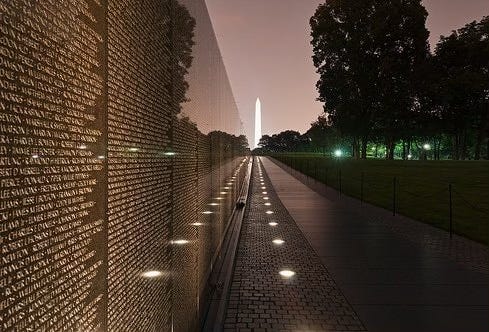
The Vietnam War Memorial in DC

After killing, or perhaps more often not killing, the guerrillas, the Army left, and the guerrillas regained control of the area. This did not disturb LTG Stanley Larson, who observed that if guerrillas returned, “we’ll go back in and kill more of the sons of bitches.” But the VC and NVA retained the initiative, had plenty of manpower, and time was on their side.

Why did the Army pursue such a faulty strategy? In part due to the legacy of World War II, particularly American experience in the Pacific. In island-hopping to Japan, Americans gained faith in massive firepower and lost interest in controlling land. The islands were a means to an end, not the end itself, and success could be measured in some sense by the number of Japanese casualties. Such was not the case in Vietnam, where control of the land was essential to winning the support of the people. Part of the Army’s problem was its lack of experience in counterinsurgency (or COIN) operations. Ronald Spector reports that in the 1950s, COIN operations were limited to four hours in most infantry training courses. What little was taught focused on preventing a conventional enemy from holding raids or infiltrating rear areas. But in the end, the Army fought the war it was trained to fight: a conventional war of maneuver and massive firepower. This worked well in Desert Storm, but failed in Vietnam.

In contrast to the Army, the Marines were far more aware of the nature of the war they were fighting, reports Andrew Krepinevich. They combined 15 marines and 34 Popular Force territorial troops (who lived in and provided security for a village or hamlet) into combat action platoons (CAPs). These CAPs sought to destroy insurgent infrastructure, protect the people and the government infrastructure, organize local intelligence networks, and train local paramilitary troops. In other words, they adopted traditional COIN tactics. But the Army ran the show in Vietnam, and its leaders rejected the Marines’ approach.

The Marines were not alone in their appreciation of the multidimensional aspects of COIN. Robert Komer’s Phoenix program also targeted the Viet Cong infrastructure, but the efforts of the CIA were not well coordinated with those of the military or the State Department, let alone the South Vietnamese. In fact Westmoreland refused to create a combined command to coordinate American actions with those of the South Vietnamese. The latter were an especially neglected resource. Admittedly, the Army of the Republic of Vietnam (ARVN) was corrupt and at times incompetent, but part of the problem was caused by American mistraining and the Army’s contempt. In the 1950s, American military advisors trained ARVN to repel a conventional invasion from the north, using North Korea as a model. From 1965-68, the US Army gave ARVN the static security mission, judged to be of low importance by the Army. US advisors assigned to help ARVN recognized their careers were endangered: they would advance far quicker if they had “true” combat assignments. After years of neglect, ARVN was built up with billions of US dollars during Nixon’s Vietnamization policy (and that’s exactly what it was – a policy, not a strategy), but by 1969 the rot had gone too far. ARVN lacked a unifying national spirit, VC agents had penetrated the ranks, and the officers were thoroughly politicized. Our ally always thought we’d be there if they ran into trouble, but they didn’t understand how American government worked. As Ambassador Bui Diem explained in 1990, “Our faith in America was total, and our ignorance was equally total.” South Vietnam paid the price in 1975.

Could the United States have won the Vietnam War if we had followed a proper strategy? This question may be unanswerable and ultimately moot, but it’s worth discussing. First, one must admit the war may not have been worth winning. Hannah Arendt has stated the Vietnam War was a case of excess means applied for minor aims in a region of marginal interest. In retrospect this seems irrefutable, but in the climate of the Cold War and Containment Vietnam seemed a critical theater in which communist aggression had to be stopped. Second, one must admit the United States was not protecting a viable government in South Vietnam: we were trying to create one. But we were creating one in our image. We ignored the Vietnamese culture and destroyed their economy with our hard currency. Rear area troops with money to spend spread prostitution and drugs in the streets of Saigon. In short, we alienated the people instead of winning them over to our cause. The few people we did win over were terrorized and often killed by the Viet Cong. Even following a proper COIN strategy, victory would have taken 5-10 more years at least. With weak support from the American people, (the “Silent Majority” was silent due to its ignorance and ambivalence), which waned dramatically after Tet, we never had a chance in Vietnam.

The one strategy that would have succeeded for the United States, I believe, is Mao’s People’s War. We must not deceive ourselves: if free elections had been held as promised in 1956, Ho Chi Minh would have won and unified the country. His was the legitimate government; we were trying to overthrow that government and replace it with almost any non-communist regime. In that effort, we should have formed an alliance of military, state department, intelligence, and academic resources to educate Americans in Vietnamese language and culture. These experts, with a suitable, politically-indoctrinated military force to protect them, would win the hearts of the people. Our main weapons would be our ideas and the ideological fervor of our troops, whether civilian or military. Diplomacy and military strikes would be used to cut-off the flow of arms to the VC and NVA from the Soviet Union. The political infrastructure of the enemy would be targeted, including Ho Chi Minh himself.

But this is ridiculous. Our very arrogance blinded us to the war’s complexities. We attacked the symptoms of the disease – the guerrillas and NVA – without examining what caused the disease in the body politic. Our can-do attitude was reinforced by our military traditions and our pride in our nation as being more moral than the rest of the world. We became our own worst enemy as we tried to manage the war. The commitment was there (at least among the soldiers), the energy was there, the money was there, the technology was there -the strategy, intelligence, and leadership wasn’t. People’s War proved superior to search-and-destroy, the VC and NVA intelligence proved superior to ARVN and ignorant Americans, the brilliant Giap out-thought the dedicated but shortsighted Westmoreland. The Vietnam War was ultimately unwinnable.

In the aftermath of the American-led victory over Iraq in Desert Storm, many Americans predicted the stigma of our defeat in Vietnam had finally been exorcised from our minds. Such was not the case, nor is such a result even desirable. The “dreaded V-word,” as the London Times recently described it, is being whispered again in the endless corridors of the Pentagon. If this breeds an aversion to the use of military force, harm may result; but if it leads to more thought and a more subtle study of the efficacy of military force as applied under different conditions, the dreaded V-word will have served a useful purpose, and those names engraved on the Wall in Washington will not have died in vain.

What Is Blitzkrieg?

And how much does the U.S. spend on weapons and war?

BILL ASTORE

JAN 23, 2026

Last January, I published “My Father’s Journal,” which recounts my dad’s experience surviving the Great Depression, serving in the Civilian Conservation Corps in Oregon fighting forest fires, military service in the Army during World War II, and bringing up five children during the “Baby Boom” years of the 1950s and 1960s while serving as a city firefighter. If you’re interested, it’s available at Amazon for $10 for the paperback and $5 for the Kindle version. Follow this link, and thanks!

*****

I received two interesting queries this week, one on Blitzkrieg and the other on how much the U.S. spends on weapons and war. On the first subject, I was asked about the characteristics of Blitzkrieg, when the concept was developed and seen in battle, and for post-World War II examples. I was also asked about Russia-Ukraine and the recent U.S. attack on Venezuela. Here are my answers:

1. Speed, surprise, combined arms, and disruption are the main characteristics of Blitzkrieg. “Combined arms” refers to all combat arms working synergistically, i.e. infantry, armor, artillery, supported by air forces (nowadays, drones might be involved in large numbers). Special forces like airborne units may also be involved. Deception and misdirection are also aspects of Blitzkrieg. The fundamental idea is to move and maneuver so quickly that the enemy can’t keep pace–to disrupt the enemy’s cohesion. To place them in an untenable position where they have to withdraw or perhaps even surrender.

2. Blitzkrieg, though associated with Nazi Germany in World War II, is an old concept in warfare. Perhaps the best practitioners were the Mongols in the 13th century. The Western concept has its roots in World War I and the stalemate of trench warfare. Ideas associated with what became known as Blitzkrieg were tried on various World War I battlefields. The idea was to break the stalemate of fixed lines and fortifications without getting into costly battles of attrition. These ideas came to maturity in World War II.

3. Blitzkrieg, perhaps ironically, is sometimes attached to the Israeli Defense Forces, as in their attacks in 1967 in the Six Day War. You might say the USA used Blitzkrieg against Iraq in 1991. Russia’s initial attack on Ukraine in 2022 was not a Blitzkrieg–it was more of an uncoordinated show of force that backfired. The USA attack on Venezuela was a “snatch and grab” kidnapping, not a military campaign per se.

*****

The second query focused on how much the U.S. spends on weaponry and war and how we measure that as a percentage of the federal budget. Here’s my answer to that:

Yes, it’s a numbers game. If you include all federal spending (including non-discretionary spending like social security and Medicare/Medicaid), it’s a smaller percentage. Roughly 15% of the federal budget.

If you focus on discretionary spending, it’s more than 50%. It depends on how you count it. If you add Pentagon spending to Homeland Security, the VA, the DOE (nukes), and interest on the federal debt due to wars and military spending, the percentage is 60% or even higher.

There are many pie and bar charts that illustrate this. See this, for example: https://fiscaldata.treasury.gov/americas-finance-guide/federal-spending/

When the warmongers really want to minimize war spending, they compare it to GDP.

*****

No matter how you measure it (or attempt to minimize it), a trillion dollars is a lot of money. Of course, the best way to think of “defense” spending is from President Dwight D. Eisenhower’s “Cross of Iron” speech in 1953:

Every gun that is made, every warship launched, every rocket fired signifies, in the final sense, a theft from those who hunger and are not fed, those who are cold and are not clothed. This world in arms is not spending money alone. It is spending the sweat of its laborers, the genius of its scientists, the hopes of its children… This is not a way of life at all, in any true sense. Under the cloud of threatening war, it is humanity hanging from a cross of iron.

That is the true cost of spending on weapons and war.

Something Is Rotten in the States of America

Look No Further than Colossal Pentagon Spending and Perpetual War

BILL ASTORE

AUG 14, 2025

Something is Rotten in the States of America.

America’s war budget now exceeds $1 trillion a year—an almost unimaginable sum.

The Pentagon plans to spend $1.7 trillion “modernizing” a nuclear triad that should instead be downsized. A proposed “Golden Dome” missile defense system may cost $500 billion while making nuclear war more likely. And a “new” Cold War with China and Russia is already underway, with threat inflation as one of its defining features.

With military spending so high—and the military so valorized—Washington offers it as the solution to nearly everything: crime in D.C., eliminating drug cartels south of the border, containing China and Russia, “winning” in Somalia, preventing Iran from acquiring nuclear weapons—the list is endless. Supporting and defending the Constitution, however, is rarely mentioned.

War has become America’s new normal. “Peace” is now a word that dare not speak its name. According to the Pentagon, the only peace worth pursuing is “peace through [military] strength.” A warrior ethos is marketed as if it were synonymous with democratic virtue.

I once called for a 10% reduction in Pentagon spending. That’s no longer enough. We need a 50% cut—we need a military dedicated to genuine national defense, not imperial dominance. Surely we can protect America for $500 billion a year rather than the $1 trillion we’re spending now.

Changing the narrative is crucial. Why do we need 750+ bases overseas? Why expand our nuclear arsenal when we already have 5,000 warheads? We don’t need these things—they are the hallmarks of wasteful militarism. They escalate tensions, endanger us, and drain the nation’s wealth.

And why do we have 17 or 18 intelligence agencies? Despite all that intelligence, we still lost in Vietnam, Iraq, and Afghanistan. Where is the accountability? Why are no generals relieved of command for such failures? In fact, they’re more likely to fail upwards.

“All governments lie,” as I.F. Stone warned. Combine that with the truth that war’s first casualty is truth itself, and you begin to see the rot in America today. Perpetual war fuels deception and government overreach. Almost anything can be justified when the cry is, “We’re at war!”—even when the reasons for going to war are false.

Consider the Gulf of Tonkin incident—revealed later as phony—and the Pentagon Papers during the Vietnam War. Consider Iraq’s mythical WMDs. Consider the lies revealed in the Afghan War Papers. Consider the weasel words of generals like David Petraeus, forever hedging “gains” as “fragile” and “reversible.” Consider the U.S. military’s record since World War II—generally ineffective because there’s been little accountability for failure. (And yes, civilian leaders share the blame.)

The military-industrial complex grows ever more powerful, sidelining the American people while democracy withers.

Something is rotten in the States of America.

Many thanks to Judge Napolitano for asking me to discuss some of these issues on his show, “Judging Freedom.”

The Russia-Ukraine War Goes On and On

Neocons and Weapons Makers Are Happy

BILL ASTORE

JUL 19, 2025

Roughly three and a half years have passed since Russia’s invasion of Ukraine in February 2022 and the war shows little sign of ending. President Trump has gone from boasting he could end the war in a day to following the policy of the Biden administration in providing weapons and aid to Ukraine. To most Americans, the war has become background noise, barely perceptible. Most Ukrainian flags have been put away or deleted from Facebook and similar social media sites.

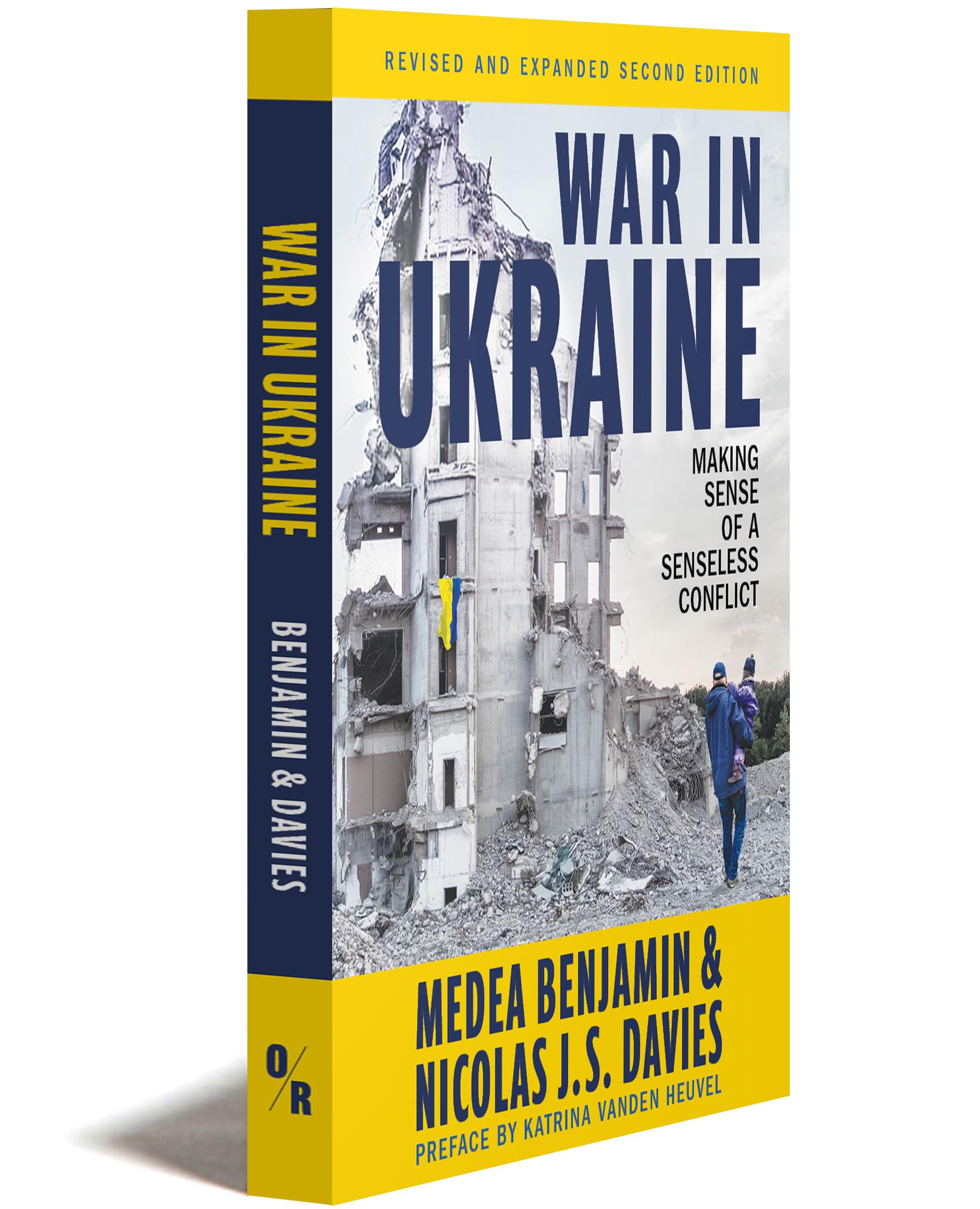
If you’re looking for a primer on the war that’s both critical and balanced, check out Medea Benjamin and Nicolas J.S. Davies’ book, “War in Ukraine: Making Sense of a Senseless Conflict,” now available in a revised and expanded second edition. ($20 paperback; $10 ebook, from OR Books.)

Benjamin and Davies recognize the war didn’t erupt out of nowhere in February 2022 nor was it completely “unprovoked.” As much as they deplore and denounce Vladimir Putin’s decision to invade, they recognize Putin had his reasons. Putin is more rational actor than a power-hungry dictator, and he’s arguably driven more by securing Russia’s position (and regional dominance) than recreating a Tsarist Russian or Soviet empire. Unlike most American commentators, Benjamin and Davies favor a diplomatic solution that would end mass killing on both sides. Not surprisingly, their views have gained little traction in the pro-war, anti-Putin mainstream media.

Speaking of the U.S. mainstream media, NBC News posted an article yesterday citing Condoleezza Rice, former Secretary of State under President George W. Bush. An unrepentant neocon, Rice is happy that Trump is sending more weapons to Ukraine while threatening more sanctions as well. In short, Trump is following a traditional neocon script while also keeping weapons factories in the U.S. going full blast. Rice approves!

What I found most staggering from Rice was this claim cited by NBC: 

Rice also criticized the Biden administration for, in her view, having taken its time to get desperately needed weapons to Ukraine from the outset. “If you had given them everything at the beginning of the war,” she said, when “the Russians were on their back foot, [Ukraine] could’ve won this war outright.”

Excuse me, but WTF? What does giving Ukraine “everything” at the beginning of the war in 2022 mean? Fighter jets, main battle tanks, long-range missiles, nuclear weapons? Ukraine wasn’t even an ally of the U.S., nor was it ever a part of NATO. And would Ukraine really have won the war against Russia with “everything”? What about the risk that Russia would have escalated as well, perhaps calling on its arsenal of 6000 or so nuclear weapons? 

Rice’s call for more smoking guns to have been sent to Ukraine early in 2022 almost certainly would have ended in a mushroom cloud or two. But I suppose that’s OK with her as long as the mushroom clouds were limited to Ukraine.

Remember 2023 and the failure of the much-hyped Ukrainian counteroffensive? I do. Remember all the hype about U.S., German, and British wonder weapons like Abrams, Leopard, and Challenger tanks? I do.

Let’s hope that Trump’s gambit to push Putin to some kind of compromise settlement bears fruit. No war should go on forever. Haven’t enough people died on both sides?

Surprise! Institute of Peace in Shutdown

W.J. Astore

Meanwhile, Institute of War Is Going Full Throttle

Surprise! America’s Institute of Peace (USIP), admittedly a think tank that is neither that peaceful nor successful, is being shut down by the Trump administration. Meanwhile, the Institute of and for War, otherwise known as the Pentagon, is going full throttle and likely getting even more money to crank up conflict around the globe.

The symbolism here is almost too obvious for words. The budget for the Peace Institute is roughly $55 million. The budget for the War Institute (Pentagon) is roughly $900 billion. That means America spends 16,000 times as much money preparing for war than it does thinking about peace. That might be one reason why we always get war—we get what we pay for.

For the yearly budget of the USIP, we could buy roughly one-half of an F-35 fighter jet. Now there’s some meaningful cost savings.

A Reminder: My new book, American Militarism on Steroids, goes live on Amazon Kindle tomorrow. It gathers all the essays I’ve written for TomDispatch, which amazingly add up to over 230,000 words. Prolix? Prolific? Profane? It must be profane if it criticizes our beloved Institute of War. Available for downloading for $7.50 at this link. Thank you.

Close Down the Pentagon!

W.J. Astore

Send the “troops” to the front!

Coming soon to a Kindle store near you: all my articles for TomDispatch, with a new introduction by me and a foreword by Tom Engelhardt. You can preorder it by clicking on this link. Thanks!

Speaking of American militarism on steroids:

It’s been called the “House of War” by esteemed author James Carroll. Within the military, it’s jokingly referred to as the five-sided puzzle palace on the Potomac. It’s a monetary black hole that consumes eagerly and without bounds (in light of seven failed audits in a row) roughly a trillion dollars in yearly military expenditures. It’s a place where full-bird colonels, who should be leading regiments in the field, become errand boys and girls to a grossly inflated number of generals. Yes, it’s America’s very own Pentagon, built in record time in the early months of World War II to manage that colossal war—and never shuttered since because perpetual global war is very much fundamental to the American way of life.

If there’s a symbol of America that captures current and past governmental budgetary priorities and foreign policy commitments, it’s the Pentagon. Forget the Statue of Liberty. Never mind Freedom Towers and national parks and bald eagles and the like. Increasingly, the Pentagon is America, a highly militarized version of our country, which is precisely why it needs to be closed down. Where’s Elon Musk and the DOGE wunderkinds when you need them?

Nearly 30,000 people work in the Pentagon on a daily basis. It makes for some crowded parking lots—and cramped offices even for those aforementioned bird colonels. It’s a hotbed of intrigue and competition among the services for money and resources. It’s depressingly short on natural light. It’s a repository for hidebound thinking, a place where good ideas go to die. A line from the original “Star Wars” has been used more than once to describe it: “You will never find a more wretched hive of scum and villainy.”

And (again) it’s time to shut it down.

Here’s an idea to make the U.S. military far more efficient. Empty the Pentagon of all its worker-bees and from them create infantry battalions. An average battalion consists of roughly 800 “effectives,” so demobbing the Pentagon work force and mobilizing them instead for action in the field would create roughly 35 battalions. Send these battalions to all combat zones where U.S. troops are deployed today. Does Ukraine need more troops at the front? Does Israel need more stormtroopers in Gaza? We’ve got some Pentagon legions for you, Bibi.

Of course, I jest. I want to close the Pentagon to weaken militarism, not to wage war and genocide. Nevertheless, I’m guessing putting the entire Pentagon workforce at the point of the spear might serve to dull it a bit. Perhaps war boosterism might decrease if the cheerleaders were sent directly into the trenches instead of remaining safely on the sidelines?

I’m Already Against the Next War

W.J. Astore

Reflections on Vietnam, Iraq, and Afghanistan

I’ve been reading John Ketwig’s memoir “…and a hard rain fell: A GI’s true story of the War in Vietnam,” and it’s reminding me just how plain dumb, destructive, and duplicitous America’s wars have been since World War II.

America’s wars are always dressed up with a necessary, even allegedly noble, cause. In Vietnam, we had to stop communism and all those dominoes from falling. In Iraq, it was about WMD and stopping Saddam Hussein, “the next Hitler.” In Afghanistan, it was about vengeance for 9/11, then creating democracy and even helping women. (How about helping women in America? Never mind.)

Vietnam is nominally communist today—and a big trading partner of the U.S. and an ally of sorts against China. No dominoes fell. Iraq didn’t have WMD and Saddam wasn’t the next Hitler; he was merely a regional strongman and a former U.S. ally who got a little too big for his britches, especially for Israel. Afghanistan was a war in search of a clear mission and attainable goals. After twenty years of effort and roughly $2 trillion in expenditures, the U.S. replaced the Taliban with—the Taliban. (I heard Norman Finkelstein say this first.)

We’re always told versions of the same lie: We need to fight them over there so that we don’t have to fight them here. Communism had to be rolled back in Vietnam else commies would be landing in Manhattan. Iraq had to be pummeled and Saddam overthrown before WMD landed in Boston. Afghanistan had to be pacified and modernized before the Taliban enforced conservative Sharia law in Biloxi. 

None of this was true. The United States would have been perfectly safe without committing any troops to Vietnam, Iraq, and Afghanistan. In fact, the U.S. would have been far better off if those wars had never been fought. Certainly Vietnam, Iraq, and Afghanistan would have been far better off if they’d never become free-fire zones for American munitions (including the poisonous Agent Orange in Vietnam and, more recently, depleted uranium and other poisons in Iraq and Afghanistan).

Now we’re hearing about a possible U.S. war with Iran, allegedly to stop that country from acquiring an atomic bomb. It’s OK for the U.S. to have more than 5000 nuclear warheads and for Israel to have 200 or so, but it’s not OK for Iran to have even one, because reasons.

The U.S. military, vast as it is, with a vision of global dominance, always needs enemies. Of course, it’s not simply the military but the whole military-industrial complex, the MICIMATT,* which needs war and conflict to sustain itself. 

I recently read “American War,” a powerful novel by Omar El Akkad. It imagines a second U.S. civil war starting roughly 50 years from now. It’s a fascinating book, well worth reading because it captures the horror of war, with all its atrocities, its massacres, its war crimes, and the deep wounds war leaves behind even among the most resolute survivors. John Ketwig’s book does the same as he recounts the fears and horrors of his year in Vietnam and the personal struggles he endured in coming to terms with what he’d seen and endured.

So, count me among those who are already against the next war, whether against Iran, China, or for that matter any other country. Sure, I think America needs to defend itself; I don’t think peace is going to break out spontaneously around the world; but I know for a fact that fighting constant wars is not a way toward greater peace and prosperity. Quite the opposite.

If you want to know what desperate and profoundly wounded war survivors are capable of, read “American War.” If you want to know what desperate and profoundly confused troops are capable of, read “…and a hard rain fell.” And ponder the continued propaganda here of the “good war,” the wonders of warriors and warfighters, and the repetition of slogans like “peace through strength,” a specific form of strength measured in kilotons and megatons of explosives, in massive body counts and military production figures.

Ask yourself: Is that “strength”? Are constant wars truly the path toward peace? How can we possibly be so dumb as to believe this?

MICIMATT: military-industrial-congressional-intelligence-media-academe-think-tank complex. It employs millions of people and spends more than a trillion dollars a year. It’s not easily confronted. Nor is it easily contained, let alone curtailed.

War Is the True Enemy

W.J. Astore

America’s Revival Will Begin When It Finally Embraces Peace

Arguably the biggest problem in America today is that the government remains on a wartime footing. The possibility of America being a normal country in normal times, at peace, is simply never mentioned. In current politics and in the mainstream media, there is no vision of America being at peace with the world. Ever.

There is always an enemy, usually plural. Russia. China. Iran. North Korea. The inchoate threat of terror and terrorists. Islamist extremism. All these and more are cited by the “experts” in the “national security state” as requiring a military response. If some kind of peace deal is orchestrated for the Russia-Ukraine War, America and its war machine will immediately pivot to Asia. Or the Middle East. Or perhaps Africa. Or all three.

I’m amazed when friends tell me they’re concerned about U.S. isolationism. Usually this concern is couched in America’s alleged withdrawal from (or even betrayal of) Europe in light of the Russia-Ukraine War. Their message to me is simple: America must keep sending weapons and intel to Ukraine until Russia and Putin are defeated, “as long as it takes.” The “it” is left undefined, but apparently “it” refers to an unqualified Ukrainian victory over Russia, followed by Ukraine’s eventual admission into NATO. Whether that “it” is even possible—whether that “it” could well lead to a nuclear exchange—doesn’t seem to matter because “We’re at war.”

I don’t know how anyone can think America will return to isolationism when the U.S. has 800 military bases globally and a vision of global reach, global power, and total dominance everywhere. And when America spends more on its military than the next ten countries combined (and most of those are U.S. allies). Dominating the globe isn’t exactly consistent with isolationism.

The problem with all the war rhetoric, the war narrative, the war framing, the warrior and lethality talk, is what it enables and facilitates, which is atrocity. Waste. Destruction. War is no way of life at all. As Ike said, the persistence of war is humanity crucifying itself on a cross of iron.

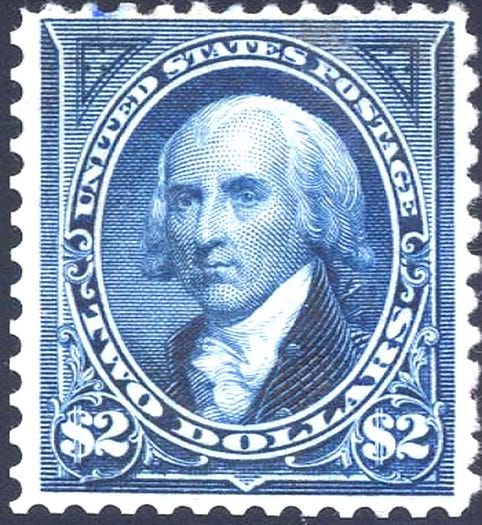
War is immensely corrosive to democracy. It is the enemy of freedom. Just listen to James Madison:

James Madison

Of all the enemies of true liberty, war is, perhaps, the most to be dreaded, because it comprises and develops the germ of every other. War is the parent of armies; from these proceed debt and taxes; and armies, and debts, and taxes are the known instruments for bringing the many under the domination of the few. In war, too, the discretionary power of the Executive is extended; its influence in dealing out offices, honors and emoluments is multiplied; and all the means of seducing the minds, are added to those of subduing the force, of the people. The same malignant aspect in republicanism may be traced in the inequality of fortunes, and the opportunities of fraud, growing out of a state of war, and in the degeneracy of manner and of morals, engendered in both. No nation can preserve its freedom in the midst of continual warfare …

*****

If you’re concerned about authoritarianism, if you’re concerned about maintaining and strengthening freedom, if you’re concerned about combatting corruption and waste, if you’re concerned about America’s huge deficits, stopping war should be your number one concern.

War is a terrible thing, and a state of war enables all kinds of butchery. Just ask the indigenous peoples of America, or the peoples of Palestine today. Even genocide can be disguised as a wartime exigency, a wartime necessity. How many times throughout history has the declaration, “We’re at war!” been used to justify the most heinous crimes against humanity? Even the Nazis hid behind wartime exigency to justify the mass euthanasia of the old, the mentally ill, and other forms of “life unworthy of life” as part of the T4 program (which anticipated the Holocaust).

The true revival of America will begin when this country declares itself to be at peace with the world. Until then, precipitous decline will continue for as long as our government remains at (and continues to celebrate) war.

An End to the Russia-Ukraine War

Accepting a Multipolar World

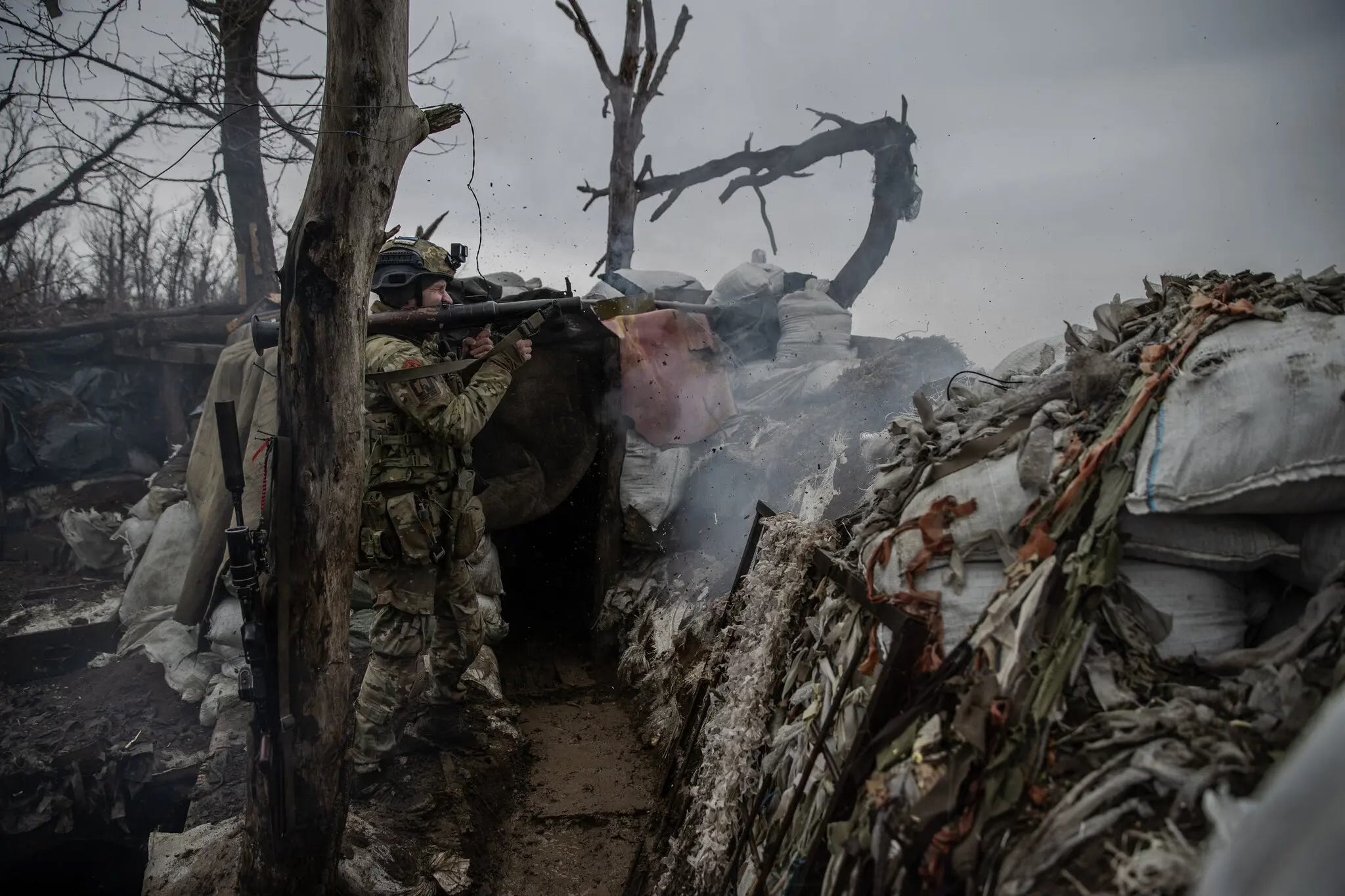
I recently read the book, “Generals Die in Bed,” a classic account of World War I. In terms of combat between Ukraine and Russia, there are serious echoes of WW1 with trench warfare and needless death on a massive scale.

There are few things dumber and more wasteful than trench warfare (Ukraine, from the New York Times)

Far too often, war is glorified when it is really colossal waste. As Dwight D. Eisenhower said, war is to be hated. So, short of abject capitulation to a tyrant, I support efforts to end wars. Stop the waste. Stop the hate. Find a way to live together in peace. The alternative, perpetual war, is too terrible to contemplate.

Diplomacy can be pursued without abandoning Ukraine or betraying NATO. Certainly, Ukraine should be a party to the negotiations. The war is being fought on their turf. They have bled, as has Russia.

But: All wars must end. The trick is ending them in a way that doesn’t generate future wars. That was the greatest tragedy of World War I: that its ending and the botched settlement led almost inexorably to World War II and an even greater bloodletting.

Here’s the rub: Ever since 9/11, indeed ever since World War II, almost without exception, America has ALWAYS been at war. And it hasn’t gone well, has it? (Except for the arms makers and the Cheney neocon crowd.) Isn’t it time we worked for peace?

Far too often, America’s worst enemy hasn’t been Putin or China or some other bogeyman. It’s been the enemy within. And I don’t mean the “red menace” or the “woke” crowd. I mean the enemy that is threat inflation. The enemy that is incessant warfare in unnecessary wars of choice, which drives deficit spending, and which is reinforced by lies.

How many times have we heard of bomber gaps, missile gaps, falling dominoes in Asia, WMD in Iraq, etc., that turned out not to be true, but which were used to justify massive military spending and (especially in Southeast Asia) drove horrendous casualties? Yes, the MICIMATT is powerful, but why are Americans so easy to scare? Why are we so fearful when this country’s geographic position is so enviably strong and defensible? It’s not like Putin’s on our northern border: friendly Canadians are there! (Even if they boo our National Anthem at hockey games.)

The world is becoming multipolar again, which doesn’t mean it has to be a scarier place. A multipolar world could be a more stable one if U.S. leaders could just back off on their goal of dominating everything everywhere all at once.

The idea of full-spectrum dominance and America as a global hegemon at any price must give way to an irenic and ecumenical view of the world. The American religion of violent militarism and prideful exceptionalism is simply too expensive to sustain. 

When the ship of state is slowly slipping under the waves, it’s not wise to steer closer to more icebergs. Let’s work to save our ship of state first.

Trump Says He’ll Audit the Pentagon

W.J. Astore

Will it prove to be a bridge too far?

FEB 08, 2025

President Donald Trump says he’s ready to tackle the Pentagon, which has failed seven audits in a row. He says America might save “trillions” after effective audits. Will it happen?

The Pentagon budget currently sits at roughly $900 billion for this fiscal year, representing more than half of federal discretionary spending. This vast sum doesn’t include (among other things) Homeland Security, nuclear weapons covered by the Department of Energy, the VA (Veterans Administration), and interest on the national debt due to wasteful failed wars in places like Afghanistan and Iraq.

A successful audit of the Pentagon would be a monumental victory for what’s left of American democracy. It may also prove to be a bridge too far for Trump. The National Security State is America’s unofficial fourth branch of government and arguably its most powerful. It is a colossus that hides malfeasance and corruption behind a “top secret” security classification. It deters and prevents efforts at transparency by crying that those who try to expose its crimes are endangering national security. It expects your obedience and praise, not your questions and criticism.

Presidents, of course, are supposed to serve as the commander-in-chief of the U.S. military. They rarely do. Not nowadays. The U.S. system may in theory rest on civilian control of the military, but the military has been out of control since at least 1947, when it rebranded itself the “Department of Defense” instead of the old War Department. Not coincidentally, every war America has fought since then has been undeclared, i.e. lacking a formal Congressional declaration of war.

America has fought a mind-blowing number of wasteful and illegal wars that have been sold to the people through lies, whether in Vietnam (“The Pentagon Papers”), Iraq (No WMD), Afghanistan (“The Afghan War Papers”), and elsewhere. Few things are needed more in America than an honest reckoning of Pentagon spending—and future Pentagon war plans.

Such a reckoning could very well save our lives—indeed, the world, if done honestly and transparently by true patriots. It could also prove to be a bridge too far—for any president.