I’m Already Against the Next War

W.J. Astore

Reflections on Vietnam, Iraq, and Afghanistan

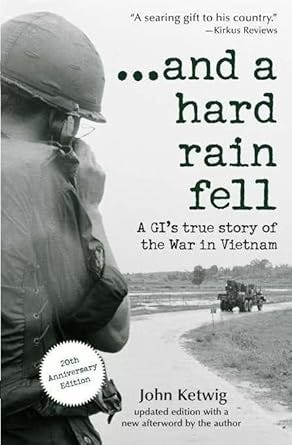
I’ve been reading John Ketwig’s memoir “…and a hard rain fell: A GI’s true story of the War in Vietnam,” and it’s reminding me just how plain dumb, destructive, and duplicitous America’s wars have been since World War II.

America’s wars are always dressed up with a necessary, even allegedly noble, cause. In Vietnam, we had to stop communism and all those dominoes from falling. In Iraq, it was about WMD and stopping Saddam Hussein, “the next Hitler.” In Afghanistan, it was about vengeance for 9/11, then creating democracy and even helping women. (How about helping women in America? Never mind.)

Vietnam is nominally communist today—and a big trading partner of the U.S. and an ally of sorts against China. No dominoes fell. Iraq didn’t have WMD and Saddam wasn’t the next Hitler; he was merely a regional strongman and a former U.S. ally who got a little too big for his britches, especially for Israel. Afghanistan was a war in search of a clear mission and attainable goals. After twenty years of effort and roughly $2 trillion in expenditures, the U.S. replaced the Taliban with—the Taliban. (I heard Norman Finkelstein say this first.)

We’re always told versions of the same lie: We need to fight them over there so that we don’t have to fight them here. Communism had to be rolled back in Vietnam else commies would be landing in Manhattan. Iraq had to be pummeled and Saddam overthrown before WMD landed in Boston. Afghanistan had to be pacified and modernized before the Taliban enforced conservative Sharia law in Biloxi. 

None of this was true. The United States would have been perfectly safe without committing any troops to Vietnam, Iraq, and Afghanistan. In fact, the U.S. would have been far better off if those wars had never been fought. Certainly Vietnam, Iraq, and Afghanistan would have been far better off if they’d never become free-fire zones for American munitions (including the poisonous Agent Orange in Vietnam and, more recently, depleted uranium and other poisons in Iraq and Afghanistan).

Now we’re hearing about a possible U.S. war with Iran, allegedly to stop that country from acquiring an atomic bomb. It’s OK for the U.S. to have more than 5000 nuclear warheads and for Israel to have 200 or so, but it’s not OK for Iran to have even one, because reasons.

The U.S. military, vast as it is, with a vision of global dominance, always needs enemies. Of course, it’s not simply the military but the whole military-industrial complex, the MICIMATT,* which needs war and conflict to sustain itself. 

I recently read “American War,” a powerful novel by Omar El Akkad. It imagines a second U.S. civil war starting roughly 50 years from now. It’s a fascinating book, well worth reading because it captures the horror of war, with all its atrocities, its massacres, its war crimes, and the deep wounds war leaves behind even among the most resolute survivors. John Ketwig’s book does the same as he recounts the fears and horrors of his year in Vietnam and the personal struggles he endured in coming to terms with what he’d seen and endured.

So, count me among those who are already against the next war, whether against Iran, China, or for that matter any other country. Sure, I think America needs to defend itself; I don’t think peace is going to break out spontaneously around the world; but I know for a fact that fighting constant wars is not a way toward greater peace and prosperity. Quite the opposite.

If you want to know what desperate and profoundly wounded war survivors are capable of, read “American War.” If you want to know what desperate and profoundly confused troops are capable of, read “…and a hard rain fell.” And ponder the continued propaganda here of the “good war,” the wonders of warriors and warfighters, and the repetition of slogans like “peace through strength,” a specific form of strength measured in kilotons and megatons of explosives, in massive body counts and military production figures.

Ask yourself: Is that “strength”? Are constant wars truly the path toward peace? How can we possibly be so dumb as to believe this?

MICIMATT: military-industrial-congressional-intelligence-media-academe-think-tank complex. It employs millions of people and spends more than a trillion dollars a year. It’s not easily confronted. Nor is it easily contained, let alone curtailed.

Declaring Our Independence from War

W.J. Astore

“War is a madhouse”

It’s Independence Day in America, so it seems like a good day to declare our independence from the insanity of war.

Sadly, since the presidency of George W. Bush if not before, it’s become routine for U.S. commanders-in-chief to boast of having the world’s finest military in all of history. Obama did it routinely, and Biden recently said the same during his disastrous debate with Trump. Few Americans stop to think about the implications of boasting about having the world’s greatest military—is such a boast truly consistent with democracy, liberty, and freedom?

Certainly, empires rely on strong militaries. Think of the Roman Empire or the Mongol Empire, or the Third Reich (Empire) of Nazi Germany. Do we want to be like them?

Those empires lived by the sword (quite literally so with the Roman Empire) and died by it as well. Their militaries, I would argue, were also more effective than the U.S. one, which hasn’t won a major war since 1945, the latter with a lot of help from our “friends” like the Soviet Union. The Roman, Mongol, and German empires are no more, worn down in part through the constant costs and demands of war. We need to learn more from history than the “fact” that America’s military is supposedly the world’s best since forever and a day ago.

I’ve been reading Oriana Fallaci’s “Nothing, and So Be It,” in which she recounted her time reporting on the Vietnam War. Two conversations with U.S. troops in Vietnam caught my attention. On pages 22-23, she recounts a conversation with Army Captain Scher, during which Scher confesses his disgust with war: 

God, how disgusting war is. Let me say it—I’m a soldier. People who enjoy making war, who find it glorious and exciting, must have twisted minds. There’s nothing glorious, nothing exciting; it’s just a filthy tragedy you can only cry over. You cry for the man you refused a cigarette to and who didn’t come back with the patrol. You cry for the man you bawled out and who is blown to pieces in front of you. You cry for the man who killed your friends …

Later in the book, she interviews a Marine Lieutenant whose surname is Teanek (pages 174-75). Here’s what he had to say:

Teanek: “Men have been saying that [we should abolish war] for thousands of years, and with the justification that they’re abolishing war, they’ve soaked the greatest periods of their civilization in blood.”

Fallaci: “That’s no good reason to keep on doing it.”

Teanek: “Theoretically, you’re right, but in practice what you’re saying is very silly. It’s like convincing yourself—as I bet you do—that when you describe people dying in war you’re helping to abolish war. On the contrary. The more you see people who’ve been killed in war, the more you want to go on fighting wars: it’s a mystery of the human soul.”

It is indeed “a mystery of the human soul” why we humans persist in killing each other in such vast numbers through war. Of course, it’s partly because we glorify it, when we should recognize, as Fallaci does on page 187, that “War is a madhouse.”

I am sane!

One of my favorite scenes in any war film came in “The Big Red One,” a World War II movie by Samuel Fuller starring Lee Marvin as a grizzled Army sergeant of the 1st Infantry Division. It’s a scene in which U.S. troops liberate an insane asylum.

The unforgettable part of this scene for me is when one of the madhouse residents picks up a submachine gun and starts blasting away, crying “I am one of you. I am sane!”

We need to declare our independence from that.

“Fighting a war they did not believe in, a war they were ashamed of”

W.J. Astore

A 52-Year-Old Letter Says Much About America’s Failed Wars

A friend sent along an old Time magazine from May 8th, 1972, which I’ve thoroughly enjoyed perusing. Back in the 1970s, I had a subscription to Time, but my old copies were long ago consigned to the trash. Anyhow, in reading the “Letters” section, I came across a stunning missive written by Oriana Fallaci, an Italian war correspondent who wrote for Europeo Magazine.

Fallaci in 1960, showing some serious attitude (Wiki)

Here’s what Ms. Fallaci had to say about the U.S. war effort in Vietnam:

As an Italian, as a longtime war correspondent in Viet Nam, as the author of a book on the Viet Nam War, I have to answer the sort of judgment made by the unnamed Rand Corp. analyst who said that the South could hold out against the North Vietnamese “unless the North Vietnamese are all Prussians and the South Vietnamese are all Italians.”

I assume that he refers to the fact that the Italian soldiers fought with total lack of enthusiasm during the second World War and particularly in its last phase. Yes, indeed they did. They showed the same lack of enthusiasm that the American soldiers have shown in Viet Nam. Many times, while following your GIs in combat, I have had the impression that I was seeing Italians and not Americans. Do you know why? Because both those Italians and those Americans were fighting a war they did not believe in, a war they were ashamed of.

She nails it. When you realize the war you’re fighting is a dishonest one, an unnecessary one, even one that is shameful, you generally don’t fight well. It doesn’t matter what nationality you are.

Ms. Fallaci’s book on the Vietnam War

When and what was the last war U.S. troops truly believed in, one that they weren’t entirely ashamed of? I think you’d have to go back to World War II, and of course even then more than a few U.S. troops had their doubts, as citizen-soldiers of a democracy are wont to have, because there’s no such thing as a “good” war.

Anyhow, note as well how the prediction of that Rand Corporation “expert” proved wrong. Instead of South Vietnam holding out against the north, it folded fairly quickly three years later in 1975. I guess its soldiers all fought like Italians and those of North Vietnam all fought like Prussians.

Waging war is a horrible thing—especially when the war one is called on to wage is false and shameful. Ms. Fallaci knew that.

America’s Disastrous Afghan War

W.J. Astore

Finally a bit of truth from the New York Times, but for what reason, and why now?

Remember when Barack Obama claimed in 2007-09 the Afghan War was the right war, the good one, as opposed to the wrong and bad Iraq War prosecuted by Bush/Cheney? Of course, they were both disastrous wars, but until the Biden administration finally pulled out, chaotically so, in 2021, the mainstream media was still supporting the idea that America was doing good in Afghanistan.

I suppose enough time has passed for the New York Times to allow for a measure of honesty, if only to support Joe Biden’s reelection this year. See, Biden made the rightdecision to withdraw because now we finally can admit the war was a disaster. Naturally, it wasn’t entirely or even mainly the U.S. government’s fault …

Of course, plenty of people knew the Afghan War was a disaster; my colleague Matthew Hoh resigned from the State Department in 2009 in protest against Obama’s “surge” there and counterproductive U.S. policy decisions. Democrats in Congress listened to Hoh and a few wanted to change course, but they were brought to heel by Nancy Pelosi, who said no dissent on the Afghan War was permissible when Obama was fighting so hard for health care reform in America. Hoh heard those words straight from Pelosi’s mouth. So we got twelve more years of disastrous war and Obamacare.

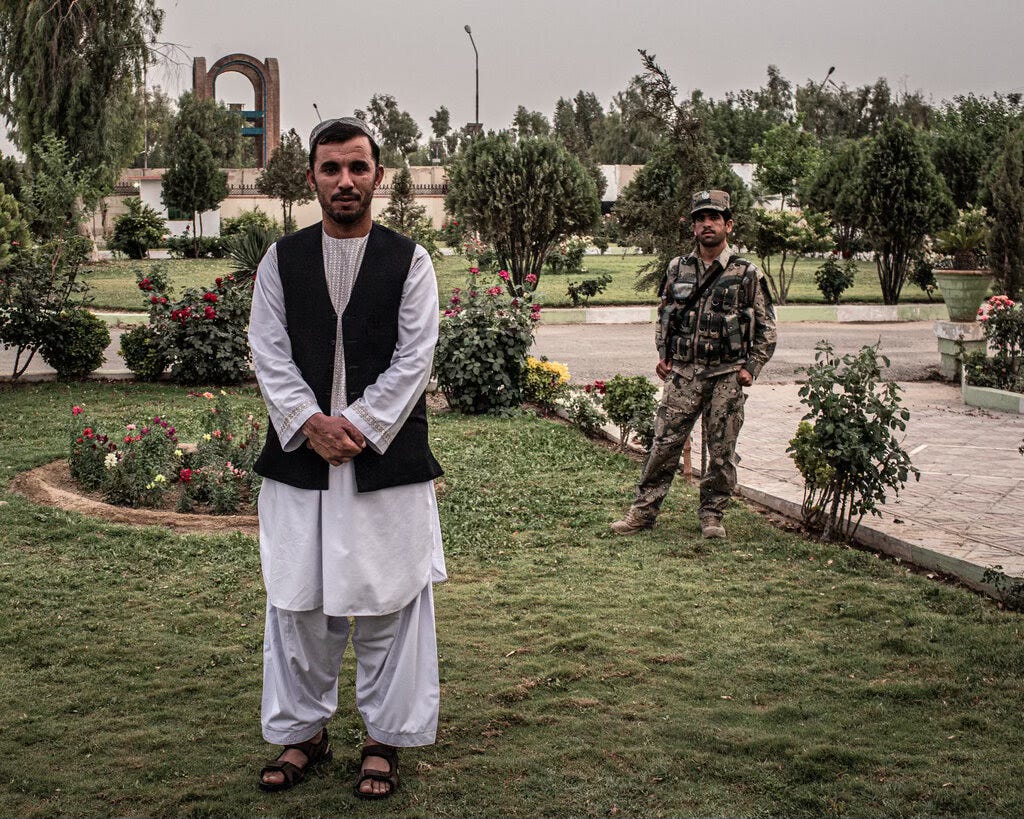
Abdul Aziq in 2015 (Bryan Denton for the New York Times)

Anyhow, in my NYT news feed this AM, the “hidden history” of America’s “savage campaign” is finally being covered, though the savageness is largely ascribed to an Afghan ally of the U.S., General Abdul Aziq. As usual, American “advisers” tried to curb his worst instincts, apparently without success. Well, what can you do with such “savages”?

Here’s how the NYT puts it:

But his [Aziq’s] success, until his 2018 assassination, was built on torture, extrajudicial killing and abduction. In the name of security, he transformed the Kandahar police into a combat force without constraints. His officers, who were trained, armed and paid by the United States, took no note of human rights or due process, according to a New York Times investigation into thousands of cases that published this morning. Most of his victims were never seen again.

Washington’s strategy in Afghanistan aimed to beat the Taliban by winning the hearts and minds of the people it was supposedly fighting for. But Raziq embodied a flaw in that plan. The Americans empowered warlords, corrupt politicians and outright criminals in the name of military expediency. It picked proxies for whom the ends often justified the means.

The NYT is shocked, shocked!, that there was a “flaw” in the U.S. plan that “empowered warlords, corrupt politicians and outright criminals” in the cause of military “progress.” Hmm…sounds more like a feature of U.S. policy than a flaw.

What about all those U.S. generals testifying to Congress under oath about the progress we were allegedly making in Afghanistan? Are any of them going to be called to account? You can bet your sweet combat boots that they’re not.

After Aziq, matters grew even worse in Afghanistan, as the NYT puts it here: “What they [new warlords and supposed U.S. allies] brought under the name of democracy was a system in the hands of a few mafia groups,” said one resident of Kandahar who initially supported the government. “The people came to hate democracy.”

So, instead of Operation Enduring Freedom, America brought Operation Endemic Corruption to Afghanistan. That latter operation most definitely succeeded.

Here’s how the NYT summarizes its new study of the Afghan War:

Historians and scholars will spend years arguing whether the United States could have ever succeeded. The world’s wealthiest nation had invaded one of its poorest and attempted to remake it by installing a new government. Such efforts elsewhere have failed.

But U.S. mistakes — empowering ruthless killers, turning allies into enemies, enabling rampant corruption — made the loss of its longest war at least partly self-inflicted. This is a story Matthieu [Aikins] and I [Azam Ahmed] will spend the coming months telling, from across Afghanistan.

Echoes of the Vietnam War here. The world’s wealthiest nation invading a much poorer one in the name of “democracy,” then spreading corruption and devastation ending in a chaotic withdrawal. And now grudging admission that maybe, just maybe, the U.S. loss in Afghanistan was “at least partly self-inflicted.”

Ya think? Or maybe we can just blame the Afghan people, just as we blamed our “allies” in South Vietnam.

Nothing against Aikins and Ahmed here. I’m sure their “hidden history” of America’s war in Afghanistan will be revelatory. Yet why was it “hidden” for so long? And why are the “hiders” never called to account?

And was it really “hidden”? Matthew Hoh wasn’t the only truth-teller willing to blow a whistle. Why was his honest voice suppressed while worm-tongued generals like David Petraeus and Stanley McChrystal were celebrated?

I wonder when we’ll get the “hidden history” of America’s “savage” involvement in Gaza and Ukraine? Perhaps in 2030?

Let’s (Not) Go To War!

W.J. Astore

Remember the days when America had to be attacked before it went to war? And when it did, it made formal Congressional declarations of the same?

In December 1941, the Japanese attacked the U.S. Pacific Fleet at Pearl Harbor as well as elsewhere in the Pacific. In response to those attacks, President Franklin Roosevelt asked Congress for a formal declaration of war. Nazi Germany then declared war on the U.S., after which the U.S. responded in kind. Compared to the future wars of U.S. empire, Americans were generally united and had some understanding of what the war (World War II, of course) was about.

We haven’t had that kind of unity and clarity since 1945, which is certainly the biggest reason America has suffered so many setbacks and defeats in unpromising places like Vietnam, Iraq, and Afghanistan. In all three of those places, there really wasn’t a clear and compelling cause for war, hence there was no Congressional declaration of the same. Hmm … maybe that should have told us something?

In Vietnam, the Gulf of Tonkin Resolution by Congress followed on the heels of an “attack” that had never happened. In Iraq, the “evil dictator” didn’t have the weapons of mass destruction we accused him of having, nor had he played any role in the 9/11 attacks. In Afghanistan, the Taliban had played a secondary role in providing a safe haven to Osama bin Laden prior to 9/11, but it was Al Qaeda, not the Taliban, that was behind the 9/11 attacks.

Indeed, since 15 of the 19 Al Qaeda terrorists were Saudi, as well as their leader, Osama bin Laden, it would have made much more sense to have declared war on Saudi Arabia and invade that country than to have invaded Afghanistan. Of course, it made no sense at all to have declared a general “war on terror,” and rather unsurprisingly, that 20-year-war has only succeeded in spreading terror further.

Now we turn to today’s situation between Russia and Ukraine. Frankly, I don’t see a border dispute between these two countries as constituting a major threat to U.S. national security. It’s certainly no reason for America to go to war. Yet the Biden Administration is taking a hard line with its economic sanctions, its weapons shipments, and its troop deployments to the region.

Somehow, America’s leaders seem to think that such actions will deter, or at least punish, Russia and its leader. But there’s another possibility, one equally as likely, that sanctions and weapons and troops will lead to escalation and a wider war, and for what reason? A Russian-Ukrainian border dispute? This dispute might resolve itself if the U.S. and NATO just had the sense and patience to mind its own business.

A rush to war made sense in 1941, when the U.S. faced powerful and implacable enemies that were focused on its destruction. It hasn’t made sense since then, nor does it make sense today.

In short, let’s not go to war.

America’s Disastrous 60-Year War

W.J. Astore

In my latest for TomDispatch.com, I tackle America’s disastrous 60-year war (1961-2021), which began with Ike’s warning of the pernicious threat to democracy of the military-industrial complex and ended with last year’s humiliating retreat from Afghanistan. Has America learned anything? Based on recent events with Russia and Ukraine, together with bellicose acts toward China, it doesn’t seem so.

Here’s an excerpt from my article; you can read it in its entirety at TomDispatch.com.

Three Generations of Conspicuous Destruction by the Military-Industrial Complex

BY WILLIAM ASTORE

In my lifetime of nearly 60 years, America has waged five major wars, winning one decisively, then throwing that victory away, while losing the other four disastrously. Vietnam, Afghanistan, and Iraq, as well as the Global War on Terror, were the losses, of course; the Cold War being the solitary win that must now be counted as a loss because its promise was so quickly discarded.

America’s war in Vietnam was waged during the Cold War in the context of what was then known as the domino theory and the idea of “containing” communism. Iraq and Afghanistan were part of the Global War on Terror, a post-Cold War event in which “radical Islamic terrorism” became the substitute for communism. Even so, those wars should be treated as a single strand of history, a 60-year war, if you will, for one reason alone: the explanatory power of such a concept.

For me, because of President Dwight D. Eisenhower’s farewell address to the nation in January 1961, that year is the obvious starting point for what retired Army colonel and historian Andrew Bacevich recently termed America’s Very Long War (VLW). In that televised speech, Ike warned of the emergence of a military-industrial complex of immense strength that could someday threaten American democracy itself. I’ve chosen 2021 as the VLW’s terminus point because of the disastrous end of this country’s Afghan War, which even in its last years cost $45 billion annually to prosecute, and because of one curious reality that goes with it. In the wake of the crashing and burning of that 20-year war effort, the Pentagon budget leaped even higher with the support of almost every congressional representative of both parties as Washington’s armed attention turned to China and Russia.

At the end of two decades of globally disastrous war-making, that funding increase should tell us just how right Eisenhower was about the perils of the military-industrial complex. By failing to heed him all these years, democracy may indeed be in the process of meeting its demise.

The Prosperity of Losing Wars

Several things define America’s disastrous 60-year war. These would include profligacy and ferocity in the use of weaponry against peoples who could not respond in kind; enormous profiteering by the military-industrial complex; incessant lying by the U.S. government (the evidence in the Pentagon Papers for Vietnam, the missing WMDfor the invasion of Iraq, and the recent Afghan War papers); accountability-free defeats, with prominent government or military officials essentially never held responsible; and the consistent practice of a militarized Keynesianism that provided jobs and wealth to a relative few at the expense of a great many. In sum, America’s 60-year war has featured conspicuous destruction globally, even as wartime production in the U.S. failed to better the lives of the working and middle classes as a whole.

Let’s take a closer look. Militarily speaking, throwing almost everything the U.S. military had (nuclear arms excepted) at opponents who had next to nothing should be considered the defining feature of the VLW. During those six decades of war-making, the U.S. military raged with white hot anger against enemies who refused to submit to its ever more powerful, technologically advanced, and destructive toys.

Please read the rest of my article here.

Destroying the Village in Vietnam

W.J. Astore

One day, a village of roughly 1200 people in South Vietnam ceased to exist. The U.S. Air Force destroyed it, and the report read “Target 100% destroyed, body-count 1200 KBA (killed by air) confirmed.”

It wasn’t an “enemy” village. It was a village that had failed to pay its taxes to a South Vietnamese provincial commander, a lieutenant colonel and ostensibly a U.S. ally. He wanted the village destroyed to set an example to other recalcitrant villages, and the U.S. Air Force did what it does: It put bombs and napalm on target.

At Seventh Air Force headquarters, the brass knew this village’s “crime.” As a brigadier general said to then-Lieutenant Colonel James Robert “Cotton” Hildreth, “Damn, Cotton, don’t you know what’s going on? That village didn’t pay their taxes. That [South Vietnamese] lieutenant colonel … is teaching them a lesson.”

It’s a “lesson” that made Cotton Hildreth, who later became a major general, “really sick” and “very bitter” about his role as a combat pilot in the Vietnam War. Later, in an oral interview, he admitted “I don’t talk about this [the war] very much.” One can understand why.

At the time, Hildreth brought his concerns to General William Momyer, the Seventh Air Force Commander, but Momyer offered only platitudes, saying that Hildreth was “doing some good, somewhere,” by dropping bombs and napalm and other ordnance on Vietnam and the Vietnamese people.

We know this story only because Cotton Hildreth was willing to share it after being retired from the Air Force for fifteen years. A few days before this village was obliterated, Hildreth and his wingman, flying A-1 Skyraiders, had been ordered to destroy the village with napalm. They refused to do so after making low and slow passes over the village, only to be greeted by children waving their arms in friendship. In “The Wingman and the Village,” Hugh Turley’s article about this in the Hyattsville Life & Times (July 2010), Hildreth admitted his wingman had dropped napalm away from the village first, and Hildreth then did the same. The wingman in question, old for a pilot at age 48 and a grandfather, had seen a woman running with two children from her hut. He’d made a snap decision to disobey orders.

As the wingman told Hildreth when they returned to base: “Sir, I have three small grandchildren at home, and I could never face them again if I had followed those orders.” The unnamed wingman was later reassigned to a non-combat role.

When Hildreth was asked later if he’d have destroyed the village if he’d been flying an F-105 “Thud,” which flew higher and much faster than the A-1 Skyraider, he admitted he likely would have, because “you don’t see the people.”

What can we learn from this story? This atrocity? That it’s very easy to kill when you never see the people being killed. That it’s easy to follow orders and much harder to disobey them. That the Air Force brass at headquarters knew they were complicit in mass murder but that it meant more to them to keep one South Vietnamese provincial commander happy than it meant to keep 1200 innocent people alive.

One day in a long and atrocious war, Cotton Hildreth and his wingman decided they’d put humanity first; that they wouldn’t destroy a defenseless village despite orders to do so. It didn’t matter. That village and those people were destroyed anyway a few days later. It was just another day in a war allegedly fought to contain communism but which instead led to uncontained barbarity by a so-called democratic alliance.

“We had to destroy the village to save it” is a catchphrase from that war that is of course a contradiction in terms. Destruction is destruction. Death is death. No one was saved. Small wonder that Hildreth was so sick, so bitter, and spoke so rarely of his experiences in Vietnam.

A Note on Sources:

Oral interview with retired U.S. Air Force Major General James Robert “Cotton” Hildreth on 9/19/96. Hildreth recounts his experience beginning at the 21-minute mark of the interview.

I first learned of Hildreth’s interview from David Martin, who wrote about it here in 2015, calling it the largest single known atrocity of the Vietnam War. Such atrocities were commonplace, given the wanton use of destructive power by the U.S. military in Vietnam. This is a theme developed by Nick Turse in his book, “Kill Anything that Moves: The Real American War in Vietnam.” (2013)

Hugh Turley, “The Wingman and the Village,” in “Hugh’s News,” Hyattsville Life & Times, July 2010.

Hildreth’s story is consistent with what Bernard Fall saw in Vietnam, which I wrote about here.

James Robert “Cotton” Hildreth. (Photo from North Carolina Digital Archive)

We Put A Man on the Moon …

apollo08_earthrise
Earthrise as seen by Apollo 8

W.J. Astore

Is it possible the U.S. hit a peak of sorts in 1969?  I know – 1969 was a Nixon year, another year of destruction in Vietnam, though the music in those days was far better than today.  But I’m thinking of Apollo, as in our landing on the moon in July of 1969.  Having recently celebrated the 50th anniversary of the moon landing, that momentous event is still on my mind, especially when I think of the old poster I had on my bedroom wall that showed the Apollo journey from earth to the moon, its various stages and maneuvers.  It was all bewildering to a young boy caught up in the space program, but at least I knew my country was at the forefront of science.

In 1969 America reached the moon!  We respected science.  Many Americans were trying to end a disastrous war in Vietnam.  People marched for civil rights, they fought for equal rights, there was a sense America’s potential was nearly limitless.

WTF in 2020?  Many Americans, including our president, don’t respect science.  We fire doctors for calling out quack medical cures.  We put a breeder of labradoodles in charge of our Covid-19 pandemic response.  Wars just go on forever with little resistance.  We’re sliding backwards in rights for minorities, for women, for workers.  And the space program?  Moribund in the USA.  We’re very much stuck on earth, an earth that is less hospitable to life than it was fifty years ago.

The years 1970-2020 has defined a half-century of American decline.  Perhaps we might speak of five bad “emperors”: Nixon, Reagan, Clinton, Shrub Bush, and Obama, now joined by Trump, our very own blend of Nero and Caligula.  He fiddles and diddles while America burns.

Joe Biden and the establishment Democrats are hardly the answer.  Even Jesus isn’t the answer unless we start taking His words about the rich (and so much else) seriously.  The Jesus of my youth had no use for greed and money and material goods – He taught us our treasure was in heaven, gained by righteous living through faith while manifesting love.  That sacrificial message is drowned out today by the so-called prosperity gospel, preached by ministers who are cashing in even as they tell their followers that wealth is the most legitimate form of God’s grace.  Back in the Catholic church of my youth, such ideas would have been blasphemous.  At my church I recall the example set by Sister Emily and Sister Jane Elizabeth – they sure weren’t living in luxury.  Forgive them, sisters, they know not what they do.

Here we are, in 2020, in a land of un-truth, in a universe of alternative facts, in belief systems where money matters more than anything, where even ministers stoke conflict, and we wonder why we can’t come together and develop a clear, coherent, and coordinated response to the coronavirus crisis.

How to change this?  How about letting experts lead us?  You know the saying: it ain’t rocket science.  But Apollo was rocket science, and so we deferred to experts, and they got us to the moon and back six times and patched together an amazing rescue of Apollo 13 when it went wrong.  To beat Covid-19, we can’t listen to Trump and his band of grifters and losers.  We must listen to the scientists, the doctors, and act collectively based on sound medical science.  The “rocket scientists” will get us through this, together with the humanists and the selfless efforts of so many medical workers and (mostly) nameless others.

Longer term, we need to re-create our government, because it has, quite simply, betrayed most of us.  Simultaneously, we need to move beyond nationalism and think and act on a global scale to save our earth.  If Apollo taught us one thing, it’s the wondrous value of our own planet.  The moon may be a place of magnificent desolation, but who wants to live permanently in desolation?  We need global vision and action, not only to help prevent future pandemics, but also to preserve our planet as a viable biosphere for a global population projected to top ten billion people in the coming decades.

Nobody said it would be easy; yet if we stay on our current course, just about anybody can guess humanity’s fate.  But if we can put a man on the moon, surely we can come together to create a better future for ourselves and our children.

The year was 1969, and this song by the Youngbloods went gold: “Come on people now, smile on your brother, everybody get together, try to love one another right now.  Right now.  Right now.”  It wasn’t – or shouldn’t be — just hippie dreaming.  Indeed, it’s the essence of true Christianity.

On Still Not Getting the Vietnam War

bbee9cf7-4785-4693-bb5e-cc937025a738-Bleier_Return_to_Vietnam
Rocky Bleier in Vietnam, 2018

W.J. Astore

I recently read an article on Rocky Bleier’s return to Vietnam, the subject of a documentary on ESPN.

Rocky Bleier played on the Pittsburgh Steelers football team in the 1970s, when the Steelers were at their finest.  Before that, he was drafted into the Army and was wounded in combat in Vietnam.  Doctors thought he’d never play football again, but Bleier proved them wrong, helping the Steelers to win four Super Bowls.

Bleier’s return to Vietnam was emotional and revealing, but in a way that is one-sided, privileging the American experience of that war.  Franco Harris, another famous football player, puts it succinctly: “It’s a tragedy, I wish the war [Vietnam] had never happened.”  But was America’s war in Vietnam simply a tragedy?  Or was it more of a crime?  What was America after in Vietnam?  And at what cost to the peoples of Southeast Asia?

As Bleier puts it, “All of a sudden I had an overwhelming feeling of loss and sadness.  Why did we fight this war? Why did we lose 58,000 soldiers and in all honesty for what? Maybe for first time I can understand on a slight basis the impact that our soldiers go through and maybe just a little what post-traumatic stress might be and how the body reacts to all the emotions.”

Those are important words.  But what about the millions of Vietnamese, Cambodians, and Laotians killed in that war?  What about their war burdens?  What about the suffering that is still ongoing in Southeast Asia today due to chemical defoliants, unexploded ordnance, land mines, and the like?

In this article on Rocky Bleier, the Vietnamese people make an appearance, but nothing is said of their suffering.  Instead, they are presented as entirely pro-American:

“Everyone we met [in Vietnam] was pro American. There is a whole generation that the war is for the history books and not an experience they were a part of. The viewpoint has changed,” Bleier said.

The “viewpoint” that’s changed isn’t specified, but I assume Bleier is saying the Vietnamese used to be anti-American (I wonder why?), but are now pro-American in spite of the enormous devastation America inflicted on Vietnam.

Again, it’s good to see a prominent American sports figure talk about the tragedy of Vietnam and the pointlessness of that war.  But, as with many other documentaries about Vietnam, including the Ken Burns series in 2017, it’s always all about us, and the tragedy is almost exclusively presented as an American one.

That bias may be predictable, but it’s no less pernicious for being so.

Update: Here’s the short version of the ESPN documentary.  It features one Vietnamese soldier who fought for the Americans; he is allowed a statement about the general waste and horror of war.  No other Vietnamese are shown, and no other opinions are solicited.

Fear of Defeat and the Vietnam War

image
General William Westmoreland in 1968 (Stars and Stripes)

W.J. Astore

Fear of defeat drives military men to folly.  Early in 1968, General William Westmoreland, America’s commanding general in Vietnam, feared that communist forces might overrun U.S. military positions at Khe Sanh.  His response, according to recently declassified cables as reported in the New York Times today, was to seek authorization to move nuclear weapons into Vietnam.  He planned to use tactical nuclear weapons against concentrations of North Vietnamese Army (NVA) troops.  President Lyndon Johnson cancelled Westmoreland’s plans and ordered that discussions about using nuclear weapons be kept secret (i.e. hidden from the American people), which for the last fifty years they have been.

Westmoreland and the U.S. military/government had already been lying to the American people about progress in the war.  Khe Sanh as well as the Tet Offensive of 1968 were illustrations that there was no light in sight at the end of the tunnel — no victory loomed by force of arms.  Thus the call for nuclear weapons to be deployed to Vietnam, a call that President Johnson wisely refused to countenance.

Westmoreland’s recourse to nuclear weapons would have made a limited war (“limited” for U.S. forces, not for the Vietnamese on the receiving end of U.S. firepower) unlimited.  A nuclear attack in Vietnam likely would have been catastrophic to world order, perhaps leading to a much wider war in Asia that could have led to world-ending nuclear exchanges.  But Westmoreland seems to have had only Khe Sanh in his sights: only the staving off of defeat in a position that American forces quickly abandoned after they had “won” the battle.

War, as French leader Georges Clemenceau famously said, is too important to be left to generals.  Generals often see the battlefield in narrow terms, seeking victory at any price, if only to avoid the stain of defeat.

But what price victory if the world ends as a result?