We often hear the USA is the richest, most powerful, most advanced, nation in the world. We also hear much talk about freedom and democracy in America, and how exceptional our country is. Given all these riches, all this power, and all this freedom, shouldn’t we have high expectations about what our government is able to accomplish for us?
Yet I’ve run across the opposite of this. I’ve come to think of it as the tyranny of low expectations. I see it most often when I criticize Joe Biden and the Democrats. I’m told that I expect too much, that Joe is doing his best but that his power is limited as president, and that I should wait patiently for party insiders to move the Biden administration ever so slightly toward the left. And if I keep criticizing Joe and Company, I’m dismissed as an unreasonable leftist who’s helping Trump and his followers, so the effect of my criticism is bizarrely equated to far-right Trumpism.
Here are a few items that I believe the richest, most powerful, most advanced nation in the world should do for its citizens in the cause of greater freedom and democracy:
A living wage of at least $15 an hour for workers.
Affordable single-payer health care for all.
A firm commitment to ending child poverty.
A firm commitment to affordable housing for all.
A firm commitment to affordable education and major reductions in student debt.
A Covid aid package dedicated to helping workers and small businesses.
A government that is transparent to the people and accountable to them rather than one cloaked in secrecy and open for business only to the rich.
These items seem reasonable to me. They don’t seem “left” or “right.” They’re not too much to expect from the richest, most powerful, nation, the one that boasts of its exceptional freedom and its strong commitment to democracy.
The money is there. A trillion dollars a year is spent in the name of national defense. Trillions have been spent to bailout Wall Street and to wage wasteful wars overseas. Why is the money always there for Wall Street and wars and weapons but it’s rarely if ever there for workers and students and children?
Why do we persist in setting our expectations so low for “our” government, whether the POTUS of the moment is Trump or Biden or someone allegedly more competent and focused on “ordinary folk,” like Obama?
Warning to ideological warriors: This is not about Trump, or Biden, or your particular party allegiance. This is about creating a government that actually listens and responds to the needs of everyone, but especially to the weakest among us, those needing the most help in their pursuit of happiness.
Too simplistic? Too idealistic? I don’t think so. Not once we overthrow the tyranny of low expectations.
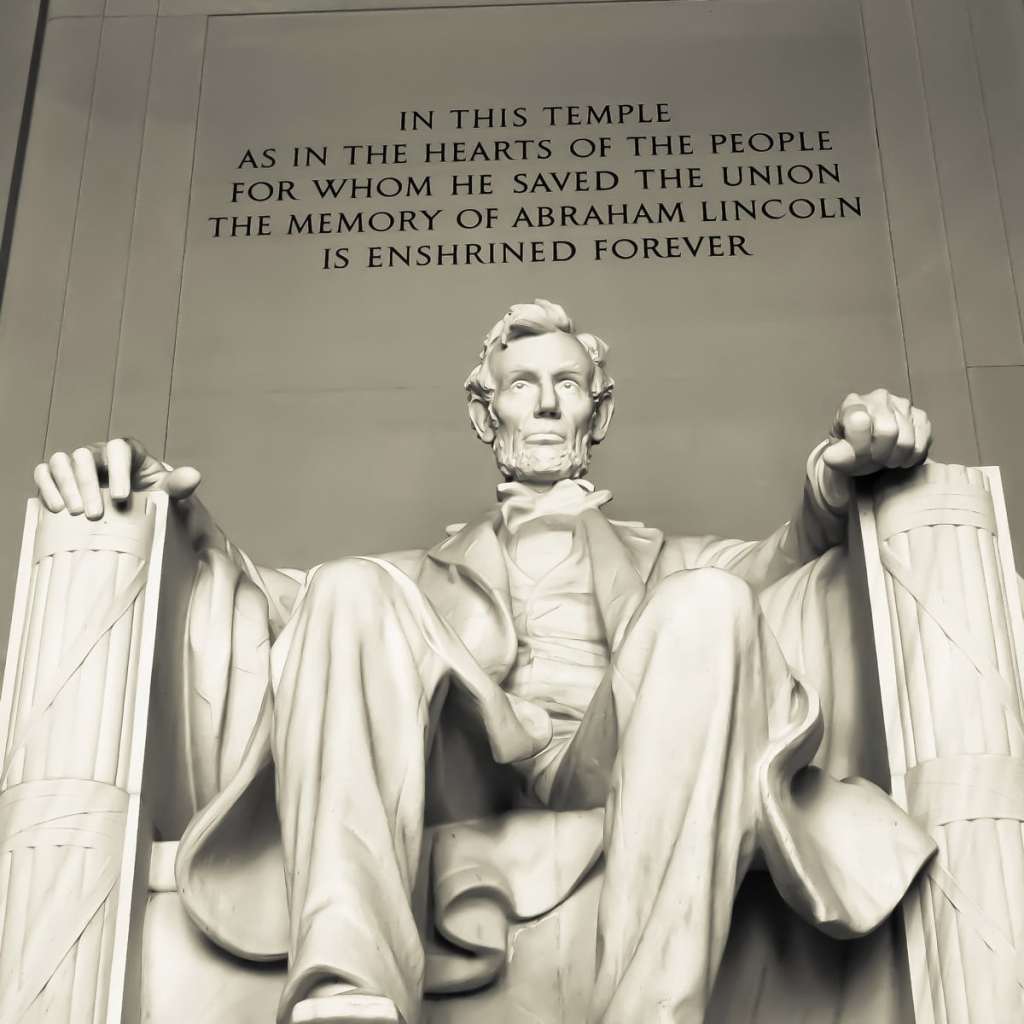
Somewhere I’ve read about a government of the people, by the people, for the people. We had better find it or reinvigorate it before it perishes from the earth.
A friend sent along a story from The Intercept about a spoiled corporate Democrat running for the Senate in Wisconsin. The article’s title reads like satire but it’s all-too-telling of our American moment: Son of Wall Street Mogul Running for Wisconsin Senate Seat Was Pleasantly Surprised Milwaukee Is a Normal City: “What most surprised me,” said Alex Lasry, “is the fact that Milwaukee has all the same things as any city,” citing bars, restaurants, and an art scene.
Who knew Milwaukee was so sophisticated. Even an “art scene”! Alex Lasry sure has his finger on the pulse of the people. We need more Senators like him, moneyed and smug and elitist — and ignorant too. He’s perfect.
Some more details about the career arc of Alex Lasry, which is short and not bending toward justice:
Though he doesn’t note it in his bio, Lasry began as an intern at Goldman Sachs during college, while Lasry’s father was a major Goldman Sachs client. Marc Lasry was a bundler for Barack Obama’s 2012 presidential campaign, gathering $500,000 for his reelection, and he led a Wall Street effort to restore relations with the White House after the president mildly criticized the financial sector. His son then scored an internship in the White House in the Office of Public Engagement, run by senior adviser Valerie Jarrett, who was one of the White House’s key links to the CEO class. The White House gig was his first job out of college, and he rose through the ranks of the office. From there, he returned to Goldman Sachs as an analyst in their government affairs department.
More recently, Alex Lasry helped lead the effort to bring the Democratic National Convention to Milwaukee in 2020 as finance chair of the city’s host committee. Lasry was also in the news this month for getting his Covid-19 vaccine, though the state’s 69-year-old governor had yet to get his.
Vitally important people like Lasry, who’s 33 years old, obviously need the Covid vaccine and pronto. I’m 57 and my wife and I joke that our scheduled date for the Covid vaccine is the 12th of never. But, heck, who are we?
It’s sure nice to see the Democratic Party so focused on “everyday” people, as Hillary Clinton called them. There are few people more down to earth, more relatable, than Goldman Sachs royalty or those like Hillary who take their money.
And the Democrats wonder why so many Americans saw and continue to see a clown like Trump as a viable alternative. One thing you can say for Trump: as much as he lies, there is an honesty to him. He’s a rich blowhard who’s out for himself and he doesn’t care who knows it. Limousine liberals are more circumspect, or more hypocritical if we’re being blunt, which makes Trump’s naked greed seem strangely refreshing.
Finally, maybe America should be more honest with itself and just elect Senator Goldman Sachs, Senator Raytheon, Senator Walmart, Senator Lockheed Martin, Senator Monsanto, and so on. Then again, why should the puppeteers come out from behind the curtain when the senatorial puppets they control are dancing so prettily and obediently?
Addendum: Of course, examples of GOP senatorial hypocrisy are legion; consider this article by David Sirota. Ready for a third party, anyone?
Trump’s motto: In generals I trust. It didn’t work out so well for him. Or the country.
W.J. Astore
As the Senate prepares to acquit Donald Trump in his second impeachment trial, I thought it would be a good time for a quick look at his legacy on war and militarism. Trump’s fans like to say he started no new wars. But he was hardly a man of peace, and his legacy on war and militarism is almost entirely negative. Here, in no particular order, are my quick thoughts on this subject:
He boosted military spending and weapons sales. Trump basically bought off the military-industrial-congressional complex by throwing scores of billions of dollars its way while selling weapons around the world. It’s an old formula for U.S. presidents and it worked.
He boosted a militant nationalism vis-a-vis rivals and even traditional allies. Trump was no friend to Russia and aggravated relations with China. Relations with NATO allies were also aggravated as he pressured them to spend more on weapons and wars.
He boosted militarism at home and specifically with police forces. Trump supported and encouraged violent police crackdowns of BLM activists. He called for the deployment of active duty military in the streets of Washington, DC. He even called for a massive military parade (which never happened).
He boosted overseas bombing and drone strikes. Recall the use of MOAB in Afghanistan, or Trump’s missile strike against Syria, and increased bombing in Afghanistan.
He boosted tensions with Iran nearly to the breaking point. Trump’s drone strike against Iranian general Qasem Soleimani was an act of war; harsh economic sanctions and withdrawal from the Obama-era nuclear treaty with Iran also heightened tensions.
He boosted the chances of nuclear war in the future. Trump was a fan of nuclear weapons; he seems to think of them simply as bigger, mightier bombs. His pursuit of “smaller” tactical nuclear warheads and their deployment on Trident-class nuclear submarines increase the possibility of nuclear war in the future.
He boosted economic sanctions against Venezuela while pursuing a coup. Trump knows Venezuela has vast oil reserves. Why not overthrow their government and take their oil? That was Trump’s policy, more or less. (It doesn’t appear to have changed under Joe Biden.)
Creation of a Space Force. Yet another military competitor for U.S. taxpayer dollars, even as space itself becomes another sphere for the U.S. military to “dominate.”
Failure to end wars that he promised to end. Trump was talked out of ending the war in Afghanistan by generals like James Mattis and H.R. McMaster. Ending such wars was a promise Trump foolishly abandoned.
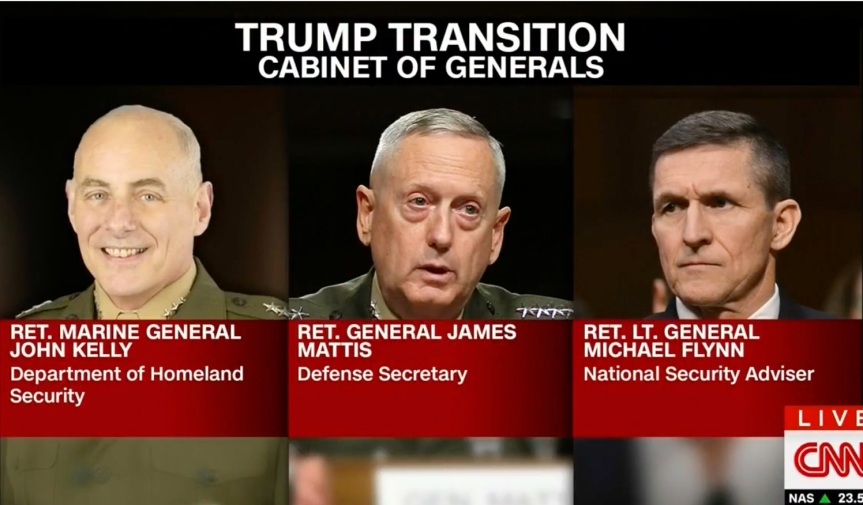
Reliance on Generals as wise men. Trump, overall a weak and vainglorious man, surrounded himself with generals like Mattis, McMaster, John Kelly, and (briefly) Michael Flynn. Thus he got narrow-minded war-mongering advice.
Seeing the world as a zero-sum game of winners and losers and debasing the art of diplomacy. Putting Mike Pompeo in charge of the State Department was a new low in the pursuit of peace through diplomacy.
Aiding genocide in Yemen while kowtowing to Israel and Saudi Arabia: Trump was a willing participant to genocide in Yemen while pursuing a “peace” plan with Israel that was totally one-sided vis-a-vis the status and rights of Palestinians.
Off the top of my head, that’s my top twelve of Trump’s legacies in this arena. What do you think, readers? Can you think of others? And will any of this really change under Joe Biden?
A shining example of awesome splendor and timeless exceptionalism
W.J. Astore
A Few Heretical Thoughts as America Celebrates Itself
Back in the days of the Cold War with the Soviet Union, most Americans took pride in not being like the USSR, or our image of the USSR. We, the USA, were not a militaristic empire. We, the USA, didn’t have state propaganda. We, the USA, took in Soviet dissidents who spoke out against state abuses of power and for personal freedoms. We, the USA, didn’t have old sclerotic leaders who were simply figureheads for elites. We, the USA, didn’t have military forces in the streets to maintain order. And so forth.
I was thinking about this today because Trump didn’t pardon Edward Snowden, whose only sanctuary is Russia. I was thinking about this today because some of the more interesting shows with critical coverage of the USA are on RT, a Russia-owned network. (I’m thinking here of shows hosted by Jesse Ventura and Chris Hedges. Their outspoken criticism and honesty is rarely heard on America’s mainstream media networks.) I was thinking today of a mainstream media that’s celebrating the inauguration of an aging man, Joe Biden, who’s visibly in decline and who is a tool for the establishment. I was thinking today of the nation’s capital that resembles an armed and fortified camp for a “peaceful” transference of power.
These are uncomfortable thoughts, I know.
Similarly, my wife and I were joking this morning about what the Washington Football Team should call itself, now that the “Redskins” has finally been rejected as impolitic and inappropriate. An innocuous name like the Washington Monuments came to mind. But if we wanted to be more honest, how about the Washington Lobbyists? The Washington Bullies? Or the Washington Awesome Splendor of Timeless Exceptionalism (WASTE)?
The idea for the latter name came from a recent statement the Trump administration released in support of a “Garden of American Heroes.” Here’s a sample of the rhetoric:
The garden’s purpose is “to reflect the awesome splendor of our country’s timeless exceptionalism.”
The garden of heroes “is America’s answer to [a] reckless attempt to erase our heroes, values and entire way of life. On its grounds, the devastation and discord of the moment will be overcome with abiding love of country and lasting patriotism. This is the American way.”
A garden of heroes is a perfect antidote to “a dangerous anti-American extremism that seeks to dismantle our country’s history, institutions and very identity.”
So, what Trump was saying is that America’s main enemy is “a dangerous anti-American extremism” that’s seeking to destroy our very identity. Meanwhile, anti-Trump forces are similarly arguing that Trump and his minions represent a dangerous anti-American extremism that’s out to destroy our way of life. Not much room for compromise and unity here, is there?
The Soviet Union collapsed in part due to internal tensions and disorder, massive military spending, and lost wars. A sclerotic leadership was incapable of changing course, and by the time the empire attempted to change course with Gorbachev, it was too late for restructuring and openness.
Is it already too late for the USA? Or does today’s pomp and ceremony promise a new beginning? Readers, what do you think?
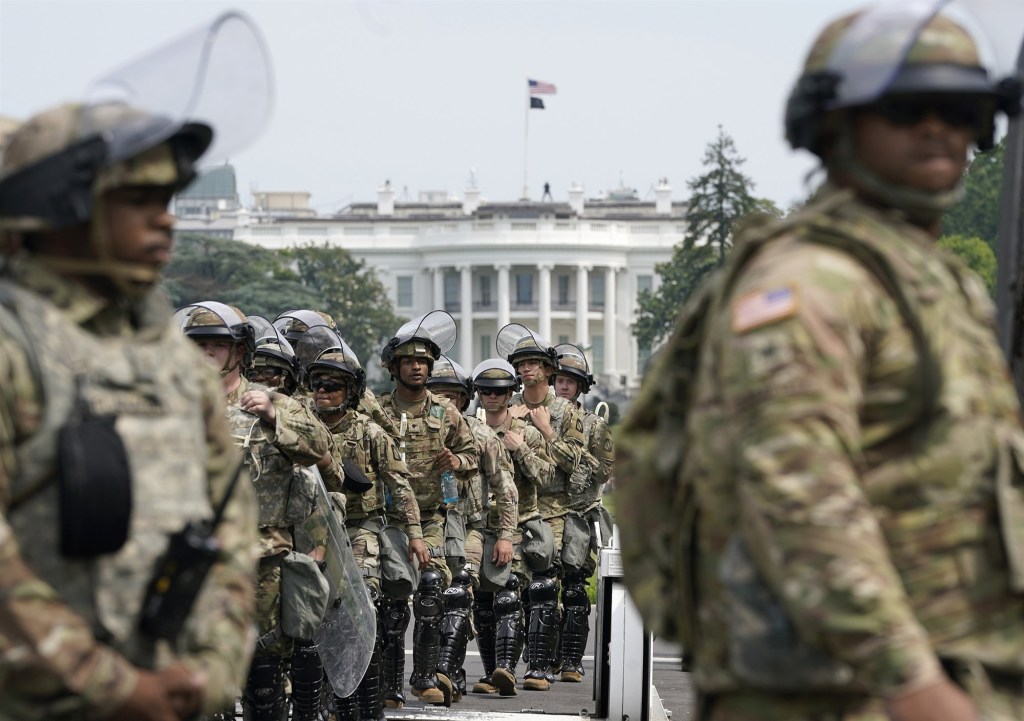
An increasingly common sight. This image is from the BLM protests in June. Note the POW/MIA flag below the American flag.
W.J. Astore
Remember when Trump said he wanted a military parade on the streets of Washington, D.C.? Looks like his dream’s come true, as the streets of Washington are filled with troops in preparation for Biden’s inauguration.
Biden’s message is supposed to stress “unity.” But unity for what? For single-payer universal health care? For an end to wars in Afghanistan, Iraq, and elsewhere? For much higher wages for workers? For a Green New Deal? “Unity” for “normalcy” is empty rhetoric of the worst kind. We need unity for policies that help the most vulnerable among us.
Republicans play to and favor their base. Democrats demobilize and betray their base.
Those rioters who stormed the Capitol — are they all lost causes? What would have happened if Obama had actually been a Progressive in 2008? What would have happened if Sanders had run against Trump in 2016? What I mean is this: Trump is offering a vision (even though it’s a lie) to his followers that mobilizes them. They want to “take back America,” but for the wrong reasons. What if Obama or Sanders (or someone like them) had offered a Progressive vision to “take back America”? But of course any meaningful economic reforms are blocked by the owners and donors of both parties, hence protest and its energy can be seized and directed in dark channels by charlatans like Trump.
Remember the old days when rulers — at risk of being killed or captured — led their troops into combat? And, if they refused to lead, were dismissed as cowards? We’re not living in those days.
Trump is the kind of schoolyard bully who instigates a fight but then stands on the sidelines, cheering and sneering until the teacher comes, after which he smirks and says, “It wasn’t me.”
I know 74 million Americans voted for Trump. But not all of them voted for all of the Trump circus. Many Republicans and Democrats are tribal voters — they’ll vote for their candidate no matter who he is and what he’s done. And I don’t blame all Trump voters for sticking with him when I consider the alternative choice of Joe Biden, a career pol who failed so miserably when he ran for president back in 1988 that he became a laughingstock in his own party.
I can only hope that Biden has learned something since 1988, when he stole speeches from Neil Kinnock and Bobby Kennedy and bragged he graduated near the top of his class on a full scholarship while winning a political science award. Fact is, he graduated near the bottom of his class on a half scholarship and won no such award. He also boasted about his IQ. He further falsely claimed to have participated in civil rights demonstrations and activism in the 1960s. (Bernie Sanders, by contrast, was arrested for his civil rights activism in the 1960s.)
More recently, Biden falsely claimed he’d been arrested while trying to see Nelson Mandela. In short, “alternative facts” won’t die when Trump leaves office.
All this is to say that Joe Biden is a typical politician, only more so. As Jimmy Dore says, politicians are not your friends; they are supposed to be public servants. It’s up to us to hold them to account, not to cheer for them. And if the Democratic party refuses to serve the people — as it likely will — a third party may be the only alternative.
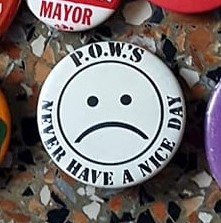
The political button in question (Photo by Tori LaGarde)
W.J. Astore
I wrote my latest article for TomDispatch.com (below) before the Capitol riot, adding a quick reference to it at the last minute in the first paragraph. Events at the U.S. Capitol as well as other recent violent events in America lend credence to the idea we’re all prisoners of war of a sort. Global wars may be invisible to most Americans, but domestic ones are all too plain to see. How do we make our “great escape” from a culture of incessant violence and permanent war?
“POWs Never Have A Nice Day.” That sentiment was captured on a button a friend of mine wore for our fourth grade class photo in 1972. That prisoners of war could never have such a day was reinforced by the sad face on that button. Soon after, American POWs would indeed be released by their North Vietnamese captors as the American war in Vietnam ended. They came home the next year to a much-hyped heroes’ welcome orchestrated by the administration of President Richard Nixon, but the government would never actually retire its POW/MIA (missing-in-action) flags. Today, almost half a century later, they continue to fly at federal installations, including the U.S. Capitol as it was breached and briefly besieged last week by a mob incited by this country’s lame-duck president, ostensibly to honor all U.S. veterans who were either POWs or never returned because their bodies were never recovered.
Remembering the sacrifices of our veterans is fitting and proper; it’s why we set aside Memorial Day in May and Veterans Day in November. In thinking about those POWs and the dark legacy of this country’s conflicts since World War II, however, I’ve come to a realization. In the ensuing years, we Americans have all, in some sense, become prisoners of war. We’re all part of a culture that continues to esteem war, embrace militarism, and devote more than half of federal discretionary spending to wars, weaponry, and the militarization of American culture. We live in a country that leads the world in the export of murderous munitions to the grimmest, most violent hotspots on the planet, enabling, for example, a genocidal conflict in Yemen, among other conflicts.
True, in a draft-less country, few enough Americans actually don a military uniform these days. As 2021 begins, most of us have never carried a military identification card that mentions the Geneva Convention on the proper and legal treatment of POWs, as I did when I wore a uniform long ago. So, when I say that all Americans are essentially POWs, I’m obviously using that acronym not in a legal or formal way, but in the colloquial sense of being captured by some phenomenon, held by it, subjected to it in a fashion that tends to restrict, if not eliminate, freedom of thought and action and so compromises this country’s belief in sacred individual liberties. In this colloquial sense, it seems to me that all Americans have in some fashion become prisoners of war, even those few “prisoners” among us who have worked so bravely and tirelessly to resist the phenomenon.
Ask yourself this question: During a deadly pandemic, as the American death toll approaches 400,000 while still accelerating, what unites “our” representatives in Congress? What is the only act that draws wide and fervent bipartisan support, not to speak of a unique override of a Trump presidential veto in these last four years? It certainly isn’t providing health care for all or giving struggling families checks for $2,000 to ensure that food will be on American tables or that millions of us won’t be evicted from our homes in the middle of a pandemic. No, what unites “our” representatives is funding the military-industrial complex to the tune of $740.5 billion in fiscal year 2021 (though the real amount spent on what passes for “national security” each year regularly exceeds a trillion dollars). Still, that figure of $740.5 billion in itself is already higher than the combined military spending of the next 10 countries, including Russia and China as well as U.S. allies like France, Germany, and the United Kingdom.
Not only that, but Congress added language to the latest defense bill that effectively blocked efforts by President Trump before he leaves office on January 20th to mandate the withdrawal of all troops from Afghanistan (and some troops from Germany). Though it’s doubtful he would have accomplished such goals anyway, given his irresolute nature, that Congress worked to block him tells you what you need to know about “our” representatives and their allegiance to the war complex.
That said, an irresolute Trump administration has been most resolute in just one area: selling advanced weaponry overseas. It’s been rushing to export American-made bombs, missiles, and jets to the Middle East before turning over government efforts to shill for America’s merchants of death to President Joe Biden and his crew of deskbound warriors.
Speaking of Biden, that he selected retired General Lloyd Austin III to be his secretary of defense sends the strongest possible signal of his own allegiance to the primacy of militarism and war in American culture. After all, upon retiring, General Austin promptly cashed in by joining the board of directors of United Technologies from which he received $1.4 million in “stock and other compensation” before it merged with giant weapons-maker Raytheon and he ended up on the board of that company. (He holds roughly $500,000 in Raytheon stock, a nice supplement to his six-figure yearly military pension.)
How better than selecting him as SecDef to ensure that the “military” and the “industrial” remain wedded in that famed complex? America’s secretary of defense is, of course, supposed to be a civilian, someone who can exercise strong and independent oversight over America’s ever-growing war complex, not a lifelong military officer and general to boot, as well as an obvious war profiteer.
War Is Peace
As Quincy Institute President Andrew Bacevich so aptly put it, “many Americans have made their peace with endless war.” Within America’s war culture, peace activists like Medea Benjamin and organizations like Veterans for Peace are seen as not just “radical,” but genuinely aberrant. Meanwhile, an unquestioning acceptance of the fact that this country is now eternally at war across significant parts of the planet is considered normal, even respectable. Certainly, not something to put real time or thought into considering.
As a result, warmongers like former Trump National Security Advisor John Bolton are touted in some quarters as hard-headed realists. In seeing the world as a hostile place that Americans need to (but somehow, almost 20 years later, can’t) dominate means their heads are screwed on straight, unlike those screwy thinkers who advocate for peace. But as Dorothy Day, the Catholic peace activist, once said: “Our problems stem from our acceptance of this filthy, rotten system.”
That Americans mostly refuse to see permanent war as filthy and rotten, or to think much about it or the “defense” budget that goes with it showcases the triumph of a broader war culture here. Whereas this country’s profligate and prodigal military complex has given us stunning failure after stunning failure overseas (just consider all those disastrous efforts to win “hearts and minds” from Vietnam to Afghanistan to Iraq and on and on), it has proved stunningly successful in winning — or at least taming — hearts and minds in the homeland. How else to explain the way those trillion-dollar-plus “national security” budgets are routinely rubber-stamped by Congress with hardly a murmur of protest?
In the twenty-first century, Americans are suffering a form of cognitive capture in which war has become the new normal. As an astute reader at my blog, Bracing Views, put it: “Our desire to live without war is held in a stockade, and every day that we wake up and walk out into the yard that understanding is being broken down by the powerful monied elites.”
In America’s collective stockade of the mind, activism for peace is an aberration, while acceptance of the war state is second nature. Small wonder that Biden’s proposed cabinet and administration features so many neocon-style policymakers who made their peace with war, whether in Iraq and Afghanistan or Libya and Syria (Antony Blinken as secretary of state; Jake Sullivan as national security advisor; retired general Lloyd Austin as secretary of defense; and Avril Haines as director of national intelligence). Biden’s hawkish picks avidly place their faith in U.S. military power. And they will be advising a new president, who once supported war in Iraq himself and talks not of reducing “defense” spending but of boosting it.
Perhaps you’ve noticed, in fact, how every president from George W. Bush in 2001 on has been proud to pose at some point as a “wartime” president. Perhaps you’ve noticed as well that this country can’t or won’t close Gitmo, the detention facility at Guantanamo Bay, Cuba, flooded with prisoners from the global war on terror beginning late in 2001, men who will likely be imprisoned until death does us part.
Perhaps this is why the U.S. government “tortured some folks,” as President Obama put it in 2014, and abused Iraqi prisoners at Abu Ghraib in Iraq. (Avril Haines, Biden’s proposed national intelligence director, once helped suppress evidence of just such abuse and torture.) Perhaps this is why every president starting with George W. Bush has unapologetically smited evildoers around the world via robotic assassin drones. (Remember, the drone assassination of Iranian Major General Qasem Suleimani at Baghdad International Airport by one Donald J. Trump?) Perhaps this is also why U.S. bombing never seems to stop and those wars never end, even when a president comes into office promising that they will. After all, it’s so empowering to be a “wartime” president!
In his novel 1984, George Orwell put it simply enough when he coined the slogan “war is peace” for his fictional dystopian society. Randolph Bourne put it no less simply when, during World War I, he explained that “war is the health of the state.” Rosa Brooks, who worked at the Pentagon, put it bluntly when she titled her 2016 book How Everything Became War and the Military Became Everything. What we have in America today is warfare as welfare, a form of man-made disaster capitalism, profitable for a few at the expense of the many.
Say it again: We are all POWs now.
The Time I Met a Real POW
In the early 1990s, when I was a young captain in the U.S. Air Force, I served as an escort officer for Brigadier General Robinson Risner. It’s not too much to say that Risner is held in awe in the Air Force. A skilled fighter pilot and Korean War ace, he was a colonel and on the cover of Time magazine in 1965, just as the Vietnam War was ramping up, after which he was shot down and became a POW. He later wrote The Passing of the Night, a harrowing account of the seven years he spent as a prisoner in the “Hanoi Hilton,” the sardonic name American POWs gave North Vietnam’s Hoa Lo Prison.
What sustained Risner through torture and those years of captivity was his Christian faith and patriotism. I vividly recall a talk he gave at the Air Force Academy about his experiences and how that faith of his had sustained him. I’ve never heard a more vivid evocation of the spirit of duty, honor, and country sustained by faith in a higher power. I was proud to have a photo taken with General Risner, as we stood next to the trophy named after him and annually awarded to the top graduate of the Air Force’s Weapons School, the AF’s Top Gun, so to speak.
Risner was gracious and compelling, and I was humbled to meet a POW who’d endured and overcome as much as he had. Yet, back then (to be honest), I never gave a thought to his actions as a fighter pilot leading bombing missions during Operation Rolling Thunder in Vietnam. Since the U.S. government had chosen not to officially declare war against North Vietnam, whether his missions were even legal should have been open to question. Lacking such an official declaration, one could argue that Risner and U.S. POWs like him did not enjoy the legal protections of the Geneva Convention. Using American terminology today, Risner might then have been termed an “enemy combatant” to be held indefinitely, as the U.S. today holds captives at Guantanamo Bay in Cuba, POWs who have little hope of ever being released.
To your average American captured by U.S. war culture, objections here are easy. Of course, Risner’s bombing missions were legal. Of course, he deserved to be recognized as a POW and treated decently. America never goes to war without righteous cause, in this case the containment of Communism by any means short of nuclear weapons. The North Vietnamese saw it differently, however, perhaps because it was they who were being bludgeoned and flattened by U.S. military power.
My point is neither to praise Risner nor to bury him. Rather, it’s to bury war and the culture that breeds and then feeds on it. The more Americans facilitate war (largely by ignoring it and so giving it our tacit approval), the more Washington funds it, the more other people die because of “our” wars and “our” weaponry, the more this country becomes a POW nation writ large.
My Friend’s Button Again
Remember my friend’s button, the one that insisted POWs never have a nice day? As a POW nation writ large, it should apply to all of us. America won’t have a nice day again until it extricates itself from war in all its manifestations. There will be no nice day until Congress stops funding munitions makers and starts seeking peace and helping the sick and poor. There will be no nice day until Americans hate war with all the passion now saved for “patriotic” flag waving. There will be no nice day until presidents bless peacemakers instead of beseeching God to protect the troops.
So, the next time you see a POW/MIA flag outside a federal building, don’t dismiss it as a relic of America’s past. Think about its meaning and relevance in an era of constant global warfare and colossal military spending. Then, if you dare, ask yourself if you, too, are a POW of sorts — not in the strictly legal sense that applies to formal militaries in declared wars, but in the sense of this country being captured by war in all its death, destruction, and despair. And then ask yourself, what does America have to do, collectively, to break out of the POW camp in which it’s imprisoned itself?
Upon that question hinges the future of the American republic.
Copyright 2021 William J. Astore
Many thanks to UTEJACK for the “stockade” quote and the inspiration. Many thanks to Tori LaGarde for identifying the POW button in the 4th grade photo — and for the inspiration as well.
It wasn’t exactly the storming of the Bastille or the sack of Rome, but yesterday’s scenes from the Capitol were disturbing enough to the self-avowed “most exceptional nation.”
If only the mob of protesters had shouted “We want affordable health care for all!” or “Racial equality!” or “Peace now!” or “Money for the poor!” instead of “USA! USA!” and “Trump! Trump!” as they marched through the Capitol on Wednesday.
But I suppose protesters who shout for health care, racial equity, and peace get clubbed and gassed, whereas Trump supporters by comparison get handled with kid gloves.
Trump, the law and order man, has always been unlawful, a man of disorder. As I wrote early in 2016, Trump disqualified himself from the presidency with his empty and dictatorial boasting. That he would incite a mob to gather at the Capitol to contest the election result was hardly surprising. What is surprising is how the Trump mob so easily breached the Capitol’s defenses, such as they were. In at least one case, it appears the police removed a barricade and let the pro-Trumpers in. Someone should be fired for this national humiliation.
It’s a small miracle that only one person was killed, an Air Force veteran who was reportedly shot in the neck as she tried to break into an inner chamber room. An avid Trump supporter who’d traveled from California, she’d be alive today if not for Trump’s selfish and reckless call for a protest at the Capitol.
Of course, predictable calls for Trump’s impeachment are coming from Squad members like AOC and Rashida Tlaib. Really. In two weeks, Trump leaves office. And you want to squander energy and time in yet another unsuccessful attempt to impeach him. At the same time, you won’t even fight for a vote on Medicare for all.
Once again, America will likely take the wrong lessons from these riots. The Capitol police will likely call for more money, more resources, more officers, more guns, more security cameras, more barricades, etc. There are already calls for more Internet censorship. Homeland Security funding will surely get a boost. And certain people will dismiss too easily the alienation and indignation of Trump supporters.
What I mean is this: Americans are upset. Angry. Alienated. Confused. And rightly so. And until our government serves the people instead of corporate, financial, and similar lobbyists and special interests, the potential for future mobs will remain. Donald Trump is a total buffoon, a shell of a man, a narcissist with ambitions centered always on himself and his self-image. But imagine a more skilled manipulator, one less narrowly focused on himself, one with a stronger work ethic, one with boundless ambition for power. Such a person could truly lead an insurrection or coup, and yesterday’s scenes suggest such a takeover would be easier than we think.
The answer is not more guns, more security, more police, nor is it impeachment. The answer is a government accountable to the people and for the people. If we don’t want our government to perish from this earth, it needs to be of the people, by the people, for the people. But it’s not, and until it is, a repeat of yesterday’s scenes, but on a much larger and more violent scale, will remain a possibility.
Who wouldn’t want a “Speaker of the House” podium?
So far, 2021 is looking much like 2020. Nancy Pelosi is once again Speaker of the House, with progressive leaders like AOC extracting no meaningful concessions for their votes. Jimmy Dore had suggested progressives could use their leverage over Pelosi to force a vote in the House on Medicare for All, but of course the progressives caved and cravenly supported Pelosi, who like Joe Biden is against Medicare for All.
America, you will never get a single-payer, publicly-funded, health care system. If you can’t even get a vote on one during a pandemic that will soon kill 400,000 Americans, you will never get a vote. America’s health care system is a wealth-extraction system that profits off the sick and dying. That system simply will not change because politicians like Pelosi and Biden are bought and paid for. Short of a revolution or a truly progressive third party, Americans will continue to suffer bankruptcy and death due to our for-profit wealth-care system that puts profit before patients.
Trump, meanwhile, is conspiring along with a dozen or so sycophantic senators to contest the election he lost. Trump, who has the virtue of saying the quiet part out loud, pressured the Georgia secretary of state to “find” about 12,000 votes for him so that he could be declared the winner. This circus is the lead story in U.S. media today, as if Trump has finally put his foot in it. But he’ll soon pardon himself, I’d wager, and even if he doesn’t the incoming Biden administration won’t do anything to prosecute him on any charge.
In other news, Americans will have to be satisfied with means-tested $600 checks (don’t spend that all in one place), instead of the $2000 checks that Trump advocated for. Interesting, that princess of virtue, Nancy Pelosi, was perfectly satisfied with $600 checks until Trump demanded $2000. Only then did Pelosi mount a weak effort for the higher figure, which was quickly killed by Scrooge himself, Mitch McConnell. Suck on that, America.
Speaking of Trump failures and revealing moments in Congress, Trump’s veto of the NDAA (the Pentagon budget) was easily overturned, as America’s representatives professed their bipartisan support of “our” troops. I’ll believe in that “support” when Congress finally acts to end America’s disastrous wars overseas. Perhaps on the twelfth of never?
Finally, it was good to hear that Julian Assange will not be extradited to the U.S., though the judge’s ruling in the UK was made on the narrow grounds that the U.S. prison system is so oppressive that Assange would likely commit suicide here, given his current mental state. Of course, the U.S. government doesn’t care that much about prosecuting and imprisoning Assange. Assange, like Chelsea Manning, Reality Winner, and other whistleblowers, has been made an example of. This is all about intimidation of journalists and other potential whistleblowers, and it’s working.
Readers, what’s caught your eye in the opening week of 2021?
Why will this man be happy when Trump vetoes the NDAA?
W.J. Astore
President Trump says he will veto the NDAA that funds the Pentagon at $740 billion for FY 2021. Congress appears to have the votes to override his veto.
What caught my eye was part of Trump’s rationale for the veto: China. China will apparently be outraged when Trump vetoes the bill. Here’s the report (from the Guardian):
Trump says he will veto defense bill
Donald Trump once again said he intends to veto the annual defense authorization bill, setting up a potential veto override by Congress.
“I will Veto the Defense Bill, which will make China very unhappy,” the president said in a tweet. “They love it. Must have Section 230 termination, protect our National Monuments and allow for removal of military from far away, and very unappreciative, lands. Thank you!”
We just witnessed four years of red-baiting by the Democrats against the Republicans and Trump (“Moscow Mitch”?) with Russia as the Bad Red Guy. Prepare for four years of red-baiting by Republicans against the Democrats and Biden (“Hunter, Made in China”?) with China as the Bad Red Guy. The winner: the military-industrial complex. The loser: the American people, and perhaps the world.
Actually, Trump has a point about the NDAA inhibiting his ability to pull troops out of Iraq and Afghanistan. It’s too bad he didn’t focus on that and the issue of bipartisan support of endless wars.
But he had to hit the China gong, and it will resound loudly in the coming years. You know what they say about payback, Democrats …
Trump lost the election more than Biden won it. Trump lost mainly because of the pandemic and the economy. Biden ran on little other than “not being Trump” and squeaked by on that weak message. Sure, he’s president, but he has no mandate.
74 million Americans didn’t vote for Trump solely because he’s racist, sexist, bigoted, and ignorant. Sure, some of them voted due to White supremacy and so on, but some pro-Trump votes reflect the bankruptcy in ideas from Biden/Harris. The Democrats simply offered little to the working class, e.g. the total rejection of Medicare for All during a pandemic. Biden was quoted as saying nothing would fundamentally change in his administration. How’s that for inspiration?
To establishment Democrats like Biden, the Republicans may be rivals but Progressives are the real enemy. So far, Biden’s announced staff and cabinet has zero Progressives in it. “Diversity” for Biden and the DNC does not include diversity in policy views. “Good” policies are those that favor the donors and owners. Anyone to the left of Biden need not apply.
If the Democratic Presidential primaries taught us one thing, it’s that voters have no say. The DNC has the only say, and they pick the candidate who will best protect their sinecures, in this case Joe Biden. Voters were told, take him or vote for Trump. Or go pound sand.
The DNC exists to defeat Progressive challengers like Bernie Sanders and Tulsi Gabbard. Both Sanders and Gabbard refused big cash from big donors, and that is simply not allowed. A “respectable” candidate must be beholden to the big donors, else the DNC simply won’t support you. Indeed, it will do most anything to stop you.
Surely one of the most despicable acts I’ve seen in politics was the smearing of Tulsi Gabbard as a Russian asset by NBC News and Hillary Clinton. They essentially denounced an Army major and Congresswoman as a traitor, or at the very least a useful idiot, a tool of the Kremlin. What was Tulsi’s main message again? Oh, she was against America’s wasteful and wanton regime-change wars.
The big winners of the 2020 election were predictable: Big pharma, private health insurance companies, the military-industrial complex, fossil fuel companies, and so on. Biden/Harris will continue to serve their interests.
When the senior leaders are Biden, McConnell, and Pelosi, you know Washington is bereft of new ideas and innovative leadership.
Even more ignored than climate change in this election was any serious talk of ending America’s wars overseas. Look for them to continue at least until 2024.
America remains a country of two parties: A Republican Party increasingly in Trump’s mold, and a Republican-lite Party (otherwise known as Democrats) in service to business and the moneyed interests. In a “pay to play” system, how could it be otherwise? The results of 2020 prove America needs a new party. Call it the Workers’ Party, the Progressive Party, the People’s Party, what-have-you, but recognize that, without campaign finance reform and public funding of elections, 2024 is likely to produce yet another round of a Trumpist candidate against a DNC corporate tool/Republican-lite. And they dare call it “choice”!