The Biggest National Security Threats

694940094001_5677950187001_5677904359001-vs
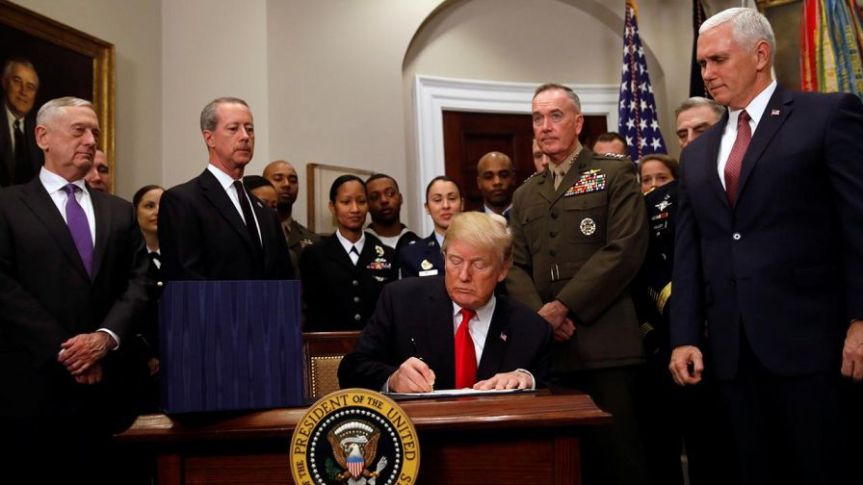
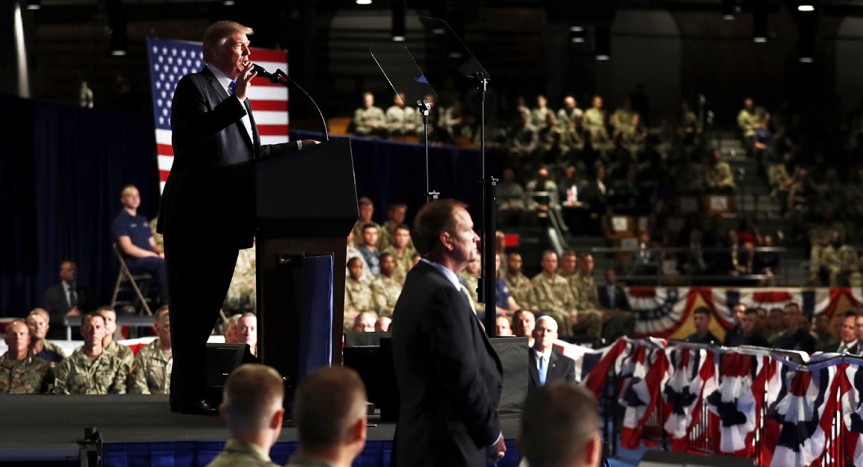
Trump, surrounded by the military, vows to give it more (and more!) money

W.J. Astore

Today at 2PM, the Trump administration releases its National Security Strategy.  It’s already making news because Trump is dropping climate change (added by the Obama administration) as a threat.  Instead, Trump is placing new emphasis on economic competitiveness and border security (“Build the wall!”), which are two corporate-friendly policies (read: boondoggles).

I’d like to cite two threats that Trump won’t mention in his national security strategy.  These two threats are perhaps the biggest ones America faces, and they are related.  The first is threat inflation, and the second is the U.S. military itself, as in Dwight D. Eisenhower’s military-industrial-Congressional complex.

Threat inflation is a huge problem in America.  The threat of terrorism is vastly inflated, as is the threat from North Korea.  If we wanted to focus on what threatens Americans, we’d be redoubling efforts to help those with opioid addictions even as we work to cut deaths by guns and in road accidents.  Roughly 120,000 Americans are dying each year from opioid overdoses, road accidents, and shootings.  How many are dying from terrorism or from attacks by North Korea?

North Korea is a weak regional power led by an immature dictator who is desperate to keep his grip on power.  Kim Jong-un knows that any use of nuclear weapons by North Korea would end in his death and the annihilation of his country.  He also knows that nuclear weapons serve as a deterrent and a symbol of prestige domestically and internationally.  Does he need to be deterred?  Yes.  Should Americans cower in fear?  Of course not.

Cyberwar is certainly a threat–just look at Russian meddling in our last presidential election.  China and Russia are nuclear powers and rivals that bear close watching, but they are not enemies.  Indeed, since the end of the Cold War the United States hasn’t faced serious peer enemies.  We should have been cashing in our “peace dividends” for the last 25 years.  Why haven’t we?

Enter the military-industrial-Congressional complex.  Ike warned us about it in 1961.  He warned about its misplaced power, its persistence, and its anti-democratic nature.  Ike, a retired five-star general who led the allied armies on the Western Front in World War II against the Nazis, knew of what he spoke.  He knew the Complex exaggerated threats, such as missile or bomber “gaps” (which didn’t exist) vis-a-vis the Soviet Union.  Ike knew the military, its corporate feeders and enablers, and Congress always wanted one thing: more.  He did his best to control the military, but once he left office, it was the Complex that took control, leading America into a disastrous war in Vietnam, the first of many “wars of choice” that ended in American defeats, but which proved highly profitable to the Complex itself.

Those endless wars that feed the Complex persist today.  Elements of the U.S. military are deployed to 149 countries and 800 foreign bases at a budgetary cost of $700 billion (that’s just for the “defense” budget).  Spending so much money on the military represents a tremendous opportunity cost–for that money, Americans could have free health care and college tuition, but who wants good health and a sound education, right?

Ike recognized the opportunity cost of “defense” spending in 1953 in this famous speech:

Every gun that is made, every warship launched, every rocket fired signifies, in the final sense, a theft from those who hunger and are not fed, those who are cold and are not clothed.

This world in arms is not spending money alone. It is spending the sweat of its laborers, the genius of its scientists, the hopes of its children. The cost of one modern heavy bomber is this: a modern brick school in more than 30 cities. It is two electric power plants, each serving a town of 60,000 population. It is two fine, fully equipped hospitals. It is some fifty miles of concrete pavement. We pay for a single fighter with a half-million bushels of wheat. We pay for a single destroyer with new homes that could have housed more than 8,000 people. . . . This is not a way of life at all, in any true sense. Under the cloud of threatening war, it is humanity hanging from a cross of iron.

What Ike said.  The point is not that Ike was a perfect man (look at the Iran coup, also in 1953), but he sure as hell was a sound and at times a penetrating thinker, a mature man who knew the awful burdens of war.

And now we have Trump, the opposite of Ike, an unsound and shallow thinker, an immature man who knows nothing of the awfulness of war.  Add Trump himself–his immaturity, his bellicosity, his ignorance, and his denial of reality–as a threat to our national security.

So, a quick summary of three big threats that won’t make Trump’s “strategy” today:

  1. Threat inflation: terrorism, North Korea, Iran, etc.
  2. The Complex itself and its profligate, prodigal, and anti-democratic nature.
  3. Trump.

And add back one more: climate change/global warming.  Because flooding, fires, droughts, famines, etc., exacerbated by global warming, are already creating security challenges, which will only grow worse over the next half-century.  Denying that reality, or calling it “fake news,” won’t change Mother Nature; she has her own implacable ways,

Trump, His Generals, and the Road to Authoritarianism

W.J. Astore

An article yesterday at NBC focusing on Trump and “his” generals got me to thinking on this subject again.  Its author, Suzanne Garment, suggests that Trump likes generals as obedient alpha males.  They lend him credibility without directly threatening his delicate ego.  And there’s truth in this.

trump generals
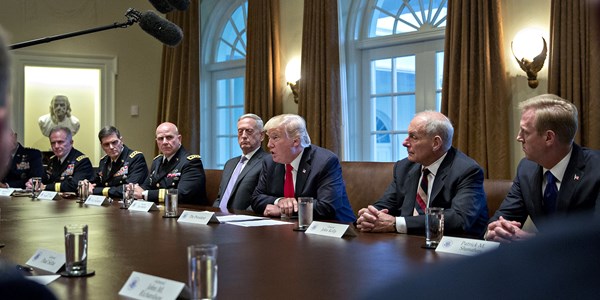
Trump and his generals.  Mattis and Kelly flanking Trump.  From the NBC article.

But I want to focus on other reasons for Trump’s preference for generals in high positions.  A year ago, I wrote an article for TomDispatch.com on “All the President’s Generals.”  That article focused mainly on the potential impact of these generals on America’s foreign policy and domestic culture.  As I wrote last December:

Collectively, the team of Mattis, Flynn, and Kelly could not be more symbolic of the ongoing process of subversion of civilian control of the military.  With Trump holding their reins, these self-styled warriors will soon take charge of the highest civilian positions overseeing the military of the world’s sole superpower.  Don’t think of this, however, as a “Seven Days in May” scenario in which a hard-headed general mounts a coup against an allegedly soft-hearted president.  It’s far worse.  Who needs a coup when generals are essentially to be given free rein by a president-elect who fancies himself a military expert because, as a teenager, he spent a few years at a military-themed boarding school?

In all of this, Trump represents just the next (giant) step in an ongoing process.  His warrior-steeds, his “dream team” of generals, highlight America’s striking twenty-first-century embrace of militarism.

I continue to think this is true.  Trump is empowering further military adventurism, even as he reinforces military-style solutions to problems.  But there are other reasons for Trump’s tight and eager embrace of the military.

Basically, by embracing the military and elevating it (while feeding it lots of money), Trump has neutralized it as a rival to his power.  Indeed, he is borrowing from the military’s authority and standing within our culture to bolster his own.

Recall how Candidate Trump was often quite critical of the U.S. military.  He knew more than the generals, he said.  Their wars he often called wasteful follies.  He was going to win (or end) these wars, he claimed, and hinted that quite a few “loser” generals might be on the receiving end of his infamous “You’re fired” line.

You hear none of this today. Trump is at pains to praise the military and his generals. He says they’re on a winning path, even in Afghanistan (because of Trump’s decisions, naturally).  He rewards them with record budgets and unalloyed praise.

And it’s working.  The military (and the larger national security state) is content with Trump.  He’s letting them have their way, which is another way of saying Trump is having his way.

In American society today, there aren’t too many power centers that truly can challenge Trump.  The media he’s diminished with all his attacks (“Fake news!”).  A Republican Congress remains quietly subservient.  Trump is stacking the judiciary with conservative judges to his liking.  The Democratic Party remains feckless and divided.  Bankers and corporations?  Trump has hired the former and given a huge gift to the latter in the latest Republican tax cut for the richest.

When you think about it, the one power center that could challenge Trump is the military-industrial complex: America’s fourth branch of government.  Yet by hiring so many of its generals and by praising it while passing loads of moola its way, Trump has co-opted its authority and power, attaching it to himself in his role as commander-in-chief.

Trump’s last hurdle may be the Robert Mueller investigation into Russian meddling and possible complicity or obstruction by Trump.  If Trump gets past this (perhaps even by firing Mueller), is there anyone left with the balls, the sand, the spine, the guts, the moxie (choose your favorite measure of fortitude) and the authority to stop his ambition and designs as an authoritarian leader?

Trump Talks About the Military as if It’s His Praetorian Guard

WGH-IR-03_PraetorianGuard
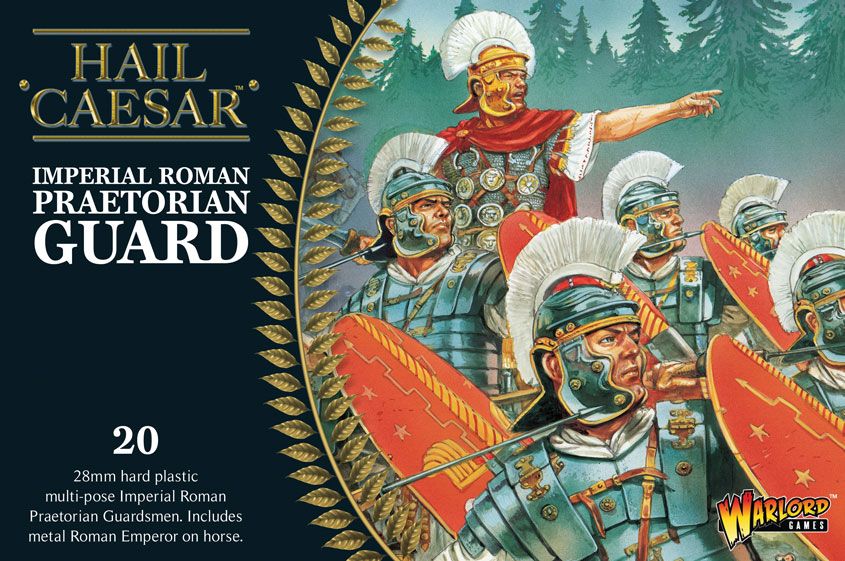
Hail Trump? Includes wannabe American Emperor in Golf Cart.

W.J. Astore

President Donald Trump has a disturbing way of talking about the U.S. military.  Consider the following Trump quotation about the recent attack on U.S. troops in Niger:

“I have generals that are great generals,” Trump said. “I gave them authority to do what’s right so that we win. My generals and my military, they have decision-making ability. As far as the incident that we’re talking about [in Niger], I’ve been seeing it just like you’ve been seeing it. I’ve been getting reports.” [emphasis added]

For Trump, it’s not the American people’s military, it’s “my” military.  Generals are not Congressionally-appointed officers, they’re “my” generals.  Trump has a fundamental misunderstanding of his role as commander-in-chief, as well as the role of the U.S. military.  He sees himself as the big boss of “his” military, with generals as his personal employees whom he can order around and fire at will.

And by “order around,” I mean the issuance of orders regardless of their legality, a point Trump made back in March of 2016, in response to a debate question by Bret Baier:

BAIER: Mr. Trump, just yesterday, almost 100 foreign policy experts signed on to an open letter refusing to support you, saying your embracing expansive use of torture is inexcusable. General Michael Hayden, former CIA director, NSA director, and other experts have said that when you asked the U.S. military to carry out some of your campaign promises, specifically targeting terrorists’ families, and also the use of interrogation methods more extreme than waterboarding, the military will refuse because they’ve been trained to turn down and refuse illegal orders.

So what would you do, as commander-in-chief, if the U.S. military refused to carry out those orders?

TRUMP: They won’t refuse. They’re not going to refuse me. Believe me.

BAIER: But they’re illegal.

TRUMP: And — and — and — I’m a leader. I’m a leader. I’ve always been a leader. I’ve never had any problem leading people. If I say do it, they’re going to do it. That’s what leadership is all about.

As I wrote then, Trump’s fundamental misunderstanding of leadership, and especially his boasts about the military obeying his orders irrespective of their legality, disqualified him as a presidential candidate.  Of course, Trump’s dictatorial statements didn’t deter his determined fans. Indeed, they elected him because they wanted a Strong Man, not because they feared one.

So here we are, with a dictator wannabe as president, treating the U.S. military as if it’s his personal Praetorian Guard.  If the Republic isn’t dead, its heartbeat is fading fast.  Meanwhile, the sordid and corrupt Empire of Trump – just by its endurance – grows ever stronger.

The Climate Change War

mothernature-pissed2
Mother Nature doesn’t care about your denials (Josh Addessi at Blogspot.com)

W.J. Astore

It seems Americans can’t rally support for something without declaring a “war” on it. The war on poverty. On drugs. On gangs and crime. On terror. And these wars have become open-ended, or “generational” in Pentagon-speak, with a dynamic of crisis-surge-“progress”-new crisis-new surge-repeat that sustains large bureaucracies and huge government spending.

To these “wars” we must add a new one, notes Michael Klare at TomDispatch.com: the climate change war.  As Texas and Florida were being clobbered by powerful hurricanes, the U.S. military and Homeland Security took the lead role in responding to these disasters, notes Klare.  Yet, even as the U.S. National Security State was mobilized to respond, identifying and seeking to mitigate a root cause of this “war” — the role global warming plays in exacerbating these storms — was and is very much forbidden by the Trump administration.

This is nothing new. As with so many other wars, the U.S. military is deployed to address symptoms rather than root causes. Worse than that, we often deny our own role in creating or worsening those root causes.

With respect to climate change, we Americans have made our choice. We’ve come to believe the advertising slogans that “we can have it all.” We’ve dismissed the dangers of wanton fossil fuel consumption, and indeed wanton materialism in general. Corporations have worked hard to persuade us that global warming might just be a hoax, or at the very least dodgy science. Many of us have willingly bought the message that coal is “clean,” that fracking along with new pipelines are safe and create jobs, even though it’s clean(er) energy like wind and solar that is the better job-creator.

Those are facts that lead me to a different “war” in America, the one being waged against truth.  Basic truths are denied (e.g. that human activity contributes to global warming) in the interests of profits enjoyed by powerful industries. But denial in “war” is not a path to victory (except for the profiteers). Denial is a path only to generational conflict, one that is sure to lead to more disasters and end only in defeat.

So, two things are most definitely certain: the climate change war will be generational. And, much like that other generational war — the war on terror — our military won’t win it. For no one wins a war against Mother Nature — not when we’re going out of our way to piss her off.

With the Pentagon, Trump Has Morphed Into Hillary Clinton

trump-clinton
More alike than we knew?

W.J. Astore

Candidate Trump occasionally said unconventional things about the Pentagon and America’s wars.  He attacked the Pentagon for wasteful spending; cost overruns on the F-35 jet fighter were a favorite target.  He attacked the Iraq and Afghan wars as wasteful, asserting they’d cost trillions of dollars without aiding the U.S. in any measurable way.  He argued for friendlier relations with Russia, a détente of sort compared to the policies followed by the Obama administration.  Naturally, even as he declaimed against America’s wasteful wars and costly weaponry, he promised to fund the military generously.  Finally, he wasn’t afraid to take America’s generals to task, asserting he knew more than they did about war and foreign policy.

President Trump is a different man.  “His” generals have brought him under control.  Criticism of the F-35 has gone away.  Trump, even if reluctantly, has embraced the Afghan war and the Pentagon’s open-ended commitment to it.  Russian détente has taken a back seat to tough talk and sanctions (not that Trump had much of a choice, considering his campaign is under investigation for possible collusion with Russia).  More than anything, Trump has tacitly admitted “his” generals know far more than he does.  Mattis controls the Pentagon and the National Security State.  Kelly, as White House Chief of Staff, does his best to control Trump.  McMaster, as National Security Adviser, increasingly controls what Trump knows and when he knows it with respect to security policy.

In short, the generals have won.  Consider the fates of Steve Bannon, Sebastian Gorka, and John Bolton.  Bannon was eased out; Gorka was fired; and Bolton, according to today’s FP: Foreign Policy report, “has been shut out of the White House under the new leadership of chief of staff John Kelly. FP’s Dan De Luce writes that several sources confirm Bolton’s regular meetings with Trump are a thing of the past, and he has been unable to deliver a plan he devised to get Washington out of the deal it signed with Tehran to halt that country’s nuclear program.”

I’m no fan of Bannon-Gorka-Bolton, but they did represent a challenge to the U.S. military and the neo-con orthodoxy that rules Washington.

Trump is now firmly under the U.S. military’s control, even as he continues to feed the beast with more money and influence.  His only way out is to starve the beast — to cut its funding by cutting its mission.  Fat chance of that happening anytime soon, with generals like Mattis, Kelly, and McMaster in charge.

Most in the mainstream media see this in a positive light.  We read about how Trump’s generals are the adults in the room, a moderating influence on Trump’s ill-informed impetuosity.  There may even be some truth to this.  But here’s the rub: President Trump, at least on national security policy, has ironically morphed into Hillary Clinton.  He’s become a conventional hawk with no new ideas, when as a candidate he had the temerity to criticize America’s wasteful weaponry and disastrous imperial policies.

As Trump himself might tweet, “Sad.”

Trump’s Afghan War Speech: More of the Same, With More Killing

download
Trump, surrounded by troops and patriotic bunting, defines his “new” Afghan strategy (Carolyn Kaster/AP)

W.J. Astore

As a private citizen and presidential candidate, Donald Trump railed against the Afghan war.  A waste, he said.  Americans should withdraw, he said.  But in last night’s speech, Trump went against his own instincts (so he said) and went with the failed policies of his predecessors.  The war will continue, no timetable set, no troop levels determined, with conditions on the ground dictating America’s actions, according to the president.

What caught my attention, beyond the usual paeans of praise to America’s “warriors” and “warfighters,” was the specious reasoning to justify the continuation of the war.  Trump gave three reasons, so let’s take them one at a time:

  1. “First, our nation must seek an honorable and enduring outcome worthy of the tremendous sacrifices that have been made, especially the sacrifices of lives …”

It’s piss-poor reasoning to argue that, because a lot of people have sacrificed and died in a war, the war should continue (with more people dying) to justify those previous sacrifices.  By this logic, the more who die, the more we should keep fighting, meaning more dead, meaning more fighting, and so on.  Where is the honor and “worthy” outcome here?

  1. “Second, the consequences of a rapid exit are both predictable and unacceptable. 9/11, the worst terrorist attack in our history, was planned and directed from Afghanistan because that country was ruled by a government that gave comfort and shelter to terrorists. A hasty withdrawal would create a vacuum that terrorists, including ISIS and al Qaeda, would instantly fill, just as happened before September 11th.”

Actually, the consequences of an American withdrawal are both unpredictable and (most probably) acceptable.  Sure, terrorist organizations may gain impetus from an American withdrawal.  It’s also possible that a notoriously corrupt Afghan government might finally negotiate with the Taliban and other organizations, and that regional power brokers like Pakistan and Iran, who have their own interests in regional stability, might broker a settlement that Americans could live with.

Trump further argued that a rapid U.S. withdrawal from Iraq in 2011 led to “hard-won gains slip[ping] back into the hands of terrorist enemies. Our soldiers watched as cities they had fought for, and bled to liberate, and won, were occupied by a terrorist group called ISIS.”  The truth is far more complex.  The prolonged U.S. occupation of Iraq helped to create ISIS in the first place, and failed American efforts to create and train reliable Iraqi security forces contributed to easy ISIS victories after U.S. forces left in 2011.

  1. “Third and finally, I concluded that the security threats we face in Afghanistan and the broader region are immense. Today, 20 U.S.-designated foreign terrorist organizations are active in Afghanistan and Pakistan — the highest concentration in any region anywhere in the world.”

Isn’t it remarkable that, after sixteen years of sustained effort by the U.S. military, the Af-Pak region is now home to 20+ terrorist organizations?  The “highest concentration” in the world?  Is this not an admission of the utter failure of U.S. policy and actions since 2001?  How is this failure to be rectified by yet more U.S. attacks?

Trump said the new American goal is to kill terrorists.  This is not a strategy.  It’s a perpetual and deadly game of Whac-A-Mole.  That’s what Trump’s vaunted new strategy boils down to, despite the talk of economic pressure and working with Pakistan and India and other regional powers.

On Afghanistan, Trump should have listened to his instincts and withdrawn.  Instead, he listened to “his” generals.  With Trump, the generals won this round.  What they can’t win, however, is the war.

Military Control of the Civilian: It’s Opposite Day in America

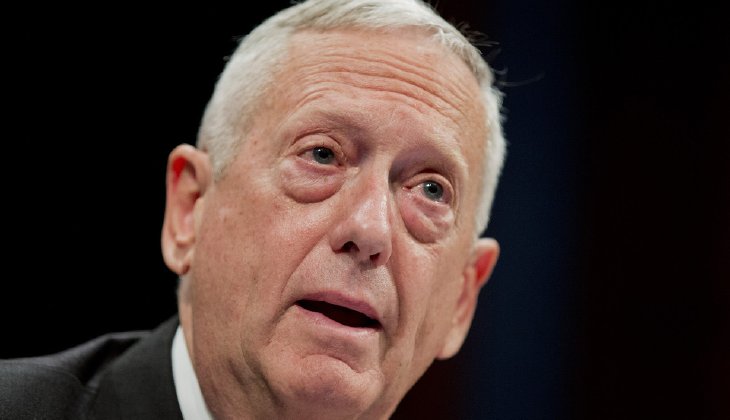
mattis
General Mattis: Celebrated as a moderating influence on Trump

W.J. Astore

It’s becoming increasingly difficult for Americans to recall that civilian leaders are supposed to command and control the military, not vice-versa.  Consider an article posted yesterday at Newsweek with the title, TRUMP’S GENERALS CAN SAVE THE WORLD FROM WAR—AND STOP THE CRAZY.  The article extols the virtues of “Trump’s generals”: James Mattis as Secretary of Defense, John Kelly as White House Chief of Staff, and H.R. McMaster as National Security Adviser.  The article presents them as the adults in the room, the voices of calm and reason, a moderating force on a bombastic and bellicose president.

I’ve written about Trump’s generals already at TomDispatch.com and elsewhere.  The latest gushing tribute to America’s generals at Newsweek illustrates a couple of points that bear repeating.  First, you don’t hire generals to rein in a civilian leader, or at least you shouldn’t if you care to keep a semblance of democracy in America.  Second, lifelong military officers favor military solutions to problems.  That’s precisely why you want civilians to control them, and to counterbalance their military advice.  Only in a democracy that is already crippled by creeping militarism can the rise of generals to positions of power be celebrated as a positive force for good.

Speaking of creeping militarism in the USA, I caught another headline the other day that referenced General Kelly’s appointment as Chief of Staff.  This headline came from the “liberal” New York Times:

John Kelly Quickly Moves to Impose Military Discipline on White House


Note that headline.  Not that Kelly was to impose discipline, but rather military discipline. What, exactly, is military discipline?  Well, having made my first career in the military, I can describe its features. Obedience.  Deference to authority.  Respect for the chain of command.  A climate that sometimes degenerates to “a put up and shut up” mentality. Such a climate may be needed in certain military settings, but do we want it to rule the White House?

Here is what I wrote back in December about Trump and “his” generals:

In all of this, Trump represents just the next (giant) step in an ongoing process.  His warrior-steeds, his “dream team” of generals, highlight America’s striking twenty-first-century embrace of militarism. At the same time, the future of U.S. foreign policy seems increasingly clear: more violent interventionism against what these men see as the existential threat of radical Islam. 

Of course, now the threat of nuclear war looms with North Korea.  For a moderating influence, America places its faith in military generals controlling the civilian commander-in-chief, and that’s something to draw comfort from, at least according to Newsweek.

When military control of the civilian is celebrated, you know it’s truly opposite day in America.

The Disco Ball of Trump-Comey

RTS15WVA-1024x653
Not them again.

W.J. Astore

An astute Bracing Views reader described the Trump-Comey-Russia hearings as “the audio version of a glittering disco ball,” which captures the moment.  Sure, there’s lots of flash there, but the real problems of the USA are being very much ignored.  Put differently, it’s hard to hear any real news when the thump-thump-thump of Trump-Comey-Russia drowns out all other voices.

I’ve already said my piece (at TomDispatch.com) about some of the big problems that face our country, so indulge me for a moment as I consider the disco inferno of Trump-Comey.

My take: Trump wanted loyalty, Comey didn’t promise that, nor should he have. Trump, it seems, also felt upstaged by Comey (not only because the former FBI Director is taller than Trump and more vigorous). Comey, in short, was uncooperative, not one of Trump’s guys, so he fired him.  As president, Trump has that power.

Was it a smart move?  No.  Does it look bad?  Yes, especially the timing. Is it obstruction of justice?  Apparently not, since the various Russia-Trump investigations are progressing.  (To my knowledge, there are at least three of them ongoing.)

More than anything, Comey’s testimony makes Trump look like a dick (to use a technical term). But we already knew that.  Trump’s been posing (it didn’t require acting) as a dick for years on TV, taking great relish in saying, “You’re fired!” to a range of has-been celebrities. Should we really be surprised that Trump is acting like a dick as president? Even his followers knew he was a dick; they just thought he was their dick.

Did Trump collude with Russia?  Of course he did!  He admitted it himself. Remember when Trump called for the Russians to hack Hillary Clinton — to find her “thirty thousand” missing emails, ha ha!  That may not be the legal definition of collusion, but if you heard that and refused to consider that Candidate Trump’s encouragement of hacking by a foreign power in an election for his benefit was wrongful, well, so be it. Those Americans who voted for Trump were apparently untroubled by it.

I’m not defending Trump.  The man is a menace to the world, with his denial of global warming/climate change, his embrace of nuclear weapons, his cocksureness fed by his ignorance, the list goes on.  But, based on the evidence that’s been presented so far, he’s done nothing that reaches an impeachable offense.  Major league dick status, yes. Impeachment?  Not yet.  Or Nyet.

The biggest problem with Trump is not that he’s a Russian stooge. It’s that he’s not presidential.  He doesn’t understand public service.  It’s utterly foreign to him, not just because he has no experience of it but because it’s contrary to his egocentric personality.

Look at his priorities as president.  (They are the same as they were when he was a real estate developer.) #1 for Trump is Trump. #2 for Trump is his immediate family, joined by a few trusted lackeys, toadies, and sycophants. #3 for Trump is his money, his position in society, and his reputation among his peers and fellow billionaires, those “masters of the universe,” to use Tom Wolfe’s phrase.

Make America great again?  That’s never been Trump’s priority.  Make Trump greater and greater?  That’s more like it.

Trump is fulfilling his version of the American dream.  Too bad it’s a nightmare for America.

Trump Consumes All the Oxygen in Washington

RTS15WVA-1024x653
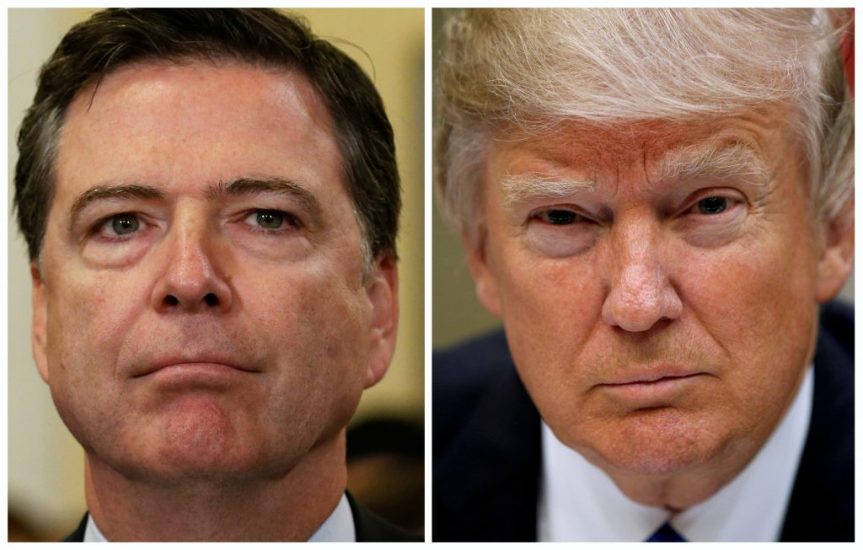
Comey and Trump: Back in the news

W.J. Astore

Another day, another Trump scandal, this one stemming from a memo written by the former FBI director, James Comey, in the aftermath of a private conversation he had with the President.  According to the Comey memo, the president urged him to drop the FBI’s investigation into Michael Flynn’s ties to Russia, using these words: “I hope you can see your way clear to letting this go, to letting Flynn go.  He is a good guy. I hope you can let this go.”

Obstruction of justice?  Impeachable offense?  That’s debatable.  But the alleged conversation obviously takes on heightened meaning after Trump fired Comey, in part because of frustration with the FBI’s investigation into alleged collusion between the Trump campaign and Russia during the election.

It’s unclear if any crimes were committed here.  What is clear is that Trump is a poor manager of himself as well as his staff.  Flynn, with his dodgy record, should never have been hired.  Furthermore, the president should not have gone out on a limb to defend him, cajoling the FBI director, in so many words, to go easy on my guy.

Perhaps Trump’s biggest flaw is his combination of boastfulness, lack of judgment, and his ego-driven need to take charge.  He reminds me of an Air Force saying: “He’s all Mach and no compass heading.”  He’ll break the sound barrier while moving in the opposite direction to sound governance.

I wrote back in March of 2016 that candidate Trump had disqualified himself from the presidency by boasting about how America’s generals would follow his orders irrespective of their legality.  My main point was that Trump had no understanding of his Constitutional responsibilities, nor did he seem to care much about learning them.  If Comey’s memo is accurate, I think it’s another instance of Trump either not knowing or not caring about propriety, about the rule of law.

Trump’s experience in life is as a CEO of a family business.  Everyone has always worked for him; in essence, he’s been King Trump.  Even though he’s now president, he still acts like a king, making up his own rules as he goes along, not knowing a rule book already exists.

Will Trump survive his first term?  As Yoda might say, Difficult to see — always in motion the future.  One thing is certain: Trump continues to consume all the oxygen in Washington, extinguishing any hope of real progress or effective governance at the federal level.

American Kleptocracy under Trump

W.J. Astore

Seven years ago, I wrote an article for TomDispatch.com on American kleptocracy.  At the time, it seemed a bit of a stretch.  Sure, America was (and is) plutocratic.  But kleptocratic?  Like a third-world dictatorship in which family members of the ruler enrich themselves while being appointed to government offices for which they’re eminently unqualified?  Surely not!  But here we are, in 2017, with Trump as president and his son-in-law Jared Kushner seemingly running everything and with daughter Ivanka the “First Daughter” and pseudo-First Lady.  I didn’t see that one coming.

"Charles James: Beyond Fashion" Costume Institute Gala - Arrivals
Jared and Ivanka: Good at looking good

Anyway, here’s my original article, unedited, from 2010.

American Kleptocracy
How Fears of Socialism and Fascism Hide Naked Theft 

By William J. Astore

Kleptocracy — now, there’s a word I was taught to associate with corrupt and exploitative governments that steal ruthlessly and relentlessly from the people.  It’s a word, in fact, that’s usually applied to flawed or failed governments in Africa, Latin America, or the nether regions of Asia.  Such governments are typically led by autocratic strong men who shower themselves and their cronies with all the fruits of extracted wealth, whether stolen from the people or squeezed from their country’s natural resources.  It’s not a word you’re likely to see associated with a mature republic like the United States led by disinterested public servants and regulated by more-or-less transparent principles and processes.

In fact, when Americans today wish to critique or condemn their government, the typical epithets used are “socialism” or “fascism.”  When my conservative friends are upset, they send me emails with links to material about “ObamaCare” and the like.  These generally warn of a future socialist takeover of the private realm by an intrusive, power-hungry government.  When my progressive friends are upset, they send me emails with links pointing to an incipient fascist takeover of our public and private realms, led by that same intrusive, power-hungry government (and, I admit it, I’m hardly innocent when it comes to such “what if” scenarios).

What if, however, instead of looking at where our government might be headed, we took a closer look at where we are — at the power-brokers who run or influence our government, at those who are profiting and prospering from it?  These are, after all, the “winners” in our American world in terms of the power they wield and the wealth they acquire.  And shouldn’t we be looking as well at those Americans who are losing — their jobs, their money, their homes, their healthcare, their access to a better way of life — and asking why?

If we were to take an honest look at America’s blasted landscape of “losers” and the far shinier, spiffier world of “winners,” we’d have to admit that it wasn’t signs of onrushing socialism or fascism that stood out, but of staggeringly self-aggrandizing greed and theft right in the here and now.  We’d notice our public coffers being emptied to benefit major corporations and financial institutions working in close alliance with, and passing on remarkable sums of money to, the representatives of “the people.”  We’d see, in a word, kleptocracy on a scale to dazzle.  We would suddenly see an almost magical disappearing act being performed, largely without comment, right before our eyes.

Of Red Herrings and Missing Pallets of Money

Think of socialism and fascism as the red herrings of this moment or, if you’re an old time movie fan, as Hitchcockian MacGuffins  — in other words, riveting distractions.  Conservatives and tea partiers fear invasive government regulation and excessive taxation, while railing against government takeovers — even as corporate lobbyists write our public healthcare bills to favor private interests.  Similarly, progressives rail against an emergent proto-fascist corps of private guns-for-hire, warrantless wiretapping, and the potential government-approved assassination of U.S. citizens, all sanctioned by a perpetual, and apparently open-ended, state of war.

Yet, if this is socialism, why are private health insurers the government’s go-to guys for healthcare coverage?  If this is fascism, why haven’t the secret police rounded up tea partiers and progressive critics as well and sent them to the lager or the gulag?

Consider this: America is not now, nor has it often been, a hotbed of political radicalism.  We have no substantial socialist or workers’ party.  (Unless you’re deluded, please don’t count the corporate-friendly “Democrat” party here.)  We have no substantial fascist party.  (Unless you’re deluded, please don’t count the cartoonish “tea partiers” here; these predominantly white, graying, and fairly affluent Americans seem most worried that the jackbooted thugs will be coming for them.)

What drives America today is, in fact, business — just as was true in the days of Calvin Coolidge.  But it’s not the fair-minded “free enterprise” system touted in those freshly revised Texas guidelines for American history textbooks; rather, it’s a rigged system of crony capitalism that increasingly ends in what, if we were looking at some other country, we would recognize as an unabashed kleptocracy.

Recall, if you care to, those pallets stacked with hundreds of millions of dollars that the Bush administration sent to Iraq and which, Houdini-like, simply disappeared.  Think of the ever-rising cost of our wars in Iraq and Afghanistan, now in excess of a trillion dollars, and just whose pockets are full, thanks to them.

If you want to know the true state of our government and where it’s heading, follow the money (if you can) and remain vigilant: our kleptocratic Houdinis are hard at work, seeking to make yet more money vanish from your pockets — and reappear in theirs.

From Each According to His Gullibility — To Each According to His Greed

Never has the old adage my father used to repeat to me — “the rich get richer and the poor poorer” — seemed fresher or truer.  If you want confirmation of just where we are today, for instance, consider this passage from a recent piece by Tony Judt:

In 2005, 21.2 percent of U.S. national income accrued to just 1 percent of earners.  Contrast 1968, when the CEO of General Motors took home, in pay and benefits, about sixty-six times the amount paid to a typical GM worker.  Today the CEO of Wal-Mart earns nine hundred times the wages of his average employee.  Indeed, the wealth of the Wal-Mart founder’s family in 2005 was estimated at about the same ($90 billion) as that of the bottom 40 percent of the U.S. population: 120 million people.

Wealth concentration is only one aspect of our increasingly kleptocratic system.  War profiteering by corporations (however well disguised as heartfelt support for our heroic warfighters) is another.  Meanwhile, retired senior military officers typically line up to cash in on the kleptocratic equivalent of welfare, peddling their “expertise” in return for impressive corporate and Pentagon payouts that supplement their six-figure pensions.  Even that putative champion of the Carhartt-wearing common folk, Sarah Palin, pocketed a cool $12 million last year without putting the slightest dent in her populist bona fides.

Based on such stories, now legion, perhaps we should rewrite George Orwell’s famous tagline from Animal Farm as: All animals are equal, but a few are so much more equal than others.

And who are those “more equal” citizens?  Certainly, major corporations, which now enjoy a kind of political citizenship and the largesse of a federal government eager to rescue them from their financial mistakes, especially when they’re judged “too big to fail.”  In raiding the U.S. Treasury, big banks and investment firms, shamelessly ready to jack up executive pay and bonuses even after accepting billions in taxpayer-funded bailouts, arguably outgun militarized multinationals in the conquest of the public realm and the extraction of our wealth for their benefit.

Such kleptocratic outfits are, of course, abetted by thousands of lobbyists and by politicians who thrive off corporate campaign contributions.  Indeed, many of our more prominent public servants have proved expert at spinning through the revolving door into the private sector.  Even ex-politicians who prefer to be seen as sympathetic to the little guy like former House Majority Leader Dick Gephardt eagerly cash in.

I’m Shocked, Shocked, to Find Profiteering Going on Here

An old Roman maxim enjoins us to “let justice be done, though the heavens fall.”  Within our kleptocracy, the prevailing attitude is an insouciant “We’ll get ours, though the heavens fall.”  This mindset marks the decline of our polity.  A spirit of shared sacrifice, dismissed as hopelessly naïve, has been replaced by a form of tribalized privatization in which insiders find ways to profit no matter what.

Is it any surprise then that, in seeking to export our form of government to Iraq and Afghanistan, we’ve produced not two model democracies, but two emerging kleptocracies, fueled respectively by oil and opium?

When we confront corruption in Iraq or Afghanistan, are we not like the police chief in the classic movie Casablanca who is shocked, shocked to find gambling going on at Rick’s Café, even as he accepts his winnings?

Why then do we bother to feign shock when Iraqi and Afghan elites, a tiny minority, seek to enrich themselves at the expense of the majority?

Shouldn’t we be flattered?  Imitation, after all, is the sincerest form of flattery.  Isn’t it?