In Praise of TomDispatch

W.J. Astore

Tom Engelhardt Is the Post-9/11 Generation’s I.F. Stone

Today’s post has a simple goal: to praise TomDispatch, a regular, reliable, and highly effective “antidote to the mainstream media.”

Its creator, editor, and chief author, Tom Engelhardt, founded the site soon after the 9/11 attacks in 2001. Its remarkable longevity and brilliant perspicacity testifies to his integrity, his character, indeed his patriotism and his humanity.

What I.F. Stone was to the Vietnam generation, Tom Engelhardt has been to the post-9/11 one. If more Americans had read his articles and truly listened to his words of wisdom, disastrous wars like the ones in Iraq and Afghanistan would never have happened, and America itself would be a far better place.

Tom began his site as a simple Listserv. Soon after 9/11, he started by putting together lists of articles he’d read, together with some commentary of his own, sharing those links and thoughts via email with friends and other interested parties. An early article that stuck in his mind (that he mentioned to me) concerned America’s bombing raids against Afghanistan in 2001, attacks that would serve mainly “to bounce the rubble” there. (Afghanistan had already been the site of a devastating war in the 1980s conducted by the Soviet Union.)

Quickly, Tom’s Listserv messages proved popular, focusing as they so often did on the folly and fallacies of American empire. A colleague suggested that he should create a website featuring his “tomgrams.” Though not a tech or computer wiz, Tom embraced the challenge, overseeing the founding of a dedicated site for original articles that would serve as “a regular antidote to the mainstream media.”

Tom has now been posting his tomgrams for 22 years, usually three original pieces each week, on Sunday, Tuesday, and Thursday. It’s the side job that took over his life, he ruefully admits. (Tom has been a longtime editor for several publishing houses, as well as writing several of his own books, notably “The End of Victory Culture,” which I highly recommend.)

I first started writing for TomDispatch in 2007. I recently posted my 106th article at the site. Tom has made me work! He features articles that are typically 2000 words or longer, articles that often include a dozen or more links that readers can follow to confirm facts and deepen their knowledge. Each article Tom posts goes through a rigorous process of editing, far more so, it seems, than many print magazines use nowadays. Typically, when I write for Tom, he edits my pieces, after which three proofreaders offer their own suggestions and corrections, all of which I review along with Tom. It’s a laborious process that produces consistently high-quality pieces at the site.

If you’re a regular reader of his site, you’ll have noticed that Tom writes introductions to nearly every piece he posts at TomDispatch. Some of his intros end up being essays in their own right. He is seemingly inexhaustible.

Tom Engelhardt, the creator of TomDispatch, with the author

Articles initially posted at TomDispatch usually go to many other sites. My most recent piece for Tom went to Common Dreams, Counterpunch, Information Clearing House, The Nation, ZNet, and LA Progressive, among other sites. Most of these are broadly liberal or progressive, but Lew Rockwell, a libertarian site, picked up my last piece as well. In the past, mainstream sites like CBS News have picked up and posted TomDispatch pieces, and three of my “tomgrams” earned a mention in the New York Times (here and here and here). Another one was posted (in shorter form) by the LA Times. All this is to say that TomDispatch’s reach far exceeds that of the site itself.

It’s amazing the network of readers and publishers Tom has built over the last 20+ years. I’m amazed as well at how some of my articles have been translated into foreign languages, including German, French, Italian, Spanish, Portuguese (in Brazil), Danish, Czech, and Arabic. Honestly, I never thought I’d be so widely read, and I owe that to Tom, who saw in 2001 the need for an alternative to the mainstream media soon after the events of 9/11 and all the mindless patriotic hoopla that followed. 

What makes TomDispatch unique? Certainly, the length and rigor of its pieces. Most sites nowadays post shorter works of 600 words or fewer. I’m also struck by the diversity of authors at the site. And, if I may, I wish to applaud Tom for seeking out military and government dissenters, military officers like Andrew Bacevich and Danny Sjursen and State Department dissenters like Peter Van Buren. And Tom has enlisted people like Noam Chomsky, Chalmers Johnson, Barbara Ehrenreich, Adam Hochschild, and so many other authors for whom he’s served as an editor.

(Check out Tom’s incredible list of authors since 2002 here.)

Later this year, Tom will celebrate his 80th birthday. He tells me TomDispatch is nearing its end, that soon, perhaps in the next year or two, it’ll post its last article. When it does, a bright light of stimulating discourse and informed dissent will be extinguished. America will be worse for it.

I urge you to dip into the TomDispatch archive. It begins in 2002 and comes forward to the present day. Read a few articles, especially on war, militarism, and empire. And tell me: Isn’t it amazing how much Tom saw that those in officialdom either didn’t see or refused to see?

America’s Foreign Policy and Cody Jarrett

W.J. Astore

Made it Ma, Top of the World!

A favorite movie of mine is “White Heat” (1949) with James Cagney playing Cody Jarrett, one-time gangster and all-time mama’s boy. In the famous ending to the movie, Cody finally makes it to the “top of the world,” in this case a refinery that explodes around him in a fireball that looks something like a nuclear mushroom cloud.

Top of the world, Ma! James Cagney at the end of “White Heat”

America’s foreign policy leaders remind me of Cody Jarrett. They want to dominate. They want to be top dog. They want to play king-of-the-hill, like so many bully-boys, and all that matters is making it to the top.

All this came to mind as I read Tom Engelhardt’s latest article at TomDispatch.com. His article reminded me that we as Americans simply don’t like dissent, no matter how well informed, no matter how well intended. In World War I, you weren’t supposed to question a war that President Woodrow Wilson had promised Americans we wouldn’t get involved in. In the 1950s, you weren’t supposed to question virulent anti-communism; you were supposed to salute smartly and demonize all communists everywhere. Today, you’re supposed to hate Putin, distrust the Chinese, and accept fully the idea that the Pentagon is wise to wage a new Cold War that may well end much like the ending of “White Heat.”

Engelhardt’s article salutes dissenters like I.F. “Izzy” Stone, people who are willing to challenge established narratives, to work against demonizing other peoples, to work toward mutual understanding and peace. Indeed, we need more Izzy Stones in America.

These are dangerous times. We’re supposed to go along with wars, with demonizing enemies, with high military spending. Bully-boy rhetoric and tactics are touted as the American way.  Our politics is retrograde, our attitude toward the world almost childish, again in a king-of-the-hill way. (America must be king, of course.)

So I fear we may well end up like Cagney at the end of “White Heat.”  Our gangster-leaders will shout: “Made it Ma, top of the world!” as the nuclear warheads explode around us.

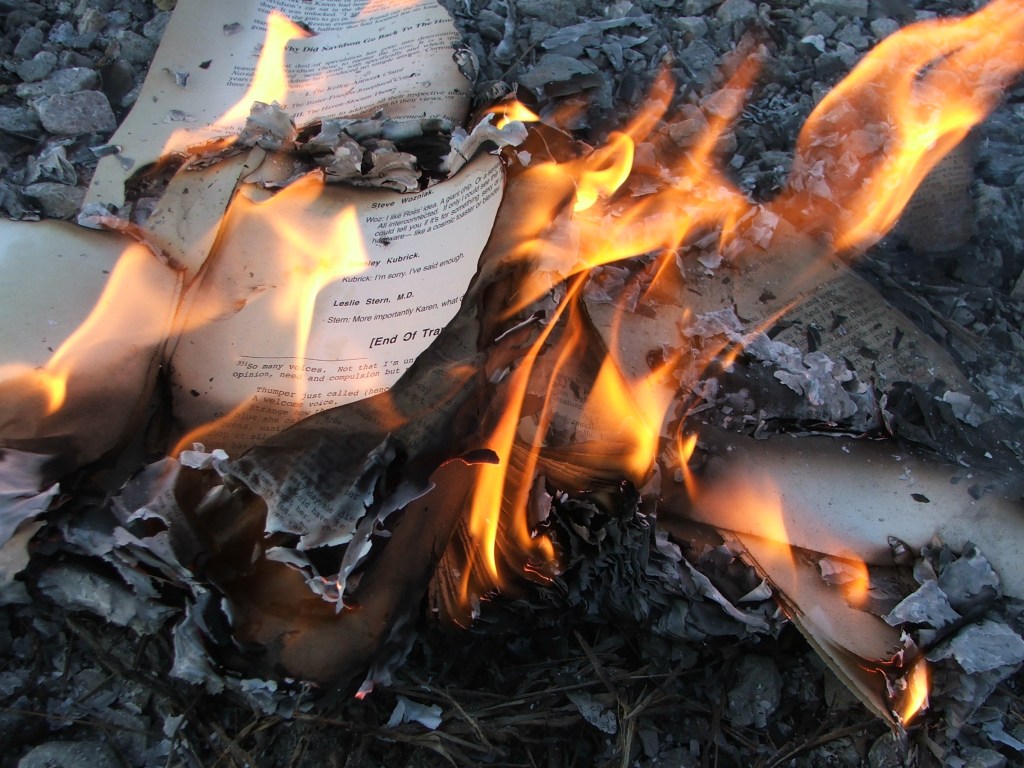
Why Burn Books When You Can Stop Them from Being Published?

You won’t have to burn them if they’re never published

W.J. Astore

There are many forms of lying. One that we don’t always think about is lying by omission. A partial truth can be a more insidious lie than an outright falsehood. I might argue, for example, that the Vietnam War was awful for America, dividing the country and costing more than 58,000 U.S. troops their lives, along with innumerable other mental and physical casualties. But if I leave out or downplay the far more horrifying costs to Southeast Asia, the literally millions of Vietnamese, Laotians, and Cambodians killed in that war, the poisoning of their land by highly toxic chemicals like Agent Orange along with millions of unexploded mines and munitions, which still kill to this day, I have most definitely lied by omission. Perhaps the Vietnam War was a “tragedy” for the U.S., but it was far, far worse for those on the receiving end of American firepower.

It’s not easy to get books published that tell tough truths we’d prefer not to hear. For example, Nick Turse’s book about “the real American war in Vietnam,” entitled “Kill Anything that Moves,” was published by Metropolitan Books, which is now being shuttered and shut down, notes Tom Engelhardt in his latest article at TomDispatch.com. Engelhardt has seen this before, with Pantheon Books, another publisher known for publishing books that told uncomfortable truths about America. It too was a victim of consolidation in publishing, of being shut down, mainly because the consolidators simply didn’t like the books being published. And perhaps too because these same books sometimes didn’t make enough money (though some proved to be bestsellers, which, from the owners’ ideological perspective, may have been worse).

Engelhardt’s heartfelt article made me think. Imagine that. It made me think that the best way to “burn” books is to make sure they’re never published.  Same with banning books.  You don’t have to ban them when they can’t find their way into print.

Also, it’s far easier to manufacture consent — to control the national discourse — when only certain books are being published and hyped — the ones reflecting and reinforcing mainstream thought.

Whether it’s shutting down Pantheon or Metropolitan or similar publishing houses, it’s about blocking alternative views that challenge capitalism, neoliberalism,, neoconservatism, and similar mainstream ideologies. You can always claim that the house you’re shuttering just wasn’t making enough money, wasn’t moving enough product, never mind the quality of that “product” and the invaluable service it was providing to democracy and the free exchange of ideas.

Readers here know that I started writing for TomDispatch in 2007. My first article was critical of the Petraeus Surge in the Iraq War, but my goal back then was “to save the U.S. military from itself,” from its misleading and often mendacious metrics to its inflated sense of itself, shown most clearly with its obsession with medals and decorations even as the war was going very poorly indeed. I tried several mainstream publishers including the New York Times and Washington Post without success. A friend mentioned TomDispatch to me, I wrote to Tom, and he found something in my writing worthy of being published at his site. My next “Tomgram” will be the 95th I’ve written for the site.

If TomDispatch didn’t exist, my criticisms and critiques would probably have never been published. Tom’s example inspired me to write further, to become a regular at Huff Post and Antiwar.com and to start my own blogs. Bracing Views exists because of the example provided by TomDispatch.

Good books beget other good books. Critical books beget other critical books. Scholarship builds on itself. When you block or severely limit opportunities for good, daring, and critical books from being published, you strike a blow against scholarship, against the free exchange of ideas, against the very idea of an enlightened America made more powerful and righteous by its informed citizens.

Sure, it’s just another publisher being put out of business. Nothing to see here, move along. Except it’s much more than that. It’s a form of book burning before the book ever existed, a silencing of synapses in our minds, an insidious form of mind control in the sense of curtailing certain thoughts and ideas from ever taking form.

Do I exaggerate? Readers, what do you think?

Are We the New Martians?

Heat rays don’t always carry the day. (I used to own this double album, narrated by the great Richard Burton)

W.J. Astore

A few years ago, I picked up H.G. Wells’s classic novel, “War of the Worlds,” and read it in full. I had seen the movies based on it and had also dipped into the book, but I finally read the whole thing, marveling at the suspense Wells created in his classic account of Martians invading our planet, stomping us with their superior technology, only to be overcome by microbes to which they had no resistance.

As I read the book, I asked myself: Are we Americans becoming the new Martians? Warlike ways, superior technology, a predilection to invade and dominate for resources, with no regard for the “primitives” we stomp on or push out of the way in our quest for full-spectrum dominance?

I’m not the only one with questions along these lines. At TomDispatch today, Tom Engelhardt recounts his own affection for “War of the Worlds,” which he avidly read as a boy, and which he recently turned to again in our era of dangerous microbes, incessant war, and a changing climate that is threatening life as we know it on this planet.

Wells, of course, intended his story partly as a critique of the British and Western imperialism of his day, which is why it remains relevant to our imperial world today.

Think about it. America’s leaders, and especially the military-industrial-congressional complex, are in many ways the new Martians. Their god seems to be Mars, the god of war, and the planet they’re remaking is increasingly red, barren, and inhospitable. They’re doing a fair job of emulating those Martians as well, leaving Planet America to attack other lands for their resources, banking on superior technology and “heat rays” (Hellfire missiles!) to win the day.

Yet, like those very same Martians in “War of the Worlds,” Planet America loses its wars to “inferior” peoples, betrayed by “primitive” and hostile environments (the sweltering jungles of Vietnam, the urban jungle and heat of Iraq, the rugged mountains and omnipresent dust of Afghanistan). But do America’s Martians ever quit? Of course not! They keep building new war machines, they keep “investing” in new technologies, they keep advocating dominance through invasion and killing, much like those desperate Martians in Wells’s book, who, faced with a dying planet, decided their only course of action was to invade a different planet and steal its resources for themselves.

In Wells’s book, the Martians reveled in war, shouting “Ulla! Ulla!” as they fired their death rays. Our leaders are doing something similar while many of us shout “USA! USA!” mindlessly.

Wells sought to teach us that war and technology and destruction are just as likely to lead to our demise as to our triumph. The more we make war on ourselves and our planet, the more likely it is that Earth will come to resemble Mars, an inhospitable place for a dying species. Yet, unlike the imaginary Martians of Wells’s book, there’s no other hospitable planet in the neighborhood for us to invade.

Bonus: Here’s an excerpt from Jeff Wayne’s musical version of “War of the Worlds,” featuring Justin Hayward on vocals and Richard Burton as narrator. “The massacre of mankind”: No one says it quite like Burton.

America Is a Sinking Warship on a Melting Iceberg

W.J. Astore

More sweltering heat, wildfires, and other extreme weather and weather-related events remind us that global warming and climate change are here to stay. When I taught about global warming a decade ago, most scientists were predicting harsh events in 2030 or 2040. Yet here it is, the year 2021, and we’re already seeing the implacable face of Mother Nature, shaking her head at our naughtiness and thoughtlessness vis-a-vis her planet. She won’t be appeased by our excuse-making or our lying or our attempts to pass the buck. As we bicker, she acts.

Mother Nature: Implacable (Josh Addessi at Blogspot.com)

Climate change is here to stay with a take no prisoners vibe, notes Tom Engelhardt in his latest post at TomDispatch.com. Tom’s message is clear: we’re reaping or about to reap what our “leaders” and corporate elites have sown for us, a much hotter, much less hospitable, planet. As Tom puts it, we’re about to witness, and indeed are already witnessing, a climate Armageddon in slow motion. Check out his article for all the grim details.

Here’s the thing. A half-century ago, America’s wonderful fossil-fuel companies knew all about this threat. More than 40 years ago, President Jimmy Carter tried to persuade America to conserve fuel and live thriftier, more meaningful, lives. But America rejected Carter’s hard facts for Reagan’s sunny optimism (or, put bluntly, his lies) and so here we are.

After Carter, the Democrats swiftly moved to the right and embraced those same fossil-fuel companies. Democrats may have made fun of Sarah Palin and her “drill, baby, drill” message, but that is exactly what Presidents Obama and Biden decided to do: drill, baby, drill. A recent article puts it well from The Guardian: Joe Biden has approved two thousand (!) drilling and fracking permits. Not exactly a green new deal, is it?

President Obama was even worse, notes David Sirota at The Guardian. He loved to boast of how he made America the world’s number one oil producer. He even asked Americans to thank him for it! Remind me again how the Democrats are so much different on this issue than the big bad Republicans?

Here’s the kicker. Even as America’s leaders acted to accelerate fossil fuel production, despite all the warnings about climate change, they squandered $6 trillion on the Iraq and Afghan wars, money that would have made a dramatic difference in preparing America for climate change while also facilitating alternative energy sources, which also would have created millions of “green” jobs in America.

I think a key inflection point for America came in the immediate aftermath of the collapse of the Soviet Union three decades ago. If America had invested its peace dividend into creating a cleaner, safer, better world, perhaps by leading the way, as Carter had suggested, in solar energy and in efforts at conservation, we truly could have been a shining city on a hill, a beacon of sanity. But we chose more weapons and more war. We chose more fossil fuel consumption. Indeed, we chose more consumption (and more guns) in general.

And thus we are where we are today, caught on a sinking warship on a rapidly melting iceberg. OK, perhaps it’s not the most clever metaphor, but you try coming up with a better one when you’re typing in a room at 87 degrees with 73% humidity. Must keep that image of an iceberg in my head …

Must keep cool …

Why Can’t American Troops Just Leave Iraq?

W.J. Astore

The Biden administration says it wants to remove U.S. combat troops from Iraq. Hooray! Mission finally accomplished, right? It may be 18 years after George W. Bush declared it to be so, but who’s counting the years?

Not so fast. For President Biden still wants to keep roughly 2000 or so U.S. troops in Iraq for training and advisory purposes. So much for mission accomplished.

Why can’t U.S. troops just leave — for good? If Iraq can’t defend itself after nearly two decades of U.S. “training” in the war on terror, maybe it’s finally time to admit our limits (or our folly) and simply leave.

It almost seems like America’s system of “defense” is an imperial project — an effort to enlarge American power at almost any cost (and the Iraq war has cost America in the trillions of dollars).

This is the telling argument of Tom Engelhardt’s latest post at TomDispatch.com. The U.S. is the empire that dare not speak its name, even as it begins to collapse due to perpetual war externally and perpetual rancor internally. And, believe me, as former President Trump would say, those two are related. He should know, given how he tapped that rancor and aggravated it for his own purposes.

Here’s an excerpt from Engelhardt’s latest, where he points out what might be termed the Pentagon Paradox: The more America’s generals fail, the more they succeed (more money, more promotions, more power):

Still, let’s face it, this isn’t the set of conflicts that, once upon a time, involved invasions, massive air strikes, occupations, the killing of staggering numbers of civilians, widespread drone attacks, the disruption of whole countries, the uprooting and displacement of more than 37 million people, the deployment at one point of 100,000 U.S. troops in Afghanistan alone, and the spending of untold trillions of American taxpayer dollars, all in the name of fighting terror and spreading democracy. And think of it as mission (un)accomplished in the truest sense imaginable.

In fact, that idea of spreading of democracy didn’t really outlast the Bush years. Ever since, there’s been remarkably little discussion in official Washington about what this country was really doing as it warred across significant parts of the planet. Yes, those two decades of conflict, those “forever wars,” as they came to be called first by critics and then by anyone in sight, are at least winding, or perhaps spiraling, down — and yet, here’s the strange thing: Wouldn’t you think that, as they ended in visible failure, the Pentagon’s stock might also be falling? Oddly enough, though, in the wake of all those years of losing wars, it’s still rising. The Pentagon budget only heads ever more for the stratosphere as foreign policy “pivots” from the Greater Middle East to Asia (and Russia and the Arctic and, well, anywhere but those places where terror groups still roam).

Buy the Book

In other words, when it comes to the U.S. military as it tries to leave its forever wars in someone else’s ditch, failure is the new success story.

And how! Maybe we need a new saying in America: Nothing succeeds like failure. It’s truly paradoxical until you realize that someone is always winning and profiting from this failure, even as the rest of America suffers.

Engelhardt’s book above has a well-judged title: “A Nation Unmade By War.” But perhaps we can improve it? How about “An Empire Unmade By War”?

When Mother Earth Dies, We All Die

W.J. Astore

Back in March, Tom Engelhardt had a stimulating article at TomDispatch.com on the wounding of planet Earth. He also made mention of the Covid-19 pandemic. And as I read his piece, I thought of Mother Earth suffering from a human-made pandemic. A virus of humans. A human-made flu of fevers (heat waves and fires), chills (freezes in the South), coughs (turbulent weather), thirst (droughts out West), and pain (nearly everywhere).

But, sadly, there’s no vaccine for Mother Earth. All we humans can do is relieve the symptoms by changing our behavior.  Mother Earth is already infected with us; now we need to leave her alone, let her rest, allow her to recover. But we don’t.  We keep stressing her with our actions (and inaction on climate change) and making her symptoms worse.

The only problem: When Mother Earth dies, we all die.

We’re on the fast track to dystopia, which puts me to mind of a recent Splinterlands trilogy written by John Feffer. His latest and last volume is called Songlands, which he writes about here at TomDispatch.com. For a dystopic trilogy, I found it strangely uplifting, for Feffer still sees hope in humans who are willing to sacrifice to save our planet. I urge you to check it out.

It’s amazing to me that ultra-rich billionaires like Jeff Bezos and Elon Musk are saluted for their “investment” in space exploration, as if we humans are going to save ourselves by building stations on the moon or Mars. If Bezos and Musk truly wanted to give back to humanity, they’d be focusing on reducing consumption here on Earth while fighting for preservation and conservation. But their space trips are really ego trips, and their fuel has always been money.

Here’s hoping humanity rejects the “final frontier” nonsense of Bezos and Musk and turns its attention to what really matters: the health and welfare of this wonderful yet fragile world of ours.

For if we refuse to honor Mother Earth, it may be the last sin we humans commit.

The Never-Ending Afghan War

General Mark Milley. So many ribbons, so few victories (Gabriella Demczuk/New America)

Tom Engelhardt. Introduction by W.J. Astore.

Ever since that fateful day of 9/11/2001, Americans have been trying to process what can only be termed a colossal defeat. Showing our usual capacity for denial, we’ve rebranded it as a day for patriotism. We built the Freedom Tower, exactly 1776 feet high, on the ruins of the Twin Towers. We “got” Osama bin Laden. Yet the first victims of our collective rage, the Taliban in Afghanistan, have somehow emerged triumphant in a long destructive war against U.S. and NATO forces.

With his usual powerful prose, careful research, and keen eye for telling details, Tom Engelhardt has written a compelling introduction to Rajan Menon’s latest article on the Afghan War. It’s reposted here with Tom’s permission. W.J. Astore

It started with three air strikes on September 11, 2001. The fourth plane, heading perhaps for the Capitol (a building that wouldn’t be targeted again until last January 6th), ended up in a field in Pennsylvania. Those three strikes led to an American invasion of Afghanistan, beginning this country’s second war there in the last half-century. Almost 20 years later, according to the New York Times, there have been more than 13,000 U.S. air strikes in Afghanistan. Call that payback after a fashion. There’s only one problem: the greatest military on the planet, with a budget larger than that of the next 10 countries combined, has visibly lost its war there and is now in full-scale retreat. It may not be withdrawing the last of its forces on May 1st, as the Trump administration had agreed to do, but despite the pressure of the American military high command, President Biden “overrode the brass” and announced that every last American soldier would be gone by the 20th anniversary of those first airstrikes against the Pentagon and the World Trade Center.

At this late date, consider it grimly fascinating that the generals who all those years kept claiming that “corners” were being turned and “progress” made, that we were “on the road to winning” in Afghanistan, as the present Chairman of the Joint Chiefs Mark Milley insisted back in 2013, simply can’t let go of one of their great failures and move on. Under the circumstances, don’t for a second assume that the American war in Afghanistan is truly over. For one thing, the Taliban have not yet agreed to the new withdrawal date, as they did to the May 1st one. Instead, some of its commanders are promising a “nightmare” for U.S. troops in the months to come. Were they, for instance, to attack an air base and kill some American soldiers, who knows what the reaction here might be?

In addition, the Pentagon high command and this country’s intelligence agencies are still planning for possibly making war on Afghanistan from a distance in order to “prevent the country from again becoming a terrorist base.” As Eric Schmitt and Helene Cooper of the New York Times reported recently, “Planners at the military’s Central Command in Tampa, Fla., and Joint Staff in Washington have been developing options to offset the loss of American combat boots on the ground.”

In other words, the American war in Afghanistan may be ending but, as with so much else about that endless experience, even the finale is still up for grabs. In that context, consider the thoughts of TomDispatch regular Rajan Menon on what has, without any doubt, been the American war from hell of this century. Tom

Please read Rajan Menon’s latest article at TomDispatch.com.

The U.S. Military Takes Us Through the Gates of Hell

nationunmade

By Tom Engelhardt

[This essay is the introduction to Tom Engelhardt’s new book, A Nation Unmade by War, a Dispatch Book published by Haymarket Books.]

(Since 2007, I’ve had the distinct honor of writing for Tom Engelhardt and TomDispatch.com.  Tom is a patriot in the best sense of that word: he loves his country, and by that I mean the ideals and freedoms we cherish as Americans.  But his love is not blind; rather, his eyes are wide open, his mind is sharp, and his will is unflagging.  He calls America to account; he warns us, as Dwight D. Eisenhower did, about the many dangers of an all-powerful national security state; and, as Ike did sixty years ago, he reminds us that only Americans can truly hurt America.  I think Ike would have commended his latest book, “A Nation Unmade by War.”  Having read it myself, I highly recommend it to thinking patriots everywhere.  W.J. Astore.)

Tom Engelhardt, A Staggeringly Well-Funded Blowback Machine

As I was putting the finishing touches on my new book, the Costs of War Project at Brown University’s Watson Institute published an estimate of the taxpayer dollars that will have gone into America’s war on terror from September 12, 2001, through fiscal year 2018. That figure: a cool $5.6 trillion (including the future costs of caring for our war vets). On average, that’s at least $23,386 per taxpayer.

Keep in mind that such figures, however eye-popping, are only the dollar costs of our wars. They don’t, for instance, include the psychic costs to the Americans mangled in one way or another in those never-ending conflicts. They don’t include the costs to this country’s infrastructure, which has been crumbling while taxpayer dollars flow copiously and in a remarkably — in these years, almost uniquely — bipartisan fashion into what’s still laughably called “national security.” That’s not, of course, what would make most of us more secure, but what would make them — the denizens of the national security state — ever more secure in Washington and elsewhere. We’re talking about the Pentagon, the Department of Homeland Security, the U.S. nuclear complex, and the rest of that state-within-a-state, including its many intelligence agencies and the warrior corporations that have, by now, been fused into that vast and vastly profitable interlocking structure.

In reality, the costs of America’s wars, still spreading in the Trump era, are incalculable. Just look at photos of the cities of Ramadi or Mosul in Iraq, Raqqa or Aleppo in Syria, Sirte in Libya, or Marawi in the southern Philippines, all in ruins in the wake of the conflicts Washington set off in the post–9/11 years, and try to put a price on them. Those views of mile upon mile of rubble, often without a building still standing untouched, should take anyone’s breath away. Some of those cities may never be fully rebuilt.

And how could you even begin to put a dollars-and-cents value on the larger human costs of those wars: the hundreds of thousands of dead? The tens of millions of people displaced in their own countries or sent as refugees fleeing across any border in sight? How could you factor in the way those masses of uprooted peoples of the Greater Middle East and Africa are unsettling other parts of the planet? Their presence (or more accurately a growing fear of it) has, for instance, helped fuel an expanding set of right-wing “populist” movements that threaten to tear Europe apart. And who could forget the role that those refugees — or at least fantasy versions of them — played in Donald Trump’s full-throated, successful pitch for the presidency? What, in the end, might be the cost of that?

Opening the Gates of Hell

America’s never-ending twenty-first-century conflicts were triggered by the decision of George W. Bush and his top officials to instantly define their response to attacks on the Pentagon and the World Trade Center by a tiny group of jihadis as a “war”; then to proclaim it nothing short of a “Global War on Terror”; and finally to invade and occupy first Afghanistan and then Iraq, with dreams of dominating the Greater Middle East — and ultimately the planet — as no other imperial power had ever done.

Their overwrought geopolitical fantasies and their sense that the U.S. military was a force capable of accomplishing anything they willed it to do launched a process that would cost this world of ours in ways that no one will ever be able to calculate. Who, for instance, could begin to put a price on the futures of the children whose lives, in the aftermath of those decisions, would be twisted and shrunk in ways frightening even to imagine? Who could tote up what it means for so many millions of this planet’s young to be deprived of homes, parents, educations — of anything, in fact, approximating the sort of stability that might lead to a future worth imagining?

Though few may remember it, I’ve never forgotten the 2002 warning issued by Amr Moussa, then head of the Arab League. An invasion of Iraq would, he predicted that September, “open the gates of hell.” Two years later, in the wake of the actual invasion and the U.S. occupation of that country, he altered his comment slightly. “The gates of hell,” he said, “are open in Iraq.”

His assessment has proven unbearably prescient — and one not only applicable to Iraq. Fourteen years after that invasion, we should all now be in some kind of mourning for a world that won’t ever be. It wasn’t just the US military that, in the spring of 2003, passed through those gates to hell. In our own way, we all did. Otherwise, Donald Trump wouldn’t have become president.

I don’t claim to be an expert on hell. I have no idea exactly what circle of it we’re now in, but I do know one thing: we are there…

Read the rest of Tom’s article here at TomDispatch.com.

America Needs a Stronger Anti-War Movement

W.J. Astore

Remember that saying from the Vietnam War era, “Suppose they gave a war and no one came?”  Considering present events, we need to modify that.  Suppose they kept giving us war after war and no one cared?

It’s remarkable that, even as President Trump expands our military involvement overseas, there is no significant anti-war protest movement in America.  Why is this?  Perhaps Americans don’t recognize the reality of today’s wars?

Tom Engelhardt has a great article today in which he reflects about World War II, the Vietnam War, and current conflicts around the world.  He ends his article with this powerful question:

In many ways, from its founding the United States has been a nation made by wars. The question in this century is: Will its citizenry and its form of government be unmade by them?

The answer to that is “yes,” if we continue largely to ignore them.

no-more-war
Protesters who shouted “No more war!” at the Democratic National Convention were silenced

Let me give you an example; it may sound trivial, but I think it’s indicative.  I just finished watching a seven-part series on HBO, “Big Little Lies.”  Set on the Monterey peninsula in California, the series revolved around several sets of mostly affluent, mostly White, parents and the travails of their privileged children.  The series did tackle serious issues, especially spousal abuse, and did feature fine acting.  What it did not feature was any sense that the U.S. has a military, let alone that America is at war around the world.

Wait a minute, you’re saying.  Why should a series featuring mostly affluent adults and their precocious children have said anything about the U.S. military and its wars?  Because of the setting.  I lived in Monterey for three years while serving as the military dean of students at the Defense Language Institute Foreign Language Center at the Presidio of Monterey.  I also taught at the Naval Postgraduate School in Monterey.  The U.S. military has a high profile there, but you’d never know it from watching “Big Little Lies.”  From that series, you’d think nearly everyone lived in sleek and expensive houses gazing out on the Pacific Ocean.  You’d never think that American adults had any concern whatsoever about what their military was up to around the world.  And perhaps that’s even true.

One teenager in “Big Little Lies” stirs family controversy by plotting to sell her virginity on the Internet to raise awareness of human trafficking.  (She eventually backs down.)  Perhaps she might have protested America’s wars instead?

So, why aren’t Americans protesting war?  Besides the unreality of these wars to the “Big Little Lies” crowd, here are some reasons that come to mind:

  • They’re couched as “necessary” wars against terrorism.
  • Unlike WWII or Vietnam, there’s no draft, hence the wars directly impact only American “volunteers” and their families/friends.
  • Recent U.S. casualties are much lower than they were from 2004-10 before, during, and after the “surges” in Iraq and Afghanistan, and much lower than in Vietnam. Americans care most when Americans die.  Witness the reaction to one Navy SEAL dying in a raid in Yemen.  If comparatively few American are dying, we don’t care much.
  • There is no major anti-war political party in the USA; the Democrats have embraced war as tightly as the Republicans. In short, there’s no strong rallying point against war.
  • The U.S. military has developed a form of war, based on technologies such as “smart” munitions and drones, that at least to us seems antiseptic and low cost.
  • American exceptionalism also plays a role, the government/mainstream media spin that Americans always enter wars reluctantly and only to do good.
  • Fear.  And nationalism (America First!) disguised as patriotism.

Another crucial reason: Many if not most Americans are remarkably disconnected from their government and its actions.  As Engelhardt wrote in another article (on the legendary journalist I. F. Stone):

What’s missing is any sense of connection to the government, any sense that it’s “ours” or that we the people matter. In its place—and you can thank successive administrations for this—is the deepest sort of pessimism and cynicism about a national security state and war-making machine beyond our control. And why protest what you can’t change?

Engelhardt wrote this in 2015, when Barack Obama was still commander-in-chief.  Now we have Trump and his unmerry crew, operating in their own bellicose reality.  In 2017 even more Americans are disconnected from the government, which they don’t see as “theirs.”  (Meanwhile, those who do see Trump and Crew as “theirs” probably embrace a bellicose approach to foreign policy.)

Disconnecting from government does not mean one should disconnect from its wars.  Those wars are being waged in our name; it’s up to us to work to end them.

Afterthoughts: Many Americans think that anti-war protest is somehow against “our” troops.  Yet, what could be better for our troops than fewer wars and less fighting?  Also, it’s foolhardy to give the U.S. military a blank check when it comes to war.  We the people are supposed to control our military, which is why America’s Founders gave Congress the power to declare war and to control the budget.  Finally, whether they know it or not, the Pentagon and its generals seriously need push-back from the American people.  When I watch Congressional hearings, most of our representatives are at pains to praise the military, instead of challenging it with tough questions.

Our military gets enough kudos!  What it needs is serious criticism, not unstinting praise along with buckets of money.