Just when you thought the assault on the English language couldn’t be more severe, I came across a new abomination in a recent memo (11/3/25) signed by the Chief of Staff of the Air Force (CSAF).
The CSAF expressed his commitment to nuclear force “recapitalization,” meaning that he fully supports the B-21 Raider and the Sentinel ICBM, which will cost more than $500 billion over the next two decades. He vowed he’d “relentlessly advocate” for them.
“Recapitalization”: What a word to describe more genocidal nuclear weapons!
Typically, the Air Force refers to “modernization” or “investment” when it comes to new nukes. This latest euphemism is an even more extreme example of bureaucratese and business-speak.
We’re just “recapitalizing” our nuclear forces, folks. Nothing to see here, move along.
One thing is certain. The new CSAF, with his talk of “recapitalization,” will make the smoothest of transitions to industry once he retires from the military.
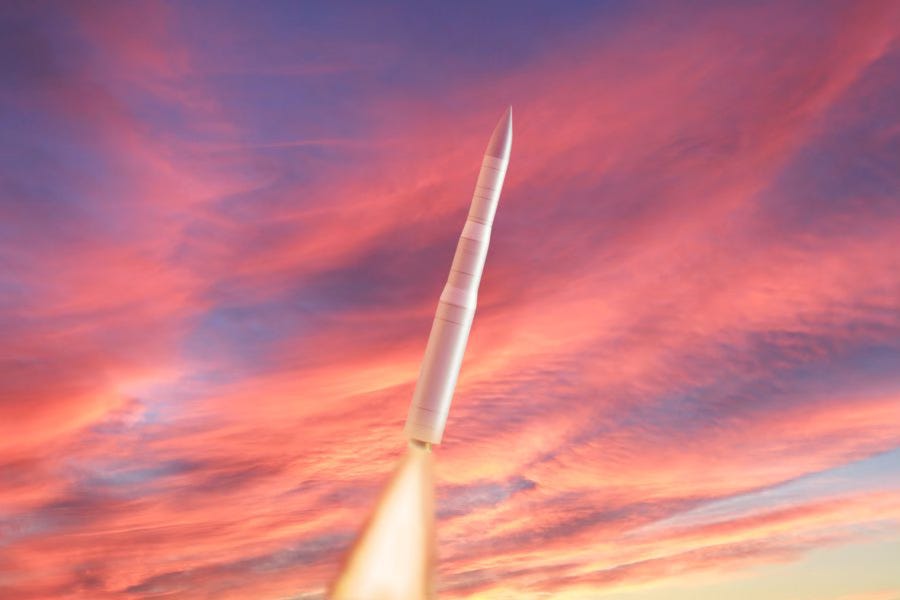
It’s time for recapitalization! (Red sky in morning, America take warning.)
Above is an idealized illustration of a Sentinel ICBM soon after launch. Don’t think about the aftermath of thermonuclear war. As NBC Pitchman Brian Williams once said, it’s important to be guided by the beauty of our weapons.
The business of nuclear weapons is booming in the U.S., as Part II of a documentary on the military-industrial complex reveals. It’s well worth a few minutes of your time:
The documentary is especially strong in its focus on the Sentinel ICBM program, the least survivable leg of the nuclear triad. I didn’t know, for example, that Northrop Grumman has already spent $220 million lobbying for the Sentinel. Meanwhile, the projected cost of the Sentinel system, the documentary points out, has mushroomed from $78 billion to $140 billion. And I see estimates today have risen to $160 billion. All this for a system that’s not needed. Land-based ICBMs should be retired, not replaced.
Because land-based ICBMs represent a fixed target (unlike bombers and submarines, the other two legs of the triad), they are likely to be attacked first in a nuclear war, contributing to a “launch on warning (of attack)” mentality. But with warnings of nuclear attacks being both uncertain (false alarms have occurred in the past) and “time-sensitive,” i.e. urgent and pressure-packed, it’s likely a U.S. president, faced with a crisis, would only have 5-10 minutes to decide whether to launch ICBMs.
As the U.S. prepares to spend as much as $1.7 trillion on upgrading the triad, more money is also being dedicated to low-yield nuclear weapons, lowering the threshold for going nuclear. An escalatory spiral could follow from any use of nuclear weapons, but that concern doesn’t seem to trouble advocates for so-called tactical nukes.
Even as President Trump in the past has bragged about the size of his nuclear button, he does appear to view nuclear weapons as awful things, which they are. They are genocidal weapons. In essence, America is “investing” $1.7 trillion in weapons that are genocidal, indeed ecocidal, for any “general exchange” of nuclear weapons in a future war would destroy most life on earth (blast and heat, followed by radiation and nuclear winter).
As the Outlaw Josey Wales once mused, “Dyin’ ain’t much of a living.” The same applies to mass dying.
Isn’t it high time we “augment” our nuclear force “posture”? Shouldn’t we fight to achieve peace through nuclear “strength” and “deterrence”? Isn’t it smart to “refurbish, rebuild, and modernize” the nuclear triad? What a great “investment” that is! And a “job-creator” too!
These are some of the buzz words thrown about by the nuclear “elites” in America. They want to sell us on new ICBMs (the Sentinel), a new stealth bomber (the B-21 Raider), and new nuclear SLBMs (on Columbia-class submarines). All this thermonuclear stupidity is projected to cost roughly $2 trillion over the next 30 years. Quite the “investment,” right?
What the “experts” don’t talk about is the genocidal and exterminatory nature of these thermonuclear bombs and missiles. They don’t talk about the destruction of most life forms on our planet due to thermonuclear winter. They don’t talk about the enormous and rapidly mushrooming cost of these weapons. (For example, the B-21 has already climbed from $550 million per plane to $750 million; much like a missile, Sentinel costs have rocketed upward even more rapidly.) And they sure as hell don’t talk about the immorality of mass murder.
Why does this idiocy, this madness, this insanity, persist? We know why. A few quick and obvious reasons:
1. Threat inflation: Oh my God, China is building some silos! Oh my God, Russia still has nukes! And Putin! Even though America has over 5000 nuclear bombs and warheads and the world’s most accurate and survivable nuclear force, the military-industrial complex is more than willing to hype and inflate new threats.
2. Lobbyists: There are outrageous sums of money to be made building genocidal weaponry, and a small army of lobbyists deployed to Washington by companies like Northrop Grumman to ensure the money keeps flowing to the weapons makers.
3. Jobs: Of course, any program that spends $2 trillion is going to create a few jobs, even earth-destroying bombs and missiles. But the jobs argument remains compelling for states like Montana, New Mexico, North Dakota, Utah, and Wyoming that profit from nuclear largesse. Senators and representatives from these states generally couldn’t care less about the nature of the “pork” they bring home—even irradiated pork in the form of nuclear weapons—as long as they can claim it’s creating good-paying jobs for the folks back home.
4. The Pentagon: Insatiable generals and admirals always want MORE. More nuclear bombers and missiles. More submarines. More of everything. No service will ever voluntarily give up a weapon system, no matter how old and dumb it is—or dangerous.
5. Lack of a unified movement against these weapons: In the early 1980s, the nuclear freeze movement put millions of people in the street to protest against new nukes like the American Pershing II and GLCMs. Then-President Ronald Reagan worked with Soviet Premier Mikhail Gorbachev to reduce—even to eliminate—nuclear weapons. Elimination wasn’t to be, but the U.S. and USSR did work to reduce nuclear weapons. That spirit of cooperation through diplomacy is dead. Meanwhile, Americans post-9/11 have grown accustomed to endless war and mushrooming Pentagon budgets. America itself has become more segmented, more stovepiped, more supine. That said, so many problems bedevil us that nuclear annihilation, as apocalyptic as that is, seems both remote and unsolvable.
To that last point: The nuclear threat is both near and solvable. Instead of our “elites”stressing about the survivability of the nuclear triad, we need to focus on the survivability of humanity. President Trump allegedly seeks a Nobel Peace Prize. He also seemingly has a genuine fear of nuclear war. Americans need to push him—as well as representatives in Congress—to seek nuclear disarmament through diplomacy rather than further nuclear escalation with new weaponry.
The problem, as one Congressman put it, is that money is the crack cocaine of politics. And nuclear weapons makers have plenty of money to hook our so-called representatives on the thermonuclear crack they’re selling.
We need an intervention to get America off its addiction to thermonuclear crack. Of course, it’s never easy overcoming a nuclear addiction—all I can say is our very survival depends on it.
It’s always the right time to stop building more weapons of mass destruction
William Astore and Matthew Hoh
[Note to readers: Back in early September, Congressman Mike Turner penned an op-ed for the “liberal” New York Times supporting a massive “investment” in new nuclear weapons. Matt Hoh and I quickly submitted letters to the Times to protest this op-ed and its arguments; the Times ignored them. We then wrote our own op-ed below, shopping it to various mainstream media outlets without success. Here it finally appears for the first time.]
*****
Representative Mike Turner’s essay on nuclear weapons in The New York Times (We Must Invest in Our Aging Nuclear Arsenal, September 6, 2024) is dangerously loyal to counterproductive US national security policies and narratives.
Turner’s lamentation over foreign nuclear weapons programs ignores destabilizing US arms control choices this century. The US spends more on nuclear weapons than the rest of the world combined. Its $1.7 trillion modernization program (the Sentinel ICBM; the B-21 Raider bomber; Columbia-class nuclear submarines) has done little more than upset the decades-long nuclear deterrence balance among nations.
In his essay, Turner neglects to mention the US government’s unilateral withdrawal from multiple arms control treaties. Then-Senator Joe Biden rightly predicted the effects of George W. Bush’s abandonment of the Anti-Ballistic Missile (ABM) Treaty: “A year ago [in 2000], it was widely reported that our intelligence community had concluded that pulling out of ABM would prompt the Chinese to increase their nuclear arsenal tenfold.” The Chinese are now clearly headed in that escalatory direction.
To prevent the apocalyptic consequences of yet another nuclear arms race, the US should act to decrease “investments” in new weapons while cutting current arsenals by negotiating and enacting new arms reduction treaties. Together, the US and Russia already possess ten thousand nuclear warheads, enough to destroy life on earth and several other earth-sized planets. We need desperately to divest from nuclear weapons, not “invest” in them.
Consider as well that America’s current nuclear triad, especially the Navy’s Trident submarine force, is potent, survivable, and more than sufficient to deter any conceivable adversary.
Simply put, the US must stop building genocidal nuclear weapons. It must instead renew international efforts and treaties to downsize these dreadful and dangerous arsenals. Spending yet more trillions on more world-shattering nukes is worse than a mistake—it’s a crime against humanity.
Here we are haunted by the words of Hans Bethe, who worked on the Manhattan Project that created the atomic bomb during World War II. The first reaction Bethe said he’d had after Hiroshima was one of fulfillment—that the project they had worked on for so long had succeeded. The second reaction, he said, was one of shock and awe: “What have we done? What have we done,” he repeated. And the third reaction: It should never be done again.
That is the imperative here. The US must act so that future Hiroshimas will never happen.
It’s not America’s fate alone that’s at stake here, but the fate of humanity itself, and indeed most life on earth, as only a few dozen thermonuclear warheads exploding would likely produce nuclear winter and an eventual “body count” in the billions.
During the First Cold War, one heard it said: “Better dead than red.” That mentality remains, even as the “reds” today are more capitalist than communist. Meanwhile, the weapons makers for the military-industrial-congressional complex (MICC), in their greed, are the adversary within. From Israel and events in Gaza, we’ve learned the MICC will literally empower a people to commit mass murder. With more and newer thermonuclear weapons, the MICC may yet kill the world.
Higher quarterly profits will mean little when everybody is dead.
During the Vietnam War, a US Army major was heard to say: “We had to destroy the town to save it [from communism].” If America can destroy towns in Vietnam to “save” them from communism, if it can facilitate the destruction of Gaza to “save” it from Hamas, it can similarly destroy the earth to “save” it from China, or Russia, or some other “threat.” That is the indefensible (il)logic of building yet more weapons of mass destruction.
Contra Congressman Turner, there is no logical, sensible, defensible reason for America’s proposed “investment” in new nuclear weapons. But there are nearly two trillion reasons why it’s going forward, because that’s the projected total cost of modernizing America’s nuclear triad. Money talks—loudly, explosively, perhaps catastrophically.
Today, more than half of US federal discretionary spending is devoted to war and weapons. Americans, in essence, live both in a permanent war state and a persistent state of war. As bad as that reality is, a state of nuclear war is unimaginable and must not be allowed to happen.
At the height of the Cold War, one of us served in Cheyenne Mountain, America’s nuclear command center, and witnessed a simulated nuclear attack on the US. Even on the primitive monitors the Air Force had back in 1986, seeing Soviet missile tracks crossing the North Pole and terminating at American cities was unforgettable.
A generation earlier, Robert Oppenheimer, the “father of the atomic bomb,” tragically noted in 1965 that it was 20 years too late to control nuclear arms. Those efforts, he said, should have been started “the day after Trinity” in July of 1945.
Let’s not make it 80 years too late. Congressman Turner is exactly wrong here. We must cut America’s nuclear arsenal and pursue new nuclear disarmament treaties. Never should our children be haunted as we were (and still are) by the darkness and doom of radioactive mushroom clouds.
William Astore, a retired lieutenant colonel (USAF) and historian, is a senior fellow at the Eisenhower Media Network.
Matthew Hoh, a former Marine Corps captain and State Department official, resigned in protest in 2009 against America’s ill-conceived war in Afghanistan. He is Associate Director at the Eisenhower Media Network.
The Stupidity of the Sentinel ICBM and the B-21 Raider Bomber
My fellow Americans, your government wants to spend nearly $2 trillion over the next 30 years to “modernize” its nuclear arsenal. Modernization, of course, is a euphemism. And the Pentagon actually uses the word “invest” rather than “spend.” The dividends on this “investment” go to the weapons makers, obviously, not to the American people.
Let’s first consider the Sentinel ICBM; the military wants to buy 400+ of these and stuff them in fixed silos in places like Wyoming and North Dakota. Land-based ICBMs were (among other things) obsolete by the 1970s; that’s why the MX was developed as a mobile system under President Jimmy Carter. Fortunately, the shell-game idea of moving nuclear missiles around by truck or rail was too dear and dumb even for the government. You don’t “modernize” that which is obsolete and redundant (and escalatory due to its inherent vulnerability). The smart move here is to eliminate land-based ICBMs.
Speaking as a retired Air Force officer, my old service will always want more of everything, including that which is obsolete. It’s all about budgetary share. No enemy is more to be dominated than the other services, who are also competing for money.
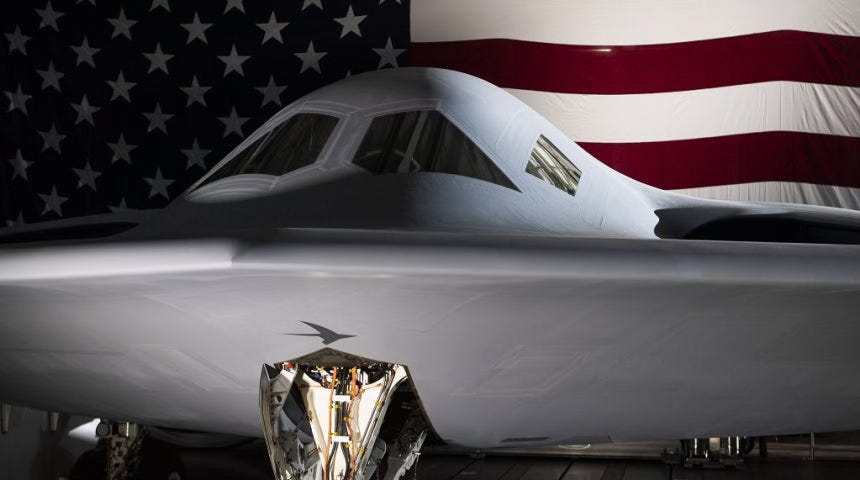
The B-21 Raider, with American flag (Northrop Grumman photo)
Similarly, strategic bombers to drop nuclear bombs (or even to launch cruise missiles) are not needed for nuclear deterrence. The whole idea of “penetrating” strategic bombers was obsolete by the late 1970s, which is why President Carter cancelled the B-1 bomber (it was revived by Ronald Reagan). We simply don’t need more strategic nuclear bombers–but the AF will always want them. If pilots can fly it (even if they have to do it remotely, as with drones), the AF wants it. Who cares if the B-21 will cost roughly $1 billion per plane when it’s finally fielded?
There is no need for the Sentinel or Raider. But the Air Force will fight until doomsday to protect its budgetary authority and the pilot and command billets that come with nuke missile fields and planes.
Let’s never forget the power of the industrial side of the military-industrial complex as well. There are hundreds—even thousands— of billions of dollars at stake here, so of course industry will fight to the end (of all of us) for the money. Weapons makers will spend millions on lobbyists, and millions more to buy politicians, to make billions in return. The profit margin here is better than crypto or most anything, actually.
They say alchemists were wrong that lead could be turned into gold, but every day the lead of bullets is sold, earning gold for the weapons makers, so alchemy is real after all. Now America’s weapons makers are turning radioactive uranium and plutonium into nearly $2 trillion in gold (or paper money, at least), the ultimate alchemical trick.
The Madness of Nuclear Warfare, Alive and Well in America
W.J. Astore
(Here’s my latest for TomDispatch.com; If you haven’t subscribed, you should!)
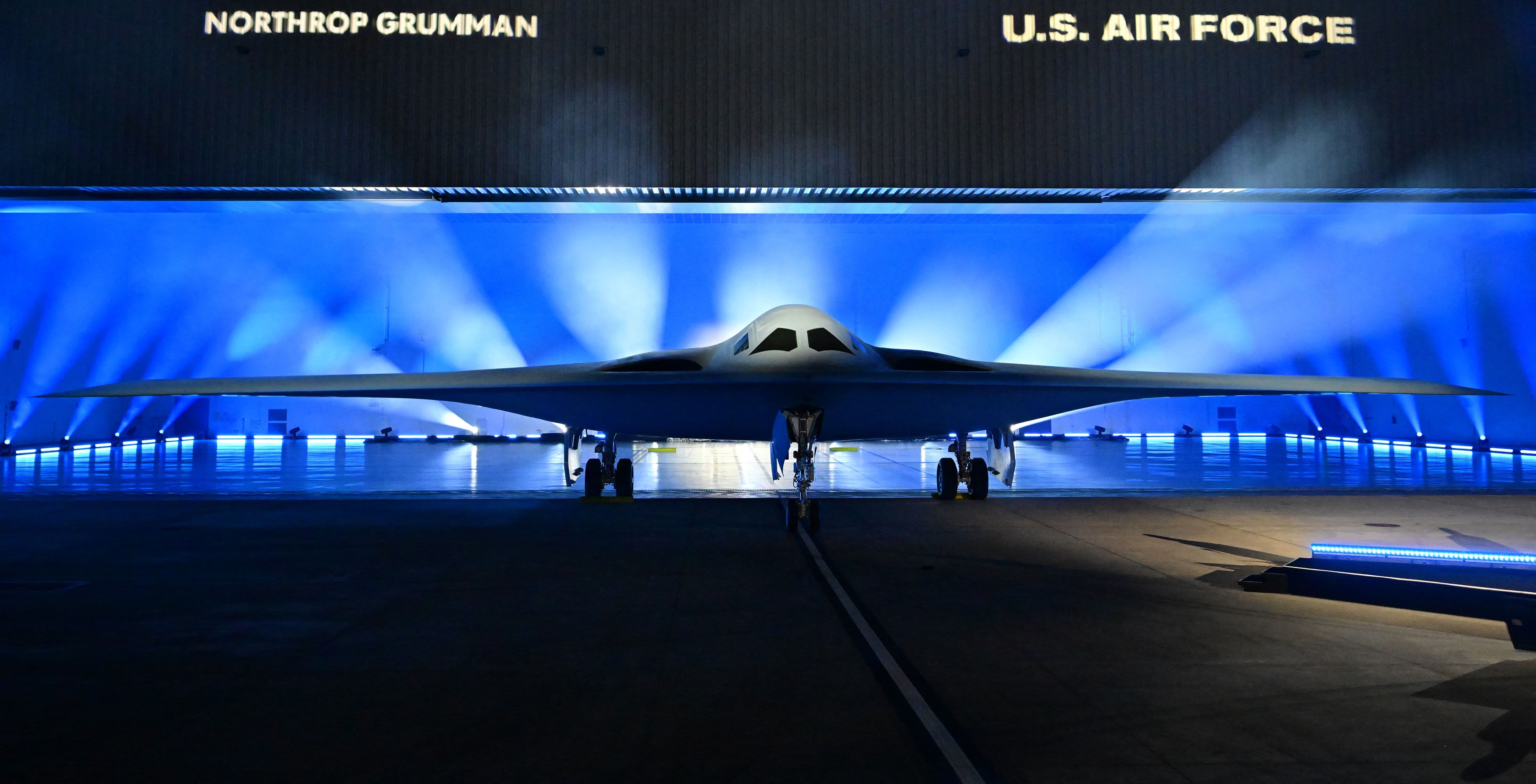
Hey, cheer up because it truly is a beauty! I’m talking about this country’s latest “stealth bomber,” the B-21 Raider, just revealed by Northrop Grumman, the company that makes it, in all its glory. With its striking bat-winged shape and its ability to deliver a very big bang (as in nuclear weapons), it’s our very own “bomber of the future.” As Secretary of Defense Lloyd Austin put it at its explosive debut, it will “fortify America’s ability to deter aggression, today and into the future.” Now, that truly makes me proud to be an American.
And while you’re at it, on this MAD (as in mutually assured destruction) world of ours, let that scene, that peculiar form of madness, involving the potential end of everything on Planet Earth, sink in. As a retired Air Force officer, it reminded me all too vividly of my former service and brought to mind the old motto of the Strategic Air Command(SAC), “Peace Is Our Profession.” Headed in its proudest years by the notorious General Curtis LeMay, it promised “peace” via the threat of the total nuclear annihilation of America’s enemies.
SAC long controlled two “legs” of this country’s nuclear triad: its land-based bombers and intercontinental ballistic missiles, or ICBMs. During the Cold War, those Titans, Minutemen, and MX “Peacekeepers” were kept on constant alert, ready to pulverize much of the planet at a moment’s notice. It didn’t matter that this country was likely to be pulverized, too, in any war with the Soviet Union. What mattered was remaining atop the nuclear pile. A concomitant benefit was keeping conventional wars from spinning out of control by threatening the nuclear option or, as was said at the time, “going nuclear.” (In the age of Biden, it’s “Armageddon.”)
Luckily, since the atomic destruction of Hiroshima and Nagasaki in 1945, the world hasn’t gone nuclear again and yet this country’s military continues, with the help of weapons makers like Northrop Grumman, to hustle down that very path to Armageddon. Once upon a time, the absurdity of all this was captured by Stanley Kubrick’s masterpiece, the satirical 1964 film Dr. Strangelove, which featured a “war room” in which there was no fighting, even as its occupants oversaw a nuclear doomsday. Sadly enough, that movie still seems eerily relevant nearly 60 years later in a world lacking the Soviet Union, where the threat of nuclear war nonetheless looms ever larger. What gives?
The short answer is that America’s leaders, like their counterparts in Russia and China, seem to have a collective death wish, a shared willingness to embrace the most violent and catastrophic weapons in the name of peace.
Nuclear Bombers and ICBMs Return!
There’s nothing magical about the nuclear triad. It’s not the Holy “Trinity,” as a congressman from Florida said long ago. Even so, it’s worshipped by the U.S. military in its own all-too-expensive fashion. America’s triad consists of bombers capable of carrying nuclear weapons (B-52s, B-1s, B-2s, and someday B-21s), those land-based ICBMs, and that most survivable “leg,” the U.S. Navy’s Trident-missile-firing submarines. No other country has a triad quite as impressive (if that’s the word for it), nor is any other country planning to spend up to $2 trillion over the next three decades “modernizing” it. The Air Force, of course, controls the first two legs of that triad and isn’t about to give them up just because they’re redundant to America’s “defense” (given those submarines), while constituting a threat to life on this planet.
Recently, when the Air Force unveiled that B-21 Raider, its latest nuclear-capable bomber, we learned that it looks much like its predecessor, the B-2 Spirit, with its bat-like shape (known as a “flying wing” design) driven by stealth or the avoidance of radar detection. The Air Force plans to buy “at least” 100 of those planes at a projected cost of roughly $750 million each. Count on one thing, though: with the inevitable delays and cost overruns associated with any high-tech military project these days, the flyaway cost will likely exceed $1 billion per plane, or at least $100 billion of your taxpayer dollars (and possibly even $200 billion).
Four years ago, when I first wrote about the B-21, its estimated cost was $550 million per plane, but you know the story, right? The F-35 was supposed to be a low-cost, multi-role fighter jet. A generation later, by the Air Force’s own admission, it’s now a staggeringly expensive “Ferrari” of a plane, sexy in appearance but laden with flaws. Naturally, the B-21 is advertised as a multi-role bomber that can carry “conventional” or non-nuclear munitions as well as thermonuclear ones, but its main reason for being is its alleged ability to put nuclear bombs on target, even without Slim Pickens (“Major Kong” in Kubrick’s Dr. Strangelove) riding down on one of them.
The main arguments for expensive nuclear bombers are that they can be launched as a show of resolve but also, unlike missiles, recalled, if necessary. (Or so we hope anyway.) They have a “man in the loop” for greater targeting flexibility and so complicate the enemy’s defensive planning. Such arguments may have made some sense in the 1950s and early 1960s, before ICBMs and their sub-launched equivalents were fully mature technologies, but they’re stuff and nonsense today. If nuclear-capable nations like Russia and China aren’t already deterred by the hundreds of missiles with thousands of highly accurate nuclear warheads in America’s possession, they’re not about to be deterred by a few dozen, or even 100, new B-21 stealth bombers, no matter the recent Hollywood-style hype about them.
Yet logic couldn’t matter less here. What matters is that the Air Force has had nuclear-capable bombers since those first modified B-29s that dropped Little Boy and Fat Man on Hiroshima and Nagasaki, and the generals are simply not about to give them up — ever. Meanwhile, building any sophisticated weapons system like the B-21 is sure to employ tens of thousands of workers. (There are already 400 parts suppliersfor the B-21 scattered across 40 states to ensure the undying love of the most congressional representatives imaginable.) It’s also a boondoggle for America’s many merchants of death, especially the lead contractor, Northrop Grumman.
A reader at my Bracing Views Substack, a Vietnam veteran, nailed it when he described his own reaction to the B-21’s unveiling:
“What struck me in my heart (fortunately, I have a great pacemaker) was the self-assured, almost condescending demeanor of the Secretary [of Defense], the Hollywood staging and lighting, and the complete absence of consideration of what cognitive/emotional/moral injuries might be inflicted on the viewer, never mind experiencing exposure to the actual bomber and its payload — add in the incredible cost and use of taxpayer money for a machine and support system that can never actually be used, or if used, would produce incalculable destruction of people and planet; again, never mind how all that could have been used to start making America into a functioning social democracy instead of a declining, tottering empire.”
Social democracy? Perish the thought. The U.S. economy is propped up by a militarized Keynesianism tightly embraced by Congress and whatever administration is in the White House. So, no matter how unnecessary those bombers may be, no matter how their costs spiral ever upwards, they’re likely to endure. Look for them flying over a sports stadium near you, perhaps in 2030 — if, that is, we’re still alive as a species.
As the Air Force buys new stealth bombers with your tax dollars, they also plan to purchase a new generation of ICBMs, or a “ground-based strategic deterrent” in Newspeak, to plant in missile silos in garden spots like rural Montana, Nebraska, North Dakota, and Wyoming. The Air Force has had ICBMs since the 1960s. Roughly 1,000 of them (though that service initially requested 10,000) were kept on high alert well into the 1980s. Today’s ICBM force is smaller, but ever more expensive to maintain due to its age. It’s also redundant, thanks to the Navy’s more elusive and survivable nuclear deterrent. But, again, logic doesn’t matter here. Whether needed or not, the Air Force wants those new land-based missiles just like those stealth bombers and Congress is all too willing to fund them in your name.
Ka-ching! But hopefully not ka-boom!
Just as the purchase price for the B-21 project is expected to start at $100 billion (but will likely far exceed that), the new ICBMs, known as Sentinels, are also estimated to cost $100 billion. It brings to mind an old saying (slightly updated): a hundred billion here, a hundred billion there, and pretty soon you’re talking real money. In a case of egregious double-dipping, Northrop Grumman is once again the lead contractor, having recently opened a $1.4 billion facility to design the new missile in Colorado Springs, conveniently close to the Air Force Academy and various other Air and Space Force facilities. Location, location, location!
Why such nuclear folly? The usual reasons, of course. Building genocidal missiles creates jobs. It’s a boon and a half for the industrial part of the military-industrial-congressional complex. It’s considered “healthy” for the communities where those missiles will be located, rural areas that would suffer economically if the Air Force bases there were instead dismantled or decommissioned. For that service, shiny new ICBMs are a budget bonanza, while helping to ensure that the real “enemy” — and yes, I have the U.S. Navy in mind — won’t end up with a monopoly on world-ending weaponry.
In the coming decades, expect those “Sentinels” to be planted in fields far from where most Americans live under the guiding principle that, if we keep them out of sight, they’ll be out of mind as well. Yet I can’t help but think that this country’s military is out of its mind in “planting” them there when the only harvest can be of mass death.
It’s a MAD Old World
As MAD magazine’s Alfred E. Neuman would undoubtedly have said, “What, me worry?”
Oh, MAD old world that has such nukes in it! Color me astonished, in fact, that America’s nuclear weapons mix hasn’t changed much since the 1960s. That sort of world-ending persistence should tell us something, but what exactly? For one thing, that not enough of us can imagine a brave new world without genocidal nuclear weapons in it.
In 1986, President Ronald Reagan and Soviet leader Mikhail Gorbachev actually did so. They came close, in fact, to reaching a deal to eliminate nuclear weapons. Sadly, Reagan proved reluctant to abandon his dream of a nuclear space shield, then popularly known as “Star Wars” or, more formally, as the Strategic Defense Initiative. Since Reagan, sadly enough, U.S. presidents have stayed the course on nukes. Most disappointingly, the Nobel Prize-winning Barack Obama spoke of eliminating them, supported by former Cold War stalwarts like Henry Kissinger and George Schultz, only to abandon that goal, partly to solidify support in the Senate for a nuclear deal with Iran that, no less sadly, is itself pretty much dead and buried today.
If saintly Reagan and saintly Obama couldn’t do it, what hope do ordinary Americans have of ending our nuclear MADness? Well, to quote a real saint, Catholic peace activist Dorothy Day, “Our problems stem from our acceptance of this filthy, rotten system.” It’s hard to think of a system more filthy or rotten than one that threatens to destroy most life on our planet, so that this country could in some fashion “win” World War III.
Win what, exactly? A burnt cinder of a planet?
Look, I’ve known airmen who’ve piloted nuclear bombers. I’ve known missileersresponsible for warheads that could kill millions (if ever launched). My brother guarded ICBM silos when he was a security policeman in SAC. I sat in the Air Force’s missile-warning center at Cheyenne Mountain under 2,000 feet of solid granite as we ran computerized war games that ended in… yep, mutually assured destruction. We were, at least individually, not insane. We were doing our duty, following orders, preparing for the worst, while (most of us, anyway) hoping for the best.
A word of advice: don’t look for those within this nightmarish system to change it, not when our elected representatives are part of the very military-industrial complex that sustains this MADness. Only an alert and knowledgeable citizenry, with real freedom, could act to do so for the benefit of humanity. But will we ever do that?
“We’re going backwards as a country,” my wife reminds me — and I fear that she’s right. She summarized the hoopla at the B-21’s recent unveiling this way: “Let’s go gaga over a mass-murder machine.”
Collectively, it seems that we may be on the verge of returning to a nightmarish past, where we lived in fear of a nuclear war that would kill us all, the tall and the small, and especially the smallest among us, our children, who really are our future.
My fear: that we’ve already become comfortably numb to it and no longer can take on that culture of mass death. I say this with great sadness, as an American citizen and a human being.
No matter. At least a few of us will have profited from building new ultra-expensive stealth bombers and shiny new missiles, while ensuring that mushroom clouds remain somewhere in our collective future. Isn’t that what life is truly all about?


 Bracing Views