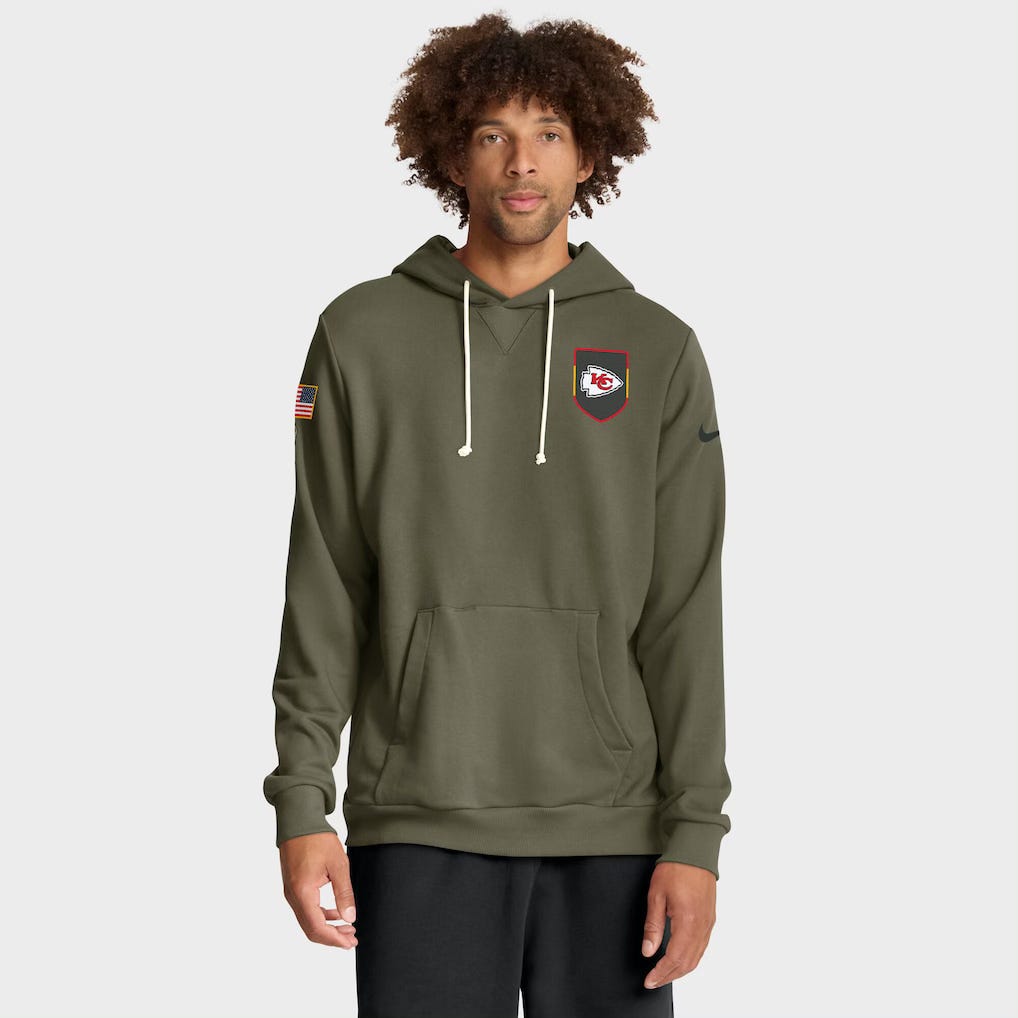
As I watched NFL football yesterday, I noticed coaches on the sidelines wearing “salute to service” fatigue-like hoodies. The NFL does this every year to celebrate the military and to “support our troops.” It’s popular and lucrative to boot, since you can buy this gear on nflshop.com (a hoody will set you back a cool $115).
For $115, you too can own a team hoodie in military olive drab. Hooah!
Sports, especially NFL football, are incredibly powerful and influential within American society.
Back in 2018, I was briefly involved in discussions, associated with the 9/11 Memorial & Museum in New York City, about the role sports played in the aftermath of the attacks in 2001. The general subject was how sports brought the nation together after those attacks. I shared the following comments below with two likeminded colleagues who were involved in the initial discussions, after which I never heard anything from the museum.
I think sports did help to bring the nation together after 9/11. The return of the games showed a return to normalcy. They were a chance for patriotic display and also an opportunity to forget, perhaps for just a moment, the losses America suffered in those attacks.
But they arguably set a precedent. In the aftermath of 9/11, patriotic displays took on a military flavor that has only grown more powerful over the years. My memory is of spontaneous displays that, over time, grew increasingly organized, exaggerated, and linked to corporate and commercial agendas, while retaining a strong military presence.
Anti-war demonstrations failed as the nation mobilized for war against Iraq in 2003. That war proved disastrous. The Bush/Cheney administration hid the costs of war from us (not even allowing us to see flag-draped caskets) and suppressed criticism of a disastrous war by telling us we needed to “support our troops.”
Not to be cynical, but how much of this sports/military/patriotism blending is done, not just for recruiting purposes, but to inhibit any kind of serious (and populist) movement against the “forever” wars we’re waging?
In other words, the post-9/11 sports/military nexus, while it may have soothed the country in the aftermath of 9/11, came with a high price tag: the lack of any serious questions about why we were attacked, and also the discouragement of anti-war protests as both divisive and disrespectful.
To me the high price is reflected in the life of Pat Tillman. He patriotically sacrificed a lucrative NFL career to fight the war on terror. It appears he came to question that war. He was killed by friendly fire [in 2004], which the Army hushed up, giving him a false narrative and a Silver Star under false pretenses. One man’s selfless patriotic act became twisted into a feel-good heroic moment that betrayed the ideals of the Army and of the country (and devastated his family as well).
Does the 9/11 museum really want to tackle tough issues like this? The appropriation of patriotism by the powerful as a way of silencing dissent? The betrayal of ideals we hold dear?
I added the following comment on “camouflage” sports uniforms being marketed around Independence Day in 2018:
I was talking with my wife yesterday. She, like me, hates the camouflage swag that’s been incorporated into sports uniforms. This is not “military appreciation.” It’s more military indoctrination and idolization.
We wear camouflage when we’re in deadly combat. It’s totally inappropriate for games that are supposed to be entertaining and fun, not a matter of life-and-death.
The Romans used gladiatorial games to accustom the mob to violence; to inure them to murder and killing; to train them to support the worst of Rome’s imperial policies. Are we using our games to accustom Americans to incessant warfare and surging military budgets and the “wonders” of our own empire?
I wrote something about this here: As America’s games are becoming more militarized, America’s wars are becoming more game-like, a form of infotainment, at least in the way they’re packaged and sold by the media:
So I think some of this macho militarism is being promoted as a counter to this “feminized society.” Trump tapped this sentiment, calling for protesters to be punched, for the NFL to allow more violent hits, etc.
We’re all supposed to be “real men” again: sort of like the Reagan years. Remember the book, “Real Men Don’t Eat Quiche”? Now it’s real men punch protesters, wear camouflage, and …
I didn’t finish my list of “real men” activities in 2018. Today, we hear even more about “warrior ethos” and the like, about the need to show toughness, e.g. by summarily murdering people on speedboats in the Caribbean who may, or may not, be drug-runners, or by dragging young teenagers off the streets and shipping them hundreds of miles to detention centers because their papers aren’t in order, and so on.
So, as the NFL persists in wearing pseudo-military gear, perhaps they might consider a new rule that would make every player a member of the reserves or national guard, subject to military recall and service from the months of March to August. If they want to salute military service so vigorously, why not just serve in uniform?
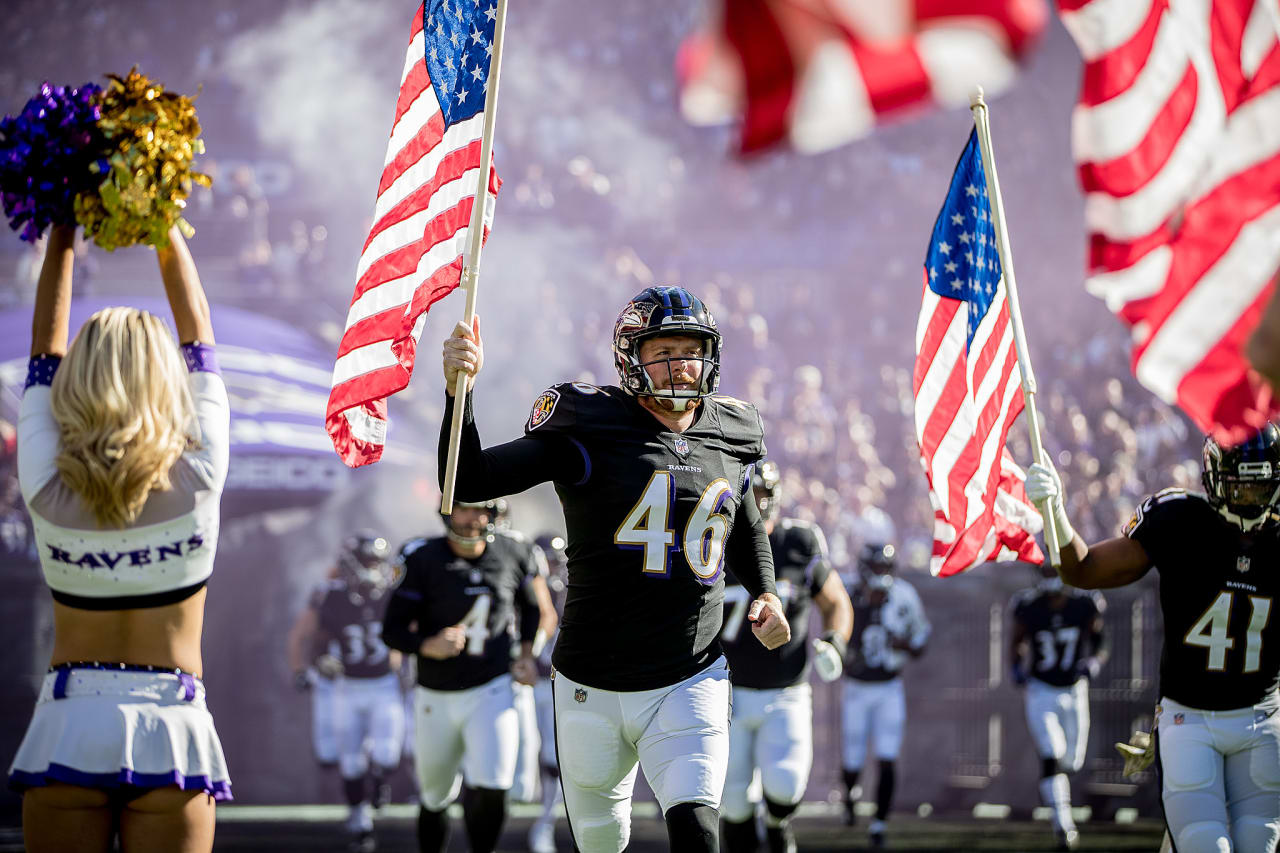
Now this makes me proud to be an American. “Salute to service” during Ravens-Steelers game.
W.J. Astore
A few months ago, I was talking to a researcher about the Pentagon, the military-industrial complex, and America’s fourth (and most powerful?) branch of government: the national security state. After talking about the enormous sweep and power of these entities, she said to me, it’s the elephant in the room, isn’t it? More than that, I replied: It’s the rampaging herd of elephants in the room. Even so, we prefer to ignore the herd, even as it dominates and destroys.
This thought came back to me as I read Danny Sjursen’s recent article at Antiwar.com. His main point was that enormous Pentagon spending and endless wars went undebated during this election cycle. President Trump preferred to talk of “invasions” by caravans of “criminals,” when not denigrating Democrats as a mutinous mob; the Democrats preferred to talk of health care and coverage for preexisting conditions, when not attacking Trump as hateful and reckless. No one wanted to talk about never-ending and expanding wars in the Greater Middle East and Africa, and no one in the mainstream dared to call for significant reductions in military spending.
As Sjursen put it:
So long as there is no conscription of Americans’ sons and daughters, and so long as taxes don’t rise (we simply put our wars on the national credit card), the people are quite content to allow less than 1% of the population [to] fight the nation’s failing wars – with no questions asked. Both mainstream wings of the Republicans and Democrats like it that way. They practice the politics of distraction and go on tacitly supporting one indecisive intervention after another, all the while basking in the embarrassment of riches bestowed upon them by the corporate military industrial complex. Everyone wins, except, that is, the soldiers doing multiple tours of combat duty, and – dare I say – the people of the Greater Middle East, who live in an utterly destabilized nightmare of a region.
Why should we be surprised? The de facto “leaders” of both parties – the Chuck Schumers, Joe Bidens, Hillary Clintons and Mitch McConnells of the world – all voted for the 2002 Iraq War resolution, one of the worst foreign policy adventures in American History. Sure, on domestic issues – taxes, healthcare, immigration – there may be some distinction between Republican and Democratic policies; but on the profound issues of war and peace, there is precious little daylight between the two parties. That, right there, is a formula for perpetual war.
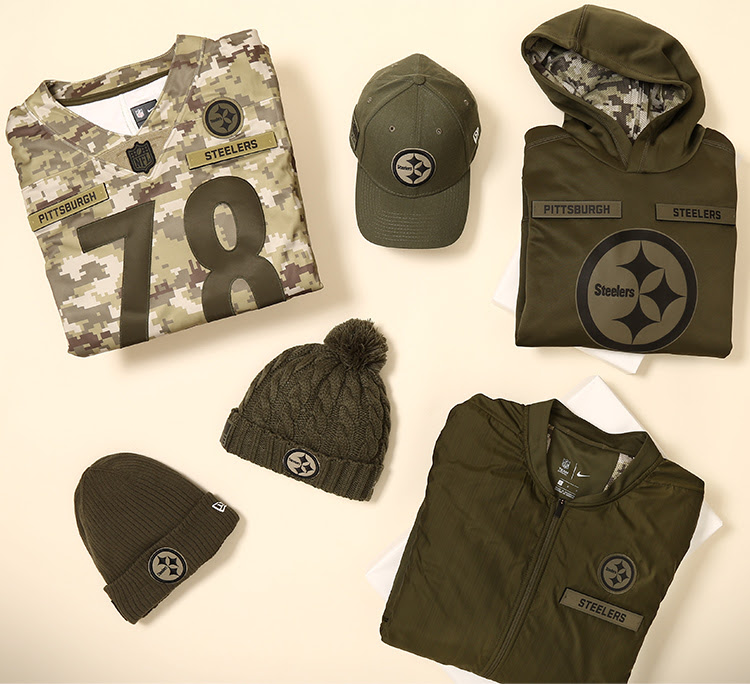
As we refuse to debate our wars while effectively handing blank checks to the Pentagon, we take pains to celebrate the military in various “salutes to service.” These are justified as Veterans Day celebrations, but originally November 11th celebrated the end of war in 1918, not the glorification of it. Consider these camouflage NFL hats and uniforms modeled on military clothing (courtesy of a good friend):
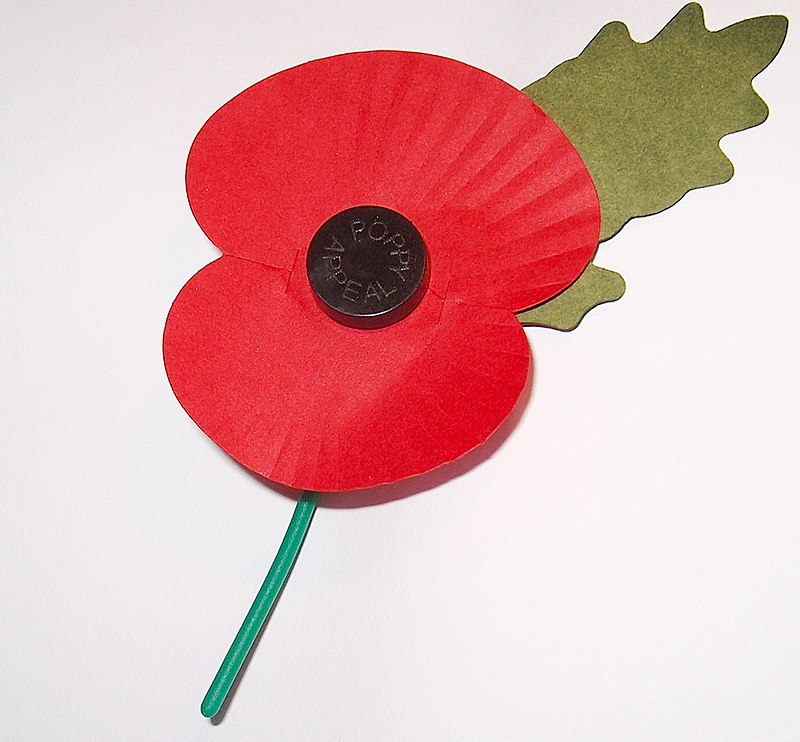
When I lived in England in the early 1990s, the way people marked Veterans or Armistice Day was with a simple poppy. I recall buying one from a veteran who went door-to-door to raise funds to support indigent vets. Students of military history will know that many young men died in World War I in fields of poppies. Thus the poppy has become a simple yet powerful symbol of sacrifice, loss, and gratitude for those who went before us to defend freedom.
No poppies for us. Instead, Americans are encouraged to buy expensive NFL clothing that is modeled on military uniforms. Once again, we turn war into sport, perhaps even into a fashion statement.


 Bracing Views