Thinking About the Russia-Ukraine War

W.J. Astore

Shooting for total victory for Ukraine may only lead to total war for the world

Recently, I’ve been discussing the Russia-Ukraine War with a friend.  He sees it as a “war of national liberation” for Ukraine and fully supports extensive U.S. military aid in weaponry, intelligence, and logistics. Supporters of Ukraine, he said, are much like those who supported republican Spain against the fascist forces of Franco in the 1930s.  Vladimir Putin is a dangerous dictator bent on Ukraine’s total subjugation.  He must be stopped, and the best way to ensure that is total military victory for Ukraine.  He also opined that Ukraine is winning the war and that the $100 billion or so that the U.S. government has pledged is money well spent.

Once Ukraine wins the war, he concluded, it should be fully integrated into NATO, still a vitally important alliance against Russian imperial expansion and exploitation.  Ukraine only seeks to protect its own sovereignty and to join European democracies and the EU, a goal the U.S. should actively seek to facilitate.  

I wish I could be as confident and certain as my friend of the nobility of both Ukraine’s cause and U.S. participation in Ukrainian politics and the war.  Why am I more skeptical than my friend?  For several reasons:

  1. The U.S. government has done nothing to facilitate diplomacy and negotiation between Ukraine and Russia.  Indeed, the Biden administration has worked to discourage diplomacy.
  2. Ukraine may see itself as engaged in a “war of national liberation,” but for U.S. officials it’s more of a proxy war to weaken Russia.  Various sanctions and the destruction of the Nord Stream pipelines suggest powerful economic and financial motives that have nothing to do with safeguarding Ukrainian territory or its “democracy.”
  3. Undeniably, U.S. aid to Ukraine, commitments of which have already exceeded $100 billion, are a major boon to the military-industrial complex in America.  When people profit massively from war and death, it’s reasonable to question their motives.
  4. The U.S. military/government exists to safeguard national security and the U.S. Constitution.  In that context, the territorial integrity of Ukraine is not a vital concern.
  5. The danger of military escalation in Europe is real.  A longer war means more dead and wounded soldiers on both sides; more destruction and collateral damage; and more inflammatory rhetoric about nuclear red lines, dirty bombs, and the like. The longer the war lasts, the more inflamed passions will become, and the more likely efforts “to end Russian occupation” of Ukraine will escalate into something far more ambitious — and likely far deadlier.
  6. To me, neither side appears to be clearly winning and neither is on the verge of victory.  If the war lasts another year, or two, or three, any kind of Ukrainian “victory” may be pyrrhic indeed if the country is a blasted husk as a result.
War is ugly. Long wars are uglier still.

As I explained to my friend, I deplore Putin’s decision back in February to invade.  I hope Ukraine prevails.  But I believe Russia, Ukraine, and indeed the world would be better off if the war ends via negotiated settlement, the sooner the better.  History teaches us that wars often spin out of control when estranged sides insist on total victory.

I added that I’d be careful indeed in placing faith in the wisdom of U.S. leaders or in appeals to ideals of the Lincoln Brigade of the Spanish Civil War of the 1930s.  Recent wars (Vietnam, Iraq, Afghanistan, etc.) should teach us how frequently U.S. leaders lie, and how willing they are to wage long and disastrous wars that compromise U.S. security.

Also, talk of “facilitating Ukraine’s liberation” is both open-ended and ill-defined. For the U.S., is that limited to weaponry and training and the like?  Or does “facilitating” mean much more than that, including combat by U.S. troops and the risk of dying or being grievously wounded in the cause of Ukraine’s liberation?  If the latter, would you send your sons and daughters to fight in such a war?

Talking about Ukrainian national liberation and protecting democracy seems unproblematic, but, as I asked my friend, are you and yours willing to fight and die for it?  When did Ukrainian “liberation” become so vitally important to U.S. national defense?  So much so that $100 billion or more of your money is sent there, so much so that the 101st Airborne Division is deployed to Romania as a form of tripwire or deterrent, so much so that plans to deploy upgraded U.S. tactical nuclear weapons to Europe are being accelerated even as recent exercises featured dry runs of nuclear weapons attacks.

Already the Russia-Ukraine War has lasted far longer than experts predicted.  Already it has cost far more than anyone expected.  Shooting for total victory for Ukraine may only lead to total war for the world.

(Please go to Bracing Views on Substack if you’d like to comment.)

Peace Is Pro-Life and Pro-Choice

W.J. Astore

On learning the value of negotiation from the Outlaw Josey Wales

We’re in a strange moment when advocating for negotiations toward peace in Ukraine is dismissed as not only wrongheaded but morally wrong.  We’re told that only Ukraine can determine its future, and that one must not appease a dictator (Putin), but in the same breath we’re told that peace will only come when Russia is totally defeated by force of arms, with the main arms supplier being the United States.  Methinks various actors in the U.S. are evincing a conflict of interest here.  When war is profitable and you keep arguing for it, it doesn’t take a detective to see motives that are suspect.

Even when it’s necessary, war is bloody awful and murderously atrocious.  Not surprisingly, Jesus Christ preferred to bless the peacemakers instead of the warmongers.  Yet peacemakers today in the U.S. are rare indeed in the government and in mainstream media.  In God we (don’t) trust.

Being anti-war strikes me as a sane position for any human being.  War, in rare cases, may be unavoidable and even necessary (I’d point to World War II as a necessary war to defeat Nazi Germany and Imperial Japan), but being anti-war should be reflexive.  As I once read on a bumper sticker: “I’m already against the next war.”  I laughed at that one.  Peace is joyful.

I’d go further and argue that peace is pro-life and pro-choice.  Everyone should be for it, unless, that is, you make your fortune from war.  It’s hard to be pro-life, after all, when you’re shouting “kill” at some enemy.  And you really have no choices when you’re dead.  If you want more choices in life, turn away from war.  There’s nothing like war to deny you choices — and perhaps life as well.

The Russia-Ukraine War may soon enter its second year.  No one in their right mind should be cheering for this.  I don’t want to see more dead Russians and Ukrainians.  I don’t want escalating tensions between the U.S. and Russia, the world’s most powerful nuclear-armed nations.  Only a fool or a war profiteer should want another cold war, considering that the previous one wasted trillions of dollars, cost millions their lives, and almost ended in nuclear Armageddon sixty years ago off the coast of Cuba.

For some reason an old Clint Eastwood film comes to mind: “The Outlaw Josey Wales.”  As Josey Wales says to Ten Bears, a Native American chief, in a grim life-or-death faceoff, “Men can live together without butchering one another.”  Wales, unafraid to be seen as “weak” by negotiating with a Comanche chief, brought his word of death even as he sought an understanding that would preserve life.  And life it was.

Negotiation is not weakness.  Peace and life, as Josey Wales knew, is far preferable to war and death.  If the will exists, even bitter opponents can find common ground and a path forward away from death.  Words of peace have iron of their own, as Ten Bears says.  They ring true when they resonate from people of honor.

Josey Wales, a man who’d lost his family to war and its butchery, a man who’d had to kill to survive, wanted nothing more than peace and a chance for a better life.  So should we all.

(If you’d like to comment, please go to Bracing Views on Substack. Thanks.)

Dammit, Where’s My Peace Dividend?

W.J. Astore

Just over 30 years ago, as a young captain in the Air Force, I was celebrating the collapse of the Soviet Union and the arrival of “the new world order.”  Those were the days!  We talked seriously about peace dividends, about America becoming a normal country in normal times, as in peaceful times.  Money on wars and weapons would be redirected to infrastructure improvements and repairs, to critical research in medicine, to improving health care, to renewable sources of energy.  America was ready to vault into the 21st century, no longer haunted by a cold war that could end the world in a heartbeat with nuclear war.

Leave it to America to snatch defeat from the jaws of victory.  For we truly have defeated ourselves since 1991 in our embrace of militarism, weaponry, and war.  And now we face renewed fears of nuclear war without any serious movement to end the proliferation of nuclear weapons.  Indeed, the U.S. military speaks of “investing” in more nuclear weapons as if they’re a growth stock, as if there are dividends awaiting us when we cash them in.  We’ll all cash in our chips, that’s for sure, if the missiles fly.

We seem possessed by a form of MADness, a certain fondness for mutually assured destruction (MAD).  Or, perhaps not fondness but resignation bordering on defeatism, which makes me think of those old posters we had as kids about nuclear war that reminded us there was little we could do once the missiles were launched, so we may as well kiss our ass goodbye.

But the world nevertheless remains full of surprises.  Color me amazed by America’s new love of Ukraine, formerly a Soviet republic that most Americans still can’t place on a map.  (I’ve seen Americans quizzed on the street who place Ukraine in Mexico or Australia.)  We love Ukraine so much that we’re willing to pledge $100 billion or more in aid, most of it in the form of military weapons and training.  America has never had a “special relationship” with Ukraine, so what gives?  My friends tell me we must defend democracy in Ukraine, but democracy doesn’t exist there (nor does it in America, but that’s another story).

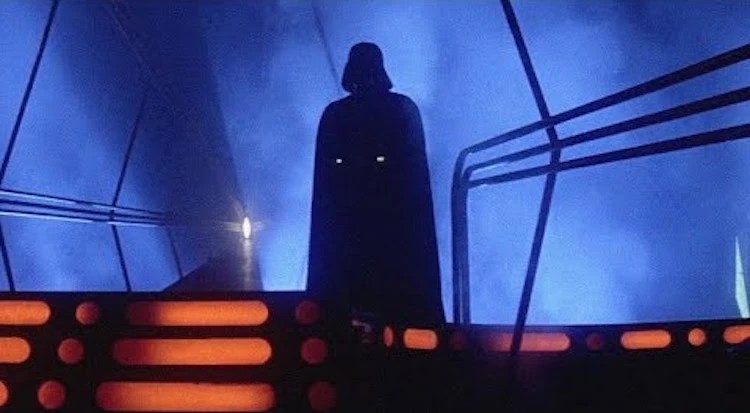
The words of Darth Vader come to mind: “You don’t know the power of the Dark Side [of the Force].  I must obey my master.”  And in the case of Congress, that master is obviously the national security state, the MICIMATT of which Congress is a card-carrying member. (MICIMATT: Military-Industrial-Congressional-Intelligence-Media-Academia-Think-Tank Complex.) Think of it as the real “evil empire,” and good luck trying to resist its power and influence.    

Yet, how can America have turned to the “dark side”?  Isn’t America a collection of Jedi knights fighting for freedom?  It sure would be nice to think so!  But when you look at America’s wars in places like Vietnam, Iraq, and Afghanistan, what you see is an incredibly rich empire throwing almost everything at countries and peoples who had little if anything compared to the wealth and power of the U.S. and its ferocious military machine.  You also see enormous profiteering, especially by the “industrial” side of the America’s militarized complex, and incessant lying by the U.S. government about progress and “winning” in its various misbegotten wars.

Only when military defeat is nearly total do U.S. troops finally come home, after which the peace advocates, relatively few in number, are blamed for weakening fighting spirit at home.

Promises of peace dividends, whether after World War II or the Cold War, have simply withered away as wars of conspicuous destruction (Vietnam, Iraq, etc.) fed a society engaged in conspicuous consumption.  A militarized form of Keynesianism provided jobs and wealth for relatively few Americans at the expense of a great many.

Paradoxically, even as America’s wars went bad, no one was ever held accountable.  When the warmongers admitted they were wrong (a rarity), they argued they were wrong for the right reasons.  And those who were truly right, whether about Vietnam or Iraq or Afghanistan, were obviously right for the wrong reasons.  Those “wrong” reasons included preferring peace to war or daring to question the purity of U.S. motives and methods when it came to foreign wars.

And so we’ve come to the point when the so-called Progressives in Congress quickly cave to pressure and withdraw a milquetoast and mealymouthed letter that argued a tiny bit for diplomatic efforts by the Biden administration to end the Russia-Ukraine War.  It was as if they’d become quislings; as if calling for negotiation was equivalent to bowing and scraping before Vladimir Putin.

So, I return to my question: Dammit, where’s my peace dividend?  And the answer is nowhere because powerful forces in America simply love their war dividends — and they’re not about to surrender them.

Note to readers: If you’d like to comment, please go to Bracing Views on Substack. Thanks.

Who or What Comes After Putin?

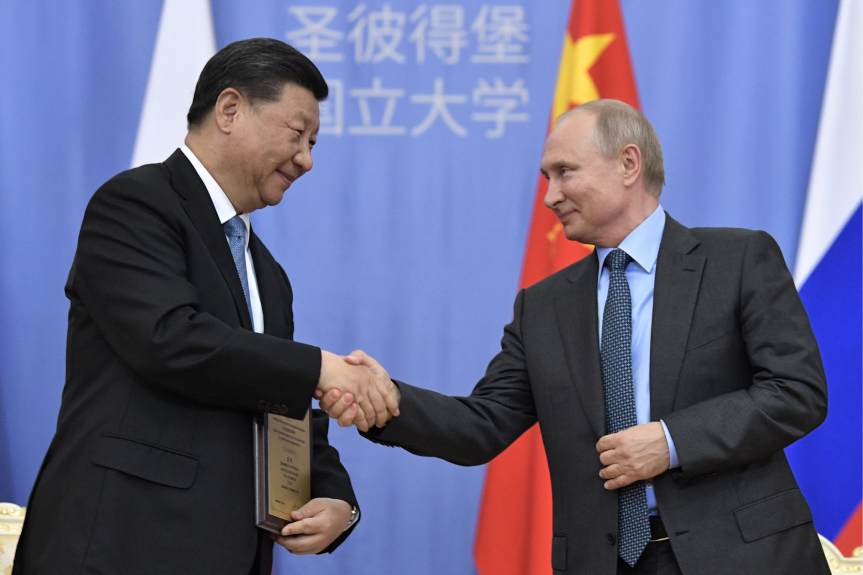
Will the world be safer if these men lose power?

W.J. Astore

The U.S. and NATO have apparently decided that the world is better (for them) if Russia is weak and chaotic instead of being comparatively strong and orderly.

Something tells me a strong and orderly Russia might be better. A weak and chaotic Russia, with nuclear weapons, is likely to be far less predictable. For example, who or what comes after Vladimir Putin if he’s overthrown? Is the West sure that a divided or disorganized Russia is a “better” one?

As Margaret Thatcher said of Mikhail Gorbachev, we can do business with him. Putin is a rational actor. Who or what follows him in Russia may be much more vengeful than rational — and vengeance and nukes are a potent, perhaps genocidal, mix.

Recently, I was thinking about the difference between the end stages of the Cold War, when I entered the Air Force in the 1980s, and the current crisis with Russia. To me, one big thing stands out. In the 1980s, the U.S. was willing to negotiate on equal terms with the USSR. Reagan and Gorbachev, despite their differences, talked to each other with respect. Today, Joe Biden refers to Putin and the Russians with disdain. Biden seems to see Putin as little more than a thug, someone not worth talking to. As Biden himself said, “For God’s sake, this man cannot remain in power.”

The U.S. has been a dominant superpower for so long that its leaders simply take it for granted and have little (if any) empathy for others. Weakening Russia is not a sign of American cleverness or strength but rather of shortsightedness.

In the 1980s, Reagan and Gorbachev talked sincerely of nuclear arms reductions, even of their eventual elimination. Nothing like this exists today. Indeed, the U.S. now speaks of “investing” in a new generation of nuclear weapons at a cost of a trillion dollars (or more). Basically, the U.S. is in a nuclear arms race with itself, even as Russia and China are trotted out as the looming nuclear threats.

In demonizing Putin and Russia, the U.S. is closing doors to negotiation and potentially opening missile silo doors to obliteration. By not bargaining at all, Biden and company are not being resolute, they’re being pigheaded.

As Winston Churchill famously said, “Meeting jaw to jaw is better than war.” Politics and war are not and should not be antithetical to each other. A negotiated settlement is better than more dead Ukrainians, more dead Russians, more blasted terrain, and even higher risks of nuclear escalation.

Haven’t we heard enough already about nuclear red lines and dirty bombs? Stability is what’s needed today based on some measure of respect, however grudgingly given. If avowed Cold War warriors like Reagan and Thatcher in the 1980s could do business with Gorbachev and the Soviet Union, America’s leaders today, from a much stronger position, should be able and willing to do business with Putin.

This is not about appeasing or rewarding Putin for his invasion. It’s about stopping a war before it potentially grows wider — and far more deadly.

Note for readers: If you care to comment on this post, please go to Bracing Views on Substack. Thanks.

Spoiling for a New World War

War! More War! Putin! Xi!

W.J. Astore

It seems strange to me how America’s leadership is spoiling for a new world war. Most Americans wanted revenge against Japan after Pearl Harbor in 1941 and understood the dangers of Nazism and Germany’s quest for world dominance, but why is risking a world war necessary in defense of Ukraine or Taiwan?  

Here’s my take: Let Ukraine and Russia settle their differences.  Let China and Taiwan settle their differences.  The fate of Ukraine or Taiwan has almost nothing to do with U.S. national security.

No other nation on the planet defines the entire world as its sphere of influence. Only in America is the fate of faraway countries like Ukraine or Taiwan tied directly to our fate. It’s like Russia being worried about the U.S./Mexican border or China taking a direct hand in defending Cuba against America.

Maybe what we need is a new Monroe Doctrine.  Instead of warning others to stay out of “our” hemisphere, Americans need to vow that we remain in “our” hemisphere, because what happens in Taiwan largely stays in Taiwan, and what happens in Ukraine largely stays in Ukraine.  Neither fundamentally compromises our national security and neither directly threatens our Constitution and way of life.

But we must stand up to Putin! We must stand up to Xi! If we don’t stop them over there, we’ll have to stop them here! To that I say, let’s wait and see. Any country foolish enough to invade America will face a heavily armed and inflamed people who are ready to rumble.

It’s time to stop spoiling for a new world war. Sadly, at least three big problems constrain Americans in plotting a saner course:

  1. Wars and preparations for war are immensely profitable for weapons makers.
  2. Domestic politics, as both parties accuse the other of being weak on China or Russia or both, driving both parties into the arms of hawks.
  3. The mainstream media, which never met a war it didn’t like, as long as ratings are high.

How do we fix this? Levy a war tax on the richest Americans for all the weaponry and other aid being sent to Ukraine and Taiwan and elsewhere. Stop voting for candidates who always vote for more and more war. Stop listening to the mainstream media and their warmongering.

One thing is certain: war is too important to be left to the generals, the Beltway bandits, and the usual neocon suspects who posture about putting on big boy pants while sitting safely in corner offices.

The Russia-Ukraine War as a World War

W.J. Astore

I haven’t written much about the progress of the Russia-Ukraine War. I have no special insight into what’s going on in Ukraine, or in Putin’s head, but I think I know something about the USA and its leadership.

The war itself: Russia and Ukraine are both losing. Russia is losing men and materiel; Ukraine is losing land and suffering all the destruction of a war fought on their turf. Many Americans seem to be cheering Ukraine and its resolute resistance, but at what cost, and for what purpose?

Historical analogies: American commentators like to refer to 1938 and Munich. Putin, naturally, is Hitler, and the world must stand up to him since Ukraine is only the first country on his list of potential conquests. If Putin wins in Ukraine, Poland would be next. Or the Baltic States. Because Putin wants to re-create the Soviet empire. Or the Russia of the Tsars.

But I think it’s much more like 1914. A regional conflict that may spin wildly out of control as more and more countries get swept into its escalatory spiral. Russian threats and nuclear red lines are more than worrisome. After all, wars are inherently chaotic and unpredictable, often creating their own bizarre logic of what’s right and wrong, what’s rational and irrational. Anyone who thinks they know how this war is going to end is overestimating the predictability of war. We’re all engaged in guess-work, and where nuclear threats are involved, guess-work is less than reassuring.

The Russia-Ukraine War could escalate to a world war: Already we’ve seen major economic sanctions involving the US, NATO countries, and Russia. Already we’ve seen Russia working with China and other countries to sell its fuel and other products as it seeks to evade those sanctions. Already we’ve seen inflation and recession in the US economy that can be tied back to those sanctions. Meanwhile, the US and NATO have sent tens of billions in weaponry to Ukraine to wage its war, which, to be blunt, is a form of proxy war for the US and NATO. The US president has called for regime change in Russia, declaring that Putin must go. Both Nord Stream pipelines have been attacked. This is not a simple regional war between Russia and Ukraine. It’s already a war with global implications openly funded by the US with the explicit goal of weakening Russia and removing Putin from power.

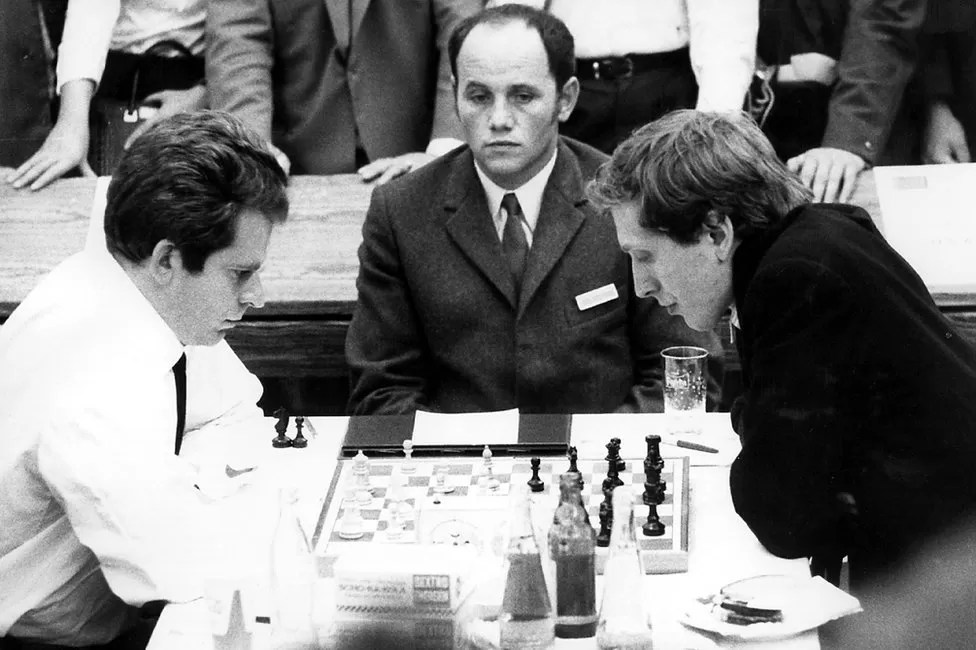
Boris Spassky versus Bobby Fischer: the good old days

To use chess terminology, the war still appears to be in its opening stages. Perhaps the middle game has begun; what’s certain is the end game is nowhere in sight. As Matt Taibbi recently noted, the Washington Post observed that “recent events have only added to the sense that the war will be a long slog,” and “all of this adds up to a war that looks increasingly open-ended.” Even worse, the paper noted:

Privately, U.S. officials say neither Russia nor Ukraine is capable of winning the war outright, but they have ruled out the idea of pushing or even nudging Ukraine to the negotiating table. They say they do not know what the end of the war looks like, or how it might end or when, insisting that is up to Kyiv.

Taibbi’s response is telling: “What??? If the White House doesn’t think the war can be won, but also refuses to negotiate itself, or ‘nudge’ others to do it for them, what exactly is its end strategy? Waiting for things to get worse and then reassessing?”

To return to chess: In games involving highly skilled players, often draws are agreed upon early in the middle game, as both players realize they have no prospects for victory and that further play will merely prolong the inevitable. It’s time for the major players in this conflict to agree to some version of a draw, a negotiated settlement, an end to conflict. Chess, after all, is just a game. The players don’t have to worry about dying in a nuclear cataclysm. We do.

Hypocrisy and “Tactical” Nukes

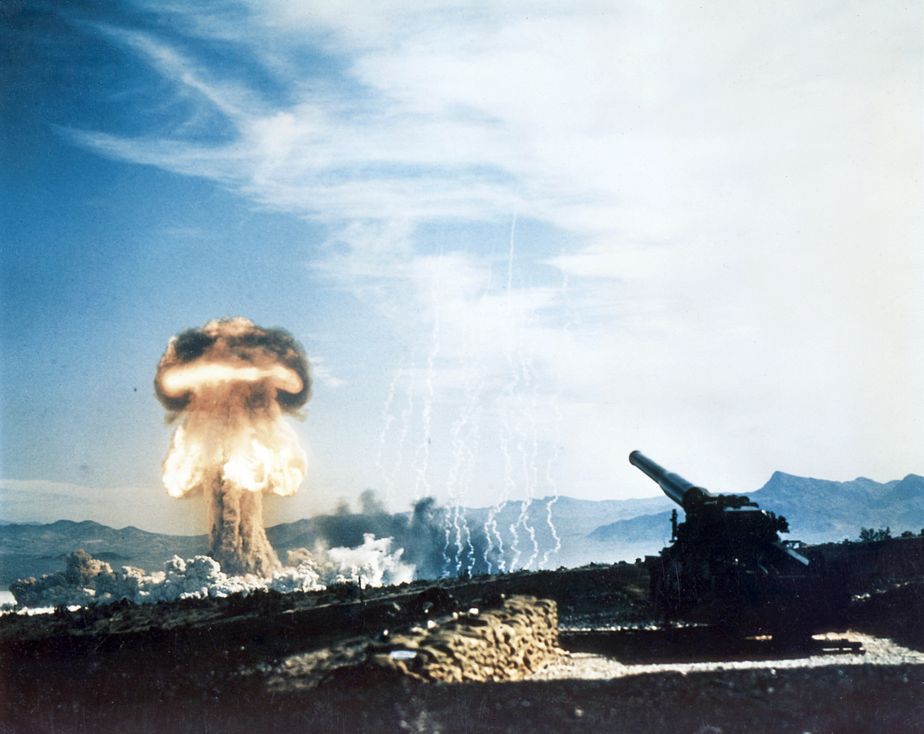
Don’t worry, it’s just a “little” tactical nuke!

W.J. Astore

With Russia issuing warnings about using all weapons at its disposal to protect its position in Ukraine, it’s a good time to talk about the distinction between “tactical” and “strategic” nuclear weapons.

Put bluntly, there’s no real distinction. All nuclear weapons, regardless of size and yield, are devastating and potentially escalatory to a full-scale nuclear war. Were Russia to use “tactical” nuclear weapons, the U.S. and NATO would likely respond in kind.  Even if a major nuclear war could be avoided, resulting political disruptions would likely aggravate ongoing economic dislocation, triggering a serious global recession, even a Great Depression, further feeding the growth of fascism and authoritarianism.

When you build weapons, there’s a temptation to use them. Weapons don’t exist in a vacuum. Within the military, people are trained to use them. Doctrine is developed along with contingency plans. Exercises are run to prepare for deployment and use in wartime, “just in case.” In short, we can’t count on sane heads to prevail here, not when some people seem to think you can use a “little” nuke to send a message.

Fortunately for the world, nuclear weapons haven’t been used in war since Hiroshima and Nagasaki in 1945. But they are used daily in the sense of intimidating other countries.  Currently, Russia is using its nuclear forces to try to contain US/NATO aid to Ukraine and involvement in the Russia-Ukraine War. Russia is drawing a nuclear red line, and I doubt it’s a bluff.

It’s hypocritical of both the US and Russia to accuse the other of nuclear brinksmanship since both countries have contingency plans to use nukes. Hopefully, it’s obvious to both countries how devastating it would be if a nuclear exchange, even a “limited” or “tactical” one, were to occur.

Even as bluffs, nuclear threats are reckless, since there’s always some fool who may seek to call the bluff. Let’s hope the US/NATO collective doesn’t play the fool. We have enough problems in the world without tossing nuclear warheads of whatever size or yield at each other.

Is Ukraine Winning?

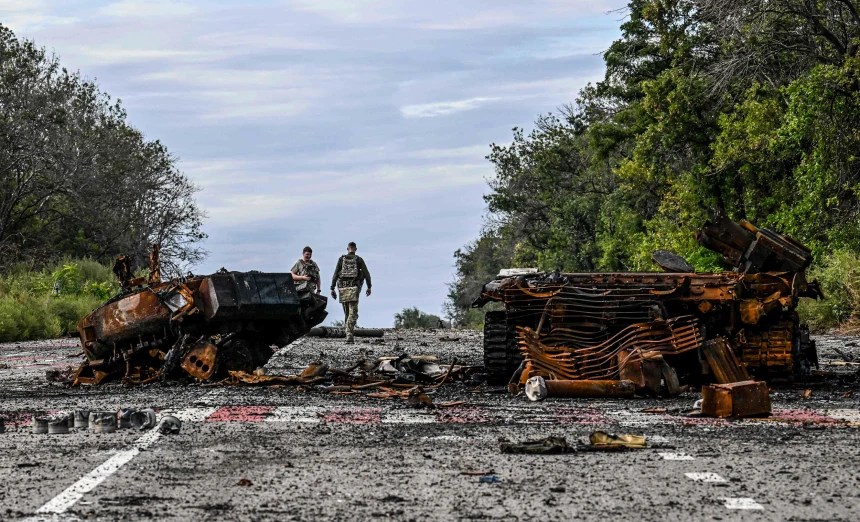
The detritus of war, but it’s Ukraine that’s bearing the brunt of war damage

W.J. Astore

At NBC News today, I saw this headline: “Ukraine’s offensive in the east surprised Russia — and it may be a turning point in the war.” Russian forces are retreating, but whether this represents a decisive turning point remains to be seen. Still, Ukraine resistance seems steady, and Russian will unsteady, at this moment in the war.

Surely, this is good news — or is it? With all the fighting taking place in Ukraine, the longer the war lasts, the worst it will likely turn out for Ukrainians. Turning points often are illusory: just ask all those U.S. generals who spoke of turning points in Afghanistan and Iraq over the last two decades. The best case scenario here is for Ukraine to use its military advantage and push for a favorable diplomatic settlement. I would hope Vladimir Putin might also see the wisdom of ending a war that has cost him more than he likely imagined when he started it earlier this year (as Andrew Bacevich explains at TomDispatch).

Too many Americans, it seems to me, are determined to see Russia suffer as much as possible. With Russia, the Pentagon’s argument goes something like this: Putin is a malevolent and irredentist dictator.  Without NATO expansion, the Baltic States would already have been reabsorbed by Russia, with Poland and other (former) eastern bloc nations next on Putin’s target list.  Putin, a “clear and present danger,” is only kept in line by U.S. and NATO military power, because his goal is a new Russian empire with borders much like those that Russia had in 1914 or, if that proves overly ambitious, 1989 before the Soviet collapse.  Only a resolute America (and now Ukraine) stands in his way, but that requires massive military spending in a renewed effort at containment, together with yet more spending on America’s nuclear triad.  “Containment” and “deterrence,” once again, are the neutral-sounding words that enable open-ended U.S. military spending against Russia (and of course Red China as well).

Truly what we don’t need is Cold War 2.0. The world barely survived the first one, and that was before climate change emerged as the serious threat that it is today.

In the 1990s, the U.S. and NATO rejected the idea that Russia maybe, just maybe, could be incorporated into the European Community in a security architecture respectful of Russian history and goals while also securing nascent democracies in former Warsaw Pact countries. Today, that rejection is complete, as Russia and Putin are dismissed as irredeemable deplorables, to borrow a phrase from Hillary Clinton.

Yet I wouldn’t underestimate Russian resilience. Just ask Hitler, Napoleon, or Charles XII about that. They all invaded Russia and got spanked. The time has come not to continue the vilification of Russia but to reach accords that Russians, Ukrainians, and other Europeans can all live with.

You wage war long, you wage it wrong, especially when it’s being waged on your turf. Short of total capitulation by either side, which is unlikely, let’s hope Zelensky and Putin can find a way to resolve their differences Let’s hope as well that the U.S. sees the wisdom of facilitating a diplomatic settlement that ends the killing.

Though President Biden previously has suggested Putin must go, I’d be very careful what he wishes for. Russia under new leaders may prove even more volatile and vengeful than U.S. leaders think it’s been under Putin.

U.S. Propaganda Gets Even Heavier

W.J. Astore

You’d think watching the U.S. Open finals in tennis would constitute a break from incessant propaganda about war, but you’d be wrong to do so.

I’m a tennis fan so I watched this weekend’s finals with interest. A Pole defeated a Tunisian in the women’s final and a Spaniard defeated a Norwegian in the men’s final, which is a fair representation of the international flavor of the field. At both trophy ceremonies, what did the U.S. Tennis Association choose to highlight? The USTA boasted of raising $2 million for Ukraine war relief while describing the Russian invasion of Ukraine as “unprovoked.”

First of all, why is Russia’s war with Ukraine being mentioned at both trophy ceremonies? What has this got to do with tennis?

Second, why is the USTA raising money for Ukraine war relief? Shouldn’t it be raising money for, well, tennis? Perhaps for scholarships for underprivileged kids around the world to play tennis? After all, the U.S. taxpayer is already on the hook for nearly $70 billion in aid to Ukraine, roughly half of it in the form of arms and armaments. Compared to this sum, $2 million is a drop in the bucket.

Third, why is Russia’s invasion always described as “unprovoked,” as if Putin and Russia simply woke up one day and decided to invade a former Soviet republic?

Let’s think back to America’s invasion of Iraq in 2003. Was that also “unprovoked”? (After all, Saddam Hussein had no WMD and nothing to do with the 9/11 attacks.) Did the USTA raise money to help Iraqi civilians recover from U.S. war damage and crimes? Not that I recall.

Earlier this year, at Wimbledon, players from Russia and Belarus were banned from the tournament. (I guess because they were waging war with their tennis rackets for Putin?) At the U.S. Open, they were allowed to play but not under the flags of their countries. Do you recall U.S. tennis players being banned because of the “unprovoked” Iraq War? Neither do I.

The U.S. mainstream managers — even tennis officials! — are so concerned to describe the Russian attack as “unprovoked” that you know that they know it was provoked — and they’re at pains to deny it, even during tennis tournaments.

The heavy hand of U.S. propaganda only gets heavier when it intrudes on what should have been an apolitical and celebratory trophy ceremony for international athletes.

Note: I am, of course, against Russia’s invasion of Ukraine. What I would like to see is the U.S. supporting diplomatic efforts to end the war as quickly as possible. Currently, we hear much of Ukrainian victories, but it’s possible the war will only grow longer and more deadly as a result of these “victories.”

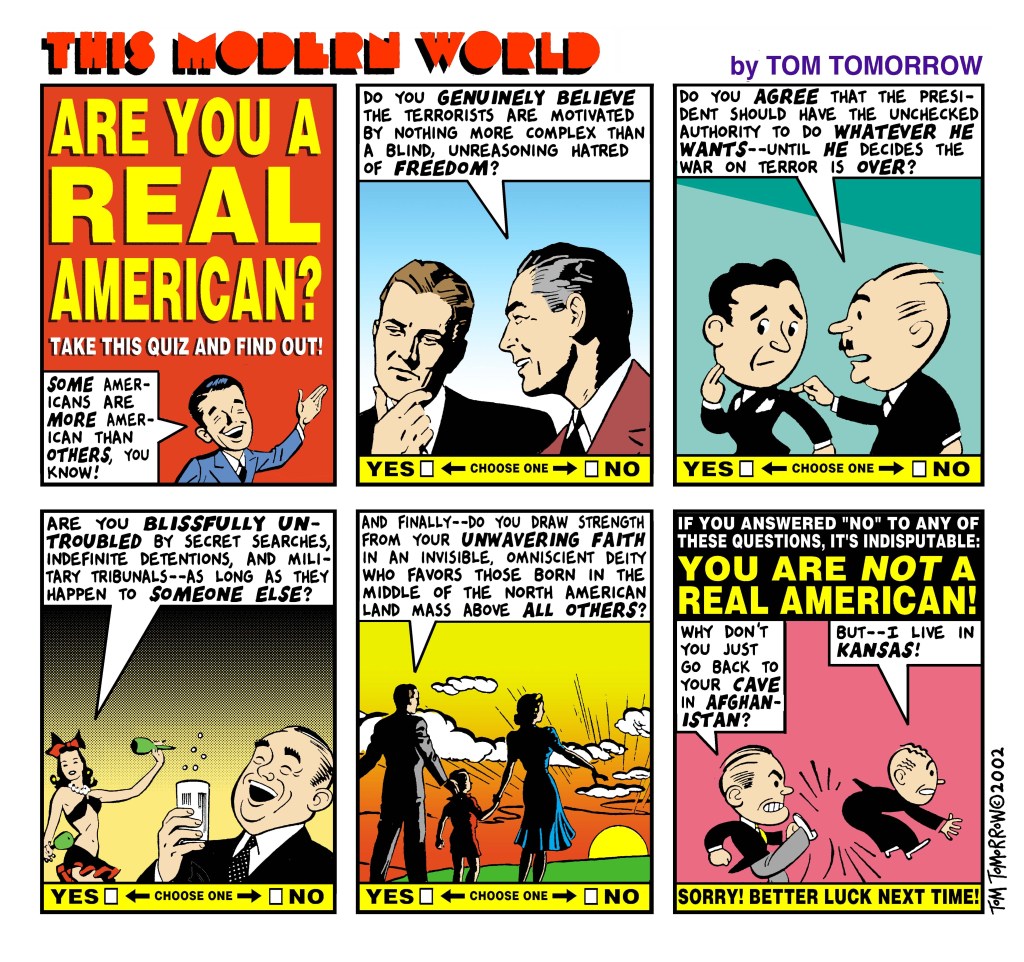
A classic “Tom Tomorrow” cartoon from 2002. Now, of course, “real Americans” must believe Russia’s invasion of Ukraine was completely unprovoked, that Ukraine deserves a blank check in U.S. taxpayer funds, and that Russian athletes should be ashamed of their own flag

The Ukrainian Boondoggle as a Black Hole

W.J. Astore

Back on June 1st, I noted that Ukraine couldn’t possibly absorb more than $54 billion in U.S. aid, most of it related to weaponry and munitions, given the country’s lack of infrastructure as well as the chaos inherent to a shooting war.

As I wrote back then:

The entire defense budget of Ukraine before the war was just under $6 billion. How can Ukraine possibly absorb (mostly) military “aid” that represents NINE TIMES their annual defense budget? It simply can’t be done…

From a military perspective, the gusher of money and equipment being sent to Ukraine makes little sense because there’s no way Ukraine has the infrastructure to absorb it and use it effectively. The U.S. approach seems to be to flood the zone with weaponry and assorted equipment of all sorts, irrespective of how it might be used or where it might ultimately end up. I can’t see how all this lethal “aid” will stay in the hands of troops and out of the hands of various criminal networks and black markets.

And so it goes. Recent reports suggest that only 30-40% of U.S. military aid is actually reaching Ukrainian troops. The rest is being siphoned off, lost, stolen, what-have-you. The response in U.S. media is to suppress this truth, per dictates from Ukraine!

Caitlin Johnstone does an excellent job of summarizing the case, and since she generously encourages her readers to share her posts, I thought I’d avail myself of her generosity. Without further ado:

Caitlin Johnstone, CBS Tries Critical Journalism; Stops After Ukraine Objects

Following objections from the Ukrainian government, CBS News has removed a short documentary which had reported concerns from numerous sources that a large amount of the supplies being sent to Ukraine aren’t making it to the front lines.

The Ukrainian government has listed its objections to the report on a government website, naming Ukrainian officials who objected to it and explaining why each of the CBS news sources it dislikes should be discounted. After the report was taken down and the Twitter post about it removed, Ukrainian Foreign Minister Dmytro Kuleba said this was a good start but still not enough.

“Welcome first step, but it is not enough,” Kuleba tweeted. “You have misled a huge audience by sharing unsubstantiated claims and damaging trust in supplies of vital military aid to a nation resisting aggression and genocide. There should be an internal investigation into who enabled this and why.”

The CBS News article about the documentary was renamed, from “Why military aid to Ukraine doesn’t always get to the front lines: ‘Like 30% of it reaches its final destination’” to the far milder “Why military aid in Ukraine may not always get to the front lines.” An editor’s note on the new version of the article explicitly admits to taking advisement on its changes from the Ukrainian government, reading as follows:

This article has been updated to reflect changes since the CBS Reports documentary ‘Arming Ukraine’ was filmed, and the documentary is also being updated. Jonas Ohman says the delivery has significantly improved since filming with CBS in late April. The government of Ukraine notes that U.S. defense attaché Brigadier General Garrick M. Harmon arrived in Kyiv in August 2022 for arms control and monitoring.”

CBS News does not say why it has taken so long for this report to come out, why it didn’t check to see if anything had changed in the last few months during a rapidly unfolding war before releasing its report, or why it felt its claims were good enough to air before Kyiv raised its objections but not after.

Someone uploaded the old version of the documentary on YouTube here, or you can watch it on Bitchute here if that one gets taken down. It was supportive of Ukraine and very oppositional to Russia, and simply featured a number of sources saying they had reason to believe a lot of the military supplies being sent to Ukraine aren’t getting where they’re supposed to go.

The original article quotes the aforementioned Jonas Ohman as follows:

“All of this stuff goes across the border, and then something happens, kind of like 30% of it reaches its final destination,” said Jonas Ohman, founder and CEO of Blue-Yellow, a Lithuania-based organization that has been meeting with and supplying frontline units with military aid in Ukraine since the start of the conflict with Russia-backed separatists in 2014.


“30-40%, that’s my estimation,” he said in April of this year.

“The US has sent tens of thousands of anti-aircraft and anti-armor systems, artillery rounds, hundreds of artillery systems, Switchblade armored drones, and tens of millions of rounds of small arms ammunition,” CBS’s Adam Yamaguchi tells us at 14:15 of the documentary. “But in a conflict where frontlines are scattered and conditions change without warning, not all of those supplies reach their destination. Some also reported weapons are being hoarded, or worse fear that they are disappearing into the black market, an industry that has thrived under corruption in post-Soviet Ukraine.”

“I can tell you unarguably that on the frontline units these things are not getting there,” the Mozart Group‘s Andy Milburn tells Yamaguchi at 17:40. “Drones, Switchblades, IFAKs. They’re not, alright. Body armor, helmets, you name it.”

“Is it safe to characterize this as a little bit of a black hole?” Yamaguchi asked him, perhaps in reference to an April report from CNN whose source said the equipment that’s being sent “drops into a big black hole, and you have almost no sense of it at all after a short period of time.”

“I suppose if you don’t have visibility of where this stuff is going, and if you’re asking that question, then it would appear that it’s a black hole, yeah,” Milburn replied.

“We don’t know,” Amnesty International’s Donatella Rovera tells Yamaguchi at 18:45 when asked if it’s known where the weapons being sent to Ukraine are going.

“There is really no information as to where they’re going at all,” Rovera says. “What is more worrying is that at least some of the countries that are sending weapons do not seem to think that it is their responsibility to put in place a very robust oversight mechanism to ensure that they know how they’re being used today, but also how they might and will be used tomorrow.”

A news outlet pulling a report because their own government didn’t like it would be a scandalous breach of journalistic ethics. A news outlet pulling a report because a foreign government didn’t like it is even more so.

We’ve already seen that the western media will uncritically report literally any claim made by the government of Ukraine in bizarre instances like the recent report that Russia was firing rockets at a nuclear power plant it had already captured, or its regurgitation of claims that Russians are raping babies to death from a Ukrainian official who ended up getting fired for promoting unevidenced claims about rape. Now not only will western media outlets uncritically report any claim the Ukrainian government makes, they will also retract claims of their own when the Ukrainian government tells them to.

It’s not just commentators like me who see the western press as propagandists: that’s how they see themselves. If you think it’s your job to always report information that helps one side of a war and always omit any information which might hinder it, then you have given yourself the role of propagandist. You might not call yourself that, but that’s what you are by any reasonable definition of that word.

And a great many western Zelenskyites honestly see this as the media’s role as well. They’ll angrily condemn anyone who inserts skepticism of the US empire’s narratives about Ukraine into mainstream consciousness, but then they’ll also yell at you if you say we’re not being told the truth about Ukraine. They demand to be lied to, and call you a liar if you say that means we’re being lied to.

You can’t have it both ways. Either you want the mass media to serve as war propagandists or you want them to tell the truth. You cannot hold both of those positions simultaneously. They are mutually exclusive. And many actually want the former.

This can’t lead anywhere good.

Follow this link to read all of Caitlin’s article: https://caitlinjohnstone.com/2022/08/10/cbs-wanted-to-do-critical-reporting-on-ukraines-government-but-ukraines-government-said-no/