Guess who’s exempt from a potential government shutdown?
I saw this today at CNN.
The Pentagon has also determined that the training and support of Ukrainian forces is exempt from a potential government shutdown, and will continue even in the increasingly likely event that Congress fails to pass a spending bill in the coming days.
Isn’t it nice to know that even if the U.S. federal government shuts down, Ukraine will still get all the weapons and related military aid they need to continue to fight and kill Russians? Americans may be furloughed from their jobs or have to work for no pay, but Ukraine will get paid.
That one sentence shows you the priorities for “your” government. Guess what? You’re not a priority, but war overseas is. You’re not exempt from a government shutdown, but Ukrainian military forces are.
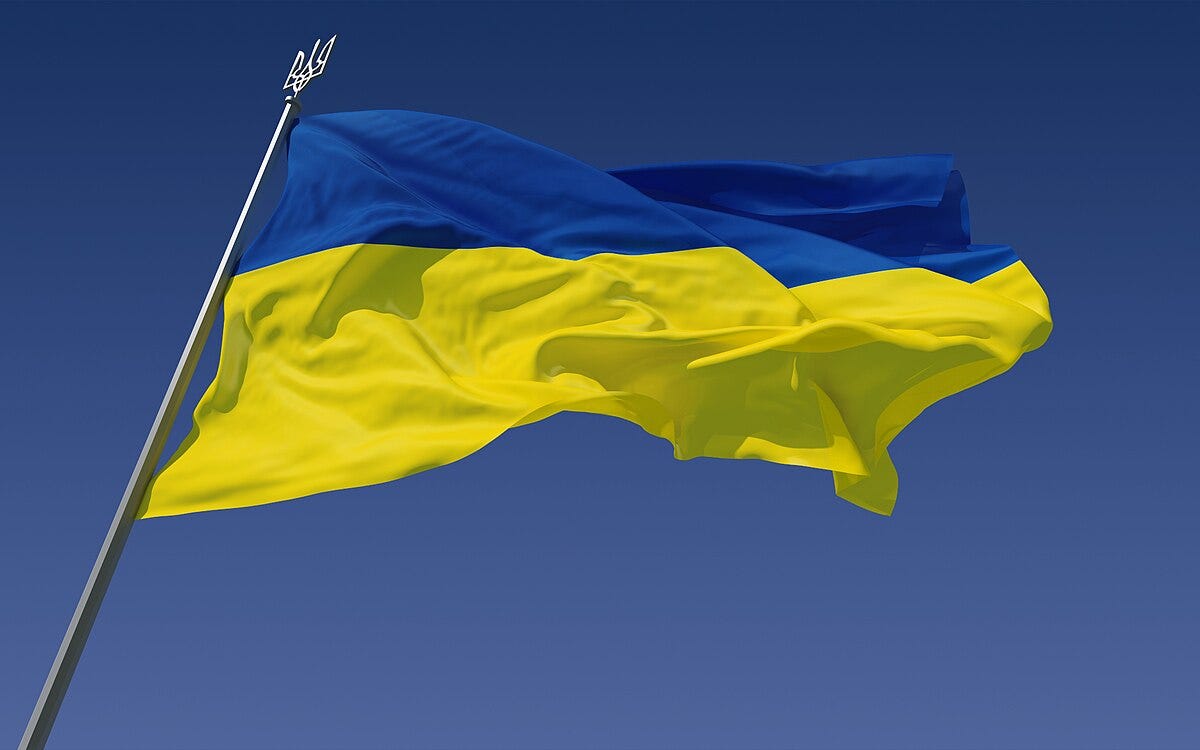
So, if you want to get paid, America, or enter a federal facility that may be closed due to a shutdown, just wave a blue-and-yellow flag and tell the government it’s all for the war effort in Ukraine.
Bring this flag with you and tell the government you’re exempt from the looming government shutdown
As the Ukrainian counteroffensive against Russia grinds on (or falters?), as U.S. disaster relief for Hawaii is tied to more military aid for Ukraine, as depleted uranium shells join cluster munitions as America’s latest gift to a blasted war zone, as calls for diplomacy continue to be muted when they’re not actively discouraged and dismissed, I was reminded of the alchemy of war.
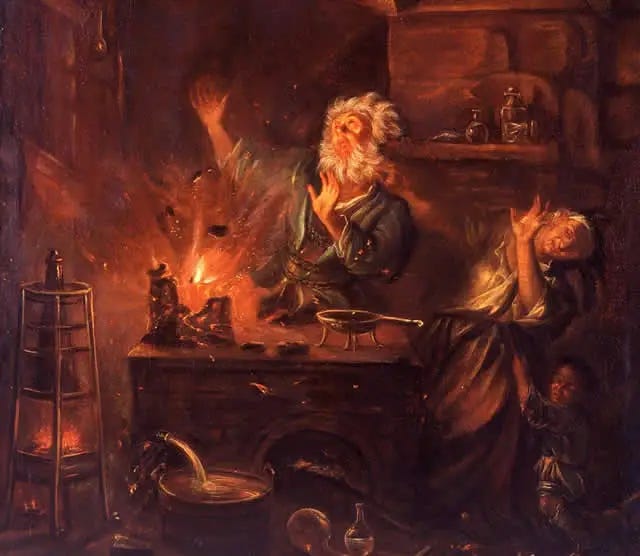
Alchemists of the early modern period were sophisticated experimenters driven by an often quasi-religious quest for perfection. We tend to remember only the most craven part of their experiments: the attempt to transmute lead into gold. This transmutation could not be effected, but alchemy itself transmuted into chemistry as its practitioners, through trial and error, developed a better understanding of the nature of the elements, reflected in part by today’s Periodic Table.
Seeking a divine spark
Yet the business of war succeeded where alchemists failed. In their alchemy, the merchants of death turned bullet lead into corporate gold. And what gold! Yearly war budgets continue to soar in the United States toward the trillion dollar mark. Weapons shipments to Ukraine continue at a pace that promises many more shattered and blasted bodies, Ukrainian and Russian.
In a sense, dead bodies are also being transmuted into corporate gold.
Transmutation, I was taught as a Catholic, is a miracle. The Word became flesh and dwelt among us (Jesus Christ, the Son of God, of course). We have made the miraculous the mundane, and indeed the profane. We take lead and spill blood which becomes gold. And some even celebrate this as good for business in the United States.
All these weapons: they’re job-creators! So we crucify the Word and elevate the life-takers and widow-makers as gods.
We are far more deluded than the alchemists of the past.
In today’s New York Times send out, I saw the following story:
Ukraine’s Forces and Firepower Are Misallocated, U.S. Officials Say
American strategists say Ukraine’s troops are too spread out and need to concentrate along the counteroffensive’s main front in the south.
Listen to the U.S. military, Ukraine! Don’t be casualty-averse! Concentrate your forces. Take the fight to the Russian enemy. Use all those cluster munitions we’ve sent you. Commit your armored reserve and punch a hole in the Russian lines. Break through, break out, and drive toward Crimea. You know: just like Americans would do in your place.
One might forgive Ukrainians if they asked, When was the last war you “experts” won for America? Afghanistan? Iraq? Vietnam? Korea? What about ongoing military commitments to Syria and Somalia? If you’re so good at winning wars, how come the U.S. military didn’t win in Afghanistan, Iraq, and Vietnam where you had overwhelming materiel and firepower superiority?
With respect to why Ukraine has its forces “too spread out”: perhaps Ukraine needs to garrison its lines so that it can fend off Russian counterattacks? If Ukraine concentrates its strategic reserve and uses it in a big counteroffensive that stalls, what’s to stop Russia from a decisive riposte? Think of Kursk for Nazi Germany in 1943. Once that huge offensive failed for Germany, using up its strategic reserve, the Red Army seized the initiative on the eastern front and never lost it.
At Kursk in 1943, the Germans committed their reserves in a desperate gamble to seize the initiative from the Soviet Union. When the offensive failed, the Red Army counterattacked and proved unstoppable.
Headlines like the one posted above from the New York Times are intended to be exculpatory for the U.S. If the war turns worse for Ukraine, U.S. “experts” can point to articles like this, casting blame on the Ukrainians for not following sage American advice.
If “we” win in Ukraine, it will be because of generous U.S. aid and especially vaunted U.S. and NATO weaponry; but if they (the Ukrainians) lose, it’s all their fault for not following the advice of America’s master strategists. And, obviously, even if Ukraine loses, plenty of weapons manufacturers in the U.S. are winning and will continue to win. Indeed, a Russian victory could be just the thing to propel even more weapons spending by NATO countries as well as even larger and more monstrous Pentagon budgets.
When others asked the truth of me, I was convinced it was not the truth they wanted, but an illusion they could bear to live with. — Anaïs Nin
War, among other things, is a place of illusion. With the Russia-Ukraine War, the illusions are many. For the mainstream media in America, the illusion promoted is this: Ukraine, a quasi-democratic country, is enduring an unprovoked invasion by authoritarian Russia, now in its 18th month. The freedom-fighters of Ukraine have been greatly assisted by benevolent military and economic aid freely offered and given by the Biden administration and NATO countries. Ukraine fights for a noble cause that the U.S. should and must support, since allowing Russia to prevail would lead to further unprovoked Russian invasions of other freedom-loving peoples in Europe.
It’s an illusion that’s comforting for Americans to live with, since it flatters us while vilifying an old enemy, the former Soviet Union and now Russia. It’s flattering to the Biden administration, which can pose as a stalwart defender of Ukraine, and certainly flattering to U.S. weapons makers, who can pose collectively as the new arsenal of democracy. It’s an illusion, moreover, that elides or disguises any economic motives the U.S. might have in supporting Ukraine so generously since the war began.
Even something as simple as smoke contains great complexity, as I recall from my fluid dynamics classes
The best illusions, the most seductive ones, have elements of truth to them. Yes, Russia did invade Ukraine; yes, Russia is authoritarian; yes, Ukraine has defied the odds and stymied Vladimir Putin’s designs; yes, NATO and U.S. weaponry has been important to Ukraine’s endurance. But partial facts are generally not impartial.
Briefly put, NATO expansion eastwards since the collapse of the Soviet Union is seen by Russia as provocative, constricting, and aggressive. Ukraine itself is very much an imperfect democracy, rating “high” on government corruption indices. U.S. meddling in Ukraine, especially in 2014, is most certainly problematic. The destruction of the Nordstream pipelines and subsequent profits by U.S.-based energy companies can’t be ignored. And, not surprisingly, U.S. weapons manufacturers are enjoying boom times. Not only does Ukraine need weaponry and ammunition, but U.S. and NATO stocks of the same must be replenished as arms and ammo are gifted to Ukrainian fighters. Nor is Ukraine completely free of neo-Nazi influences, which is to say that the situation is muddier and more complex than the comfortable illusion that’s so often sold by the mainstream media.
Which brings me to CNN’s report today, that showed up in my morning email:
President Joe Biden is asking Congress for more than $24 billion in aid for Ukraine and other international needs as he works to sustain support for the war amid signs of softening support among Americans. The request — which includes more than $13 billion in security assistance and $7 billion for economic and humanitarian assistance for Ukraine — sets up a potential battle with Republicans in Congress. Biden has promised support will last “as long as it takes,” but an increasingly skeptical Republican Party has cast doubt on US involvement going forward. This comes after a CNN poll released last week found 55% of Americans believe Congress should not authorize additional funding to support Ukraine.
As the Russia-Ukraine War drags on with neither side apparently having a quick victory in sight, questions accelerate. How much are Americans prepared to pay to Ukraine? Is an open-ended, “as long as it takes” commitment truly wise? What happens if the war escalates even further? And, perish the thought: What happens if someone uses a nuclear weapon or another form of WMD?
Many Americans today are in dire straits. Credit card debt for Americans recently exceeded $1 trillion and rising. The Biden administration has failed to provide promised and significant student debt relief; a public option for health care; a $15 federal minimum wage; while acting to break a railroad strike and promoting more fossil fuel drilling on fragile federal lands as well as offshore.
Americans are not stupid to wonder about the priorities of the Biden administration and why Ukraine gets a blank check as Americans continue to suffer. Illusions may be comfortable, but they don’t put food on the table or pay health care bills. And the price they come at may be high indeed, which is one reason, I think, a majority of Americans are none too comfortable with this illusion.
There is a famine of peace in the world today. I came across that phrase, “famine of peace,” in an article in the New Yorker that reported on a papal envoy sent to advocate for a truce and diplomacy to President Joe Biden. Biden, a practicing Catholic, gave the envoy a hearing, but as yet I’ve heard no change from the White House with respect to sending more weapons to Ukraine and maximum support for the war effort.
Pope Francis, working for peace, is exactly what I’d expect from Christ’s representative here on earth. Indeed, it is what I’d expect from all Christians everywhere. Yet we continue to have a glut of war in the world, with plenty of war pigs feeding at the trough.
Cardinal Matteo Maria Zuppi brought a message of peace to President Biden.
I’m a lapsed Catholic, but I have nothing but respect when the Church does its best to embody, obey, and manifest Christ’s two commandments: love God, love thy neighbor. Being faithful to these commandments is everything for Christians.
War is a terrible sin that enables and empowers so many other sins. Meanwhile, a famine of peace and a glut of war means terrible suffering for the world’s most vulnerable. War is thus to be avoided or averted under nearly all circumstances; indeed, Christ implored us to turn the other cheek when we are struck.
I’ve read enough “just war” theory to see how almost any war can be twisted as “defensive” and “necessary.” And I believe in rare circumstances the evil of war may be necessary to stop or prevent even worse evils, e.g. World War II put a stop to Nazi domination and the enslavement and massacre of millions of people, most especially Jews and gypsies, among other “undesirables” and “lesser humans” according to Nazi ideology.
The Pope in those days, Pius XII, did not speak forcibly enough to condemn the crimes of the Nazis. In Francis it is good to have a pope who’s willing to speak of today’s famine of peace. All Christians everywhere should look within to consider why peace is dying and war is thriving. Under these conditions, if we fail to act, do we dare even call ourselves “Christian”?
The U.S. Mainstream Media Finally Admits to a Costly Stalemate
It can’t be coincidence. In the past few days, I’ve seen articles at mainstream media outlets like the New York Times and Wall Street Journal that the much-hyped and much-delayed Ukrainian “spring” counteroffensive has stalled, and at high cost to Ukrainian troops. Here’s a quick online headline from the NYT on Monday:
The war is approaching a violent stalemate. Ukraine has made only marginal progress lately and is deploying less experienced soldiers after heavy casualties.
And here’s what the WSJ had to say (intro here from an article by Caitlin Johnstone):
In a new article titled “Ukraine’s Lack of Weaponry and Training Risks Stalemate in Fight With Russia,” the Wall Street Journal’s Daniel Michaels reports that western officials knew Ukrainian forces didn’t have the weapons and training necessary to succeed in their highly touted counteroffensive which was launched last month.
Michaels writes:
“When Ukraine launched its big counteroffensive this spring, Western military officials knew Kyiv didn’t have all the training or weapons — from shells to warplanes — that it needed to dislodge Russian forces. But they hoped Ukrainian courage and resourcefulness would carry the day.
“They haven’t. Deep and deadly minefields, extensive fortifications and Russian air power have combined to largely block significant advances by Ukrainian troops. Instead, the campaign risks descending into a stalemate with the potential to burn through lives and equipment without a major shift in momentum.”
So: We have both the NYT and WSJ admitting the war is likely to be stuck in a destructive stasis for the foreseeable future. This isn’t that surprising. Russia is deploying “defense in depth” tactics with minefields and other traps. Ukrainian forces try bravely to advance, they get stuck, and Russia replies with withering artillery fire.
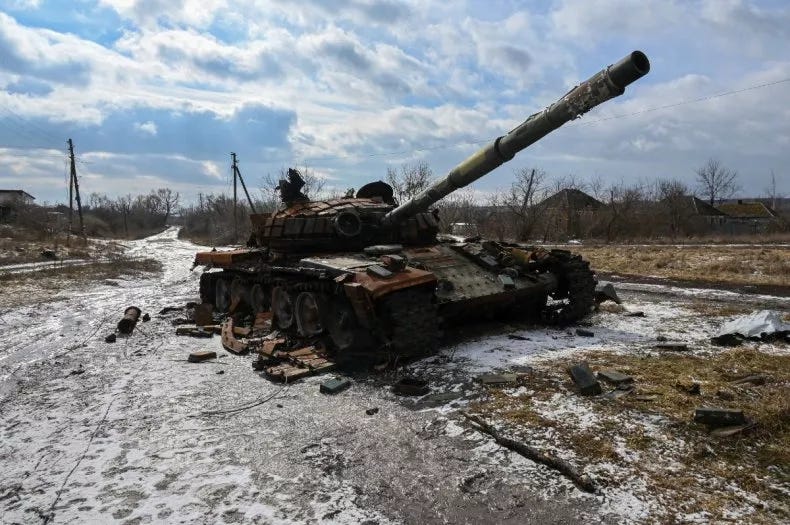
A destroyed Russian tank from March 2023, part of the poisonous detritus of war
There’s much of World War I here. WWI only ended when Germany collapsed from exhaustion after four terribly long and incredibly costly years of war.
I don’t know if Russia or Ukraine will collapse first. Certainly, Ukraine would collapse quickly without massive infusions of U.S./NATO aid.
What’s striking to me is how the MSM hyped the “decisive” spring counteroffensive, and how that narrative is now largely forgotten as a new narrative is rolled out, one where the course must be stayed until all those new U.S. weapons turn the tide, like M-1 tanks and F-16 jets.
Only time — and lots more dead — will tell. Supporters of Ukraine allege that progress is being made, that Russia is suffering more dearly, and that U.S./NATO aid must continue at the highest possible level to ensure that the forces of democracy will prevail against those of authoritarianism. These same supporters reject calls for diplomacy as misguided at best and at worst treasonous to Ukraine and appeasement to Putin. As long as Ukraine is apparently willing to fight to the last Ukrainian, the U.S./NATO should help them to do so.
I confess I don’t support this idea, which I hope doesn’t imply I’m a Putin puppet. Sorry, I don’t want to see Ukraine destroyed in a lengthy, murderous, and destructive war fought on their turf. Assuming this war is truly stalemated or otherwise bogged down, what better time for both sides to come together for a truce and some wheeling and dealing? The worst that could happen if talks bore no fruit, i.e. more killing, more war, is already happening and will continue to do so.
And indeed there are much worse things than a costly stalemate here: an expanded war that goes nuclear.
Interestingly, so far the mainstream sources I’ve read may be admitting to a stalemate but they’re not suggesting diplomacy in earnest. When they start doing that, I suppose that’ll mean things have truly gone bad for the embattled people of Ukraine.
In 1998, as an Air Force major, I attended a military history symposium on coalition warfare that discussed the future of NATO. One senior officer present, General Sir Anthony Farrar-Hockley, spoke bluntly in favor of NATO expansion. From my notes taken in 1998:
Farrar-Hockley took the position that to forego expansion because of Russian concerns would be to grant Russia a continuing fiefdom in Eastern Europe. Russia has nothing to fear from NATO, and besides, it can do nothing to prevent expansion. If the Soviet Union was an anemic tiger, Russia is more like a circus tiger that may growl but won’t bite.
That sums up the Western position vis-a-vis NATO expansion and Russia: too bad. You lost the Cold War. There’s nothing you can do.
Until the “circus tiger” finally bit back.
The U.S. and NATO calculated that Russia, now led by Vladimir Putin, wouldn’t bite back. It did so in 2022.
Even circus tigers may do more than growl
Now, you might argue it’s the tiger’s fault for biting; you might say Ukraine didn’t deserve to be bitten. But I don’t think you can say that U.S. and NATO actions were entirely guiltless or blameless in provoking the tiger. At the very least, the actions were misjudged (assuming there wasn’t a plot to provoke Putin and Russia into attacking).
Ukraine is central to Russia’s concerns. Both countries share a long common border and an even longer history. By comparison, Ukraine, I think, is peripheral to U.S. concerns, just as Afghanistan and Vietnam ultimately proved peripheral. Here I recall the critique of political scientist Hannah Arendt that, with respect to America, the Vietnam War was a case of using “excessive means to achieve minor aims in a region of marginal interest.” Whether in Vietnam or more recently in Afghanistan, the U.S. could always afford to accept defeat, if only tacitly, by withdrawing (even though die-hard types at the Pentagon always want to keep fighting).
All this is to say Russia’s will to prevail may prove more resilient than the current U.S. commitment to Ukraine of “blank check” support.
Ukraine resistance to Russia has indeed been strong, backed up as it has been by bountiful weapons and aid from the U.S. and NATO. Faced by an invasion, they are defending their country. But a clear victory for Ukraine is unlikely in the short term, and in the long term will likely prove pyrrhic if it is achieved.
No one in the U.S. thought that a punitive raid against the Taliban in 2001 would produce an Afghan War that would last for 20 years. When the U.S. committed troops in big numbers to Vietnam beginning in 1965, most at the Pentagon thought the war would be over in a matter of months. How long is the U.S. and NATO truly prepared to support Ukraine in its war against Russia?
In the 17 months or so since the Russian invasion, the U.S. has already committed somewhere between $115-$200 billion to Ukraine and the war. Should that commitment remain open-ended at that level until Ukraine “wins”? What of legitimate fears of regional escalation or nightmare scenarios of nuclear exchanges?
Long wars usually don’t end with a healthier democracy. Indeed, wars most often generate censorship, authoritarianism, suppression of dissent, and many other negative aspects. Think of the enormous burden on Russia and Ukraine due to all the wounded survivors, the grieving families, the horrendous damage to the environment. The longer the war lasts, the deeper the wounds to society.
Scorched by decades of war, areas of Afghanistan are wastelands. Vietnam, Laos, and Cambodia are still recovering from America’s orgy of violence there. What will Ukraine have to recover from, assuming it’s fortunate enough to “win”?
I don’t see a quick victory for either side in the immediate weeks and months ahead. Channeling John F. Kennedy’s famous “peace” speech of June 10, 1963, I do believe that peace need not be impractical, and war need not be inevitable. As JFK also cautioned, forcing a nuclear power into a humiliating retreat while offering no other option is dangerous indeed.
Recent attention has focused on the Biden administration’s decision to provide cluster munitions to Ukraine. Russia can, and likely will, match Ukraine’s use of U.S.-provided cluster munitions. Earlier, the U.S. claimed Russia was guilty of war crimes for using these munitions. Now it’s all OK since Ukraine needs them. When they kill Russians, they’re “good” bombs?
I also hear U.S. commentators speaking of “terror bombing campaigns” by Russia. Perhaps so, but when U.S. commentators use that expression, they should fully acknowledge what the U.S. did in Japan, North Korea, Vietnam, Laos, Cambodia, Iraq, Afghanistan, and elsewhere. No country in the world comes close to the number and amount of bombs, defoliants, cluster munitions, DU shells, and napalm that the U.S. has used in various wars in the last 80 years. When it comes to terror bombing, the U.S. is truly the exceptional nation.
But can the U.S. be exceptional at peace? The U.S. should and must wage diplomacy with the kind of fervor that it usually reserves for war.
A popular song of defiance that came soon after the Pearl Harbor attack on December 7, 1941 was “Praise the Lord and Pass the Ammunition.” Today, that song title must be amended: Praise the Lord and pass the cluster munitions.
From its stockpiles, the U.S. is providing cluster munitions to Ukraine, munitions that have been banned by more than 100 countries. It appears that Russia has already used cluster munitions in the war, which Biden administration spokesperson Jen Psaki denounced as a potential war crime. Ukraine, of course, will only use cluster munitions in a godly way, so no worries there. It’s a crime when Russia does it but they are freedom munitions when Ukraine uses them.
They’ll free you of your legs, your arms, and maybe your life
Naturally, Putin and the Russians have promised to respond with more of their own cluster munitions, assuming Ukraine uses its American-made bombs and bomblets. Basically, the Biden administration is sending cluster munitions as a stopgap since the U.S./NATO is running short of conventional high explosive (HE) artillery shells. HE shells are more effective against fixed fortifications and trenches than cluster shells (the latter is a higher-tech variant of shrapnel shells). But in the absence of HE shells, cluster munitions will have to do, even though the “dud” bomblets will persist in the environment for years, if not decades, killing and maiming anyone unlucky enough to come across them.
Supporters of sending cluster munitions to Ukraine, including most members of Congress, are essentially saying that just about any weapon of any brutality is OK if it theoretically helps Ukraine. Short of poison gas and nuclear weapons, I’m not sure there are any weapons they wouldn’t send to Ukraine in the name of “democracy.”
With respect to progress in this war, I’ve read conflicting reports that say that Russia is winning by grinding up Ukrainian forces and vice-versa. I’ve read where Ukraine will soon reach a “tipping point” and breakthrough Russian defense lines, driving toward Crimea, but such optimism isn’t shared by some U.S. experts. For example, John Kirchhofer of the U.S. Defense Intelligence Agency recently said the war is “at a bit of a stalemate” and that “magical” weapons like Leopard and Challenger tanks are not “the holy grail that Ukraine is looking for” and that a breakthrough in the near-term is unlikely.
So, “praise the Lord and pass the cluster munitions” is likely to be a very long funereal dirge rather than an exultant victory anthem.
News that the Biden administration is sending cluster munitions to Ukraine highlights the dangerous escalatory nature of wars. These are special bombs and artillery shells with hundreds of “bomblets” that disperse to kill or maim as many people as possible. They persist in the environment; children have been known to pick them up and to be killed or grievously wounded as a result.
The apparent rationale behind this decision is that cluster munitions will help Ukraine in its counteroffensive against Russia. While these munitions will certainly increase the body count, probably on both sides, they are unlikely to be militarily decisive.
There are other issues as well, notes Daniel Larison at Eunomia:
The decision also opens the U.S. up to obvious charges of hypocrisy. U.S. officials have condemned the Russian use of these weapons and said that they have no place on the battlefield, but now the administration is saying that they do have a place. Providing cluster munitions to Ukraine makes a mockery of the administration’s earlier statements and creates more political problems for its effort to rally support for Ukraine. Many states in Latin America, Africa, and Asia are parties to the treaty banning the use, transfer, and stockpiling of cluster munitions, and now they will have one more reason to dismiss U.S. appeals to defending the “rules-based order” as so much hot air. The decision will probably embarrass and antagonize some of our allies in Europe, as most members of NATO are also parties to the treaty.
It’s rather amazing to think about the incredible variety of weaponry being sent to Ukraine in the name of “victory.” At first, the Biden administration spoke only of providing defensive weaponry. Biden himself declared that sending main battle tanks, jet fighters, and the like was tantamount to provoking World War III. More than a year later, the U.S. has committed to sending Abrams tanks, F-16 fighter jets, and offensive weapons of considerable potency like depleted uranium shells and now cluster munitions. And always with the same justification: the new weapons will help break the stalemate and lead to total victory for Ukraine.
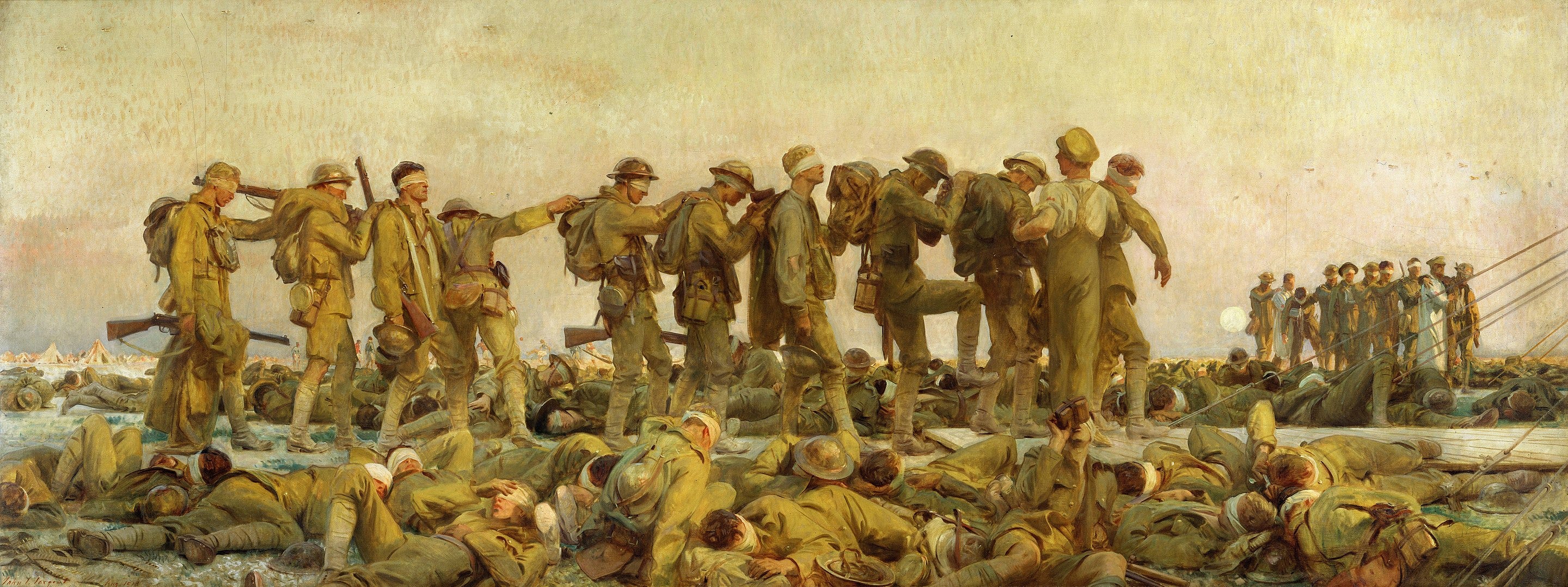
John Singer Sargent, “Gassed” (1919). Gas in World War I produced a million casualties—only aggravating the horrors of trench warfare
This is nothing new, of course, in military history. Think of World War I. Poison gas was introduced in 1915 in an attempt to break the stalemate of trench warfare. It didn’t. But it did stimulate the production of all sorts of dangerous chemical munitions and agents such as chlorine gas, phosgene, and mustard. Tanks were first introduced in 1916. Stalemate persisted. Flamethrowers were introduced. Other ideas to break the stalemate included massive artillery barrages along with “creeping” barrages timed to the advancing troops.
But there was no wonder weapon that broke the stalemate of World War I. After four years of sustained warfare, the German military finally started to falter in the summer of 1918. The Spanish Flu, the contagion of communism from Russia, and an effective allied blockade also served to weaken German resolve. The guns finally fell silent on November 11, 1918, a calm that wasn’t produced by magical weapons.
I wonder which weapon will next be hailed as crucial to Ukrainian victory? Who knows, maybe even tactical nukes might be on the minds of a few of the madmen advising Biden.
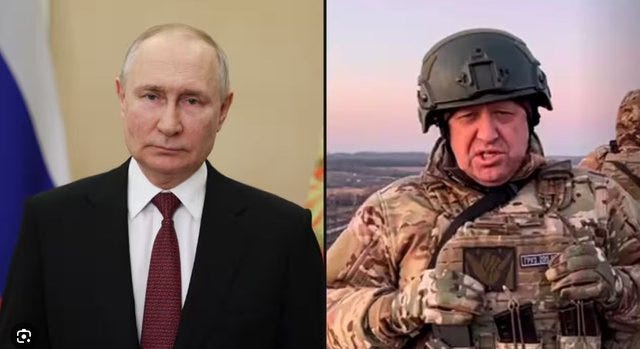
News of the rebellion of the Wagner mercenary group in Russia and the exile of its leader have led to confident announcements of Vladimir Putin’s weakening grip on power. Secretary of State Antony Blinken said the rebellion was “the latest failure” in Putin’s war against Ukraine, and NBC News declared “Putin’s rule is now more uncertain than ever.”
Vladimir Putin and the leader of the Wagner group, Yevgeny Prigozhin
Perhaps so. Wars often act as an accelerant to change, generating political chaos in their wake. The results of chaos, obviously, don’t lend themselves to predictability. Who knew in 1914, when the guns of August sounded, that four years later four empires would have collapsed under the strain of war (the Russian Empire, the Austro-Hungarian Empire, the Ottoman Empire, and the German Second Reich).
President Joe Biden was unusually frank in March of 2022 when he declared that Putin “cannot remain in power” due to his decision to invade Ukraine. Be careful what you wish for, Mr. President. Is overthrowing Putin truly a wise goal for global stability?
I honestly don’t know. A weaker, possibly fragmented Russia could increase the chances of nuclear war. A struggle for power within Russia could lead to the emergence of hardline leader who might make the West nostalgic for the relative predictability of Putin.
Most of us have heard the saying: better the devil you know than the one you don’t know. (This isn’t to suggest Putin is diabolical, of course.) In World War I, many of the allies professed to hate the Kaiser; his eventual successor as leader of the German people was Adolf Hitler. Again, wars may unleash elemental and fundamental changes, and change isn’t always for the better.
So, my position on the Russia-Ukraine War remains unchanged. Negotiate a truce. Use diplomacy to put a permanent end to this war. If Putin is truly weakened, this might be the best of times to seek a diplomatic settlement. After all, if Putin is truly worried about his grip on power within Russia, he might be open to ending the war largely on Ukraine’s terms so he can redirect his attention to consolidating his power base.
War has been given plenty of chances. Why not give peace a chance?







 Bracing Views