
For the U.S. Establishment, Violence Is the Answer

W.J. Astore

Meandering Thoughts on Campus Protests against Genocide and Police Responses

College and university campuses across the USA are increasingly the sites of violence, but that violence is largely being committed by police units called in to disperse and arrest protesters. The police, I assume, are, as they say, just following orders. The question is: Who’s giving those orders? And the answer most often seems to be senior administrators at those colleges and universities. Welcome to your education in liberal values!

Police do what they’re trained to do, just as soldiers do what they’re trained to do. Soldiers aren’t freedom-bringers and diplomats: they are trained in the use of deadly force under the most violent of conditions. Police aren’t educators and negotiators: they are also trained in the use of suppressive force under violent conditions.

On campuses across America, police have done what police are armed and trained to do here. They break out their riot gear, their sniper rifles, their armored cars, their tools of behavior modification (e.g. cuffs, Tasers, truncheons, rubber bullets, tear gas and pepper spray), and they go to work. They literally kick ass and take names (and mug shots, fingerprints, and so on).

Police are here to protect and to serve, so we’re told. But to protect and to serve whom? And for what cause? Ultimately, police protect the powerful, those with property and money, because those are the ones giving them their orders. If and when police begin to refuse orders from above, that’s when the powerful will truly begin to worry.

It’s interesting that some student protesters, as at Columbia, are now being compared (as by MSNBC) to the January 6th protesters and rioters for Trump. It’s a sign of desperation by the establishment to equate anti-genocide protesters with pro-Trump rioters, but there you have it. Recall on January 6th that the police largely stepped aside and allowed protesters for Trump into the Capitol. I don’t see the police stepping aside on campuses or taking selfies with protesters, or even removing barriers, as some police did on January 6th.

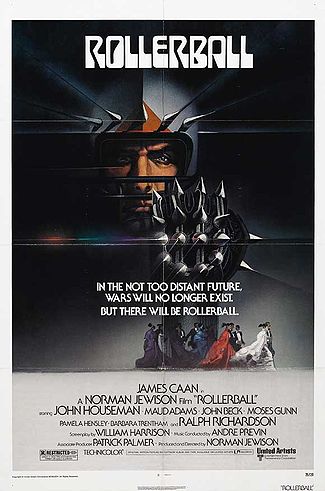
In “Rollerball,” John Housemen explains to James Caan that he is not to interfere with management decisions

The overly violent and repressive responses we’re witnessing across America to largely peaceful protests reveals the imperative at the heart of America’s political system. Recalling the movie “Rollerball,” the one thing you’re never supposed to do as a corporate-citizen is to question management decisions. America’s managers have decided to support Israel’s genocide in Gaza, and YOU ARE NOT TO INTERFERE WITH THAT. If you do, your protest will be suppressed, often quickly and violently.

There’s a reason America’s managers “invest” so much in the “thin blue line” of the police. They believe in violence as the way to uphold their power and privilege. It doesn’t matter that violence hasn’t always worked, especially in foreign wars (Vietnam, Afghanistan, Iraq, etc.). They’ll continue to use violence as long as it remains profitable to do so, whether economically or politically.

How long before people are killed or seriously injured in these police actions? How long before those who are killed or wounded are denounced as “bums,” as President Richard Nixon called the dead students of Kent State? How long before we hear that the “silent majority” supports Trump and/or Biden in their call for “law and order”?

How long before Israel renders Gaza Palestinian-free, as various U.S. police forces mobilize to render college campuses protester-free?

And how long before we’re told once again that America is the greatest, most exceptional, nation on earth because of all our freedoms?
Yes, Education is about Social Control

Don't ask questions. Don't seek answers. Enjoy the spectacle. (Image: Wiki)
Don’t ask questions. Don’t seek answers. Enjoy the spectacle. (Image: Wiki)

W.J. Astore

Education in my sense of liberating and strengthening (making articulate and uncompromising) the intellect is of course antithetical to much of what is going on in our schools and universities, which I would rather refer to by such terms as training, molding, socialization, mystification, memorizing of facts, obfuscation of meaning–all processes designed to produce intelligent citizens who are ready to execute jobs faithfully and not ask any questions about their meaning or purpose or value to fellow human beings.

(Christian Bay, Strategies of Political Emancipation, 1981)

Corporate society takes care of everything.  And all it asks of anyone, all it’s ever asked of anyone ever, is not to interfere with management decisions. 

Mr. Bartholomew (played by John Houseman) in Rollerball, 1975

As a professor and lifelong learner, I see education as equal parts empowering and enlightening.  Knowledge is power, as Francis Bacon said, and the lamp of learning helps to illuminate our lives.

But is education also about social control?  Sadly, the answer is “yes.”  Education that is simplified and standardized is often little more than indoctrination.  Education that is too regimented, too centralized, too much like a factory, prepares students for a life of unquestioning obedience and unreflective conformity.

Authorities have often been keen to restrict or outlaw forms of knowledge that they see as undermining their privileges and power.  Writing from Australia, Dr Teri Merlyn reminded me that:

There have been very direct, coordinated battles [against knowledge and reformers] – witness the censorship battles over Tom Paine’s ‘The Rights of Man’, when you could go to gaol for simply owning a copy, and the 19th Century ‘Church and King’ mobs sent to punish radical writers and publishers by burning down their houses … There are powerful social forces at work that have their self-interest at heart and see what they do in that context.  Witness the great educator of the working class, Hannah Moore, writing to her Bishop at the turn of the 18th Century, assuring him whilst she was teaching these working class girls to read, sufficient for their service duties, they would never learn to write, for that would encourage them to aspire beyond their station.

Education today still largely teaches students to stay within their station.  Today’s focus on vocational education is both salutary and one-dimensional.  Students are told to get degrees as passports to a job.  They’re not told to aspire to be skeptical citizens who dare to question (or even to supplant) authority.

And there’s the rub.  We face difficult, seemingly intractable, problems in the world today.  Global warming.  Fossil fuel dependence.  A widening gap between rich and poor.  A military-industrial-intelligence complex that dominates our foreign policy as well as much of our domestic policy.  Worrisome budget deficits.  Unaffordable health care.  The list goes on.

But our students are not being educated to address these challenges, at least not in any radical way, in the sense of getting to the roots of the problem.

Education, in essence, has largely become training, just another form of careerism.  And the high student debt that many students incur in obtaining their “passport to success” ensures they are essentially indentured servants, forced to keep working to pay off their debt (and often to keep their health care benefits as well).

Even as students incur debt in the process of training for a career, higher education brags most loudly about its close ties to business and industry.  Yet business and industry, as Teri Merlyn notes, “has effectively [outsourced] its responsibility to train its workforce, diverting that cost onto the public purse.  In order to do that, it has infested educational language with its own terminology.  The dominance of the Business Paradigm is now absolute.”

Just as college football is a feeder to the NFL, higher education is increasingly a feeder to business and industry.  It’s a Rollerball world dominated by violent sports and corporate conglomerates.

Education, in short, has lost any sense of higher purpose.  “Adapt to the world as you find it” is both the implicit and explicit message. And whatever you do, don’t rock the boat.

Part of the method is to destroy any sense of class identity among students.  Today, virtually all my students self-identify as being members of the “middle class,” even though many are working class (just as I am a son of factory workers).  In American society, we’ve lumped blue-collar with white-collar jobs, so that now janitors and fast-food workers (for example) think of themselves as middle class.

This is not to denigrate janitors or fast-food workers.  Rather, it’s to highlight the calculated decline of class identity and solidarity in the U.S.  If we’re all middle class, if we’re all bourgeois, why bother uniting in unions to fight for our rights?  If we allegedly inhabit a post-class society of social mobility, education can then ignore ethical and societal questions of fairness to focus on workforce training and professional development.

As my Aussie correspondent, Dr Teri Merlyn, astutely noticed:

“That phenomenon of working class identity is a most unwilling one, so the strategy to co-opt the working class as nominal members of the owning class through the share and property markets was very successful.  One might even suspect this recent ‘economic crisis’ [of 2008] as the ‘owners’ simply taking back what they see as rightfully theirs.”

Put differently, you can’t see you’re being screwed as a worker when you view yourself as an “owner” in your own right.  And when you’re educated to conform, to produce the standard answer, to aspire to a respectable job (with your identity confined to that job), your consciousness will never be raised to challenge the system in any radical way.

In fact, your goal is to become the system, to reap its rewards for yourself, just as those that you now work for have done and are doing.

As we witness uprisings around the world, from Egypt to Greece to Brazil and elsewhere, we should ponder why there are not similar uprisings in the U.S.  Is it because the U.S. really is, pardoning Voltaire, the best of all possible worlds?  Or is it because our educational system immunizes us against any form of “socialism” (a curse word in American politics) or class consciousness?

Education, when it’s about getting the right answer that leads to the right job without ever questioning prevailing authority, becomes a status quo operation in social control.

To recognize that is not to surrender to it.  Rather, it’s to begin to fight it.