Last week, I talked to Judge Napolitano about the Russia-Ukraine War, the Trump administration’s designs on Venezuela, and the rule of law in America.
A point I could have made more clearly involves casualty figures in the Russia-Ukraine War. There are no official figures that are trustworthy; each side is exaggerating the casualties of the other, which is unsurprising, since the first casualty of war is truth.
Figures that I’ve seen suggest that Ukraine has suffered over 100,000 killed and another 400,000 wounded/missing/captured. Russian figures may be double those of Ukraine but I honestly don’t know. My guess is that Russian casualty figures are higher because they have been on the offensive more and Ukrainian defenses have generally been robust and the troops increasingly skilled. Added to these battlefield casualties are the more than 30,000 Ukrainian citizens killed in the war, plus another six to seven million Ukrainians who have fled the country.
My point here isn’t to celebrate one side as “winning” or “losing.” To my mind, both sides are losing as they wage this devastating war, a war that will enter its fourth year next February. While some commentators see this war as a necessary one for Ukraine, a war for high ideals like democracy and freedom, I see a country that has lost roughly 20% of its territory, a country that suffers because the war is being fought largely on Ukrainian land, a country where roughly 7 in 10 people seek an end to this costly struggle.
A common narrative in the West is that Putin must not be allowed to profit from war, and if he does, the Russian military will next be on the march against NATO countries. This narrative suggests war and more war until either Putin is defeated or Ukraine collapses under the strain.
I would prefer to see negotiations to end the killing, the suffering, and the destruction, allowing Ukraine to recover, even if Ukraine must give up its desire to join NATO. I remain concerned that this war could expand further, as lengthy wars tend to do, becoming a wider regional war that could conceivably escalate toward nuclear weapons.
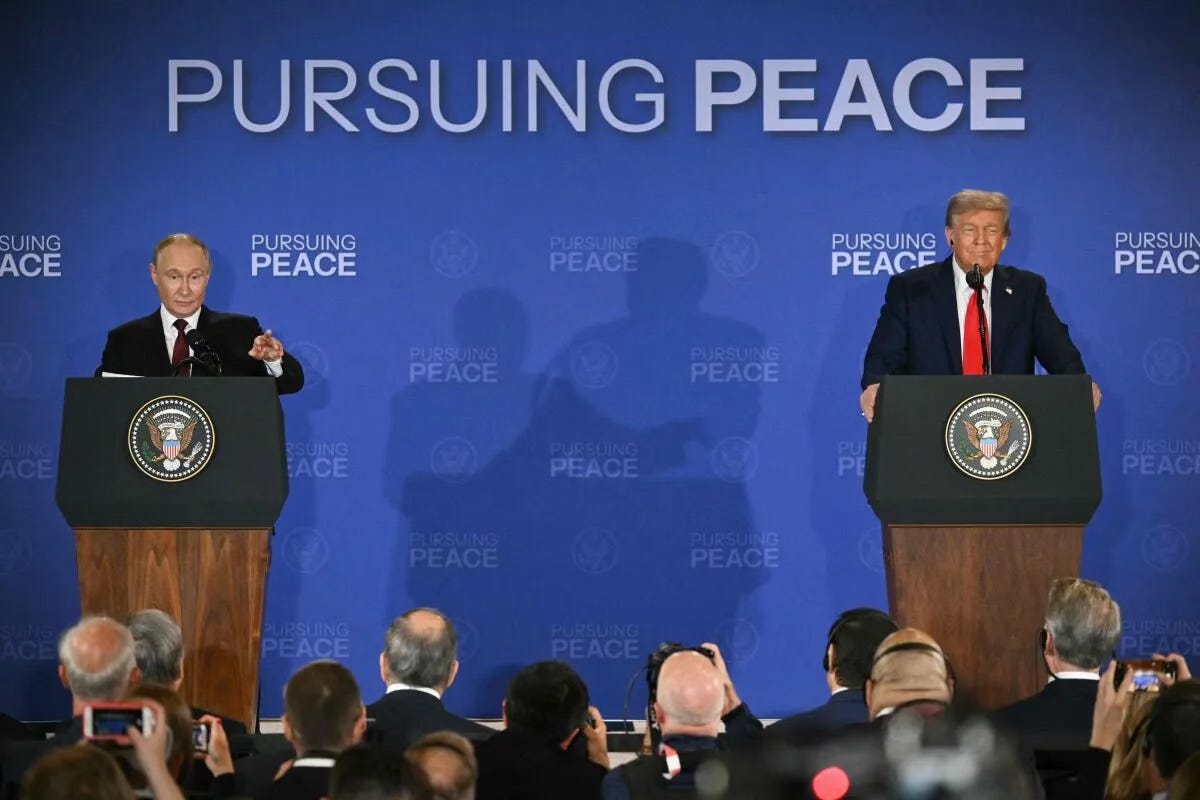
I’m glad President Donald Trump met with his Russian counterpart, Vladimir Putin, in Alaska. No country possesses more nuclear warheads than Russia, so dialogue is essential. As Churchill once allegedly observed, “jaw-jaw” is better than “war-war,” especially when nuclear weapons and humanity’s fate are at stake.
Unsurprisingly, the two leaders announced no breakthrough on ending the Russia-Ukraine War. Still, the fact they were talking matters. They even floated the idea of a second meeting in Moscow. Putin quipped about it; Trump replied that he might “take some heat” for visiting the Kremlin. Innocuous banter, yes—but I’ll take that over nuclear threats any day.
Pursuing peace—but not yet finding it.
The transcript of their closing remarks made for revealing reading. Putin spoke first, striking an amicable and measured tone. He invoked the U.S.-Soviet alliance of World War II, when both nations fought a common enemy. His words were thoughtful, cautious, above all diplomatic. He repeatedly emphasized the “businesslike” nature of the meeting, framing his approach as pragmatic and respectful—an approach likely to resonate with Trump, the self-proclaimed master of “the art of the deal.” Putin’s message, in essence, was: I’m someone you can do business with.
Trump’s remarks, by contrast, were more improvisational, filled with his trademark superlatives. Putin’s words, he said, were “very profound,” the meeting itself “very productive,” and the progress “great.” He even declared his relationship with Putin “fantastic.” That may be fantasy, but better that than animosity and hostility.
One passage from Trump’s comments stood out as both peculiar and revealing:
I would like to thank President Putin and his entire team—faces I know in many cases, faces I see all the time in the newspapers. You’re almost as famous as the boss—especially this one right over here. But we have had good, productive meetings over the years, and I hope to have more in the future.
That offhand line about Putin’s advisers being “almost as famous as the boss,” and about seeing their faces “all the time in the newspapers,” points to Trump’s obsession with fame. For Trump, people seem to matter only if they are celebrities. Recall his boasts about his own face appearing on the cover of Time magazine. His ego and craving for recognition make him vulnerable to manipulation. Unless you’re “famous”—someone whose picture appears regularly in the media—you scarcely exist in his world.
Trump’s deep need to be respected by other famous figures serves as a way to affirm his own worth. The danger, of course, is where that need might lead him—and the country.
Roughly three and a half years have passed since Russia’s invasion of Ukraine in February 2022 and the war shows little sign of ending. President Trump has gone from boasting he could end the war in a day to following the policy of the Biden administration in providing weapons and aid to Ukraine. To most Americans, the war has become background noise, barely perceptible. Most Ukrainian flags have been put away or deleted from Facebook and similar social media sites.
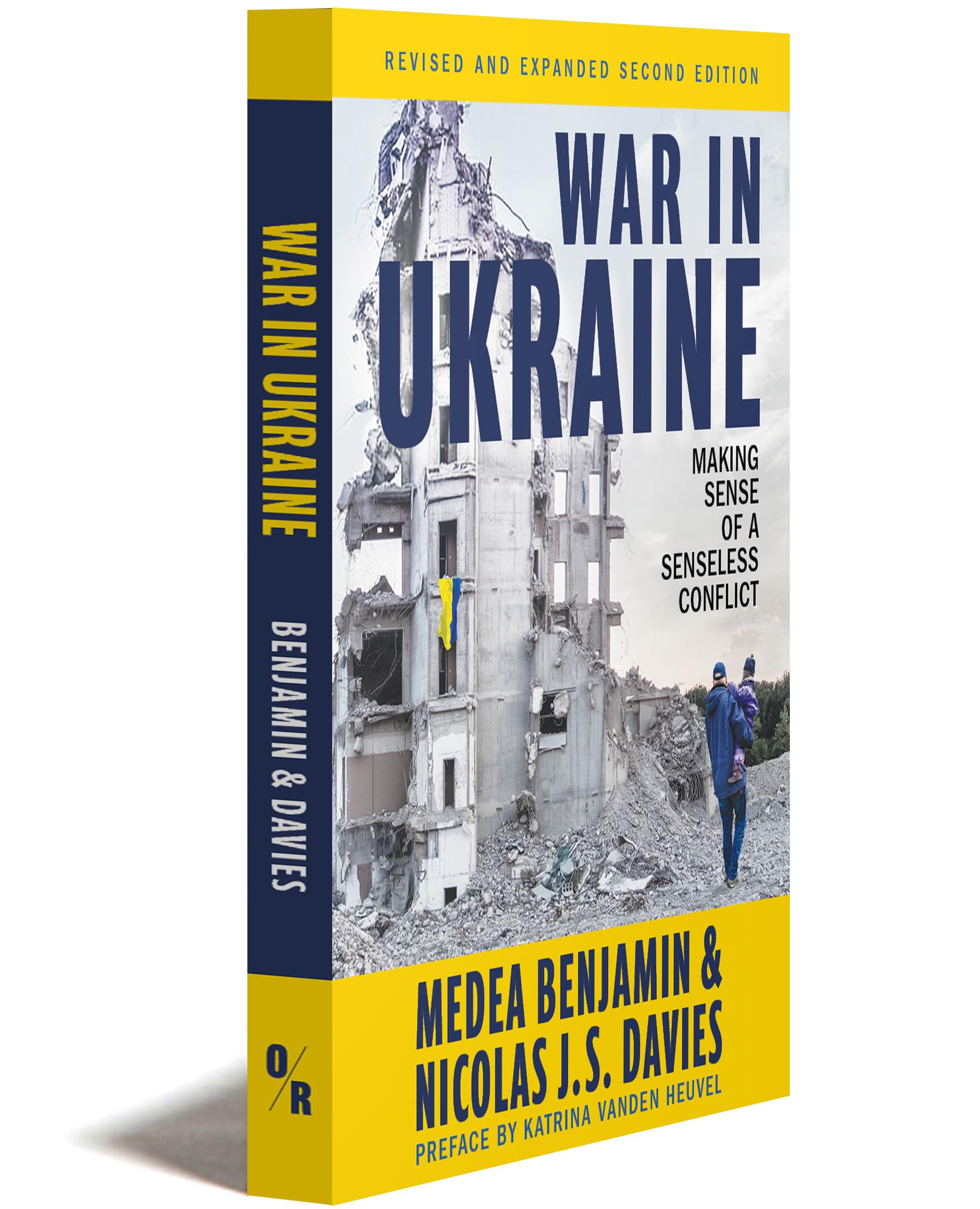
If you’re looking for a primer on the war that’s both critical and balanced, check out Medea Benjamin and Nicolas J.S. Davies’ book, “War in Ukraine: Making Sense of a Senseless Conflict,” now available in a revised and expanded second edition. ($20 paperback; $10 ebook, from OR Books.)
Benjamin and Davies recognize the war didn’t erupt out of nowhere in February 2022 nor was it completely “unprovoked.” As much as they deplore and denounce Vladimir Putin’s decision to invade, they recognize Putin had his reasons. Putin is more rational actor than a power-hungry dictator, and he’s arguably driven more by securing Russia’s position (and regional dominance) than recreating a Tsarist Russian or Soviet empire. Unlike most American commentators, Benjamin and Davies favor a diplomatic solution that would end mass killing on both sides. Not surprisingly, their views have gained little traction in the pro-war, anti-Putin mainstream media.
Speaking of the U.S. mainstream media, NBC News posted an article yesterday citing Condoleezza Rice, former Secretary of State under President George W. Bush. An unrepentant neocon, Rice is happy that Trump is sending more weapons to Ukraine while threatening more sanctions as well. In short, Trump is following a traditional neocon script while also keeping weapons factories in the U.S. going full blast. Rice approves!
What I found most staggering from Rice was this claim cited by NBC:
Rice also criticized the Biden administration for, in her view, having taken its time to get desperately needed weapons to Ukraine from the outset. “If you had given them everything at the beginning of the war,” she said, when “the Russians were on their back foot, [Ukraine] could’ve won this war outright.”
Excuse me, but WTF? What does giving Ukraine “everything” at the beginning of the war in 2022 mean? Fighter jets, main battle tanks, long-range missiles, nuclear weapons? Ukraine wasn’t even an ally of the U.S., nor was it ever a part of NATO. And would Ukraine really have won the war against Russia with “everything”? What about the risk that Russia would have escalated as well, perhaps calling on its arsenal of 6000 or so nuclear weapons?
Rice’s call for more smoking guns to have been sent to Ukraine early in 2022 almost certainly would have ended in a mushroom cloud or two. But I suppose that’s OK with her as long as the mushroom clouds were limited to Ukraine.
Remember 2023 and the failure of the much-hyped Ukrainian counteroffensive? I do. Remember all the hype about U.S., German, and British wonder weapons like Abrams, Leopard, and Challenger tanks? I do.
Let’s hope that Trump’s gambit to push Putin to some kind of compromise settlement bears fruit. No war should go on forever. Haven’t enough people died on both sides?
That’s a headline that proves once again that America is led by the best and brightest. (Sarcasm alert.)
Vladimir Putin has already said that long-range weapons striking targets in Russia means war between Russia and NATO. I don’t think he’s bluffing. And, lest we forget, Russia has nearly 6000 nuclear warheads in its inventory.
Why is the U.S. and NATO allowing Ukraine to use missiles that can strike targets deep into Russian territory? The short answer is that Ukraine is losing the war. But any escalation by Ukraine can be matched (and over-matched) by Russia. The most likely scenario is an even more devastated Ukraine. The worst-case scenario is World War III.
Wars are made by fools with stars on their shoulders and produce more fools, especially in government circles. Ukraine isn’t going to win the war by launching Storm Shadow missiles 150 miles into Russia. More attacks on Russia are likely to reinforce Putin’s rule than to weaken it.
Meanwhile, Ukraine continues to lose more territory to Russian forces in the east, as this map (courtesy of the NYT) shows.
In a war that’s now lasted more than two and a half years, we’ve been told repeatedly that new “magical” weapons will make all the difference for Ukraine, whether Leopard and Challenger and Abrams tanks or F-16 fighter jets or ATACMS or what-have-you. Yet the Russia-Ukraine War is largely an old-fashioned infantry and artillery war, a land war, an attritional war, in which Ukraine is slowly being worn down.
Long-range missiles launched into Russia aren’t going to turn the tide in Ukraine’s favor. But they may provoke a devastating response from Russia that could provoke a far wider conflict. And for what, exactly?
When Barack Obama took over as president in 2009, the global war on terror, or GWOT, just didn’t seem to fit the tenor of his “hope” and “change” message. So wars in Iraq and Afghanistan were rebranded as “overseas contingency operations.” Talk about the banality of evil! Even Orwell’s Big Brother might be impressed by OCOs as a substitute for invasion and war.
A euphemistic word Obama didn’t banish was “surge.” The “surge” in Iraq allegedly had worked under General David Petraeus, even though its gains proved as “fragile” and “reversible” as Petraeus hinted they would be. So Obama conducted his own surge in Afghanistan, the so-called good or smart war after the Bush/Cheney disaster in Iraq. And of course the “gains” in Afghanistan also proved both fragile and reversible, though no one was held to account for the miserable failure of the Afghan War. Whoops. I mean the Afghan contingency operation for democracy and enduring freedom.
Showing that he too could learn from America’s folly, Vladimir Putin termed his invasion of Ukraine a “special military operation.” U.S. leaders laughed at this, criticizing Putin for his propagandistic euphemism, even as they persisted in using terms like “overseas contingency operation” for America’s “kinetic” military actions. The eye of the beholder, I guess.
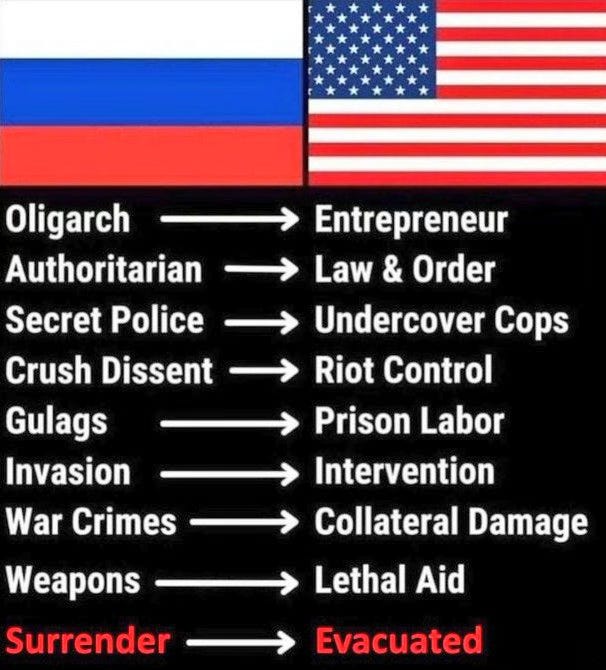
These thoughts came to mind as I perused my Twitter/X feed yesterday and spied this illustration posted by Chay Bowes:
Though the Russian flag is on the left, it could be the flag of China, Iran, North Korea, or any other alleged evildoer. The Russians invade, we intervene (for the sake of democracy, naturally). The Russians commit war crimes, we have unfortunate instances of collateral damage. In the war of the words, the U.S. military is clearly rather clever in a self-aggrandizing and self-exculpatory way.
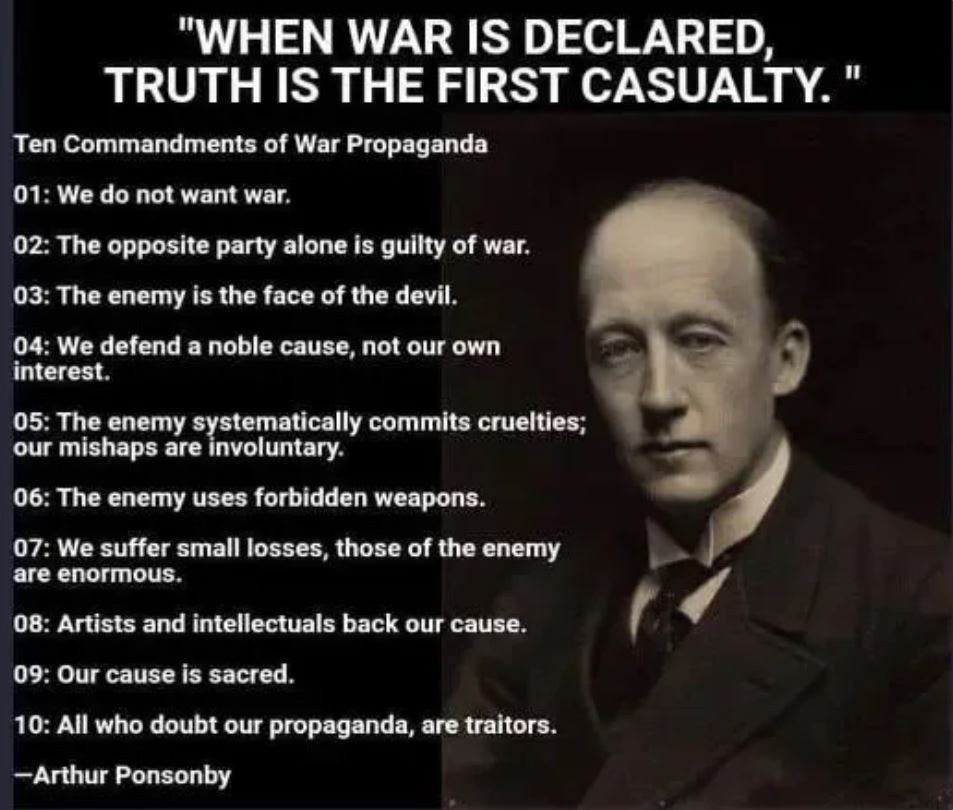
Looking at comments from this Twitter feed, I came across another useful illustration of manipulating language and information in the cause of war. Take a gander:
I confess I’d never heard of Arthur Ponsonby and his book, Falsehood in War-Time. I need to check it out.
This may prove a handy list to keep around as America’s national (in)security state acts to gin up the next war.
I saw the following oped at the Boston Globe yesterday morning:
If Republicans won’t stand up to Putin, he won’t stand down in his threats to American interests
Helping Ukraine fight off Russia is not an act of charity. It is a vital investment in world security.
There’s so much to write about here. First, as Vice President Kamala Harris has already said, charity is now a bad or disreputable idea. Helping Ukraine is not about charity, apparently because that message doesn’t resonate strongly with Congress. So, what does resonate? The idea of war as “a vital investment.” Apparently, if the House approves $61 billion in more aid to Ukraine, the payoff will be “world security.” How can you argue against that, right?
Second, apparently Republicans who oppose another $61 billion in aid to Ukraine, on top of roughly $120 billion in aid already provided since the Russian invasion two years ago, are all Putin appeasers. They are weak, refusing to “stand up to Putin.” Apparently Democrats are strong because they are standing up to Putin.
In sum, if America wants to be smart and strong, it must “invest” in more war against Putin and Russia.
How about “investing” in more trench warfare? Such a “rich” history!
I’m sorry but I never see war as an “investment.” Perhaps I would if I were the CEO of Boeing or Raytheon, but I’m not. I see war as “all hell,” as Civil War general William T. Sherman famously said. It’s horrific, it’s wasteful, it’s the negation of humanity. Sorry: no “vital investments” in war for me.
The war isn’t going well for Ukraine. Russia currently has the edge, Ukraine is short on troops and ammunition, and now might be a propitious time for serious negotiations to end the killing, before Ukraine collapses. Yes, in seeking peace, Ukraine will probably have to cede territory. Yes, perhaps Putin will sell this as a Russian victory. But I very much doubt that Putin’s costly “victory” in Ukraine will embolden him to launch attacks on NATO countries. He knows he would risk total defeat and nuclear war if he did so, and Putin, whatever else he is, is no fool.
Meanwhile, the French are making noises about the possibility of European troops deploying to Ukraine to fight against Russia. This would be folly in the extreme, turning a regional Russia-Ukraine conflict into a more general European war on Russia, with echoes to World War II.
I love that term, “strategic ambiguity.” Is that a good idea, creating “strategic ambiguity” against Russia, a nuclear power with the ability to destroy the world? Macron was being recklessly idiotic here.
Forget about “investments” in more war and strategic ambiguity. Try charity and peace. It’s time to end the killing.
The Russia-Ukraine War Enters Its Third Year with No End in Sight
Russia launched its “special military operation” against Ukraine on February 24th, 2022. Russia and Ukraine had been feuding since 2014, with U.S. meddling in Ukraine exacerbating the tensions. NATO expansion to Russia and Ukraine’s borders, along with calls to incorporate Ukraine into NATO at some future date, also led to increased tensions with Russia. The result has been a costly and enduring war in which Ukraine has lost roughly 20% of its territory in the east; both sides have suffered high casualties in horrendous conditions that recall the trench warfare of World War I.
At the moment, Russia appears to have the edge. Ukraine recently lost the city of Avdiivka. Manpower in Ukraine is stretched thin. The average age of troops at the front for Ukraine is 43 even as I’ve seen stories touting the recruitment of young women for the front as well as 17-year-old teenagers. Artillery ammunition is in short supply; $60 billion in weapons, munitions, and other military aid from the United States is frozen in Congress. A path to military victory for Ukraine is unclear.
Nevertheless, the Biden/Harris administration is fully behind the Ukraine war effort. I take the title of this article from Vice President Kamala Harris and her recent vow that the U.S. will support Ukraine for “as long as it takes.” The word “it” apparently refers to a complete victory by Ukraine over Russia by force of arms, i.e. the expulsion or withdrawal of all Russian troops from Ukrainian territory. Since it is unlikely Vladimir Putin will withdraw his troops voluntarily, the U.S. government has signed up to support Ukraine until it is able to defeat Russian forces on the battlefield, whether that takes one year, five years, or forever and a day.
Zelensky and Harris recently in Munich, together for “as long as it takes”
Such an open-ended commitment by the U.S. requires some explanation. The conventional narrative goes something like this: Putin is a bully and a thug. He is the next Hitler, or even worse. If he’s allowed to win in Ukraine, he will be emboldened to strike at NATO countries in Europe. Meanwhile, other authoritarian dictators around the world will see Russia’s victory as permission to strike at U.S. interests globally, undermining democracy and the “rules-based order.” Supporting Ukraine with vast sums and amounts of weaponry and munitions, therefore, is necessary to stop worldwide aggression by Putin and those who would emulate him. This is, in essence, the narrative of the Biden administration.
I believe this narrative is wrong. I see no evidence that Putin has plans to invade NATO countries; indeed, his invasion of Ukraine has strengthened NATO and led to its expansion. Russia is bogged down in a costly war in Ukraine, and while its forces have generally performed better recently than they did two years ago when they first invaded, the outcome of this war remains unclear. The Russian economy isn’t strong; an enduring war in Ukraine isn’t beneficial to Putin or the Russian people.
So far, “diplomacy” seems to be the hardest word in this conflict. Negotiation seems to be seen as capitulation. There’s evidence to suggest the U.S. and Great Britain have discouraged—even sabotaged—talk of ceasefires and settlements. To my knowledge, there are no efforts by the U.S. to seek a truce or some kind of armistice or other agreement that would end the war with all its suffering and devastation. The war must go on, full stop.
More than a stated fear of Putin as the new Hitler is involved here. Domestic politics are critical. In the U.S., Democrats are using Republican opposition to $60 billion in more aid to Ukraine to accuse GOP members of favoring Russia and of sabotaging Ukraine’s noble and heroic war effort. If the Republican-controlled House doesn’t approve the $60 billion aid package and Ukraine suffers a serious setback this year, Democrats will accuse Republicans of having “lost” Ukraine, of having become Putin-appeasers. Facing this possibility, it’ll be interesting to see if Republicans eventually cave and provide the $60 billion in aid.
Meanwhile, the military-industrial-congressional complex continues to profit from this war. The U.S. State Department recently boasted of a 56% increase in foreign arms sales in 2023, much of that going to Ukraine. More and more, the State Department is simply a tiny branch of the Pentagon, “negotiating” through arms sales and shipments and boasting of profits from the same.
War may be the health of the state of the self-styled “arsenal of democracy,” but it’s very unhealthy for the people of Ukraine and Russia and indeed for the planet. The New York Times, consistently on the side of Ukraine and more war, recently referred to the heavy troop losses of both sides and the “relentless devastation” of a war being fought on Ukrainian territory. Recent articles in publications like Reuters and The New Yorker pose the question, “Can Ukraine Still Win?” Their conclusion seems to be “possibly,” but not in 2024, and not without massive aid from the U.S., and even then, “victory” by feat of arms is increasingly unlikely.
Meanwhile, I keep seeing articles that favor more offensive and destructive weaponry for Ukraine, most recently long-range missiles to strike at Russia. Recall that U.S./NATO aid to Ukraine first focused on defensive weapons such as Stinger and Javelin missiles. Very quickly, aid escalated to armored vehicles, including main battle tanks (Challenger, Leopard, and Abrams), heavy artillery, rockets, and now F-16 fighter jets. Tank ammunition included depleted uranium shells; artillery rounds included cluster munitions. All these weapons have increased the deadliness of the battlefield, ensuring a blasted, dangerous, and toxic environment for generations to come without delivering decision on the battlefield for Ukraine.
The outlook for 2024 seems dire. Ukraine, outgunned and outmanned, is facing another bleak year of war. Optimism about a decisive Ukrainian counteroffensive (that was supposed to come in 2023) is long gone, with U.S. advisors having pointed fingers at Ukrainian leaders for their alleged hesitancy in absorbing large casualties on the offensive. An increasing number of American voters are questioning whether a war costing them roughly $180 billion in two years (assuming the Biden aid package is approved) is truly in their national interest, even as Members of Congress tell them that much of that money provides good-paying jobs to Americans making bullets and bombs to kill Russians.
Is America an arsenal of democracy, or just an arsenal?
Having served in the U.S. military for 20 years during the end of the Cold War, I remember a time when U.S. leaders talked to their Soviet counterparts. Kennedy talked to Khrushchev, Nixon talked to Brezhnev, Reagan talked to Gorbachev. Agreements were reached; crises were deescalated; wars were avoided. Courage and resoluteness aren’t shown through more weapons and war; they’re shown by reducing weapons and putting an end to war. Why can’t Biden talk to Putin?
“Blessed are the peacemakers” is a sentiment that shouldn’t be limited to the New Testament. If only this nation’s leaders would work to pursue peace “for as long as it takes.” Sadly, war always finds a way, especially when it’s sold as stopping the next Hitler.
America as the Essential Nation for Trigger Treats
Some thoughts — more or less connected — on war in Gaza and Ukraine:
Israel is engaged in a “traditional” war of conquest. Like the Romans destroyed Carthage, Israel is essentially destroying Gaza using American-provided weaponry, together with hoary approaches like famine and disease.
What surprises so many is that ruthless wars of conquest aren’t supposed to happen. It’s 2023! We’re civilized people! Only dictators like Putin are ruthless! But, as many people have noted, Israel has already killed more children in two months than Russia has killed in nearly two years of war in Ukraine.
No — Israel and the USA are not civilized. The so-called rules-based order is might makes right. Thucydides defined Israel/USA policy 2400 years ago: The strong do what they will; the weak suffer what they must.
The Palestinians are being killed, starved, and shoved off their land because Israel wants it. The Hamas attacks provided the excuse for the final solution to the Gaza question.
But let’s be clear here: Wars of conquest are a feature of humanity throughout history. Look at the history of the United States and its conquest of Native Americans or its war of “manifest destiny” against Mexico. It’s a land grab.
Gaza isn’t primarily a religious war of Jews versus Muslims. There may be some Jews who believe it’s “their” land because the Torah says so, but many other Jews are against this brazen war of conquest. Religion isn’t the main cause here. The causes are greed and power, land lust and the pursuit of black gold (fossil fuels off Gaza). And vengeance.
The Biden administration refuses to place any conditions on massive weapons shipments to Israel. So much for “leverage.”
*****
Judging by the U.S. federal budget, America’s leaders are most addicted to violence and war, whether manifested against our fellow humans or against nature and the planet. Dangerously, in violence people often find a sense of purpose and belonging as well as scapegoats even as they embrace and empower leaders who promise them blood-soaked redemption.
It’s quite possible the historical Jesus was betrayed and killed because he rejected redemptive violence. Jesus seems to have taught redemptive peace, and that was an unpopular message among Jewish people 2000 years ago, who apparently were looking for liberation through military victory over the Romans, not salvation through the grace offered them by a peace-preaching prophet and rabbi who took the side of the marginalized and oppressed.
*****
The average age of Ukrainian troops is now 43. Young women are being actively recruited into the ranks. Men as old as 60 are being pressed into service. “Body snatchers” are illegally grabbing men off the streets and forcing them to the front. Does this sound like a winnable war for the “imperfect democracy” of Ukraine?
I continue to see a stalemated situation with little chance of a decisive military victory for Ukraine. Assuming the war continues, Ukraine will continue to be hollowed out.
Meanwhile, Russia has most certainly been weakened militarily by this war, and perhaps economically as well with the destruction of the Nordstream pipelines. Russia is less of a threat to NATO than it was two years ago, meaning that NATO has even less to fear from an alleged expansionist Putin. Given the quagmire faced by Russia in Ukraine, I doubt very much that Putin is contemplating an invasion of any NATO country.
Suffice to say I am against another $62+ billion for Ukraine and I am for diplomatic efforts to foster a ceasefire and settlement. Indeed, I think that if the U.S. stops military aid to Ukraine, Zelensky and Putin would likely find a way to end this war and all its killing and destruction.
Yet, the Biden administration is persisting in its plans to send scores of billions in more weaponry to Ukraine, with Senator Lindsey Graham still boasting Ukraine will fight and die to the last man (and woman?). If Biden’s war package is approved, U.S. aid (mainly military) to Ukraine will approach $200 billion in two years. That’s roughly $8 billion a month, double the monthly cost of the Afghan War. Yet Americans are told this is the price of freedom: massive shipments of weapons and other forms of aid so that Ukraine can kill Russians.
The Biden administration has embraced war in Ukraine as well as war in Gaza, essentially placing no conditions on massive shipments of U.S. weaponry to fuel these conflicts. Someone please tell me what is “progressive” and humane about Joe Biden’s policies.
I know freedom isn’t free; I had no idea freedom came at so high a cost in deadly military weaponry and dead bodies. I guess it’s true, then: America is the freest country in the world because we dominate the world’s trade in life-takers and widow-makers. Exceptional we are in our belief in war and weapons; essential we are to any country looking to add “trigger treats” to their arsenals of democracy.
In 1998, as an Air Force major, I attended a military history symposium on coalition warfare that discussed the future of NATO. One senior officer present, General Sir Anthony Farrar-Hockley, spoke bluntly in favor of NATO expansion. From my notes taken in 1998:
Farrar-Hockley took the position that to forego expansion because of Russian concerns would be to grant Russia a continuing fiefdom in Eastern Europe. Russia has nothing to fear from NATO, and besides, it can do nothing to prevent expansion. If the Soviet Union was an anemic tiger, Russia is more like a circus tiger that may growl but won’t bite.
That sums up the Western position vis-a-vis NATO expansion and Russia: too bad. You lost the Cold War. There’s nothing you can do.
Until the “circus tiger” finally bit back.
The U.S. and NATO calculated that Russia, now led by Vladimir Putin, wouldn’t bite back. It did so in 2022.
Even circus tigers may do more than growl
Now, you might argue it’s the tiger’s fault for biting; you might say Ukraine didn’t deserve to be bitten. But I don’t think you can say that U.S. and NATO actions were entirely guiltless or blameless in provoking the tiger. At the very least, the actions were misjudged (assuming there wasn’t a plot to provoke Putin and Russia into attacking).
Ukraine is central to Russia’s concerns. Both countries share a long common border and an even longer history. By comparison, Ukraine, I think, is peripheral to U.S. concerns, just as Afghanistan and Vietnam ultimately proved peripheral. Here I recall the critique of political scientist Hannah Arendt that, with respect to America, the Vietnam War was a case of using “excessive means to achieve minor aims in a region of marginal interest.” Whether in Vietnam or more recently in Afghanistan, the U.S. could always afford to accept defeat, if only tacitly, by withdrawing (even though die-hard types at the Pentagon always want to keep fighting).
All this is to say Russia’s will to prevail may prove more resilient than the current U.S. commitment to Ukraine of “blank check” support.
Ukraine resistance to Russia has indeed been strong, backed up as it has been by bountiful weapons and aid from the U.S. and NATO. Faced by an invasion, they are defending their country. But a clear victory for Ukraine is unlikely in the short term, and in the long term will likely prove pyrrhic if it is achieved.
No one in the U.S. thought that a punitive raid against the Taliban in 2001 would produce an Afghan War that would last for 20 years. When the U.S. committed troops in big numbers to Vietnam beginning in 1965, most at the Pentagon thought the war would be over in a matter of months. How long is the U.S. and NATO truly prepared to support Ukraine in its war against Russia?
In the 17 months or so since the Russian invasion, the U.S. has already committed somewhere between $115-$200 billion to Ukraine and the war. Should that commitment remain open-ended at that level until Ukraine “wins”? What of legitimate fears of regional escalation or nightmare scenarios of nuclear exchanges?
Long wars usually don’t end with a healthier democracy. Indeed, wars most often generate censorship, authoritarianism, suppression of dissent, and many other negative aspects. Think of the enormous burden on Russia and Ukraine due to all the wounded survivors, the grieving families, the horrendous damage to the environment. The longer the war lasts, the deeper the wounds to society.
Scorched by decades of war, areas of Afghanistan are wastelands. Vietnam, Laos, and Cambodia are still recovering from America’s orgy of violence there. What will Ukraine have to recover from, assuming it’s fortunate enough to “win”?
I don’t see a quick victory for either side in the immediate weeks and months ahead. Channeling John F. Kennedy’s famous “peace” speech of June 10, 1963, I do believe that peace need not be impractical, and war need not be inevitable. As JFK also cautioned, forcing a nuclear power into a humiliating retreat while offering no other option is dangerous indeed.
Recent attention has focused on the Biden administration’s decision to provide cluster munitions to Ukraine. Russia can, and likely will, match Ukraine’s use of U.S.-provided cluster munitions. Earlier, the U.S. claimed Russia was guilty of war crimes for using these munitions. Now it’s all OK since Ukraine needs them. When they kill Russians, they’re “good” bombs?
I also hear U.S. commentators speaking of “terror bombing campaigns” by Russia. Perhaps so, but when U.S. commentators use that expression, they should fully acknowledge what the U.S. did in Japan, North Korea, Vietnam, Laos, Cambodia, Iraq, Afghanistan, and elsewhere. No country in the world comes close to the number and amount of bombs, defoliants, cluster munitions, DU shells, and napalm that the U.S. has used in various wars in the last 80 years. When it comes to terror bombing, the U.S. is truly the exceptional nation.
But can the U.S. be exceptional at peace? The U.S. should and must wage diplomacy with the kind of fervor that it usually reserves for war.
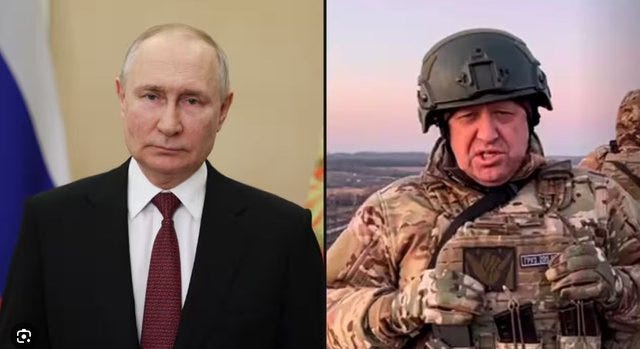
News of the rebellion of the Wagner mercenary group in Russia and the exile of its leader have led to confident announcements of Vladimir Putin’s weakening grip on power. Secretary of State Antony Blinken said the rebellion was “the latest failure” in Putin’s war against Ukraine, and NBC News declared “Putin’s rule is now more uncertain than ever.”
Vladimir Putin and the leader of the Wagner group, Yevgeny Prigozhin
Perhaps so. Wars often act as an accelerant to change, generating political chaos in their wake. The results of chaos, obviously, don’t lend themselves to predictability. Who knew in 1914, when the guns of August sounded, that four years later four empires would have collapsed under the strain of war (the Russian Empire, the Austro-Hungarian Empire, the Ottoman Empire, and the German Second Reich).
President Joe Biden was unusually frank in March of 2022 when he declared that Putin “cannot remain in power” due to his decision to invade Ukraine. Be careful what you wish for, Mr. President. Is overthrowing Putin truly a wise goal for global stability?
I honestly don’t know. A weaker, possibly fragmented Russia could increase the chances of nuclear war. A struggle for power within Russia could lead to the emergence of hardline leader who might make the West nostalgic for the relative predictability of Putin.
Most of us have heard the saying: better the devil you know than the one you don’t know. (This isn’t to suggest Putin is diabolical, of course.) In World War I, many of the allies professed to hate the Kaiser; his eventual successor as leader of the German people was Adolf Hitler. Again, wars may unleash elemental and fundamental changes, and change isn’t always for the better.
So, my position on the Russia-Ukraine War remains unchanged. Negotiate a truce. Use diplomacy to put a permanent end to this war. If Putin is truly weakened, this might be the best of times to seek a diplomatic settlement. After all, if Putin is truly worried about his grip on power within Russia, he might be open to ending the war largely on Ukraine’s terms so he can redirect his attention to consolidating his power base.
War has been given plenty of chances. Why not give peace a chance?






 Bracing Views