
Rigging the Primaries for Biden/Harris Has a Serious Drawback

W.J. Astore

Iowa and New Hampshire get sidelined in the cause of propping up Joe Biden

This past week’s Iowa Caucuses ended with a clear winner, Donald Trump, over the undynamic duo of Nikki Haley and Ron DeSantis. Meanwhile, nothing happened on the Democratic side. The same is likely to be true next week, when New Hampshire goes to the polls. The DNC is refusing to recognize the NH primary; Joe Biden isn’t even on the ballot, though there is a campaign to write-in his name.
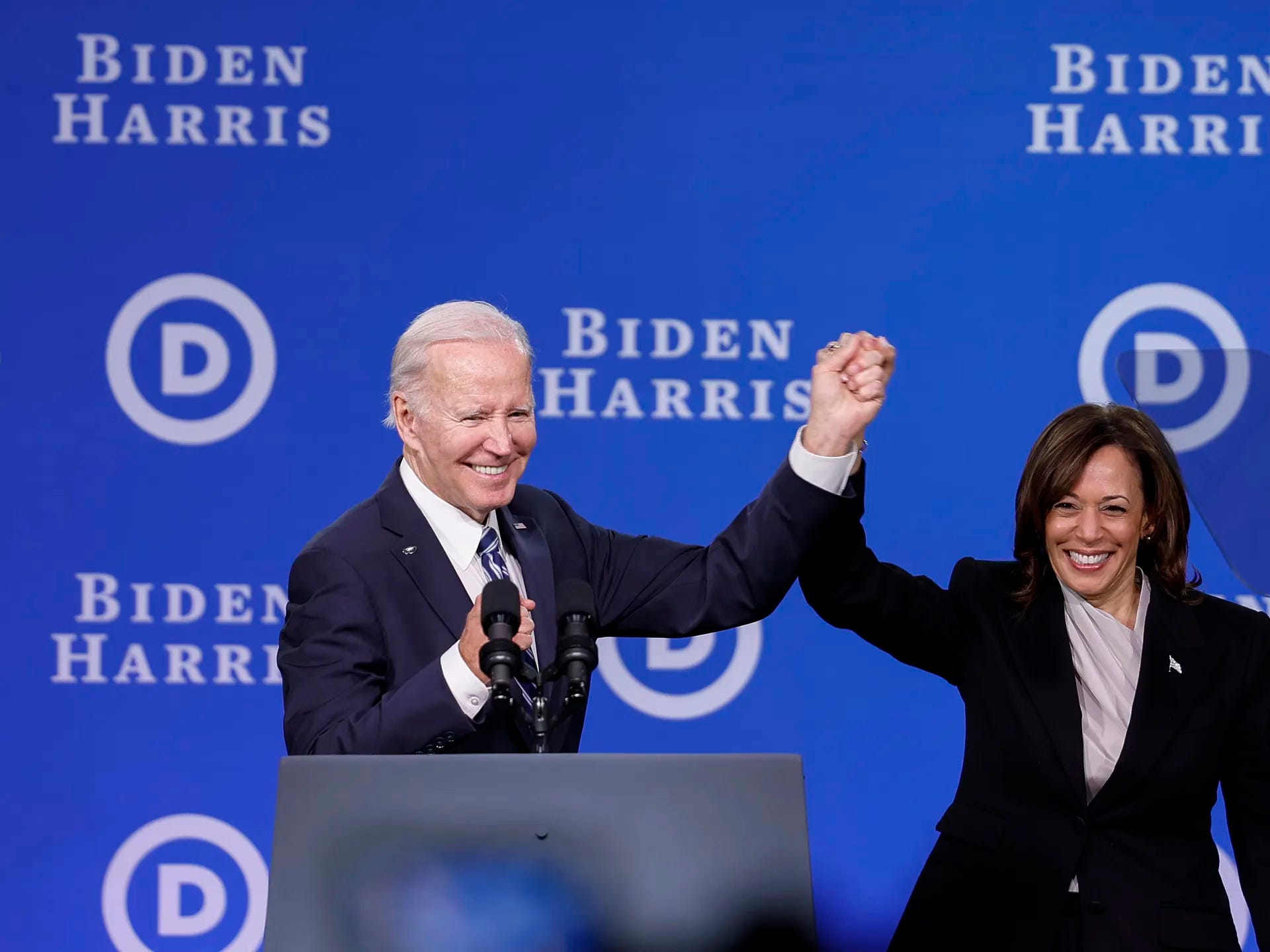
You’re not doing America (or “democracy”) favors by propping them up

The first primary that matters according to the DNC is South Carolina on 2/3, followed by Nevada on 2/6 and Michigan on 2/27. These states are supposedly more representative for the Democratic Party than Iowa and NH, meaning they are more racially and ethnically diverse, though to my mind any candidate running for president should be seeking to put his or her best foot forward in all fifty states. No matter. Apparently, the DNC believes this is the best way to shore up support for the Biden/Harris ticket.

Perhaps the DNC is right, but their plan has a serious drawback. If the DNC had kept the old schedule of Iowa and NH, and Biden had performed poorly in both states, it would have allowed the DNC more notice and time to pivot, or perhaps to craft a message more appealing to voters.  Privileging states that are expected to support Biden, in contrast, may breed overconfidence that his support remains strong and his candidacy remains viable against the clear Republican frontrunner, Trump.

If you really want to defeat Trump in November, you need the most rigorous vetting process for the Biden/Harris ticket.  Rigging the primaries for Biden by deleting Democratic rivals from the ballot, as the DNC has done in Florida, North Carolina, and elsewhere, while effectively throwing out results in Iowa and NH, may ensure both that Biden/Harris win renomination and lose the general election in November.

At which point the DNC will likely blame Jill Stein, RFK Jr., Susan Sarandon, Vladimir Putin, and white supremacists, instead of blaming themselves for putting forward a losing ticket.

Trump is not to be underestimated. The time to discover that Biden/Harris just don’t have it is now, not in October. If Trump is THE existential threat to democracy that the Democrats claim he is, why are the Democrats rigging the field to put forward what may prove to be a weak and losing ticket against him?
Bernie Sanders Won Last Night’s Democratic Debate

bernie
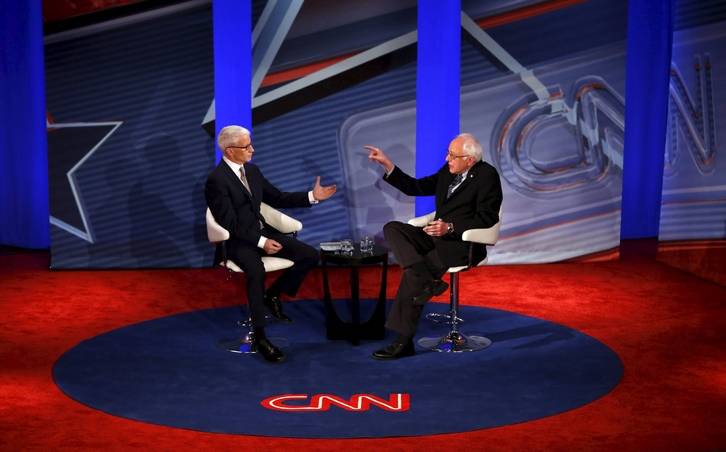
Bernie Sanders makes a point to Anderson Cooper during last night’s debate

W.J. Astore

Last night, Bernie Sanders and Hillary Clinton separately took questions from a “town hall” in Derry, New Hampshire with Anderson Cooper moderating.  Overall, both candidates did well, though I give the edge to Sanders (more on why in a moment).

Sanders came across as passionate on the issues and concerned for ordinary Americans.  He continues to speak of a political revolution, which to him doesn’t mean tumbrels to the guillotine.  It means getting more people involved in the political process, especially youth and the disadvantaged.  He spoke eloquently of helping others.  Memorable to me was his work to desegregate housing owned by the University of Chicago when Sanders was a student.  When asked why he fought against racist policies, Sanders said he’s always hated a bully – and always fought for fairness and equality.  He came across, in short, as an honest and decent man, a man of integrity, which is the word his wife used to describe him (she was sitting in the audience, and was asked to describe her husband with a single word).

Hillary came across as determined and competent and informed.  She tended to meander during her answers, coming across as somewhat of a policy wonk or a technocrat.  She rejected Sanders’ talk of a revolution, preferring to build on President Obama’s (and her own) legacy.  For example, she wants to put the finishing touches to Obamacare, rather than going for Sanders’ idea of a single-payer, “Medicare for all” system.  She spoke briefly of breaking the ultimate glass ceiling for women – her gaining the office of the presidency – and how that would inspire women of all ages.  She took her usual hardline on U.S. foreign policy, making no promises that she would reduce wars or for that matter spending on defense.

In sum, if you’re happy with the status quo, you’ll get plenty of that with Clinton.  If you want change, if you’re tired of a “rigged” economy and a corrupt political process, Sanders is far more likely to act in your favor.

Where I thought Hillary fell down was in her posturing as a progressive.  The millions of dollars she has accepted in speaking fees from banks and investment houses, she suggested, would have no impact on her policy decisions, which is simply implausible.  Powerful organizations don’t give political candidates big money without strings attached to it, and of course Clinton knows this.  It also seemed implausible when Clinton suggested she had not decided to run for president when she accepted those speaking fees.  As if her “doubts” about running absolved her of responsibility for taking big money from Wall Street.  It was all frankly unconvincing.

Hillary Clinton is a fighter.  She came across best when she spoke of the Republican right-wing attacks she’d had to endure over the last 25 years, and what they’d taught her about the political process.  Her footing was less secure when she had to relate to other people.  For example, a man suffering from advanced-stage cancer asked her about dying with dignity.  Bill Clinton, the “natural” as Hillary called him, would have turned this into an empathetic “I feel your pain” moment.  But Hillary got lost in the details, saying she would have to study up on the ethics of terminal care, the laws, the role of medical professionals, what other countries are doing (she mentioned The Netherlands), and so on.  As she tackled the problem in a wonkish way, she seemed to forget the person standing in front her.

In sum, Bernie Sanders is driving the narrative, not Hillary Clinton.  It’s Bernie who’s been talking about a rigged system, about economic fairness, about working for unions, about justice and prison reform, and it’s Hillary who’s been put on the defensive.  So lately Hillary’s been borrowing liberally from Bernie’s script.  She’s now talking about “the deck being stacked” against ordinary people, and how she’s going to fight for workers, and how much Wall Street is supposedly against her candidacy.

As Bernie has gained in the polls, as his message has begun to resonate, Hillary has responded by trying to be more like Bernie.  And it just doesn’t ring true, at least for me.  Advantage, Bernie.