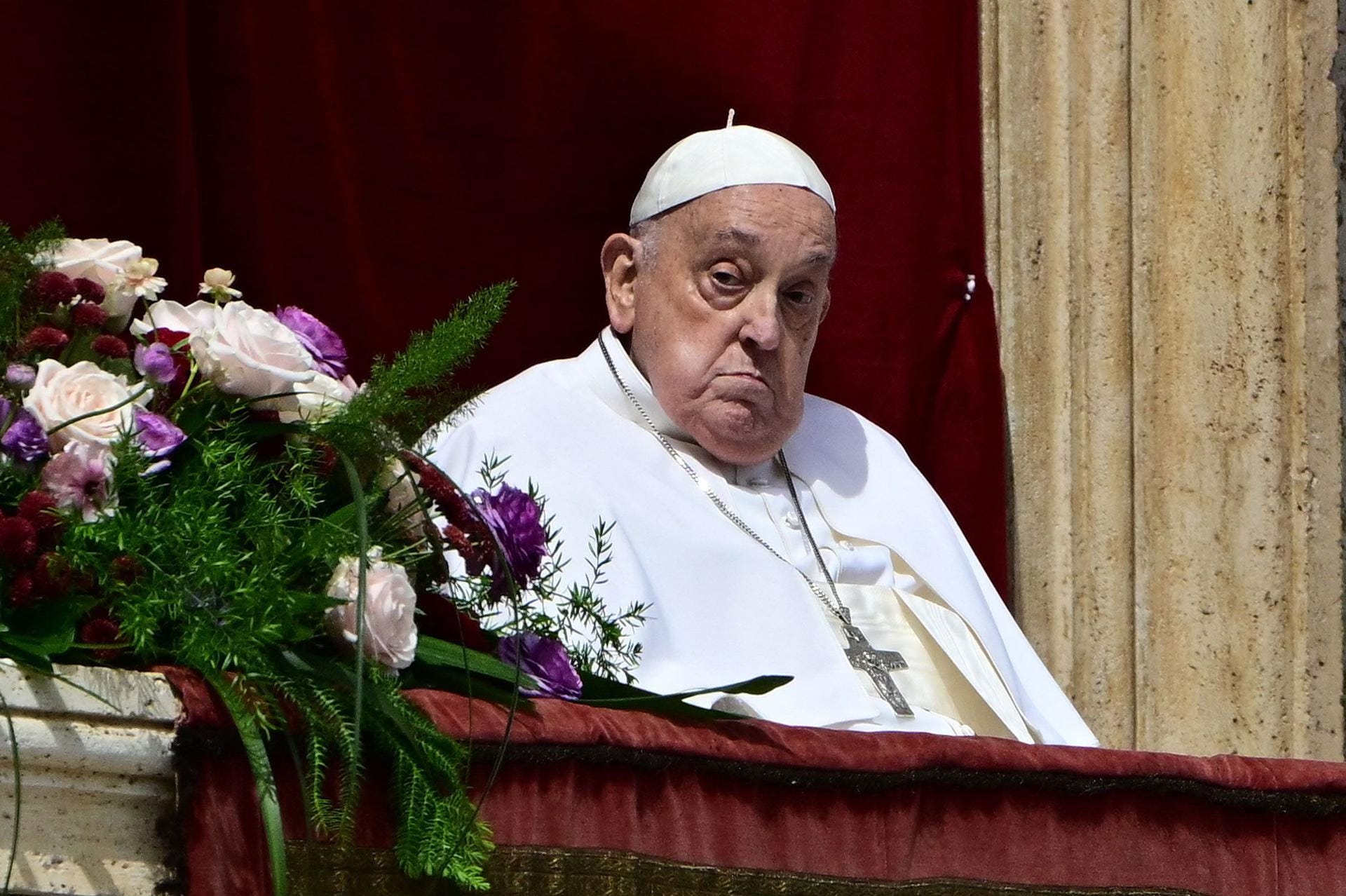
I woke to the news that Pope Francis had died at the age of 88. Francis had qualities that I admired, including his lack of pomp and his support of the disadvantaged. As Caitlin Johnstone notes, Francis was an advocate for the Palestinians. He was known as a “liberal” pope, so my guess is that we’ll soon see an old-school conservative elected as the new pope.
Pope Francis (Tiziana Fabi/AFP/Getty Images)
I was raised Catholic, getting confirmed back in 1979, but I’m very much a lapsed one today. I think the Church should allow female priests and should not persist in upholding chastity for the hierarchy. I think the Church should speak out far more strongly against genocidal nuclear weapons and warfare in general. I think the Church should use its great wealth and power to ease the suffering of people around the world. And I know all this is not going to happen in an institution dedicated to its own survival.
There are, of course, many “good” priests, “good” sisters, committed to charity and guided by the teachings of Christ, but those who are bumped upstairs, who become the bishops and cardinals of the Church, are often those who are most committed to the trappings of power. They are the most political, the most worldly, the most vulnerable to vainglory and sin, especially the sin of pride and the lust for power.
Perhaps a new pope will carry on the legacy of Francis, but something tells me that the College of Cardinals is going to coalesce behind a traditionalist, a symbol of orthodoxy. There will be no Vatican III, no fresh opening of the Church, no revolutionary spirit.
After Francis I see regression, not reformation, and it makes me sad to type that.
I’m a member of the Eisenhower Media Network, or EMN. We’re a small network of retired military types and former U.S. government officials who are openly critical of the military-industrial-congressional complex, America’s open-ended forever wars (the global war on terror; the cold war against Russia and China), and rising militarism within and across our society.
Recently, EMN issued a new letter in opposition to the Washington bipartisan consensus for war and more war. I’m proud to say I had a hand in writing it, as did Matthew Hoh and other members of EMN. Here’s what we had to say:
Military and Foreign Policy Experts Open Letter on U.S. Diplomatic Malpractice
Does America inspire the world by the power of its example or the example of its power? Far too often, and despite President Joe Biden’s words during his inaugural address, America’s overmilitarized power and diplomatic malpractice are its examples to the world.
We must change that. To make America truly essential and indispensable, we must not remain the world’s leading arms maker and weapons exporter. We must instead become the world’s greatest and most committed peacemaker and diplomat.
The problem is that America continues to make war, continues being “essential” only as the world’s leading merchant of death, and continues seeking dominance through military supremacy that ends, in places like Afghanistan, Iraq, and earlier in Vietnam, in mass death and colossal folly.
In our first open letter last spring in The New York Times, we, the undersigned, argued that a thoroughly militarized U.S. foreign policy would generate ruinous and worsening consequences and increasingly limited options for the U.S. and the world. Recent events bear this out.
The results of U.S. diplomatic malpractice are cruelly displayed in Eastern Europe, the Middle East and the Indo-Pacific. Risks of further escalation and a world war are rising. Predictably, a militarized foreign policy characterized by rejecting or ignoring international laws and treaties and by disingenuous negotiations and talks has offered no solutions to volatile wars in Eastern Europe and the Middle East while making war more likely in the Indo-Pacific.
Militarized solutions breed and feed more war. Earnest and deliberate diplomacy is the best hope to bring peace, stability and reconciliation to the world.
We chose Ike as our inspiration because he warned Americans of the dangers of the military-industrial complex and because he rejected a world dedicated to manufacturing weapons to commit mass murder.
War in Ukraine
The failure to pursue diplomacy in Eastern Europe, both before and after Russia’s invasion of Ukraine, has resulted in a costly and destructive stalemate for which there are two likely futures:
The collapse of the Ukrainian state due to a deteriorating economic and military situation hastened by corruption.Here, Ukraine’s fragility resembles that of previous houses of cards built by the U.S. in Afghanistan, Iraq, and Vietnam.
A harrowing and bloody stalemate in Ukraine where firepower, made more lethal by technological advances, rules a battlefield where neither side can achieve decisive tactical or operational gains. The pursuit of ways out of this stalemate likely entails horizontal and vertical escalation, neither of which offers solace to those seeking an end to death and destruction in Ukraine and the establishment of peace and stability.
Horizontal escalation sees the war extending further to civilian population centers and infrastructure and includes the possibility of other nations joining the conflict. Vertical escalation sees the expansion of arsenals to weapons of greater range, lethality, and consequence, including nuclear weapons. These two forms of escalation may be intertwined and reinforcing. So, as the war may expand horizontally to resemble The War of Cities between Iran and Iraq in the 1980s, it may expand vertically as well with more powerful weapons being introduced by both sides. The use of nuclear weapons is increasingly conceivable under these conditions.
These two likely futures may intersect. For example, a Ukrainian collapse could see NATO forces, likely Polish and Romanian, marching into western and central Ukraine to counter a Russian push to fill a collapsing Ukrainian state. Such an event could lead to a war between NATO and Russia, a war that conceivably could go nuclear.
Hamas, Israel and the Middle East
The Russia-Ukraine War now rages concurrently with the war between Hamas and Israel. This war, too, is born of a U.S. refusal to foster diplomacy. Unlike the conventional war between Russia and Ukraine, we are witnessing an asymmetrical conflict more akin to the wars of insurgency many of us experienced in Vietnam, Afghanistan, and Iraq.
Worse, the Hamas/Israel bloodletting in Gaza is characterized by an ethnic cleansing campaign that would be impossible without U.S. diplomatic, economic, media, military and political support. We are disgusted by and find repugnant the brazen and bipartisan support by the U.S. government for rampant violations of international law by Israel. Ethnic cleansing in Gaza, long planned by senior members of the Israeli government and powerful elements of Israel’s reactionary right wing, follows in the ghastly wake of Hamas atrocities against civilians on October 7.
Here, the U.S. government isn’t just passively witnessing war crimes; it is enabling them. With the frightening possibility of escalation to a regional or even a world war, the violence in Gaza has fed and feasted upon decades of deliberate diplomatic malpractice in America. Decades of putting Israel first, second, and last while ignoring the plight and pleas of Palestinians have made political settlements to the blockade of Gaza and the occupation of East Jerusalem and the West Bank nearly impossible.
Whereas a month ago, we lived with the risk of nuclear war as an outcome of escalating conflict in Ukraine, we now face the elevated risk of a rightfully feared world war as a consequence of entangling alliances between nuclear-armed Moscow and Washington in the Middle East.
China and the Path Ahead
To this, we must add the dangers of war with China, something hyped by leading U.S. politicians; the still unpaid costs of the $8 trillion wars in Afghanistan and Iraq; a militarized federal budget for which 60% of discretionary spending goes to war and all its wounds; and a hollowed American economy.
Decades of reckless U.S. war-making, both direct and via proxies, while coddling corrupt, ruthless, and unjust foreign governments has, not surprisingly, made the world more dangerous and less stable. Failure to invest in and maintain our country has weakened and corroded America’s infrastructure, institutions, and industries. A hypocritical flaunting of international law and an espousal of an ethereal rules-based order, coupled with an arrogant disregard for past U.S. crimes and blunders, have caused dozens of nations to flock to competitors – a movement away from America that will undoubtedly accelerate if we remain on our current militaristic path.
Moreover, decades of colossal military spending have witnessed few strategic gains for the U.S. Our military, often saluted as the world’s greatest by politicians, hasn’t won a major war since World War II. That same military annually faces significant recruiting shortfalls that cast considerable doubt on the integrity and staying power of the All-Volunteer Force. America’s legacy of failed wars is not redeemed by ongoing displays of vacuous military boosterism. Feel-good patriotism can’t suppress the bitterness many of us military veterans feel toward the past, nor does it calm the worries we have about our nation’s future.
Pope Francis has spoken of a “famine of peace” that exists in the world today. In this spirit, we call for immediate ceasefires, without conditions, in Gaza and Ukraine.
The surest way to prevent wars from exploding into uncontainable wildfires is to starve them of fuel. To think or speak that these conflagrations can be managed, adjusted as if by damper or thermostat, is a fool’s conceit or a liar’s word. We have been burned too many times in our professional lives to believe hot wars can be “won” by throwing more gasoline on them, whether rhetorically or in the form of cluster munitions, depleted uranium shells, and similar forms of “aid.”
A better path ahead is clear. Peace, not war, must be fostered. In embracing peace through diplomacy conducted in good faith, America would indeed exhibit the power of its example, becoming essential to a world that cries out for liberty and justice for all.
There is a famine of peace in the world today. I came across that phrase, “famine of peace,” in an article in the New Yorker that reported on a papal envoy sent to advocate for a truce and diplomacy to President Joe Biden. Biden, a practicing Catholic, gave the envoy a hearing, but as yet I’ve heard no change from the White House with respect to sending more weapons to Ukraine and maximum support for the war effort.
Pope Francis, working for peace, is exactly what I’d expect from Christ’s representative here on earth. Indeed, it is what I’d expect from all Christians everywhere. Yet we continue to have a glut of war in the world, with plenty of war pigs feeding at the trough.
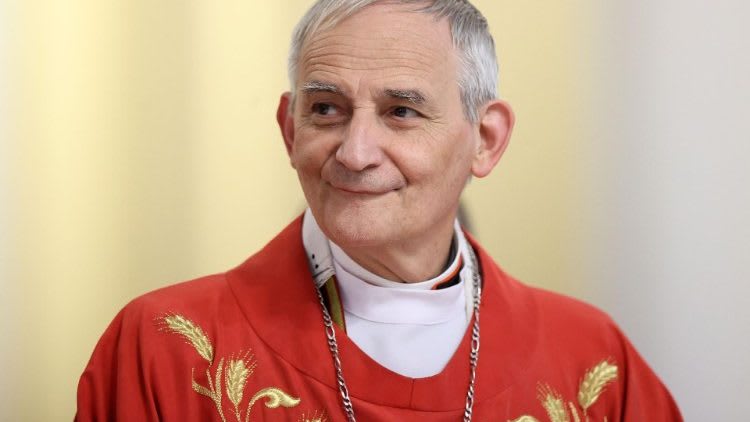
Cardinal Matteo Maria Zuppi brought a message of peace to President Biden.
I’m a lapsed Catholic, but I have nothing but respect when the Church does its best to embody, obey, and manifest Christ’s two commandments: love God, love thy neighbor. Being faithful to these commandments is everything for Christians.
War is a terrible sin that enables and empowers so many other sins. Meanwhile, a famine of peace and a glut of war means terrible suffering for the world’s most vulnerable. War is thus to be avoided or averted under nearly all circumstances; indeed, Christ implored us to turn the other cheek when we are struck.
I’ve read enough “just war” theory to see how almost any war can be twisted as “defensive” and “necessary.” And I believe in rare circumstances the evil of war may be necessary to stop or prevent even worse evils, e.g. World War II put a stop to Nazi domination and the enslavement and massacre of millions of people, most especially Jews and gypsies, among other “undesirables” and “lesser humans” according to Nazi ideology.
The Pope in those days, Pius XII, did not speak forcibly enough to condemn the crimes of the Nazis. In Francis it is good to have a pope who’s willing to speak of today’s famine of peace. All Christians everywhere should look within to consider why peace is dying and war is thriving. Under these conditions, if we fail to act, do we dare even call ourselves “Christian”?



 Bracing Views