Imagine If America Had A Real Department of Defense

W.J. Astore

In my latest article for TomDispatch.com, I ask a simple question: What would real national defense look like? Here are some answers.

What would real national defense for this country look like?  Rarely do any of us pose this question, no less examine what it might truly mean.  Rarely do we think about all the changes we’d have to make as a nation and a people if we were to put defense first, second, and last, while leaving behind both our imperial wars and domestic militarism.

I know what it wouldn’t look like.  It wouldn’t look like today’s grossly inflated military.  A true Department of Defense wouldn’t need 800 foreign military bases, nor would the national security state need a budget that routinely exceeds a trillion dollars annually.  We wouldn’t need a huge, mechanized army, a navy built around aircraft carriers, or an air force that boasts of its global reach and global power, all of it created not for defense but for offense — for destruction, anytime, anywhere.

As a country, we would need to imagine a new “people’s” military as a force that could truly defend the American republic. That would obviously mean one focused above all on supporting the Constitution and the rights we (at least theoretically) hold sacred like freedom of speech, the press, and assembly, the right to privacy and due process, and of course the right to justice for all, not just for the highest bidder or those with the deepest pockets.

What might such a new military look like?  First, it would be much smaller.  America’s current military, including troops on active duty, reservists, and members of the National Guard, consists of roughly 2.4 million men and women.  Those numbers should gradually be cut at least in half.  Second, its budget should similarly be dramatically cut, the end goal being to have it 50% lower than next year’s proposed budget of $715 billion.  Third, it wouldn’t be based and deployed around the world. As a republican force (note the lower-case “r”), it would instead serve democratic ends rather than imperial ones.  It would certainly need far fewer generals and admirals.  Its mission wouldn’t involve “global reach,” but would be defensive, focused on our borders and this hemisphere.

Buy the Book

A friend of mine, a Navy veteran of the Vietnam War, speaks of a military that would consist of a Coast Guard, “militias” (that is, the National Guard) for each of the fifty states, and little else.  Yes, in this America, that sounds beyond extreme, but he has a point.  Consider our unique advantages in terms of geography.  Our continent is protected by two vast oceans.  We share a long and peaceful border with Canada.  While the border with Mexico is certainly troubled, we’re talking about unarmed, desperate migrants, not a military invasion flooding into Texas to retake the Alamo. 

Here, then, are just 10 ways America’s military could change under a vision that would put the defense of America first and free up some genuine funds for domestic needs as well:

  1. No more new nuclear weapons.  It’s time to stop “modernizing” that arsenal to the tune of possibly $1.7 trillion over the next three decades.  Land-based intercontinental ballistic missiles like the Ground Based Strategic Deterrent, expected to cost more than $264 billion during its lifetime, and “strategic” (nuclear) bombers like the Air Force’s proposed B-21 Raider should be eliminated.  The Trident submarine force should also be made smaller, with limited modernization to improve its survivability.
  2. All Army divisions should be reduced to cadres (smaller units capable of expansion in times of war), except the 82nd and 101st Airborne Divisions and the 10th Mountain Division.
  3. The Navy should largely be redeployed to our hemisphere, while aircraft carriers and related major surface ships are significantly reduced in number.
  4. The Air Force should be redesigned around the defense of America’s air space, rather than attacking others across the planet at any time.  Meanwhile, costly offensive fighter-bombers like the F-35, itself a potential $1.7 trillion boondoggle, should simply be eliminated and the habit of committing drone assassinations across the planet ended. Similarly, the separate space force created by President Trump should be folded back into a much-reduced Air Force.
  5. The training of foreign militaries and police forces in places like Iraq and Afghanistan should be stopped.  The utter collapse of the U.S.-trained forces in Iraqin the face of the Islamic State in 2014 and the ongoing collapse of the U.S.-trained Afghan military today have made a mockery of this whole process.
  6. Military missions launched by intelligence agencies like the CIA, including those drone assassination programs overseas, should be halted and the urge to intervene secretly in the political and military lives of so many other countries finally brought under some kind of control.
  7. The “industrial” part of the military-industrial complex should also be brought under control, so that taxpayer dollars don’t go to fabulously expensive, largely useless weaponry. At the same time, the U.S. government should stop promoting the products of our major weapons makers around the planet.
  8. Above all, in a democracy like ours, a future defensive military should only fight in a war when Congress, as the Constitution demands, formally declares one.
  9. The military draft should be restored.  With a far smaller force, such a draft should have a limited impact, but it would ensure that the working classes of America, which have historically shouldered a heavy burden in military service, will no longer do so alone. In the future America of my military dreams, a draft would take the eligible sons and daughters of our politicians first, followed by all eligible students enrolled in elite prep schools and private colleges and universities, beginning with the Ivy League.  After all, America’s best and brightest will surely want to serve in a military devoted to defending their way of life.
  10. Finally, there should be only one four-star general or admiral in each of the three services. Currently, believe it or not, there are an astonishing 44 four-star generals and admirals in America’s imperial forces. There are also hundreds of one-star, two-star, and three-star officers.  This top-heavy structure inhibits reform even as the highest-ranking officers never take responsibility for America’s lost wars.

Pivoting to America

Perhaps you’ve heard of the “pivot to Asia” under the Obama administration — the idea of redeploying U.S. military forces from the Greater Middle East and elsewhere in response to perceived threats from China.  As it happened, it took the new Biden administration to begin to pull off that particular pivot, but America’s imperial military regularly seems to be pivoting somewhere or other.  It’s time to pivot to this country instead.

Echoing the words of George McGovern, a highly decorated World War II bomber pilot who unsuccessfully ran for president against Richard Nixon in 1972, “Come home, America.” Close all those foreign military bases.  Redirect resources from wars and weapons to peace and prosperity.  Focus on restoring the republic.  That’s how Americans working together could truly defend ourselves, not only from our “enemies” overseas, almost always much exaggerated, but from ourselves, the military-industrial-congressional complex, and all our fears.

Please read all of this article at TomDispatch.com.

The Unexamined U.S. Military

W.J. Astore

Perhaps you’ve heard the saying that the unexamined life is not worth living. Can it also be said that the unexamined military is not worth having?

What amazes me about the U.S. military is how little it is scrutinized. Sure, there’s armed services committees in the House and Senate, but they seem most concerned about shoveling more money toward the Pentagon. Either that or the dire perils of “critical race theory,” which is surely threatening the Republic more than runaway militarism, endless wars, and unneeded nuclear weapons.

What is to be done? I see only one solution: major cuts to the “defense” budget. And that budget is even higher than the stated figure of $705 billion or thereabouts. Nuclear weapons come under the Department of Energy, for example. Homeland Security has its separate budget (isn’t defense of the homeland what the Pentagon is all about?). The various intelligence agencies like the CIA and NSA and so forth churn through scores of billions yet couldn’t predict the collapse of the Soviet Union or the 9/11 attacks. Interestingly, after 9/11 these agencies saw vast increases in funding. Who knew incompetence could be so rewarding?

If you add up all the billions tied to weapons and wars and “defense” in America, you routinely exceed a trillion dollars a year. It’s almost an unfathomable sum. Perhaps it is to the U.S. military as well, since they can’t pass an audit. No one really knows where all the money is going.

Ike knew the score. Sixty years ago, President Eisenhower warned us all about the military-industrial-Congressional complex. A few people listened, but nobody in power did anything about it. Since then the Complex has only grown stronger and more pervasive (and invasive) in America. And now that same Complex owns the mainstream media. Remarkably, the “journalists” telling us all about the Complex on MSNBC and CNN and Fox are often retired CIA and military officials; they don’t even bother disclosing their obvious conflict of interest here.

Strangely, it’s become patriotic to salute our military rather than to examine it and challenge it. Americans, generally a boisterous and busy bunch, are remarkably quiet and passive except for all the saluting and praising. Until this mindset, and this behavior, changes radically, America will continue on a wasteful and wanton path forged by weapons and war.

And that really is something we need to examine in the collective life of our country.

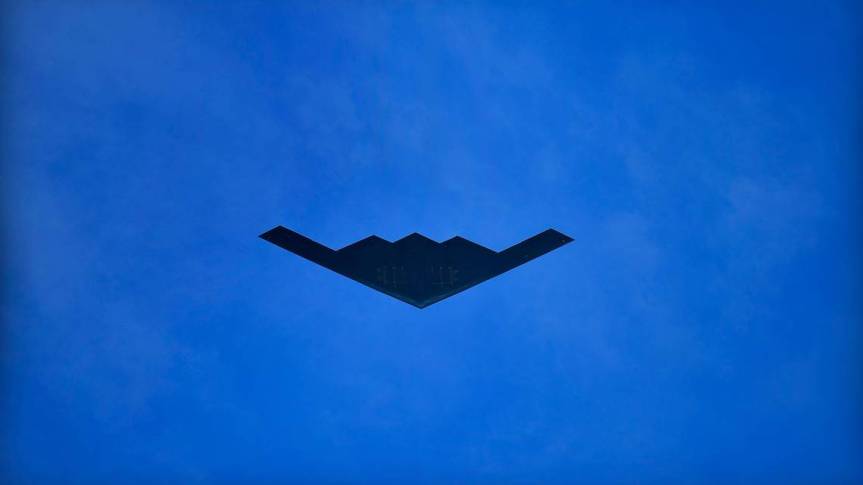
Sure, stealth bombers look cool. But together we paid roughly $2 billion per plane for a weapon designed to drop nuclear bombs on people.

America Doesn’t Have A Foreign Policy, It Has A Business Plan

Business as usual

W.J. Astore

America doesn’t have a foreign policy, it has a business plan, and it’s business as usual in the Biden administration. Joe Biden promised his donors that nothing would fundamentally change in his administration. Kamala Harris said her agenda wasn’t about substantive change. So what we’re getting under the Biden/Harris team is eminently predictable:

  1. More blank checks for Israel, and no recognition of any rights for Palestinians.
  2. A revival of the old Cold War, with China as the leading “threat” but with Russia not forgotten.
  3. Politics subordinated to the military, rather than the military in service of political aims. In brief, military dominance is America’s foreign policy.
  4. Related to (1-3) is dominance of the world’s trade in weapons. The State Department has become a tiny branch of the Pentagon and the military-industrial complex. It’s all about closing arms deals, moving hardware, selling weaponry, making a buck.
  5. Naturally, one of Biden’s first acts as president was to bomb a foreign country, in this case Syria. So presidential!

In Joe Biden, America has a fading and flailing man to lead a fading and flailing empire. In Kamala Harris, America has an example of old wine in new packaging. She’s a woman, she’s Black, she’s South Asian — and she thinks like Hillary Clinton and Henry Kissinger.

Joined at the hip

Remember when Joe Biden said he’d be all about diplomacy? That the power of America’s example would rule over the example of our power? Nice words, but that’s all they’ve been so far. Words.

Two examples where Biden has appeared to offer meaningful change are with Afghanistan and Yemen. With Afghanistan, Biden has promised a complete military withdrawal by 9/11/2021. But does this apply only to combat troops while excluding mercenaries, the CIA, special forces “trainers,” and the like? It’s not yet clear. Plus anything can happen between now and 9/11 for Biden to switch gears and keep some combat troops in place.

With Yemen, Biden made a point about excluding offensive arms sales to Saudi Arabia while still allowing defensive ones. Almost any weapon can be labeled as defensive in nature, so it’s doubtful whether Saudi operations in Yemen will be impacted at all by Biden’s weasel-word policies.

The Biden/Harris foreign policy, such as it is, is retrograde. It’s a return to the Cold War, with an emphasis on new nuclear weapons and larger Pentagon budgets. It’s about global dominance while America at home burns. It’s foolish and stupid yet it will make a few people richer for a few more business cycles.

And thus it’s business as usual in Washington, which is exactly what Biden/Harris were hired for.

More Afghan War Lies

Like much of Biden’s face, America’s Afghan War is kept hidden behind a dark mask (Samuel Corum/Getty Images)

W.J. Astore

President Biden has announced that all U.S. military combat troops will be withdrawn from Afghanistan by 9/11/2021. That date was chosen deliberately and cynically. Recall that 15 of the 19 terrorist hijackers of 9/11 were Saudi. Recall that Osama bin Laden was Saudi. Recall that it was Al Qaeda, not the Taliban in Afghanistan, that was behind the 9/11 attacks on America. Yet America’s Afghan War has always been falsely advertised as both preemptive and preventative, i.e. America went to war to preempt another 9/11-style attack and has continued that war to prevent similar attacks coming from Afghanistan. It’s a false narrative that has largely worked to sustain the Afghan War for twenty years, and Biden is reinforcing it.

Another critical issue: What does it really mean when Biden says those combat troops will be withdrawn? What it doesn’t mean is that the war will end. Doubtless the CIA and similar intelligence operatives will remain behind, shrouded in secrecy. Doubtless some special forces units will stay. Doubtless private contractors, many of them ex-military, will stay. Doubtless America will reserve the “right” to continue to bomb Afghanistan and to conduct drone strikes from halfway across the world, ostensibly in support of the Afghan “national” government in Kabul. So is the war really ending?

Meanwhile, the Pentagon is getting what it wants: a boosted budget (even above what Trump requested) and a future defined by plans for war with China and Russia (and perhaps Iran as well). I’ve seen plenty of articles screaming that China is building a powerful navy, that China is building dangerous missiles, that China is building advanced fighter jets, and so on, which is exactly what the Pentagon wants: a “near-peer” rival to justify even more military spending, especially for big-ticket items like aircraft carriers, fighters, bombers, missile defense systems, and so on.

Biden’s linking of the failed Afghan War to 9/11 and its forthcoming 20th anniversary is yet another exercise in pernicious lying by America’s vast national security state. Once again, we’re reminded that the first casualty in war is truth. And perhaps the last casualty of the Afghan War (whenever it really ends, at least for America) will also be truth.

Monday Military Musings

W.J. Astore

1. Recently I came across a reference to the U.S. military complaining that it never fights with a “home field” advantage. That the fight is always “away,” in sports speak, on the other guy’s field. And the gist of the comment was that the U.S. military must always be prepared to fight at a disadvantage. It seemingly never occurs to the decisionmakers that maybe, just maybe, the U.S. doesn’t have to fight on the other guy’s field. Maybe, just maybe, Vietnam was a bad idea. Iraq was a bad idea. Afghanistan was and remains a bad idea. China in the future would be a very, very, bad idea. And so on.

Or maybe, just maybe, the Pentagon and America’s generals are just too vainglorious in identifying the entire world as their home court?

2. Surprise! Joe Biden’s Pentagon budget is basically the same as Trump’s with a few extra billion thrown in for good measure. So much for reforming “defense” spending in any meaningful way.

3. The U.S.. military continues to define exertion (and merit) mainly in physical terms. Consider this chart sent along by a friend:

As my friend amusingly put it, “If I read this chart correctly, humans reach their full potential only at the moment of death.”

I wrote back to him: Why is exertion in the military always physical? Maybe we should be thinking harder too? It’s fascinating this devotion to physical strength and fitness when modern weaponry is truly the great equalizer.  If I can sit in an air-conditioned trailer in Nevada and smite evil-doers in Afghanistan via a drone strike, should I be kicked out if I fail to do 50 pushups or run the obstacle course?

Mental fitness is rarely considered in the U.S. military except in the sense of weeding out the mentally ill or those who can’t conform to military discipline.

Even military promotion seems driven more by brawn than brains.  If I run a sub-3 hour marathon, I bet the OPR (officer proficiency report) bullet would be far more favorable than if I wrote an article for Armed Forces Journal.

As another friend of mine, the distinguished military historian Dennis Showalter, said to me: Some flab around the waistline is preferable to flabby thought processes. Just think here of David Petraeus and Stanley McChrystal, both celebrated in the U.S. media as running and exercise enthusiasts.

5. To come back to the subject of “home field” advantage, it’s precisely because we never have that that U.S. troops have to wear heavy body armor and carry all kinds of gear with them. Whereas the “enemy,” whether in Vietnam, Afghanistan, or Iraq, is at “home” and can wear street/farm clothes and carry a much lighter load, e.g. a rifle, some ammo, some rations.

The result is that U.S. troops often look like the imperial stormtroopers of “Star Wars” who are always bungling and losing to the lighter-armed rebel alliance.

You do need to be in decent physical shape to carry so much armor and so much weaponry and gear into hostile and foreign lands. But, maybe instead of turning every soldier into Rambo, we should find smart ways to advance our policies without having to fight at all?

It certainly is smarter than a bunch of Army Rangers driving themselves to the brink of death in the cause of maximizing their “human potential.”

The Cold War, Rebooted and Rebranded

In my latest for TomDispatch.com, I tackle the Pentagon’s latest proclivity for “near-peer” conflicts, the near-peers being China and Russia, which conveniently serves to justify huge war budgets in perpetuity. It’s the Cold War, rebooted and rebranded, with a new generation of nuclear weapons thrown into the mix to make things even more interesting. As they say, what could possibly go wrong?

What follows is an excerpt that focuses on a “Star Trek” episode that has much to teach us:

In the 1970s, in fact, I avidly watched reruns of the original Star Trek. Lately, one episode, “A Taste of Armageddon,” has been on my mind. It featured two planets, Eminiar VII and Vendikar, at war with each other for 500 years. Here was the catch: those planets no longer used real weapons. Instead, they fought bloodlessly with computer-simulated attacks, even as citizens marked as “dead” had to report to disintegration chambers in a bizarre ritual meant to keep the peace through a computer-driven holocaust. The peoples of these two planets had become so accustomed to endless war that they couldn’t imagine an alternative, especially one that ended in a negotiated peace.

So many years later, I can’t help thinking that our country’s military establishment has something in common with the leaders of Eminiar VII and Vendikar. There’s so much repetition when it comes to America’s wars — with little hope of negotiated settlements, little talk of radically different approaches, and a remarkably blasé attitude toward death — especially when it’s largely the death of others; when foreign peoples, as if on another planet, are just “disintegrated,” whether by monster bombs like MOAB or more discrete Hellfire missile strikes via remotely piloted drones.

What gives? Right now, America’s military leaders are clearly turning back to the war they’d prefer to be fighting, the one they think they can win (or at least eternally not lose). A conventional warlike state vis-à-vis those near-peers seems to play to their skills. It’s also a form of “war” that makes loads of money for the military-industrial complex, driving lucrative acquisition decisions about weaponry in a remarkably predictable fashion.

Near-peer “war” remains largely a fantasy set of operations (though with all-too-real dangers of possible conflagrations to come, right up to nuclear disaster). In contrast, real war, as in this century’s terror wars, is a realm of chaos. So much the better to keep things as predictable as possible. Fresh and original ideas about war (and peace) are unlikely to prove profitable for the military-industrial complex. Worse yet, at an individual level, they could damage one’s chances for promotion or, on retirement, for future posts within the industrial part of that complex. It’s a lot healthier to salute smartly, keep planning for a near-peer future, and conform rather than fall on one’s sword for a dissenting idea (especially one related to peace and so to less money for the Pentagon).

Please read the article in its entirety here at TomDispatch.

On Eminiar VII, “casualties” of computer war willingly enter disintegration chambers to die as a way of keeping “peace”

The Pentagon’s Wasteful Weapons

Now the “lemon” is up to $1.7 trillion. Even more lemonade?

W.J. Astore

Imagine you’re a soldier in combat. What’s the most important feature of any weapon system? That it works. That it’s reliable. Nobody wants a weapon that jams in a firefight. Reliability, simplicity, ruggedness are key features of weaponry.  Yet the Pentagon and the military-industrial complex seem to specialize in unreliable, complex, fragile ones. Ones that don’t work, or that don’t work very well, and at inflated prices as well. This is the subject of my latest article at TomDispatch, and here’s an excerpt from it:

Cancel culture is a common, almost viral, term in political and social discourse these days. Basically, somebody expresses views considered to be outrageous or vile or racist or otherwise insensitive and inappropriate. In response, that person is “canceled,” perhaps losing a job or otherwise sidelined and silenced. In being deplatformed by Twitter, Facebook, and other social media sites, for instance, this country’s previous president has, it could be argued, been canceled — at least by polite society. More than a few might add, good riddance.

Cancel culture is all around us, with a single glaring exception: the U.S. military. No matter how poorly a major weapons system performs, no matter how much it goes over budget, no matter how long it takes to field, it almost never gets canceled. As a corollary to this, no matter how poorly a general performs in one of our twenty-first-century wars, no matter his lack of victories or failure to achieve mission objectives, he almost never gets cashiered, demoted, or even criticized. A similar thing could be said of America’s twenty-first-century wars themselves. They are disasters that simply never get canceled. They just go on and on and on.

Is it any surprise, then, that a system which seems to eternally reward failure consistently produces it as well? After all, if cancel culture should apply anywhere, it would be to faulty multibillion-dollar weapons systems and more than a few generals, who instead either get booted upstairs to staff positions or retire comfortably onto the boards of directors of major weapons companies.

Let’s take a closer look at several major weapons systems that are begging to be canceled — and a rare case of one that finally was.

* The F-35 stealth fighter: I’ve written extensively on the F-35 over the years. Produced by Lockheed Martin, the plane was at one point seven years behind schedule and $163 billion over budget. Nonetheless, the U.S. military persisted and it is now nearing full production at a projected total cost of $1.7 trillion by the year 2070. Even so, nagging problems persist, including engine difficulties and serious maintenance deficiencies. Even more troubling: the plane often can’t be cleared for flying if lightning is anywhere in the area, which is deeply ironic, given that it’s called the Lightning II. Let’s hope that there are no thunderstorms in the next war.

* The Boeing KC-46 tanker: A tanker is basically a flying gas station, air-to-air refueling being something the Air Force mastered half a century ago. Never underestimate the military’s ability to produce new problems while pursuing more advanced technology, however. Doing away with old-fashioned windows and an actual airman as a “boom operator” in the refueling loop (as in a legacy tanker like the KC-135), the KC-46 uses a largely automated refueling system via video. Attractive in theory, that system has yet to work reliably in practice. (Maybe, it will, however, by the year 2024, the Air Force now says.) And what good is a tanker that isn’t assured of actually transferring fuel in mid-air and turns out to be compromised as well by its own fuel leaks? The Air Force is now speaking of “repurposing” its new generation of tankers for missions other than refueling. That’s like me saying that I’m repurposing my boat as an anchor since it happened to spring a leak and sink to the bottom of the lake.

* And speaking of boats, perhaps you won’t be surprised to learn that the Navy has had serious problems of its own with its most recent Gerald R. Ford-class aircraft carriers. That service started building carriers in the 1920s, so one might imagine that, by now, the brass had gained some mastery of the process of updating them and building new ones. But never underestimate the allure of cramming unproven and expensive technologies for “next generation” success on board such vessels. Include among them, when it comes to the Ford-class carriers, elevators for raising munitions that notoriously don’t operate well and a catapult system for launching planes from the deck (known as the Electromagnetic Aircraft Launch System or EMALS) that’s constantly breaking down. As you might imagine, not much can happen on an aircraft carrier when you can’t load munitions or launch planes effectively. Each new Ford-class carrier costs in the neighborhood of $14 billion, yet despite all that money, it simply “isn’t very good at actually being a carrier,” as an article in Popular Mechanics magazine bluntly put it recently. Think of it as the KC-46 of the seas.

* And speaking of failing ships, let’s not forget the Navy’s Littoral Combat Ships (LCS), which have earned the nickname “little crappy ships.” A serious propulsion design flaw may end up turning them into “floating garbage piles,” defense journalist Jared Keller recently concluded. The Navy bought 10 of them for roughly half a billion dollars each, with future orders currently on hold. Lockheed Martin is the lead contractor, the same one responsible for the wildly profligate (and profitable) F-35.

* Grimly for the Navy, problems were so severe with its Zumwalt-class of stealth destroyers that the program was actually canceled after only three ships had been built. (The Navy initially planned to build 32 of them.) Critiqued as a vessel in search of a mission, the Zumwalt-class was also bedeviled by problems with its radar and main armament. In total, the Navy spent $22 billion on a failed “next generation” concept whose cancelation offers us that utter rarity of our moment: a weapon so visibly terrible that even the military-industrial complex couldn’t continue to justify it.

Chief of Naval Operations Admiral Michael Gilday has gone on record as rejecting the idea of integrating exotic, largely untried and untested technologies into new ship designs (known in the biz as “concurrent development”). Godspeed, admiral!

Much like the troubled F-35 and the Littoral Combat Ship, the Zumwalt’s spiraling costs were due in part to the Pentagon’s fixation on integrating just such “leading-edge” technologies into designs that themselves were in flux. (Not for nothing do military wags refer to them as bleeding edge technologies.) Such wildly ambitious concurrent development, rather than saving time and money, tends to waste plenty of both, leading to ultra-expensive less-than-fully effective weapons like the Zumwalt, the original version of which had a particularly inglorious breakdown while passing through (or rather not passing through) the Panama Canal in November 2016.

Given such expensive failures, you might be forgiven for wondering whether, in the twenty-first century, while fighting never-ending disastrous wars across significant parts of the planet, America’s military isn’t also actively working to disarm itself. Seriously, if we’re truly talking about weapons that are vital to national defense, failure shouldn’t be an option, but far too often it is.

With this dubious record, one might imagine the next class of Navy vessel could very well be named for Philip Francis Queeg, the disturbed and incompetent ship captain of novelist Herman Wouk’s The Caine Mutiny. It’s also quite possible that the Pentagon’s next advanced fighter jet will fulfill former Martin Marietta CEO Norman Augustine’s estimate from the 1980s that, by the year 2054, the entire Pentagon budget would be needed to buy one — and only one – combat aircraft. Perhaps a Death Star for America’s new Space Force?

Be sure to read the rest of the article here at TomDispatch.com.

Ten Ways to Work Toward Peace

W.J. Astore

I came across this quotation yesterday: “I am worried about the state of the readiness of the nuclear triad,” Deputy SecDef nominee Kath Hicks tells the Senate Armed Services Committee this morning, “and, if confirmed, that is an area I would want to get my team in place and start to look at right away.”

The U.S. military plans to spend well over a trillion dollars over the next thirty years to “modernize” the nuclear triad of land-based ICBMs, nuclear-capable bombers, and sub-launched ballistic missiles. Long ago, I remember reading (from December 1982) that Charles Bennet, a Democratic Congressman, had said “The triad is not the Trinity.” But the Pentagon treats it as if it is a (un)Holy Trinity, shoveling money to build even more nuclear weapons to devastate and destroy humanity. I don’t use the concept of evil lightly, but I can’t think of policies much more evil than developing yet more genocidal weaponry at enormous cost.

We desperately need new thinking in America, which is why I wrote the following article for TomDispatch. Maybe some of these are pipe dreams; then again, maybe we should all be smoking peace pipes more often.

The Power of America’s Example

When it comes to war, if personnel is policy, America is yet again in deep trouble.

As retired Army Major Danny Sjursen recently pointed out at TomDispatch, when it comes to foreign policy, President Joe Biden’s new cabinet and advisers are well stocked with retired generalsreconstituted neoconsunapologetic hawks, and similar war enthusiasts. Biden himself has taken to asking God to protect the troops whenever he makes a major speech. (How about protecting them by bringing them home from our pointless wars?) “Defense” spending, as war spending is generally known in this country, remains at record levels at $740.5 billion for fiscal year 2021. Talk of a new cold war with Russia or China (or both) paradoxically warms Pentagon offices and corridors with yet more funds. The only visible dove of peace at Biden’s inaugural was the giant golden brooch worn by Lady Gaga. So what exactly is to be done?

Peace-driven progressive policies will not emerge easily from the rainbow kettle of hawks Biden has so far assembled, but his inaugural speech did mention leading and inspiring others globally “not merely by the example of our power but by the power of our example.” It would have been an apt rhetorical flourish indeed, if not for this country’s “forever wars” in Afghanistan, Iraq, Libya, Syria, Yemen, and elsewhere across the Greater Middle East and Africa. America’s harsh war-fighting reality suggests that “the example of our power” still remains standard operating procedure inside the Washington Beltway. How could this possibly be changed?

I have a few ideas for Biden — a 10-point plan, in fact, for turning his softball rhetoric into hardball reality. Consider, Mr. President, the following powerful examples you could set as America’s latest commander-in-chief:

1. Stop the U.S. from building new generations of nuclear weapons and downsize the vast existing American arsenal, while launching global negotiations to work toward the elimination of all such arsenals. The U.S. military is set to spend well over a trillion dollars in the coming decades to “modernize” its nuclear triad of bombers and land-based and submarine-launched missiles. Such a staggering “investment” can only move the world closer to nuclear Armageddon. If America is to lead by example when it comes to the ultimate power on this planet, why not begin by cancelling this trillion-dollar-nightmare as part of a new global anti-nuclear initiative? Why not commit us, long term, to the elimination of all nuclear weapons everywhere, while moving to adopt a “no-first-use” policy?

2. When it comes to President Biden’s commitment to slow climate change and clean up the environment, why not do something in military terms? America’s armed forces have an enormous appetite for fossil fuels. The Pentagon also has a sordid record when it comes to the poisoning of the environment. (Consider the legacy of Agent Orange in Vietnam, or the military’s burn pits in Iraq and Afghanistan, or the birth defects and severe health problems that were linked to the munitions its forces used in assaulting the Iraqi city of Fallujah in 2004.) If the president wants to set an example when it comes to demilitarizing this over-armed, over-polluted planet of ours, reducing both the military’s fossil-fuel emissions and its poisonous munitions would be a powerful way to start.

3. End this century’s forever wars and radically downsize this country’s unprecedented global network of military bases. Driving the colossal size of today’s military is what my old service, the Air Force, likes to call its “global reach, global power” mission. At least in theory, that mission, in turn, helps justify the sprawling network of 800 or so overseas bases, a network that costs more than $100 billion a year to maintain. Such bases not only consume resources needed here in the U.S. and help stoke those forever wars, but they present high-value targets to opponents and incite ill-feeling and resistance from “host” countries. So, downsizing that global base structure would be an act of peace — and fiscal sanity.

4. Make major cuts in the country’s war budget. Fewer bases and fewer or no wars should translate into a far lower defense budget. Somewhere in the neighborhood of $400 billion annually to defend this country and cover its real “national security” interests seems reasonable for the self-styled lone superpower. The money saved (roughly $340 billion based on this year’s budget) could then perhaps be partly rebated directly to American families in need in this pandemic. Perhaps every American family earning less than $50,000 a year could see a rebate on their taxes directly attributable to downsizing that budget and America’s imperial footprint overseas. Taking a page from Donald Trump, President Biden, as America’s thrifty and giving commander-in-chief, could even have his name put on those rebate checks. Call it a long-delayed peace dividend. Regular Americans, after all, need such “dividends” far more than giant defense contractors like Boeing or Raytheon. And don’t get me started on the need to invest in rebuilding this nation’s infrastructure at a moment when the extremities associated with climate change threaten to devastate parts of the country.

5. Create a Department of Peace (here’s looking at you, Dennis Kucinich) with influence at least approaching that of the so-called Department of Defense. Currently, the U.S. military is all about power projection, domination of the global battlespace, and similar buzzwords that add up to exporting violence abroad, special op by special op, drone by drone. You are what you do and the U.S. military does permanent war with plenty of “collateral damage.” (Picture mutilated black and brown bodies and flattened and poisoned cities and towns.) If the U.S. government can create a Space Force just to fulfill the fantasies of Donald Trump, then why not a peace force, too? (America’s current, humble Peace Corps asked for $401 million for Fiscal Year 2021, roughly the cost of four underperforming F-35 jet fighters.) Peace, much like war, doesn’t just happen. You have to work at it — and that would be precisely the mission of the Department of Peace.

6. Pay attention, for once, to President Dwight D. Eisenhower’s 1961 farewell address and exert rigorous oversight and zealous control over the military-industrial complex. That means ending the 2001 AUMF, the authorization for use of military force that Congress passed in a climate of panic and revenge in the immediate aftermath of 9/11 (though it was only to be against those associated in some fashion with those terror attacks), and the second one Congress authorized in 2002 in preparation for the Bush administration’s invasion of Iraq. They have been misused and abused by presidents ever since. Furthermore, end any conflict that hasn’t been authorized by a direct Congressional declaration of war. That means withdrawing all U.S. troops from Iraq, Afghanistan, Syria, and elsewhere across the Greater Middle East and Africa. America’s security is not, in fact, directly threatened by those countries. As a self-declared democracy, the United States should set an example by not fighting wars disconnected from the people’s will and the true needs of national defense.

7. And speaking of President Eisenhower, America needs to embrace his lesson that military spending represents a theft from Americans who are hungry, sick, and need help. For its “national security,” this country needs more hospitals, better education, safer food, a cleaner environment, and, most of all, clean water and fresh air. Eisenhower knew that warships and warplanes were simply not the answer to the American people’s real and pressing needs.

8. Reject threat inflation, including the heightening talk of a “new cold war” with Russia or China or of an ongoing “generational” war on terror. Eliminate talk of a new Red Menace, of likely wars with Iran or North Korea, or of America’s backwardness in cyberwarfare research and development. Terrorism is nothing new and will always be with us in one form or another (including, vis-a-vis the Capitol on January 6th, domestic terrorism). Indeed, since war is terror, a war on terror should truly be considered an oxymoron. Terrorist acts are mostly the recourse of the weak when taking on the strong. The United States isn’t going to stop them by getting stronger yet. Nor are China and Russia about to invade this country. (This isn’t Red Dawn.) Iran is not coming to impose Sharia law and North Korea is not about to launch nukes against us. As for cyber-attacks, don’t worry: no matter what you’ve heard, no country does cyberwarfare better than the U.S.A.

9. End the practice of foreign aid taking the form of military aid. When taxpayers give aid to foreign countries, it should be in the form of food, medicine, and other essentials, not cluster bombs, F-16s, and Hellfire missiles.

10. Learn from Abraham Lincoln. In President Biden’s recent Inaugural Address, as a call to national unity, he made reference to Lincoln’s initial inaugural appeal to “the better angels of our nature.” But he should have focused on Lincoln’s Second Inaugural Address, the finest speech ever given by any president. As Lincoln put it then, when it came to ending the American Civil War:

“With malice toward none; with charity for all; with firmness in the right, as God gives us to see the right, let us strive on to finish the work we are in; to bind up the nation’s wounds; to care for him who shall have borne the battle, and for his widow, and his orphan — to do all which may achieve and cherish a just, and lasting peace, among ourselves, and with all nations.”

Lincoln was unafraid of speaking of and seeking a just and lasting peace. In this century, until at least the Trump years, Americans often heard their leaders speak of this nation’s “exceptional” nature. What could be more exceptional, more laudable, than seeking a lasting global peace?

Biden, like me, is Roman Catholic. My Catholic bible (Matthew 5:9) tells me that Christ said, “Blessed are the peacemakers, for they shall be called children of God.” Instead of beseeching God to protect the troops that American presidents have continually sent into harm’s way, Joe Biden might ask for blessings for America’s peace activists. To echo Lincoln again, that would indeed be a case of right making might, instead of the might-making-right vision that a militaristic America has grown far too comfortable with.

An Alert and Knowledgeable Citizenry

So long ago, President Eisenhower spoke of the importance of having an “alert and knowledgeable citizenry.” Isn’t it time for mainstream media outlets to foster real, critical, investigative journalism that would truly inform those very citizens about America’s wanton military spending and endless wars, while providing educators with crucial material to teach their students about the horrific costs of militarism? This country needs to free its collective mind from the prevailing forever-war narrative. To paraphrase Crosby, Stills, and Nash, if we teach the children well, perhaps they won’t repeat their father’s hell.

In his song “Imagine,” John Lennon asked us all to imagine a different world and said that it’s easy if you try. Lennon got the first and most important part right, but the second part sadly doesn’t apply, at least to this country in this century. Nowadays, Americans are so immersed in a culture driven by war, profit, and exploitation that it’s no longer easy to imagine anything but war. If Americans truly paid attention to war, up close and as personal as they could get, they’d begin to grasp the folly and wickedness of it and so perhaps relinquish what I’ve come to think of as their prisoner-of-war mentality in relation to it. They might actually begin breaking down mental barriers to peace.

Buy the Book

Don’t count on Congress doing it, though. Congress is incestuously part of what should be renamed the military-industrial-congressional complex. Don’t count on the military doing it either. Its most senior men and women have been carefully selected, groomed, and promoted because they believe in the system, which includes incessant lobbying for more weaponry and exaggerating the threats to this country to get it. They exist to wage war; the rest of us should be willing to fight for peace.

Change, if and when it comes, will have to be driven by people like us.

It won’t be easy, but it is necessary for America’s survival. And it’s unlikely to come without campaign finance reform and the public funding of elections. In a “pay-to-play” oligarchy disguised as a democracy, the giant weapons-making corporations simply pay much more than you do and so speak through megaphones, leaving you with a dead mic. Unless the corporate dominance of our politics is curtailed, ordinary Americans will continue to be outshouted and overwhelmed by the bellicose and the greedy, leaving the country forever at war.

It won’t be easy to work for peace, but it sure is worth the try. It sure as hell beats the alternative of guns, bombs, and missiles being produced like so many sausages in a militaristic country that ever more resembles George Orwell’s nightmarish image of the future as “a boot stamping on a human face — forever.”

America’s new president has called for us to lead with the power of our example rather than just the example of our power. I can’t think of anything more exemplary and powerful than a strong commitment to making war no more.

Copyright 2021 William J. Astore

A Typical Democratic Official on the Pentagon and War

Jeh Johnson with Biden and Obama, 2013 (White House photo)

W.J. Astore

Jeh Johnson, formerly homeland security secretary under President Obama, showed how a typical Democratic official approaches the Pentagon and war as he spoke on ABC’s This Week on Sunday (11/15).  For Johnson, the Pentagon “is typically an island of stability” in the U.S. government, but President Trump was destabilizing that island because of recent changes to Pentagon personnel.  Trump’s changes could be driven by his desire to get U.S. troops out of Afghanistan, speculated Johnson, which was not a good thing:

“If he [Trump] wants troops out of Afghanistan, as I know most Americans do, we have to do it in a way that makes sense, in an orderly manner, and that comports with battlefield reality … in trying to strike a deal, you don’t unilaterally surrender your greatest point of leverage by unilaterally withdrawing troops before the Afghan government and the Taliban have stuck a deal. So this is very concerning and if I were in the Biden transition team right now, I’d be very focused … on restoring stability in our national security.”

We can’t surrender our “leverage,” those thousands of U.S. troops that remain in harm’s way in an unnecessary war that was won and then lost almost two decades ago, because it’s that “leverage” that will compel the Taliban, who have already won the war, to strike a deal with an Afghan government that exists mainly because the U.S. government props it up.  Makes sense to me.

By the way, only “most Americans” want our troops to come home?  Where are all the other Americans who want them to stay there indefinitely?  Within the Washington Beltway, I’d wager.

The Afghan war has always struck me as nonsensical.  Yes, some kind of response to the 9/11 attacks was needed, and initial U.S. military strikes in 2001-02 succeeded in toppling the Taliban, in the sense they saw no reason to stand and fight against withering fire.  At that moment, the U.S. military should have declared victory and left.  Instead, the Bush/Cheney administration decided on its own disastrous occupation, extended another eight years by Obama/Biden, even though we knew full well the extent of the Soviet disaster in Afghanistan in the 1980s. 

The Afghan war has lasted so long that I’ve been writing articles against it for more than a decade.  You’d think any sensible and sane Democrat would love to see U.S. troops withdrawn and the war finally come to an end.  Not so.  The war must continue in the name of “leverage” and “stability.”

I like Johnson’s truly absurdist reference to “battlefield reality,” which, if we’re being real for a moment, reflects a Taliban victory.  Unless the U.S. wants to occupy Afghanistan forever, with hundreds of thousands of troops, that victory is not about to be reversed.  And what kind of “victory” would that be? 

“Stability” is not preserved by fighting unwinnable wars on the imperial periphery, unless you’re talking about the stability of Pentagon finances and corporate profits.  Johnson’s wiki bio does mention he’s on the boards of Lockheed Martin Corporation and U.S. Steel, which certainly hints at a conflict of interest when it comes to offering advice on ending wars.

In the meantime, we probably shouldn’t tell our troops, whom we’re supposed to love and support, that we’re keeping them in Afghanistan for “leverage” until the “battlefield reality” is more in our favor.  That’s truly a recipe for endless war in a place that well deserves its reputation as the graveyard of empires.

Finally, a reminder to Democrats: your Pentagon is an island of stability, and your troops are creating the leverage that allows democracy to flourish everywhere.  If this makes sense to you, and if this is the guiding philosophy of Joe Biden’s national security team, we’re truly in deep trouble.

Bonus Lesson: The Pentagon is an “island” of government only if that island is roughly the size of Pangaea.

William Astore, a retired lieutenant colonel (USAF) and history professor, is a senior fellow at the Eisenhower Media Network (EMN), an organization of critical veteran military and national security professionals.

In the year 2049 …

Marching ahead to 2049?

W.J. Astore

Who says Americans can’t plan ahead? According to the Pentagon, China may exceed the U.S. military in reach and power in the year 2049. As debatable as that prediction is, you can be sure it’s fodder for officials to clamor for high “defense” budgets, if only to stay ahead of the allegedly surging Chinese.

Speaking of the defense budget, it would be an amazing thing if that budget was truly based on the defensive needs of the USA. But we Americans love NFL football and that sport teaches us “the best defense is a good offense,” which makes some sense in the NFL but not so much in war.

Defense, to my mind, is best provided by citizen-soldiers. But that old concept has been replaced by the warrior ideal in the USA. Today’s military is increasingly detached from the people even as it’s celebrated as a band of noble heroes. “Support our troops!” read the bumper stickers. But are they really “ours” if they self-identify as warriors who see themselves as something better and apart from the rest of us?

Even as Americans tend to glorify the military (as in sports, movies, and TV, among other venues), we speak with our tax dollars, giving the Pentagon vast sums of money in the name of “defense.” It’s really militarism in disguise. “Our” military is not defensive — it’s offensive and configured that way. Indeed, it’s potentially world-destroying even as its vision is world-dominating.

If that isn’t militarism I don’t know what is. It’s also the honest definition of American exceptionalism. Consider again the Pentagon’s worry that in 2049, China might — just might — have a military that’s roughly equal to the U.S. military. Parity cannot be tolerated! The U.S. military must be the world’s strongest, the most dominant, the one best able to project massive power. Why? Because we’re exceptional. And we’re exceptional because of that same military.

Something tells me that in the year 2049, China’s military will be the least of America’s problems.