Show me your budget and I’ll tell you what you value. Under the Trump administration, what is valued is spending on military weaponry and wars. The Pentagon is due to get a major boost under Trump, as reported by the Associated Press and FP: Foreign Policy:
Money train. It’s looking like it might be Christmas in February for the U.S. defense industry. The Pentagon has delivered a $30 billion wish list to Congress that would fund more ships, planes, helicopters, drones, and missiles, the AP reports.
And that might only be the beginning.
President Trump has already ordered the Pentagon to draft a “supplemental” budget for 2017 that would include billions more for the U.S. military on top of the $600 billion the Obama administration budgeted for…
As FP’s Paul McLeary and Dan De Luce recently reported, there are proposals floating around for a defense budget as high as $640 billion for 2018, which would bust through congressionally-mandated spending caps that Democrats — and many Republicans — are happy to keep in place. Defense Secretary Jim Mattis has been tasked with completing the supplemental request by March 1.
The Pentagon, which has never passed a financial audit and which has wasted more than two trillion dollars over the years (this figure came in 2001, when Donald Rumsfeld was Secretary of Defense under Bush/Cheney), is due to be given even more money to spend, irrespective of past performance or future need.
Naturally, each military service is already posturing and clamoring for the extra money promised by Trump. Consider the U.S. Navy, which, according to Vice Chief of Naval Operations Admiral William Moran, will be “Just Flat Out Out Of Money” without this supplemental funding boost from Congress.
According to the Navy and Marine Corps:
Five attack submarines would see their maintenance availabilities canceled this year and be put at risk of being decertified if no supplemental were passed out of Congress, Moran added, in addition to similar cuts to surface ship maintenance availabilities.
Assistant Commandant Gen. Glenn Walters said “we would stop flying in about July” without a supplemental. He clarified that forward forces would continue to operate, but for units training at home, “all training would cease without a supplemental, and that includes the parts money and the flying hour money.”
Even if the supplemental – which could total between $30 and $40 billion for all the armed services – is passed in a timely manner, the Navy and Marine Corps still face massive readiness issues that money can’t immediately address.
That last part is disturbing indeed. Even with billions in additional funding, the Navy still faces “massive readiness issues.”
Well, here are a few radical suggestions for Trump and the Pentagon:
If money is tight, why not re-prioritize? If readiness is compromised, why not scale back the mission?
Before boosting funding, why not force the Pentagon to pass a financial audit?
If trillions of dollars have gone “missing” over the last decades (remember, a Republican Secretary of Defense made this claim), why not launch missions to find that money before spending billions of new money?
You don’t reform a bureaucracy that wastes money by giving them more money. It’s like reforming an addict on drugs by giving him more money to spend on drugs. Until the Pentagon can account for its spending, its budget needs to be flatlined or cut.
The only way to force the Pentagon to think about “defense” spending is to limit its budget. Throwing money at the Pentagon just ensures more of the same, only more: as in more weaponry, more wars, and more fraud, waste, and abuse.
Given the Pentagon’s track record over the last half-century, does anyone truly think that more money is a solution to anything?
Reporter David Barstow (right) in 2014. He won a Pulitzer in 2009 for his reporting on retired generals serving as Pentagon hacks (referenced in the article below)
W.J. Astore
Note to reader: In May of 2008, I wrote this draft article, which became the basis of a shorter piece published at Nieman Watchdog later that year under the title, “Networks should replace Pentagon cheerleaders with independent military analysts.” Media coverage of the U.S. military and America’s wars is often lamentable as well as one-sided; if anything, media coverage as well as access under Obama has worsened. I’ve decided not to edit what I wrote in 2008, partly because the underlying dynamic remains the same. Rare it is for the curtain to be lifted on the messy realities of war; and those who choose to lift it, like Chelsea Manning, pay a high price indeed for honesty.
Obama’s recent decision to commute Manning’s prison sentence was a rare case of mercy, in this case extended to a truth-teller who did far more than the silver-haired generals cited below to educate Americans about war and its awful realities. 1/18/2017
The first thing that came to mind as I read David Barstow’s exposé [April 2008] in the New York Times, “Behind TV Analysts, Pentagon’s Hidden Hand,” was the classic scene in Casablanca where Claude Rains expresses his shock to Humphrey Bogart at the gambling going on, even as he collects his own winnings. Surely, Americans knew that the retired generals and colonels being paraded before them on network news were, in spite of their mufti, anything but unbiased, independent, “civilian” critics?
OK, maybe I’m more skeptical than some. But I was genuinely surprised, even shocked, at the brazenness of the Pentagon’s PR campaign, the fact that so many retired military men eagerly joined in “to carry [the Pentagon’s] water,” even at how eagerly they traded on their military expertise. Some even continued to advise top defense contractors as they offered supposedly disinterested testimony on TV. At times, however, their testimony merely echoed talking points fed to them during invitation-only briefings at the Pentagon. These briefings were designed not to support troops in harm’s way (a laudable goal) but to defend [Secretary of Defense] Don Rumsfeld and the Bush Administration’s strategy. (Those few officers who refused to parrot the Pentagon’s line found their access curtailed or even denied, Barstow shows.)
Not surprisingly, the mainstream media has either ignored Barstow’s exposé or effectively dismissed it as old news or business as usual. Fortunately, Glenn Greenwald at Salon has tenaciously pursued the story, revealing ever more clearly how the Pentagon’s propaganda campaign tried “to put the best possible face” (one retired officer’s words) on failing efforts in Iraq.
Clearly, the Pentagon courted these retired military men, identifying reliable “go to guys” and rewarding them with access to the Pentagon and the Secretary of Defense (access being pure gold within the Washington beltway). Such access included the aforementioned, invitation-only, PowerPoint briefings, which included “talking points” that these officers could then robotically repeat on TV, passing them off as their own informed and unbiased opinions. Such collusion indicates a well-oiled, influence-peddling, Pentagonal machine serviced by sycophantic cheerleaders, and it assuredly warrants investigation by Congress.
Seven Reasons to Dismiss the Sycophants
That said, the very idea of relying on retired military men as expert critics was fundamentally flawed from the beginning. The obvious reason why networks relied on these men (and they were all men) as expert commentators was because they lacked their own in-house experts. That, and the fact that they wanted to purchase the authority of these colonels and generals while being seen by viewers at home as patriotic and supportive of the troops.
I’d like to suggest seven reasons why this reliance on retired military “talking heads” was so wrongheaded, some obvious, some perhaps less so:
Despite their civilian coat-and-tie camouflage, these officers are not ex-generals and ex-colonels: they are retired colonels and generals–a distinction with a difference. They still carry their rank; they still wear the uniform at military functions; the rank-and-file still deferentially call them “sir”; their cars still have military stickers with eagles (for full colonels) and stars (for generals); they’re still saluted smartly when they drive on- and off-post. These men enjoy constant reminders and privileges of their high military status, and I’d wager nearly all of them think of themselves as military men first, “civilians” second. In short, these men identify with the U.S. military–indeed, they are the military–hardly a recipe for disinterested or dispassionate analysis of our military’s performance in Iraq, or anywhere else for that matter.
Along with identifying closely with the military, many of these media generals and colonels serve as advisors to defense contractors, who potentially stand to profit from continued fighting. This remarkable state of affairs persists despite the fact that, throughout their career, military officers are taught to avoid even the appearance of conflicts of interest, precisely because the potential for impropriety taints the integrity of the officer as well as the entire military-contractor process. It’s not enough to say, “I’m a man of integrity and I’d never compromise it for self-interest or personal gain.” You must strive to avoid even the appearance of a conflict of interest–a maxim that is so drilled into military training that it should be reflexive to these men, like coming to attention and saluting the flag as the National Anthem is played. Yet several of these men apparently saw no conflict in advising defense contractors while marching before the TV cameras to present “critical” and “independent” military analysis.
Within the military, there’s a strong bias against Monday-morning quarterbacks. There’s a natural tendency to defer to the commander-in-the-field, and to allow him or her to get on with the job without being micro-managed or second-guessed. As newly minted “civilian” advisors to the networks, these men don’t want to become what they themselves probably despised while they still wore the uniform–those cold, timid, milquetoast critics who’ll never know the triumphs and tribulations of Teddy Roosevelt’s mythical man in the arena.
Along with a strong bias against second-guessing, many military men see criticism as disloyal and destructive, not loyal and constructive. As a concept, loyalty within the military is simple to define but incredibly complex in its manifestations. Officers swear an oath to the Constitution of the United States, of course, and to that they must remain loyal. But there also exist strong personal and institutional loyalties; sometimes, these loyalties are so strong that they come to obscure the somewhat more abstract, if higher, loyalty to the Constitution. Sadly, some military men put loyalty to their service branch first, even before loyalty to the Constitution. Or they conflate the two: What’s good for the Army is ipso facto good for the country.
This is not to say these military men are somehow “bad”–only that they’re human. To understand this better, let’s look at a typical general’s background. In a very powerful way, this man probably lives for and loves the military. Military service may be in his family tree for generations. Perhaps he followed his father from post to post as a child (a military “brat,” it’s called, with affection). He then attends a service academy like Annapolis or West Point, where he’s told incessantly that he’s the best, and where he also learns that loyalty to one’s peers and service is paramount. As a commissioned officer, he then serves for thirty or more years in uniform, achieving flag rank and all the privileges as well as burdens that come with that rank. After this man retires, would we expect him to become a dynamic and even outspoken critic of an institution that defined his life? An institution that he loves?
It’s unlikely that senior military men will provide trenchant criticism, not only because they identify closely and personally with the military, but because they don’t want to run the risk of possibly undermining troop morale in the field. Related to this is the belief that “negative” and “biased” media criticism led to America’s defeat in Vietnam, the old “stab-in-the-back” myth that I’ve addressed elsewhere, and that Barstow’s exposé proves is still alive and well in today’s military.
Thus the testimony of these military men is not simply self-interested. They genuinely believe their boosterism is helping to redress the balance of otherwise negatively-biased, “liberal,” anti-military media coverage. Lending credence to this reading is a recent article in the Naval Institute’s Proceedings (January 2008). In “Stop Blaming the Press,” journalist David Danelo recalls a comment made by the current Commandant of the Marine Corps, General James Conway, back in September 2006. Lauding Marine reporters, Conway barked to rousing applause, “Maybe if we could get the rest of the media to do the job like you folks, we might have a chance of winning the war [in Iraq].”
In defending the evenhandedness of most media coverage, Danelo’s piece drew two strong dissents in the February issue of Proceedings. One Navy officer wrote to complain that Danelo failed “to level criticism at reporters for not doing their part to ensure victory.” Today’s press, this officer implied, neither supported the American soldier nor wanted to see America succeed in the war. Another officer, a retired Marine, wrote that “just one negative story” from an American journalist “bolsters our enemies’ confidence and resolve while equally destroying support from the public at home, thus eroding our servicemen’s and women’s resolve on the battlefield.” Refusing to suffer such journalistic “fools,” whose “stories could not have been more harmful than if al Qaeda had written them,” this officer demanded immediate military censorship of media working in-theater. Those journalists who refused to cooperate “would operate at their own risk and without military protection,” he concluded ominously.
Such opinions remain a commonplace in today’s military, especially among men of a certain age who began their service at the tail end or soon after the end of the Vietnam War. Indeed, evidence strongly suggests Senator John McCain shares this opinion.
Paradoxically, the fact that the war in Iraq has not gone well may be a reason why some of these military men believe we can’t afford criticism, especially if you believe this war can and must be won, as most of them do. Call this the “You can’t handle the truth” argument, combined with the “wars are always messy” argument. These arguments lead military men to suppress their own doubts, fearing that, if they air them fully, they’ll not only fatally wound an already faltering war effort, but that their peers may even see them as having given aid and comfort to the enemy.
The last, and perhaps most powerful, reason why networks should not lean heavily on retired military men as commentators is that it’s extremely difficult for anyone, let alone a diehard military man, to criticize our military because such criticism is taken so personally by so many Americans. When you criticize the military, people don’t necessarily recognize the patriotic subtlety of your exposé of the military-industrial complex. They hear you attacking Johnny and Suzy—the efforts of their son and daughter, or the boy and girl next door, who selflessly joined the military to defend America and make a positive difference in the world. Who really wants to hear that Johnny and Suzy may possibly be fighting (and dying) for a mistake? (Another way of putting this might be, “Why doesn’t that Cindy Sheehan shut up already?”) And, assuming he believed it, what retired military man wants to pass along that message to an audience of millions on TV?
What Is to be Done?
Relying on senior military officers, recently retired, to serve as disinterested critics is a bit like inviting Paul von Hindenburg, ex-Field Marshal of the German Army, to testify in 1919 on why his army lost World War I. You may get some interesting testimony–just don’t expect it to be critical or for that matter even true.
What the mainstream media must do now is act. Specifically, they must develop their own, independent, military experts, ones not beholden to the military-industrial complex, ones who don’t own stock in the defense industry, ones who don’t serve as advisors to defense contractors.
The mainstream media must also be willing to risk the ire of the American people by criticizing the military in stronger terms. The fact that major media outlets have come to rely on military talking heads for “critical” analysis reveals the inherent timidity of today’s media in taking on the Pentagon and the Bush Administration. Media outlets must get over their fear of being perceived as unpatriotic. They must air tough-minded criticism, even if some viewers tune out, turn off, and drop in to “patriotic” outlets like Fox News.
Obviously, it will take time for the media to develop its own, truly independent, military experts. In the meantime, they should consider using junior officers and NCOs, with recent combat experience, who have separated from the service. Why does an “expert” have to be a retired, white-haired colonel or general?
For that matter, why does an “expert” need to have worn an American military uniform? Some of the most creative analysis may come from “civilian” military historians or even from foreign military officers who are not emotionally connected to the U.S. military, and who thus don’t have to worry about having their patriotism questioned each time they hazard a criticism of U.S. strategy or tactics.
Until the mainstream media takes these steps, it will continue to be in thrall to the military, as is Congress itself, which also largely refuses to challenge the military before or during a war, in part because members of Congress fear being accused of defeatism and thus of losing elections.
The truth is that there’s a creeping militarism in our country–an excessive deference to military men, whether retired or still on active duty. Just look at the acclaim awarded to General Petraeus each time he comes to testify before Congress. Indeed, the presumptive Republican presidential nominee, John McCain, is already deferring to Petraeus, stating he would not make any decision regarding diverting troops to Afghanistan to search for Osama bin Laden without first receiving the blessing of the presumptive commanding general of CENTCOM.
If that’s where we’re headed, why don’t we just declare Petraeus to be our Caesar and appoint our “civilian” mainstream media military experts to command his Praetorian Guard? It sure would make matters clearer to the American people.
Will Donald Trump keep his campaign promise to end America’s wasteful wars overseas? Since he’s stated he knows more than America’s generals, will he rein them in? Will he bring major reforms to the military-industrial complex, or will he be nothing but talk and tweets?
At Trump’s first news conference today as president-elect, he had little to say about the military, except once again to complain about the high cost of the F-35 jet fighter program. The questions asked of him dealt mainly with Russia, hacking, potential conflicts of interest, and Obamacare. These are important issues, but how Trump will handle the Pentagon and his responsibilities as commander-in-chief are arguably of even greater import.
Ironically, the last president who had some measure of control over the military-industrial complex was the retired general who coined the term: Dwight D. Eisenhower. Another president – Jimmy Carter – attempted to exercise some control, e.g. he cancelled the B-1 bomber, a pet project of the U.S. Air Force, only to see it revived under Ronald Reagan.
Excepting Carter, U.S. presidents since Ike have issued blank checks to the military, the Pentagon, and its bewildering array of contractors. Whether Democrats (JFK, LBJ, Clinton, Obama) or Republicans (Nixon, Ford, Reagan, the Bushes), rubber-stamping Pentagon priorities has been a common course of presidential action, aided by a willing Congress that supports military spending to “prime the economic pump” and create jobs.
Ike, of course, was hardly perfect, but he had the cred to command the military, to rein it in, perhaps as much as any one man could in the climate of fear generated by McCarthyism and the Cold War hysteria of the 1950s. Hardly a pacifist, Ike nevertheless came to hate war. Can we imagine any president nowadays writing these words?
Every gun that is made, every warship launched, every rocket fired signifies, in the final sense, a theft from those who hunger and are not fed, those who are cold and are not clothed. This world in arms is not spending money alone. It is spending the sweat of its laborers, the genius of its scientists, the hopes of its children… This is not a way of life at all, in any true sense. Under the cloud of threatening war, it is humanity hanging from a cross of iron.
Ike’s wisdom stemmed from his experience with the bloody awfulness of war. Recent presidents, by comparison, have been unstinting in their praise of the U.S. military. Ronald Reagan, who had a cozy job in Hollywood during World War II, was a snappy saluter who oversaw a major military expansion. More recently, Barack Obama, with no military experience, went out of his way to praise the U.S. military in hyperbolic terms as the “greatest” in human history.
Recent presidents have idolized the military, perhaps because they either never served in it or never really experienced its foibles and faults, its flaws and failings. Perhaps as well they’ve celebrated the military because they saw it as a popular and easy form of patriotism. But the Pentagon needs a commander-in-chief, not a cheerleader-in-chief. It needs to be challenged, it needs a boot up its collective ass, if it’s ever going to reform its prodigal ways.
Trump has been critical of the military, an encouraging sign. But his appointment of retired generals to key positions of power suggests conformity and business as usual. Trump himself is a military poseur, a man impatient with facts, a man who didn’t know what the nuclear triad was even as he talked of (false) nuclear gaps vis-à-vis Russia.
Even as he talked of wasteful wars and clueless generals, Trump promised to use the U.S. military as a battering ram to smash America’s enemies. He promised as well to rebuild the military, increasing the Pentagon budget while taking the fight to ISIS, words that suggest President Trump won’t often say “no” to the national security state. Ike, however, could and did say “no.” He had the toughness to weather the predictable Pentagon, Congressional, and military/corporate storms. Will Trump?
Again, the last president to lead a novel initiative in national security was Jimmy Carter, with his focus on human rights. Dismissed as naïve and pusillanimous, he became a one-term president. Trump has promised to end wasteful wars, to re-prioritize federal spending to focus on internal “security” measures such as national infrastructure, and to make NATO and other U.S. allies pay their fair share of defense costs.
If he carries through on these promises, he’ll be the first president since Ike to make a measurable and significant course correction to America’s warship of state. But first he needs to be held to account, most certainly at press conferences but elsewhere as well. Endless war is a threat to democracy; so too are politicians who posture but do nothing to rein in militarism, imperialism, and authoritarianism.
If Trump combines the two, if he doubles down on incessant war and a cult of authority, American democracy may suffer a mortal blow.
In a longer article for TomDispatch.com, I recently wrote about Donald Trump’s team of generals for national defense and homeland security. Trump wants four senior retired generals, two from the Army and two from the Marine Corps, to serve as his senior civilian advisers in matters of defense and security.
Here’s the point: You simply can’t have civilian control of the military when you appoint senior generals to these positions.
I’m astonished more Americans aren’t outraged at this. It’s a sign of how much militarism has gripped our nation and government, as well as the sweep and scope of the national security state.
I was reading Samuel Hynes’ excellent book, The Soldiers’ Tale: Bearing Witness to Modern War, and came across two passages that resonated with me. In talking about war as a culture, Hynes notes that “Military traditions, values, and patterns of behavior penetrate every aspect of army [and Marine Corps] life and make the most ordinary acts and feelings different.”
The generals Trump is hiring are all military careerists, men whose “traditions, values, and patterns of behavior” are steeped in the ways of the Army and Marine Corps, affecting even “the most ordinary acts and feelings.” Their behavior, their commitments, their loyalties, their world views, are the antithesis to civilian culture and to the ethos of democracy. (For example, General James Mattis, Trump’s selection as Secretary of Defense, is most often described as a “warrior-monk,” a man with a Spartan-like dedication to war. But would Athens have anointed a Spartan, even as its minister of war?)
Again, the point is not to attack the military. It’s that the U.S. government already has plenty of generals in charge, wielding enormous authority. Trump’s decision to add yet another layer of military authority to his government makes it less of a democracy and more of a junta.
A second point from Hynes. He notes how most citizen-soldiers in America’s military past were not war-lovers, but that a few were, notably General George S. Patton. In the same breath, Hynes notes that dictators like Hitler and Mussolini “loved war.”
Which American general does Trump profess to admire the most? George S. Patton. And who among his generals most resembles Patton as a “real” warrior? According to Trump, it’s General Mattis.
Again, the point is not to attack the military, but rather to note the U.S. national security state already has plenty of warriors and warfighters in charge. Putting an alleged Patton-clone in charge of the Pentagon represents an abrogation of two centuries of American tradition that insisted on civilian supremacy over the military.
Given his inflammatory tweets about nuclear arms races with their “bring it on” mentality, Trump has all the makings of tinpot provocateur, an unstable military poseur who likes to speak loudly while swinging a nuclear-tipped stick. Will Trump’s generals, his Pattons and MacArthurs, serve as a check to his provocations and his posturings? It doesn’t seem likely.
Congress should reject Trump’s choices for Secretary of Defense (Mattis) and Homeland Security (Kelly). Not because these retired generals are bad men, but because they are the wrong kind of people. If you want civilian control of the military (and don’t we still want that?), you need to hire true civilians. Men and women whose identities haven’t been forged in armories. Independent thinkers and patriots with some history of dissent.
How about someone like Daniel Ellsberg for Secretary of Defense? And, since global warming is a huge threat to the U.S., how about Bill McKibben for Homeland Security?
After all, whether they’re in or out of uniform, the U.S. government already has plenty of generals.
You can hang a lot more weaponry from an A-10 Warthog (vintage 1970s) than you can from a modern F-35
W.J. Astore
Is Donald Trump putting coal in Lockheed Martin’s Christmas stocking?
Trump has sent another tweet about the F-35 jet fighter (Lockheed Martin is the primary contractor), this time asking Boeing to price out a comparable F-18 Super Hornet as a possible replacement for that jet. Trump’s tweet caused Lockheed Martin shares to dive even as Boeing shares climbed.
Trump is right to pressure Lockheed Martin on the F-35, though I’m not sure tweets are the best way to do this. I remember planning for the F-35 twenty years ago when I was on active duty in the Air Force. The F-35 Joint Strike Fighter was supposed to be a relatively low cost fighter/attack aircraft that would meet Air Force, Navy, and Marine needs. Back then, the flyaway cost was estimated at $40 million per plane, more expensive than the F-16 but roughly equivalent to the F-15E “Strike Eagle.” The current flyaway cost is roughly $200 million per plane,* and even higher for the Marine Corps version with its vertical landing/short takeoff capacity.
The F-35: Stealthy but expensive, with a long history of cost overruns
What happened? Everything went wrong as each service piled requirements onto the F-35 and all kinds of exotic features were added to it. Stealth capability. Loads of special software featuring millions of lines of code. Unique (and expensive) helmets for its pilots. Vertical landing/short takeoff capacity for the Marines, which drove an airframe configuration that made it less maneuverable for the Air Force. In short, the F-35 became like a Swiss army knife, featuring lots of tools and moving parts. Sure, in a pinch a Swiss army knife can be used as a screwdriver or what have you, but most of the time what you really need is the best screwdriver for the job.
The F-35 is reminiscent of another ill-fated effort to build a jet acceptable to all the services: the F-111 “swing-wing” program of the 1960s.
Big and ungainly, the F-111 was mainly used as a bomber and electronics warfare plane
The Navy never deployed it, and the Air Force was never that happy with it, converting it to a fighter/bomber and an electronics warfare plane. The Navy went on to build its own fighter jet, the F-14, even as the Air Force built its fighter jet, the F-15. Then the Air Force and Navy got two decent fighter/attack jets, the F-16 and F-18, out of the lightweight fighter competition.**
Here’s the thing: Although jets like the F-15 and F-18 are not stealthy, they are very effective, especially when updated with the latest weaponry and avionics and flown by skilled pilots. Meanwhile, highly effective UAVs (drones) have emerged, e.g. Predators and Reapers, with long loiter times and no risk of U.S. casualties. To put it bluntly, does the U.S. really need the F-35, especially given its high cost and underwhelming performance?
Back to Donald Trump. Is he bluffing when he threatens to buy Boeing-made F-18s instead of the F-35? Is he posturing to get Lockheed Martin to cut the price of the F-35 (which, at this late stage of its development, may not even be possible)? One thing is certain: A lot of good American jobs are riding on Trump’s tweets. Expect Lockheed Martin to rally its Congressional allies to defend the program. The plane’s multitude of contracts were deliberately spread throughout the 50 states to gain as much Congressional support as possible.
For a little fun, go to the Lockheed Martin website at the following link:
Let’s put in Pennsylvania. Here’s what you get: 41 supplier locations, 2100 jobs, $172.5M in economic impact. How about New York? 77 suppliers, 8160 jobs, $695.2M in economic impact. How about Bernie Sanders’s state of Vermont? 3 suppliers, 1410 jobs, $124.5 million in economic impact. Small wonder that even Bernie Sanders during the campaign was an F-35 supporter.
One thing is certain: the stealthy F-35 has not evaded Trump’s radar. Whether Trump will shoot it down or simply watch it as it soars on by while burning through piles of money remains to be seen.
Note: For a more detailed report on the F-35’s performance issues, see “The F-35 Stealth Fighter May Never Be Ready for Combat: Testing report contradicts the U.S. Air Force’s rosy pronouncements,” by DAN GRAZIER & MANDY SMITHBERGER, available at this link. In short, the plane’s “requirement” to be stealthy is driving higher costs and lower performance. The plane gobbles gas so it has limited combat endurance. It’s a step backwards in effectiveness, at a much higher cost to the American taxpayer than previous planes such as the F-15, F-16, and A-10. Meanwhile, many of its missions are now filled by drones.
For a counterpoint in favor of the F-35, see this link. The F-35 has unique capabilities; it should, given its price tag. Leaving aside high cost and questionable performance, it’s vital to remember the mission. Are there really missions that only the F-35 can do, or that no plane can do as effectively? But the real case for the F-35 seems to come down to the fact that the program is simply too big to fail; the “sunk costs” are too high; its rivals are too old; and too many American jobs are dependent on it. In short, the U.S. military is stuck with the plane — and the American taxpayer is stuck with the bill.
*Estimates vary about the final flyaway cost since it’s ultimately dependent on how many F-35s are produced. Current estimates for the entire U.S. purchase are $400 billion, with another trillion dollars for maintenance and spares and related costs over the program’s lifetime.
**The most rugged and effective attack jet in the Air Force’s inventory, the A-10, was never much liked by the Air Force; generals have fought to eliminate it in favor of the much less effective F-35, but Congress has actually fought back to keep the A-10, affectionately known as the Warthog, a name and image contrary to the AF fighter pilot mystique of “eagles” and “fighting falcons.”
With Trump’s election, it’s a bull market at the Pentagon
W.J. Astore
In two recent speeches, President Obama has repeated the conceit that the United States is “the indispensable nation.” Apparently, that means the U.S. must lead “the free world,” with a none-too-subtle corollary that other “free” nations must follow. Yet the conceit of indispensability gets the U.S. into serious trouble. It facilitates interventionism and meddling, and when the U.S. intervenes and meddles, it’s almost always in military ways, often disastrously (Afghanistan, Iraq, Libya are just three recent examples).
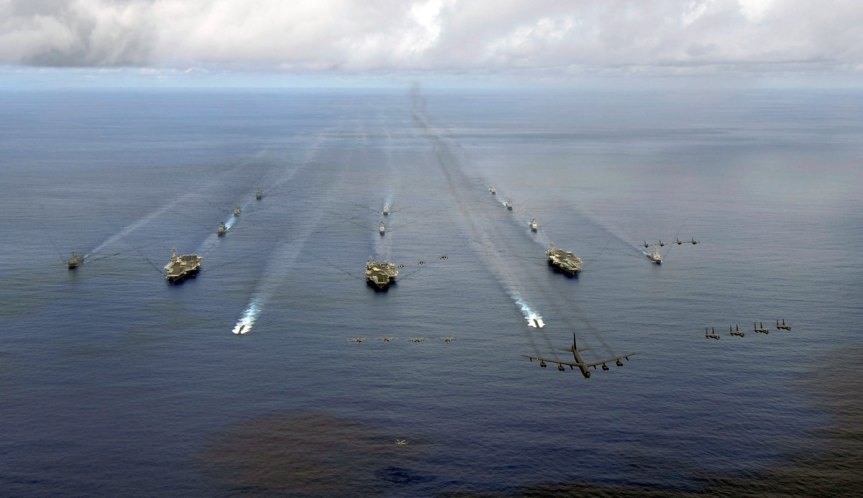
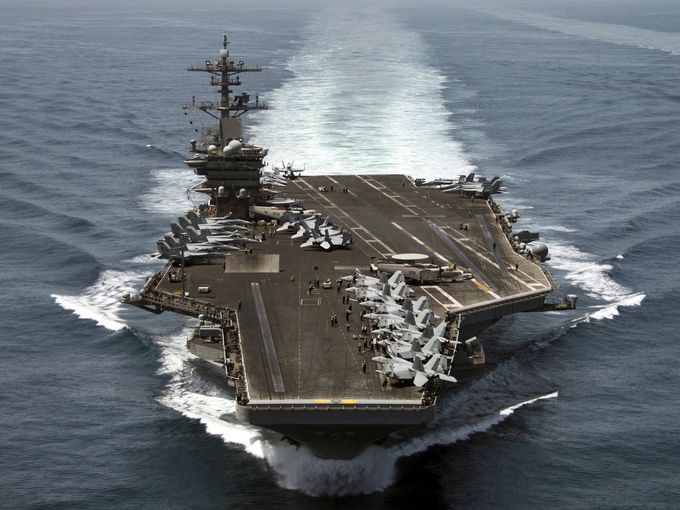
This is hardly surprising. The U.S. military has roughly 800 bases worldwide. Its aircraft carriers are essentially mobile American bases, bristling with weapons and munitions. The U.S. spends roughly $600 billion a year maintaining this military and empire, even as it continues to dominate the world’s arms trade. This heavy investment in weaponry and war-making, abetted by a mentality that celebrates “global reach, global power,” is a strange way to define your nation as being “indispensable.”
How did America come to invest so much of itself in military weaponry and incessant wars? One reason is the quest for total safety. As one of my friends put it:
It [the notion of total safety] must be a post-1941 thing [after the shocking sneak attack on Pearl Harbor]. I think in both cases (1917 [U.S. entry into World War I] and 1941 and maybe 2001) the question Americans have asked is how to keep an evil “over there” somehow from affecting us. In all three cases, I think the answer was neutrality until neutrality no longer seemed to offer safety. My guess is that the idea that total safety required global involvement comes from c.1948, fears of the USSR’s globalism, atomic paranoia, and the desire to protect and preserve the new American affluence. Thus NSC-68 gets passed with nary a whisper of opposition.
What is NSC-68? We must turn the clock back to 1950, the Cold War, and the Truman Administration, as detailed here by The History Channel:
According to the [National Security Council’s] report, the United States should vigorously pursue a policy of “containing” Soviet expansion. NSC-68 recommended that the United States embark on rapid military expansion of conventional forces and the nuclear arsenal, including the development of the new hydrogen bomb. In addition, massive increases in military aid to U.S. allies were necessary as well as more effective use of “covert” means to achieve U.S. goals. The price of these measures was estimated to be about $50 billion; at the time the report was issued, America was spending just $13 billion on defense.
Under President Trump, we’re likely to see a new version of NSC-68, another expansion of the U.S. military (and U.S. militarism), along with covert action by a newly empowered CIA, this time in the name of containing and defeating radical Islam rather than godless communism.
Defense company stocks are already soaring at the prospect of much higher military spending under Trump, notes William Hartung today at TomDispatch.com. Trump is difficult to predict, so Hartung takes him at his word in this passage:
A window into Trump’s thinking [on defense] can be found in a speech he gave in Philadelphia in early September. Drawing heavily on a military spending blueprint created by Washington’s right-wing Heritage Foundation, Trump called for tens of thousands of additional troops, a Navy of 350 ships (the current goal is 308), a significantly larger Air Force, an anti-missile, space-based Star Wars-style program of Reaganesque proportions, and an acceleration of the Pentagon’s $1 trillion “modernization” program for the nuclear arsenal (now considered a three-decade-long project).
Todd Harrison of the Center for Strategic and International Studies estimates that, if Trump faithfully follows the Heritage Foundation’s proposal, he could add more than $900 billion to the Pentagon’s budget over the next decade.
In other words, Obama’s America, the “indispensable nation,” is likely under Trump to channel enormous resources into more weapons even as Trump’s military advisers, men like retired general Mike Flynn, posture for a no-holds-barred crusade against “the cancer” of radical Islam around the globe.
Here’s a harsh truth: America has allowed its arsenal of democracy of World War II fame to become simply an arsenal. A nation that fought in the name of democracy in two world wars has become one that wages endless wars driven by a crusader’s righteousness.
In the puzzle palace on the Potomac, nothing succeeds like failure
W.J. Astore
When it comes to the Pentagon, nothing succeeds like failure. That is the message of William Hartung’s latest article at TomDispatch.com. The Pentagon, Hartung notes, continues to receive massive funding from the American taxpayer, even as its various wars drag on, seemingly without end. Hartung, who wrote a book on Lockheed Martin and the military-industrial complex, has a knack for revealing the latest Pentagon follies. Even as you read his latest at TomDispatch.com, I’d like to add two more items to his list:
1. Washington Think Tanks: Perhaps you’ve heard of them, centers for thinking about national defense, hiring the best and the brightest to come up with disinterested recommendations to safeguard America. Ha! A few days ago, The National Interest ran an article on what these think tanks were proposing, the “latest fashions in warfighting,” as the article’s title put it. Please note there’s no “fashion” in peacemaking or war-ending.
Four out of the five think tanks featured in the article were in basic agreement. “Deterrence” had to be based on massive investments in offensive weaponry. There was much agreement as well on modernizing America’s nuclear arsenal, on the need to feature more drones and other unmanned platforms, on air power and power projection, as well as support for the wildly expensive F-35 jet fighter. In sum, more of the same at the Pentagon, only more.
One think tank, the Cato Institute, a Libertarian outfit, dared to depart from Pentagon orthodoxy. Cato called into question the Pentagon’s need for better nukes, prodigal jet fighters, and similar “sticker shock” items on the Pentagon’s wish list. This dissent drew a stinging rebuke from The National Interest, which suggested Cato had developed a defense plan for Canada rather than the great and powerful USA.
To that I say, tell me again what is wrong with Canada?
A question: If four out of five think tanks essentially agree with each other, are not at least three of them redundant?
2. Forcing Soldiers to Pay Back Bonuses: Yes, you read that right. Even as the Pentagon spends nearly $750 billion a year, even as it avoids any semblance of an audit, U.S. troops who fought overseas are being forced to pay back bonuses that the Pentagon gave them, apparently by mistake (but also with some fraud involved on behalf of recruiters), at a time when the U.S. military was under duress to improve retention rates.
Let’s be clear: In accepting the bonuses, the individual troops were not at fault. They took the money in good faith from a military that patted them on the back for staying in. But now the military says, whoops, we were wrong, we want the money back.
In Pentagon terms, we’re not talking big money. We’re talking chump change. It’s $15,000 here, $30,000 there. But of course it is big money to the troops and their families. Consider the stress of having government-sanctioned collection agencies on your tail. One soldier had to refinance his house to raise the money to repay an incentive bonus he’d accepted in good faith.
Here’s the kicker. In California, where these abuses and mistakes happened, the military “assigned 42 auditors to comb through paperwork for bonuses and other incentive payments given to 14,000 soldiers.”
Imagine that. The Pentagon can’t even hold an audit, let alone pass one, but it’s willing to hire a platoon of auditors to go after troops and their bonuses.
Here’s my recommendation: Let’s deploy an army of 42,000 auditors to comb through Pentagon paperwork for waste, fraud, and abuse. Let’s get our money back, America. And let’s stop thinking about “fashions” in “warfighting,” and instead dedicate ourselves to ending our wars — before they end us.
Today brings yet another announcement of more U.S. troops to Iraq. This time 600 are being sent as logistics support, advisers, and enablers (that term, “enabler,” is fuzzy indeed: enabler of what? More failure?). That brings the number of U.S. troops in Iraq to more than 5200, but of course this figure seriously under-represents the American presence in the region. Nowadays, most “troops” are provided by private contractors, and many of these are U.S. military veterans who discovered they could make a lot more money wearing mufti than in Uncle Sam’s uniforms. At the same time, the U.S. continues to provide heavy-duty weaponry to the Iraqi military, including Apache attack helicopters and the HIMARS rocket system. All of this is intended to help the Iraqi military retake the city of Mosul.
That the U.S. is yet again providing more troops as well as heavy weapons as “force multipliers” highlights the failure of U.S. military efforts to “stand up” an effective Iraqi military. The enemy, after all, has no Apache helicopters, no HIMARS system, and no U.S. advisers, although we certainly “enable” them with all the U.S. weaponry they’ve been able to capture or steal. Despite a lack of U.S. military training and aid, ISIS and crew have proven to be remarkably resilient. What gives?
Two years ago, I wrote an article at TomDispatch.com on “America’s Hollow Foreign Legions.” Back then, I said this:
Military training, no matter how intensive, and weaponry, no matter how sophisticated and powerful, is no substitute for belief in a cause. Such belief nurtures cohesion and feeds fighting spirit. ISIS has fought with conviction. The expensively trained and equipped Iraqi army hasn’t. The latter lacks a compelling cause held in common. This is not to suggest that ISIS has a cause that’s pure or just. Indeed, it appears to be a complex mélange of religious fundamentalism, sectarian revenge, political ambition, and old-fashioned opportunism (including loot, plain and simple). But so far the combination has proven compelling to its fighters, while Iraq’s security forces appear centered on little more than self-preservation.
Despite an ongoing record of failure, pulling out of Iraq is never an option that’s considered by the Pentagon. The only option our leaders know is more: more troops, more weapons, more money. As I wrote for TomDispatch back in October 2014:
pulling out is never an option, even though it would remove the “American Satan” card from the IS propaganda deck. To pull out means to leave behind much bloodshed and many grim acts. Harsh, I know, but is it any harsher than incessant American-led bombing, the commitment of more American “advisers” and money and weapons, and yet more American generals posturing as the conductors of Iraqi affairs? With, of course, the usual results.
Here we are, two years later, and nothing has changed. The war song remains the same, as discordant as ever, with a refrain as simple as it is harsh: putting out the fire with gasoline.
A good friend passed along an article at Forbes from a month ago with the pregnant title, “U.S. Army Fears Major War Likely Within Five Years — But Lacks The Money To Prepare.” Basically, the article argues that war is possible — even likely — within five years with Russia or North Korea or Iran, or maybe all three, but that America’s army is short of money to prepare for these wars. This despite the fact that America spends roughly $700 billion each and every year on defense and overseas wars.
Now, the author’s agenda is quite clear, as he states at the end of his article: “Several of the Army’s equipment suppliers are contributors to my think tank and/or consulting clients.” He’s writing an alarmist article about the probability of future wars at the same time as he’s profiting from the sales of weaponry to the army.
As General Smedley Butler, twice awarded the Medal of Honor, said: War is a racket. Wars will persist as long as people see them as a “core product,” as a business opportunity. In capitalism, the profit motive is often amoral; greed is good, even when it feeds war. Meanwhile, the Pentagon is willing to play along. It always sees “vulnerabilities” and always wants more money.
But back to the Forbes article with its concerns about war(s) in five years with Russia or North Korea or Iran (or all three). For what vital national interest should America fight against Russia? North Korea? Iran? A few quick reminders:
#1: Don’t get involved in a land war in Asia or with Russia (Charles XII, Napoleon, and Hitler all learned that lesson the hard way).
#2: North Korea? It’s a puppet regime that can’t feed its own people. It might prefer war to distract the people from their parlous existence.
#3: Iran? A regional power, already contained, with a young population that’s sympathetic to America, at least to our culture of relative openness and tolerance. If the U.S. Army thinks tackling Iran would be relatively easy, just consider all those recent “easy” wars and military interventions in Iraq, Afghanistan, Libya, Syria …
Of course, the business aspect of this is selling the idea the U.S. Army isn’t prepared and therefore needs yet another new generation of expensive high-tech weaponry. It’s like convincing high-end consumers their three-year-old Audi or Lexus is obsolete so they must buy the latest model else lose face.
We see this all the time in the U.S. military. It’s a version of planned or artificial obsolescence. Consider the Air Force. It could easily defeat its enemies with updated versions of A-10s, F-15s, and F-16s, but instead the Pentagon plans to spend as much as $1.4 trillion on the shiny new and under-performing F-35. The Army has an enormous surplus of tanks and other armored fighting vehicles, but the call goes forth for a “new generation.” No other navy comes close to the U.S. Navy, yet the call goes out for a new generation of ships.
The Pentagon mantra is always for more and better, which often turns out to be for less and much more expensive, e.g. the F-35 fighter.
Wars are always profitable for a few, but they are ruining democracy in America. Sure, it’s a business opportunity: one that ends in national (and moral) bankruptcy.
Last night’s “commander-in-chief” security forum that featured Hillary Clinton and Donald Trump was, not surprisingly, disappointing. (You can read the transcript here.) Trump recently stated he was in favor of large increases in defense spending, but he wasn’t asked about this. He wasn’t asked about his support of torture, nor was he challenged on his remarkably dangerous statement back in March that military officers would obey his presidential decrees, even when they were unlawful. Hillary was challenged on her email fiasco at the State Department, and rightly so, but she pretty much got a free pass on her support of the calamitous Iraq war and the chaos following the Libyan intervention. And of course neither candidate was challenged on their blanket support of Israel.
What you got was two self-absorbed candidates, one wonkish, the other one clearly a wanker, both of them posing as warriors as long as someone else’s kids are doing the fighting. Here’s a question for Trump and Hillary: the next time you deploy troops to Iraq or Syria or Afghanistan or wherever, will you include Ivanka or Chelsea, respectively, and put them in harm’s way?
Most interesting to me was Trump’s old-fashioned imperialism, which explains much of his appeal to the rabid right. Here’s what Trump had to say about how the Iraq war should have turned out for the USA:
“We [the USA] go in [to Iraq in 2003], we spend $3 trillion, we lose thousands and thousands of lives, and then, Matt, what happens is, we get nothing. You know, it used to be to the victor belong the spoils. Now, there was no victor there, believe me. There was no victor. But I always said: Take the oil.”
You have to hand it to The Donald: at least he’s occasionally honest. The Iraq war was about oil, among other things, and Trump says the USA as the “victor” should have taken it. Why? Because might makes right. Because, as Thucydides said so many centuries ago, the strong do what they will and the weak suffer as they must.
Remember when George W. Bush said Iraq’s oil was the “patrimony” of the Iraqi people and that the USA wasn’t about to take it? That the Iraq war was about freedom and democracy in the Middle East, not a naked grab for resources? Trump is having none of that. Any wonder that he’s so popular among Americans who are tired, as they see it, of losing?
“Take the oil!” It’s a statement that could easily appear on the next iteration of Trump’s baseball cap.