
Lies

W.J. Astore

They’re Everywhere in America

Soon after Joe Biden took office as president in 2021, I remember hearing that his VP, Kamala Harris, was put in charge of immigration, informally known as the “border czar.” Yesterday, the House passed a resolution condemning Harris for her handling of the border crisis. Yet I’ve also been hearing from Democrats and the media that Harris never was the border czar, even as there’s plenty of video evidence of networks like ABC, CBS, and NBC referring to her using that term.

Denying that Harris was the border czar is a fairly small lie immersed in much larger sea of lies, and of course it’s a bipartisan effort. Donald Trump exaggerates and lies just to stay in shape. Democrats love to attack Trump for lying even as they lie themselves. Truly, it’s hard to run a government and a country when lies confuse every issue.

Another lie being told about Kamala Harris is that her candidacy is the result of democracy in action. She’s the people’s choice! Except almost nobody voted for her as a presidential candidate. She’s been elevated and selected by the DNC and the donor class. She is a packaged product of the so-called elites within the party, the very opposite of a candidate chosen by the people. And yet I’m told this packaged product is going to “save democracy” from Trump, who was actually selected as a candidate in a more democratic process.

Of course, there are far bigger and more serious lies than whether Harris was the border czar or whether she’s the people’s choice as the savior of democracy. U.S. troops’ deadliest enemies, I’d argue, are most often the lies told by the U.S. government, abetted and amplified by senior officers in the military. Think here of Iraq and Afghanistan, or go back further to Vietnam.
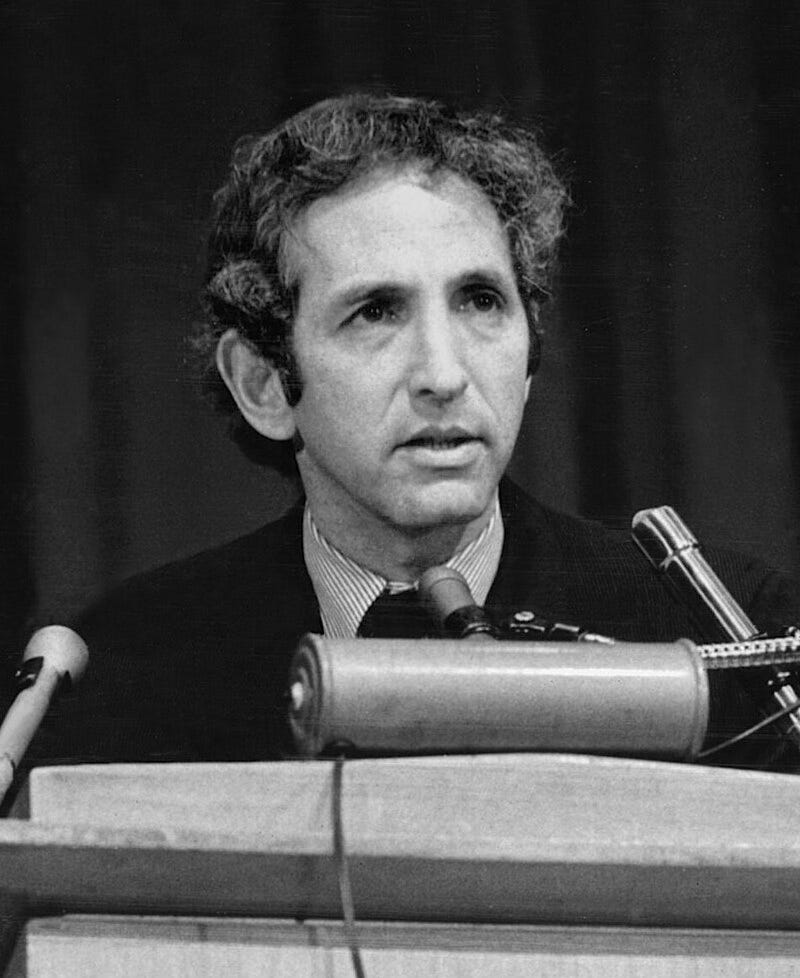
Daniel Ellsberg, truth-teller about the Vietnam War and so many other things

Knowing (or sensing/feeling) you killed for lies, or knowing your friends died for lies, is surely a contributing cause to a rash of suicides in the U.S. military today. The sacrifices and horrors of war may be eased by a “just” war, like World War II, but they are aggravated by unjust wars.  And they are further aggravated when you try to get help through the VA only to be turned away or stonewalled.

All this is prologue to a note I received from a regular reader of Bracing Views about lies in America. I’ve decided to retain the profanity because it’s more than appropriate:

I don’t know about you, but I find it quite amazing that, despite decades of bold-faced lying about US wars, all of it proven and even reported in the NYT and other mainstream media, the narrative of the each subsequent war is always accepted as true, until it too is exposed as being nothing but lies.

Let’s look at the recent record:

1) Vietnam–exposed as nothing but lies by the Pentagon Papers.

2) Iraq–exposed as lies when the infamous WMD were never found and there was nothing found to back up the claim of links to Al Qaeda.

3) Afghanistan–exposed as pure fiction as revealed by the Washington Post “Afghanistan Papers” which said that “senior U.S. officials failed to tell the truth about the war in Afghanistan throughout the 18-year campaign, making rosy pronouncements they knew to be false and hiding unmistakable evidence the war had become unwinnable.”

Add to the above list the fact that the Mueller report investigating the Russiagate hoax came up with nothing, ZERO.

Currently, there are a couple of new false narratives duly reported by the mainstream media and, for the most part, swallowed by most people. First is the false narrative about the US war in Ukraine, that NATO expansion has nothing to do with it but rather was caused by naked Russian aggression and Putin’s plans to re-create the Soviet Union and take over the rest of Eastern Europe. Second, the false narrative that Israel is just defending itself against Palestinian terrorism rather than committing grotesque war crimes, completely ignoring the fact that the Israelis have been keeping the Palestinians under illegal occupation for over 50 years, since June 1967. 

Lie after lie after lie after lie. And yet none of it matters. It is all sent down the memory hole as if it never happened. And then it is on to the next war, when the official narrative spewed out by the DC blob will once again be swallowed hook, line and sinker. It appears to be never ending. No matter how much lying is exposed, it simply does not matter.

I think it is pretty fucking amazing. What will it take to get people to come out of their coma and realize what the fuck is going on?

And keep in mind…..it has nothing to do with party affiliation. The lying is endemic, it’s in the DNA of the National Security State. Presidents come and go, but the lying for war-making never stops. And no one is ever held accountable either. 

It’s pretty fucking impressive, when you think about it.

Keep this is in mind……one would think that, after this abhorrent track record, the appropriate response would be to assume that the narrative justifying the new war of the moment was not true and nothing but more of the same lying. But that NEVER happens. NEVER.

How is that possible? Is it just a serious form of denial? Is it due to mental illness? Is it just some perverted form of patriotism? In what other realm is it possible to lie non-stop and never be held accountable? Even worse, to continue to have credibility despite a track record of pathological lying? 

A friend of mine pointed out that, in the old USSR, people knew that the official news on their TV every night was nothing but lies. 

So, this begs the question: Which system is more pernicious and has more effectively brainwashed its people? The one where people are controlled but they are aware that they are being fed nothing but lies, or the one that is constantly lied to but the people still believe they are being told the truth?

To those keen insights, I made this reply:

Our [American] system of lying is better! We have state/corporate media too, it’s just more subtle and advertised as “free.” We have our own “Pravda” except it rarely tells the truth, unless that “truth” is in the interests of the powerful.

To which our BV keen reader replied:

Exactly. But to suggest that we have our own version of “Pravda,” only worse because it has the cover of supposedly being “free,” is tantamount to treason, you realize.

This is the reason why Julian Assange/Wikileaks was such a threat…for actually challenging the right of the National Security State to lie non-stop about its war making and never be exposed for its lying or held accountable.

Of course, that is exactly why Assange was locked away in prison for so long and tortured, not because he was spreading lies but because he was revealing truths.

And we can’t have that in America!

*My hearty thanks to this Bracing Views keen reader for allowing me to cite this. I always say I learn so much from my readers, and I mean it.

The Key Reason Why the USA Keeps Losing Wars

lie

W.J. Astore

In a word, dishonesty.  That’s the key reason why America keeps losing its wars of choice, whether in Iraq, Afghanistan, Libya, Syria, or elsewhere.

Dishonesty is nothing new, of course.  Recall the lessons from the Pentagon Papers in the Vietnam War.  U.S. leaders knew the war was lost, yet they lied to the American people about seeing lights at the end of tunnels.  Recall the Iraq war and the “fixing” of intelligence to justify the invasion.  Today the newspeak for Afghanistan is “corners,” as in we’ve turned yet another corner toward victory in that 16-year conflict, according to military testimony before Congress this week.

About those “corners,” here’s a concise summary from FP: Foreign Policy:

Afghanistan turning a corner. Again. Or still? After 16 years of war, the United States and its Afghan partners “have turned the corner,” and Kabul’s battered forces are “on a path to a win.” the top U.S. general there told reporters on Tuesday.

But FP’s Paul McLeary notes that we’ve heard this before. American generals have been seeing victory on the horizon since at least 2007, and “Gen. John Nicholson is at least the eighth top commander in the last decade to forecast a pathway to victory in a war that has dragged on nearly all century, and his optimistic forecasts contrast starkly with deteriorating Afghan government control and a resurgent Taliban.”

The military and our leaders can’t even level with us on the number of troops deployed in Syria.  Consider this report today, courtesy of FP: Foreign Policy:

The Pentagon is good at a great many things, but they can do absolutely magical things with troop numbers. The U.S. Central Command announced this week that it was pulling 400 Marines out of Syria, where they had been providing artillery support for the Syrian Democratic Forces battling ISIS.

The number is remarkable given that the military continues to insist there are only 503 U.S. troops in Syria overall. And somehow, that 503 number has managed to remain exactly the same even after the Marines left. Recently, a general running U.S. special operations in Iraq and Syria said there were 4,000 U.S. troops in Syria. He quickly backtracked, saying the number was around 500 and holding steady, despite all actual physical evidence to the contrary.

Do we have 500 troops in Syria, or 2000, or 4000?  Who are our generals trying to fool?  Our rivals and enemies know how many troops we have in their regions and countries.  Why can’t the American people have a full and honest accounting of what “our” troops are up to in places like Syria?

Whether from the Executive branch or from the military, the dishonesty keeps coming.  This is exactly why we fail.

Why are we so persistent in our folly?  For several reasons.  Some people come to believe their own lies, their own happy talk.  Careerism plays a role; so does politics.  Money is a big concern, since there’s so much of it to be made in war.  Some people even think it’s OK to lie if it’s for the “right” reason, i.e. better to project an image of dumb strength than one of pacific wisdom.  America must never appear “weak”!  For some, that means never quitting a war, no matter how foolish.  Better to lie about “progress” than to admit problems that should lead to dramatic change.

Deception is at the heart of war, but we’re supposed to be deceiving the enemy, not ourselves.  We’ve allowed public relations — driven by dishonesty — to rule our thinking and reporting on war.  But, to paraphrase a saying of Richard Feynman with respect to the Space Shuttle Challenger disaster,

To wage a successful war, reality must take precedence over public relations, for the war gods cannot be fooled.

And to borrow from the penultimate sentence of his report (using the Pentagon in place of NASA): The Pentagon “owes it to the citizens from whom it asks support to be frank, honest, and informative, so that these citizens can make the wisest decisions for the use of their limited resources.”

Imagine if our leaders were frank, honest, and informative about our wars and their costs?  But they prefer dishonesty instead — and that is why they (and we) fail.

The Vietnam War, the Pentagon Papers, and Lying

Arendt
Hannah Arendt (Arendt Center at Bard College)

W.J. Astore

In November 1971, the political philosopher Hannah Arendt published “Lying in Politics: Reflections on the Pentagon Papers” in the New York Review of Books.  Earlier that year, Daniel Ellsberg had shared those highly classified government papers with the U.S. media.  They revealed a persistent and systematic pattern of lying and deception by the government about U.S. progress in the Vietnam War.  By undermining the people’s trust in government, lies and deception were destabilizing democracy in America, Arendt said.  Furthermore, America was witnessing two new and related categories of lying.  The first was lying as public relations, the creation and distribution of images substituting for facts and premised in human manipulability (a Madison Avenue approach to war and foreign policy).  The second was lying tied to a country’s reputation as embraced by professional “problem-solvers” as the basis for political action.  Both categories of lying constituted a crisis to the republic.

Widespread lying during the Vietnam War, Arendt explained, had not been aimed at the enemy, as lies often are in war.  Rather, governmental lying had targeted Americans.  The enemy could hardly be fooled, but most Americans could – at least for a time.  Throughout the war, Arendt noted, senior U.S. government and military officials made decisions about Vietnam with the firm knowledge they could not be carried out, a form of self-deception facilitated by constant goal-shifting.  As goals changed and chaos mounted, U.S. officials then became driven by concerns about saving face.  Image-making and image-saving took precedence over reality. The truth about Vietnam – that the U.S. was losing the war – hurt, therefore it was denied, especially in public discourse.

Official lies can fool even the officials themselves, a fact Pulitzer prize-winning reporter David Halberstam noted in his prescient book, “The Making of a Quagmire,” published in 1965.  With respect to the Kennedy Administration’s support of the corrupt Diem/Nhu government of South Vietnam, Halberstam wrote that:

Having failed to get [the Diem/Nhu regime to make needed] reforms, our officials said that these reforms were taking place; having failed to improve the demoralized state of the [South] Vietnamese Army, the Americans talked about a new enthusiasm in the Army; having failed to change the tactics of the [South Vietnamese] military, they talked about bold new tactics which were allegedly driving the Communists back.  For the essence of our policy was: There is no place else to go.

When reporters began to file stories which tended to show that the [U.S.] policy was not working, its authors, President Kennedy and General [Maxwell] Taylor, clung to it stubbornly.  At least part of the explanation for this apparent blindness is that although they knew things were going wrong, they felt that the alternatives were worse.

This “blindness,” a sustained willingness to deny harsh truths about the Vietnam War, persisted throughout the Kennedy, Johnson and Nixon administrations.  U.S. leaders continued to package and sell a losing effort as a winning product. It helped, in Arendt’s words, that U.S. officials had “a truly amazing and entirely honest ignorance of the historically pertinent background” when it came to Vietnam.  Their ignorance was “honest” in the sense they did not believe facts were all that important to success.  What was needed, U.S. officials concluded, were not incontestable facts but the right premises, hypotheses, and theories (such as the infamous Domino Theory) to fit Vietnam within prevailing Cold War orthodoxies.  Overwhelming applications of U.S. military power would serve to actuate these premises, facts be damned.

Upon taking power in 1969, the Nixon Administration, which had promised a quick and honorable end to the war, continued the lies of previous administrations.  Even as Nixon and Henry Kissinger spoke publicly of peace with honor, they talked privately of a lost war.  To shift the blame for defeat, they cast about for scapegoats (as corroborated recently in the HBO documentary, “Nixon by Nixon: In His Own Words”).  Kissinger settled on South Vietnamese “incompetence” as the primary scapegoat.  He reassured Nixon that, after a “decent interval” between U.S. withdrawal and the inevitable South Vietnamese collapse, most Americans would come to see Vietnam as a regrettable (and forgettable) “backwater.”  Naturally, harsh facts such as these were ones Nixon and Kissinger refused to share with the American people.

For Hannah Arendt, truth as represented by verifiable facts is the chief stabilizing factor in politics.  Lacking truths held in common, action is compromised, judgment is flawed, reality is denied.  Deception feeds self-deception until politics is poisoned and collective action for the common good is disrupted.  Yet lies cannot be eliminated simply by moral outrage, Arendt noted.  Rather, truth must be fought for even as humility before truth must be cultivated.

The American people must fight for the truth: that is the lesson of Arendt’s essay.

Next Week: Part II: More Lies and Deception in the Iraq War of 2003