Today is Earth Day: a good day to commit ourselves to saving the earth from the ravages of nuclear war. Global warming may get us in the long term, but nothing will kill the planet quicker than a nuclear war.
I’ve written a lot about the folly, the greed, the absurdity, of yet another round of “investment” in nuclear weapons. There’s no need for an updated nuclear triad when the present triad is more than enough to destroy the earth and probably several other planets as well.
America’s nuclear triad currently consists of land-based ICBMs (Minuteman III), bombers like the B-1 and B-2, and submarines that carry nuclear-tipped missiles. The Pentagon plans to “modernize” all these “legs” of the triad at a possible total cost of $2 trillion over the next 30 years.
First off, land-based ICBMs and nuclear bombers are no longer needed. The ICBMs are especially vulnerable to attack, putting pressure on DC decisionmakers to launch them quickly in case of a warning (perhaps false) of a nuclear attack against their silos.
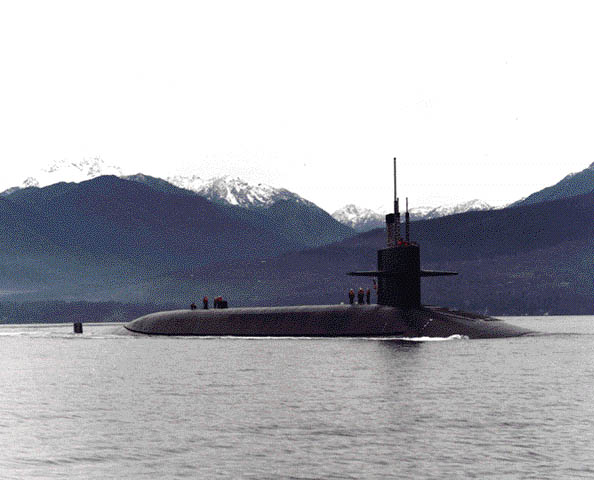
All the U.S. truly needs for deterrence is the current Ohio-class sub force with its Trident II missiles. That force can be modernized without an entirely new class of sub being built, which is perhaps why we’re seeing ads about building new submarines as “job-creators.”
In the USA, more nukes are “justified” most often by threat inflation (or even threat creation) and military Keynesianism—morally dubious claims that jobs are created by building genocidal weapons and doomsday machines.
Speaking of America’s submarines and their missiles: Each Trident II D5 missile has up to 8 warheads, with up to 20 missiles per submarine. One submarine could conceivably destroy 160 targets, with each of those warheads having a “yield” of somewhere between 5 and 25 Hiroshima bombs. That arsenal, if launched, could very well tip the world into nuclear winter while killing tens of millions of people outright. A nuclear winter would kill billions. From one sub! And the Navy has 14 of them!
Senator George McGovern in 1963 complained about the absurd nuclear “overkill” the U.S. possesses. Just over 60 years ago, some members of Congress vowed to do something to stop the madness. And then came Vietnam … and so many other wars and rumors of war.
We Americans are so easily distracted by war and propagandized into believing that safety comes from swinging the biggest nuclear club.
Anyone who thinks about nuclear weapons and war games in the abstract should watch this scene from “Terminator II.” It’s perhaps the best, most visceral, image of what one nuclear bomb would produce.
“There’s no fate but what we make for ourselves.” The more nuclear weapons we build, the darker our fate becomes, and the closer we come to terminating ourselves and our planet.
On this Earth Day, the U.S. should commit itself to a “no first use” policy with respect to using nuclear weapons and to total nuclear disarmament, to be achieved over the next 20-30 years.
Something like a JFK-like vow is needed here: Before the decade is out, America should commit itself to halving its nuclear forces, working with other countries on the goal of nuclear disarmament.
Only the future of humanity, as well as that of the earth and all living things, is at stake here.
When I was in the U.S. military, I learned a saying (often wrongly attributed to the Greek philosopher Plato) that only the dead have seen the end of war. Its persistence through history to this very moment should indeed be sobering. What would it take for us humans to stop killing each other with such vigor and in such numbers?
Song lyrics tell me to be proud to be an American, yet war and profligate preparations for more of the same are omnipresent here. My government spends more on its military than the next 10 countries combined (and most of them are allies). In this century, our leaders have twice warned of an “axis of evil” intent on harming us, whether the fantasy troika of Iraq, Iran, and North Korea cited by President George W. Bush early in 2002 or a new one — China, Russia, and North Korea — in the Indo-Pacific today. Predictably given that sort of threat inflation, this country is now closing in on a trillion dollars a year in “defense spending,” or close to two-thirds of federal discretionary spending, in the name of having a military machine capable of defeating “evil” troikas (as well as combatting global terrorism). A significant part of that huge sum is reserved for producing a new generation of nuclear weapons that will be quite capable of destroying this planet with missiles and warheads to spare.
My country, to be blunt, has long been addicted to war, killing, violence, and massive preparations for more of the same. We need an intervention. We need to confront our addiction. Yet when it comes to war and preparations for future conflicts, our leaders aren’t even close to hitting rock bottom. They remain in remarkable denial and see no reason to change their ways.
To cite two recent examples: Just before Easter weekend this year, President Biden swore he was personally devastated by Palestinian suffering in Gaza. At the same time, his administration insisted that a United Nations Security Council resolution for a ceasefire in Gaza that it allowed to pass was “non-binding” and, perhaps to make that very point, reportedly shipped 1,800 MK84 2,000-pound bombs and 500 MK82 500-pound bombs off to Israel, assumedly to be used in — yes! — Gaza.
The Biden administration refuses to see the slightest contradiction in such a stance. Men like Joe Biden and his chief diplomat Antony Blinken confess to being disturbed, even shocked, by the devastation our bombs deliver. Who knew Israel would use them to kill or wound more than 100,000 Palestinians? Who knew that they’d reduce significant parts of Gaza to rubble? Who knew that a blank check of support for Israel would enable that country to — it’s hard not to use the phrase — offer a final solution to the Gaza question?
Not to be outdone by the Democrats, Republican Congressman Tim Walberg of Michigan recently cited the examples of Hiroshima and Nagasaki in seeking a “quick” end to the conflict in Gaza (before walking his comments back somewhat). For him, Israel remains America’s greatest ally, whatever its actions, even as he argues that Palestinians in Gaza merit no humanitarian aid from the United States whatsoever.
With that horrifying spectacle — and given the TV news and social media, it truly has been a spectacle! — of genocide in Gaza, America’s leaders have embraced the very worst of Machiavelli, preferring to be feared rather than loved, while putting power first and principle last. Former National Security Adviser and Secretary of State Henry Kissinger, recently deceased, rightly vilified for pursuing a Bismarckian Realpolitik, and deeply involved in the devastation of Vietnam, Cambodia, and Laos, might even have blanched at the full-throttled support for war (and weapons sales) now being pursued by this country’s leaders. Dividing the world into armed camps based on fear seems basic to our foreign policy, a reality now echoed in domestic politics as well, as the Democratic blue team and the MAGA Republican red team attack each other as “fascistic” or worse. In this all-American world of ours, all is conflict, all is war.
When asked about such an addiction to war, your average government official will likely claim it’s not our fault. “Freedom isn’t free,” so the bumper sticker says, meaning in practice that this country stands prepared to kill others without mercy to ensure its “way of life,” which also in practice means unbridled consumption by an ever-shrinking portion of Americans and unapologetic profiteering by the richest and greediest of us. Call it the “moderate” bipartisan consensus within the Washington Beltway. Only an “extremist” would dare call for restraint, tolerance, diplomacy, and peace.
A Common Cause to Unify Humanity
Short of an attack on Earth by aliens, it’s hard to imagine the U.S. today making common cause with “enemies” like China, Iran, North Korea, or Russia. What gives? Isn’t there a better way and, if so, how would we get there?
In fact, there is a common foe — or perhaps a common cause — that should unite us all as humans. That cause is Earth, the health of our planet and all the life forms on it. And that foe, to state the obvious (even if it regularly goes unsaid), is war, which is unhealthy in the extreme not just for us but for our planet, too.
War turns people into killers — of our fellow humans, of course, but also of all forms of life within our (often very large) blast radii. In addition, war is a mass distraction from what should truly matter to us: the sacredness of life and the continued viability of our planet and its ecology. Call it a cliché but there’s no way to deny it: there is indeed only one Spaceship Earth. As far as we know now, our planet is the sole body in the universe teeming with life. Of course, the universe is incomprehensibly vast and there could well be other forms of life out there, but we don’t know that, not with certainty anyway.
Imagine, in a dystopic future, America’s “best and brightest” (or the “best and brightest” of another country) acting in a nuclear fury, employing the very weaponry that continues to proliferate but hasn’t been used since the destruction of two Japanese cities on August 6 and 9, 1945, and so crippling Spaceship Earth. Imagine also that our planet is truly the universe’s one magnificent and magical spot of life. Wouldn’t it be hard then to imagine a worse crime, not just against humanity, but life itself cosmically? There would be no recompense, no forgiveness, no redemption — and possibly no recovery either.
Of course, I don’t know if God (or gods) exists. Though I was raised a Catholic, I find myself essentially an agnostic today. Yet I do believe in the sacredness of life in all its diversity. And as tenacious as life may be, given our constant pursuit of war, I fear the worst.
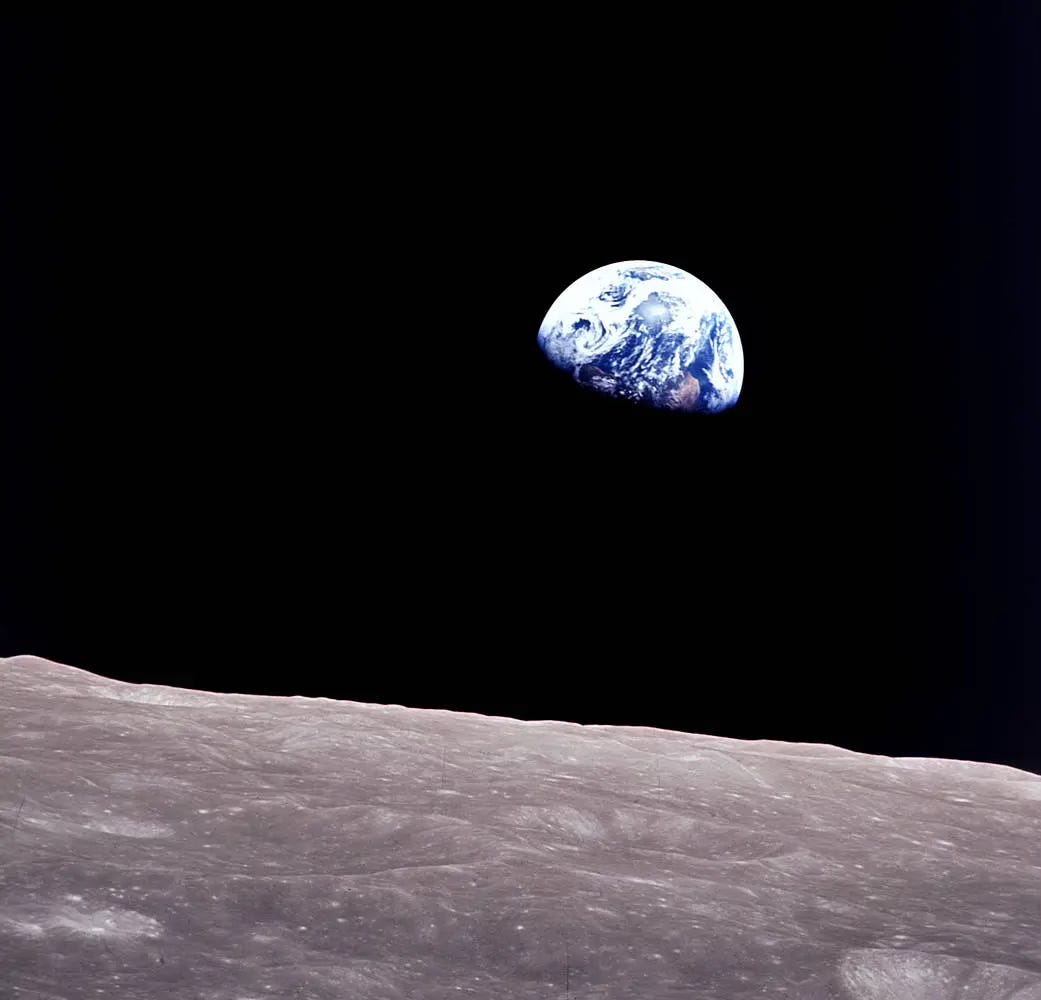
Earthrise from the Apollo 8 mission
If you’re of a certain age, you may recall when the astronauts on Apollo 8 witnessed earthrise as their spaceship orbited the moon in 1968. The crew read from Genesis, though in truth it could have been from any creation story we humans have ever imagined to account for how we and our world came to be. Specific religions or creeds didn’t truly matter at that moment, nor should they now. What mattered was the sense of awe we felt as we first viewed the Earth from space in its full glory but also all its fragility.
For make no mistake, this planet is fragile. Its ecosystems can be destroyed. Not for nothing did the inventor of the atomic bomb, J. Robert Oppenheimer, turn to the Hindu scriptures to intone, “Now I am become death, the destroyer of worlds,” when he saw the first atomic device explode and expand into a mushroom cloud during the Trinity test in New Mexico in July 1945.
In the febrile postwar climate of anti-communism that would all too soon follow, America’s leaders would decide that atomic bombs weren’t faintly destructive enough. What they needed were thermonuclear bombs, 1,000 times more destructive, to fight World War III against the “big fat commie rat.” Now nine (9!) nations have nuclear weapons, with more undoubtedly hankering to join the club. So how long before mushroom clouds soar toward the stratosphere again? How long before we experience some version of planetary ecocide via a nuclear exchange and the nuclear winter that could follow it?
Genocide and Ecocide on a Planetary Scale
The genocide happening in Gaza today may foreshadow one possible future for this planet. The world’s lone superpower, its self-styled beacon of freedom, now dismisses U.N. Security Council resolutions to stop the killing as “non-binding.” Meanwhile, Israel, whose founding was a response to a Holocaust inflicted during World War II and whose people collectively said Never Again, is now killing, starving, and displacing hundreds of thousands of Palestinians in the name of righteous vengeance for Hamas’s October 7th attack.
If the U.S. and Israel can spin mass murder in Palestine as not just defensible, but even positive (“defeating Hamas terrorists”), what hope do we have as a species? Is this the future we have to look forward to, an endless echoing of our murderous past?
I refuse to believe it. It truly should be possible to imagine and work toward something better. Yet, in all honesty, it’s hard to imagine new paths being blazed by such fossilized thinkers as Joe Biden and Donald Trump.
“Don’t trust anyone over thirty” was a telling catchphrase of the 1960s. Now, we’re being told as Americans that we’ll have to place our trust in one of two men almost at or exceeding 80 years of age. Entrusting and empowering political dinosaurs, however, represents an almost surefire path toward future extinction-level events.
Let me turn instead to a 25-year-old who did imagine a better future, even as he protested in the most extreme way imaginable the genocide in Gaza. This February, fellow airman Aaron Bushnell lit himself on fire outside the Israeli embassy in Washington, D.C. He sacrificed his life in a most public way to challenge us to do something, anything, to stop genocide. America’s “leaders” answered him by ignoring his sacrifice and sending more bombs, thousands of them, to Israel.
Aaron Bushnell did, however, imagine a better world. As he explained last year in a private post:
“I’ve realized that a lot of the difference between me and my less radical friends is that they are less capable of imagining a better world than I am. I follow YouTubers like Andrewism that fill my head with concrete images of free, post-scarcity communities and it makes me so much more prepared to reject things about the current world, because I’ve imagined how things could be and that helps me see how extremely bullshit things are right now.
“What I’m trying to say is, it’s so important to imagine a better world. Let your thoughts run wild with idealistic dreams of what the world should look like and let the pain and anger at how it’s not that way flow through you. Let it free your mind and fuel your rage against the machine.
“It’s not too late for you or anyone. We can have the world of our dreams tomorrow, but we have to be willing to fight today.”
His all-too-public suicide was a fiery cry of despair, but also a plea for a better future, one free of mass murder.
Earlier this week, millions of people across America witnessed a total eclipse of the sun. It’s awe-inspiring, even a bit alarming, to see the sun disappear in the middle of the day. Those watching took comfort in knowing that it would reappear from behind the moon in a matter of seconds or minutes and so gloried in that fleeting moment of preternatural darkness.
But imagine if the moon and sun were somehow to become permanently stuck in place. Imagine that darkness was our future — our only future. Sadly enough, however, it’s not the moon but we humans who can potentially cast the Earth into lasting darkness. Via the nuclear winter that could result from a nuclear conflict on this planet, we could indeed cast a shadow between the sun and life itself, a power of destruction that, tragically, may far exceed our current level of wisdom.
We know from history that it’s far easier to destroy than to create, far easier to kill than to preserve. Yet when countries make genocide or ecocide (from nuclear winter) possible and defensible (as a sign of uncompromising “toughness” and perhaps the defense of “freedom”), you know that their leaders are, in some sense, morally obtuse monsters. And who or what are we if we choose to follow such monsters?
As human populations rise, as vital resources like water, food, and fuel shrink, as this planet grows ever hotter thanks to our intervention and our excesses, we’ll need to cooperate more than ever to ensure our mutual survival. Far too often, however, America’s strategic thinkers dismiss cooperation through diplomacy or otherwise as naïve, unreliable, and impractical. “Competition” through zero-sum games, war, or other hyperviolent urges seems so much more “reasonable,” so much more “human.”
To the victor goes the spoils, so it’s said. But a planet despoiled by thermonuclear war, cast into darkness, ravaged by radiation, disease, and death, would, of course, offer no victory to anyone. Unless we put our efforts into ending war, rather than continuing to war on one another, such conflicts will, sooner or later, undoubtedly put an end to us.
In reality, our worst enemy isn’t some “axis” or other combination of imagined foes from without, it’s within. We remain the world’s most dangerous species, the one capable of wiping out most or all of the rest, not to speak of ourselves, with our folly. So, as Aaron Bushnell wrote, free your mind. Collectively, there must be a better way for all creatures, great and small, on this fragile spaceship of ours.
I woke this morning to the sad news that Daniel Ellsberg has pancreatic cancer and has been given only a few months to live. Ellsberg has lived a long and heroic life; he famously leaked the Pentagon papers, risking lifelong imprisonment to put a stop to America’s calamitous and atrocious war against Vietnam.
Five years ago, I read Ellsberg’s book on his years as a nuclear war theorist for the U.S. government. I was so impressed (and so alarmed) that I immediately wrote my own review of it, which I’m reposting today in Ellsberg’s honor.
Ellsberg is one of the giants of recent American history. He has lived a life of great value. Perhaps the best way to honor him is to read him, listen to him, and act to put a stop to our collective nuclear madness.
The Doomsday Machine: The Madness of America’s Nuclear Weapons
(Originally posted 12/28/17)
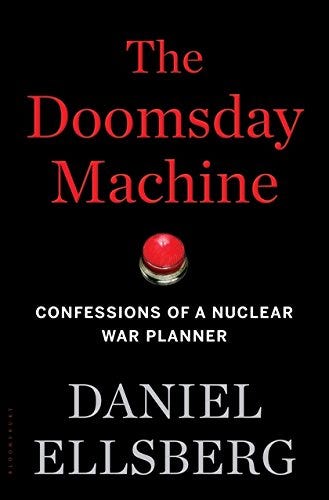
I just finished Daniel Ellsberg’s new book, The Doomsday Machine: Confessions of a Nuclear War Planner. Talk about hair-raising! Ellsberg, of course, is famous for leaking the Pentagon papers, which helped to end the Vietnam war and the presidency of Richard Nixon as well. But before Ellsberg worked as a senior adviser on the Vietnam war, he helped to formulate U.S. nuclear policy in the late 1950s and early 1960s. His book is a shattering portrayal of the genocidal nature of U.S. nuclear planning during the Cold War — and that threat of worldwide genocide (or omnicide, a word Ellsberg uses to describe the death of nearly everything from a nuclear exchange that would generate disastrous cooling due to nuclear winter) persists to this day.
Rather than writing a traditional book review, I want to list some memorable facts and lessons I took from the book, lessons that should lead us to question the very sanity of America’s leaders. To wit:
U.S. nuclear war plans circa 1960 envisioned a simultaneous attack on the USSR and China that would generate 600 million deaths after six months. As Ellsberg notes, that is 100 Holocausts. This plan was to be used even if China hadn’t directly attacked the U.S., i.e. the USSR and China were lumped together as communist bad guys who had to be eliminated together in a general nuclear war. Only one U.S. general present at the briefing objected to this idea: David M. Shoup, a Marine general and Medal of Honor winner, who also later objected to the Vietnam War.
The U.S. military consistently overestimated the Soviet nuclear threat, envisioning missile and bomber gaps that didn’t exist. In the nuclear arms race, the U.S. was often racing itself in the fielding of more and more nuclear weapons.
General Curtis LeMay, the famous commander of Strategic Air Command (SAC) and later AF Chief of Staff, said that once war started, politicians like the president had no role to play in decision-making.
When the atomic bomb was first tested in 1945, there were fears among the scientists involved that the atmosphere could be ignited, ending all life on earth. The chance was considered remote (perhaps 3 in a million), so the scientists pressed ahead.
The Cuban Missile Crisis of 1962 came much closer to nuclear war than most people recognize. Soviet submarines in the area, attacked by mock U.S. depth charges, were prepared to launch nuclear torpedoes against U.S. ships. Fidel Castro’s air defenses were also preparing to shoot down American planes, which may have ended in U.S. air attacks and an invasion in which Soviet troops on Cuba may have used nuclear weapons to defend themselves.
The U.S. military was (and probably still is) extremely reluctant to reveal nuclear secrets to senior American civilian leaders, including even the President himself. Ellsberg, possessing the highest security clearances and acting with presidential authority, had to pry answers from military officers who refused to provide detailed and complete information.
The U.S. has always refused, and continues to refuse, to pledge to a “no first use” policy for nuclear weapons.
The U.S. remains the only country to have used nuclear weapons (Hiroshima and Nagasaki). Yet, as Ellsberg notes, the U.S. uses nuclear weapons all the time — by threatening their use, as President Eisenhower did during the Korean War, as President Nixon did during the Vietnam War, and as President Trump is doing today, promising “fire and fury” against North Korea. The U.S. uses nuclear weapons like a loaded gun — holding it to an enemy’s head and threatening to pull the trigger, Ellsberg notes. In short, there’s nothing exceptional about Trump and his nuclear threats. All U.S. presidents have refused to take nuclear attacks “off the table” of options for U.S. action.
Interservice rivalry has always been a driver of U.S. nuclear force structure and strategy. The Navy (with its nuclear submarine programs, Polaris followed by Trident) and especially the Air Force (with its ICBMs and bombers) jealously guard their nuclear forces and the prestige/power/budgetary authority they convey.
President Eisenhower’s emphasis on massive retaliation (as represented by SAC and its war plan, the SIOP) was a way for him to limit the power of the military-industrial complex (MIC). But once Ike was gone, so too was the idea of using the nuclear deterrent as a way of restricting U.S. expenditures on conventional weaponry and U.S. adventurism in foreign wars, e.g. Vietnam. (It should be said that Ike’s exercise at limiting the MIC in America held the world as a nuclear hostage.)
Ellsberg shows convincingly that control over U.S. nuclear weapons was decentralized and delegated to much lower levels than most Americans know. It’s not the case that only the president can launch a nuclear war. Especially in the late 1950s and early 1960s, Ellsberg shows how it was possible that field-grade officers (majors and colonels) could have made decisions in the heat of battle to release nuclear weapons without direct orders from the president.
Most Americans, Ellsberg notes, still don’t understand the huge quantitative and qualitative differences between atomic bombs and hydrogen (thermonuclear) weapons. Hydrogen bombs are measured in megatons in equivalent TNT yield; atomic bombs are in kilotons. In short, hydrogen bombs are a thousand times more destructive than atomic ones. And this is just their explosive yield. Radioactive fallout and massive fires are even bigger threats to life on earth.
Most Americans still don’t understand that even a smallish nuclear exchange involving a few dozen hydrogen bombs could very well lead to nuclear winter and the deaths of billions of people on the earth (due to the widespread death of crops and resulting famine and disease).
Despite the genocidal threat of nuclear weapons, the U.S. is persisting in plans to modernize its arsenal over the next 30 years at a cost of $1 trillion.
Ellsberg sees this all as a form of collective madness, and it’s hard to disagree. He quotes Nietzsche to the effect that madness in individuals is rare, but that it’s common among bureaucracies and nations. The tremendous overkill inherent to U.S. nuclear weapons — its threat of worldwide destruction — is truly a form of madness. For how do you protect a nation or uphold its ideals by launching a nuclear war that would kill nearly everyone on earth? How does that make any sense? How is that not mad?
Ellsberg ends his “confessions” with many sane proposals for downsizing nuclear arsenals across the world. But is anyone in power listening? Certainly not U.S. presidents like Trump or Obama, who both signed on to that trillion dollar modernization program for U.S. nuclear weapons.
Ellsberg shows us there have been many chair-bound paper-pushers in the U.S. government who’ve drawn up plans to murder hundreds of millions of people — to unleash doomsday — all in the name of protecting America. He also shows how close they’ve come to doing just that, especially during the Cuban Missile Crisis, but during other crises as well.
Nuclear brinksmanship, threats of nuclear war, and similar uses of nuclear weapons to intimidate hold the potential for catastrophe. Miscalculations, mishaps, mistakes, are more than possible in an atmosphere of mistrust, when words and actions can be misinterpreted.
Ellsberg’s recommendations for changes point the way to a better world, a world where the threat of nuclear doomsday could be much reduced, perhaps eliminated completely. The question remains: Is anyone in power listening?
My Speech for the Rage Against the War Machine Rally
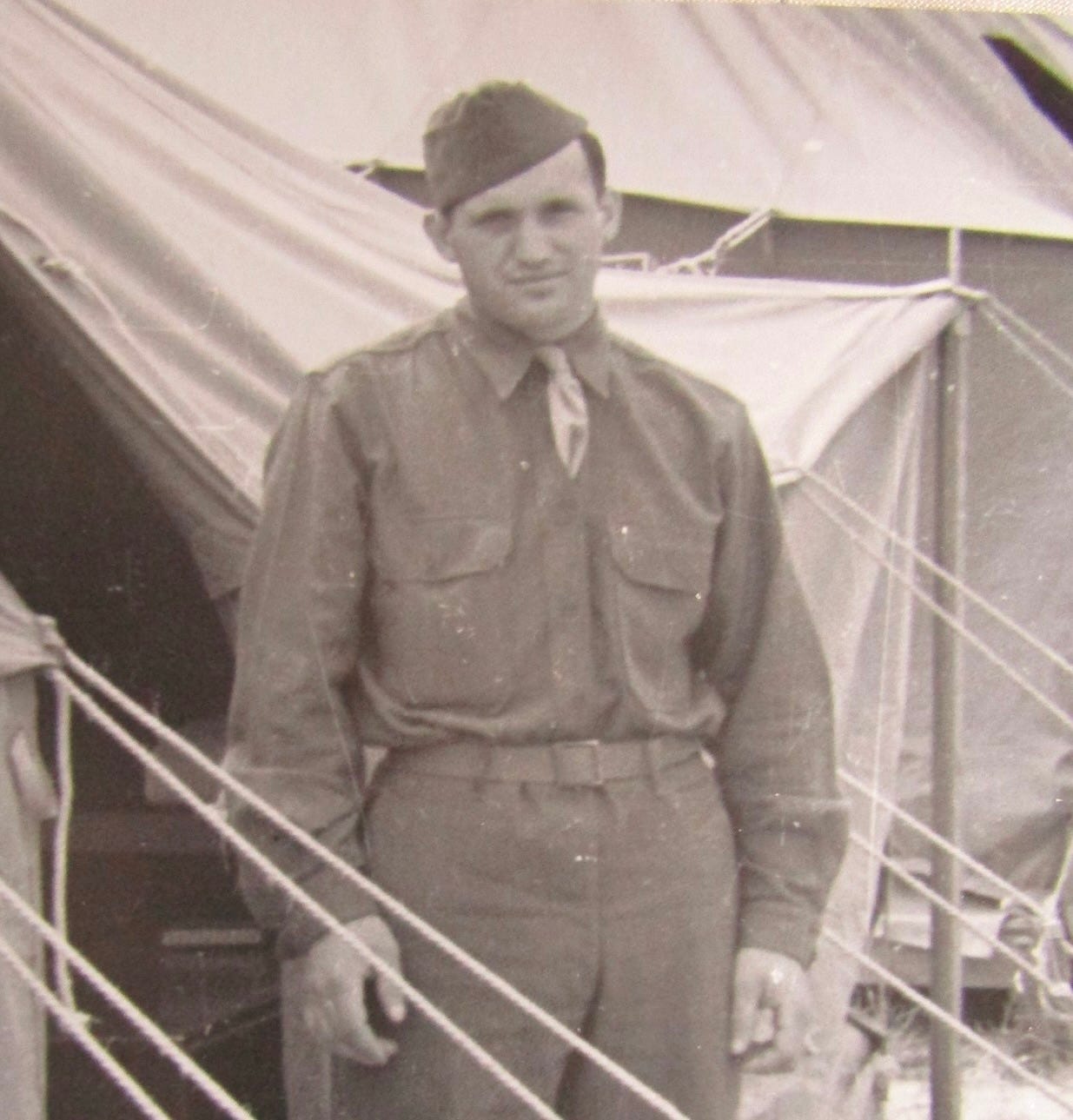
February 19th is the Rage Against the War Machine rally in DC. It just so happens to be my dad’s birthday as well. He was born on that date in 1917, endured the Great Depression, worked in the Civilian Conservation Corps and in factories until being drafted in 1942, and after the war became a firefighter, serving for more than thirty years until retiring. With my dad in mind, here’s the speech I’d give if I was invited on the stage. (The rally already has 27 speakers, but hopefully I can add a bit of rage and inspiration of my own.)
[To be clear: this is an “imaginary” speech. I am not one of the 27 speakers.]
My dad in the Army during World War II
Hello everyone. Today would have been my dad’s 106th birthday. Happy Birthday, Dad!
In the late 1930s, when my dad was working hard for low pay in a factory, he tried to enlist in the U.S. Navy. The Navy recruiter rejected him because he was roughly a half inch too short. After Pearl Harbor, and remembering his rejection, my dad didn’t join the eager volunteers. He waited to be drafted and reported to the Army. He served in an armored headquarters group but never went overseas to fight. That fact, and his earlier rejection by the Navy, is perhaps why I’m alive today to add my voice of rage against the military-industrial complex and America’s permanent state of undeclared war.
Dad and Mom raised me during the Cold War. I was conceived around the time of the Cuban Missile Crisis and was in diapers when John F. Kennedy was shot and killed in Dallas. As a boy, I embraced military things, played with toy soldiers, GI Joes, imitation M-16s, and similar toys of war. I built model tanks, model warplanes, model warships. I blew them up with firecrackers, imagining heroic battles.
As a teenager in the 1970s, I believed the Soviet Union was an insidious threat to American democracy. We faced the prospect of nuclear destruction. My dad was philosophical about this. Even if Americans and Russians killed each other in mutual assured destruction, known appropriately as MAD, a billion Chinese would survive to kickstart humanity, he quipped.
But there were two harsh realities my dad and I didn’t know back then. Nuclear winter was one. Any major exchange between nuclear powers, we now know, wouldn’t just kill the people in those countries. The soot and ash thrown into the atmosphere from thermonuclear war would likely lead to mass starvation globally. (Let’s not forget global radioactivity, sickness, and death as well.) The second one was that America’s nuclear plans, known as the SIOPs, envisioned not just massive attacks on the USSR but China as well, even if China hadn’t attacked the United States.
Sorry, Dad: In case of a major nuclear war, China’s goose was cooked, as was most other forms of life on our planet.
When I graduated from college in 1985, a brand-new 2nd lieutenant in the U.S. Air Force, my first assignment took me to Colorado Springs and Cheyenne Mountain, America’s very own Mount Doomsday. Cheyenne Mountain was America’s nuclear command and control center, literally blasted and tunneled out of a mountain, protected by 2000 feet of solid granite above it. Giant blast doors and buildings mounted on immense springs theoretically enabled us to ride out a nuclear war. But we few under the mountain knew that if DEFCON 1 came to pass, we’d likely be among the first to die in a nuclear war, even with all that rock over our heads.
You might say I’ve been to the mountain, Cheyenne Mountain, that is, both inside and outside. I much preferred the outside, hiking in the cool crisp Colorado air.
Once, when I was inside the mountain, the “battle staff” ran a wargame that ended with a nuclear attack on U.S. cities. In a sense, then, I’ve seen the missiles fly, I’ve seen their tracks end at American cities, if only on a monochrome monitor. Even that low-tech video screen convinced me that I never, ever, want to see the real thing.
A few years later, I walked the desert wilderness of Alamogordo, New Mexico, site of the first atomic blast in July of 1945, the Trinity test that preceded Hiroshima and Nagasaki. I’ve seen what little remained from that test, a test that changed everything, after which the survival of humanity as a species became problematic, precarious, and uncertain, dependent on men and their control over their thermonuclear toys, the playthings of the demented.
I’ve been to doomsday mountain, I’ve walked in an atomic wilderness, and I’ve come here to say: enough is enough.
As the doomsday clock ticks ever closer to midnight, we must act to stop it, to turn it back. We must act so that it never has the remotest chance of striking midnight.
We must walk – better yet, run – out of the dark and dank tunnel of doomsday mountain into the glorious light awaiting us. We must relish the wondrous sights and sounds of life. We must embrace each other, share the warmth of our common humanity as we seek a better, peaceful future for everyone everywhere.
Because mountains won’t protect us. Missiles won’t save us. Weapons won’t warm us, unless by warmth you mean death by nuclear fire.
Ending war will protect us. Ending missiles will save us. Compassion, tolerance, and love will warm us.
I know because I’ve been to doomsday mountain. I’ve witnessed nuclear war, if only during an exercise. I’ve walked in a desert where an atomic blast obliterated and irradiated most everything in its path. And that’s not a future I want. That’s not a future any sane person wants. That way lies madness.
Come, take my hand. Join me in leaving Cheyenne Mountain. Let’s run like children, with joy, away from tunnels and blast doors, toward the light of peace.
And, once we’re out, let’s put the darkness of war and nuclear terror behind us and never look back.
I just finished Daniel Ellsberg’s new book, The Doomsday Machine: Confessions of a Nuclear War Planner. Talk about hair-raising! Ellsberg, of course, is famous for leaking the Pentagon papers, which helped to end the Vietnam war and the presidency of Richard Nixon as well. But before Ellsberg worked as a senior adviser on the Vietnam war, he helped to formulate U.S. nuclear policy in the late 1950s and early 1960s. His book is a shattering portrayal of the genocidal nature of U.S. nuclear planning during the Cold War — and that threat of worldwide genocide (or omnicide, a word Ellsberg uses to describe the death of nearly everything from a nuclear exchange that would generate disastrous cooling due to nuclear winter) persists to this day.
Rather than writing a traditional book review, I want to list some memorable facts and lessons I took from the book, lessons that should lead us to question the very sanity of America’s leaders. To wit:
U.S. nuclear war plans circa 1960 envisioned a simultaneous attack on the USSR and China that would generate 600 million deaths after six months. As Ellsberg notes, that is 100 Holocausts. This plan was to be used even if China hadn’t directly attacked the U.S., i.e. the USSR and China were lumped together as communist bad guys who had to be eliminated together in a general nuclear war. Only one U.S. general present at the briefing objected to this idea: David M. Shoup, a Marine general and Medal of Honor winner, who also later objected to the Vietnam War.
The U.S. military consistently overestimated the Soviet nuclear threat, envisioning missile and bomber gaps that didn’t exist. In the nuclear arms race, the U.S. was often racing itself in the fielding of more and more nuclear weapons.
General Curtis LeMay, the famous commander of Strategic Air Command (SAC) and later AF Chief of Staff, said that once war started, politicians like the president had no role to play in decision-making.
When the atomic bomb was first tested in 1945, there were fears among the scientists involved that the atmosphere could be ignited, ending all life on earth. The chance was considered remote (perhaps 3 in a million), so the scientists pressed ahead.
The Cuban Missile Crisis of 1962 came much closer to nuclear war than most people recognize. Soviet submarines in the area, attacked by mock U.S. depth charges, were prepared to launch nuclear torpedoes against U.S. ships. Fidel Castro’s air defenses were also preparing to shoot down American planes, which may have ended in U.S. air attacks and an invasion in which Soviet troops on Cuba may have used nuclear weapons to defend themselves.
The U.S. military was (and probably still is) extremely reluctant to reveal nuclear secrets to senior American civilian leaders, including even the President himself. Ellsberg, possessing the highest security clearances and acting with presidential authority, had to pry answers from military officers who refused to provide detailed and complete information.
The U.S. has always refused, and continues to refuse, to pledge to a “no first use” policy for nuclear weapons.
The U.S. remains the only country to have used nuclear weapons (Hiroshima and Nagasaki). Yet, as Ellsberg notes, the U.S. uses nuclear weapons all the time — by threatening their use, as President Eisenhower did during the Korean War, as President Nixon did during the Vietnam War, and as President Trump is doing today, promising “fire and fury” against North Korea. The U.S. uses nuclear weapons like a loaded gun — holding it to an enemy’s head and threatening to pull the trigger, Ellsberg notes. In short, there’s nothing exceptional about Trump and his nuclear threats. All U.S. presidents have refused to take nuclear attacks “off the table” of options for U.S. action.
Interservice rivalry has always been a driver of U.S. nuclear force structure and strategy. The Navy (with its nuclear submarine programs, Polaris followed by Trident) and especially the Air Force (with its ICBMs and bombers) jealously guard their nuclear forces and the prestige/power/budgetary authority they convey.
President Eisenhower’s emphasis on massive retaliation (as represented by SAC and its war plan, the SIOP) was a way for him to limit the power of the military-industrial complex (MIC). But once Ike was gone, so too was the idea of using the nuclear deterrent as a way of restricting U.S. expenditures on conventional weaponry and U.S. adventurism in foreign wars, e.g. Vietnam. (It should be said that Ike’s exercise at limiting the MIC in America held the world as a nuclear hostage.)
Ellsberg shows convincingly that control over U.S. nuclear weapons was decentralized and delegated to much lower levels than most Americans know. It’s not the case that only the president can launch a nuclear war. Especially in the late 1950s and early 1960s, Ellsberg shows how it was possible that field-grade officers (majors and colonels) could have made decisions in the heat of battle to release nuclear weapons without direct orders from the president.
Most Americans, Ellsberg notes, still don’t understand the huge quantitative and qualitative differences between atomic bombs and hydrogen (thermonuclear) weapons. Hydrogen bombs are measured in megatons in equivalent TNT yield; atomic bombs are in kilotons. In short, hydrogen bombs are a thousand times more destructive than atomic ones. And this is just their explosive yield. Radioactive fallout and massive fires are even bigger threats to life on earth.
Most Americans still don’t understand that even a smallish nuclear exchange involving a few dozen hydrogen bombs could very well lead to nuclear winter and the deaths of billions of people on the earth (due to the widespread death of crops and resulting famine and disease).
Despite the genocidal threat of nuclear weapons, the U.S. is persisting in plans to modernize its arsenal over the next 30 years at a cost of $1 trillion.
Ellsberg sees this all as a form of collective madness, and it’s hard to disagree. He quotes Nietzsche to the effect that madness in individuals is rare, but that it’s common among bureaucracies and nations. The tremendous overkill inherent to U.S. nuclear weapons — its threat of worldwide destruction — is truly a form of madness. For how do you protect a nation or uphold its ideals by launching a nuclear war that would kill nearly everyone on earth? How does that make any sense? How is that not mad?
Ellsberg ends his “confessions” with many sane proposals for downsizing nuclear arsenals across the world. But is anyone in power listening? Certainly not U.S. presidents like Trump or Obama, who both signed on to that trillion dollar modernization program for U.S. nuclear weapons.
Ellsberg shows us there have been many chair-bound paper-pushers in the U.S. government who’ve drawn up plans to murder hundreds of millions of people — to unleash doomsday — all in the name of protecting America. He also shows how close they’ve come to doing just that, especially during the Cuban Missile Crisis, but during other crises as well.
Nuclear brinksmanship, threats of nuclear war, and similar uses of nuclear weapons to intimidate hold the potential for catastrophe. Miscalculations, mishaps, mistakes, are more than possible in an atmosphere of mistrust, when words and actions can be misinterpreted.
Ellsberg’s recommendations for changes point the way to a better world, a world where the threat of nuclear doomsday could be much reduced, perhaps eliminated completely. The question remains: Is anyone in power listening?
An Ohio-Class Submarine, armed with Trident nuclear missiles
W.J. Astore
America’s nuclear triad of land-based intercontinental ballistic missiles (ICBMs), sub-launched ballistic missiles (Ohio-class nuclear submarines), and nuclear-capable bombers is a relic of the Cold War. The triad may have made some sense in a MAD (as in mutually assured destruction) way in the 1960s and 1970s, at the height of the Cold War with the USSR. But it makes no strategic or financial (or moral) sense today. Nevertheless, the U.S. is investing $10 billion over the next six years to update land-based ICBMs, missiles that should be decommissioned rather than updated precisely because they are both outdated and redundant.
The most survivable leg of the nuclear triad remains the U.S. Navy’s nuclear submarines, which carry Trident II missiles with multiple warheads. These submarines are virtually impossible for any potential American foe to locate and sink in any timely fashion, therefore ensuring a survivable nuclear deterrent that is more than sufficient in any conceivable crisis.
Indeed, it’s arguable whether the U.S. needs any nuclear deterrent, given the size of the U.S. military and the power of its conventional military forces. Even old Cold War warriors like Henry Kissinger have come out in favor of eliminating nuclear weapons from the earth, as did Barack Obama when he first ran for president in 2008.
But morality and common sense quickly disappear when politics and fear-mongering intervene. States where nuclear missiles are currently based, such as North Dakota and Wyoming, want to keep them in their silos so that federal dollars continue to flow into local and state economies. Fearful “hawks” point to the existence of nuclear missiles in China or Russia (or even Pakistan!) as the reason why the U.S. needs to maintain nuclear superiority, even though no country comes close to the power and survivability of the U.S. Navy’s Trident submarines.
And let’s not, of course, forget morality. With Christmas coming, I recall something about “Thou Shall Not Kill” and loving thy neighbor. Spending scores of billions (maybe even a trillion dollars!) to update America’s nuclear arsenal, an arsenal that has the capacity to unleash genocide against multiple enemies while plunging the planet into nuclear winter, seems more than a little contrary to the Christian spirit, whether at Christmas or indeed any time of the year.
The decision to “invest” in outdated and redundant land-based ICBMs says much about the American moment. It’s almost as if our government believes the nuclear triad really is the Holy Trinity. Heck — why else did our country choose to anoint genocidal nuclear missiles as “Peacekeepers“?
It should sadden us all that some American leader of the future may yet utter the line, “We had to destroy the planet to save it.” Such is the horrifying potential and maddening logic of our nuclear forces.


 Bracing Views