More “War” in Gaza

It’s not an invasion, it’s a “forceful entry”

BILL ASTORE

MAY 06, 2025

It’s rather amazing how the New York Times covers ethnic cleansing and genocide in Gaza. Today’s NYT features an article (in my email newsfeed) that talks about the “war” on Hamas and identifies the key issue as the hostages and their return. From this article, you’d never know Gaza has been reduced to rubble in a bombing campaign equivalent to seven Hiroshima atomic bombs. You’d never know that more than 60,000 Palestinians have been killed, but that the likely number of killed is probably twice or three times that. You’d never know the Israeli government’s plan is to kill or push out all the Palestinians in Gaza, a “final solution” to the Gaza problem. You’d never know the main victims of Israel’s “war” have been innocent women and children in Gaza.

And while the NYT does mention starvation and the spread of diseases, it provides no estimate for the number of Palestinians killed as a result of Israel’s blockade.

Also, the NYT mentions that Israeli’s latest invasion may endanger the hostages. Nothing is said about endangering the lives of Palestinians in Gaza. Basically, all those who live in Gaza are treated as Hamas, as terrorists, who must either be killed or removed.

This is your “paper of record,” America, with all the news that’s fit to print.

Here’s what appeared in my news feed from the NYT. Judge for yourself:

WAR RETURNS TO GAZA
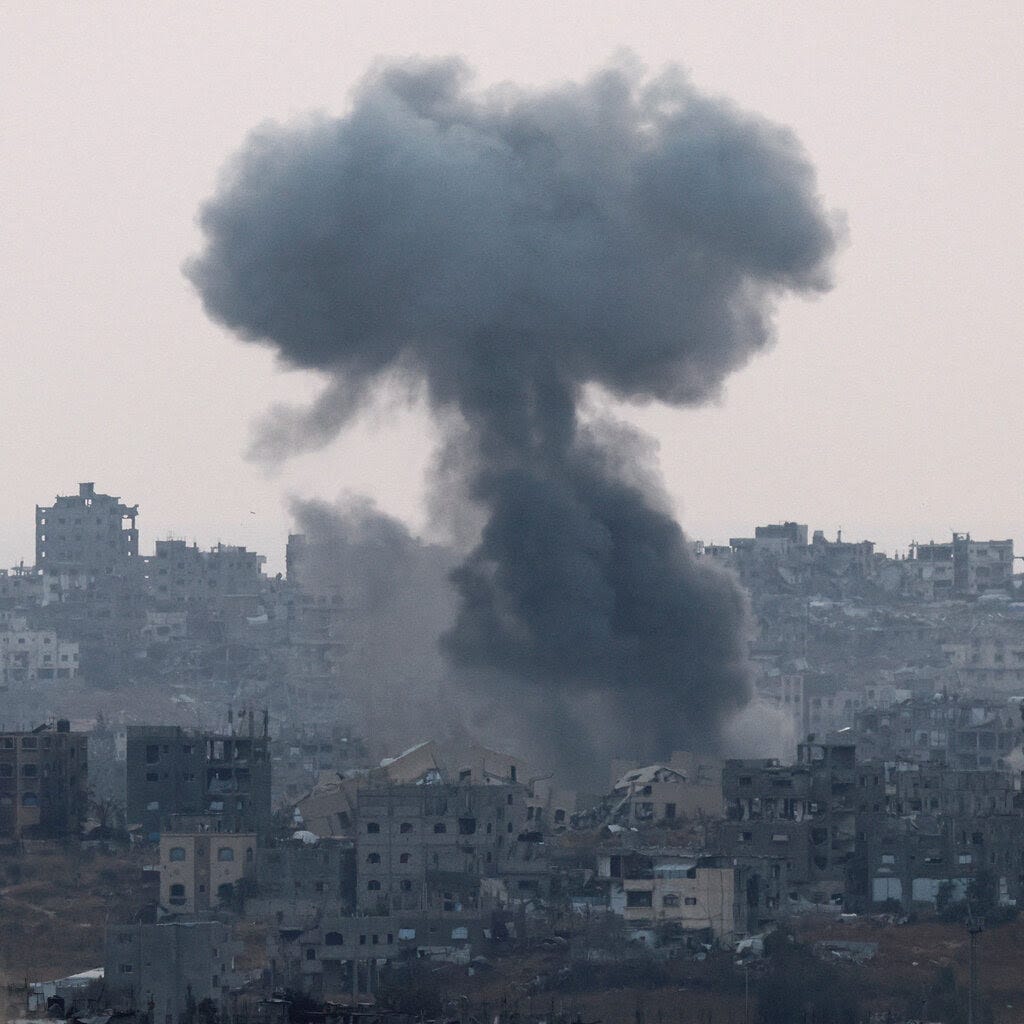
A plume of dark smoke rises over a Gaza neighborhood in ruins.

After an Israeli airstrike in Gaza on Saturday. Amir Cohen/Reuters

Over the weekend, Israel decided to call in military reservists and escalate the war in the Gaza Strip again.

The news reflects a sharp turn of events. Earlier this year, Israel and Hamas agreed to a cease-fire. That deal held for months, during which Israel halted operations in Gaza and Hamas handed over some Israeli hostages. But the cease-fire ended in March. Now, it seems the war is truly returning.

Why escalate now?

Israel has pressured Hamas to return all of the remaining hostages, especially the 24 who officials believe are still alive. Officials also say that Hamas must disarm as part of any future deal. But Hamas has refused. Before it makes further concessions, it wants the war over and Israel out of Gaza.

Israel hopes escalation will get Hamas to capitulate and return all of the hostages — while giving its troops a chance to destroy the group’s remaining infrastructure.

What is Israel’s plan?

The generals are calling up tens of thousands of reservists to expand operations in Gaza. They plan to occupy the region, forcibly relocate Palestinians in affected areas and oversee aid distribution.

Israel has blocked all aid, including food and medicine, from entering the territory for more than two months. (Some aid workers are accused of participating in the Oct. 7 attacks, The Times explained, and a lawsuit claims that Hamas skimmed $1 billion in U.N. aid. But the blockade has led to starvation and the spread of diseases, as The Times documented.) With direct control, Israel says, it will allow distribution to resume.

Will the plan work?

Israeli leaders say that military pressure secured the release of hostages before. They hope to replicate that success. Critics argue that Israel has by now exhausted its ability to pressure Hamas with force. They worry more fighting will put the surviving hostages at risk. — German Lopez

Related: Israel’s prime minister said the country was “on the eve of a forceful entry to Gaza.”
Explore the “Nuances” of Genocide in Gaza

W.J. Astore

The New York Times Does It Again

DEC 22, 2024

I caught this headline in the morning send-out for the New York Times:

It Can Be Lonely to Have a Middle-of-the Road Opinion on the Middle East

Some college students and faculty members are seeking space for nuanced perspectives on the Israel-Hamas war on deeply divided campuses.

See, it’s a “war” between Israel and Hamas, and what’s really needed here is “space” for “nuanced perspectives.”

Don’t you want to have “a middle of the road opinion” on genocide in Gaza? Don’t you want to explore all the “nuances” of Israel’s ongoing destruction of Gaza, where the death toll is likely to have reached 200,000 and counting? (Or not counting, since apparently Palestinian deaths don’t count for much.)

Here are some “nuances”: As Chris Hedges recently noted, the genocide in Gaza resembles that of Armenians during World War I. It’s happening in the open, unlike the Holocaust which the Nazis tried to hide, yet not enough people, especially in the West, are seeking to stop it.

In fact, the U.S. government is deeply complicit in the genocide in Gaza, arming Israel and providing military and diplomatic cover at a cost of scores of billions of dollars (when you factor in maintaining two carrier strike groups in the region as well as all the weapons shipments to Israel).

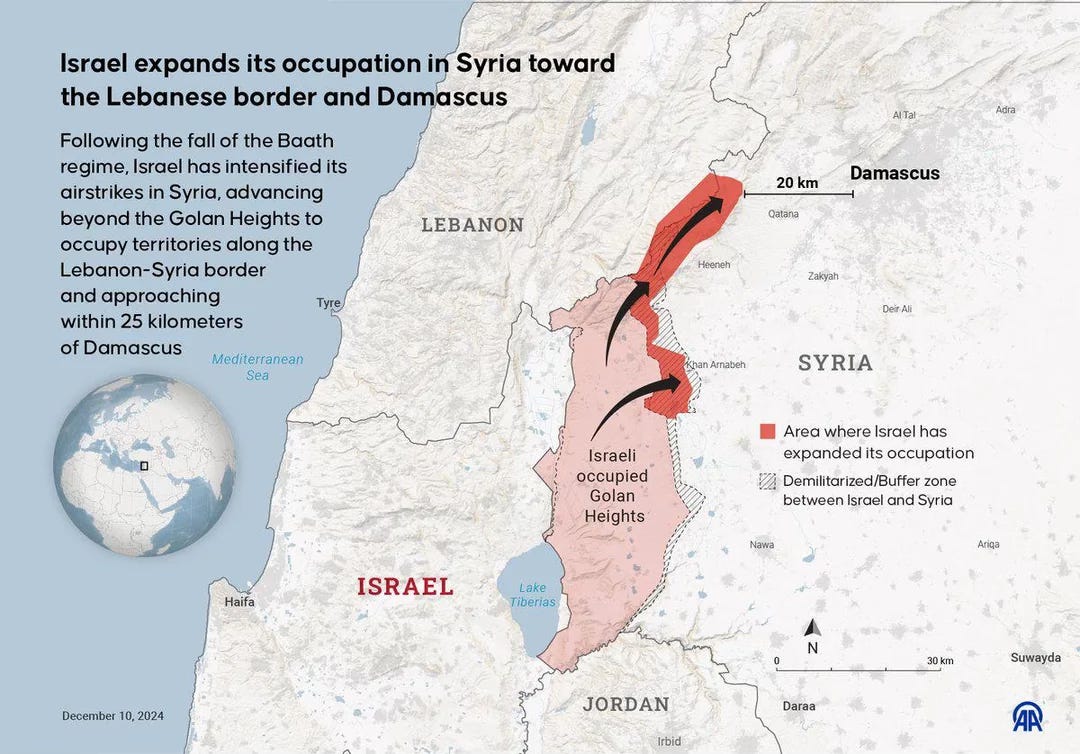
The intent is obvious: the creation of a Greater Israel in which Gaza and the West Bank cease to exist as lands for a Palestinian state. The “nuance” here is a “no-state solution,” as Palestinians are killed or forced from their land in the name of Israel’s “right to exist.” The fall of the Syrian government, meanwhile, sees Israel expanding into the Golan Heights and beyond, also in the name of protecting Israel.

It’s a land grab, a water grab, a gas reserves grab, a power grab, all for Israel and its big brother, the USA. It’s an illustration of Thucydides’ lesson that “The strong do what they will; the weak suffer what they must.” Israel, supported wholeheartedly by the U.S. government, is strong; the Palestinians (and now the Syrians) are weak; so the latter suffer.

The New York Times article suggests I should be looking for “middle ground” here, but I have news for them: Israel has already seized and occupied it.

“Invest” in New Nuclear Weapons? No Thanks

 It’s always the right time to stop building more weapons of mass destruction

William Astore and Matthew Hoh

[Note to readers: Back in early September, Congressman Mike Turner penned an op-ed for the “liberal” New York Times supporting a massive “investment” in new nuclear weapons. Matt Hoh and I quickly submitted letters to the Times to protest this op-ed and its arguments; the Times ignored them. We then wrote our own op-ed below, shopping it to various mainstream media outlets without success. Here it finally appears for the first time.]

*****

Representative Mike Turner’s essay on nuclear weapons in The New York Times (We Must Invest in Our Aging Nuclear Arsenal, September 6, 2024) is dangerously loyal to counterproductive US national security policies and narratives.

Turner’s lamentation over foreign nuclear weapons programs ignores destabilizing US arms control choices this century. The US spends more on nuclear weapons than the rest of the world combined. Its $1.7 trillion modernization program (the Sentinel ICBM; the B-21 Raider bomber; Columbia-class nuclear submarines) has done little more than upset the decades-long nuclear deterrence balance among nations.

In his essay, Turner neglects to mention the US government’s unilateral withdrawal from multiple arms control treaties. Then-Senator Joe Biden rightly predicted the effects of George W. Bush’s abandonment of the Anti-Ballistic Missile (ABM) Treaty: “A year ago [in 2000], it was widely reported that our intelligence community had concluded that pulling out of ABM would prompt the Chinese to increase their nuclear arsenal tenfold.” The Chinese are now clearly headed in that escalatory direction.

To prevent the apocalyptic consequences of yet another nuclear arms race, the US should act to decrease “investments” in new weapons while cutting current arsenals by negotiating and enacting new arms reduction treaties. Together, the US and Russia already possess ten thousand nuclear warheads, enough to destroy life on earth and several other earth-sized planets. We need desperately to divest from nuclear weapons, not “invest” in them.

Consider as well that America’s current nuclear triad, especially the Navy’s Trident submarine force, is potent, survivable, and more than sufficient to deter any conceivable adversary.

Simply put, the US must stop building genocidal nuclear weapons. It must instead renew international efforts and treaties to downsize these dreadful and dangerous arsenals. Spending yet more trillions on more world-shattering nukes is worse than a mistake—it’s a crime against humanity.

Here we are haunted by the words of Hans Bethe, who worked on the Manhattan Project that created the atomic bomb during World War II. The first reaction Bethe said he’d had after Hiroshima was one of fulfillment—that the project they had worked on for so long had succeeded. The second reaction, he said, was one of shock and awe: “What have we done? What have we done,” he repeated. And the third reaction: It should never be done again.

That is the imperative here. The US must act so that future Hiroshimas will never happen.

It’s not America’s fate alone that’s at stake here, but the fate of humanity itself, and indeed most life on earth, as only a few dozen thermonuclear warheads exploding would likely produce nuclear winter and an eventual “body count” in the billions.

During the First Cold War, one heard it said: “Better dead than red.” That mentality remains, even as the “reds” today are more capitalist than communist. Meanwhile, the weapons makers for the military-industrial-congressional complex (MICC), in their greed, are the adversary within. From Israel and events in Gaza, we’ve learned the MICC will literally empower a people to commit mass murder. With more and newer thermonuclear weapons, the MICC may yet kill the world.

Higher quarterly profits will mean little when everybody is dead.

During the Vietnam War, a US Army major was heard to say: “We had to destroy the town to save it [from communism].” If America can destroy towns in Vietnam to “save” them from communism, if it can facilitate the destruction of Gaza to “save” it from Hamas, it can similarly destroy the earth to “save” it from China, or Russia, or some other “threat.” That is the indefensible (il)logic of building yet more weapons of mass destruction.

Contra Congressman Turner, there is no logical, sensible, defensible reason for America’s proposed “investment” in new nuclear weapons. But there are nearly two trillion reasons why it’s going forward, because that’s the projected total cost of modernizing America’s nuclear triad. Money talks—loudly, explosively, perhaps catastrophically.

Today, more than half of US federal discretionary spending is devoted to war and weapons. Americans, in essence, live both in a permanent war state and a persistent state of war. As bad as that reality is, a state of nuclear war is unimaginable and must not be allowed to happen.

At the height of the Cold War, one of us served in Cheyenne Mountain, America’s nuclear command center, and witnessed a simulated nuclear attack on the US. Even on the primitive monitors the Air Force had back in 1986, seeing Soviet missile tracks crossing the North Pole and terminating at American cities was unforgettable.

A generation earlier, Robert Oppenheimer, the “father of the atomic bomb,” tragically noted in 1965 that it was 20 years too late to control nuclear arms. Those efforts, he said, should have been started “the day after Trinity” in July of 1945.

Let’s not make it 80 years too late. Congressman Turner is exactly wrong here. We must cut America’s nuclear arsenal and pursue new nuclear disarmament treaties. Never should our children be haunted as we were (and still are) by the darkness and doom of radioactive mushroom clouds.

William Astore, a retired lieutenant colonel (USAF) and historian, is a senior fellow at the Eisenhower Media Network.

Matthew Hoh, a former Marine Corps captain and State Department official, resigned in protest in 2009 against America’s ill-conceived war in Afghanistan. He is Associate Director at the Eisenhower Media Network.

Yet Another Smear Piece on Tulsi Gabbard

W.J. Astore

Where else but the New York Times

In my morning news feed from the New York Times came this article on Tulsi Gabbard:

How Tulsi Gabbard Became a Favorite of Russia’s State Media

President-elect Donald J. Trump’s pick to be the director of national intelligence has raised alarms among national security officials.

Here’s the key paragraph from the article, which, of course, is delayed until the sixth paragraph:

No evidence has emerged that she has ever collaborated in any way with Russia’s intelligence agencies. Instead, according to analysts and former officials, Ms. Gabbard seems to simply share the Kremlin’s geopolitical views, especially when it comes to the exercise of American military power. [Emphasis added]

Did you get that? NO EVIDENCE. Tulsi has never collaborated with Russia in any way. The problem is that she’s a critic of unnecessary and disastrous wars like Iraq and Afghanistan. She’s a critic of massive U.S. military aid to Ukraine. And since those criticisms are vaguely useful to Russia, she must therefore be a “Russian asset,” a dupe of Putin, according to Hillary Clinton and now the New York Times.

Within the so-called intelligence community (IC), you are allowed to be a cheerleader, a booster, even a selective critic in the sense that you may call for more money for the IC because of certain limitations or oversights, but you are not allowed to question America’s disastrously wasteful imperial foreign policy.

No matter how poorly the IC performs (consider the colossal failure of 9/11, or the total obliviousness about the impending collapse of the Soviet Union in the late 1980s, or recent disastrous wars in Afghanistan, Iraq, and Libya), no one is ever held accountable, even as the IC gets more money and authority.

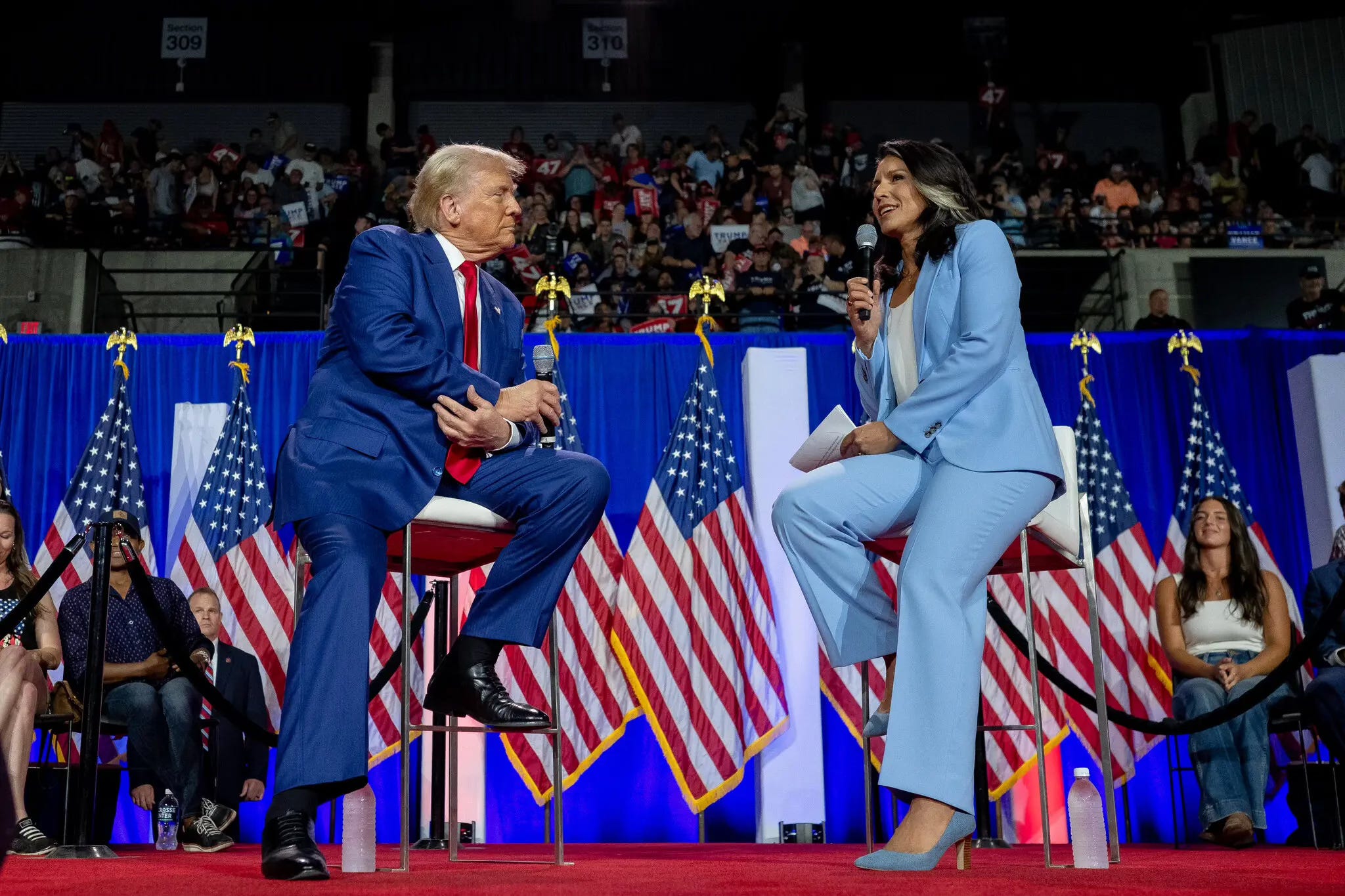
Tulsi Gabbard with President-elect Trump. (Jim Vondruska for the NYT)

Tulsi Gabbard promises to be a game-changer. Skeptical of the blatant misuse of American military power, she’s been an articulate critic of forever wars. She is especially sensitive to deploying U.S. troops in harm’s way for purposes other than the defense of the United States.

The “liberal” New York Times is having none of that. Consider this remarkable paragraph:

“Nominating Gabbard for director of national intelligence is the way to Putin’s heart, and it tells the world that America under Trump will be the Kremlin’s ally rather than an adversary,” Ruth Ben-Ghiat, a professor of history at New York University and the author of “Strongmen,” a 2020 book about authoritarian leaders, wrote on Friday. “And so we would have a national security official who would potentially compromise our national security.” [Emphasis added]

Who knew that “Putin’s heart” could be won so easily? And note the weasel wording that Tulsi could “potentially compromise” U.S. national security. Again, no evidence is presented. 

Well, we certainly don’t want the U.S. to have a rapprochement with Putin. He must always be our adversary, am I right? How dare that Trump and Gabbard might, just might, pursue a policy that is less antagonistic toward the Kremlin? Don’t you enjoy teetering on the brink of a world-ending nuclear exchange? I much prefer that to listening and negotiation.

In making enemies of Hillary Clinton and now the New York Times, Tulsi Gabbard has demonstrated she has what it takes to serve as director of national intelligence.

America Is Weak!

W.J. Astore

Spend More on the Military! Says the New York Times

As the U.S. deploys more troops to the Middle East (now nearing 50,000 and rising), as Israel expands its war into Lebanon by killing nearly 500 people there, as Palestinians continue to die in Gaza and the West Bank as Israel steals their land, the “liberal” New York Times is running features on how “weak” the U.S. military is.

This is from yesterday’s New York Times send-out, citing a recent (and typical) bipartisan study:

*******

American weaknesses

The report cited several major U.S. weaknesses, including:

A failure to remain ahead of China in some aspects of military power. “China is outpacing the United States and has largely negated the U.S. military advantage in the Western Pacific through two decades of focused military investment,” the report concluded.

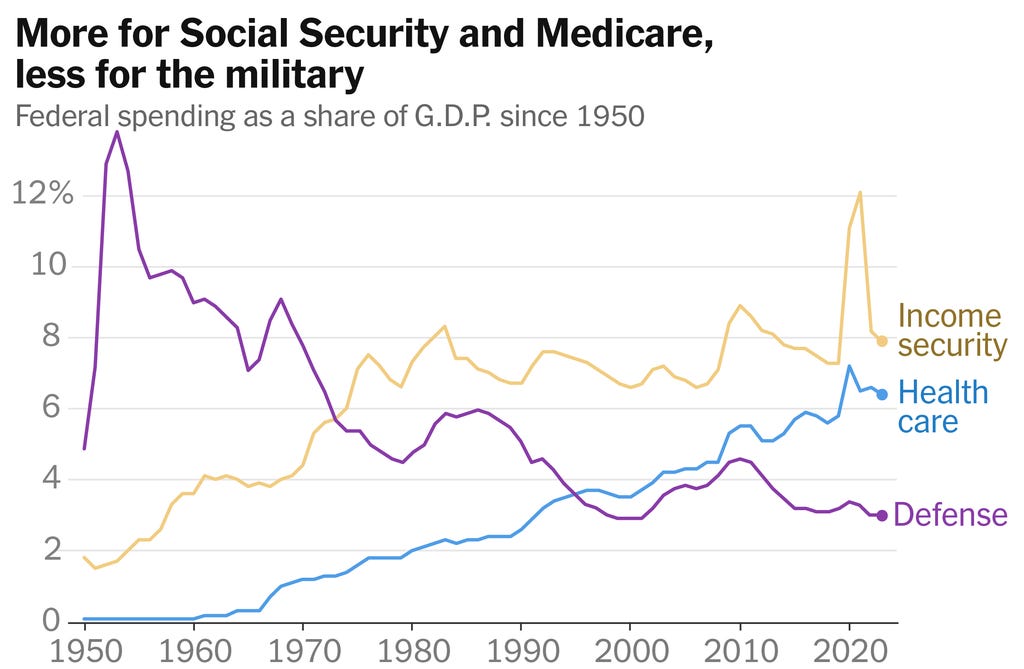
One reason is the decline in the share of U.S. resources devoted to the military. This Times chart, which may surprise some readers, tells the story:

Three lines track federal spending on health care, social security and defense. Total budget allocated to defense has fallen since 1950, while money spent on health care and income security has risen.

Source: Congressional Budget Office | By The New York Times

The report recommended increasing military spending, partly by making changes to Medicare and Social Security (which is sure to upset many liberals) and partly by increasing taxes, including on corporations (which is sure to upset many conservatives). The report also called for more spending on diplomacy and praised the Biden administration for strengthening alliances in Europe and Asia.

A Pentagon bureaucracy that’s too deferential to military suppliers. The report criticized consolidation among defense contractors, which has raised costs and hampered innovation. The future increasingly lies with drones and A.I., not the decades-old equipment that the Pentagon now uses.

A U.S. manufacturing sector that isn’t strong enough to produce what the military needs. A lack of production capacity has already hurt the country’s efforts to aid Ukraine, as The Times has documented. “Putin’s invasion has demonstrated how weak our industrial base is,” David Grannis, the commission’s executive director, said. If the Pentagon and the innovative U.S. technology sector collaborated more, they could address this problem, Grannis added.

A polarized political atmosphere that undermines national unity. A lack of patriotism is one reason that the military has failed to meet its recent recruitment goals. Perhaps more worrisome, many Americans are angry at one another rather than paying attention to external threats.

*******

Where to begin with such nonsense?

  1. So-called “defense” spending currently sits at or above $1 trillion, representing roughly 60% of federal discretionary spending. It continues to rise. Showing it as declining vis-a-vis the GDP is lying through statistics.
  2. Even if military spending was truly declining, which it isn’t, that would be a “good news” story. As President Eisenhower explained in 1953, military spending represents a theft from those who hunger, those who need shelter, those who need better schools and hospitals.
  3. Social Security: Yes, the government is going to keep trying to cut benefits while handing the savings to military contractors. Ditto for Medicare.
  4. Notice who’s mainly to blame for the alleged need for higher military spending: Putin and China.
  5. The Pentagon has misspent funds and misunderstands war. The solution: give the Pentagon more money as a reward.
  6. Americans are allegedly so angry with each other we’re not sufficiently hating Russians, Chinese, Iranians, and other alleged “external threats.”
  7. America lacks patriotism!

All this is reported with a straight face and the utmost seriousness by your “liberal” friends at the New York Times

So, when your Social Security benefits are reduced, when your Medicare bills go up, as you struggle even more mightily to make ends meet, just know your money is going to the Pentagon and the weapons makers.

Got a problem with that? The real problem just might be your lack of patriotism.

If Trump Wins, Resist Him!

W.J. Astore

Because Democracy

These are strange times in America. Today the New York Times is telling me there’s already a movement afoot to resist Donald Trump if he wins the election, in the cause of defending democracy, naturally. Here’s the blurb:

Top News

The Resistance to a New Trump Administration Has Already Started

An emerging coalition that views Donald J. Trump’s agenda as a threat to democracy is laying the groundwork to push back if he wins in November, taking extraordinary pre-emptive actions.

Now, as I’ve said on numerous occasions, I won’t be voting for Trump or Biden. I’m not a Trump supporter and I hope he loses. Yet, assuming the election isn’t “rigged,” as Trump likes to say whenever he loses, I’m prepared to accept the result as an expression of democracy, or at least as much “democracy” as the electoral college in America permits us to express.

I’m glad an “emerging coalition” is planning something, apparently, to curb the worst excesses of Trump and the Republicans. I hope this coalition will act to end Israel’s genocide in Gaza, pursue diplomacy to end the Russia-Ukraine War, pursue peace wherever and whenever possible, lower the threat of nuclear war on the planet, and cut the Pentagon budget while rebuilding America. How about fighting for America’s workers, raising the minimum wage, providing affordable health care for all that’s untied to employment, and similar steps that put the health and welfare of people first.

Or, is this “emerging coalition” motivated purely by animus against Trump and his followers? Is it still going to fully fund the Pentagon and wage war across the globe? In which case I’m not so excited.

Again, I come back to this question: If an “emerging coalition” is so worried about a Trump victory, why not put forward a candidate more fit to beat Trump than Joe Biden? Don’t “resist” Trump after he’s already won again—defeat him at the polls by putting forth a dynamic candidate with a populist worker-first platform.

I’m with James Madison that the biggest threat to liberty and freedom in America is perpetual war. War breeds authoritarianism and weapons built in the name of war represent, as Dwight D. Eisenhower famously said in 1953, a theft from the people. Weapons do not represent an “investment”; quite the reverse. And incessant preparations for war are not a recipe for peace.

If you truly want to defend democracy, resist war and the authoritarianism it breeds. Make major cuts to the Pentagon budget and invest in education and health rather than death and destruction. That’s the “emerging coalition” I’d like to see.

Waging War Against War

W.J. Astore

Even as the Military-Industrial Complex Becomes Ever Stronger and More Dangerous, We Must Keep Fighting Against It

In today’s article, I’d like to feature insights from friends and colleagues.

At TomDispatch, Tom Engelhardt takes on man’s seemingly endless addiction to war, an addiction most certainly manifested by the US of A, where bumper stickers tell me peace comes through superior firepower. Check out Tom’s article here. Not only do we wage war on each other, Tom notes, we wage war on the planet. In fact, few things degrade the environment more than war and all the destruction it brings with it. 

John Rachel, a peace activist, has a telling theme: War is making us poor. He’s been making short punchy videos to hammer home the point. Check out his latest here:

Why are wars so persistent in the U.S., despite their stupidity, their destruction, their waste? One of my readers put it well in a comment to me: 

The endless wars without a traditional definition of success have not been failures to those who have profited. For them, the only war that is lost, is the one that ends. God forbid one should be won under the standard definition and profits then ended.

Cynical? Not when you measure that statement against the U.S. experience of war since 1945.

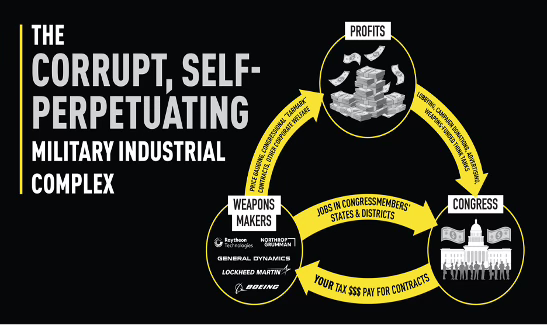
Finally, also at TomDispatch, David Vine and Theresa Arriola have an article: “The Military-Industrial Complex Is Killing Us All,” which is what Ike warned us about in 1961 if we refused to act as alert and knowledgeable citizens to keep that complex in check. Their article features clear and insightful charts on the basic features of the MIC and the dangers it poses. Here’s an example:

Vine and Arriola are part of an effort whose goal it is to dismantle, or very much to downsize, that complex. (I’ve been involved in their efforts.) Here’s the website: 

https://www.dismantlethemic.org

Where you’ll find more charts and resources.

Meanwhile, last week the “liberal” New York Times posted an article ostensibly written by Senator Roger Wicker calling for even more military spending by the U.S.

Here’s how The New York Times introduced Wicker’s op-ed on May 29th:

In a guest essay today, Senator Roger Wicker writes that we are approaching a version of that moment [a major war crisis] “faster than most Americans think.” Worse, he argues, the U.S. military is unprepared to meet the moment. After decades of underfunding, the American military lacks the strength or the equipment to deal with the wide range of new threats coming from our nation’s adversaries, including Iran, China, Russia and North Korea, he writes.

The answer to this problem, Wicker says, is a short-term “generational investment” in the U.S. military — and a national conversation on how to create a safer future for America. In a new white paper, he lays out a road map to “rebuild” the military, starting with an additional $55 billion in military spending in the 2025 fiscal year and an increase of annual military G.D.P. spending from its current projected level of around 3 percent to 5 percent over the next five to seven years.

That’s a serious amount of money that will inevitably raise big questions about where it will come from — and at the expense of what — at a moment when voices all along the political spectrum are questioning both U.S. military spending overseas and the role of the American military in the world today.

Wicker makes the case that the cost of a war with an increasingly powerful adversary like China would be far higher. “Regaining American strength will be expensive,” he writes. “But fighting a war — and worse, losing one — is far more costly.”

Readers, isn’t that inspiring? A “generational investment” in more guns, more bombs, and, as likely as not, more war? What a great idea!

Apparently, the only way to prevent a war is to prepare mightily for one, according to Senator Wicker. Wicker has apparently never heard, or read, or understood the words of Ike.

Senator Wicker is a shining example of the military-industrial-congressional complex that perpetuates war to the detriment of us all, indeed to all life on our planet. But it’s his words that are amplified by the “liberal” New York Times, not the wise words of my friends and colleagues here.

And so it goes, unless we act to put an end to it. We must be the alert and knowledgeable citizens that Ike implored us to be.

America’s Disastrous Afghan War

W.J. Astore

Finally a bit of truth from the New York Times, but for what reason, and why now?

Remember when Barack Obama claimed in 2007-09 the Afghan War was the right war, the good one, as opposed to the wrong and bad Iraq War prosecuted by Bush/Cheney? Of course, they were both disastrous wars, but until the Biden administration finally pulled out, chaotically so, in 2021, the mainstream media was still supporting the idea that America was doing good in Afghanistan.

I suppose enough time has passed for the New York Times to allow for a measure of honesty, if only to support Joe Biden’s reelection this year. See, Biden made the rightdecision to withdraw because now we finally can admit the war was a disaster. Naturally, it wasn’t entirely or even mainly the U.S. government’s fault …

Of course, plenty of people knew the Afghan War was a disaster; my colleague Matthew Hoh resigned from the State Department in 2009 in protest against Obama’s “surge” there and counterproductive U.S. policy decisions. Democrats in Congress listened to Hoh and a few wanted to change course, but they were brought to heel by Nancy Pelosi, who said no dissent on the Afghan War was permissible when Obama was fighting so hard for health care reform in America. Hoh heard those words straight from Pelosi’s mouth. So we got twelve more years of disastrous war and Obamacare.

Abdul Aziq in 2015 (Bryan Denton for the New York Times)

Anyhow, in my NYT news feed this AM, the “hidden history” of America’s “savage campaign” is finally being covered, though the savageness is largely ascribed to an Afghan ally of the U.S., General Abdul Aziq. As usual, American “advisers” tried to curb his worst instincts, apparently without success. Well, what can you do with such “savages”?

Here’s how the NYT puts it:

But his [Aziq’s] success, until his 2018 assassination, was built on torture, extrajudicial killing and abduction. In the name of security, he transformed the Kandahar police into a combat force without constraints. His officers, who were trained, armed and paid by the United States, took no note of human rights or due process, according to a New York Times investigation into thousands of cases that published this morning. Most of his victims were never seen again.

Washington’s strategy in Afghanistan aimed to beat the Taliban by winning the hearts and minds of the people it was supposedly fighting for. But Raziq embodied a flaw in that plan. The Americans empowered warlords, corrupt politicians and outright criminals in the name of military expediency. It picked proxies for whom the ends often justified the means.

The NYT is shocked, shocked!, that there was a “flaw” in the U.S. plan that “empowered warlords, corrupt politicians and outright criminals” in the cause of military “progress.” Hmm…sounds more like a feature of U.S. policy than a flaw.

What about all those U.S. generals testifying to Congress under oath about the progress we were allegedly making in Afghanistan? Are any of them going to be called to account? You can bet your sweet combat boots that they’re not.

After Aziq, matters grew even worse in Afghanistan, as the NYT puts it here: “What they [new warlords and supposed U.S. allies] brought under the name of democracy was a system in the hands of a few mafia groups,” said one resident of Kandahar who initially supported the government. “The people came to hate democracy.”

So, instead of Operation Enduring Freedom, America brought Operation Endemic Corruption to Afghanistan. That latter operation most definitely succeeded.

Here’s how the NYT summarizes its new study of the Afghan War:

Historians and scholars will spend years arguing whether the United States could have ever succeeded. The world’s wealthiest nation had invaded one of its poorest and attempted to remake it by installing a new government. Such efforts elsewhere have failed.

But U.S. mistakes — empowering ruthless killers, turning allies into enemies, enabling rampant corruption — made the loss of its longest war at least partly self-inflicted. This is a story Matthieu [Aikins] and I [Azam Ahmed] will spend the coming months telling, from across Afghanistan.

Echoes of the Vietnam War here. The world’s wealthiest nation invading a much poorer one in the name of “democracy,” then spreading corruption and devastation ending in a chaotic withdrawal. And now grudging admission that maybe, just maybe, the U.S. loss in Afghanistan was “at least partly self-inflicted.”

Ya think? Or maybe we can just blame the Afghan people, just as we blamed our “allies” in South Vietnam.

Nothing against Aikins and Ahmed here. I’m sure their “hidden history” of America’s war in Afghanistan will be revelatory. Yet why was it “hidden” for so long? And why are the “hiders” never called to account?

And was it really “hidden”? Matthew Hoh wasn’t the only truth-teller willing to blow a whistle. Why was his honest voice suppressed while worm-tongued generals like David Petraeus and Stanley McChrystal were celebrated?

I wonder when we’ll get the “hidden history” of America’s “savage” involvement in Gaza and Ukraine? Perhaps in 2030?

Come On, Ukraine, Learn from the U.S. Military

W.J. Astore

American experts have all the answers for Ukraine

In today’s New York Times send out, I saw the following story:

Ukraine’s Forces and Firepower Are Misallocated, U.S. Officials Say

American strategists say Ukraine’s troops are too spread out and need to concentrate along the counteroffensive’s main front in the south.

Listen to the U.S. military, Ukraine! Don’t be casualty-averse! Concentrate your forces. Take the fight to the Russian enemy. Use all those cluster munitions we’ve sent you. Commit your armored reserve and punch a hole in the Russian lines. Break through, break out, and drive toward Crimea. You know: just like Americans would do in your place.

One might forgive Ukrainians if they asked, When was the last war you “experts” won for America? Afghanistan? Iraq? Vietnam? Korea? What about ongoing military commitments to Syria and Somalia? If you’re so good at winning wars, how come the U.S. military didn’t win in Afghanistan, Iraq, and Vietnam where you had overwhelming materiel and firepower superiority?

With respect to why Ukraine has its forces “too spread out”: perhaps Ukraine needs to garrison its lines so that it can fend off Russian counterattacks? If Ukraine concentrates its strategic reserve and uses it in a big counteroffensive that stalls, what’s to stop Russia from a decisive riposte? Think of Kursk for Nazi Germany in 1943. Once that huge offensive failed for Germany, using up its strategic reserve, the Red Army seized the initiative on the eastern front and never lost it.

At Kursk in 1943, the Germans committed their reserves in a desperate gamble to seize the initiative from the Soviet Union. When the offensive failed, the Red Army counterattacked and proved unstoppable.

Headlines like the one posted above from the New York Times are intended to be exculpatory for the U.S. If the war turns worse for Ukraine, U.S. “experts” can point to articles like this, casting blame on the Ukrainians for not following sage American advice.

If “we” win in Ukraine, it will be because of generous U.S. aid and especially vaunted U.S. and NATO weaponry; but if they (the Ukrainians) lose, it’s all their fault for not following the advice of America’s master strategists. And, obviously, even if Ukraine loses, plenty of weapons manufacturers in the U.S. are winning and will continue to win. Indeed, a Russian victory could be just the thing to propel even more weapons spending by NATO countries as well as even larger and more monstrous Pentagon budgets.

Higher Military Spending Will Save Democracy

W.J. Astore

So the “liberal” New York Times says

Four days ago, I got a story in my New York Times email feed on “A Turning Point in Military Spending.” The article celebrated the greater willingness of NATO members as well as countries like Japan to spend more on military weaponry, which, according to the “liberal” NYT, will help to preserve democracy. Interestingly, even as NATO members have started to spend more, the Pentagon is still demanding yet higher budgets, abetted by Congress. I thought if NATO spent more, the USA could finally spend less? 

No matter. Russia’s invasion of Ukraine, as well as the hyping of what used to be called the “Yellow Peril,” today read “China,” is ensuring record military spending in the USA as yearly Pentagon budgets approach $900 billion. That figure does not include the roughly $120 billion or more in aid already provided to Ukraine in its war with Russia. And since the Biden administration’s commitment to Ukraine remains open-ended, you can add scores of billion more to that sum if the war persists into the fall and winter.

Here’s an excerpt from the New York Times piece that I found especially humorous in a grim way:

[Admittedly,] The additional money that countries spend on defense is money they cannot spend on roads, child care, cancer research, refugee resettlement, public parks or clean energy, my colleague Patricia points out. One reason Macron has insisted on raising France’s retirement age despite widespread protests, analysts believe, is a need to leave more money for the military.

But the situation [in Europe of spending more on butter than guns] over the past few decades feels unsustainable. Some of the world’s richest countries were able to spend so much on social programs partly because another country — the U.S. — was paying for their defense. Those other countries, sensing a more threatening world, are now once again promising to pull their weight. They still need to demonstrate that they’ll follow through this time.

Yes, Europe could continue to invest in better roads, cleaner energy, and the like, but now it’s time to buckle down and build more weapons. Stop freeloading, Europe! Dammit, “pull your weight”! You’ve had better and cheaper health care than Americans, stellar educational systems, child care benefits galore, all sorts of social programs we Americans can only dream of, but that’s because we’ve been paying for it! Captain America’s shield has been protecting you on the cheap! Time to pay up, you Germans, you French, you Italians, and especially you cheap Spaniards.

Look at all those cheap Spaniards. They have good stuff because of Captain America. Freeloaders! (NYT Chart, 7/12/23)

As the NYT article says: NATO allies need to “follow through this time” on strengthening their militaries. Because strong militaries produce democracy. And European “investments” in arms will ensure more equitable burden sharing in funding stronger cages and higher barriers to deter a rampaging Russian bear.

Again, you Americans out there, that doesn’t mean we can spend less on “defense.” What it means is that the U.S. can “pivot to Asia” and spend more on weaponry to “deter” China. Because as many neocons say, the real threat is Xi, not Putin.

We have met the enemy, and he is us. That’s an old saying you won’t see in the “liberal” NYT.